Discernment

Discernment: What’s Love Got to Do with It?

Originally published January 22, 2016

…so that we may no longer be children, tossed to and fro by the waves and carried about by every wind of doctrine, by human cunning, by craftiness in deceitful schemes. Rather, speaking the truth in love, we are to grow up in every way into him who is the head, into Christ…

Ephesians 4:14-15

Christians who know what discernment is have a variety of perspectives about how it should be practiced. Should we teach about false doctrine at all or just make sure our church is teaching sound doctrine? Should we name the names of false teachers or speak about them anonymously? Should we warn people away from false teachers or just pray for them privately? What’s the biblical precedent for using a stringent tone when speaking of those who teach false doctrine?

Recently, I’ve been thinking a lot about the phrase “speaking the truth in love” from Ephesians 4:15 as it pertains to speaking and writing about false doctrine and false teachers.

Many Christian women have the mistaken idea that “speaking the truth in love” equals being “nice.” We’re always smilingly sweet and never say anything that might hurt someone’s feelings or could rock the boat at church.

Many Christian women have the mistaken idea that “speaking the truth in love” equals being “nice.”

Are we to be kind? Yes. Are we to do our best not to hurt others? Of course. Should we be making waves over every little thing that rubs us the wrong way? Absolutely not. We are to deny ourselves, setting aside our personal preferences and, in many cases, even our own rights, to the point of laying down our lives for others.

We need to understand the distinction between personal preferences and biblical doctrine. We die *to* personal preferences. We die *for* the purity of biblical doctrine.

But we need to understand the distinction between personal preferences and biblical doctrine. And that’s where I think a lot of people get confused. We die to personal preferences. We die for the purity of biblical doctrine. The enemy is stealthily infiltrating and conquering church after church with false doctrine. We are at war. And that’s going to mean ruffling feathers, rocking the boat, and hurting feelings sometimes. Because the full armor of God doesn’t come with a white flag or a pen for signing peace treaties.

The full armor of God doesn’t come with a white flag or a pen for signing peace treaties.

But how do we war for the truth “in love”?

Well, think about the concept and practice of “love.” Love always has an object. We don’t just say, “I love.” We say, “I love my children,” or “I love peanut butter and chocolate ice cream.” Speaking the truth “in love” is not as much about our demeanor or tone of voice as it is about the object of our love. It’s our love for others that compels us to speak biblical truth. And it’s that same love for others that should drive the manner in which we speak the truth.

So when it comes to speaking the truth about false doctrine, how should we be motivated by love? And love for whom?

We love Christ– As Christians, our love for Christ should motivate everything we do. If we’re speaking truth from fleshly motives such as pride, the desire to make a name for ourselves, or the competitive drive to win an argument, everything we say can be 100% factually right and we can still be spiritually in the wrong because the motive of our heart is wrong. God isn’t a debate judge awarding us points for compelling arguments. God weighs the heart.

We love God’s Word– To love Christ is to love the Bible because Scripture is literally God Himself speaking to us. Besides the cleansing of the temple, the passage in which we see Jesus’ righteous anger displayed most clearly is Matthew 23. Here, Jesus delivers a scorching rebuke to the scribes and Pharisees for twisting God’s Word and, in doing so, leading people away from the truth of Scripture. It is only natural for those of us who have the mind of Christ and are indwelt by the Holy Spirit to have that same love for God’s word and feel righteous anger over the maligning of it.

We love the church– To love Christ is also to love His bride, the church. Christ gave his life to cleanse the church “so that he might present the church to himself in splendor, without spot or wrinkle or any such thing, that she might be holy and without blemish.” Seeing Christ’s bride blemished and corrupted by false doctrine should grieve us deeply and motivate us to call the church to be cleansed “by the washing of water with the Word.”

We love the captives– Paul speaks of false teachers “who creep into households and capture weak women.” Often, the women who follow false teachers simply don’t know any better. Though Scripture is clear that they’re complicit in their own captivity, they are casualties and prisoners of war held hostage by the enemy. We are to love them enough to show them the truth of God’s word so that “they may come to their senses and escape from the snare of the devil, after being captured by him to do his will.”

We love the enemyEvery Christian was at one time an enemy of the cross. Every last one of us. Until someone loved us enough to intervene with the truth of the gospel. False teachers – those who, despite biblical correction, unrepentantly teach doctrine which is plainly refuted by Scripture – have made themselves enemies of the cross, even if they call themselves “Christian,” even if they wear the title of “pastor,” even if they’re holding a Bible in their hands and refer to it occasionally as they “teach” us.

In the same way that a loving sister would not turn a blind eye and hope for the best if her sibling began using drugs and became increasingly addicted, it is not loving to stand idly by and allow false teachers to continue to sink deeper and deeper into Satan’s clutches by doing his bidding without making every effort to stop them in order to rescue them.

*It is not loving* to stand idly by and allow false teachers to continue to sink deeper and deeper into Satan’s clutches by doing his bidding without making every effort to stop them in order to rescue them.

Sometimes – just as with the drug abuser – this can be accomplished early on with a private word of correction. And sometimes – as with the addict – more extreme measures of “tough love” and intervention must be employed. But we always love them enough to desire that they come to repentance and embrace the truth.


Our love for these also drives the manner in which we speak truth to them. A good soldier would never deal with a civilian casualty in the same way he would fight off an enemy bent on waging war. Likewise, part of discernment is knowing who the enemy is (and is not) and dealing with people in a biblically appropriate way. This requires humility, wisdom, thorough proficiency with our tools and weapons, unceasing prayer, and complete dependence on and self-crucifying love for our King. We trust in Him and His Word to guide us in the wise and loving way to humbly speak His truth.

Discernment. Speaking truth. What’s love got to do with it?

Everything.

Discernment. Speaking truth. What’s love got to do with it? Everything.

False Teachers

6 Thoughts on Responding to the Death of a False Teacher

Originally published May 17, 2019

Rachel Held Evans died a couple of weeks ago. Myles Munroe, Paul Crouch, Jan Crouch, Tammy Faye Bakker, and Oral Roberts within the last several years. Eventually, Joel Osteen, Beth Moore, Andy Stanley, Joyce Meyer, Kenneth Copeland, Bill Johnson, and Priscilla Shirer will die.

Death comes for us all, including false teachers and heretics.

And how do we find out, and express our feelings about, the deaths of evangelical celebrities? It used to be via the newspaper and around the water cooler. Now it’s on social media.

There are three typical social media responses when a false teacher dies: Her fans laud her and turn her into a virtual saint. A few who claim to be Christians dance on her grave in celebration. And doctrinally sound Christians are kind of left groping for how to respond, biblically. There’s a feeling of wanting to have compassion for the family who has lost a loved one while not appearing to endorse or approve of the deceased’s false teaching and sin merely because she has died.

So how can we respond biblically to the death of a false teacher?

1.
Distinguish the Biblical Response
from the Cultural Response

“Don’t speak ill of the dead.” Where is this idea taught in Scripture? I can’t find it anywhere, can you? Does that mean we should speak ill of the dead? Of course not, because we don’t find a command to do that in Scripture either. I’m just trying to point out that a lot of the notions we have about death and other issues in life don’t come from the Bible, they come from our culture, etiquette, tradition, etc. If we truly want to respond to a false teacher’s death – or do anything else, really – in a biblical way, we need to be able to separate what the Bible tells us to do from what culture and society tell us is the right thing to do. In all aspects of life, that ability has never been more crucial than it is now.

2.
To Respond or Not to Respond; That Is the Question

There’s absolutely no biblical requirement for anyone to proffer an unsolicited public comment on the death of a false teacher. Or anyone else for that matter. Other than mentioning her name in this article, I have not publicly commented on the death of Rachel Held Evans for several reasons, though I found out about her passing shortly after it happened. My friends Gabe and Elizabeth did decide to comment on her death, and, in my opinion, both did a lovely job. Commenting or deciding not to comment can both be perfectly biblical.

The only time it’s really incumbent upon a Christian to speak to the issue of a false teacher’s death is when someone you know asks you about it directly. And even then, if the person seems to be overwrought with emotion, it might be wisest to simply postpone your comment until after a “cooling off” period has taken place.

3.
How to Respond

Briefly. Because the longer your comment, the greater chance you will either slip into eulogizing the false teacher or, conversely, making unnecessarily inflammatory remarks that will only serve to stir the ire of her family and followers and will make you look like a jerk.

Gently. Because even the gentlest remark is going to pour salt into the wound of someone who’s grieving if you’re not outright praising the deceased. And though “Don’t speak ill of the dead” isn’t a biblical concept, if you’re addressing the followers of a false teacher, you’re probably not dealing with people who are going to split that biblical/cultural hair. If they were overly concerned about distinguishing biblical concepts from worldly concepts, they wouldn’t be following a false teacher in the first place. Be sensitive to their cultural mores of gentle speech in this instance or you surely won’t get a hearing.

Non-speculatively. Because you do not have God’s omniscience, and speculation can serve no helpful purpose. Is it possible God ended the false teacher’s life as judgment for her unbiblical teachings? Yes. It is also possible He ended her life for a completely different reason known only to Him. Is it likely she will be spending an eternity in Hell? Yes. But unless you were at her bedside listening to her blaspheme the name of the Lord with her final breath, you don’t know that for certain.

Evangelistically. Because the greatest thing that could come out of the false teacher’s death, or anyone’s really, is for someone whose ultimate hope was in the hopelessness of false doctrine to find her ultimate hope in Christ.

4.
Prepare for Backlash

One of the reasons I intentionally chose not to comment on Rachel Held Evans’ death is that I knew I would receive tons of vitriolic, possibly even threatening, backlash from her disciples if I said anything about Rachel that wasn’t pure praise of her. At that moment in my week, due to various things going on in my life, I had neither the time nor the spiritual strength to deal with an onslaught like that. It’s not that I was afraid or didn’t know how to answer the barbs I’m sure I would have received, it’s just that it would have been a distraction from other things that were a higher priority in my life than responding to strangers about the death of another stranger.

If you choose to make a non-laudatory statement about the death of a false teacher, even if it’s gentle, compassionate, completely biblical, and annotated with Scripture, you must be prepared to be attacked by her followers. No matter how much the teacher claimed to be a Christian or how much her followers claim she helped them grow in the Lord, the fact of the matter is that the overwhelming majority of people who steadfastly follow, love, and defend false teachers over a long period of time are very likely not saved and will respond to your biblical remarks in the angry, emotional, often abusive way that can be characteristic of lost people.

This, in fact, happened to a Facebook friend of mine who has a growing platform. She made just such a gentle, compassionate, completely biblical statement on Facebook about Rachel Held Evans’ death. I would link to it except that she had to delete the statement because some of Rachel’s followers found pictures my friend had posted of her child and proceeded to make vile remarks and threats against her child.

This is the kind of thing you can expect if you comment with anything but praise for the deceased, so keep it in mind when you’re deciding whether or not to say anything.

5.
Weep

Romans 12:15b tells us to “weep with those who weep.” It is absolutely good and kind to be compassionate toward someone – anyone – who has lost a loved one, whether it’s your brother or sister in Christ, the widow of your atheist nephew, or even the family of a false teacher. Take a look at what Jesus said in Matthew 5:43-45:

“You have heard that it was said, ‘You shall love your neighbor and hate your enemy.’  But I say to you, Love your enemies and pray for those who persecute you, so that you may be sons of your Father who is in heaven. For he makes his sun rise on the evil and on the good, and sends rain on the just and on the unjust.”

Christians showing compassion to the “evil” and the “unjust” is part of God’s common grace to the world. It is an opportunity to reflect the kindness of God that led us to repentance.

But another reason to be grieved by the death of a false teacher is that she is most likely beginning her eternity of death in Hell. Because people who continually and unrepentantly harden their hearts against God’s Word and godly rebuke and correction are displaying the fruit of an unsaved soul. And that is no reason to celebrate. As Ezekiel tells us:

Have I any pleasure in the death of the wicked, declares the Lord God, and not rather that he should turn from his way and live?
Ezekiel 18:23

God does not giddily damn people. His heart is for all to come to repentance and faith in Christ. And that should be our heart as well. Could it be that, in His infinite mercy and grace, God gave that false teacher a final opportunity to repent and trust Him moments before her death? It could, and that is what we should hope for, not only for the false teacher and her eternity, but for the glory it brings to God every time He washes a sinner in the blood of Christ.

6.
Rejoice

But while we demonstrate compassion for the family and grieve the likely condemnation of the false teacher, there is also a righteous, Kingdom-focused, and biblical reason to rejoice: one more voice of blasphemy, lies, and deception has been silenced. At least in the sphere of influence of that particular teacher, no one will be led astray from Christ any longer.

But the wicked will perish;
the enemies of the Lord are like the glory of the pastures;
they vanish—like smoke they vanish away.
Psalm 37:20

God shall arise, his enemies shall be scattered;
and those who hate him shall flee before him!
Psalm 68:1

Will another false teacher step up to take her place? Almost certainly. Where there are those who clamor to have their itching ears scratched, a wicked confidence man will arise to peddle his ungodly snake oil. But for today, for a short time, perhaps, no wares will be sold to this crowd of customers. And that is reason enough to rejoice.


Commenting on the death of a false teacher can be a tricky needle to thread. When we choose to do so, let us exercise the common grace of compassion, reflect the kindness of a merciful God, and always be ready to give a reason for the hope that lies within us with gentleness and respect.

Discernment

Throwback Thursday ~ Bad Fruit, Diseased Trees, and the Authority of God’s Word

Originally published October 14, 2016

I hate having to warn women against false teachers. I really do. I would like nothing better than to write Bible studies all day long, but, like Jude said, sometimes contending for the faith is more urgent at the moment. Today, as it was in the New Testament church, false doctrine is rampant. You can hardly throw a rock out the sanctuary window without hitting a false teacher, particularly female false teachers.

You can hardly throw a rock out the sanctuary window without hitting a false teacher, particularly female false teachers.

Invariably, when I warn against a specific popular false teacher I get a few responses from disgruntled readers jumping to that teacher’s defense. (I understand where those feelings come from. I’ve had to hear hard, biblical truths about teachers I’ve followed, too. It’s no fun.) I tend to hear the same arguments over and over (which is one reason I wrote this article). But there’s one thing all of these arguments have in common:

They’re not based on rightly handled Scripture.
Sometimes they’re not based on Scripture at all.

As Christians, we are supposed to base everything we believe and teach upon the truth of Scripture. And the women defending these false teachers aren’t doing that. They’re basing their defense of a false teacher on twisted, out of context Scripture and/or their own opinions, feelings, experiences, and preferences.

As Christians, we are supposed to base everything we believe and teach upon the truth of Scripture. And the women defending these false teachers aren’t doing that.

Twisted Scripture:

Sometimes these ladies will try to appeal to Scripture to defend the false teacher. I applaud them for that. Genuinely. At least they know that we’re supposed to be basing what we say and do on the Bible. That’s a step in the right direction. Unfortunately, most of these attempts only reveal how poorly they’ve been taught the Bible by the false teachers who have trained them.

“Did you meet privately with this teacher before writing this article?”

“You’re just judging! The Bible says not to judge!”

“You’re creating division in the church!”

Most of the time these women have no idea where those Scriptures are found, or even precisely what they say, much less the context of the verses they’re appealing to. (In order not to misunderstand their intent, I usually have to respond by saying, “Are you referring to Matthew 18:15-20?” or “I’m sorry, could you tell me which verse you’re talking about?”) They don’t know or understand the Scripture they’re alluding to, they’re just repeating what they’ve heard from the false teacher (or her other followers) defending herself and lashing out at those who call her to account.

Nothing More than Feelings:

Perhaps more disturbing are the near-Stepford gushings of some defenders:

“I’ve never heard anything so mean! How could you say such things about this wonderful teacher?”

“I just love her and the way she teaches!”

“You’re just jealous of her success.”

“She’s been such a help and encouragement to me!”

These ladies don’t even attempt to bring the Bible into the discussion, and their loving support for the false teacher is often coupled with vitriolic, completely un-Christlike, devoid of any fruit of the Spirit, attacks on those who dare to question the false teacher. I like this person. I’ve had a positive experience with this person. I have good feelings and opinions about this person. And that – not the Bible – is what I’m basing my decision to follow her upon. How dare you speak against her?

And is it any wonder? When women sit under the teaching of pastors and teachers who skip through the Bible ripping verses out of context and twisting their meanings, who say “the Bible says” followed by their own agenda and imaginings, who point women back to themselves as their own authority, rather than Scripture, by basing their teachings on their own ideas and life experiences instead of the Bible, what do we expect?

Jesus said in Matthew 7:15-20:

“Beware of false prophets, who come to you in sheep’s clothing but inwardly are ravenous wolves. You will recognize them by their fruits. Are grapes gathered from thorn bushes, or figs from thistles? So, every healthy tree bears good fruit, but the diseased tree bears bad fruit. A healthy tree cannot bear bad fruit, nor can a diseased tree bear good fruit. Every tree that does not bear good fruit is cut down and thrown into the fire. Thus you will recognize them by their fruits. (emphasis, mine)


Ladies, look at the fruits of these false teachers: women who believe false doctrine because they are unable to properly read, understand, and handle God’s Word, and who base their belief system on their own feelings rather than on the authority of Scripture. That is bad fruit from a diseased tree.

Look at the fruits of these false teachers: women who believe false doctrine because they are unable to properly read, understand, and handle God’s Word.

Christian women must be properly trained in the Scriptures. How? By eradicating false teachers and all their sundry materials from our churches, homes, and Bible study classes. By properly training Sunday School and Bible study teachers. By teaching the women of our churches proper hermeneutics and sound doctrine. By exercising biblical church discipline against false teaching. And most of all, by reinstating the authority of Scripture to its rightful preeminence in our lives and in our churches.

It is imperative that we train Christians to understand and embrace that Scripture alone decides what we believe, which teachers we allow into our churches and our lives, and how we are to worship and practice the Christian faith. Basing these things on our feelings, opinions, and preferences is folly, a house built on the sand, because our hearts are deceitful and desperately sick, and we will always trend toward having our ears tickled with smooth words rather than having our souls pierced by the sharp two edged sword of God’s Word. “Sanctify them in the truth,” Jesus prayed in John 17:17, “Your Word is truth.” And, indeed it is. It is the only trustworthy basis for life, faith, and doctrine that will never lead us astray. When our feelings and opinions rise up against God’s Word, God’s Word wins.

When our feelings and opinions rise up against God’s Word, God’s Word wins.

May we hold high the banner of Sola Scriptura, training the precious souls of women to understand and submit to the authority of God’s Word, that one day, bad fruit and diseased trees might become a thing of the past.

Discernment, False Doctrine

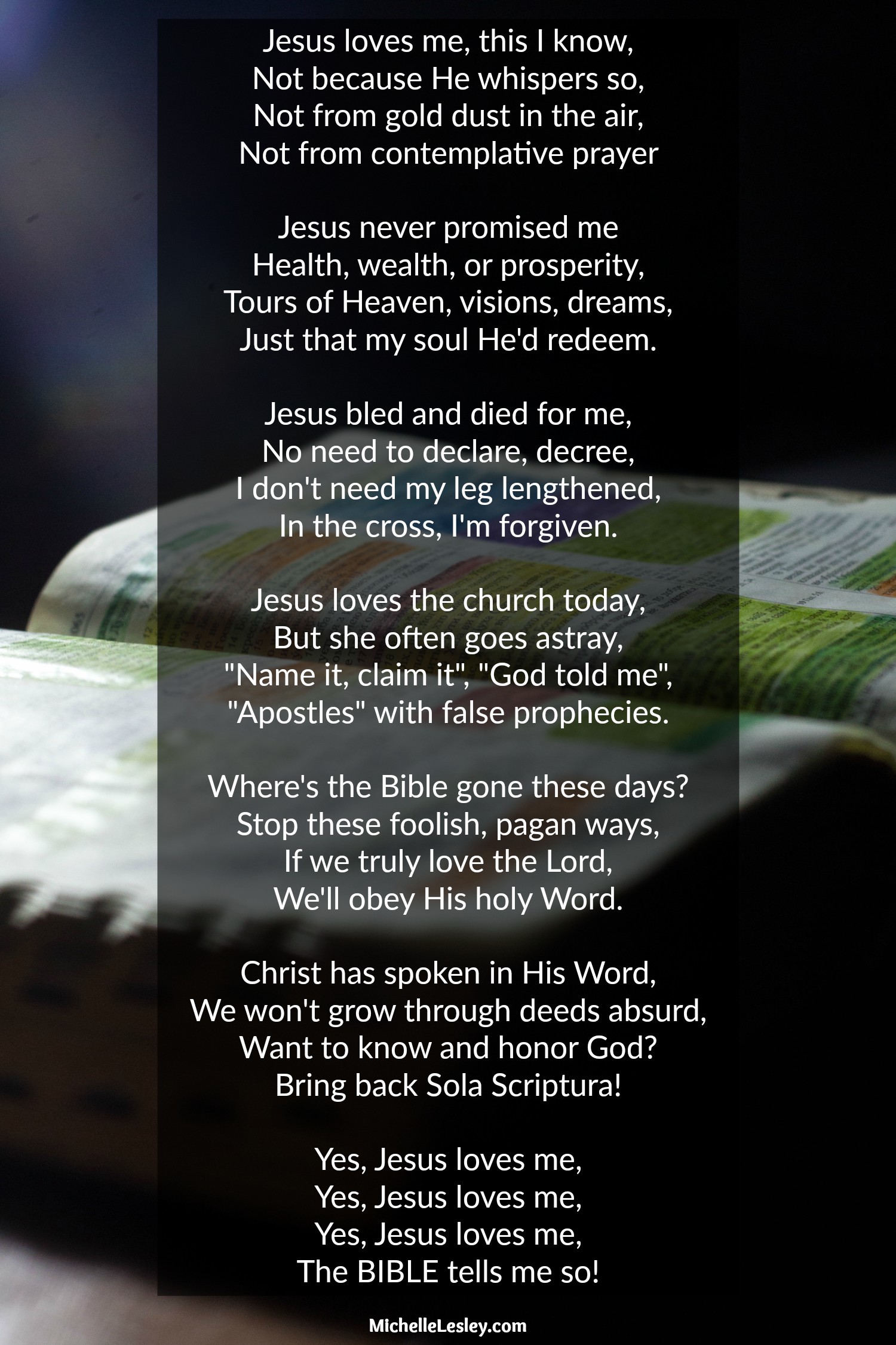
Throwback Thursday ~ Jesus Loves Me: The “Contending for the Faith” Version

Originally published March 6, 2018

Every now and then I do a little creative writing… :0)

Discernment

Throwback Thursday ~ Discernment: A Spiritual Battle, Not a Logical One

Originally published May 11, 2018

The way people think, the way we react to environmental stimuli, the way we relate to one another, the way our backgrounds and experiences shape the way we view and interact with the world absolutely fascinates me. It’s probably what led me to pursue degrees in psychology and counseling as well as every sociology, anthropology, criminology, and every other social science -ology elective I could get my hands on when I was in college. What makes people tick? Why does the human mind perceive things the way it does? Why is it that two people can witness the exact same event and come away with two completely different interpretations of it?

Those human-centered constructs and sciences can be helpful when it comes to studying observable behavior, but that’s exactly where their helpfulness ends – at the line of observable human behavior. Statistical psychology can perform a longitudinal study on people who were abused as children and show us that those people are much more likely to become abusers themselves. But, try as they might, none of those -ologies can accurately explain why they don’t all turn out to be abusers, or why some become abusers and then, for no earthly reason, suddenly stop and are seemingly magically transformed into healthy parents or spouses.

It’s because all of the -ologies lack a major operating component in their schemata – the spiritual realm. They’re like a football team with an adequate defensive team but no offensive team. You can’t play the game of football that way, and you can’t begin to understand people without acknowledging and understanding the spiritual.

Humans are more than just brains transported around by a bag of bones and muscles. People have spirits, and there are only two kinds: a spirit that has been redeemed by the blood of Christ, or a spirit that is in rebellion against Christ. And even among those who have been redeemed, there’s a broad spectrum of maturity, both overall and in specific areas of sanctification. You can generalize someone as a “baby Christian” or a “mature Christian”, but even among mature Christians, you’ll find that Christian A isn’t as mature in trusting God as Christian B, that Christian B isn’t as mature in generosity as Christian C, that Christian C isn’t as mature in patience as Christian D, and so on.

People are wonderfully and weirdly spiritually complex and unique.

People are wonderfully and weirdly spiritually complex and unique.

As Christians, I think most of us realize all of this on some level. We know that the Bible says that when we’re born again, we become completely new creatures in Christ. Out with the old man, in with the new. It’s a redeemed spirit that causes us to do things – in varying levels of maturity – like: love Christ, hate our sin, enjoy worship, and weep over the lost. Conversely, not having a redeemed spirit will cause those things to be absent in someone’s life. The words, attitudes, and behaviors we see on the outside are driven by what’s on the inside – the state of our spirits. Or, as Jesus put it:

The good person out of the good treasure of his heart produces good, and the evil person out of his evil treasure produces evil, for out of the abundance of the heart his mouth speaks.

Luke 6:45

We know this in our heads – when we’re dealing with someone’s sinful or otherwise inappropriate or aberrant actions, the words and behavior we’re observing are an outflow of the person’s spiritual state.

Sometimes, it’s easy to apply that knowledge. You observe someone murdering someone else, and it seems pretty clear-cut to say that the murderer is almost certainly not a genuinely regenerated Christian. Which is why he’s murdering someone.

The waters get a bit murkier when it comes to discernment issues in the church and among professing Christians, but the same spiritual principle applies. We’re ultimately dealing with someone’s spiritual state, not their external behavior.

“I don’t understand why my friend can’t see that _____ is a false teacher!”, I frequently hear from frustrated Christians (and myself!). “I’ve shown her video evidence, print evidence, and audio evidence of this teacher twisting Scripture, teaching false doctrine, and blatantly sinning, and she dismisses it all, telling me I’m being hateful and legalistic or that what the teacher is saying and doing is no big deal!”

What we’re dealing with is a spiritual issue, not a logical one. No amount of biblical evidence in the world is going to convince your friend of false doctrine until the Holy Spirit opens her eyes to it.

That’s because what we’re dealing with is a spiritual issue, not a logical one. No amount of biblical evidence in the world is going to convince that friend of false doctrine until the Holy Spirit opens her eyes to it. My job is not to argue my friend into believing that Joel Osteen or Beth Moore or Benny Hinn or Christine Caine is a false teacher. My job is to lovingly present what Scripture says, demonstrate how the teacher is in conflict with it, leave it on the table, walk away, and continue to pray for my friend. My job is done. It is now the Holy Spirit’s job to open my friend’s eyes and change her heart.

My job is not to argue my friend into believing that Joel Osteen or Beth Moore is a false teacher. My job is to lovingly present what Scripture says. It is now the Holy Spirit’s job to open my friend’s eyes and change her heart.

Still not sure about all this? Let’s take a look at what Scripture has to say:

The sheep hear his voice, and he calls his own sheep by name and leads them out. When he has brought out all his own, he goes before them, and the sheep follow him, for they know his voice. A stranger they will not follow, but they will flee from him, for they do not know the voice of strangers…but you do not believe because you are not among my sheep. My sheep hear my voice, and I know them, and they follow me. John 10:3b-5, 26-27

You really need to read all of John 9-10 to get the fullest picture of what’s going on here. Jesus has, once again, proved His divinity and Messiahship – this time, by healing a man who was born blind. That’s all the proof the formerly blind man needs. He is all in. “He said, ‘Lord, I believe,’ and he worshiped him.” (John 9:38) and that’s all she wrote.

The Pharisees, on the other hand, despite having just witnessed a miracle only God can do, and despite the very words coming out of the mouth of God Himself in 9:39-10:30 – overwhelming, irrefutable, biblical video and audio evidence, you might say – refuse to believe. Instead, they do the first century equivalent of calling Jesus a legalistic-Pharisee-hater: “Many of them said, ‘He has a demon, and is insane; why listen to him?’…The Jews picked up stones again to stone him.” (10:20,31)

Jesus gave them evidence. He gave them Scripture. And He did it perfectly because He was God. But they still chose to believe false doctrine over sound doctrine because they were not regenerate: Jesus answered them, “I told you, and you do not believe. The works that I do in my Father’s name bear witness about me, but you do not believe because you are not among my sheep.” (10:25-26)

Jesus gave them evidence. He gave them Scripture. And He did it perfectly because He was God. But they still chose to believe false doctrine over sound doctrine because they were not regenerate.

Sometimes that’s what’s going on, spiritually, with our friends who follow false teachers. Despite what they say, how many times they’ve walked the aisle, prayed a prayer, or been baptized, or how intense an encounter with the Lord they think they’ve had, they’ve never been genuinely saved.

Jesus definitively says that His sheep – genuinely regenerated Christians – know His voice. They either instinctively know, through the power of the indwelling Holy Spirit, when what they’re being taught is biblical (Jesus’ voice) and when it’s not (the voice of strangers), or they’re willing to learn as someone else teaches them God’s Word. Whether it’s an instant spiritual aversion to false teachers, or a gradual opening of their eyes through the teaching of Scripture, they will not follow the voice of strangers.

I can’t tell you how many women have told me (and I’ve personally experienced the same thing myself), “I was attending this women’s Bible study where they were using a book by _____. I couldn’t really put my finger on it, but I knew something was wrong, so I stopped going. Later, as I learned more and matured in my faith, I realized I had felt uneasy because the author teaches false doctrine.”

If a friend is following the voice of strangers, it could be that she doesn’t know the voice of the Shepherd and needs you to share the gospel with her.

If a friend is following the voice of strangers, it could be that she doesn’t know the voice of the Shepherd and needs you to share the gospel with her.

And the Lord’s servant must not be quarrelsome but kind to everyone, able to teach, patiently enduring evil, correcting his opponents with gentleness. God may perhaps grant them repentance leading to a knowledge of the truth, and they may come to their senses and escape from the snare of the devil, after being captured by him to do his will. 2 Timothy 2:24-26

The natural person does not accept the things of the Spirit of God, for they are folly to him, and he is not able to understand them because they are spiritually discerned. 1 Corinthians 2:14

People who aren’t saved, even if they appear to be and say that they are, aren’t going to “get it” when it comes to rejecting false teachers and false doctrine in favor of sound biblical doctrine. That’s something that only comes with a regenerated heart.

For though by this time you ought to be teachers, you need someone to teach you again the basic principles of the oracles of God. You need milk, not solid food, for everyone who lives on milk is unskilled in the word of righteousness, since he is a child. But solid food is for the mature, for those who have their powers of discernment trained by constant practice to distinguish good from evil. Hebrews 5:12-14

For among them are those who creep into households and capture weak women, burdened with sins and led astray by various passions, always learning and never able to arrive at a knowledge of the truth. 2 Timothy 3:6-7

Being unregenerate isn’t always the reason people follow false teachers. Sometimes the reason a friend follows a false teacher is that she has recently become a Christian, is immature in the faith, doesn’t know her Bible well, or is weak in the area of discernment.

When someone is genuinely saved, her life is on a trajectory toward holiness. But that doesn’t mean that God grows every aspect of her spiritual life at the same time or at the same rate. God may be growing your friend in kindness, or purity of speech, or self-control right now, and the “constant practice” of discernment might take a little longer, or not come as easily to her as it did to you. All Christians grow in the same direction, but we don’t all grow in the same time frame or in the same way. And that’s a good thing, because that way there’s always somebody strong to help me in my areas of weakness, and I can help others who are weak in the areas I’m strong in.

Something interesting I’ve discovered as I’ve studied and taught through the Old Testament books of Kings and Chronicles is a recurrence of some variation of this statement: “Nevertheless, the people still sacrificed at the high places, but only to the Lord their God.” (2 Chronicles 33:17)

Often, a righteous king came to power on the heels of an evil king. The evil king had introduced all sorts of idolatry into the nation, including building temples for idols and altars on the “high places” where the people sacrificed to false gods. As the righteous king settled into office and began painstakingly ridding the land of all the vestiges and accoutrements of idol worship, the people sometimes continued worshiping on the high places, but would worship God instead of idols. Was this pleasing to God? No. Not only was the place they were worshiping God defiled because it had been used for idol worship, but God had been very clear that the temple was the proper place for worship and sacrifice. However, the fact that the king had not yet been able to remove the high places did not make him an evil king or negate the fact that he was hard at work removing other, sometimes larger, icons of idol worship.

There are “high places” – areas of spiritual weakness – in all of our lives. I’ve got them, and you do too. Are they pleasing to God? No, and we should be working toward finding out what they are and tearing them down. But their existence doesn’t negate the fact that we love the Lord and are striving toward holiness, nor that God is hard at work conforming us to the image of Christ. Just because your friend’s “high place” is following a false teacher doesn’t necessarily mean she doesn’t love the Lord or that He isn’t at work in her life.

For we do not wrestle against flesh and blood, but against the rulers, against the authorities, against the cosmic powers over this present darkness, against the spiritual forces of evil in the heavenly places. Ephesians 6:12

We’re not at war with friends who follow false teachers, so we shouldn’t be fighting with them, trying to “win.” Our enemy is the Enemy – the one who holds lost sinners captive. The deceiver. The tempter. The father of lies.

The next time you get frustrated with a friend who’s following a false teacher…don’t.

Remember that this is a spiritual battle. Lovingly lay out biblical truth as long as she’ll let you. Then, stand down, keep praying, and trust the Holy Spirit to do His good work through His Word.

This is a spiritual battle. Lovingly lay out biblical truth, stand down, keep praying, and trust the Holy Spirit to do His good work through His Word.