

Mark Bible Study

Mark: Lesson 14

Previous Lessons: 1, 2, 3, 4, 5, 6, 7, 8, 9, 10, 11, 12, 13

Mark 10:1-31

And he left there and went to the region of Judea and beyond the Jordan, and crowds gathered to him again. And again, as was his custom, he taught them.

And Pharisees came up and in order to test him asked, “Is it lawful for a man to divorce his wife?” He answered them, “What did Moses command you?” They said, “Moses allowed a man to write a certificate of divorce and to send her away.” And Jesus said to them, “Because of your hardness of heart he wrote you this commandment. But from the beginning of creation, ‘God made them male and female.’ ‘Therefore a man shall leave his father and mother and hold fast to his wife, and the two shall become one flesh.’ So they are no longer two but one flesh. What therefore God has joined together, let not man separate.”

10 And in the house the disciples asked him again about this matter. 11 And he said to them, “Whoever divorces his wife and marries another commits adultery against her, 12 and if she divorces her husband and marries another, she commits adultery.”

13 And they were bringing children to him that he might touch them, and the disciples rebuked them.14 But when Jesus saw it, he was indignant and said to them, “Let the children come to me; do not hinder them, for to such belongs the kingdom of God. 15 Truly, I say to you, whoever does not receive the kingdom of God like a child shall not enter it.” 16 And he took them in his arms and blessed them, laying his hands on them.

17 And as he was setting out on his journey, a man ran up and knelt before him and asked him, “Good Teacher, what must I do to inherit eternal life?” 18 And Jesus said to him, “Why do you call me good? No one is good except God alone. 19 You know the commandments: ‘Do not murder, Do not commit adultery, Do not steal, Do not bear false witness, Do not defraud, Honor your father and mother.’” 20 And he said to him, “Teacher, all these I have kept from my youth.” 21 And Jesus, looking at him, loved him, and said to him, “You lack one thing: go, sell all that you have and give to the poor, and you will have treasure in heaven; and come, follow me.” 22 Disheartened by the saying, he went away sorrowful, for he had great possessions.

23 And Jesus looked around and said to his disciples, “How difficult it will be for those who have wealth to enter the kingdom of God!” 24 And the disciples were amazed at his words. But Jesus said to them again, “Children, how difficult it is to enter the kingdom of God! 25 It is easier for a camel to go through the eye of a needle than for a rich person to enter the kingdom of God.” 26 And they were exceedingly astonished, and said to him, “Then who can be saved?” 27 Jesus looked at them and said, “With man it is impossible, but not with God. For all things are possible with God.” 28 Peter began to say to him, “See, we have left everything and followed you.” 29 Jesus said, “Truly, I say to you, there is no one who has left house or brothers or sisters or mother or father or children or lands, for my sake and for the gospel, 30 who will not receive a hundredfold now in this time, houses and brothers and sisters and mothers and children and lands, with persecutions, and in the age to come eternal life. 31 But many who are first will be last, and the last first.”


The Holy Bible, English Standard Version. ESV® Permanent Text Edition® (2016). Copyright © 2001 by Crossway Bibles, a publishing ministry of Good News Publishers.


Questions to Consider

1. What does verse 1 say it was Jesus’ “custom” (notice also the words “and again”) to do? Considering this verse and all we’ve studied in the previous nine chapters, which aspect of His ministry do you think Jesus considered spiritually weightier, His teaching or His miracles? Which was more temporal and which was more eternal? What are the implications of this for the church today? Should our focus be on the teaching of Scripture, which has an eternal impact, or on miracles, signs, and wonders, which (if they’re even real and biblical) only have a temporal impact?

2. What was the purpose of the Pharisees’ questions? (2) Where does Jesus point them for the answer? (3) Think back over what we’ve learned about Jesus’ authority. He not only had the authority, as God, to definitively answer the Pharisees’ questions, but He was regarded by many of the people as a rabbi (or teacher), and rabbis’ teachings were authoritative. Why do you think Jesus – who had the authority (“you have heard it said…but I say to you…”) to answer the Pharisees’ questions directly – pointed them to Scripture instead? Can you think of more situations in which Jesus pointed others to Scripture to answer them? If Jesus – God Himself – pointed people back to Scripture what does this tell us about the place and authority Scripture should hold in our own lives?

3. Examine Deuteronomy 24:1-4, what “Moses commanded” (3), and compare it with verses 4-12. Does the content and tone of the Deuteronomy passage agree with what Jesus says in these verses? How would you summarize God’s view of marriage? (5-9) What does Jesus teach about divorce in verse 11? Who is guilty of adultery in a divorce and subsequent remarriage- the spouse initiating the divorce, or the spouse who didn’t initiate the divorce? Compare Mark 10:1-11 to these passages. What are the two biblically allowable circumstances for divorce and remarriage? Is divorce required by Scripture in these situations?

4. Why do you think the disciples rebuked people for bringing their children to Jesus to bless them? (13) Which attribute(s) of God does Jesus showcase in verses 13-16? Take a look at these Greek, Roman, and other Gentile attitudes and practices toward children circa the time of Jesus. As a first century Gentile, what would this passage have said to you about God’s love and care for children? How should this passage inform us today about abortion as well as the need to nurture our children and raise them in a godly way?

5. Examine Jesus’ teaching about marriage in 5-9 and His words and actions about children in 13-16. If you were to formulate a theology of family from these verses, what would it say?

6. Compare verses 14-15 with Mark 9:35-37. How can one “receive the kingdom of God like a child”? (15) What does it mean to have a “childlike faith”? Is there a difference between having a childlike faith and having a childish faith?

7. Fill in the blanks from verse 17: “…what must __ ___ to inherit eternal life?”. Does the gospel require us to do (perform, behave) something in order to be saved? In verse 18, is Jesus denying His deity? When Jesus says, “No one is good except God alone,” (18) He is implying to the rich young ruler that by calling Him good, he is also calling Him _____. Considering the remainder of his interaction with Jesus (19-25), was the rich young ruler ready to concede that Jesus was God?

8. Take a look back at the Ten Commandments. The first table of the Law (Commandments 1-4) deals with the (vertical) relationship between people and Whom? The second table of the Law (Commandments 5-10) deals with the (horizontal) relationship between people and whom? Examine verse 19. Which table of the Law do all of these commands come from? So if what the rich young ruler says in verse 20 is true, with whom is he in a right relationship by keeping all these commands? Examine verses 21-25 and compare the man’s love of his riches (and refusal to give them up to follow Jesus) to the first table of the Law. Which Commandment(s) is he breaking? This demonstrates he is not in right relationship with Whom? What do verses 23-25 teach about the idolatry of wealth versus following Jesus?

9. Some people use verse 21 to teach that anyone who ministers to the poor is in right standing with God (i.e. saved, going to Heaven), regardless of whether or not they’ve repented and placed their faith in Christ. Examining this verse in the context of this passage and in the context of the biblical gospel, is that truly what this verse is teaching? Is verse 21 a command for all Christians to follow (a prescriptive verse) or is it simply a description of something Jesus said to this particular person to elicit a particular response (a descriptive verse)?

10. Consider verses 26-27 in their immediate context – the power of idolatry to keep people from Christ. Have you ever prayed for the salvation of someone you felt was a hopeless case, that it would be pretty much impossible for her to get saved? How does this passage offer hope about those “hard cases”? Compare with John 6:44.

11. Examine verses 28-31. Sometimes people take verses 29-30 to mean that if you follow Jesus you’ll get more houses, lands, loved ones, and wealth. Think about Peter (28), the rest of the disciples, and Paul- what they left behind to follow Jesus and to be founders of the New Testament church. Think about the hardships and martyrdom they faced. What does this passage mean in light of their suffering? Could this passage be pointing to God providing for our needs and the love and comfort of church family rather than the promise of temporal wealth?


Homework

Mark 10:1,17 again mention Jesus’ travels. Find a good Bible map of Israel during Jesus’ lifetime (there’s probably one in the back of your Bible or Google “Bible maps”), go back over Mark 1-10, and trace Jesus’ travels on the map. You might even want to print out a map you can write on and mark the various places He visited and routes He took.


Suggested Memory Verse

“For even the Son of Man came not to be served but to serve, and to give his life as a ransom for many.”
Mark 10:45

Mailbag

The Mailbag: Remarriage After Salvation


Prior to getting saved, I had married and then divorced. Once I became a Christian, I married my second husband. God has blessed us with children and we have been married nearly twenty years. What is your take on a second marriage when your first is before becoming a Christian?

Whew, this is a tough question! It’s a really good one to ask, too, because the simple act of wondering about it indicates a desire to be obedient to God and an understanding that, in most cases, divorce is a sin- one that God takes just as seriously as other sins. And I think we forget that sometimes because divorce has become so prevalent in our culture and, sadly, even the church.

The reason this is a tough question is that there’s no particular Bible verse that specifically says, “Yes, it’s OK for you to marry again if your divorce was prior to your salvation,” or “No, it’s not OK.” So, we have to glean what we can from the Scriptures we have.

There are two main topics we need to examine here: what the Bible says about divorce and what the Bible says about salvation. We need to work backwards a little bit, so let’s start with divorce.

It is helpful to start off by reading what Scripture says about marriage and divorce. The central passages are Genesis 2:18-25, Malachi 2:13-16, Matthew 5:31-32, Matthew 19:3-9, and 1 Corinthians 7:10-16. The Bible specifically cites two¹ biblically allowable grounds for divorce in the New Testament: adultery and abandonment by an unsaved spouse.

God does not require divorce in these situations. Indeed, as far as it depends on the Christian spouse who has been sinned against, and is possible, forgiveness and reconciliation – especially in light of how much Christ has forgiven us and reconciled us to Himself – should be the goal. I personally know of marriages that survived these situations and have brought much glory to God and hope to other couples as a result. Yes, it’s excruciatingly hard. No, it’s not fair. It was hard and unfair for Jesus to go to the cross for our sin, too, but He was willing because of His love for us and for the Father.

Seeking a divorce for reasons¹ other than these two – such as irreconcilable differences, “falling out of love,” etc. – are not allowed by Scripture for Christians.

But our sister asking the question wasn’t a Christian when she got divorced. How does that factor in?

Here, we need to recall the nature of salvation- the foundational differences between a lost person and a saved person. First Corinthians 2:12-14, John 14:23-24, Hebrews 11:6, and Romans 3:9-20 help us understand that – while a lost person might sometimes be able to outwardly behave in a way which appears to comply with Scripture – that’s not obedience to God. Obedience is an action of the heart that is made possible only by the transformation and indwelling of the Holy Spirit. Only saved people are transformed and indwelt by the Holy Spirit, which means only saved people can obey God and His word. So, not to over-simplify, but, basically, everything lost people do is sin because they are in a spiritual state (devoid of the Holy Spirit) that renders them unable to be obedient to God. This means that our reader’s divorce was sinful – regardless of whether or not it was for one of the two biblical reasons – because all of her behavior prior to salvation – divorce, driving a car, giving money to charity, eating breakfast – sprang from a heart that belonged to her father, the Devil.

(I know that’s pretty heavy, so if you’re not grasping it, or find yourself in disagreement, I’d encourage you to go back and read over the Scriptures I’ve hyperlinked above.)

But when someone repents and trusts Christ as Savior, all of that sin gets wiped out instantaneously. The old has gone, 2 Corinthians 5:17 tells us. Salvation is more than just new life, it’s also a death. It’s a death to sin. Death to the old man, the old desires, the old ways, the old thoughts. That whole sinful ball of wax gets crucified – nailed to the tree – with Christ, and dies. Including that divorce.

And when Christ resurrects us from that death, we are born into a new life. Baptism is a beautiful, visible picture of this invisible spiritual truth: we are buried with Christ in baptism and raised to walk with Him in newness of life. The old has gone. The new has come. A new life. A clean slate. Life has just started for this sister. There is no biblical reason she should not have married a godly husband.

In closing, there are a few things that don’t pertain to this particular reader’s question (since her divorce, salvation, and remarriage are already a done deal), but which might be pertinent to others in similar situations.

1. This reader did not ask whether or not she should leave her second husband (nor does she want to- she is happily married). She already knows that would be wrong, and she’s correct about that. We don’t fix one sin by committing another.

2. If this reader had asked me this question prior to marrying her second husband. I would have urged her to first explore the possibility – depending on the circumstances¹ and with intense pastoral counseling – of reconciliation with her first husband. That is what 1 Corinthians 7:10-16 is all about.

3. Marriage is a huge thing. Divorce is a huge thing. Remarriage is a huge thing. Whatever your particular situation might be, search the Scriptures about it, ask God for wisdom and direction, and get wise counsel from your pastor.

4. This was a challenging question to answer. I’d like to thank my husband and two of my pastor buddies for their help. Thanks, guys. Y’all are awesome!


¹Physical and sexual abuse within marriage is a serious issue, but it was not a factor in this particular reader’s question, so I am keeping the scope narrow and not addressing the issue of abuse in this article. If you are being abused, please get yourself and your children to safety and seek help. If you know someone who is being abused, help her.

If you have a question about: a Bible passage, an aspect of theology, a current issue in Christianity, or how to biblically handle a family, life, or church situation, comment below (I’ll hold all questions in queue {unpublished} for a future edition of The Mailbag) or send me an e-mail or private message. If your question is chosen for publication, your anonymity will be protected.

Sin, Throwback Thursday

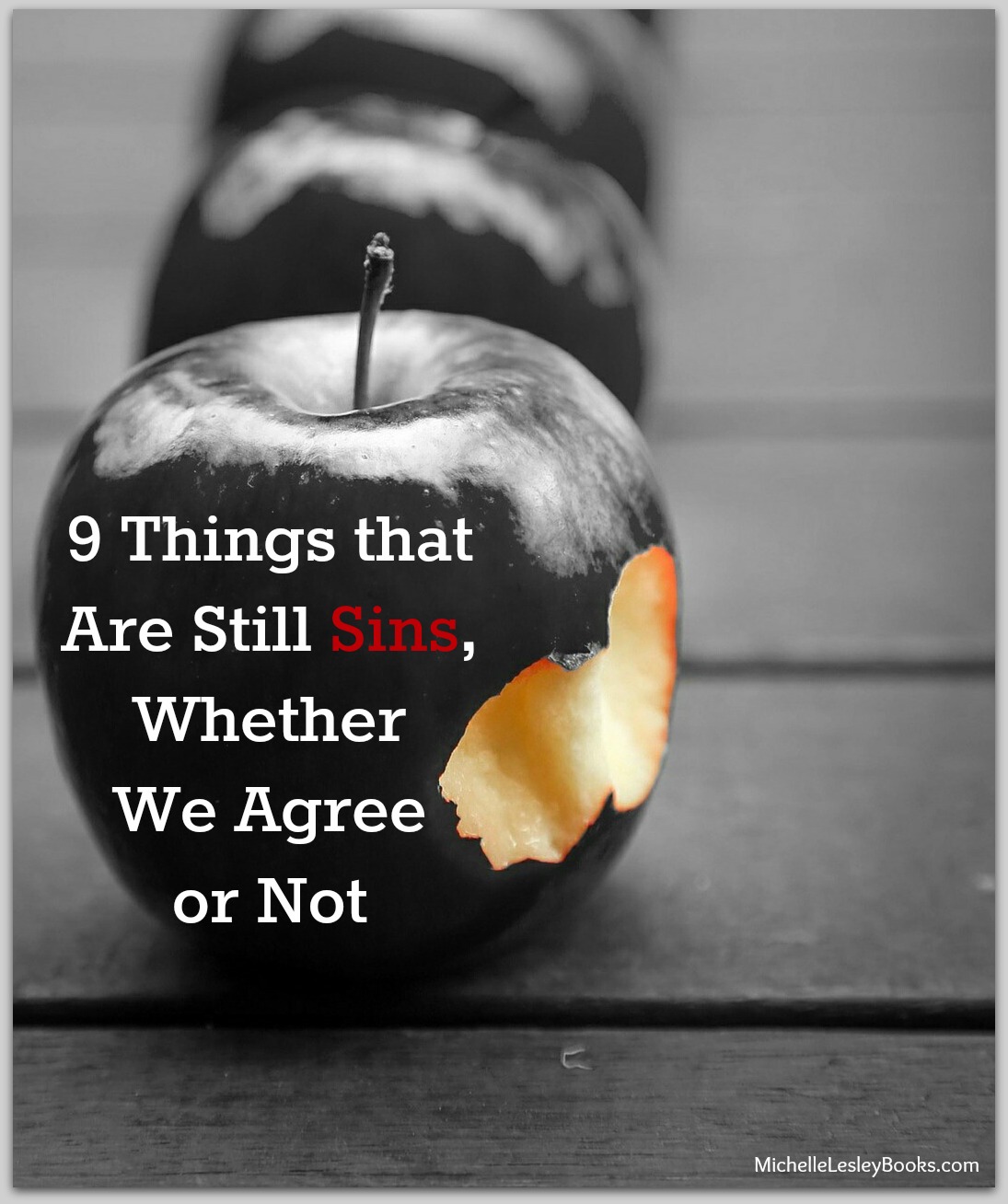
Throwback Thursday ~ 9 Things that Are Still Sins Whether We Agree or Not

Originally published June 19, 20159 still sins


I do it all the time, Mother, and I’ve decided something-
it’s not a sin.

I heard this line several years ago on a popular sitcom, spoken by an adult daughter to her Christian mother about a behavior the Bible unambiguously calls a sin. I mean, it’s right smack dab in the middle of the Big 10; “thou shalt not” and everything.

It’s one thing to say, “I know it’s a sin, but I don’t care. I’m going to do it anyway,” but how depraved is the world when they think they – in God’s place – are the ones who get to define what sin is? And what’s even worse is that the church has begun to adopt this audacious depravity as well, whether approving of sin by fiat or by simply ignoring God’s word and letting sin slide without rebuke.

When it comes to what’s a sin and what’s not, God made up His mind a long time ago. And He’s not changing it, regardless of what you or I or Joe Politician or Jane Celebrity might think. Maybe we all need a remedial course in hamartiology, so let’s start with the basics. These things are all still sins whether the world and the church agree with God or not:

1. Homosexuality

Let’s just get it out of the way right up front. I don’t care how many celebrity “pastors” and “Christian” authors twist God’s word to say otherwise, or how many people declare themselves to be (unrepentant, practicing) “gay Christians,” or how many homosexuals declare that God made them that way, God’s word is clear: homosexual lust and behavior are sins.

2. Abortion

Abortion is the taking of an innocent human life. We don’t murder people because they’re small or sick or inconvenient or will hinder our sucess. God didn’t say, “You shall not murder, except when…” He said, “You shall not murder.” Period.

3. Extra-Marital (Heterosexual) Sex

Adultery, fornication, whatever form it might take, if you’re not legally married to the person you’re engaging in sexual activity – up to and including actual intercourse – with, you’re sinning.

4. Cohabitation

See #3. And don’t try to whitewash it by saying you’re living together but not sleeping together. A) The Bible says we’re to flee temptation, not move in with it, and B) we’re supposed to avoid every form of evil, even the appearance of it. If you call yourself a Christian and you’re shacking up, you’re living in sin (that’s why they call it “living in sin”). Repent and move out or marry up.

5. Divorce

Yep, still a sin, except in two cases: unfaithfulness or an unsaved spouse leaving a saved spouse. In those two cases the spouse who was wronged is not sinning and is free to marry again.

6. Swearing

The air is saturated with it. Foul language coming from our TVs, music, movies, social media, and the people we’re around all day. But expletives have no place in the vocabulary of a Christian. Is your potty mouth on Saturday the same one you praise God with on Sunday?

7. Taking God’s Name in Vain

It’s gotten to the point where we think so little of casually punctuating our sentences with, “Oh my G-d,”  or using the name of Jesus as an exclamation that pastors are even doing so from the pulpit these days. God’s name is high and holy and should be spoken only reverently and worshipfully. How can we look people in the eye and call them to repentance and faith in a Person whose name we use as a cuss word?

8. Gluttony

We have almost completely amputated gluttony from the spiritual realm by cordoning it off as merely a physical or medical issue. We’ve renamed it “overeating,” but that doesn’t change the fact that it’s a sin. God created good food for us to enjoy, but just as with all the other good gifts He gives us, He expects us to exercise Spirit-enabled self control when we receive it.

9. Female Usurpation

God makes it abundantly clear in His word that women are not to instruct men in the Scriptures or hold authority over them in the church. Women sin when they pastor churches, preach sermons in church, teach men in Sunday School classes, and hold other positions of authority over men in the church. Men, however, bear the primarily responsibility for this when they sin by failing to rebuke usurping women, or when women feel they have no other choice but to take on male responsibilities in the church because men are shirking their own duties before God.


We don’t get to decide what sin is. That’s God’s job. And all of us – whether we’ve committed one of these nine sins or not – are guilty of sinning against Him. That’s the bad news.

But, in Christianity, we never give the bad news without following it up with the good news. And, oh what wonderfully good news it is: forgiveness. Jesus paid for our sin at Calvary so that if we will only turn from it and trust Him, He will forgive us for all nine of these sins and countless others.

If we confess our sins, he is faithful and just to forgive us our sins and to cleanse us from all unrighteousness.
1 John 1:9

Ezra Bible Study

Ezra: Lesson 11

ezra-study-e1465330077513

Previous Lessons: 1, 2, 3, 4, 5, 6, 7, 8, 9, 10

Ezra 10

While Ezra prayed and made confession, weeping and casting himself down before the house of God, a very great assembly of men, women, and children, gathered to him out of Israel, for the people wept bitterly. And Shecaniah the son of Jehiel, of the sons of Elam, addressed Ezra: “We have broken faith with our God and have married foreign women from the peoples of the land, but even now there is hope for Israel in spite of this. Therefore let us make a covenant with our God to put away all these wives and their children, according to the counsel of my lord and of those who tremble at the commandment of our God, and let it be done according to the Law. Arise, for it is your task, and we are with you; be strong and do it.” Then Ezra arose and made the leading priests and Levites and all Israel take an oath that they would do as had been said. So they took the oath.

Then Ezra withdrew from before the house of God and went to the chamber of Jehohanan the son of Eliashib, where he spent the night, neither eating bread nor drinking water, for he was mourning over the faithlessness of the exiles. And a proclamation was made throughout Judah and Jerusalem to all the returned exiles that they should assemble at Jerusalem, and that if anyone did not come within three days, by order of the officials and the elders all his property should be forfeited, and he himself banned from the congregation of the exiles.

Then all the men of Judah and Benjamin assembled at Jerusalem within the three days. It was the ninth month, on the twentieth day of the month. And all the people sat in the open square before the house of God, trembling because of this matter and because of the heavy rain. 10 And Ezra the priest stood up and said to them, “You have broken faith and married foreign women, and so increased the guilt of Israel. 11 Now then make confession to the Lord, the God of your fathers and do his will.Separate yourselves from the peoples of the land and from the foreign wives.” 12 Then all the assembly answered with a loud voice, “It is so; we must do as you have said. 13 But the people are many, and it is a time of heavy rain; we cannot stand in the open. Nor is this a task for one day or for two, for we have greatly transgressed in this matter. 14 Let our officials stand for the whole assembly. Let all in our cities who have taken foreign wives come at appointed times, and with them the elders and judges of every city, until the fierce wrath of our God over this matter is turned away from us.” 15 Only Jonathan the son of Asahel and Jahzeiah the son of Tikvah opposed this, and Meshullam and Shabbethai the Levite supported them.

16 Then the returned exiles did so. Ezra the priest selected men, heads of fathers’ houses, according to their fathers’ houses, each of them designated by name. On the first day of the tenth month they sat down to examine the matter; 17 and by the first day of the first month they had come to the end of all the men who had married foreign women.

18 Now there were found some of the sons of the priests who had married foreign women: Maaseiah, Eliezer, Jarib, and Gedaliah, some of the sons of Jeshua the son of Jozadak and his brothers. 19 They pledged themselves to put away their wives, and their guilt offering was a ram of the flock for their guilt. 20 Of the sons of Immer: Hanani and Zebadiah. 21 Of the sons of Harim: Maaseiah, Elijah, Shemaiah, Jehiel, and Uzziah. 22 Of the sons of Pashhur: Elioenai, Maaseiah, Ishmael, Nethanel, Jozabad, and Elasah.

23 Of the Levites: Jozabad, Shimei, Kelaiah (that is, Kelita), Pethahiah, Judah, and Eliezer. 24 Of the singers: Eliashib. Of the gatekeepers: Shallum, Telem, and Uri.

25 And of Israel: of the sons of Parosh: Ramiah, Izziah, Malchijah, Mijamin, Eleazar, Hashabiah, and Benaiah. 26 Of the sons of Elam: Mattaniah, Zechariah, Jehiel, Abdi, Jeremoth, and Elijah. 27 Of the sons of Zattu: Elioenai, Eliashib, Mattaniah, Jeremoth, Zabad, and Aziza. 28 Of the sons of Bebai were Jehohanan, Hananiah, Zabbai, and Athlai. 29 Of the sons of Bani were Meshullam, Malluch, Adaiah, Jashub, Sheal, and Jeremoth. 30 Of the sons of Pahath-moab: Adna, Chelal, Benaiah, Maaseiah, Mattaniah, Bezalel, Binnui, and Manasseh. 31 Of the sons of Harim: Eliezer, Isshijah, Malchijah, Shemaiah, Shimeon, 32 Benjamin, Malluch, and Shemariah. 33 Of the sons of Hashum: Mattenai, Mattattah, Zabad, Eliphelet, Jeremai, Manasseh, and Shimei. 34 Of the sons of Bani: Maadai, Amram, Uel, 35 Benaiah, Bedeiah, Cheluhi, 36 Vaniah, Meremoth, Eliashib, 37 Mattaniah, Mattenai, Jaasu. 38 Of the sons of Binnui: Shimei, 39 Shelemiah, Nathan, Adaiah, 40 Machnadebai, Shashai, Sharai, 41 Azarel, Shelemiah, Shemariah, 42 Shallum, Amariah, and Joseph. 43 Of the sons of Nebo: Jeiel, Mattithiah, Zabad, Zebina, Jaddai, Joel, and Benaiah. 44 All these had married foreign women, and some of the women had even borne children.


The Holy Bible, English Standard Version Copyright © 2001 by Crossway Bibles, a publishing ministry of Good News Publishers.


Questions to Consider:

1. In chapter 9, Ezra prayed a beautiful prayer of repentance for Israel’s corporate sin, which you may wish to briefly review, as it led to the events in chapter 10. What specific sin do chapters 9 and 10 deal with? Why had God commanded His people not to commit this sin?

2. What does verse 1 say Ezra was doing? The people of Israel? Explain the impact and example Ezra’s genuine (6-7) repentance and contrition had on the people. Why is it important for our pastors, elders, and teachers to model contrition, repentance, and other godly traits and habits for us today? Do you set a godly example for others to imitate?

3. Why did Shecaniah say “even now there is hope for Israel in spite of [our sin]”? (2) What was Israel’s hope? Compare Israel’s hope for God’s mercy and forgiveness of sin in response to true repentance with 1 John 1:9. Why does God’s forgiveness bring hope? How does God’s response to repentance in both the Old and New Testament demonstrate His immutability?

4. What did the proclamation say would happen to anyone who failed to appear for the assembly? (7-8) How did the people respond? (9) How do the concepts of “covenant” (3), “oath” (5), and the details of, and Israel’s response to the proclamation indicate the gravity with which they regarded their sin? Why are gravity and grief proper responses to our sin?

5. In this chapter, God’s people divorced their unbelieving, pagan spouses. Is this chapter a command for Christians today to divorce their unbelieving spouses? How can we be sure it is not? How do these two passages on divorce (Ezra 10 and 1 Corinthians 7:12-16) demonstrate the importance of understanding the difference between descriptive and prescriptive passages? (For more on divorce in Ezra 10, click here and scroll about 2/3 of the way down to the paragraph that begins “And one issue comes to the floor…”) How does this chapter show us what it means to take the actions necessary to turn from our sin and walk in repentance?

6  Do verses 12-14 indicate that Israel was trying to put off repenting or that they wanted to go about repenting in a thorough and orderly way? How many months did the repentance and divorce process take? (16b-17a) Which classes of people went first in the repentance and divorce process? (18, 23) Followed by which class? (25) How does this order again stress that the leaders of God’s people must set a godly example?


Mailbag

The Mailbag: Is it all right for a Christian to get divorced?

mailbag

Is it all right for a Christian to get divorced? What are the biblical grounds for divorce?

God holds marriage in very high esteem because it is a picture of Christ and His bride, the church (Ephesians 5:22ff). In Matthew 19:1-9, Jesus is clear that marriage is precious and not to be discarded carelessly as it was in the Old Testament under the Mosaic covenant. Here, He also gives us one of two reasons Christians may (but are not required to) biblically divorce: adultery.

The second reason Christians may divorce on biblical grounds is found in 1 Corinthians 7:15. If an unbelieving spouse abandons the believing spouse, the believer is not held to the bonds of marriage and may divorce.

Naturally, divorce is a last resort even in these two situations. There are many beautiful stories of marriages surviving adultery through forgiveness. As well, there are many husbands who have been saved after witnessing their wives’ faithfulness to Christ. God’s desire is always for reconciliation whenever possible.

Additional Resources:

Divorce and Remarriage at Grace to You

What does the Bible say about divorce and remarriage? at Got Questions


If you have a question about: a well known Christian author/leader, a Bible passage, an aspect of theology, a current issue in Christianity, or how to biblically handle a family, life, or church situation, comment below (I’ll hold all questions in queue {unpublished} for a future edition of The Mailbag) or send me an e-mail or private message. If your question is chosen for publication, your anonymity will be protected.