Mailbag, Worship

The Mailbag: Potpourri (Boundaries… Submit vs. address sin?… Discernment- Who do you think you are?)

Welcome to another โ€œpotpourriโ€ edition of The Mailbag, where I give short(er) answers to several questions rather than a long answer to one question.

I like to take the opportunity in these potpourri editions to let new readers know about my comments/e-mail/messages policy. Iโ€™m not able to respond individually to most e-mails and messages, so here are some helpful hints for getting your questions answered more quickly. Remember, the search bar (at the very bottom of each page) can be a helpful tool!

Or maybe I answered your question already? Check out my article The Mailbag: Top 10 FAQs to see if your question has been answered and to get some helpful resources.


This comment was left on my article, Taking Offense:

Thank you for this biblical truth: โ€œJesusย taught usย toโ€ฆlove our enemies, do good to those who hate us, bless those who curse us, pray for people who abuse us, turn the other cheek, give to those who want to take from us, treat others the way we want to be treatedโ€. Are boundaries biblical then? Do we stick around when someone is pouring out non-stop criticism and verbally abusing us or talking behind our back? Family members can be the worst. People who are not following Jesus and who are consumed with darkness, hate people who are walking in the Light. I understand not taking offense, but in my experience, when I turn the other cheek to abusers, they keep abusing and hate you more. It is not good to allow them to sin against us because when their sin flows freely, it not only harms me but it harms them too. Thoughts?

Great question! It’s one Amy Spreeman and I have received numerous times over the past few years, so we’ve recorded a podcast mini-series on it!

Beautiful Biblical Boundaries- part 1 deals with the Scriptures and biblical precepts addressing boundaries. We discuss how and when to erect boundaries (and how and when not to). This episode is currently scheduled to drop next Wednesday, November 12.

In Beautiful Biblical Boundaries- part 2, we’ll answer listeners’ questions about boundaries in their own lives and relationships. This episode is currently scheduled to drop in about two weeks, on Wednesday, November 19.

Please note that the links above will not work until the dates specified.


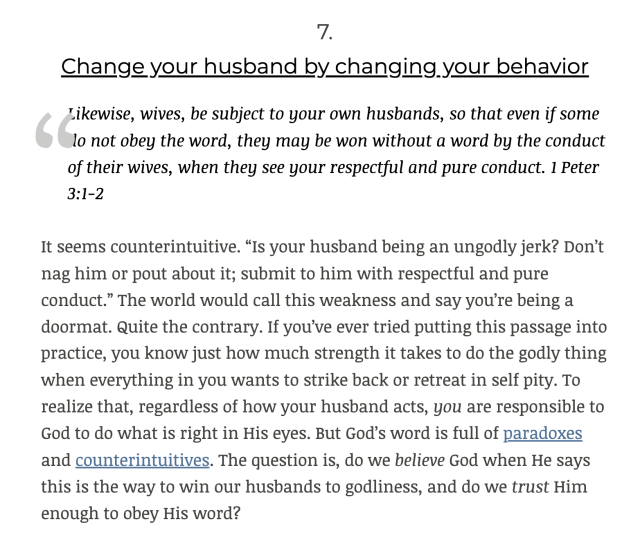
This comment was left on my article, Marriage: Itโ€™s My Pity Party and Iโ€™ll Cry if I Want To ~ 7 Ways to Take Your Focus Off Yourself and Put it Back onย Christ (By the way, yes, I realize that the length of the titles of some of my articles rivals those of many of the Puritans’ books and pamphlets. I’m OK with that.๐Ÿ˜€)

I have a question about number 7…

This article pertains to normal, relatively healthy, Christian marriages. In other words, not abusive marriages. If you are being abused, get yourself and your children to a safe place, and call the police, your pastor, or a loved one for help.

Of course, I agree that we should be subject to our husbands. However, are we not to call them out gently on their sin when they are acting like โ€œan ungodly jerkโ€ according to various verses such as Proverbs 27:5, Luke 17:3, Matthew 18:15, and Galatians 6:1? I guess Iโ€™m just confused because both commands seem to contradict each other.

This is another super question! The short answer is, “Yes,” but as Ecclesiastes 3:1,7 tells us, “there is a time for every matter under heaven…a time to be silent and a time to speak,” and in the moment when your husband is acting like “an ungodly jerk,” he’s apt to respond poorly to his sin being exposed and corrected, which just compounds his sin. (And frankly, we wives usually respond just as poorly in that moment when the shoe is on the other foot.)

In that moment, generally speaking, it’s usually a time to be silent, and, assuming he’s not asking you to sin, do whatever it is he’s gruffly or impatiently asking you to do with a gracious, kind, willing, and loving attitude and demeanor, as opposed to pouting and feeling sorry for yourself – which is the theme of the article (and also why #7 focuses on the “a time to keep silent” aspect of submission rather than the “a time to speak” aspect of addressing your husband’s sin).

Have you ever heard the phrase “killing someone with kindness”? God has an amazing way of taking our example of godly obedience, kindness, and refusing to retaliate, and using that to convict the other person of his sin. He does that Himself with us:

Or do you think lightly of the riches of His kindness and forbearance and patience, not knowing that the kindness of God leads you to repentance?

Romans 2:4

So, yes, there’s a time to speak and – approaching your husband the way you would want to be approached – kindly and humbly address his sin. That time is usually… later. Not in the moment.


What makes you confident in your ability to determine who is a true or false teacher of the Bible? Are you a theologian or do you have background in studying theology and the Bible? Just curious.

(I’ve distilled this question down from a much longer laundry list of complaints from a follower about a Facebook post in which I warned against false teacher Priscilla Shirer. It’s hard to tell from the wording in the brief excerpt above, but this was not a genuine, good faith question from someone desiring to grow in her discernment skills. It was tossed out in a snarky, accusatory, “Who do you think you are?” tone. My tone below, per Proverbs 26:5, is a biblically appropriate response to hers.)

The Bible makes me confident in my ability to determine who is a true or false teacher of the Bible. And if you’re a genuinely regenerated Christian, it should make you confident too.

Our authority as Christians comes from God’s Word, not from a seminary. You don’t have to go to seminary to be a discerning Christian (in fact, many seminaries are so rife with false doctrine that you’d better be discerning before you get there). If you think about it, none of the people who wrote the Bible’s teachings on false teachers and false prophets ever went to seminary, including the Bereans, whom God praised for their discernment.

Scripture tells us:

Beloved, do not believe every spirit, but test the spirits to see whether they are from God, because many false prophets have gone out into the world.

1 John 4:1


Examining teachers and comparing their teaching and behavior with Scripture is a command from God for Christians, not an option, and certainly not something for Christians to criticize and scorn other Christians for doing (as long as they’re doing it biblically, which I am).

So the question here is not why am I obeying God’s Word, testing this spirit against Scripture, and when she’s found to be a false teacher, warning other Christians about her. The question is, if you’re a Christian, why aren’t you? Why aren’t you studying your Bible so that you understand it, and can see how Shirer’s words and actions conflict with it? Why aren’t you warning others against her? I would be very concerned about that for my own spiritual life if I were you.

I hope this resource will answer any other objections to the Bible’s command for discernment that you may have.

I later added these remarks (slightly edited here) to the remainder of the commenters on that post:

I would encourage you younger ladies (especially those who have been commenting in the “Where do you get off?!?!” vein to me) to consider this:

“When one becomes so familiar with His Word you can spot a false teacher a mile away – I told my girls that when you walk close to God and His WORD you become sensitive to the clanging gong of false teachers.”

This quote is from a 70+ year old “Titus 2:3-5 woman” who has been walking with the Lord and a passionate student of God’s Word for over 50 years. And she’s right. And as a younger woman (I’m 56), I’m very thankful for the wisdom she just spoke into my life.

As I said, I’m 56. I have been a faithful member of decent churches since 9 months before I was born. I’ve been saved since I was 12. That means I’ve been walking with the Lord and studying His Word at church, a Christian high school and college, in other Christian organizations, and on my own for 44 years. Longer than many of you have been alive. Furthermore, I’ve been blogging and “doing discernment ministry” for over 17 years.

If you had a doctor with 44 years of training and 17 years of diagnostic experience and he gave you a diagnosis you didn’t like, would you immediately throw it back in his face with a sassy, disrespectful, “What qualifies YOU to say so?” or “What makes you so sure you’re right? MY opinion is…”. I doubt it. You might respectfully ask him some questions or request some resources to help you understand. You might even politely seek a second or third opinion, but you would not be so brash and arrogant to immediately assume he has no idea what he’s talking about and is just being mean to you, and you know better than he does.

I’m not saying this to toot my own horn or “look down on anyone’s youth” (that would be out of context, anyway), and I’m certainly not saying I’m without sin or never make mistakes. I’m saying there’s a reason Titus 2:3-5 specifies that older women are to train younger women. (Which implies that younger women should listen to older women instead of immediately dismissing us out of hand when we say something you don’t like – especially when it’s backed up with rightly handled Scripture and other mature, doctrinally sound Christians corroborate it.) Younger women do not have the same spiritual maturity, life experience, wisdom, and biblical training that older women have who have been walking with the Lord for decades. (I definitely didn’t have it when I was a younger woman!)

By all means, get a second opinion from rightly handled, in context Scripture. Politely ask questions. Do the research on your own. But stop being so reactionary and lashing out every time you hear something biblical that you don’t like. All you’re doing is showcasing your spiritual immaturity and ignorance of Scripture and your lack of self control. Or, worst case scenario, you’re bearing the fruit of someone who isn’t saved.

I’m far from perfect, but I didn’t just fall off the turnip truck and start slinging the label of “false teacher” around willy nilly. By God’s incredible grace, mercy, wisdom, and sanctification, I’ve been doing this a long time, and I know what I’m talking about – all glory to Him.


If you have a question about: a Bible passage, an aspect of theology, a current issue in Christianity, or how to biblically handle a family, life, or church situation, comment below (Iโ€™ll hold all questions in queue {unpublished} for a future edition of The Mailbag) or send me an e-mail or private message. If your question is chosen for publication, your anonymity will be protected.


Discernment

Discernment: What’s Love Got to Do with It?

Originally published January 22, 2016

…so that we may no longer be children, tossed to and fro by the waves and carried about by every wind of doctrine, by human cunning, by craftiness in deceitful schemes. Rather, speaking the truth in love, we are to grow up in every way into him who is the head, into Christ…

Ephesians 4:14-15

Christians who know what discernment is have a variety of perspectives about how it should be practiced. Should we teach about false doctrine at all or just make sure our church is teaching sound doctrine? Should we name the names of false teachers or speak about them anonymously? Should we warn people away from false teachers or just pray for them privately? What’s the biblical precedent for using a stringent tone when speaking of those who teach false doctrine?

Recently, I’ve been thinking a lot about the phrase “speaking the truth in love” from Ephesians 4:15 as it pertains to speaking and writing about false doctrine and false teachers.

Many Christian women have the mistaken idea that “speaking the truth in love” equals being “nice.” We’re always smilingly sweet and never say anything that might hurt someone’s feelings or could rock the boat at church.

Many Christian women have the mistaken idea that “speaking the truth in love” equals being “nice.”

Are we to be kind? Yes. Are we to do our best not to hurt others? Of course. Should we be making waves over every little thing that rubs us the wrong way? Absolutely not. We are to deny ourselves, setting aside our personal preferences and, in many cases, even our own rights, to the point of laying down our lives for others.

We need to understand the distinction between personal preferences and biblical doctrine. We die *to* personal preferences. We die *for* the purity of biblical doctrine.

But we need to understand the distinction between personal preferences and biblical doctrine. And that’s where I think a lot of people get confused. We die to personal preferences. We die for the purity of biblical doctrine. The enemy is stealthily infiltrating and conquering church after church with false doctrine. We are at war. And that’s going to mean ruffling feathers, rocking the boat, and hurting feelings sometimes. Because the full armor of God doesn’t come with a white flag or a pen for signing peace treaties.

The full armor of God doesn’t come with a white flag or a pen for signing peace treaties.

But how do we war for the truth “in love”?

Well, think about the concept and practice of “love.” Love always has an object. We don’t just say, “I love.” We say, “I love my children,” or “I love peanut butter and chocolate ice cream.” Speaking the truth “in love” is not as much about our demeanor or tone of voice as it is about the object of our love. It’s our love for others that compels us to speak biblical truth. And it’s that same love for others that should drive the manner in which we speak the truth.

So when it comes to speaking the truth about false doctrine, how should we be motivated by love? And love for whom?

We love Christ– As Christians, our love for Christ should motivate everything we do. If we’re speaking truth from fleshly motives such as pride, the desire to make a name for ourselves, or the competitive drive to win an argument, everything we say can be 100% factually right and we can still be spiritually in the wrong because the motive of our heart is wrong. God isn’t a debate judge awarding us points for compelling arguments. God weighs the heart.

We love God’s Word– To love Christ is to love the Bible because Scripture is literally God Himself speaking to us. Besides the cleansing of the temple, the passage in which we see Jesus’ righteous anger displayed most clearly is Matthew 23. Here, Jesus delivers a scorching rebuke to the scribes and Pharisees for twisting God’s Word and, in doing so, leading people away from the truth of Scripture. It is only natural for those of us who have the mind of Christ and are indwelt by the Holy Spirit to have that same love for God’s word and feel righteous anger over the maligning of it.

We love the church– To love Christ is also to love His bride, the church. Christ gave his life to cleanse the church “so that he might present the church to himself in splendor, without spot or wrinkle or any such thing, that she might be holy and without blemish.” Seeing Christ’s bride blemished and corrupted by false doctrine should grieve us deeply and motivate us to call the church to be cleansed “by the washing of water with the Word.”

We love the captives– Paul speaks of false teachers “who creep into households and capture weak women.” Often, the women who follow false teachers simply don’t know any better. Though Scripture is clear that they’re complicit in their own captivity, they are casualties and prisoners of war held hostage by the enemy. We are to love them enough to show them the truth of God’s word so that “they may come to their senses and escape from the snare of the devil, after being captured by him to do his will.”

We love the enemyEvery Christian was at one time an enemy of the cross. Every last one of us. Until someone loved us enough to intervene with the truth of the gospel. False teachers – those who, despite biblical correction, unrepentantly teach doctrine which is plainly refuted by Scripture – have made themselves enemies of the cross, even if they call themselves “Christian,” even if they wear the title of “pastor,” even if they’re holding a Bible in their hands and refer to it occasionally as they “teach” us.

In the same way that a loving sister would not turn a blind eye and hope for the best if her sibling began using drugs and became increasingly addicted, it is not lovingย to stand idly by and allow false teachers to continue to sink deeper and deeper into Satan’s clutches by doing his bidding without making every effort to stop them in order to rescue them.

*It is not loving* to stand idly by and allow false teachers to continue to sink deeper and deeper into Satan’s clutches by doing his bidding without making every effort to stop them in order to rescue them.

Sometimes – just as with the drug abuser – this can be accomplished early on with a private word of correction. And sometimes – as with the addict – more extreme measures of “tough love” and intervention must be employed. But we always love them enough to desire that they come to repentance and embrace the truth.


Our love for these also drives the manner in which we speak truth to them. A good soldier would never deal with a civilian casualty in the same way he would fight off an enemy bent on waging war. Likewise, part of discernment is knowing who the enemy is (and is not) and dealing with people in a biblically appropriate way. This requires humility, wisdom, thorough proficiency with our tools and weapons, unceasing prayer, and complete dependence on and self-crucifying love for our King. We trust in Him and His Word to guide us in the wise and loving way to humbly speak His truth.

Discernment. Speaking truth. What’s love got to do with it?

Everything.

Discernment. Speaking truth. What’s love got to do with it? Everything.

Answering a Fool, Mailbag

The Mailbag: Answering a Fool #5

Answer a fool according to his folly,
lest he be wise in his own eyes.
Proverbs 26:5

There’s a lot of foolishness masquerading as Christianity these days. Occasionally, I get e-mails and messages showcasing this type of foolishness. It needs to be biblically corrected so these folks can stop “being wise in their own eyes,” repent, and believe and practice the truth of Scripture. From time to time, I share those e-mails in The Mailbag with a biblical corrective, not only so the e-mail writer can be admonished by Scripture, but to provide you with Scriptures and reasoning you can use if you’re ever confronted with this kind of foolishness.

To answer a fool according to his folly (or in the case of most of the foolishness addressed to me – a professing Christian acting the fool by spouting unbiblical folly) is to stand toe to toe with him and firmly and biblically address his unbiblical foolishness without backing down or letting him run roughshod over you – sometimes even mirroring his own words back to him to help him see his hypocrisy. Some Christians think holding your ground, refusing to compromise on biblical truth, and offering correction in this way is unkind or unloving. It is not. Not if you’re going by the Bible’s definition of love rather than the world’s definition (“be nice” “accept everything” “don’t confront”), and not when you’re dealing with a pridefully stubborn person. One of the most unloving things a Christian can do is to see a professing brother or sister in biblical error and ignore it rather than trying to help that person see the truth of God’s Word. Jesus, Paul, Peter, Jude, John, Jeremiah, Isaiah, and many others, did this plenty of times in Scripture, and, often, much more stringently that I and other 21st century Christians do. Sometimes love – real, biblical love – has to be tough in order to reach someone’s heart.

You can read more in the “Answering a Fool” series here.


If you’re on pretty much any form of social media, you know foolishness abounds. Such was the case, recently on X (the artist formerly known as Twitter). But it gave me some great teaching and evangelism opportunities.

I’d like everyone to be aware of the fact that these people were commenting and leveling these accusations against me on my own post. I’ve made it a practice not go on to other people’s posts (especially those I don’t follow) and comment to them in this manner.

Immediately below is my post (it’s clickable if you’d like to read more), followed by three different comments on my post and my responses (with some modifications) to each of them.

Thomas, my friend, that is a foolish and unbiblical way of responding to my statement, but it does provide a great opportunity for a teaching moment.

1. I did not address the idea of perfection in my comment. I didn’t say anyone is or isn’t, should or shouldn’t be, can or can’t be perfect. Perfection was not the topic, so your response makes no sense.

2. This response is virtue signaling. It’s meant to demonstrate that you are more virtuous than I am. That’s a form of pride.

3. This response is meant to shame me when I have said nothing unbiblical or worthy of shaming. I don’t know if you’re a Believer or not, but if you are, that’s not only unbiblical, but very unloving toward a sister in Christ.

4. The topic I was addressing in my comment was unChristlike character. Your response was basically, “You’re not perfect so you can’t address unbiblical behavior.” As you said, no one but Jesus is perfect. So I guess that means no Christian can ever address any issue of sin because no Christian is perfect? That’s certainly not a biblical idea.

5. If no one is perfect and therefore I shouldn’t be addressing unbiblical behavior, why are you addressing what you feel to be my unbiblical behavior by responding this way to me? Are you perfect and therefore allowed to call my comment into question?

6. Your X bio proclaims you to be “just another voice in the wilderness.” That’s an allusion to John the Baptist. He called out a lot of sin and called a lot of people to repentance – much more stringently than I did in my comment. Was he perfect, or only Jesus? Perhaps he shouldn’t have rebuked Herod’s sin of adultery since he was not perfect himself. (You might want to study up on John the Baptist a little more.)

7. Would you have responded the same way if I were remarking on any other sin? What if I had made a negative remark about bank robbery or child abuse? Would you have responded, “Jesus is perfect, we are not, unless you are?”.

Or is it that I can only say that something is unbiblical or wrong if you agree it’s unbiblical or wrong, or that the world generally agrees is wrong? If that’s the case, you or society have just become my authority on right and wrong rather than Scripture.

So thank you, Thomas, for giving us this example of an unbiblical response and giving me the opportunity to make it a teaching moment. I hope it’s been edifying and helpful to you.


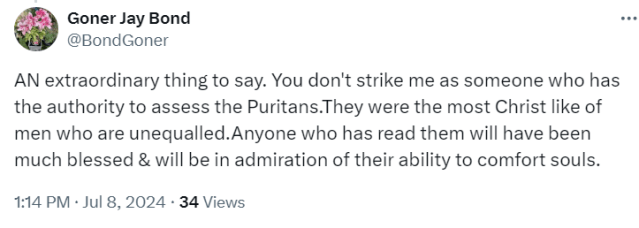
Your comment is an extraordinary thing to say. You don’t strike me as someone who has the authority to assess me or whether or not I have the authority to assess anyone/anything else. You don’t follow me and this is the first time, to my recollection, that we’ve ever interacted, so where did you get the authority you feel gives you the right to assess me?

Your authority to assess me is called into question even further by your lack of reading comprehension skills. My comment was not, by any stretch of the imagination, an assessment of the Puritans or how valuable reading them might be. It was an assessment of people who, despite reading the Puritans (plus the other things I mentioned), lack Christlike character. I would encourage you to go back to my OP and read slowly and carefully for understanding.

Goner’s response was to call me prideful, belligerent, and “arrogance personified”. That’s the type of childish, unsubstantial response you can expect when you point out someone’s hypocrisy and/or that he is wrong about something. Rather than manning up, owning it, and apologizing, he will turn around like an eight year old and call you a doody-head because he knows what you’re saying is right. He doesn’t like that you’re right, and he wants to defend himself, but he hasn’t a leg to stand on, so this is what he’s reduced to. I’m embarrassed for grown adults with jobs and driver’s licenses who act this way. It’s one of the reasons I usually ignore comments like the ones I’m sharing today.


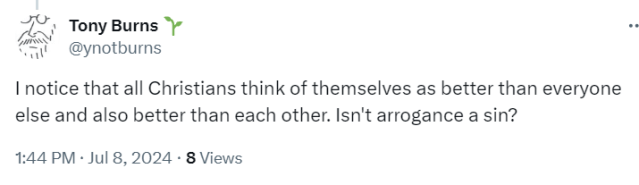
A) You’re assuming facts not in evidence.

B) If “ALL” the Christians you know genuinely think they’re better than everybody else, then you might know some people who claim to be Christians, but you don’t know any who actually are Christians.

However, it’s been my experience that people like you assume Christians think they’re better than everybody else, when, in reality we think nothing of the sort.

What’s actually happening in that situation is that because the Holy Spirit abides in that Christian, you’re feeling Him, in all His holiness, convicting you of your sins so that you can repent and believe the gospel.

You don’t like that feeling, so you deflect it by sublimating your feelings of guilt and conviction into an assumption that that Christian thinks he’s better than you.

This allows you to – arrogantly – feel superior to him, and that feeling of superiority dulls the guilt and conviction you’re feeling, so you feel better.

That is what’s actually happening.

I suspect that’s what’s going on in your heart right now, leading you to make this comment. So, striking while the iron is hot, let me take this opportunity to encourage you to carefully and prayerfully consider the materials and Scriptures here, and repent and believe the gospel.

I haven’t heard back from Tony yet, and maybe I won’t, but unless he actually responds to the conviction of the Holy Spirit in repentance and faith in Christ, my guess is that he’ll respond kind of like Goner did, because…

The natural person does not accept the things of the Spirit of God, for they are folly to him, and he is not able to understand them because they are spiritually discerned.

1 Corinthians 2:14

And at that point, I’m obligated to discontinue the discourse out of obedience to Scripture:

Do not give dogs what is holy, and do not throw your pearls before pigs, lest they trample them underfoot and turn to attack you.

Matthew 7:6

This social media generation (myself included – often) has failed to wisely distinguish between answering a fool according to his folly and the fact that you cannot argue a blind man into seeing. Let’s allow these two passages remind us of that and inform, guard, and guide our interactions online.

If you’d like to follow me on social media (as long as it’s not to argue!), click the Contact and Social Media tab in the blue menu bar at the top of this page.


If you have a question about: a Bible passage, an aspect of theology, a current issue in Christianity, or how to biblically handle a family, life, or church situation, comment below (Iโ€™ll hold all questions in queue {unpublished} for a future edition of The Mailbag) or send me an e-mail or private message. If your question is chosen for publication, your anonymity will be protected.
Answering a Fool, Mailbag

The Mailbag: Answering a Fool #3

Originally published September 2, 2019

Answer a fool according to his folly,
lest he be wise in his own eyes.
Proverbs 26:5

There’s a lot of foolishness masquerading as Christianity these days. Occasionally, I get e-mails and messages showcasing this type of foolishness. It needs to be biblically corrected so these folks can stop “being wise in their own eyes,” repent, and believe and practice the truth of Scripture. From time to time, I’ll be sharing those e-mails in The Mailbag with a biblical corrective, not only so the e-mail writer can be admonished by Scripture, but to provide you with Scriptures and reasoning you can use if you’re ever confronted with this kind of foolishness.


(This reader’s blog comment {in blue},
responding to this article, is reprinted in full.)

You are a liar and devils tool. There is no role for corporate discernment. God doesnโ€™t need you to defend His flock from false teachers, when did God become powerless or when did His flock become unintelligent or indiscernible? How come itโ€™s OKY you who can discern? And just remember the same standard which you use to judge others, God will use to judge you.

Allllllllllrighty then. Let’s break this down.

You are a liar and devils [sic] tool. 

A liar is someone who intentionally deceives other people or says something she knows is not true. I have done neither. If there is something in my article that is incorrect, I assure you it was an innocent and unintentional mistake. If you could kindly specify exactly what you think I have gotten wrong with the evidence or rightly handled Scripture to back up your assertion, I will gladly correct my mistake.

As for being the “devil’s tool,” could you please explain how someone who points out biblical error and points people to the truth of Scripture is being used by the devil? The devil is the one who twists and misuses Scripture in order to lead people into error. Was Jesus the “devil’s tool” when He publicly pointed out and biblically corrected the unscriptural teachings of the scribes and Pharisees? How about PeterPaulJohnJude, and others whom God the Holy Spirit inspired to write the Scriptures that rebuke false teachers and false doctrine? Were these men the “devil’s tool” too?

When you accuse the brethren (me) without biblical cause or evidence, and in the face of Scripture that proves your accusations to be unfounded, what you’re doing is called slander and unbiblical judgment, and you are the one who is being used as a tool of the devil.

There is no role for corporate discernment.

I honestly have no idea what this means. “Corporate” means “a large company or group.” In Christian circles, when we use the term “corporate,” we usually mean the gathering of the church body. I’m an individual, not a group, so I really don’t have a clue as to how this statement applies to me.

Furthermore where does the Bible say or teach this? If you’re going to make a biblical assertion, you need to back it up with rightly handled, in context Scripture. There’s tons of New Testament evidence that God does want the church as a body and individual Christians to practice discernment, but I don’t know which verses to provide you with to refute your point, because I don’t know what your point is.

God doesnโ€™t need you to defend His flock from false teachers,

God doesn’t “need” anybody. He doesn’t “need” you to rebuke me either. Did you consider that before you wrote your comment? Why didn’t you just remain silent and trust Him to convict me of whatever sin you think I’ve committed? Or is it that it’s OK for you to call someone on the carpet for what you perceive to be violations of Scripture, but it’s not OK for me to do so? Hypocrisy, much?

As I clearly stated in the very first paragraph of the article (which I’m assuming you read since you commented on it), people have written to me asking whether or not certain teachers are doctrinally sound. The articles I’ve written are answers to these readers’ questions.

Titus 2:3 says:

Older women likewise are to be reverent in behavior, not slanderers or slaves to much wine. They are to teach what is good,

Teaching women the truth of God’s Word about false teachers, discernment, or any other biblical issue is good. Some other passages you might want to consider:

I appeal to you, brothers, to watch out for those who cause divisions and create obstacles contrary to the doctrine that you have been taught; avoid them. For such persons do not serve our Lord Christ, but their own appetites, and by smooth talk and flattery they deceive the hearts of the naive.
Romans 16:17-18

Here’s Paul, under the inspiration of the Holy Spirit, warning fellow Christians to “watch out for” and “avoid” false teachers. You know what else Paul said? “Imitate me.

Beloved, although I was very eager to write to you about our common salvation, I found it necessary to write appealing to you to contend for the faith that was once for all delivered to the saints. For certain people have crept in unnoticed who long ago were designated for this condemnation, ungodly people, who pervert the grace of our God into sensuality and deny our only Master and Lord, Jesus Christ…save others by snatching them out of the fire;
Jude 3-4,23a

Jude, under the inspiration of the Holy Spirit, exhorts the church to fight for the purity of biblical doctrine and to save those who are vulnerable to false doctrine, “snatching them out of the fire.”

โ€œSo you, son of man, I have made a watchman for the house of Israel. Whenever you hear a word from my mouth, you shall give them warning from me. If I say to the wicked, O wicked one, you shall surely die, and you do not speak to warn the wicked to turn from his way, that wicked person shall die in his iniquity, but his blood I will require at your hand. But if you warn the wicked to turn from his way, and he does not turn from his way, that person shall die in his iniquity, but you will have delivered your soul.
Ezekiel 33:7-9

God commands Ezekiel to warn people away from their sin and says He will hold Ezekiel responsible if he fails to warn them.

But I guess God didn’t “need” Paul or Jude or Ezekiel or any of the people in the congregations they were writing or speaking to or, by extension, Christians today, “to defend His flock from false teachers,” right?

So whoever knows the right thing to do and fails to do it, for him it is sin.
James 4:17

It’s clear from Scripture that warning people away from sin and false doctrine is “the right thing to do.” You’re asking me to stop doing the right thing. It would be a sin for me to stop, and it’s a sin for you to demand that I stop. And now that you know that warning people away from false teachers is the right thing to do, that means if you fail to do so, that’s sin for you.

So the real question here is not, “Why am I warning others about false teachers,” but “Why aren’t you?”.

when did God become powerless or when did His flock become unintelligent or indiscernible?

OK, so following your logic, why does every single book of the New Testament (except Philemon) address the issue of false doctrine or false teachers? Why did God have so many of the Old Testament prophets rebuke the false prophets of their day – false prophets who, much like today’s false teachers, would say “thus saith the Lord” and then tell the people things God had not said, or things that were in direct contradiction to what God had said? Was He so powerless that these New Testament writers had to write books and letters (“blog articles,” if you will) warning against false doctrine and false teachers and these Old Testament prophets had to publicly denounce the false prophets?

When did His flock become unintelligent or undiscerning? Let’s dispense with “unintelligent” because that has nothing to do with being discerning. Some of the most intelligent people in evangelicalism with strings of academic letters behind their names are some of the most undiscerning Christians out there – seminary presidents and professors, denominational heads, CEOs of Christian retail outlets. And there are people who have very little in the way of intelligence or education who are very discerning.

When did God’s people become undiscerning? In Genesis 3, when a serpentine false teacher, “a liar and a tool of the devil,” walked up to Eve, twisted God’s Word and said, “Did God really say…?”. And lack of discernment has been a pervasive problem ever since.

How come itโ€™s OKY [sic] you who can discern? (I think you mean “only”?)

It’s NOT only I who can discern. Praise God, there are lots of Christians out there who are discerning. The people who have written asking me about these false teachers are discerning (because they want help understanding whether or not they’re being taught sound doctrine). There are other writers and teachers doing the good and hard work of teaching discernment. Pastors, elders, deacons, Bible teachers, church members, podcasters, authors, parachurch ministries. They are out there warning fellow Christians against false teachers in their venues just like I am in my venue, and I thank God that they are! I wish every pastor and local church were so diligent about teaching discernment that I wouldn’t have to write discernment articles any more.

But the vast majority of them aren’t. In fact, the vast majority are throwing the doors of the sheep pen wide open to the wolves in sheep’s clothing and welcoming them in. And until that changes, somebody has to warn those vulnerable sheep. Like I said before, why aren’t you helping to warn them?

And just remember the same standard which you use to judge others, God will use to judge you.

The standard I use to biblically judge the observable behavior and teaching of evangelical teachers is Scripture, and that’s the standard God will judge me (and everyone else) by. I am totally OK with that because I am doing my best to be obedient to Scripture, and when I’m disobedient to Scripture I repent.

Can you say the same? What standard do you use for judging me and others? Let’s just put the opening and closing lines of your comment together:

You are a liar and devils tool.
And just remember the same standard which you use to judge others, God will use to judge you.

What standard are you using?

I’d like to leave you with a few passages of Scripture to consider:

“I tell you, on the day of judgment people will give account for every careless word they speak, for by your words you will be justified, and by your words you will be condemned.โ€
Matthew 12:36-37

Judge not, that you be not judged. For with the judgment you pronounce you will be judged, and with the measure you use it will be measured to you. Why do you see the speck that is in your brother’s eye, but do not notice the log that is in your own eye? Or how can you say to your brother, โ€˜Let me take the speck out of your eye,โ€™ when there is the log in your own eye? You hypocrite, first take the log out of your own eye, and then you will see clearly to take the speck out of your brother’s eye.
Matthew 7:1-5

O Lord, who shall sojourn in your tent?
Who shall dwell on your holy hill?
He who walks blamelessly and does what is right
and speaks truth in his heart;
who does not slander with his tongue
and does no evil to his neighbor,
nor takes up a reproach against his friend;
in whose eyes a vile person is despised,
but who honors those who fear the Lord;
who swears to his own hurt and does not change;
who does not put out his money at interest
and does not take a bribe against the innocent.
He who does these things shall never be moved.
Psalm 15


If you have a question about: a Bible passage, an aspect of theology, a current issue in Christianity, or how to biblically handle a family, life, or church situation, comment below (Iโ€™ll hold all questions in queue {unpublished} for a future edition of The Mailbag) or send me an e-mail or private message. If your question is chosen for publication, your anonymity will be protected.
Mailbag

The Mailbag: Potpourri (Doreen’s vision, Bible apps, ESV Women’s Study Bible, Women teaching on Zoom)

Welcome to another โ€œpotpourriโ€ edition ofย The Mailbag, where I give short(er) answers to several questions rather than a long answer to one question. I also like to take the opportunity in these potpourri editions to let new readers know about my comments/e-mail/messages policy. Iโ€™m not able to respond individually to most e-mails and messages, so here are someย helpful hintsย for getting your questions answered more quickly.ย Remember, the search bar (at the very bottom of each page) can be a helpful tool!

In these potpourri editions of The Mailbag, I’d also like to address the three questions I’m most commonly asked:

“Do you know anything about [Christian pastor/teacher/author] or his/her materials? Is he/she doctrinally sound?”

Try these links:ย 
Popular False Teachersย /
ย Recommended Bible Teachersย /ย search bar
Is She a False Teacher? 7 Steps to Figuring It Out on Your Own
(Do keep bringing me names, though. If I get enough questions about a particular teacher, I’ll probably write an article on her.)

“Can you recommend a good women’s Bible study?”

No. Here’s why:
The Mailbag: Can you recommend a good Bible study for women/teens/kids?
The Mailbag: โ€œWe need to stop relying on canned studies,โ€ doesnโ€™t mean, โ€œWe need to rely on doctrinally sound canned studies.โ€.

“You shouldn’t be warning against [popular false teacher] for [X,Y,Z] reason!”

Answering the Opposition- Responses to the Most Frequently Raised Discernment Objections


Just a brief note to all of my readers to kick off this edition of The Mailbag. I really love and appreciate y’all. I don’t say that enough but I do – deeply. One of the things (among many) I appreciate is that upwards of 99.99999999% of you have read my e-mail/messages policy (linked in the first paragraph above) and the information at the Contact & Social Media tab (in the blue menu bar at the top of this page), and you have been extremely understanding and gracious when it comes to my limitations regarding answering individual e-mails/messages. Thank you!

But for the handful of folks out there who haven’t read and followed the directions at those links, may I just gently and lovingly say this: demanding that I answer your e-mail/message immediately, or sending me multiple copies of the same e-mail/message over the course of a few days isn’t going to work for me, or for you. If you have an emergency situation or one that needs an immediate answer, you need to contact your pastor or a mature brother or sister at your church for help.ย  That’s one of the functions of the local church.

I wish I could answer everyone’s questions right away, but as I’ve explained at the aforementioned links (which everyone seeking my e-mail address is asked to read before they e-mail me), I can’t. I get too much mail to be able to do that and have time to properly care for my family, home, and other responsibilities.

Thanks again for your understanding and grace, and keep sending me those e-mails/messages! I love hearing from y’all even if I’m not able to answer you personally.


I have some concerns about Doreen Virtue and the “vision” of Jesus she had that supposedly led her to Christ. I came out of the New Age movement and something just doesnโ€™t โ€œsit rightโ€ with me as a discerning Christian about that. And now, you and other Christians have endorsed her book? Iโ€™m just seeking the truth as I do with every other subject I research.

Seeking the truth and doing your research is awesome! That’s just the kind of thing I love to hear from my readers!

The thing about doing research is that you have to consider the source and make sure the sources you go to are reliable, trustworthy, and handle Scripture correctly. I’m sorry to say that many of the online “discernment” resources out there (including the ones you mentioned in your e-mail, but others as well) are not. Many of them exhibit zeal without knowledge, and some exhibit knowledge without love. (I know I have crossed these lines at times, myself, which I am sorry for. God is still working on me and growing me in that area.)

You and other discerning readers have surely noted the signs of these types of “ministries”: attacking doctrinally sound pastors and teachers, speaking/writing in a vicious, enraged, or biting tone, failing to provide in context and rightly handled evidence to support their assertions, reporting their opinions as fact, exaggerating or extrapolating from something a teacher said or did in order to make their case, and so on. It is just as much a part of discernment to examine “discernment” ministries as it is to examine the teachers they are critiquing.

Having never heard of her before, I first “met” Doreen Virtue when she and her co-host Melissa asked me to appear on their YouTube podcast to discuss the role of women in the church. Doreen and I kept in touch afterwards and have become good friends.

Doreen has thoroughly explained the issue you mentioned in her videos, her book, and to me and many others personally. As Doreen was coming out of the New Age movement and turning toward Christ, she had some sort of experience which she believed at the time was a vision of Jesus. She said at the time that this vision turned her further toward Christ.

As Doreen has continued to growย  she has progressively come to a biblical understanding of her experience, and now believes the vision was demonic activity that happened before she actually got saved. She does not believe she was saved by this vision, but by the preaching, teaching, and reading of the Word. Doreen hasn’t had any more experiences like this since she’s been saved, and she certainly doesn’t encourage this type of experience – quite the opposite, in fact. She speaks against it. As I’ve listened to Doreen’s videos, read her personal testimony in her book, and chatted with her privately, I can see how God has grown her in holiness and sound doctrine in the short time she’s been saved, as evidenced by the fruit she displays.

Have we forgotten how far God has brought us in holiness and the knowledge of the Word since we have been saved? Haven’t we all repented over dumb or unbiblical things we used to believe when we were unsaved or new Christians that we now look back on in shame? Why wouldn’t God do the same thing for Doreen? I mean, let’s remember that she was totally immersed in a demonic system her entire life until Christ saved her in her 50’s, and she has only been saved less than three years now. It’s completely understandable that God would have to undo all of that as He grows her. Where is our mercy, grace, and patience for babes in Christ?

If you feel confused regarding conflicting information about Doreen, I would encourage you not to listen to what others are saying about her (even me) and go straight to the horse’s mouth: watch Doreen’s videos – including her most recent concerning the “vision”: Unpacking Doreen’s vision with Pastor Chris Rosebrough of Fighting for the Faith – read her wonderful book, Deceived No More (which I was honored to write an endorsement for and highly recommend, and which she has already edited to clarify the part about the vision), follow her on Instagram or Facebook, and let her speak for herself. And if you make a good faith effort to do all of that and you still have a question, message her and ask.

If you’re honest, objective, and compare what Doreen says and does with rightly handled Scripture, I think you’ll find your answers.


I am a new Christian and am wondering if you know of a good Bible app? I have been using YouVersion, but today’s video featured Joyce Meyer, and I am unsure how I feel about it.ย 

Great question – and welcome to the family!

Readers, this is one of the reasons I recommend against YouVersion. You may recall from a previous Mailbag article that I explained that YouVersion was developed, and is maintained, by Craig Groeschel’s Life.Church. He has preached at Joyce Meyer’s women’s conference and is immersed in relationships and ministry partnerships with numerous other false teachers.

For Bible app recommendations, check out my article My Favorite Bible & Study Apps.ย 


Would you recommend the ESV Women’s Study Bible? Some of the contributors are Jen Wilkin, Lauren Chandler, Ann Voskamp, Trillia Newbell, and Kristyn Getty.

I’m so glad you asked and brought this to my attention. I have been seeing the ads for that Bible, but I didn’t realize all of those people were contributors. I attempted to find a list of all of the contributors, but was unable to do so. So just going on these, I would say, no, I can’t recommend the ESV Women’s Study Bible.

In addition to the problems with Lauren Chandler, there are issues with Jen Wilkin, and Ann Voskamp is flat out a mystical false teacher.

I haven’t thoroughly researched Trillia Newbell, but just from seeing a few of her tweets from time to time on Twitter, I’m concerned that she might be leaning toward the woke/social justice movement. She’s also friendly with and supportive of Beth Moore (once tweeting “I thank God for you, too!” to Beth), Priscilla Shirer (here, here), and possibly other biblically problematic teachers, so, at the very least, there are a few red flags.

I’d recommend you invest in a much better study Bible, like the MacArthur Study Bible. You can also get the Faithlife Study Bible app for free. I use both of those regularly and they’re both very good.


Love the clarity of your writing! I am curious how you apply commands against women holding authority and teaching to online situations. Is it also sinful for a woman to teach Scripture over YouTube or Zoom? This seems to be a huge issue right now. Thanks!ย 

Super question, and thanks!

The reason this is a huge issue right now is that many churches have temporarily begun moving many of their regular “in person” activities to livestream, YouTube, Zoom, Skype, etc., due to COVID restrictions that prevent members from gathering together easily. Likewise, many Christian conferences have had to move to video because of gathering restrictions and difficulties.

All of that being the case, we need to follow the biblical principles we would be following if we were meeting face to face. A woman should not be preaching the Sunday sermon for your church just because it’s going to be on Facebook Live instead of people gathering face to face in the sanctuary. I’m not going to teach my co-ed Sunday School class just because we’re “meeting” together on Zoom instead of in our Sunday School room. A Christian conference should not have women preaching the main sessions if those sessions would be co-ed if the attendees were all in the room together.

If it is not something that would normally be a violation of Scripture, in the face to face gathering of the church – for example: a woman speaking at a women’s conference that had to be moved online, or a woman teaching a children’s Bible class on Zoom – then it’s perfectly fine to do it online.

Readers, in case we’re tempted, let’s be sure we all keep in mind here that the goal in Christianity is not to see how close to the line of sin we can get without accidentally putting a toe over, or to find some loophole in God’s Word that lets us do what we want. The goal is to get as far away from the line of sin as possible, and to look – not for loopholes – but for ways we can better obey Christ.


If you have a question about: a Bible passage, an aspect of theology, a current issue in Christianity, or how to biblically handle a family, life, or church situation, comment below (Iโ€™ll hold all questions in queue {unpublished} for a future edition of The Mailbag) or send me anย e-mail or private message. If your question is chosen for publication, your anonymity will be protected.