Mailbag

The Mailbag: My husband wants to stay at an unbiblical church.

There are unbiblical things happening in my church. I want to leave and find a better church. My husband wants to stay. Do I submit to him and stay at this church or go against his wishes and find another church to join by myself?

I receive some variation of this question several times a year, which absolutely breaks my heart. Normal, everyday disagreements in marriage are hard enough, but when it’s something this important that involves such a huge part of your life, it can be excruciating.

It’s also an impossible question for me to answer a) since I’m so far removed from the situation, and b) because every situation is different. All I can do is ask some questions and provide some resources that may help as you make your decision.

◊ Is the issue at your church actually unbiblical? Just because you don’t like something (the genre of music, that women wear pants to this church, that there are/aren’t age-segregated activities, etc.) doesn’t necessarily mean it’s unbiblical. Search the Scriptures. Is what is happening at your church clearly violating a chapter and verse, rightly handled, in context passage of Scripture?

◊ Are you fairly certain your husband is saved? Does he usually make godly decisions as he leads your family? The answers to these questions may give you some insight into your husband’s perspective on this church and help you understand his side of things better.

◊ Is this a “We must obey God rather than men” situation? Carefully examine that passage. Scripture has always been clear that we are to obey those in authority over us, and the apostles knew it. The only reason they disobeyed the authorities is because the authorities commanded them to do something that clearly conflicted with God’s Word. Is that the situation you’re in at this church? If not, Scripture is clear that you’re to submit to your husband.

◊ Don’t underestimate how greatly your submission could impact your husband. Scripture says it can make such an impression that God can even use it as a tool to draw unsaved husbands to Himself for salvation. If submission can soften an unsaved man’s heart toward salvation, perhaps it could soften your husband’s heart toward finding a better church.

◊ Is it possible that in obeying God’s instruction to submit to your husband in this circumstance God is keeping you in this church in order to give you an opportunity to serve Him by bringing biblical truth to bear on the unbiblical situation (in a godly way, of course)? Sometimes the solution to a problem at church is not to cut and run, but to roll up your sleeves and get to work.

◊ Submitting to your husband doesn’t mean you can’t pray for him and the situation at church. You should definitely be praying that your husband is making the right decision and that God will change his heart and mind if not. You should also be praying that you would have the right heart in this situation, praying for your children if they are also in the church, and praying that God would change the situation at church. Pray fervently about everything.

◊ Have you and your husband actually sat down and talked this through? If not, set aside some uninterrupted time in a pleasant environment, and carefully, prayerfully, and objectively (no histrionics) explain – citing clear Scripture – what is bothering you about the church. And then listen to what your husband has to say in response. If he is anything like my husband, he’ll probably bring up at least one good point you hadn’t thought about, but need to.

◊ Would it be helpful to bring in a third party to bounce the situation off of? Maybe a pastor friend you both trust, a spiritually mature couple you’re friends with, your parents or in laws, even a biblical counselor? Sometimes a fresh, objective set of eyes and ears can help.

◊ Is there a solution you and your husband can work out besides the two options of you staying or leaving? Do some brainstorming. Is the unbiblical situation at your church self-contained enough that you could arrange your attendance habits in order to avoid it? (For example: The women’s ministry only offers classes using materials by false teachers. Solution: You don’t have to attend those classes. Or, you could volunteer to teach a class that studies a book of the Bible. The “contemporary” service at your church uses Bethel and Hillsong music. Solution: Maybe your husband would compromise and go to the “traditional” service with you that only uses hymns.) Maybe your husband works a lot of Sundays and would be OK with you going to another church on those Sundays. Perhaps the two of you could reach a compromise of going to the doctrinally sound church you like every other Sunday, and the old church the rest of the time. What about a trade off? “If you’ll switch to this new church for me, I’ll do ____ for you.” Think outside the box, ask God for wisdom, discuss it with your husband, and see what you can come up with.

◊ Keep the perspective that God is using this situation in your life (your husband’s too) for his glory and your good. Maybe God will use this situation to grow your trust in Him, to strengthen your prayer life, to give you more practice in submitting to your husband, or to train you in the Scriptures. Whatever His purposes, He is doing it for a good reason. He loves you. He hasn’t forgotten you. He hasn’t abandoned you. He’ll bring you through this.

Conflict over church can be rough on a marriage, and the solution is not always easy. Pray without ceasing, obey God’s Wordseek godly counsel, and trust God to lead you.


If you have a question about: a Bible passage, an aspect of theology, a current issue in Christianity, or how to biblically handle a family, life, or church situation, comment below (I’ll hold all questions in queue {unpublished} for a future edition of The Mailbag) or send me an e-mail or private message. If your question is chosen for publication, your anonymity will be protected.

Basic Training, Bible Study, Sermons

Basic Training: Bible Studies and Sermons

For more in the Basic Training series, click here.

When I started the Basic Training series, I thought I’d be writing about foundational theological concepts and practices in Christianity. You know, like baptism or the sufficiency of Scripture. It never occurred to me that I might someday need to explain something so basic that most lost people could define it as well as (sometimes better than) many professed Christian leaders.

But the more “Bible” studies and sermons I take in, the more I think a remedial course in exactly what those things are supposed to consist of might be very beneficial to the church at large, and an unfortunate necessity for many pastors, teachers, and Christian celebrities.

I could be way off base here, but I’d almost bet that if you went up to ten random people on the street and asked them what a Bible study class is supposed to do, at least nine out of ten of them would answer, “Study the Bible.” If you asked those same people what a sermon is, you might get more varied answers, “It’s when the preacher explains what the Bible says,” or “It’s a pastor telling you how to be a good person,” (remember these are random, probably unsaved, people) or “A sermon tells you about God.” But I’m guessing none of them would answer, “It’s when a preacher gives a stand up comedy routine,” or “A sermon is mostly stories about the preacher, his family, and other people,” or “A sermon is when you watch a movie and then the preacher adds a few remarks at the end about what you can learn about God or life from the movie.”

Yet, that’s pretty much where way too many churches are these days.

So let’s take a look at what Bible studies and sermons are and aren’t supposed to be.

It’s All About The Bible

This is supposed to be a “duh” moment for Christians, pastors, teachers, and churches. If someone is teaching a Bible study or a pastor is preaching a sermon, the first thing he should reach for is his Bible. He is to be preaching or teaching God’s written Word. It’s right there in black and white in 2 Timothy 4:1-2:

I charge you in the presence of God and of Christ Jesus, who is to judge the living and the dead, and by his appearing and his kingdom: preach the word; be ready in season and out of season; reprove, rebuke, and exhort, with complete patience and teaching.

That’s a very solemn and weighty charge to pastors. In today’s vernacular, it’s almost like placing your right hand on the Bible, raising your right hand, and saying, “As God is my witness, I swear to God I will ______.” (and actually understanding the gravity of that and meaning it). God is witnessing this charge to you pastor – you’d better take seriously your duty to preach His Word.

And notice, there are only two times when a pastor is supposed to preach the Word: in season and out of season. When his people want to hear it and when they don’t. When he feels like it and when he doesn’t. When he’ll be persecuted and when he won’t. When it’s easy and when it’s hard. When it’s a pleasant, encouraging passage, and when it’s a passage that offends people. Pastors, and, by extension teachers, are to preach and teach the written Word of God in every sermon and teaching opportunity. Always.

It’s Not About the Preacher/Teacher/Author

There are a lot of awesome pastors, teachers, and authors out there who labor faithfully to rightly teach God’s Word to His people. I am unspeakably grateful to them and for them.

But let’s face it, there are also a lot of narcissistic gas bags out there who use the pulpit and the pages to pump up their already over-inflated egos by endlessly blathering on and on about themselves, their families, their friends, and their experiences. You can tell by the ratio of personal stories to Scripture who they love best and are most interested in.

I’ve read books and heard sermons that I walked away from thinking, “I know more about that pastor or author, his family, his trips, the charity work he does, and who his important friends are than I do about God and His Word.” (I’ll tell you this, he’s received his reward.)

Pastors, teachers, authors aren’t to preach themselves, they’re to preach the Word.

It’s Not About Gimmicks and Entertainment

A sermon series based on movies. A pastor riding a motorcycle into church. Ziplining during the sermon. Rock concerts and light shows. Raffles and giveaways of cars and other big ticket items. The pastor and his wife promoting a sermon series on sex. On the news. From a bed. On the roof of the church.

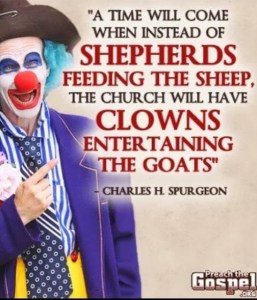
Pastors and teachers aren’t charged to entertain people or get them in the doors of the church and keep them there by any means necessary. Pastors and teachers are charged – with God as their witness – to faithfully preach and teach His written Word. Jesus said shepherds who love Him will feed His sheep, not entertain them.

Newsflash – the world isn’t going to find that interesting enough to get out of bed for on Sunday morning. Newsflash – That’s fine. The gathering of the church isn’t for the world. The gathering of the church is for the church – the people who have been saved out of the world and into the body of Christ – to give them an opportunity to worship the Savior they love with their brothers and sisters, to disciple them in God’s Word, and to equip them with God’s Word to go out and share the gospel with the world.

It’s Not About You, Either

The flip side of “it’s all about the Bible” is, it’s not about you. What does that mean? The sermon or the Bible study lesson should not teach us to look down in narcissistic navel-gazing, it should teach us to look up at God, who He is, what He has done, and what He says in His written Word.

Over the years, I’ve had the discouraging duty of reviewing various women’s “Bible” studies. Though some have been better than others, the theme running through the majority of them is “it’s all about you” – your feelings, your hurts, your ego, your opinions, your personal experiences. It’s evident in the way authors insert long stories about their own lives and base their ideas, agendas, and assertions on those personal experiences rather than on Scripture. It’s evident in the questions the reader is supposed to answer at the end of each lesson: “Have you ever experienced _____?” “How does ____ make you feel?” “If you could ____, how would you do it?” “What do you think others’ opinion of you is?”

Good Bible studies give you rightly handled, in context Scripture until it’s coming out of your ears, and then they ask questions like, “What are the attributes of God listed in this passage?” “Verse 3 talks about lying. What are some other verses that talk about lying, and how can we tell from these verses how God views lying and why?” “How does this passage point us to Christ?”

Is there a need for introspection during Bible studies and sermons? Sometimes. But the focus is not you and your feelings and experiences. The focus is on reflecting on the glory of God in the passage you’ve just heard, repenting of the sin the passage you’ve just read has convicted you about, obeying the command in the passage you’ve just heard, and things like that. It’s Bible-focused, driven, and governed, not me-focused, driven, and governed.

Context, Context, Context

It’s not just important to preach and teach the Bible, it’s important to handle the text of the Bible correctly and in context.

You’ve probably heard the old joke about the guy who wants God to tell him what he should do with his life. So he opens up the Bible to a random spot, closes his eyes, puts his finger down on the page, and looks at the verse he’s pointing at. It’s a New Testament verse: “Judas went and hanged himself.” “Hmm,” he thinks, “that doesn’t make much sense.” He shuts his Bible and tries the process again. This time, it’s an Old Testament verse, “Go and do thou likewise.”

We laugh at the silliness of this little story, but it hits frighteningly close to home for far too many pastors and teachers.

Perhaps you’ve read a devotional that quotes a Bible verse (or maybe even just part of a verse) at the top of the page. The author then goes on to teach on that verse or tell a personal story. When you look up the verse and read a little more of the chapter it’s in, you discover it has nothing to do with the author’s story or doesn’t mean what the author was teaching.

Or maybe you’ve sat in a church service where the pastor reads a verse or two at the beginning of the sermon and then basically closes his Bible and shares personal thoughts and stories for the rest of the sermon time that have nothing to do with the verses he read at the beginning. Or a sermon in which the pastor hopscotches all over the Bible (often using a myriad of translations) reading a verse here, half a verse there, in an effort to prove his homespun thesis or support the agenda he’s crafted.

Yes, technically, there’s Bible in all of those teachings, but none of those methods handle Scripture properly or in context. That’s called eisegesis, and it basically means reading your own ideas into the text of Scripture, or twisting Scripture to get it to say what you want it to mean.

The proper method of teaching Scripture is exegesis. Exegesis is taking a passage of Scripture in context, and “leading out” of it- teaching what the passage means. That’s nearly always going to require reading several verses from the passage to catch the reader or listener up on what’s going on in the story she’s just parachuted into.

Good pastors and teachers read and teach the biblical text in an organized way. When you sit down to study, say, a history book, you start at the beginning of the book and you work your way through to the end. You don’t start by reading two paragraphs out of the middle of chapter 7, then move on to the last three sentences of chapter 49, then the first half of chapter 1. That’s how people preach, teach, and “study” the Bible sometimes, and it’s just as crazy to read the Bible that way as it would be to study a history book, or math book, or science book that way, or even to read a novel or a magazine using that helter-skelter method.

Expository vs. Topical

This section is a brief, modified excerpt from my article The Mailbag: Expository or Topical Preaching: Which is better?.

For readers who might not be familiar with the terms, expository preaching and teaching is basically when a pastor preaches (or a teacher teaches) through books of the Bible from beginning to end carefully explaining what each passage means. (Ezra is an example of an expository Bible study.)

Topical preaching can have a couple of different meanings depending on who you’re talking to and what she understands the term to mean. Some people understand “topical preaching” to mean a sermon series, usually in a seeker driven church, that centers around something in pop culture. (For example, popular movies or the Olympics.) Normally, these sermons are very shallow, biblically – sometimes nothing more than a pep talk or self-help tips. This type of preaching and teaching is unbiblical, and if it makes up the bulk of the teaching at your church, I’d recommend finding a new church.

There is, however, a biblical form of topical preaching and teaching that can be very helpful, occasionally. If a doctrinally sound pastor sees an issue in the church that needs to be addressed, or a biblical topic to explore, there is nothing wrong with his taking a break from preaching through a certain book (or when he’s between books) to teach on this issue from the pulpit. (Imperishable Beauty: A Study of Biblical Womanhood is an example of a biblical, topical Bible study.)

In my opinion, the majority of a pastor’s preaching and a Bible study’s teaching should be expository with occasional breaks for (biblical) topical preaching and teaching as needed. There are a variety of reasons for this (more in the linked article):

• Expository preaching models for the congregation the proper, systematic way they should study the Bible at home.

• Expository preaching helps a pastor better preach the whole counsel of God.

• Expository preaching pushes pastors to tackle hard and unfamiliar passages as they come up in the text.

• Expository preaching should keep the Old Testament and certain books of the Bible from being neglected as much as they usually are.

• Expository preaching gives the congregation a better grip on the overall story arc of the Bible and the culture of the period being studied.

Expository and topical preaching are both helpful in their own ways, but the most important thing is that the pastor is “rightly handling the word of truth.”


There’s a lot of lousy preaching and teaching out there these days, but if you’ll look for good, solid biblical preaching and teaching (check the Recommended Bible Teachers and Bible Studies tabs above for ideas) God can use it mightily in your spiritual life to grow you to greater Christlikeness.

Mailbag

The Mailbag: Potpourri (Todd Friel on Rick Warren, Enneagram, Should I stay or should I go?…)

Welcome to another “potpourri” edition of The Mailbag, where I give short(er) answers to several questions rather than a long answer to one question. I also like to take the opportunity in these potpourri editions to let new readers know about my comments/e-mail/messages policy. I’m not able to respond individually to most e-mails and messages, so here are some helpful hints for getting your questions answered more quickly. Remember, the search bar can be a helpful tool!


Do you have any thoughts on Todd Friel’s latest comment that Rick Warren is not a heretic?

Yes, I’m a faithful listener of Wretched Radio, and I did hear that episode. (You can listen to the specific remarks this reader is referencing here starting around the 5:25 mark.)

I’d like to start by saying that I don’t speak for Todd, so if this is of great concern to you, I would recommend contacting Todd directly and getting a “straight from the horse’s mouth” response from him.

The following is what I understood Todd’s remarks to mean:

I believe Todd was using a more classical theological definition of heresy used by many pastors and theologians (and which I agree with), which a lot of people are unaware of these days because the term “heresy” is tossed about so haphazardly (I’m sure I’ve been guilty of it myself). In this definition, real heresy is narrowly focused. It has only to do with the basic doctrines of salvation. In other words, the things you have to believe to be a Christian, and the things you can’t believe to be a Christian.

For example, T.D. Jakes is a heretic for two reasons: a) he is a modalist, a classic heresy which denies the biblical nature of the Trinity, and b) he preaches Word of Faith heresy – “another gospel” as described in Galatians 1:6-9.

Rick Warren, on the other hand, is someone I would categorize as a “false teacher” (again, I cannot speak for Todd, so I don’t know if he would use that label, but I think he would agree with the remainder of this paragraph). He says and does a lot of unbiblical things which he needs to stop and repent of, and nobody should be following him, but he does not preach or claim to believe anything (to my knowledge anyway) that goes against the basic doctrines of salvation. If you sat him down and talked to him, he would affirm the biblical doctrine of the Trinity, the deity of Christ, that Christ is the only way of salvation, etc.

I think the confusion is that the classical definition of heresy differentiates between true heretics and false teachers, but many Christians don’t seem to understand that because the terms “heretic” and “false teacher” are often used interchangeably. This is a definitional thing. Todd is not saying Rick Warren is a doctrinally sound pastor you should be following. He’s made that abundantly clear on a number of occasions.


My friend Samuel had a great question on Twitter recently:

This testimony is true. Therefore rebuke them sharply, that they may be sound in the faith,
Titus 1:13

It’s a great passage with a lot to consider. My thoughts:

1. Look at the rest of 13: “that they may be sound in the faith”. That’s the goal of the sharp rebuke- to bring them out of false doctrine and restore them to sound doctrine. That goal is what should inform the “sharpness” of the rebuke as well as the tone.

2. I think the “sharpness” has more to do with the urgency and immovability of the content of the message you’re conveying, and gentleness, kindness, etc., have more to do with the way (tone) in which you convey it.

3. Notice the word “For” at the beginning of v. 10. It draws our attention back to v. 5-9, the qualifications for elders. In other words, “Elders need to have these qualities (5-9) because of the need to silence and sharply rebuke these false teachers (10-16).” Verses 7-8 call for an elder not to be “arrogant…quick-tempered…violent…but…self-controlled, upright, holy, and disciplined.” Those qualities should govern how an elder gives a sharp rebuke.

4. I totally agree [I think someone else in the Twitter discussion mentioned this] that we should follow Christ’s example in Matthew 23, but we need to keep in mind that a culturally appropriate sharp rebuke in the first century Middle East might not be exactly the same as a culturally appropriate sharp rebuke in 21st century America. We convey the same message, but in a different way.


What is an Enneagram? A church in my area is offering a Bible study on it. Is it biblical?

The Enneagram is basically a tool that purports to help you discover which of nine fundamental personality types you are in order to maximize your strengths and grow in areas in which you are weak.

Is it biblical? There are a lot of different opinions and information out there, so it depends on who you ask. Some would say it’s merely a tool that helps identify less Christlike areas of your personality so you can be aware of, and strive to be more obedient in, those areas of weakness. Others grab on to the Enneagram and dive headfirst into the New Age mysticism that seems to be lurking in all its nooks and crannies.

I would just ask – have you ever read a passage of Scripture that says we need to analyze our personalities – using any tool, for any reason? No, you haven’t. And that’s the main reason I would say you don’t need the Enneagram or any other personality evaluation tool. Just like Christians for the past 2000 years haven’t needed them.

God gives us everything we need for life and godliness in the Bible. Do you tend to be too much of a people pleaser? That’s called fear of man. It’s in the Bible. Too harsh with others? You’re being unkind. It’s in the Bible. Struggle with anxiety? You’re not trusting God. It’s in the Bible.

A lot of people don’t want to hear this again and again because it’s not shiny and new, popular and fun like the Enneagram, personality tests, or internet quizzes (plus it takes longer and involves hard, spiritual work), but we don’t need to be looking for the latest evangelical fad to microwave us into spiritual maturity. We need the slow, deep, plodding work of studying our Bibles, sitting under good preaching and teaching at church, being discipled by older, wiser brothers and sisters in Christ, praying for wisdom, and repenting of sin.

If I were considering using the Enneagram, here’s what I would ask myself:

Why would I rather use the Enneagram – which isn’t mentioned or suggested anywhere in Scripture and has some sketchy spiritual elements to it – than use the methods (prayer, Bible study, discipleship, etc.) I know God has prescribed in Scripture?

For more information on the Enneagram here are some good resources:

Enneagram at Berean Research

Christian Answers for the New Age (Marcia posts great information on her Facebook page. You may have to scroll a bit or ask her to find the specific topic you’re looking for. Here’s something on the Enneagram I happened to find near the top of her feed today.)

Girl What’s Your Number? The Enneagram Episode at Sheologians

The New Age & Quack Spirituality Origins of the Enneagram with Marcia Montenegro and Steve Kozar


Can you recommend a good resource on _____ [a very specific relationship issue]?

There are a lot of wonderful books and other materials out there that can help us deal with certain relational issues, and when I’m aware of those resources I try to recommend them if I think they would help. I am all for reading and learning from helpful, doctrinally sound materials.

But the more specific and interpersonal the issue is, the less helpful resources are, because those resources are general by nature and can’t address every conceivable scenario, including yours. Sometimes you don’t need to read a book, you need to have a conversation with the other person(s) involved in the issue.

For example, if Sally is constantly gossiping about you to other people at church, you don’t need to read a book on gossip or relationships between church members. You need to go to Sally and ask why she’s saying these things. You might need to set the record straight about your behavior that she’s gossiping about. You might have received a false report that she’s gossiping about you. You might need to rebuke her and proceed to the next step of church discipline. But you won’t know any of those things unless you sit down and talk to her. And you’re not going to find those answers in a book.

In other situations, getting the wise counsel of a godly older sister in your church, or setting up an appointment with your pastor for counseling can be much more helpful than simply reading a book. These people know you and care about you. They’re available to help you and answer your questions. They can walk through the changing ups and downs of the situation with you over time. You can’t get all of that from a book.

Materials and resources are great and can be very helpful, but not in every situation.


I still meet with my ladies Bible study group, but they continue to choose very questionable material. Teachers that you have warned against as false and I agree with you. I have voiced my concerns to them over and over and at this point I am just starting to sound like a broken record. My question is, do I still participate and try my level best to help them discern or do I just leave the group?

In my article The Mailbag: Should I attend the “Bible” study to correct false doctrine? I addressed the question, “Should I attend a study using a false teacher’s materials in order to correct false doctrine, or should I decline to attend the study due to the unbiblical materials they’re using?”

Either option can be perfectly biblical depending on the situation and the people involved. This reader chose to go the former route, which brings up an additional question: If I join this group and they continue to teach false doctrine via materials by false teachers despite my correction, how long do I hang in there and continue to correct?

Since every situation is different, I can’t give a hard and fast answer to that. I would reiterate the counsel I gave in the previous article about praying for wisdom and discussing it with your husband and your pastor. If, in these discussions, you and your husband decide that, in addition to the women’s group, there are sufficient biblical reasons to look for another church, you may want to hang in there until you move to a new church.

If you decide to leave the group, another natural time to make the break would be when they finish the book they’re currently using and before they begin a new book.

If the question is less, “When should I leave?” and more, “Is it biblical to leave the group when it’s obvious they aren’t going to listen to biblical rebuke and sound doctrine?” the answer is yes, and practically the whole Bible is precedent for this.

Think back over the Scriptures. What is the Bible’s general posture and response to people – particularly God’s people – who have been repeatedly warned about their sin or presented with biblical truth, and choose to continue in that sin or ignore that truth (as this group seems to be acting toward the reader)?

Think about God’s repeated warnings to Old Testament Israel about their sins of idolatry and syncretism (which are basically what importing false doctrine into a church is). Even God didn’t hang in there continuing to warn them forever. What was His eventual response to them? He used pagan nations to conquer them and send them into exile.

Passages like these also help us see the New Testament’s take on moving on when sound doctrine is rejected:

As for a person who stirs up division, after warning him once and then twice, have nothing more to do with him, knowing that such a person is warped and sinful; he is self-condemned.
Titus 3:10-11 (For more on false doctrine as “division”, see Romans 16:17-18, Jude 18-19.)

And if any place will not receive you and they will not listen to you, when you leave, shake off the dust that is on your feet as a testimony against them.
Mark 6:11 (see verses 7-13 for context)

Do not give dogs what is holy, and do not throw your pearls before pigs, lest they trample them underfoot and turn to attack you.
Matthew 7:6

Do you have scriptural grounds to leave if a group rejects biblical correction of their false doctrine? Yes. When should you leave? You’ll have to ask God to give you the wisdom to decide.


If you have a question about: a Bible passage, an aspect of theology, a current issue in Christianity, or how to biblically handle a family, life, or church situation, comment below (I’ll hold all questions in queue {unpublished} for a future edition of The Mailbag) or send me an e-mail or private message. If your question is chosen for publication, your anonymity will be protected.

Favorite Finds

Favorite Finds ~ January 14, 2019

Here are a few of my favorite recent online finds…

It’s a few years old, but this excellent episode of the Issues, Etc. radio show: This Week in Pop-American Christianity: Priscilla Shirer on Hearing the Voice of God recently came across my news feed. Many false teachers (in this case, Priscilla Shirer) twist or misunderstand John 10 to mean that, if you’re a Christian, God will speak to you audibly. That’s not what it means, as anyone who takes the time to read the passage in context can attest. Pastor and podcaster Chris Rosebrough explains simply, carefully, and biblically, why this teaching is wrong and what John 10 actually means.

 

“I get dozens of emails each month from parents whose teens are leaving the church or being swept away by a false version of Jesus and the gospel…In this list I’ve compiled ten critical topics for the modern teen.” Great for youth directors and parents of teens, but the adults in your church probably need to read this too. Check out Ten Theological Topics for Parents of Modern Teens by our friend Costi Hinn on his blog, For the Gospel.

 

Pornography is usually addressed as a “men’s problem”, but, increasingly, women are succumbing to this insidious temptation. Stephanie offers pastors three suggestions (these would be helpful for anyone) for counseling and discipling women who participate in the sin of pornography in her 9Marks article Helping Women Who Struggle with Pornography.

 

Thoroughly and knowledgeably written by Denny Burk (head of CBMW), What Does It Mean That Women Should “Remain Quiet” in Church? (1 Timothy 2) from Crossway is one of the best commentaries I’ve ever read on 1 Timothy 2:11-14. I’ve added it as a resource to my own article on that passage: Rock Your Role: Jill in the Pulpit.
 

Fasting mirrors the hunger we should have for Christ. Do Christians Fast Because Food and Drink Are Bad? from Crossway explains more.

Christmas, Church

The 25 Churches of Christmas – Final Report

Friends, thank you so much for your recommendations!

Unfortunately, we did not reach the goal of 25 churches (meeting the parameters outlined in the article below) by Christmas, but with your help, we did get 14, and I was able to remove 8 states – Oklahoma, Maryland, Iowa, New York, Wisconsin, Massachusetts, Delaware, and Connecticut – from the “endangered species list” (states with 2 or fewer recommendations). The 14 Churches of Christmas were: 

1. Village Church, Dingley, Australia
2. Christ Reformed Church, Tulsa, OK
2. Fellowship Baptist Church, Saskatoon, Saskatchewan, Canada
4. Harvest Reformed Church, Minot, ND
5. Hope Bible Church, Columbia, MD
6. Baltimore Bible Church, Baltimore, MD
7. Walsh Baptist Church, Walsh, Ontario, Canada
8. Missio Church, Ridge NY
9. Rock of Hope Church, Wisconsin Dells, WI
10. Grace Life Church of Greater Des Moines, Ankeny, IA
11. Calvary Bible Church, Westport, MA
12. Faith Fellowship Baptist Church, Brandon, Manitoba, Canada
13. Berean Community Church, Milford, DE
14. Presbyterian Church of Coventry, Coventry, CT

I’m looking forward to adding many more recommendations of doctrinally sound churches in 2019, so keep those recommendations coming!

This Christmas season, I’d like to offer you an opportunity to help me give our brothers and sisters in Christ a gift – a gift that won’t cost you a dime.

If you’ve followed me for a minute, you know I’m passionate about helping people find doctrinally sound churches to join. And if you’ve ever perused my list of Reader Recommended Churches, you’ve probably noticed that we have tons of listings for churches in some states, only one or two for others, and hardly any for countries outside the U.S.

What I’m hoping to do is add 25 doctrinally sound churches to the list in the states and countries that are lacking. Of course anyone is welcome to recommend a church anywhere, but in order for it to “count” toward The 25 Churches of Christmas, it needs to be a recommendation for a church:

⛪️ in one of our U.S. states that has two or fewer recommendations (currently: Alaska, New Hampshire, North Dakota, Rhode Island, West Virginia)

OR

⛪️ a church in any country besides the U.S.

I’ve made the list, you check it twice. If recommendations are naught, be nice and make one! :0) If you have a personal connection to a solid church that’s not on the list, comment below with:

🎄The full, correctly spelled name of the church
🎄The city and state, or city and country it’s located in
🎄The church’s website (please, please, please include this – it saves me a lot of time).

Think we can add 25 churches by Christmas Day? Let’s give it a shot and make it a merry Christmas for our brothers and sisters who are searching for a new church! Thanks for your help! :0)