Church, Complementarianism, Worship

Throwback Thursday ~ Six Questions for a Potential Church

Originally published March 27, 2015
church questions1

Have you ever had to look for a new church? Even with recommendations from godly friends, it can be hard to know which churches and pastors are doctrinally sound, and, of those doctrinally sound churches (because you certainly don’t want to go to one that isn’t doctrinally sound), which ones would be a good fit for your family.

There are lots of great articles out there with good, probing questions you should ask about the theology and doctrine of a church you’re considering. (I would recommend this one, this one, and this one. Also, make sure you understand these doctrinal issues and that the church you’re considering lines up with Scripture on these issues.) However, there are times when the answers to these types of questions don’t give you the whole picture of what is actually going on in a church on a day to day basis. In other words, sorry to say, a church can give you all the right answers on paper (or on their web site), but their practices don’t mirror those answers. Additionally, there are some non-doctrinal issues that are important to know about that questions about soteriology, baptism, biblical inerrancy, etc., won’t give you the answers to.

My husband and I are currently looking for a new church for our family. Since we are Southern Baptist and somewhat familiar with the handful of Southern Baptist churches we’re looking at, we already know the answers to the most important questions (the inspiration of Scripture, the divinity of Christ, the way of salvation, etc.) But I want to zoom in a little more on the finer points of belief and practices of these churches, so here are some questions I might ask the pastor of the church we would potentially join.

1.
Which Christian authors have had the biggest impact on your life, beliefs, and ministry?

When I ask this question (and look over the pastor’s shoulder at the titles on his bookshelf), I’m listening for the names of authors and pastors, living or dead, that I know are committed to sound biblical doctrine. If I hear a name like Joyce Meyer, TD Jakes, Andy Stanley, Steven Furtick, Perry Noble, Rick Warren, Beth Moore, or any Word of Faith or New Apostolic Reformation personality, I’m going back to ask more probing doctrinal questions. If I hear multiple names like those, I’m outta there.

2.
Are you/this church complementarian or egalitarian?

Now you may not be familiar with those terms but any Christian pastor should be. It is a current issue in evangelicalism, and it’s part of his job to stay abreast of such things. I’m not looking for a pastor to be an expert on this topic, but he should be familiar with the terms and have a working understanding of the issues at play as well as the applicable Scriptures, and he should embrace and practice complementarianism as the biblical position.

Because I have been given the right “on paper” answer to this question in the past only to find out later that the church’s practices didn’t match up with its profession, I will probably ask the follow up question: “In what positions of leadership are women currently serving? Do any of them hold authority over men or instruct men in the Scriptures?” If I hear that women are (or would be allowed to in the future) teaching co-ed adult Sunday School classes, giving instruction during the worship service, serving on committees in which they hold biblically inappropriate authority over men, etc., that’s problematic.

3.
Can you give me some examples, from any time during your career as a pastor, of church
discipline issues that have arisen and
how you have handled them?

I’m looking for three things here. First, what does this pastor think constitutes a church discipline issue? If he thinks it’s necessary to discipline a female church member for wearing pants instead of a skirt, that’s an issue, because he’s disciplining someone who’s not sinning. If he doesn’t think it’s necessary to discipline church members who are unmarried yet cohabiting, that’s an issue because he’s not disciplining people who are sinning. Church discipline should only be exercised over unrepentant sinful behavior.

Second, is he afraid to exercise church discipline? Generally speaking, someone who has been a pastor for many years and has never handled a church discipline issue is either woefully ignorant of the biblical requirement of a pastor to rebuke those in sin, or he is afraid to rock the boat because he might get fired. Both of these are huge red flags.

Third, how does he exercise church discipline? Does he follow the steps outlined in Matthew 18 and other Scriptures with a heart to see the church member repent and be reconciled to Christ and the church body? Is he harsh and condemning? Is he firm enough in his resolve to carry all the way through to disfellowshipping a church member if necessary?

4.
How much oversight do you (or an
associate pastor or elder) have over the
women’s ministry at this church?

With this question, I’m trying to find out how much the pastor knows about what’s actually going on inside the women’s ministry (if they have one) and how much responsibility he takes to make sure all teaching and activities are in line with Scripture. Does he research and approve all teaching materials before a women’s Bible study commences? Does a women’s ministry director have complete autonomy over all materials and activities? Are all of the women in leadership positions in the women’s ministry godly and spiritually mature? Would any of the women’s ministry leadership raise a stink if someone showed them from Scripture that a Bible teacher whose materials they use or a women’s ministry activity they enjoy is unbiblical?

5.
Does the music ministry at this church follow a
minister of music model or a concert model?

There’s nothing wrong with Christian concerts per se, but my husband and I feel strongly (notice, I did not say “the Bible says”) that the worship service is not the place for one. We believe that a minister of music, preferably one who is ordained to the ministry, should lead and take responsibility for the church’s worship in a pastoral role. He should be trained in the Scriptures, preferably at seminary, in order to rightly handle and apply them to the music portion of the worship service and other music programs. He should also be trained in music theory and conducting so that he is able to lead in the practical aspects of music.

By contrast, we do not believe that making the music portion of the service like a concert, in which a band gets up and plays in a dark room with a laser light show and a smoke machine and the congregation can sing along if they want to, if they happen to know the songs, and if they are able to follow the ad libbing of the lead singer, is conducive to worship. We believe this tends to make the worship band into entertainers and the congregation into spectators, whereas the minister of music model fosters an atmosphere of “we’re all pulling together to do the work of worship as a unified body.”

This is not about contemporary music versus hymns, it is about one worship model versus another. It is our conviction (again, not a biblical mandate, but our strongly held conviction) after more than two decades in music ministry ourselves, that the minister of music model – regardless of the genre of worship music used – is the one most conducive to strong, biblical congregational worship. So this is something we’re going to want to know about, even though it is not necessarily a doctrinal issue.

6.
Do you preach topically or expositorily or both?

Topical preaching is when the pastor selects a topic to preach on (parenting, money, etc.) and uses biblical passages that apply to that topic to form his sermon. Pastors who preach expositorily usually preach through a book of the Bible from beginning to end before moving on to the next book.

Both are valid forms of preaching as long as God’s word is rightly handled and applied. However, it has been my experience that pastors who preach exclusively topically have more of a tendency to lift Bible verses out of their context in order to make them fit the topic they’re preaching. This is usually not as much of an issue for pastors who preach expositorily because they are simply preaching the Word, verse by verse, in its context.

Additionally, expository preaching gives church members a better understanding of Scripture and how it fits together, and exposes them more thoroughly to a wider range of biblical truth than exclusively topical preaching does. Therefore, I am looking for a pastor whose preaching style leans mostly towards expository, but who isn’t afraid to preach topically if he believes the church needs instruction on a certain topic.

So, those are some of the questions I’m thinking about asking. What questions would you ask when considering a new church?


For more resources on finding a new church, or what to look for in a church, click the Searching for a new church? tab in the blue menu bar at the top of this page.

Church

Throwback Thursday ~ Is It Really All Our Fault?

Originally published July 15, 2016

all our fault

“If the church would just _________,
the world would flock to us.”

“The world is in the state it’s in because
the church has fallen down on the job.”

Over the past few years, I’ve been hearing and reading statements like these more and more frequently. But are they true? Is the world really in such sad shape as a result of the failings of the church?

Yes!…and…no.

It is absolutely true that the visible church – everything that wears the label “church” or “Christian,” whether or not it’s biblical Christianity – has a lot to be ashamed of. Westboro. TBN. Homosexual church leaders and members. Pastors caught in adultery. Child molestation scandals. Female “pastors.” All manner of demonic behavior masquerading as “worship,” blasphemously attributed to the “Holy Spirit.”

Even churches with an orthodox statement of faith – which, to onlookers, seem to be doing fine, biblically – water down the gospel in the name of being seeker sensitive, use materials produced by false teachers, invite false teachers to speak at their conferences, fail to evangelize, place women in unbiblical positions of leadership, have pastors and teachers whose main form of teaching is eisegesis and pandering to felt needs, fail to provide for the needs of their members and their surrounding community, focus on fun and silliness in their youth and children’s ministries instead of Scripture and holiness, allow members to gossip, backbite, and exercise selfishness, fail to practice church discipline, make their worship services into irreverent entertainment-fests, have “pastors” who are little more than stand up comedians, and have largely biblically ignorant congregations.

Some churches are spiritually healthier than others, but nobody’s getting out of this one with clean hands. Even the healthiest church is doing something wrong in some little nook or cranny. And as Christ’s bride, it is incumbent upon us, whenever we discover those nooks and crannies, to repent, set things right, and do things biblically as we move forward.

Christ loved the church and gave himself up for her, that he might sanctify her, having cleansed her by the washing of water with the word, so that he might present the church to himself in splendor, without spot or wrinkle or any such thing, that she might be holy and without blemish. Ephesians 5:25b-27

That’s Christ’s vision of the church. A vision all churches fall woefully short of. And when the church fails in any area, it does contribute to the downhill slide of the world, because it is not being the city on the hill Christ wants it to be, and it is producing individual Christians (or false converts) who aren’t being the salt and light Christ wants them to be.

But is it fair to lay all the world’s woes and sinfulness at the doorstep of the church? Is it really true that if we would just clean up our act in this area or on that issue that we’d magically see an influx of pagans begging, “Sirs, what must I do to be saved?”

No, it isn’t.

The world isn’t steeped in sin because of the failings of the church. The world is steeped in sin because of the Fall.

Look back over history. The world was vicious and depraved long before the church ever came on the scene. And, for that matter, long before God set apart and established Israel as His chosen people. (Hello? The ante-diluvian world? Sodom and Gomorrah? Ancient Egypt? Baal and Molech worship?)

Examine any era in the last two millenia when you think the church was doing a better job than it is now and take a look at the society that church was situated in. The New Testament church? It was surrounded by a world of war, oppression, torture, debauchery, sexual deviance, slavery, misogyny, poverty, famine, and child abuse.

The head of the church, Jesus Christ, spent over thirty years physically present on this earth. We know He conducted His ministry perfectly. Not once did He fail to preach the gospel or provide for people’s needs or fall short in any other way. He even went so far as to lay His life down for the sin of the world. And what impact did that have on His immediate society? Did all the Pharisees repent and temple worship was restored to godliness? No. Did Rome stop ruling the world with an iron fist? No. Did acts of sedition and perversion and persecution suddenly disappear? No. In fact, some of those things actually got worse during and after Jesus’ time.

Just like He prophesied.

You see, Jesus didn’t say, “Be more like Me and the world will come running,” or “The church can solve the ills of the world.” He said:

If you were of the world, the world would love you as its own; but because you are not of the world, but I chose you out of the world, therefore the world hates you. John 15:19

Indeed, all who desire to live a godly life in Christ Jesus will be persecuted, while evil people and impostors will go on from bad to worse, deceiving and being deceived. 2 Timothy 3:12-13

The more the church and individual Christians look and act like Christ, the more world will hate, persecute, and ostracize us.

The church is not going to fix all the evils of society. And it’s not fair to lay that burden of responsibility – one that even Jesus’ earthly ministry didn’t accomplish – on believers who genuinely love their Savior and want to serve Him. Holding out the stick and carrot of a utopian world to the church – if only we’ll get our act together – does nothing but breed hopelessness, despair, and futility in the pews.

Does the church have a lot of repenting to do? Yes. Are there right hands we need to chop off and right eyes we need to gouge out in order to facilitate obedience to Christ? You bet. Should we be exponentially more proactive and passionate about preaching the gospel and meeting the needs of a lost and dying world? Absolutely.

But we do not do those things because we’re failing the world. We do those things out of love for and faithfulness to Christ. Christ is our goal, not a changed world. Christ is the prize we’re to fix our eyes on, not a society that behaves itself. Christ is the finish line we press toward, not domestic tranquility and morality.

Christ.

Because if it’s the church’s job to set the world right, we’re doomed. The world sins because the world is made up of sinners. And the world will continue to sin – even if every church on the planet suddenly becomes perfect – because the world is made up of sinners. But if the church’s highest attainment is love for Christ, faithfulness to Christ, and obedience to Christ, then we are successful in God’s eyes regardless of what the world around us looks like.

Let’s be faithful and trust God to handle changing the world.

Christian women, Church

Throwback Thursday ~ 10 Ways Godly Women Can Help Improve the Spiritual Health of Their Churches

Originally published June 10, 201610 ways healthy churches

Let’s face it, ladies- not one of us goes to a church that’s one hundred per cent spiritually healthy. Every church has its problems. Some, just a few; others, well… they’re more like “fixer uppers”. From the encroachment of false doctrine to women serving in improper places of authority to toxic personalities to sin being swept under the rug, what are we to do when we see things in our churches that conflict with Scripture? How can we bring about spiritual change without stepping outside the boundaries of biblical womanhood?

1. Make sure you’re understanding, viewing, and responding to the problem biblically
Are you basing your concern about the situation on a correct or incorrect understanding of Scripture? Is the problem actually a violation of Scripture or just something that rubs you the wrong way personally? Is it possible something you’re doing is contributing to the problem? Sometimes what needs to be changed in your church might be your incorrect understanding of Scripture, your behavior, or your heart attitude.

2. Pray
We are waaaaaaaaaaaaaaaaaaaaaaaaaaaaaaaaaaaaaaaaaaaaaaaay (yes, it really does require that many a’s) underestimating the role prayer plays in our churches in general, but especially the role it plays in changing things in the church. Don’t blow prayer off as unimportant or a last resort. Pray for your church every day. Pray about the problems you’re seeing in the church and the people involved. Pray for wisdom for your pastor and whoever is in charge of handling the problem. Pray about it faithfully, fervently, and according to Scripture. It’s not just a biblical motion to go through. I’ve seen God change things in response to prayer time and time again.

3. Approach the appropriate person
If you’ve been praying about the problem and the people involved, and you’re certain you have a biblically correct understanding of and outlook on the situation, and you think you need to address the issue with someone, go to the appropriate person in humility, kindness, gentleness, and patience and discuss it with him or her in the same way you would want to be approached. (And use wisdom- in some cases it might be best for your husband or another man to approach the person.)

Most of the time, the appropriate person to approach first is the person at the center of the problem. A lady in your Sunday School class is a gossip? Go to her first, not the Sunday school teacher. The women’s ministry director is selecting materials authored by false teachers? Go to her first, not the board of elders. Hopefully, you’ll “win your brother.” If not, Matthew 18:15-20 outlines the appropriate subsequent steps to take when dealing with sin. (And, P.S., don’t stop praying. Pray more.)

4. Set a good example
Conduct yourself like a lady – a godly lady – whether you’re dealing with a problematic issue, worshiping, serving, fellowshipping, teaching, learning, or whatever you’re doing at church. Be a velvet covered brick. Strong, firm, and unwavering from Scripture on the inside, meek, gentle, kind, and loving on the outside. Be obedient to Scripture. Repent and seek forgiveness when you sin. Maintain a reputation that’s above reproach. People are watching you, even looking up to you.

5. Be faithful
As Christians we are supposed to be faithful members of the local body of Christ. That means you become an official member. You attend services unless Providentially hindered. You show up on time. You give offerings. You join a Sunday school/Bible study/small group class. You plug in and serve. You bond with your brothers and sisters in Christ. You get invested in the life of the church. You can’t be a strong, godly influence on your church or have people take you seriously when you address a problem if you’re lackadaisical in your approach to church or you’re only there half the time.

6. Be humble and willing
Sometimes helping to resolve a problem in a godly way might require you to do something that, while biblical and appropriate, makes you feel uncomfortable. Maybe you’re introverted and scared to death to address an issue of sin with a fellow church member. Maybe you’re needed in a position of service you don’t have much experience in. Maybe that sister at church that you don’t really like needs a friend. Are you willing to humble yourself, put your own preferences aside, and serve the body of Christ in whatever way is needed?

7. Teach
If you know how to properly handle God’s word and you’re able to teach, find an open position and get in there, whether it’s a children’s Sunday School class, a women’s Bible study, discipling a younger sister one on one, or helping out with the youth girls. Biblical illiteracy is absolutely and astonishingly rampant in the church, which means there are Christians in your church who don’t know how to behave biblically, which means issues of sin will arise. Prevent those issues before they happen by correctly teaching God’s word to as many women and children as you can. (And if you don’t know how, get trained.)

8. Put on your work clothes and roll up your sleeves
We can no longer go to church with the attitude that we’re going to just row our boats gently down the stream and if a problem arises and somebody else doesn’t deal with it to our satisfaction, we’re leaving. Church isn’t the buffet line at Golden Corral, existing only to provide us with multiple options and opportunities for a pleasant worship experience. Church is often more like being employed by Roto Rooter- it’s hard, hot, sweaty, unpleasant work. Don’t turn tail and run at the first sign of trouble. God may have put you in that church to be a catalyst for biblical change. Maybe the problematic situation at church is not about your comfort. Maybe it’s about you helping the body of Christ.

9. Encourage, help, and pray for your pastor and other church leadership
Pastoring (and other ministry leadership positions) is a tough, often thankless job. Your pastor, associate pastor, minister of music, elders, deacons, teachers, etc., can use all the support they can get. Be generous with your attaboys. Volunteer to help out where you can. And, again, pray. Pray for wisdom and discernment for your pastor and leadership. Pray that God will grow them in their understanding and teaching of the Word. Pray for their marriages and parenting. Do what you can to support your leadership so they can be strong, healthy shepherds for the flock.

10. Keep your focus on Christ and trust Him
It’s easy to get so wrapped up in the details of a problem at church that we forget about God. Are you remembering that God loves and wants what’s best for your church and the people involved in the problem far more than you do? Have you stepped back, taken a deep breath, and recognized that changing people’s hearts and growing the church to maturity is on God’s shoulders, not yours? Are you acknowledging the fact that God is in control and is working in the situation even if you can’t see it? Do you believe that God is out for His glory and the good of His people even if visible circumstances suggest otherwise? Are you trusting in Christ Himself or are you trusting in a positive outcome to the situation?

No church is perfect, ladies. Your church has problems. My church has problems. Let’s work together with our brothers and sisters in the local body of Christ – humbly, lovingly, patiently, and as mature, godly women – to solve those problems and encourage our churches toward holiness and spiritual health.

Mailbag

The Mailbag: How to Leave a Church


What is the biblical way to leave a church?

This is a great question that I’ve received from several readers. There are a lot of different circumstances that might cause someone to leave her church, and there are right ways and wrong ways to leave. I’ve been so grateful to hear from women who want to handle things biblically.

First, a couple of words of counsel that generally apply to nearly all situations when you’re considering leaving a church:

โ€ขIn most circumstances, even bad ones, I would counsel against “ghosting” your church – simply disappearing with no explanation or goodbyes to anyone. When you’re preparing to leave, as appropriate to your particular situation, tell your pastor how much he has meant to you. Say a special goodbye to dear friends. Speak words of encouragement to your leaders and teachers. Search your heart for anyone you may have sinned against, repent, and apologize. Leave graciously.

โ€ขIf you’re married, you and your husband will need to talk and pray together about whether or not to leave and how to do so. Be sure to remember that your husband is responsible for making the final decision and you are responsible for submitting to him.

Let’s talk about some of the more specific reasons you might have to leave a church, and what it would look like to leave well in each situation.

Death

If you’re a faithful member in good standing and you die unexpectedly, you’re off the hook. It’s OK to “ghost” your church. :0)

If you’re a faithful member in good standing and have a terminal illness, use some of your remaining time (if you’re able) to make a gracious exit. Take some time for special goodbyes. Discuss your funeral service and details with your pastor if applicable. Consider leaving a gift to your church in your will.

Moving or Temporarily Relocating

If you’re moving too far away to continue attending your church, let your pastor and those you’re close to at church know.

Do you know your new address and/or e-mail address? Provide it to the church office if you’d like them to keep sending you the church newsletter and any other mailings, and let them know if it’s OK to give that information out to other church members who would like to stay in touch. Make sure you have correct phone numbers and e-mail addresses for church friends you want to stay in contact with. If you’re not yet connected to a church in your new hometown, ask your pastor if he can suggest a good church in the area.

For those who are temporarily relocating (for example, college students or military families) and want to keep your membership in your home church, yet be active members of a church in your new location, find out if your new church has any sort of dual membership option (sometimes called “watchcare”). This allows you to maintain your membership in your home church while giving you membership benefits (voting, teaching, communion, or whatever your new church’s policies are) in your new church.

Switching from a good church to a church that’s a better fit for your family

Maybe the church you’ve been attending is a good one, but you’ve recently become more Reformed in your soteriology and you’d like to join another church in town that you more closely align with, theologically. Perhaps there’s a nearby church that has started offering programs and accommodations your disabled child could benefit from that your current church isn’t equipped to offer. Maybe, though doctrinally sound, your current church has switched to a genre of music that, even after giving it a good faith effort, still grates on you to the point of distracting you from worship, but another local church has music you’re more in harmony with.

None of these are reasons you absolutelyย have to leave a church. In fact, if your church is teaching sound doctrine, and the reason you’re considering leaving is a matter of preference or convenience, I would encourage you to try to work things out and stay at your current church if at all possible. It might be that God would have you start programs and accommodations for the disabled at your current church, or that He will begin to use the new music style in your life in some way. At the very least, when it comes to non-doctrinal issues like these, give it plenty of time, prayer, and serious thought before you leave.

Talk to your pastor (or appropriate elder) when you start thinking about leaving. This should not be an “If you don’t change X,Y, and Z, we’re outta here!” type of conversation. Be kind. Express your concerns or needs lovingly and biblically. Find out if there’s any information you need to know that would affect your thoughts about leaving. For example, maybe the pastor has also started becoming more Reformed and needs you to stay and support him as he begins transitioning the church in that direction. Maybe a lot of other church members have expressed discomfort with the new direction the worship music has taken and the leadership is considering changes that would make it easier for you to stay. You never know until you discuss it with your pastor.

If you come to the decision that you really need to move to another church, talk with your pastor again and let him know your decision. Take care of all of your church responsibilities before leaving: if you’re teaching a class with a definite end date, finish it. If you’re teaching a permanent class, let whoever is in charge of securing teachers know when you’ll be leaving so a new teacher can be found. Wrap up any projects or turn them over to the appropriate person. Resign any positions you hold. Don’t leave your brothers and sisters in the lurch.

When you say your goodbyes, it’s not necessary to disclose to everyone every detail of your reasons for leaving, but, if possible, try to stop any gossip before it starts by making sure people understand you’re not leaving because of someone else’s sin, unresolved conflict, false teaching, etc.

Leaving due to sin or false doctrine

The chairman of deacons is having an affair and nothing has been done about it. Your pastor just finished Bill Johnson’s book and is starting to teach New Apostolic Reformation false doctrine. Women have been preaching from time to time on Sunday mornings.

The most crucial timeย not to simply disappear from your church is when there’s sin or false doctrine in the camp. Jesus and the Apostles did not handle sin and false doctrine by avoiding it or ignoring it. They loved the people committing the sin and teaching the false doctrine enough to confront them – sometimes harshly, if needed – so that they might repent and be reconciled to Christ. We don’t run. We reconcile.

Just as God placed Esther in exactly the right position at the right time to help rescue His people, it could be that God has placed you in your church and given you a biblical understanding of the situation for such a time as this.

In cases of both sin and false doctrine, you should usually* follow the steps for church discipline outlined in Matthew 18:15-20:

1. If your brother sins against you, go and tell him his fault, between you and him alone. If he listens to you, you have gained your brother. (15)

2. But if he does not listen, take one or two others along with you, that every charge may be established by the evidence of two or three witnesses. (16)

3. If he refuses to listen to them, tell it to the church. (17a)

4. And if he refuses to listen even to the church, let him be to you as a Gentile and a tax collector. (17b)

(*If you have knowledge that someone is imminently about to commit sin, especially if that sin will victimize someone else, and time is of the essence, gather the appropriate leaders and/or church members and intervene immediately. If a crime has been committed, alert law enforcement.)

In my article, The Mailbag: How should I approach my church leaders about a false teacher theyโ€™re introducing?, I’ve outlined some steps to take when approaching your pastor or lay leaders about using materials authored by false teachers. Most of this information can be adapted for dealing with issues of sin and church discipline as well.

If the sin or false teaching issue is resolved biblically, praise God, forgive, do whatever you’re able to do to be at peace with all involved, and stay at your church if at all possible.

If you have done everything you’re able to do to help bring about a biblical resolution to the situation and the sin or false doctrine is being allowed to continue, it’s probably time to leave and find a spiritually healthy church. Talk to your pastor or elders, and let them know you’ve decided to leave and why.

Attempt to leave as graciously as possible, taking care of your teaching/serving responsibilities, saying goodbye, making arrangements to stay in touch with friends, etc.

You will need to prayerfully consider the biblically appropriate way to explain to fellow church members and leadership why you’re leaving. Don’t slander people, make an unnecessary scene, or disclose inflammatory details indiscriminately on your way out, including on social media. However, it may be a situation in which those left behind need to know what’s going on so they can make an informed decision about how to address the situation or whether to stay or leave themselves. It may be appropriate to write out a calm, objective, scripturally annotated letter explaining your reasons for leaving, and mail or hand deliver copies of it to the appropriate people. You might need to talk to the denominational leadership board or organization that oversees your church. There are so many different possible scenarios it would be impossible for me to make a blanket statement as to what would or would not be biblically wise and appropriate in every single situation.


No matter your reasons for leaving your current church, your search for a new church to join with needs to begin as soon as you’ve made the decision to leave. If you need some help, ask your pastor or trusted Christian friends for suggestions of good churches, or explore the Searching for a new church?ย tab at the top of this page. Whatever you do, don’t succumb to the sin of staying out of church, because for the Christian, Church is Not Optional. And that’s Non-Negotiable.


If you have a question about: a Bible passage, an aspect of theology, a current issue in Christianity, or how to biblically handle a family, life, or church situation, comment below (Iโ€™ll hold all questions in queue {unpublished} for a future edition ofย The Mailbag) or send me anย e-mail or private message. If your question is chosen for publication, your anonymity will be protected.

Christian women, Complementarianism, Ministry, Sin

Women Preaching: It’s Not a Secondary Doctrinal Issue

When it comes to Christianity, are the specifics of what people believe important?

I think most of us would answer a resounding “yes” to that question. Of course, the various concepts we believe are important. You can’t just believe anything you like and still be a Christian. There are certain things you must believe in order to become a Christian at all, and there are certain things you will come to believe because you are a genuinely regenerated Christian. But what are those things, and how do we know which is which?

You can’t just believe anything you like and still be a Christian.

Maybe you’ve heard the terms “essential doctrines” or “primary, secondary, and tertiary theological issues” or “first, second, and third tier levels of doctrine”? For years, theologians have been attempting to organize beliefs of the Christian faith – all drawn from the Bible, naturally – into nice neat categories in order to make things a little simpler. As someone who thrives on organization and categories, I’m grateful for their efforts. But if you begin to study this categorization of beliefs, you’ll find that we haven’t reached an across the board consensus yet.

Generally speaking, “essential”, “primary”, or “first tier” doctrines are those which you, biblically, have to believe in order to become a Christian and/or be considered a Christian. For example:

โœข Sin is a thing, and I am a sinner.

โœข God exists and is the supreme authority of the universe.

โœข Jesus was God in human flesh.

โœข Jesus rose bodily from the grave.

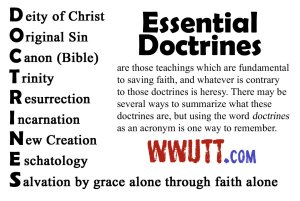
See how this works? If you don’t believe you’re a sinner, you’re not saved. If you don’t believe in the bodily resurrection of Christ, you’re not saved. Here’s how our friend, Pastor Gabriel Hughes, briefly outlines essential doctrines:

(Gabe later tweaked the acrostic a little and added an “S”, which I think is helpful.)

The vast majority of brand new Christians have only the most basic understanding of most of these tenets at the moment of salvation. But it’s not an issue of fully understanding – or else we’d all have to be theologians in order to get saved – it’s an issue of believing. Someone who is genuinely regenerated may not completely understand how the Trinity works (honestly, no one does), but when she’s introduced to the biblical idea of the Trinity, she believes it, learns more about it, and does not reject it.

There is typically agreement among most reputable theologians regarding what constitutes first tier doctrine. Scripture is clear about these things, and several of these issues were settled long ago by the church fathers in assorted church councils (Nicea, Chalcedon, etc.)

Secondary issues are routinely defined as non-salvific but still extremely biblically important, if not quite as biblically clear-cut as primary issues. Doctrines surrounding baptism (credo versus paedo, affusion versus immersion), for example, are usually cited as a secondary issue. A disagreement on a secondary issue doesn’t mean one person is saved and another isn’t, but it normally prevents close partnership in ministry activities involving these issues. For example, my Presbyterian friends and I can join together in pro-life ministry, but we would most likely not plant a church together.

Tertiary issues are non-salvific, less immediately urgent, biblical issues in which the Bible is even less clear-cut and open to wider (yet still biblical) interpretation. These are issues over which Christians can disagree and still maintain close doctrinal fellowship, even in the same church, if they’re in agreement on first and second tier doctrine. Eschatology – the order and timing of events at Jesus’ second coming – is a doctrine that’s often considered third tier. Someone can hold a different eschatological view than mine, yet, for the most part, it shouldn’t affect our ability to worship together, work together, or participate in the ordinances together in the same church.

Some theologians add a fourth category – issues of adiaphora, conscience, or Christian liberty. Usually these are issues of much less importance that the Bible either doesn’t specifically address, or doesn’t give commands about one way or the other. Individual Christians may use biblical principles to inform their consciences and decide for themselves. These would be things like whether or not to take your child trick-or-treating or deciding whether to dress formally or casually for church.

While theologians are largely in agreement about primary doctrines, there is wider spread disagreement on which doctrines are secondary and tertiary (many consider eschatology to be a second tier doctrine, for example) and whether or not there is a need for a category of adiaphora, since such issues are normally not considered to be “doctrinal” issues. In fact, there’s enough space for disagreement that pastors and theologians often wisely refrain from making concrete lists of secondary and tertiary doctrines.

But when we’re talking about the different levels of doctrine, what you won’t find is questions like these: Is murder a first, second, or third tier doctrine? What about gossip? Rape? Adultery? Lying? Gluttony? Pride?

And it’s not because these issues aren’t important or because the Bible doesn’t address them. It’s because they’re in a different category from the other issues: the category of sin. They aren’t doctrines upon which salvation hinges, they aren’t open to interpretation, and the Bible is clear that we are absolutely not to do these things.

The category of doctrine deals with beliefs. The category of sin deals with behavior.

In 2005, Dr. Albert Mohler wrote an excellent article about the different levels of doctrine entitled A Call for Theological Triage and Christian Maturity. He carefully explains the importance of each level of doctrine and what it covers in a plea to keep each level’s urgency in its proper place of significance during discussion, debate, and decision-making.

It was a helpful article to which I always refer people who have questions about tiers of doctrine, and I agree with Dr. Mohler’s thoughts in the article wholeheartedly1 …except on one point:

“In recent years, the issue of women serving as pastors has emerged as another second-order issue.”

Women serving as pastors, women preaching, women teaching men Scripture, and women exercising authority over men in the gathering of the Body is not a secondary issue. Nor is it a primary or tertiary issue. It does not belong in the category of “doctrine” in the same way baptism and eschatology do. It belongs in the category of sin in the same way murder, gossip, and adultery do. Let’s take a look at the reasons for this.

Women serving as pastors, preaching, teaching men Scripture, and exercising authority over men in the gathering of the Body is *not* a secondary issue. Nor is it a primary or tertiary issue. It is a sin.

I do not permit a woman to teach or to exercise authority over a man; rather, she is to remain quiet. 1 Timothy 2:12

(The preponderance of Scripture supports and affirms this concept, so to keep things simple, we’ll use this verse as an exemplar.)

โœข The prohibition in 1 Timothy 2:12 is a clear command against a certain behavior. And when we behave in a way God has prohibited, that is called “sin”. All of the tenets in the three levels of doctrine are affirmative statements regarding beliefs (you must believe in the resurrection of Christ, we believe in baptism by immersion, etc.). None of them are commands, in the negative, against sinful behavior (Thou shalt not murder, I do not permit a woman to teach… etc.)

โœข Secondary and tertiary doctrines can be open – to varying degrees – to biblical interpretation. Every stripe of non-heretical eschatological thought can provide you with chapter and verse passages that can, depending on the angle from which you approach the subject, be biblically plausible and scripturally supported. There is no biblical support for anything God prohibits. No one can cite a properly handled, in context Bible verse in which God says, “It’s OK to commit adultery,” or “Women are allowed to preach.” There can be multiple views on a secondary or tertiary issue that can all be considered biblical, but there can only be one view of sin that is biblical.

โœข Differing beliefs on true secondary and tertiary issues are not sin. My Presbyterian friends have a different view of baptism than I do. That doesn’t mean either of us is sinning. I may think their interpretations of the verses they believe support paedo baptism are incorrect, but they are not breaking any of God’s commands. Differing behavior (again, we see the distinction between doctrinal belief and sinful behavior) on issues of sin is sin. If someone behaves differently from God’s command about lying, she is sinning. If a woman behaves differently from God’s command in 1 Timothy 2:12, she is sinning.

โœข Differing beliefs on secondary and tertiary issues are not born of disobedience and rebellion toward God. Usually, it’s quite the opposite. When someone has studied a theological issue enough to hold a particular position on it, it’s usually because she is striving to please God and to be biblical in her beliefs. Differing behavior on issues of sin is born out of disobedience and rebellion toward God. Someone who steals has already decided in her heart that her desires are better than God’s command. A woman who knowingly holds improper authority over men in her church is doing so because she has already decided to defy God’s clear command against such.

โœข Because different beliefs on secondary and tertiary issues are not born of rebellion and are not sin, they do not require church discipline. Sin does require church discipline. If someone in your church is openly dishonoring her parents, she is sinning and should be subject to church discipline. If a woman is pursuing a career as a pastor, she is sinning and should be subject to church discipline. 

Since the publication of Dr. Mohler’s article (and perhaps as a result of others teaching the same thing) the idea of the violation of 1 Timothy 2:12 being a “secondary doctrine” has spread in a most unhelpful way, leading many Christians to treat the issue in a c’est la vie, “We can just agree to disagree on this,” manner.

No, we cannot.

The idea of the violation of 1 Timothy 2:12 being a “secondary doctrine” has spread in a most unhelpful way, leading many Christians to think “We can just agree to disagree on this.”. No, we cannot.

We would not say, “We can agree to disagree,” on lying or adultery or homosexuality or abortion, and we cannot say it about women preaching, teaching men, or holding unbiblical authority, either. We disciple and teach a sister in Christ who is unaware of what the Bible says on these matters, and if she is committing any of these sins, we begin the process of church discipline. But it would not be loving toward her, or honoring God, to allow her to continue in biblical ignorance or in willful sin.

Furthermore, the violation of 1 Timothy 2:12 brings with it dangers to the church that true secondary and tertiary issues, and even many sins, do not…

The violation of 1 Timothy 2:12 brings with it dangers to the church that true secondary and tertiary issues, and even many sins, do notโ€ฆ

She may not say it with her lips, but when a woman preaches to men in defiance of Scripture, sheโ€™s teaching false doctrine through her behavior. What is the false doctrine sheโ€™s teaching? โ€œI donโ€™t have to obey Godโ€™s Word, and neither do you. If thereโ€™s a part of the Bible you donโ€™t like, youโ€™re free to disregard it.โ€ If your pastor stood up in the pulpit on Sunday morning and said that in words, youโ€™d run him out of town on a rail, and rightly so. Neither should a woman be able to teach that same false doctrine via her actions.

Additionally, I have mentioned several times when dealing with this issue that women preaching to men is highly correlated with women teaching other forms of false doctrine. I have researched scores of women teachers. Every single one of them who unrepentantly teaches men also teaches false doctrine in some other aspect of her theology (usually progressivism, Word of Faith, or New Apostolic Reformation). In other words, if a woman teaches men, you can just about take it to the bank that she also teaches additional false doctrine. False doctrine and heresy are infecting the church – via female preachers – at an alarming rate.

We dare not simply “agree to disagree” on this.

The violation of God’s command that women are not to instruct men in the Scriptures nor hold improper authority over men is a sin like any other. It is not a doctrinal issue in the same sense that other second and third tier doctrines are. If left undisciplined, however, it can lead to first tier doctrinal issues infiltrating a church and eventually destroying it. It is detrimental to the church to label and treat any sin as a secondary doctrinal issue.

Additional Resources

Is Women Preaching a Secondary Issue? on A Word Fitly Spoken

What Are Essentials and Non-Essentials? on A Word Fitly Spoken

Christian Liberty on A Word Fitly Spoken

The importance of Primary and Secondary Doctrines on the Truth Be Known Podcast


1In the years since 2018, when this article was originally written, Dr. Mohler has said, done, and supported various biblically questionable things, leading some to question whether or not he has “gone woke”. While I don’t support his stance on those questionable things, I also don’t believe he has reached the point at which I need to warn against him (although I don’t proactively recommend him, either). To my knowledge, at this time, he is still generally doctrinally sound.