Ezra Bible Study

Ezra: Lesson 1

ezra study

Welcome to our brand new Wednesday’s Word Bible study! Over the next several weeks, we’ll be studying the book of Ezra. Many of us feel like our knowledge of the Old Testament – particularly the post-exilic writings – could use some beefing up, and Ezra is a perfect book to study for that purpose.

But is Ezra relevant to us as Christians today? As we study, I think you’ll find the answer to that question is a resounding yes. Second Timothy 3:16-17 reminds us:

All Scripture is breathed out by God and profitable for teaching, for reproof, for correction, and for training in righteousness, that the man of God may be complete, equipped for every good work.

God’s people are God’s people, B.C. or A.D. We love God, love His word, and struggle with many of the same sins. And, of course, God Himself never changes.

So let’s roll up our sleeves and start digging in, shall we?

Introduction to the book of Ezra:

Before we begin studying a book of the Bible, it’s very important that we understand some things about that book. We need to know…

Who the author was and anything we might be able to find out about him or his background.

Who the audience of the book is: Jews or Gentiles? Old Testament Israelites or New Testament Christians? This will help us understand the author’s purpose and approach to what he’s writing.

What kind of biblical literature we’re looking at. We approach books of history differently than books of wisdom, books of wisdom differently than books of prophecy, etc.

What the purpose of the book is. Was it written to encourage? Rebuke? Warn?

What the historical backdrop is for the book. Is Israel at war? At peace? In exile? Under a bad king? Good king? Understanding the historical events surrounding a piece of writing help us understand what was written and why it was written.

When the book was written. Where does the book fall on the timeline of bibical history? This is especially important for Old Testament books which are not always arranged in chronological order.

So this week, before we start studying the actual text of the book of Ezra, we need to lay the foundation to understanding the book by finding the answers to these questions.

Read the following overviews of the book of Ezra, taking notes on anything that might aid your understanding of the book, and answer the questions below:

Ezra at Grace to You

Overview of the Book of Ezra at Reformed Answers

Book of Ezra at Got Questions

1. Who wrote the book of Ezra? What was his profession? His background and lineage? What do these things tell us about his position in society, his knowledge of Scripture, his approach to writing, or anything else about him?

2. Who is the intended audience of the book of Ezra?

3. Which genre of biblical literature is the book of Ezra: law, history, wisdom, poetry, narrative, epistles, or prophecy/apocalyptic? What does this this tell us about the approach we should take when studying this book versus our approach to books of other genres?

4. What is the theme or purpose of the book of Ezra?

5. Who are the leaders and significant personalities in the book of Ezra?

6. What is the historical backdrop of the book of Ezra? When did the events of the book of Ezra take place on the timeline of biblical history (ex: before the Flood, during the period of the judges, during or after the exile, etc.)? What are the historical events immediately surrounding the events of the book of Ezra? Where do the events take place? (Sometimes, a good Bible map like this one or this one can be helpful.)

7. What else did you learn about Ezra or the setting of his book that might help you understand the text of the book better?

Christian women, Church, Discernment

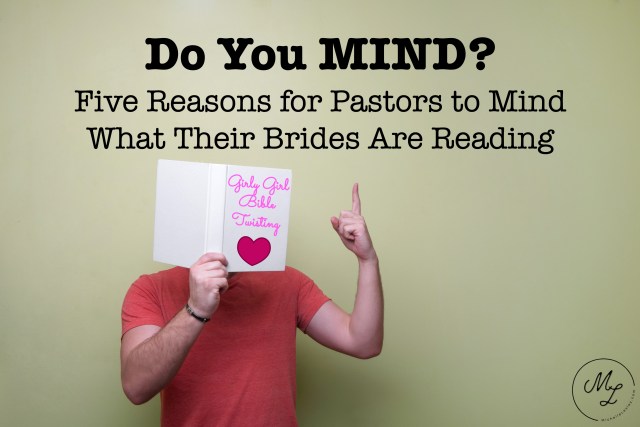
Do You MIND? : Five Reasons for Pastors to Mind What Their Brides Are Reading

A while back, my husband and I were driving down the road on the way to the store discussing various aspects of ministry. At some point the conversation turned to a pastor with whom we were both vaguely familiar. Neither of us knew much about him, so we decided to look him up on Facebook to see if we could get a better handle on where he was coming from, theologically. Aside from a couple of mildly iffy posts that it wasn’t a stretch to extend the benefit of the doubt about, it didn’t seem as though there were any major doctrinal red flags. He just seemed like your average, Bible believing pastor who needed to brush up a little on his discernment. (Hey, who doesn’t, right?)

I was actually more interested in the pastor’s wife and what kind of ministries she was involved in that I might also like, so I clicked over to her page. I was pretty disappointed by what I saw. She had posted materials from several major false teachers- the female equivalents of people from Joel Osteen all the way down to Benny Hinn.

I remarked to my husband that I thought there might be some concerns about this pastor’s theology if he was OK with his wife following and sharing materials from high profile false teachers. And my husband gently reminded me that wasn’t necessarily the case:

“He probably doesn’t even know those women are false teachers.”

My husband went on to say that he wouldn’t have known that people like Beth Moore and Joyce Meyer are false teachers if I hadn’t done the research and filled him in. Not because he doesn’t care whether or not I read sound doctrine, but because pastors and Christian men in general don’t often pick up and read books written for Christian women to examine the theology we’re feeding on.

Until the last few decades, they haven’t always needed to. If your wife went shopping and came home with a book from LifeWay, it never crossed your mind to question whether or not it was biblical. It was LifeWay for heaven’s sake. LifeWay is run by pastors and theologians with years of experience and doctoral degrees from seminary. Of course it was biblical.

Well not any more, it isn’t. The majority (and that’s not an exaggeration) of the “Bible” studies and other materials marketed to Christian women by Christian retailers are authored by false teachers.

what rose reads_kindlephoto-19662398

Pastors, on behalf of Christian women everywhere, I plead with you: check out the theology of the authors and bloggers (including me) your wife is reading and the Christian personalities she follows and shares on social media. Please thoroughly vet the materials your Sunday School/small group/Bible study classes and women’s ministry are using. Find out about the speakers headlining the women’s conference or simulcast your ladies are attending. Make sure guest speakers appearing at your church’s women’s event teach sound doctrine.

Why?

It’s not my place to instruct you (and I’m sure you already know, anyway) in what the Scriptures say about being the spiritual leader of your family, responsible for its theological health or your obligations as a pastor to guard your church against false doctrine. I’ll leave that to godly men, fellow pastors, theologians, etc. What I’d like to do is to offer you some practical insights (in no particular order) from the pink side of the pew that you might find to be helpful tools as you think about and pray through how to handle vetting the teachers your wife or church ladies follow:

1. Your wife’s decision to follow false teachers could cost you a job. There are women out there like me who are familiar with the “twisted sisters” your wife is sharing on social media. If I could wrongly make assumptions about the theology of the aforementioned pastor based solely on his wife’s Facebook activity (because wives can be a reflection of their husbands’ spiritual leadership), others could do the same – maybe even those on a pulpit search committee – and that could impact your search for a pastoral position.

2. You don’t want to shoot yourself in the foot. A pastor’s wife can have a huge influence on her church. She is often the one teaching the women’s Bible study or heading up the women’s ministry, and even if she doesn’t, her input on curricula, guest speakers for women’s events, etc., is usually seen by the women of your church as carrying the weight of your approval or preferences. If you’re up in the pulpit preaching sound doctrine every week while your wife or women’s leader is importing false doctrine into the women’s ministry, it’s like bailing water out of a boat with a hole in the hull.

3. Your wife or (women’s ministry leader) may be chasing off spiritually healthy church members. (If you’ve stuck with me thus far, what follows is unlikely to describe your wife, but I’m going to go ahead and throw it out there for awareness’ sake.) I have heard the following prototypical scenario from dozens of Christian women (and experienced it myself):

“My pastor’s wife is in charge of our church’s women’s ministry, and is a big Beth Moore fan. We only do Beth Moore studies in our small groups, and last year our church hosted a Beth Moore simulcast. I participated in a couple of the studies, but they just seemed “off” biblically, so I started doing some research.

I discovered Beth Moore was teaching false doctrine, partnering with false teachers, and doing other unbiblical things. I went to the pastor’s wife and very kindly, humbly, and patiently showed her the scriptural evidence of Beth Moore’s false teaching. I couldn’t believe it when she flew into a rage, screamed at me, and accused me of trying to create disunity in the church! My husband and I tried to talk to the pastor about it, but he seemed completely unaware of what goes on in the women’s ministry or any problems with Beth Moore, and backed up his wife. We are now looking for a new church.”

This is not an exaggeration or isolated case. I don’t know what it is about Beth Moore’s disciples, but they (especially the ones who are pastors’ wives) seem to be some of the most vicious defenders of false teachers out there. And if your wife or women’s ministry leader acts like this it could cost you godly, spiritually mature church members.

4. Your children’s spiritual lives are at stake, both at home and at church. As with any dad who works long hours, your wife probably has more of an influence in the moment to moment aspects of your children’s lives than you do, even when it comes to training them in godliness. If her spiritual diet consists of false teaching, that’s what is being imparted to your children on a daily basis.

The same goes for the children at your church. The majority of children’s Sunday School teachers and children’s ministry workers are women. The false doctrine these women consume today will be taught to the children of your church on Sunday.

5. When women are spiritually healthy, the whole family benefits. Statistically, women make up about 60% of church attenders, and, of course, 50% of a marriage. That is an enormous influence on your own family and your church family. You want those women spiritually healthy. It’s not only biblical and good for them personally, but everyone they influence and interact with benefits.

When women are taught sound doctrine, they grow to Christlike maturity. They exhibit the fruit of the Spirit. They want to share the gospel. They walk in humility, patience, love, repentance, forgiveness, and biblical submission. They encourage their husbands toward godliness. And you know what else they do?

They teach other women to do the same. They train up children who are godly. They’re self-replicating.

Spiritually healthy, mature, godly women make your life easier, more peaceful, and more of a joy, both at home and at church, because they’re working with you, not against you.

But your wife and the women of your church are not going to get the pure milk of the Word they need to grow in Christlikeness from the pantheon of divangelistas lining the shelves of your local Christian bookstore. And most of those precious ladies you shepherd are completely unaware of that fact. So they need your help, Pastor. Your bride, and the Bride, desperately need you to mind what they’re reading.


Kitchen/Recipes, Throwback Thursday

Throwback Thursday ~ Top 10 Money Saving, Time Saving Kitchen Hacks

Originally published October 30, 2014kitchen hacks

I’m a stay at home, home schooling mom with a large family, so we’ve had to make some -completely worth it- financial sacrifices to make that happen. We rarely eat out, and lots of convenience and froo froo foods are crazy expensive. Consequently, I spend a lot of time in the kitchen, which I happen to love. Over the years, I’ve had a lot of fun finding creative ways to “beat the system” of spending too much money and wasting too much time. Here are my top ten favorite kitchen hacks:

1. Make your own “convenience” foods and items instead of buying them at the store.

It’s usually cheaper, often more healthful, and you can make larger or smaller batches than the store’s pre-packaged convenience size depending on your family’s needs. Here are three examples from the Satisfaction Through Christ blog: Haylee’s taco seasoning, Lauren’s home made cleaning products, and my copycat Chick-Fil-A recipe.

mayo-e14140868289102. Baked goods just tend to be moister and better with a little fat in them.


If you use low fat or skim milk, mix in a dollop (1-2 tablespoons) of mayonnaise or sour cream when you’re baking brownies, cakes, biscuits, or instant mashed potatoes. (A little cream cheese in the mashed potatoes is also good!)


3. If possible, make friends with your store’s stockers, butcher, etc.

First of all, making friends is a great way to share the gospel with them. Second, they can often alert you as to when items will be marked down or go on clearance. My husband often shops for me and has made friends with employees at a couple of stores. One employee explained to him how and when his store marks down meat. The employee from another store actually calls him whenever they’ve got a good clearance deal.

breadcrumbs-150x1504. What do you do with your bread ends, leftover dinner rolls, garlic bread, etc.?

I use them to make my own bread crumbs for breading pork chops or chicken, as filler for meatballs, and as garnish on top of baked pasta. Just put that bread through the food processor (I’ve found that it works better to freeze it first, so I save up a bunch of bread in the freezer until I’m ready to make a batch), and voila! You can also season it by adding powdered ranch dressing, garlic powder, onion powder, rosemary, or other spices. I like to mix in Italian seasonings and parmesan cheese and bread chicken breasts with it for chicken parmesan.

5. I have a bad habit of heading off to the store and forgetting my grocery list, so every time I update my list, I take a picture of it with my phone.

That way, it’s always with me, even if I decide to make an impromptu stop at the store while I’m out doing other errands. I also text the picture of the list to my husband to keep in his phone for when he stops by the store. There are several free grocery list apps available, too, if you like that method better.

10006923_861042400603362_8453181981795771252_n6. Large families with lots of kids would be better off just buying a cow.


Unfortunately, my neighborhood is not zoned for that. I also don’t have time for frequent milk shopping, plus the store with the cheapest milk prices isn’t very close to my house. What to do? Every month or so, I go to the store with the lowest prices on milk, buy five or six gallons and freeze them. You have to pour a little off the top of each gallon so the jug doesn’t crack (water expands as it freezes), but it works beautifully.

7. Substitutions are your friend.

They’re often cheaper and create less waste than buying the ingredient the recipe calls for and having most of it go bad because you only need a smidge. My two favorite substitutes are for buttermilk (add 1 T. lemon juice or vinegar to 1 c. milk and let stand 5 minutes) and baking chocolate (3 T. baking cocoa plus 1 T. shortening or oil).

taters-150x1508. “Leftovers” is such an unimaginative way to think of extras. I “upcycle” my left over food.

Leftover pork roast, ribs, brisket, and barbecued chicken can be boned (if necessary), then cooked down into pulled pork (or chicken) sandwiches. Strain mushrooms and onions out of your extra gravy or sauce to use in casseroles and roasts. Leftover baked potatoes can be made into mashed potatoes or potato soup. Extra vegetables go great in soups, too. Leftover baked or grilled chicken can be used in pasta or casseroles. I save my ham bones to stew into my red beans and rice, and the bones from whole baked chickens to boil for chicken stock (much better than the canned stuff).

9. Buy in bulk (when the per unit price is lower- sometimes it’s not), then repackage and/or freeze.

Large packages of ground beef can be reapportioned into one pound bags and frozen. Pork chops, chicken breasts, and leg quarters can be individually frozen (side by side on a large baking sheet, and covered), then repackaged. Buy produce, such as onions, bell peppers, and carrots, when they’re on sale, then chop and freeze. We buy large bags of cereal instead of boxes, then put smaller portions into plastic containers that are easier to pour and keep closed.

clearance-225x30010. Meat and other food items that are on clearance are not only a great way to save money, but they can really inspire you to cook imaginatively.
A clearance can of cheese soup “recipe starter” recently became a home made mac and cheese in my kitchen. Some thin sliced steak -which I’d never worked with before- led me to a recipe for steak sandwiches. Both were big hits with my family, and they always look forward to the next mystery meal. Also be aware of your store’s day old bread/bakery rack. Why make or buy expensive dinner rolls when you can get a loaf of french bread (or other great items) for a dollar or less?

First Corinthians 10:31 says:

So, whether you eat or drink, or whatever you do, do all to the glory of God.

All. That means kitchen hacks, too. But how can kitchen hacks glorify God? When we save money and time in the kitchen, we’re able to invest those resources into Kingdom purposes, whether it’s something as simple as a few extra minutes to pray with your child or something as far-reaching as giving more money to missions. God gives us lots of opportunities each day to steward every moment for His glory.


this article was originally published at SATISFACTION THROUGH CHRIST.
Wednesday's Word

Wednesday’s Word ~ Zechariah 7

zech 7 13

Zechariah 7

In the fourth year of King Darius, the word of the Lord came to Zechariah on the fourth day of the ninth month, which is Chislev. Now the people of Bethel had sent Sharezer and Regem-melech and their men to entreat the favor of the Lord, saying to the priests of the house of the Lord of hosts and the prophets, “Should I weep and abstain in the fifth month, as I have done for so many years?”

Then the word of the Lord of hosts came to me: “Say to all the people of the land and the priests, When you fasted and mourned in the fifth month and in the seventh, for these seventy years, was it for me that you fasted? And when you eat and when you drink, do you not eat for yourselves and drink for yourselves? Were not these the words that the Lord proclaimed by the former prophets, when Jerusalem was inhabited and prosperous, with her cities around her, and the South and the lowland were inhabited?”

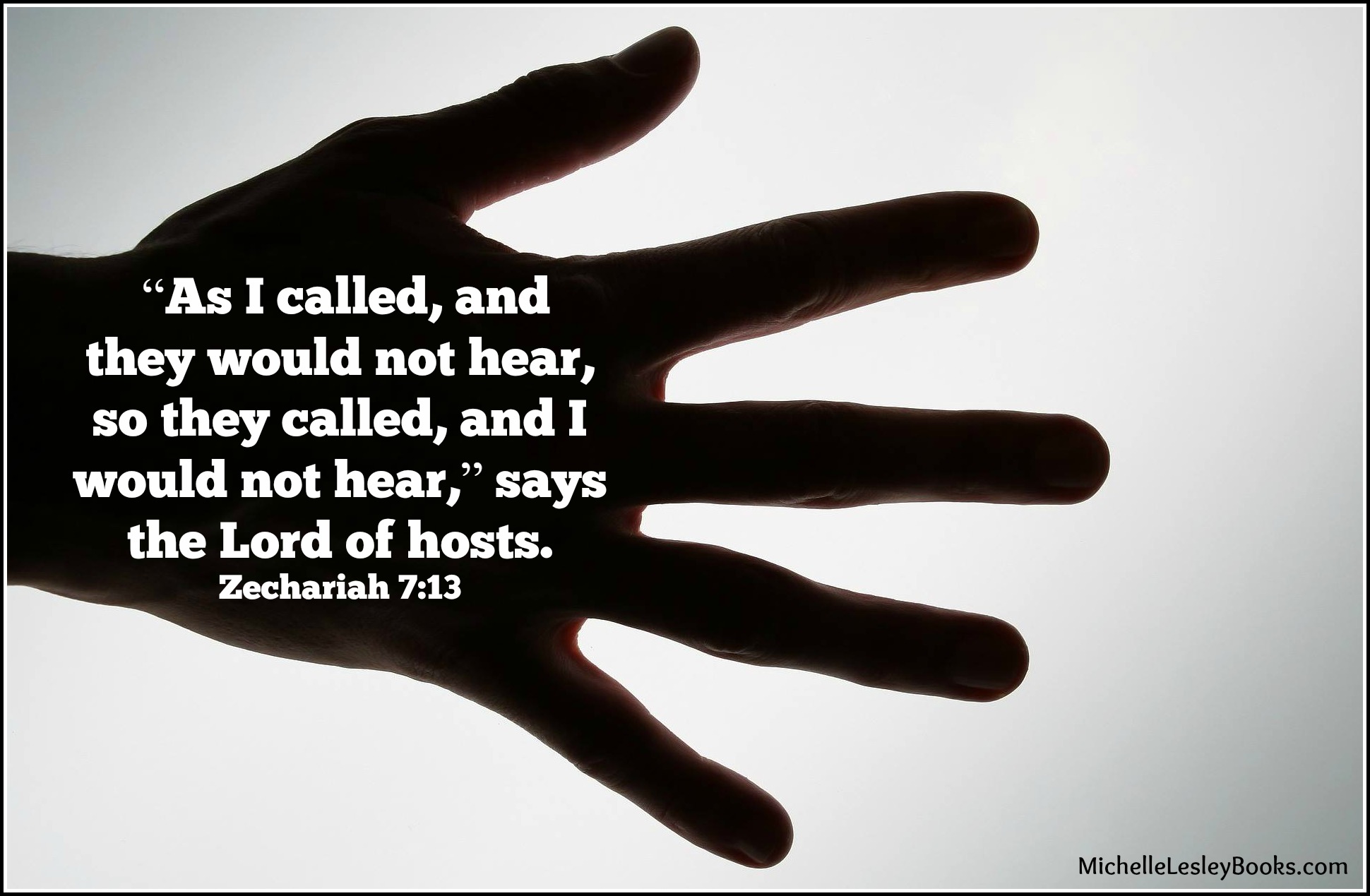
And the word of the Lord came to Zechariah, saying, “Thus says the Lord of hosts, Render true judgments, show kindness and mercy to one another, 10 do not oppress the widow, the fatherless, the sojourner, or the poor, and let none of you devise evil against another in your heart.” 11 But they refused to pay attention and turned a stubborn shoulder and stopped their ears that they might not hear. 12 They made their hearts diamond-hard lest they should hear the law and the words that the Lord of hosts had sent by his Spirit through the former prophets. Therefore great anger came from the Lord of hosts. 13 “As I called, and they would not hear, so they called, and I would not hear,” says the Lord of hosts, 14 “and I scattered them with a whirlwind among all the nations that they had not known. Thus the land they left was desolate, so that no one went to and fro, and the pleasant land was made desolate.”

The Holy Bible, English Standard Version Copyright © 2001 by Crossway Bibles, a publishing ministry of Good News Publishers.

Questions to Consider:

1. What is the theme or purpose of the book of Zechariah? Which other Old Testament, post-exilic prophet was a contemporary of Zechariah’s? What is the historical backdrop for the book of Zechariah?

2. What is the “weeping and abstaining in the fifth month” referred to by Sharezer and Regem-melech? (2-5) Instead of saying, “Yes, keep the fast,” or “No, forego the fast,” what does God say instead? (4-7) During the seventy years of exile, were the people keeping the fast out of love and reverence for God or simply as a self-pitying ritual? (5-6) Which is more important to God, the outward actions of obedience, or obedience from a heart of love for Him?

3. Examine your motives for going to church, worship, serving others, giving offerings, studying your Bible, and praying. Do you do these things out of rote obedience or because you love God? Pray and ask God to change your change your heart in any area in which you are not acting out of love for Him.

4. What instructions did God give the people in verses 9-10? What does the word “they,” the use of the past tense (refusED, turnED, etc.), and the phrase “former prophets” in verses 11-14 indicate about the previous recipients of these instructions? Who were these recipients? What was Israel’s response to God’s instructions before the exile? (11-12) What was God’s response to Israel’s disobedience? (13-14)

5. Why did God have Zechariah tell the people about Israel’s past disobedience and His punishment of that disobedience? (11-14) What can we, as Christians learn from this passage about the importance God places on obedience from the heart? Though verses 9-10 were written specifically to Israel, does God want Christians to carry out these same principles? How do you know? What are some examples of ways you can carry out the spirit of God’s instructions in verses 9-10?

Christian women, Complementarianism

Women Teaching Men: My Thoughts on Aimee’s and Mary’s Articles

aimee mary

UPDATE: Please note, this article was written in 2016. It should not be construed to be a current endorsement of either Aimee or Mary.

My friends and readers are the best. They are so sweet and helpful when it comes to making sure I stay up to date on what’s happening out there in Evangelicaland. It’s like having a little army of really smart co-laborers who are great at research.

Last week, a couple of articles about women teaching men appeared on the Reformed complementarian women’s landscape, and several folks were kind enough to send them to me and ask for my reaction. I e-mailed the readers back with my responses, which I’ve posted below.

What is Sunday School? What Does it Appear to Be? And Who Can Teach It?
by Aimee Byrd
May 18, 2016

I have loved and respected Aimee’s work as a writer and podcaster for a while. This article was apparently written to clarify some things that had been said on a Mortification of Spin podcast.

“I didn’t catch the podcast, but I did read the article. I was disappointed with what Aimee said, because Steve’s comments [Steve Cooley’s comments in the comment section following the article] are correct. Also, if we look at the broad pattern of male headship in Scripture…

man was created first, then woman
woman was created to be helper to man
women are to submit to their husbands
women are not to serve in the office of elder or pastor
women are not to preach to men
women are not to exercise authority over/lead men in the church

…which fits better with this pattern, women teaching men in co-ed Sunday School or women not teaching men in co-ed Sunday School? I think it’s pretty clear that women not teaching men in co-ed Sunday School fits best. Why would God set this pattern of male headship in motion and then turn around and contradict it when it comes to women teaching men in Sunday School?

Furthermore, the gathering of a body of believers for studying the Bible is the gathering of the church, whether it is in someone’s home (like the first century church), a sanctuary, or a Sunday School classroom. We’re the ones who have invented all these lines of delineation between Sunday School, worship service, Christian conferences, revival meetings, etc., and then tried to go back and figure out which of these man-made distinctions 1 Timothy 2:12 applies to. When 1 Timothy was written, they didn’t have all that. The church was just the gathering of the believers for worship, study, etc. So 1 Timothy 2:12 applies to the gathered body of believers without respect to all these artificial lines we’ve drawn.”

Again, I have great respect for Aimee, but I disagree with her on this particular issue. It’s possible that the differences in our denominational viewpoints of Sunday School play a big part in this, and that if we ever had the chance to sit down and hash it out over coffee or something, we might find more common ground.

Women Teaching Men- How Far is Too Far?
by Mary Kassian
May 21, 2016

I’m not as familiar with Mary as I am with Aimee, but I’ve read and enjoyed a few of her articles. This one may have been a response to Aimee’s article above.

“Good stuff! I agree with her about 90%. I love that she brought out the part about “teaching under a man’s authority.” I wrote about that not long ago. It’s nice to hear somebody with a bigger platform say it. I hope people will listen to her!

I also love what she says about what we love versus following a set of rules. So true! Another aspect of this that I run into frequently with women who want to preach is that they’re so focused on leading they forget about Jesus’ example of humility in servanthood. We’re supposed to be focused on serving, not gaining notoriety.

My main disagreement with her would be the line she (and most others who address this issue) draws between the worship service and things like Sunday School and Christian conferences. Those are really man made lines of distinction rather than biblical ones. The “church” is the gathered body of believers for worship and biblical instruction. So whenever believers are gathered for those purposes – whether we call it Sunday School or worship service or a Christian conference, and whether it’s in a sanctuary, Sunday School classroom, or conference center – that’s the church, and the Scriptural mandate for women not to teach or hold authority over men applies.

I also think it’s interesting that in the second paragraph under “Can Women Teach Under Male Authority” she rightly points out, “The text doesn’t say, ‘A woman may teach men if…'”. But then later in the article she talks about how she feels it’s OK for her to teach men if they’re much younger than she is. Well, just like the text doesn’t say a woman can teach men if she’s doing so under male authority, it also doesn’t say it’s OK for a woman to teach men if she’s much older than they are. It just says “don’t”. Curious.”

Mary’s position on this issue is much more similar to mine. I hope to hear more from her about this in future articles.