Speaking Engagements

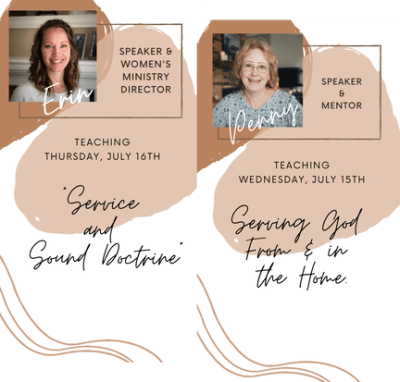
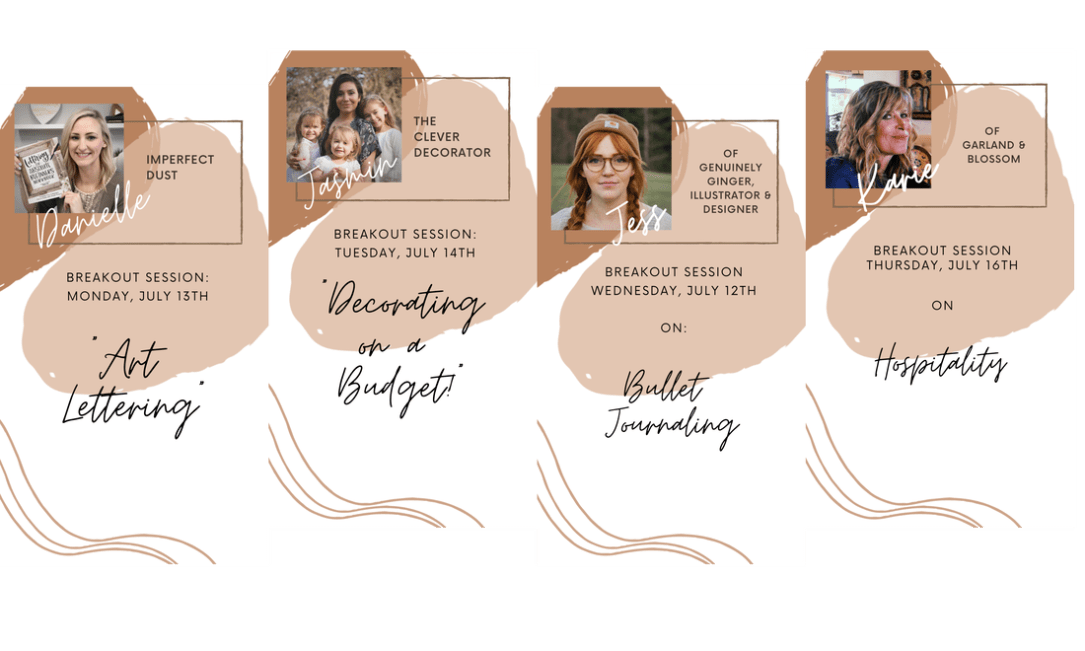
Open Hearts in a Closed World Online Women’s Conference

Have you been enjoying all of the awesome conferences that have been offered online over the past few months? Me too! And here comes another one that I think you’ll really enjoy and be edified by:

Open Hearts in a Closed World
July 13-17 ~ 9:30 a.m. daily
Cost: FREE


Worship with City Alight starts at 9:30 a.m. (Central).


After worship, join me, Susan Heck, and these other lovely ladies for five days of teaching about servanthood.

Following each teaching session will be a fun breakout session.

To attend,

simply log on to the conference’s

Facebook

Instagram

or

YouTube

page and watch!
(No registration necessary.)

The conference livestream will begin at 9:30 a.m. (Central) each day, Monday, July 13 – Friday, July 17. Can’t attend in real time? The recordings of each session will remain available on these platforms so you can watch later.

Any Questions?

***** Please contact the conference organizers here.ย *****

Mailbag

The Mailbag: Guess who’s coming to (the women’s ministry) dinner?


(In the interest of full disclosure, this question was not sent to me by a reader, but was asked in an online Christian women’s forum I’m a member of. I have altered and condensed the question somewhat while retaining the main idea.

You may also notice that when addressing this topic my phraseology will be somewhat euphemistic {ex: “perversion-affirming”}. This is out of an abundance of caution due to the limits many online platforms are now placing on free speech.)


My husband pastors our church, which is situated in a very liberal (perversion-affirming) area. I help lead the women’s ministry. Recently a man, who is in the process of having his body surgically altered to appear female, and who has visited the church a few times, approached me and asked if she could attend an upcoming women’s ministry event. How should I handle this? What should I tell her?

I get that this is an uncomfortable situation, I really do. I would feel uncomfortable if this happened to me, too. But it is not nearly as complicated or agonizing as many would like to make it if we have our doctrine and theology straight and have the faith to commit to it unwaveringly.

One of the reasons this situation can seem insurmountable is an issue I addressed in my recent article Guilt and Shame: Burden or Blessing?. Our culture has made people’s feelings into an untouchable idol, and Christians and the church have followed suit. There is hardly a greater crime in the church these days than hurting someone’s feelings. In fact, we have so idolized people’s feelings that God’s Word, and actually providing biblical help and truth to the person whose feelings we’re trying not to hurt, are often not even a consideration.

Another challenge in this situation is fear of man and fear of suffering. We’ve all seen the news. We know the legal implications for Christians who refuse to toe society’s line on sexual mores. Christians who say no to celebrating sin get arrested. They lose their jobs, their positions of prestige, their reputations, their leases, their businesses, and sometimes even custody of their children. Churches that stand on Scripture in a perversion-affirming area could be publicly slandered, picketed and protested, even vandalized or burned down. This is our reality, and I fully admit, it’s a terrifying one.

But no more terrifying than being crucified upside down, thrown to the lions, or burned at the stake.

This isn’t hyperbole. This is what is coming for us. And now – right now, before it gets here – we get to prepare and practice for persecution by making some hard decisions.

Do we so love the lost and ache to see them rescued from sin that we’re willing to risk hurting their feelings, being reported, arrested, and someday even executed for lovingly telling them the truth of the gospel? That they are sinners with the wrath of God abiding upon them who desperately need to repent and trust the Savior?

We need to count the cost and prayerfully set our faces toward Jerusalem. Christianity isn’t a call to self-preservation, it’s a call to die.

With that perspective firmly in place, here are a few thoughts I hope will be helpful to you as you navigate this situation…

โ™‚โ™€This is an issue for your pastor and elders handle, not you. Let your husband know what happened. The pastor and/or elders need to take this man aside very kindly, share the gospel with him, and then disciple him, long term, in repentance and his biblical role as a man. In conjunction with that, they should help him get whatever medical help he needs to transition back (as far as possible) to physical manhood.

โ™‚โ™€ If he rejects the gospel, he should be regarded and treated as any other lost man who comes to your church. He should be welcomed to attend worship service, a male-only Sunday School class, and any church-wide or men’s ministry functions he’d like to attend. Because he is lost, he is not eligible for church membership, and therefore not eligible to hold any position of leadership or service – from teaching a class to helping with the youth bake sale to folding the bulletins – in the church. 

โ™‚โ™€ If he chooses to continue attending services and classes, the pastor and elders should make clear to him that he is to dress as a man, no makeup, no feminine hairdos or accessories. Dressing as a member of the opposite sex in order to deny one’s God-determined sex is a sin, and your pastor should not allow this sin to be committed at church any more than he would allow any other sin to be committed at church. 

If, after being informed of this, the man shows up for church dressed as a woman, the pastor and elders should remind him he was told not to do this and firmly ask him to leave.

โ™‚โ™€ It would probably be a good idea for the church to address this issue in some sort of codified/legal way, similar to the way many churches have developed a written policy prohibiting their facilities from being used for same sex “weddings”. The pastor or appropriate elder should contact a lawyer with experience working with churches, or possibly a Christian legal organization such as the ACLJ or the ADF, to find out the wisest course of action.

โ™‚โ™€ You need to have a biblical perspective on God’s creative design for this man. God created him male. You need to submit to that in your thoughts, speech, and behavior toward him. You should not be referring to him as “she” to others, to him, personally, or even in your thoughts. He is a man, not a woman. To call him “she,” treat him like “one of the girls,” or allow him to take part in women’s activities would be to affirm him in his sin. It would also perpetuate the world’s lie that men can become women, and vice versa. 

โ™‚โ™€ Doing anything to accommodate or affirm this man’s sin is cruel and unloving. Christians rescue people out of slavery to sin, we don’t encourage them to embrace their chains.

As I said, when we have our doctrine and theology straight and have the faith to commit to it unwaveringly, situations like this become much less complicated. Scary and risky to the glory of God, maybe, but simpler. Are we of the world, or of Christ?

For am I now seeking the approval of man, or of God? Or am I trying to please man? If I were still trying to please man, I would not be a servant of Christ. Galatians 1:10
You adulterous people! Do you not know that friendship with the world is enmity with God? Therefore whoever wishes to be a friend of the world makes himself an enemy of God. James 4:4

If you have a question about: a Bible passage, an aspect of theology, a current issue in Christianity, or how to biblically handle a family, life, or church situation, comment below (Iโ€™ll hold all questions in queue {unpublished} for a future edition of The Mailbag) or send me an e-mail or private message. If your question is chosen for publication, your anonymity will be protected.

Share Your Testimony

Testimony Tuesday: Michelle’s Story

Michelle’s* Story

Literally the other day, I was set completely free. Iโ€™m still dancing!! And, I am not the dancing type!

About a year ago, my husband and I began attending a new church. I could not put my finger on what happened during that initial service, but I remember saying to my husband, โ€œWhatever that was, I want more of that.โ€

At that time, I was a Christian, but a struggling one. I had not yet come to understand what being free in Christ meant. I was struggling physically with un-diagnosable chronic physical pain. I was on a downward spiral of acute insomnia coupled with not only the physical pain, but also fear and anxiety. I read my Bible. I went to Bible studies. My friends were almost all self-professing Christians. I grew up in a churched family. No one shared with me the truth I was about to hear and understand.

No one shared the truth with me…

About 18 months ago, after exhausting all of my options for treatment, I felt even more anxious that I (keyword, I) couldnโ€™t do anything further to fix this. It was then that God brought an amazing woman into my life to teach me what a true and vibrant personal relationship with the Living Christ was โ€ฆ I bombarded her with questions. What she was teaching me and what I was learning at church on Sunday lined up with each other seamlessly. I have never met this woman face-to-face, she was introduced and referred to me through long-distance friends. Come to find out, she knew the pastor of my new church years back through a family member. Through her, God confirmed the difference was this church was under the leadership of a true Christ-follower. Praise God for people who know their identity in Christ and continue referring you back to Him.

God brought an amazing woman into my life…

As I continue to study, Iโ€™m really beginning to wonder if I ever was a Christian. I mentioned that I was a Christian, but a struggling one. And I did read my Bible, and go to countless Bible Studies.

Whether or not I was I guess is not important, because now I am – I get it, oh thank you, Jesus, that I get it. I didnโ€™t get it before. I was under the assumption that since Godโ€™s will is for everyone to be saved, then anyone who wanted to be saved and prayed the prayer was saved forever and that could not change. In fact, my uncle recently passed away and we were not close but I talked to someone about this and I was assured of “once saved always saved.”

Oh, thank You, Jesus, that I get it.

A fire has now been lit under me that screams most people I know are likely false converts and they have no idea. Iโ€™d never heard of the idea that God saves you in His timing. I thought that as soon as you prayed that prayer, boom, that was it. Your address for eternity had permanently changed. I was never convicted of sin to the point of complete repentance and I donโ€™t recall ever being corrected on this – in fact, I only remember being assured over and over again that I was saved. I was sorry for my sin, I didnโ€™t like my sin, I knew Jesus died for my sin. All good, but I wasnโ€™t changed. But now, the Truth has set me free.


*This is from a reader who shares my first name. This is not my (Michelle Lesley’s) testimony.

Ladies, God is still at work in the hearts and lives of His people, including yours! Would you like to share a testimony of how God saved you, how He has blessed you, convicted you, taught you something from His Word, brought you out from under false doctrine, placed you in a good church or done something otherwise awesome in your life? Private/direct message me on social media, e-mail me (MichelleLesley1@yahoo.com), or comment below. Your testimony can be as brief as a few sentences or as long as 1500 words. Letโ€™s encourage one another with Godโ€™s work in our lives!

Bible Study

A Hard Bible for Hard Times

These days, popular women’s “Bible” studies tend to be seven lessons of fluff, feelings, and false doctrine.

This is the “anti-study”.

Roughly 20 lessons of digging into the text of what can be a challenging passage of Scripture.

I believe you’re up for the challenge, ladies. Let’s study.

A couple of days ago, I launched Ezekiel – our new Bible study here on the blog – with these introductory remarks on social media. I made it pretty clear, both in my social media remarks and the introduction to the study itself that this wasn’t going to be your typical walk-in-the-park women’s “Bible” study designed to make you feel better about yourself.

Ezekiel is a long book. There are parts of it that are going to be hard to understand. There are parts of it that, to our flesh, are going to be boring. There are cubits. Lots and lots of cubits. This is a Bible study that’s going to require extra work – probably with commentaries and study Bibles. And I’m not making any “feel good” guarantees.

And yet, I was overwhelmed by the response from so many readers: “I’m in!” “Sign me up!” “Looks like a good time!” “Excited is an understatement!”

All this about….a hard text? More work? Even as we endure Corona and quarantine, separation from loved ones, the shuttering of our churches, economic hardship, increasing persecution, racial strife, rampant crime, rioting, anarchy, and God only knows what’s next?

Yeah. Want to know why?

It’s the same reason that being bone-weary after a long day of hot, sweaty yard work feels better than the mind-numbed sleepiness you feel when you’ve been binge-watching Netflix in your pajamas all day. The same reason you feel better after a satisfying, well-balanced meal than after snarfing a dozen Oreos.

It’s what we need.

It’s what’s good for us.

It’s accomplishing something lasting.

We need a hard Bible in these hard times.

Think about the hard times the first century Christians of the New Testament went through. For refusing to offer a pinch of incense in worship to Caesar, for declaring that Jesusย aloneย – not Jesus plus the pantheon – is Lord, they were fed to the lions for sport, burned and boiled alive, crucified, beheaded, speared, beaten, stoned, whipped, exiled, and considered “the scum of the world, the refuse of all things.”

And for most of that first century, the bulk of the Scriptures Believers had access to was the Old Testament. The part that soft, milquetoasty, “I want a God made in my own image” evangelicals today want to “unhitch” from preciselyย becauseย it’s hard.

While fearing for their very lives for following Christ, our forefathers in the faith studied the God who flooded the earth for its rebellion against Him, who wiped out pagan nations for their idolatry, who sent horrific plagues upon those who defied Him, and who poured out His wrath on His own people for their sin and spiritual whoredom.

They had a hard Bible during their hard times.

To be sure, they saw, and we also see, the God of mercy, love, and grace who spared Noah, who provided His children with a land flowing with milk and honey, who rescued the Hebrews out of slavery, and who blessed all who were faithful to Him. And we know that all of Scripture – the hard to swallow parts and the easy to embrace parts, the “dig in and study hard” parts and the simple and sweet to the soul parts –ย all of Scripture is profitable.

But we need a hard Bible for hard times.

Because hard passages that make us stop and spend extra time and effort build discipline, endurance, and patience into our spirits. They make us do the hard work of digging for the nature and character of God and reward us with the treasure of knowing Him more intimately. They show us who God is in a unique way that the easy passages do not.

Feelings, fluff, and false doctrine can never accomplish those ends. They do not prepare us to endure suffering and persecution with strength and dignity, but to whine and complain and focus on the hurt. They do not teach us who God truly is in our trials and temptations, but that we can create a custom-made idol we’re comfortable with and call it “God”. They do not lead us to trust and obey God when the going gets tough, but to abandon His Word and His statutes in favor of worldly means and methods of dealing with difficulties.

Most evangelical women today are spiritually flaccid because no one – not their denomination, nor their church, nor their pastor, nor their Sunday School teachers, nor their women’s ministry leaders, nor their favorite “Bible” study authors – has ever made them do the hard work of wrestling with challenging Scriptures, overcoming them, and adding that victory to their inventory of joy in Christ.

We need to raise the bar.

We need to expect more, not less.

We need to encourage the pink side of the pew to do hard spiritual things, and cheer them on and help them as they try.

The Kingdom doesn’t need weak women who don’t know their Bibles because all they’ve been taught – and all they’ve been taught to hunger for – is feelings, fluff, and false doctrine. Because those women crumple in the face of controversy. They fall away rather than stand and fight.

The Kingdom needs strong, godly women who apply their hearts and minds to knowing and understanding God’s Word and reach down to help their weaker sisters do the same.

Hiding God’s Word in our hearts doesn’t just mean we learn the surface-level do’s and don’t’s, giving us a spiritual Post-It note reminder not to lie and steal. In order to hide something, we first have to possess it. Own it. And to own God’s Word we have to plunge in and swim in it. Breathe it in and out. Drink deeply of it. Eat the honey-sweet scroll. Let it so penetrate our souls’ DNA that when the rooster begins to crow, and the accusers point and say, “I know you. You were with Jesus,” we can plant our feet firmly and mean it when we boldly declare, “Yes. And though others may fall away because of Him, I will never fall away. Even if I must die for Jesus, I will not sin by denying Him.โ€

Because those hard times are coming.

Indeed, they are already here.

And we need a hard Bible for hard times.

Ezekiel Bible Study

Ezekiel ~ Lesson 1- Introduction

Welcome to our new study: Ezekiel!

What is God’s perspective on sin?ย  What is Hisย posture toward His people when they persist in sin…and when they repent? What was it like to be aย prophet of (mostly) doom and gloom? For the next few months we’ll work our way through the book of Ezekiel, learning about the holiness of God and what it’s like to stand on God’s Word even when “God’s people” don’t want to hear it. You might be surprised to find out just how relevant this Old Testament book is to Christians today!

The image in the title pic for this study alludes to Ezekiel 33:7:

So you, son of man, I have made a watchman for the house of Israel. Whenever you hear a word from my mouth, you shall give them warning from me.

In Ezekiel’s day a watchman would be stationed in a watchtower in an area with good visibility so he could see if an enemy was approaching the city. The watchman needed good eyes and the ability to distinguish an enemy from an ally. If he spotted an enemy, he was to alert everyone to the impending threat and the need to mount a defense. God appointed Ezekiel a spiritual “watchman” to His people, Israel. The book of Ezekiel is God’s warning to His people – through the prophet Ezekiel – that the enemy of sin is overtaking them.

Parts of the book of Ezekiel can be a little challenging. Your comprehension will be challenged. Your patience might even be challenged. But it’s good to stretch ourselves and choose books that help us to develop discipline in our study of the Word, rather than always choosing the shorter or “easier” books of Scripture. I have complete confidence that you’re up for the challenge and that God will grow you in the grace and knowledge of Christ as you apply yourself to His Word.

Ezekiel is one of the longer books of Scripture, weighing in at 48 chapters. This means that instead of studying approximately one chapter per week in depth (as we usually do in my studies of shorter books), we will be covering at least two chapters (often more) per week with a broader perspective.

As I mentioned inย this recent articleย on study resources, you might – particularly for this book of the Bible – want to invest in a good study Bible or at least check out some of the online resources that can help if you have questions while you’re studying.


If you’re new to using my Bible studies, just a few housekeeping items and helpful hints:

The studies Iโ€™ve written (you can find all of them at the Bible Studies tab in the blue menu bar at the top of this page) are like โ€œtraining wheelsโ€. Theyโ€™re designed to teach you how to study the Bible for yourself and what kinds of questions to ask of the text so that, when you get the hang of it, you wonโ€™t have to depend on other peopleโ€™s books and materials โ€“ even mine โ€“ any more. To that end, I do not provide answersย for the study questions in the studies Iโ€™ve written.

My studies are meant to be extremely flexible and self-paced so that you can use them in the way that works best for you. You can do an entire lesson in one day or work on the questions over the course of the week (or longer). You do not need to feel obligated to answer all (or any) of the questions. If the Holy Spirit parks you on one question for several days, enjoy digging deep into that one aspect of the lesson. If He shows you something I haven’t written a question about that captures your attention, dive in and study it! Those are ways the Holy Spirit speaks to us through His Word. This is your time to commune with the Lord, not a school assignment or work project you are beholden to complete in a certain way by a certain deadline.

I will post a new lesson on the blog every Wednesday, so there is nothing to sign up for or commit to. Simply stop by the blog each week, or subscribe to the blog via e-mail to have the lessons delivered to your inbox.

I use hyperlinksย liberally.ย The Scriptures for each lesson will be linked at the beginning of the lesson and in the lesson questions. As you’re reading the lesson, whenever you see a word in a different color text, click on it, and it will take you to a Scripture, article, or other resource that will help as you study.

All of the studies Iโ€™ve written are suitable for groups or individuals. You are welcome to use them as a Sunday school or Bible study class curriculum (for free) with proper attribution.

You are also welcome to print out any of my Bible studies (or any article Iโ€™ve written) for free and make as many copies as youโ€™d like, again, with proper attribution. Iโ€™ve explained more about that inย this articleย (3rd section).


Introduction to Ezekiel

Before we begin studying a book of the Bible, itโ€™s very important that we understand some things about that book. We need to knowโ€ฆ

Whoย the author was and anything we might be able to find out about him or his background.

Whoย the audience of the book is: Jews or Gentiles? Old Testament Israelites or New Testament Christians? This will help us understand the authorโ€™s purpose and approach to what heโ€™s writing.

Whatย kind of biblical literature weโ€™re looking at. We approach books of history differently than books of wisdom, books of wisdom differently than books of prophecy, etc.

Whatย the purpose of the book is. Was it written to encourage? Rebuke? Warn?

Whatย the historical backdrop is for the book. Is Israel at war? At peace? In exile? Under a bad king? Good king? Understanding the historical events surrounding a piece of writing help us understand what was written and why it was written.

Whenย the book was written. Where does the book fall on the timeline of biblical history? This is especially important for Old Testament books which are not always arranged in chronological order.

So this week, before we start studying the actual text of the book of Ezekiel, we need to lay the foundation to understanding the book by finding the answers to these questions.

Read the following overviews of the book of Ezekiel, taking notes on anything that might aid your understanding of the book, and answer the questions below:

Bible Introductions: Ezekielย at Grace to You

Overview of the Book of Ezekielย at Reformed Answers

Summary of the Book of Ezekielย at Got Questions

1. Who wrote the book of Ezekiel? How do we know this?

2. Approximately when was Ezekiel written? What is the geographical setting of the book of Ezekiel? Here are some maps (scroll down to โ€œEzekielโ€) that may be helpful as you study through the book of Ezekiel.

3. Who is the original, intended audience of the book of Ezekiel? Describe the historical setting (historic events, politics, sociology of the time, etc.) of Ezekiel.

4. Whichย genre of biblical literature is the book of Ezekiel: law, history, wisdom, poetry, narrative, epistles, or prophecy/apocalyptic? What does this tell us about the approach we should take when studying this book versus our approach to books of other genres?

5. What is the theme or purpose of the book of Ezekiel?

6. What are some of the major topics of instruction or exhortation in the book of Ezekiel? How do these topics relate to the theme of Ezekiel?

7. What are some ways Ezekiel points to and connects to Jesus?

8. What else did you learn about Ezekiel or the setting of this book that might help you understand the text of the book better?

Take some time in prayer this week to begin preparing your heart for this study. Ask God to give you wisdom and understanding for the text and a greater appreciation for his attributes of wrath and mercy as we study Ezekiel together.