“Why is the doctrine of justification by faith alone so important? Luther said that sola fide is ‘the article upon which the church stands or falls.’ As R. C. Sproul puts it, ‘We are either justified by a righteousness that is in us or by a righteousness that is apart from us. There is no third way.’ This short work surveys the main tenets of the doctrine of justification in Roman Catholicism and evangelicalism.”
Have you ever wondered where Paul’s wife was when he was gallivanting all over the world preaching the gospel? Denny Burk explores Paul’s marital status through Scripture in this excellent article, Was the apostle Paul married? Yes, he was. Here’s how we know. (Also included: the audio to Denny’s sermon on this topic, in case you’d like to listen.
Some of God’s attributes are communicable and some are incommunicable. Which of God’s attributes do humans, made in the imago dei (image of God) possess, and which attributes belong only to God? Check out this helpful resources from CARM (Christian Apologetics & Resource Ministry), What are the communicable and incommunicable attributes of God?
“By God’s help may we not retreat from the fight for truth. May we be all the more invigorated by a love for our Lord, His truth, and His people. And may this commitment be evident to all as we discern with precision, humility, and sorrow.”Reagan Rosehas a wonderful article about exercising love when practicing discernment over at TMS’s blog: The Danger of Loveless Discernment.
What’s the difference between Baptists and Presbyterians and Lutherans and Methodists and all the other Protestant denominations out there? Dr. Gregory Wills of Southern Baptist Theological Seminary explains the basic similarities and differences in What’s the Difference between Christian Denominations?.
The resources listed above are not to be understood as a blanket endorsement for the websites on which they appear, or of everything the author or subject of the resource says or does. I do not endorse any person, website, or resource that conflicts with Scripture or the theology outlined in the Statement of Faith and Welcome tabs at the top of this page.
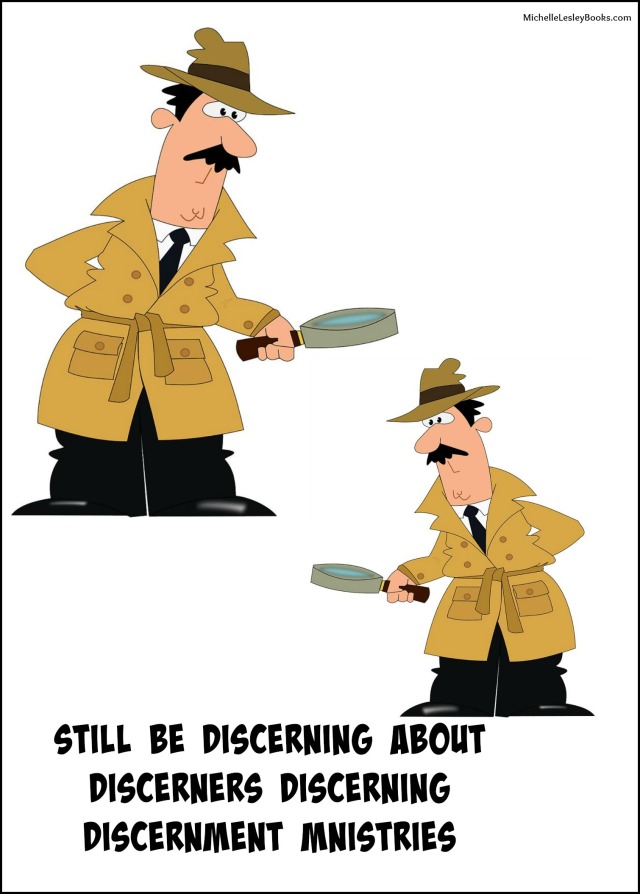
Recently, one of my favorite blogs, ParkingSpace23 (a fantastic, doctrinally sound blog I’d encourage everyone to subscribe to), published an excellent article by John Chester called Still Be Discerning about Discernment Ministries. It’s all about John’s thoughts on discernment blogs and podcasts and why he has chosen to swear off of them.
John seems like a thoughtful guy and he handled what can be a touchy subject evenly, calmly, scripturally, and with grace. As someone who frequently writes on discernment topics, it gave me some good food for thought and an opportunity to biblically examine both my writing and reading/listening habits. It’s a great article, I was thankful for it, and I agree with a lot of his points.
But while John has decided not to partake of discernment blogs and podcasts, I still find discernment ministry to be an important aspect of this blog as well as my personal spiritual “diet”. Does that mean I think John, or any other Christian, is wrong for not wanting to regularly read or listen to discernment material? Absolutely not! But I’d like to present a bit of a different perspective regarding the value of discernment ministry.
In the first few paragraphs of his article, John draws a distinction between two different types of discernment ministries- a disctinction which I think is both astute and important. John differentiates between what I would call “propositional” discernment sites like CARM, and, if I’m understanding him correctly, mine – which generally post single, position paper-type articles on a given false teacher or false doctrine – and what I would call “daily news” discernment ministries such as Berean Research and Fighting for the Faith – which report on the shenanigans du jour of false teachers and apostate churches.
John’s position is that the propositional discernment ministries [PDM] can be helpful when needed, but he is not fond of the daily news discernment ministries [DNDM]. I think both can be beneficial, assuming they’re done biblically. Take a look at John’s points and my counterpoints, and then you can prayerfully decide whether or not it would be profitable for your sanctification to include discernment media as part of your spiritual fare.
John’s point: “[DNDMs] often spend much time dissecting sermons or blog posts that someone with even a rudimentary sense of discernment would have stopped listening to or reading within the first few phrases.”
Michelle’s counterpoint: “Someone with even a rudimentary sense of discernment” is the crucial phrase here. Perhaps John is blessed to pastor a body of believers who are good bereans and most of the Christians he knows are discerning. I hope that’s the case. It should be the case that every believer has “a rudimentary sense of discernment” and immediately rejects false doctrine when she hears it. Nothing would bring me more joy.
But, sadly, that’s not the case. In fact, in my experience, the exact opposite is true, especially among Christian women. The vast majority of Christians are very undiscerning when it comes to false teachers and false doctrine. Often, people lack discernment because they’re false converts. But because most churches don’t proactively teach discernment, there are also plenty of genuninely born again believers who take at face value that anything which wears the label of “Christian,” is sold at a Christian retailer, or is proclaimed by a Christian celebrity is biblical and trustworthy.
I know, because I used to be one of those undiscerning Christians who hadn’t been taught any better by my church. Sure, I could pick out charlatans like Benny Hinn or Todd Bentley, and I probably would have described people like Kenneth Copeland and Jesse Duplantis as “wrong” or “that’s not what Baptists believe” without really knowing why. But the Beth Moore Bible studies that every church I’ve ever been a member of has pushed on its female membership? I had no idea she was teaching false doctrine, especially since my own church was endorsing her books.
It wasn’t until I Providentially “stumbled across” Todd Friel’s TV program, Wretched, one night several years ago that I began to understand what false doctrine was, why it was wrong, biblically, and how it could hurt me and the church. And it wasn’t until I discovered Chris Rosebrough’s Fighting for the Faith that I learned how to compare everything to Scripture – to listen to sermons with a discerning ear and read Christian books with a discerning mind. Todd and Chris taught me the discernment no church ever bothered to mention to me. And from the myriad of discerning Christians I’ve known, heard from, and read about, people like me are the rule, not the exception.
It’s not right that the church isn’t teaching Christians how to be discerning. I think every biblically responsible discernment ministry would agree that it is the church’s job, not a discernment ministry’s, to teach Christians to be bereans. But that’s not happening. And I thank God for those ministries who are standing in the gap- who have helped thousands of Christians like me.
John’s point: “[DNDMs] are unbiblical. What I mean is that there seems to me to be no biblical model or mandate for this kind of ‘ministry’.”
Michelle’s counterpoint: John may hold more closely to the regulative principle than I do, which would, understandably, account for my difference in perspective from this point. We do a lot of things, both in church and in parachurch ministry, that there’s no specific biblical model or mandate for. There’s no biblical model or mandate for vacation Bible school or crisis pregnancy ministry or handing out gospel tracts or even writing for a Christian blog. Yet these, and many other ministries, can carry the gospel to the lost (I’ve heard of many people who have read/listened to DNDMs, realized they were false converts, and have become believers.) and edify the saved – just like discernment ministries can. And there’s certainly a biblical mandate for that.
John’s point: “Did Jesus ever engage in a point by point take down of a particular Pharisee’s teaching that is recorded in Scripture? How much do we know about the Nicolaitans…in Revelation 2:15?… Or… the Colossian heresy…in Colossians 2:8?”
Michelle’s counterpoint: Jesus didn’t do sermon reviews (that we know of) the same way Chris Rosebrough does. But He did publicly enumerate and correct many of the Pharisees’ false teachings in Matthew 23. He publicly clarified Scripture and corrected unbiblical beliefs and false teachings – “You have heard it said…but I say to you…” – in the Sermon on the Mount. He publicly warned people against the false teaching of the scribes, Pharisees, and Sadducees. And every time those scribes, Pharisees, and Sadducees confronted Him with questions or after a miracle, He set them straight for the whole crowd to hear.
As to the Nicolaitan and Colossian heresies, Colossians and Revelation 2 were addressed to particular churches. Just because we may not know much about these heresies doesn’t mean the Ephesian and Colossian churches weren’t thoroughly familiar with them. Perhaps that’s why John and Paul didn’t elaborate- because their intended audiences were already knowledgeable about those heresies. And perhaps the reason they might have been familiar with those heresies is that they were constantly being warned about them. Every book in the New Testament (except Philemon) warns against false teaching or false teachers.
Not so with the church today. Christians are not only not being warned about the heresies and false teachers running rampant in evangelicalism, undiscerning pastors are actually embracing false teachers, inviting them to speak at their churches, simulcasting their conferences, sharing their social media posts, and ordering their materials for the church’s small groups. And the church at large is so biblically illiterate that Christians have no idea they’re being fed false doctrine.
John’s point: “Curiously many discernment mavens will quote 1 Peter 3:15 as a text that supports what they do. But to be blunt, it doesn’t, not by a long shot…. This is about being ready to proclaim Christ to those who would persecute you.”
Michelle’s agreement: I could not agree with this point more. This verse isn’t about discernment. (I usually hear this verse more frequently in support of apologetics ministries, and it isn’t about apologetics, either.) It’s about evangelism.
One of the main features of today’s false doctrine is the twisting of Scripture and ripping it out of context. How can we who do discernment work rebuke false teachers for taking Scripture out of context and then turn right around and do the same to justify our own ministries? We know better. Specks and logs, anyone?
There are plenty of other passages of Scripture (such as the ones I’ve cited above and others) that speak of the importance of warning against false teachers and removing false doctrine from the church. We should not be using a verse that has nothing to do with discernment to justify discernment ministry.
John’s point: “Don’t get me started on the lack of gentleness and respect [from 1 Peter 3:15] that permeates many of these blogs and podcasts.”
Michelle’s agreement/counterpoint: John is right, here. Some of the discernment ministries that (incorrectly) claim the first part of 1 Peter 3:15 as justification for their ministry are not following the second part of the verse which says to “do so with gentleness and respect”. There are discernment ministries whose articles I absolutely will not share or link to because their snideness and name calling are so over the top it overshadows the valid point they’re trying to make, sometimes even damaging their own credibility.
At the same time, we do see instances of Jesus using harsh language and calling false teachers names, and Paul, Elijah, and others couldn’t always be characterized as gentle or respectful.
The thing is, their cultural context was a little different from ours, and these are descriptive passages, not prescriptive. Sometimes different cultures call for different approaches. Additionally, one woman’s “gentle and respectful” is another woman’s “harsh and unkind.” I’ve written discernment articles that were characterized as hateful by some Christians and too nice toward the false teacher by others- both about the same article!
Although I fail miserably at it – often – I try to use 2 Timothy 2:24-26 as my guideline when I write:
And the Lord’s servant must not be quarrelsome but kind to everyone, able to teach, patiently enduring evil, correcting his opponents with gentleness. God may perhaps grant them repentance leading to a knowledge of the truth, and they may come to their senses and escape from the snare of the devil, after being captured by him to do his will.
It not only reminds me of how to contend for the faith (not quarrelsome, kind, patient, gentle), it reminds me who I’m contending for (those being held captive by Satan’s snare of false doctrine), and why I’m contending (that they might repent, know the truth, come to their senses, and escape captivity).
John’s point: “[DNDMs] are unhealthy…’you are what you eat’…A diet of constant critical speech and reading is naturally going to produce a critical spirit.”
Michelle’s agreement: This is absolutely true. I don’t know whether it makes me over-critical or not, but when I OD on discernment media it certainly makes me feel angry, frustrated, depressed, and that there’s no hope for the church. It takes my eyes off Christ and the very real salvific and sanctifying work He is still doing in churches across across the globe, and causes me to focus on the monster of false doctrine instead.
It’s exceedingly important that we not go overboard on discernment or any other single aspect of theology or or spiritual life. In order to be spiritually healthy, we must have a balance of all the good things: discernment, Bible study, prayer, evangelism, fellowship, worship, service, etc. When I find myself spending too much time in Discernment Land, I know it’s time to step back and readjust my focus.
John’s point: “They are not very helpful…I don’t think very many Christians, especially the kind who read theological blogs, are going to be taken in by [blatantly obvious false teachers].”
Michelle’s agreement/counterpoint: I’ve already shared my thoughts on the helpfulness of discernment ministries for Christians who are not discerning, but, if I’m understanding him correctly, I think what John is saying here is that Christians who are already discerning aren’t going to be taken in by false teachers, and, therefore, have little need for regular consumption of discernment media. I generally agree with that. I still subscribe to a few DNDMs and peruse their daily headlines, not because I need to learn discernment, but because I like to know what’s going on in the church, just like people skim section A of the newspaper because they like to know what’s going on in the world.
I might add, though, that just because someone is the type of person who reads theological blogs doesn’t mean he’s on top of things, discernment-wise. Thom Rainer writes a theological blog (and books, and has a seminary Ph.D), yet persists in allowing false doctrine onto the shelves of LifeWay despite the many rebukes he has received from pastors, seminarians, lay people, and, yes, discernment media. Not long ago, I took a class via video from a conservative Southern Baptist seminary president who positively (albeit in passing) cited Beth Moore and Rick Warren in one of the sessions. And these are just two isolated examples. There are many more.
John’s point: “[DNDMs] often have significant blindspots…In their rush to expose the errors of others, often discernment bloggers/podcasters can overlook real problems with themselves or with their theological allies, especially in the areas of tone and conduct.”
Michelle’s agreement: This is so true. There’s no way I could disagree with this, because I have been guilty of it myself far too often. I would only add that this is not a problem specific to discernment ministry. Every ministry has blind spots because every Christian has blind spots. We’re all guilty of hypocrisy, myopia, failure, and sin. And, because we’re believers, when a brother or sister points out our sin, we repent, we receive God’s wonderful, cleansing, restorative grace, mercy, and forgiveness, and we move forward in obedience to Him and His word.
John closes out his insightful article with this thought:
I am not saying that you must swear off “discernment” blogs and podcasts, but I am saying I did, for the reasons above along with others, and I think I am better off for it. I would challenge you to consider what I have written and to think deeply about your spiritual diet. I am exhorting you to be discerning about discernment ministries.
I am not saying you must partake of discernment blogs and podcasts. But I am saying I do, for the reasons above along with others, and I think I am better off for it. I would challenge you to consider what John and I have written and to think deeply about your spiritual diet. I am exhorting you to think about it, study about it, pray about it, and discern what God would have you do about consuming discernment media.
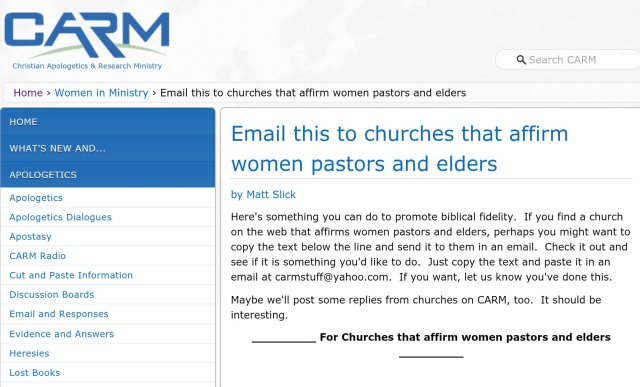
Are you familiar with the Christian Apologetics & Resource Ministry (CARM)? You should be. It’s an invaluable resource. From answers to tough questions, to apologetics training, to information on tons of cults, world religions, and heresies, CARM is a treasure trove of materials that will inform you, help you grow in your faith, and evangelize and disciple others.
Recently, I came across this resource article for churches which approve female pastors and elders. Readers often ask me for information like this that they can send out, so I thought I’d pass it along. Click here for the full article.
Recently, one of my favorite blogs, ParkingSpace23 (a fantastic, doctrinally sound blog I’d encourage everyone to subscribe to), published an excellent article by John Chester called Still Be Discerning about Discernment Ministries. It’s all about John’s thoughts on discernment blogs and podcasts and why he has chosen to swear off of them.
John seems like a thoughtful guy and he handled what can be a touchy subject evenly, calmly, scripturally, and with grace. As someone who frequently writes on discernment topics, it gave me some good food for thought and an opportunity to biblically examine both my writing and reading/listening habits. It’s a great article, I was thankful for it, and I agree with a lot of his points.
But while John has decided not to partake of discernment blogs and podcasts, I still find discernment ministry to be an important aspect of this blog as well as my personal spiritual “diet”. Does that mean I think John, or any other Christian, is wrong for not wanting to regularly read or listen to discernment material? Absolutely not! But I’d like to present a bit of a different perspective regarding the value of discernment ministry.
In the first few paragraphs of his article, John draws a distinction between two different types of discernment ministries- a disctinction which I think is both astute and important. John differentiates between what I would call “propositional” discernment sites like CARM, and, if I’m understanding him correctly, mine – which generally post single, position paper-type articles on a given false teacher or false doctrine – and what I would call “daily news” discernment ministries such as Berean Research and Fighting for the Faith – which report on the shenanigans du jour of false teachers and apostate churches.
John’s position is that the propositional discernment ministries [PDM] can be helpful when needed, but he is not fond of the daily news discernment ministries [DNDM]. I think both can be beneficial, assuming they’re done biblically. Take a look at John’s points and my counterpoints, and then you can prayerfully decide whether or not it would be profitable for your sanctification to include discernment media as part of your spiritual fare.
John’s point: “[DNDMs] often spend much time dissecting sermons or blog posts that someone with even a rudimentary sense of discernment would have stopped listening to or reading within the first few phrases.”
Michelle’s counterpoint: “Someone with even a rudimentary sense of discernment” is the crucial phrase here. Perhaps John is blessed to pastor a body of believers who are good bereans and most of the Christians he knows are discerning. I hope that’s the case. It should be the case that every believer has “a rudimentary sense of discernment” and immediately rejects false doctrine when she hears it. Nothing would bring me more joy.
But, sadly, that’s not the case. In fact, in my experience, the exact opposite is true, especially among Christian women. The vast majority of Christians are very undiscerning when it comes to false teachers and false doctrine. Often, people lack discernment because they’re false converts. But because most churches don’t proactively teach discernment, there are also plenty of genuninely born again believers who take at face value that anything which wears the label of “Christian,” is sold at a Christian retailer, or is proclaimed by a Christian celebrity is biblical and trustworthy.
I know, because I used to be one of those undiscerning Christians who hadn’t been taught any better by my church. Sure, I could pick out charlatans like Benny Hinn or Todd Bentley, and I probably would have described people like Kenneth Copeland and Jesse Duplantis as “wrong” or “that’s not what Baptists believe” without really knowing why. But the Beth Moore Bible studies that every church I’ve ever been a member of has pushed on its female membership? I had no idea she was teaching false doctrine, especially since my own church was endorsing her books.
It wasn’t until I Providentially “stumbled across” Todd Friel’s TV program, Wretched, one night several years ago that I began to understand what false doctrine was, why it was wrong, biblically, and how it could hurt me and the church. And it wasn’t until I discovered Chris Rosebrough’s Fighting for the Faith that I learned how to compare everything to Scripture – to listen to sermons with a discerning ear and read Christian books with a discerning mind. Todd and Chris taught me the discernment no church ever bothered to mention to me. And from the myriad of discerning Christians I’ve known, heard from, and read about, people like me are the rule, not the exception.
It’s not right that the church isn’t teaching Christians how to be discerning. I think every biblically responsible discernment ministry would agree that it is the church’s job, not a discernment ministry’s, to teach Christians to be bereans. But that’s not happening. And I thank God for those ministries who are standing in the gap- who have helped thousands of Christians like me.
John’s point: “[DNDMs] are unbiblical. What I mean is that there seems to me to be no biblical model or mandate for this kind of ‘ministry’.”
Michelle’s counterpoint: John may hold more closely to the regulative principle than I do, which would, understandably, account for my difference in perspective from this point. We do a lot of things, both in church and in parachurch ministry, that there’s no specific biblical model or mandate for. There’s no biblical model or mandate for vacation Bible school or crisis pregnancy ministry or handing out gospel tracts or even writing for a Christian blog. Yet these, and many other ministries, can carry the gospel to the lost (I’ve heard of many people who have read/listened to DNDMs, realized they were false converts, and have become believers.) and edify the saved – just like discernment ministries can. And there’s certainly a biblical mandate for that.
John’s point: “Did Jesus ever engage in a point by point take down of a particular Pharisee’s teaching that is recorded in Scripture? How much do we know about the Nicolaitans…in Revelation 2:15?… Or… the Colossian heresy…in Colossians 2:8?”
Michelle’s counterpoint: Jesus didn’t do sermon reviews (that we know of) the same way Chris Rosebrough does. But He did publicly enumerate and correct many of the Pharisees’ false teachings in Matthew 23. He publicly clarified Scripture and corrected unbiblical beliefs and false teachings – “You have heard it said…but I say to you…” – in the Sermon on the Mount. He publicly warned people against the false teaching of the scribes, Pharisees, and Sadducees. And every time those scribes, Pharisees, and Sadducees confronted Him with questions or after a miracle, He set them straight for the whole crowd to hear.
As to the Nicolaitan and Colossian heresies, Colossians and Revelation 2 were addressed to particular churches. Just because we may not know much about these heresies doesn’t mean the Ephesian and Colossian churches weren’t thoroughly familiar with them. Perhaps that’s why John and Paul didn’t elaborate- because their intended audiences were already knowledgeable about those heresies. And perhaps the reason they might have been familiar with those heresies is that they were constantly being warned about them. Every book in the New Testament (except Philemon) warns against false teaching or false teachers.
Not so with the church today. Christians are not only not being warned about the heresies and false teachers running rampant in evangelicalism, undiscerning pastors are actually embracing false teachers, inviting them to speak at their churches, simulcasting their conferences, sharing their social media posts, and ordering their materials for the church’s small groups. And the church at large is so biblically illiterate that Christians have no idea they’re being fed false doctrine.
John’s point: “Curiously many discernment mavens will quote 1 Peter 3:15 as a text that supports what they do. But to be blunt, it doesn’t, not by a long shot…. This is about being ready to proclaim Christ to those who would persecute you.”
Michelle’s agreement: I could not agree with this point more. This verse isn’t about discernment. (I usually hear this verse more frequently in support of apologetics ministries, and it isn’t about apologetics, either.) It’s about evangelism.
One of the main features of today’s false doctrine is the twisting of Scripture and ripping it out of context. How can we who do discernment work rebuke false teachers for taking Scripture out of context and then turn right around and do the same to justify our own ministries? We know better. Specks and logs, anyone?
There are plenty of other passages of Scripture (such as the ones I’ve cited above and others) that speak of the importance of warning against false teachers and removing false doctrine from the church. We should not be using a verse that has nothing to do with discernment to justify discernment ministry.
John’s point: “Don’t get me started on the lack of gentleness and respect [from 1 Peter 3:15] that permeates many of these blogs and podcasts.”
Michelle’s agreement/counterpoint: John is right, here. Some of the discernment ministries that (incorrectly) claim the first part of 1 Peter 3:15 as justification for their ministry are not following the second part of the verse which says to “do so with gentleness and respect”. There are discernment ministries whose articles I absolutely will not share or link to because their snideness and name calling are so over the top it overshadows the valid point they’re trying to make, sometimes even damaging their own credibility.
At the same time, we do see instances of Jesus using harsh language and calling false teachers names, and Paul, Elijah, and others couldn’t always be characterized as gentle or respectful.
The thing is, their cultural context was a little different from ours, and these are descriptive passages, not prescriptive. Sometimes different cultures call for different approaches. Additionally, one woman’s “gentle and respectful” is another woman’s “harsh and unkind.” I’ve written discernment articles that were characterized as hateful by some Christians and too nice toward the false teacher by others- both about the same article!
Although I fail miserably at it – often – I try to use 2 Timothy 2:24-26 as my guideline when I write:
And the Lord’s servant must not be quarrelsome but kind to everyone, able to teach, patiently enduring evil, correcting his opponents with gentleness. God may perhaps grant them repentance leading to a knowledge of the truth, and they may come to their senses and escape from the snare of the devil, after being captured by him to do his will.
It not only reminds me of how to contend for the faith (not quarrelsome, kind, patient, gentle), it reminds me who I’m contending for (those being held captive by Satan’s snare of false doctrine), and why I’m contending (that they might repent, know the truth, come to their senses, and escape captivity).
John’s point: “[DNDMs] are unhealthy…’you are what you eat’…A diet of constant critical speech and reading is naturally going to produce a critical spirit.”
Michelle’s agreement: This is absolutely true. I don’t know whether it makes me over-critical or not, but when I OD on discernment media it certainly makes me feel angry, frustrated, depressed, and that there’s no hope for the church. It takes my eyes off Christ and the very real salvific and sanctifying work He is still doing in churches across across the globe, and causes me to focus on the monster of false doctrine instead.
It’s exceedingly important that we not go overboard on discernment or any other single aspect of theology or or spiritual life. In order to be spiritually healthy, we must have a balance of all the good things: discernment, Bible study, prayer, evangelism, fellowship, worship, service, etc. When I find myself spending too much time in Discernment Land, I know it’s time to step back and readjust my focus.
John’s point: “They are not very helpful…I don’t think very many Christians, especially the kind who read theological blogs, are going to be taken in by [blatantly obvious false teachers].”
Michelle’s agreement/counterpoint: I’ve already shared my thoughts on the helpfulness of discernment ministries for Christians who are not discerning, but, if I’m understanding him correctly, I think what John is saying here is that Christians who are already discerning aren’t going to be taken in by false teachers, and, therefore, have little need for regular consumption of discernment media. I generally agree with that. I still subscribe to a few DNDMs and peruse their daily headlines, not because I need to learn discernment, but because I like to know what’s going on in the church, just like people skim section A of the newspaper because they like to know what’s going on in the world.
I might add, though, that just because someone is the type of person who reads theological blogs doesn’t mean he’s on top of things, discernment-wise. Thom Rainer writes a theological blog (and books, and has a seminary Ph.D), yet persists in allowing false doctrine onto the shelves of LifeWay despite the many rebukes he has received from pastors, seminarians, lay people, and, yes, discernment media. Not long ago, I took a class via video from a conservative Southern Baptist seminary president who positively (albeit in passing) cited Beth Moore and Rick Warren in one of the sessions. And these are just two isolated examples. There are many more.
John’s point: “[DNDMs] often have significant blindspots…In their rush to expose the errors of others, often discernment bloggers/podcasters can overlook real problems with themselves or with their theological allies, especially in the areas of tone and conduct.”
Michelle’s agreement: This is so true. There’s no way I could disagree with this, because I have been guilty of it myself far too often. I would only add that this is not a problem specific to discernment ministry. Every ministry has blind spots because every Christian has blind spots. We’re all guilty of hypocrisy, myopia, failure, and sin. And, because we’re believers, when a brother or sister points out our sin, we repent, we receive God’s wonderful, cleansing, restorative grace, mercy, and forgiveness, and we move forward in obedience to Him and His word.
John closes out his insightful article with this thought:
I am not saying that you must swear off “discernment” blogs and podcasts, but I am saying I did, for the reasons above along with others, and I think I am better off for it. I would challenge you to consider what I have written and to think deeply about your spiritual diet. I am exhorting you to be discerning about discernment ministries.
I am not saying you must partake of discernment blogs and podcasts. But I am saying I do, for the reasons above along with others, and I think I am better off for it. I would challenge you to consider what John and I have written and to think deeply about your spiritual diet. I am exhorting you to think about it, study about it, pray about it, and discern what God would have you do about consuming discernment media.
If you are considering commenting or sending me an e-mail objecting to the fact that I warn against false teachers, please click here and read this article first. Your objection is most likely answered here. I won’t be publishing comments or answering emails that are answered by this article.
This article is kept continuously updated as needed.
Discerning the False Teachers: Beth Moore Part 1 and Part 2 are episodes of the A Word Fitly Spoken podcast with Michelle Lesley and Amy Spreeman based on this article if you’d like to listen to an audio version.
Beth Moore is easily the world’s best known women’s Bible study author and teacher in the world. With her down home charm, endless energy, and stunning smile, she has captured the hearts of millions with her humor and storytelling style of teaching.
In forty years of ministry, Beth has written dozens of books. She also gives numerous Living Proof Live conferences every year and has a radio show and a television show on TBN, both called Living Proof with Beth Moore (canceled as of Dec. 2024).
Beth truly seems to care about her followers and her passion about the issues of sexual abuse and racism have endeared her to many inside and outside the church.
As beloved and likable as she is, it would be so much easier and more pleasant to jump on the Beth Bandwagon than to have to warn against her as a false teacher. But as Christians, no matter how much we love a certain teacher, our highest love and loyalty must always be to Christ and His Word first, which means we must reject anything – even a beloved teacher – that is at odds with Him and the Scriptures. Beth Moore’s teaching and behavior conflicts with Scripture in several ways. For these reasons it is my sad duty to recommend that you not follow Beth Moore or receive any teaching from her or anyone connected to Living Proof Ministries.
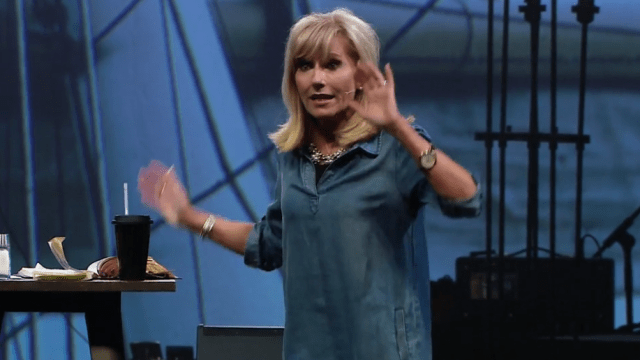
There are dozens, if not hundreds, of videos on YouTube featuring Beth Moore’s preaching and Bible teaching which clearly show men in the audience. Beth Moore has, for quite a while, been teaching (screenshot) and preaching to men as well as women. First Timothy 2:12 clearly forbids this.
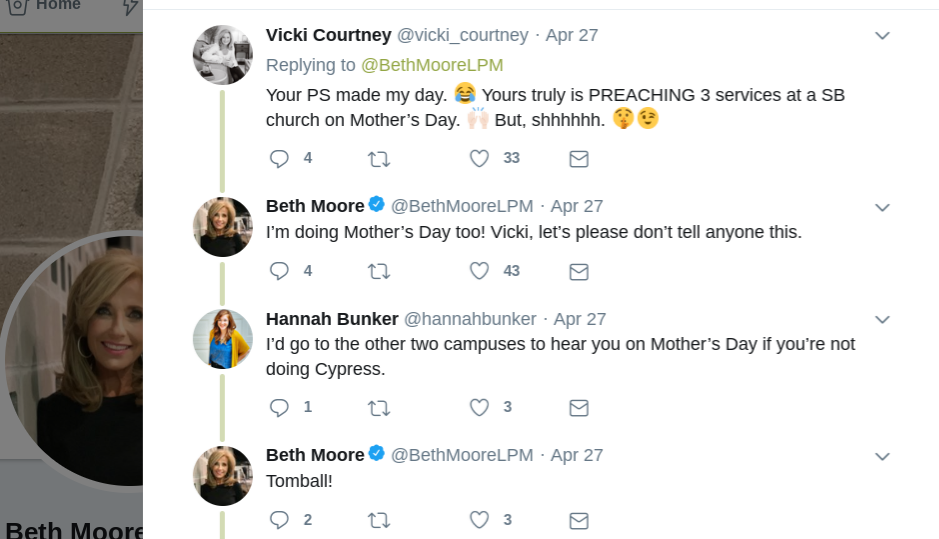
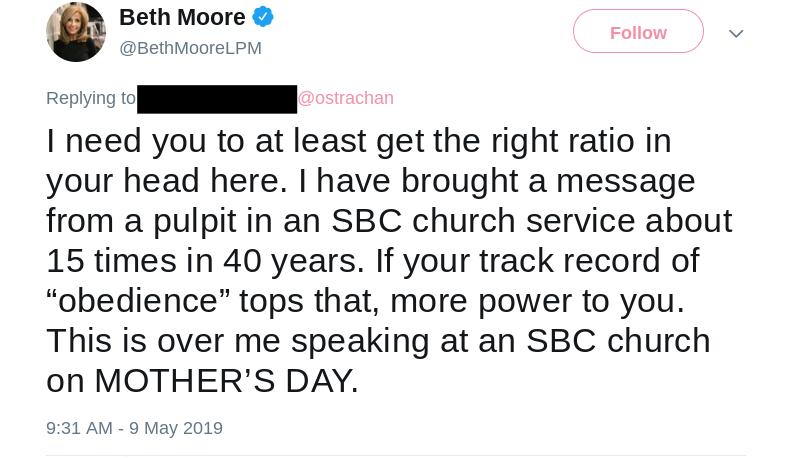
For those who would try to defend her by saying, “She can’t help it if men come to her conferences,” or “Co-ed conference preaching isn’t ‘in the church’ so it’s OK,” Beth not only preaches to men at conferences and other parachurch events, she is no stranger to preaching Sunday morning sermons to the entire congregation (including men) in churches (see links and videos above and the Additional Resources section at the end of this article). In addition to the videos above of two of her Sunday morning sermons, the screenshot below refers to Beth preaching the Mother’s Day Sunday morning service at the Tomball, Texas campus of her (now former) home church, Bayou City Fellowship, on May 12, 2019 (read more here).
(And to those who would attempt to defend the trend of women preaching the Sunday sermon on Mother’s Day, let’s be clear about something. The Bible doesn’t say women are prohibited from preaching except on Mother’s Day. Mother’s Day didn’t even exist when Scripture was written. Scripture makes the blanket statement that women are not to preach to, teach Scripture to, or exercise authority over men in the gathering of the Body. Period.)
Here (in a continuation of the preaching on Mother’s Day kerfuffle), Beth admits to having preached in multiple Southern Baptist worship services over her 40 year career (she has also preached in many non-SBC churches) and seems to proudly defend her sin of doing so, while simultaneously boasting of her track record of obedience, by saying it “only” happened fifteen times.
It’s a bit confusing. Is Beth saying preaching to men is a sin and we should be grateful she “only” did it fifteen times? If so, this is not how we handle sin. We do not boast like the Pharisee about how few times we have sinned and how obedient we are, we grieve over even one sin, repent, and cry out with the publican, “God be merciful to me, a sinner!”. Also if Beth is saying it’s a sin, why is she defending the fact on Thursday, May 9, that she is still planning to preach on Sunday, May 12? Why isn’t she instead confessing her plan to sin, humbly repenting, and announcing that she will not preach on Sunday?
If Beth is saying preaching to men is not a sin, why is she defending herself as only having done it fifteen times? Why didn’t she do it far more than only fifteen times over 40 years? Why not proudly enumerate all the times and places she has preached? Why have we not heretofore heard about these fifteen preaching events, as we hear about all her other speaking events, if it was OK for her to preach? Why didn’t she list the Mother’s Day event in question on her website alongside all her other speaking engagements? Why didn’t she talk it up on social media as she does with other speaking engagements? Why didn’t the church she’s speaking at excitedly advertise that she would be speaking as other venues do when she speaks?
Beth seems to know that preaching to men is a sin, but is trying to defend the fact that she does so.
Beth Moore partners with, and is being influenced by, false teachers
Scripture is quite clear that we are to have nothing to do with false teachers, especially when it comes to ministry. But Beth has been surrounding herself with false teachers for decades.
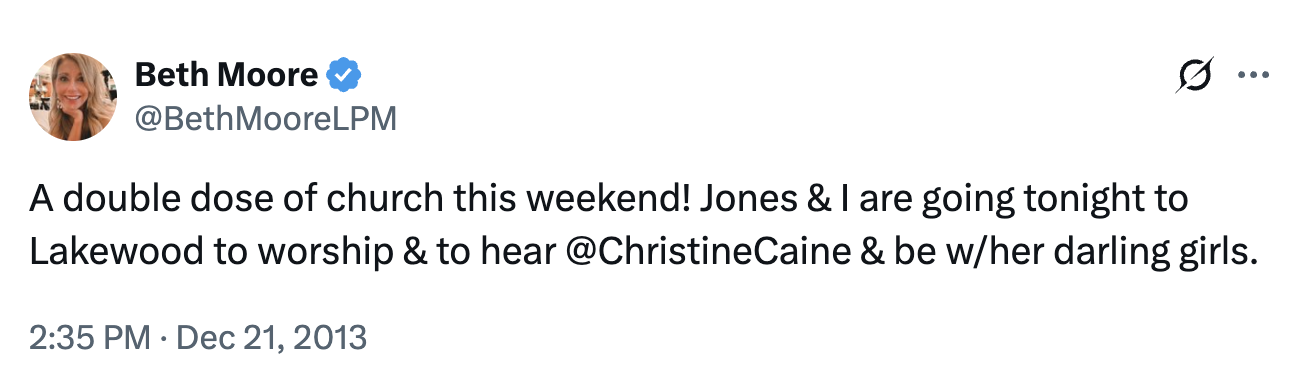
Beth Moore tweeted this in December 2013. “Lakewood” is prosperity preacher Joel Osteen’s church. Christine Caine also preaches to men (as she did at Lakewood that night) and originally hails from the leadership team of Word of Faith (prosperity gospel) church, Hillsong.
One need only peruse Beth’s Twitter feed to see other false teachers she allows herself to be influenced by: Matthew Vines, Rachel Held Evans, Christine Caine, Andy Stanley, and more (including Jen Hatmaker and Jonathan Merritt – see An Open Letter to Beth Moore below).
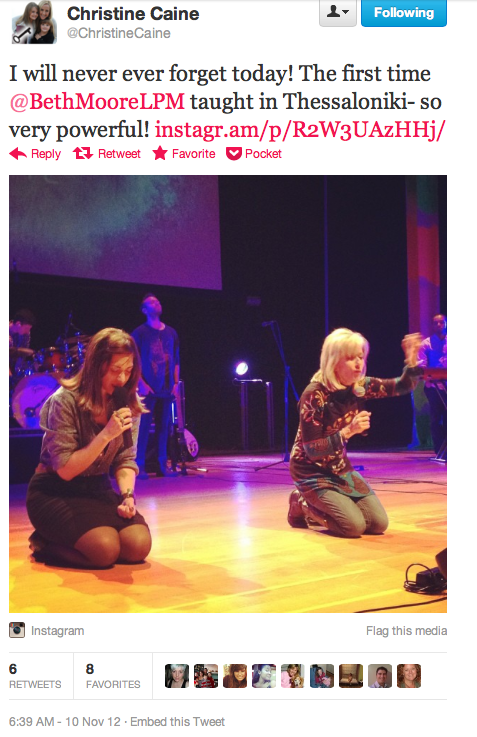
(Screenshot) As you can see in the screenshot and in the video below, not only is Beth preaching at a Hillsong conference, it’s a co-ed conference, so she’s once again preaching to men.
At the 0:50 mark Beth says, “I’ve gotten to serve at three different ‘Colours’…”. She’s referring to Colour Conference, Hillsong’s annual women’s conference, which seems now to have been replaced by the co-ed Hillsong Conference at which she is preaching in the video above.
Beth Moore has been a featured speaker at Hillsong‘s Colour Conference for women several times (2012, 2014, 2015), and at the 2017 Hillsong Conference which is co-ed. Until scandals over recent years forced Hillsong to scale back its media empire, Beth even had her own page at the Hillsong church website and was featured multiple times on the Hillsong channel. She was also a featured speaker at the Be the Change conference with Christine Caine and Lisa Bevere in 2012.
In 2015, Beth launched her own show on TBN, which is sometimes jokingly called the “Total Blasphemy Network,” due to the fact that nearly all of their programs feature or are hosted by some of the worst of the worst false teachers, mostly those of the New Apostolic Reformation variety. (On December 11, 2024, Beth announced she was breaking with TBN and would henceforth be releasing content on her YouTube channel and Living Proof app.)
The pictures below were posted by former head “pastor” of Hillsong, Brian Houston, on his Facebook page on March 8, 2019 after he interviewed Beth for his TBN television show “Let’s Talk, with Brian Houston”.
Beth Moore claims to receive direct, personal, extra-biblical revelation from God
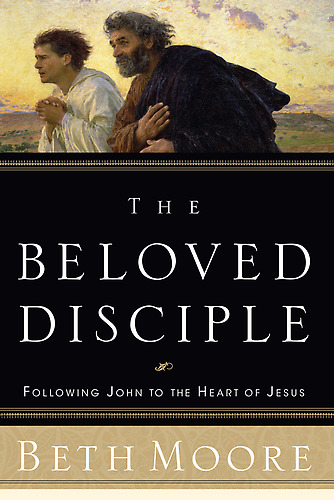
Beloved, I am convinced one of our severest needs is pure rest. Not only sleep, but refreshment and recreation. Recently God spoke to me about capturing what He and I are calling “Sabbath moments.” Like many of yours, my schedule right now is particularly tough, and I see no time in the near future for a number of days off. God spoke to my heart one Saturday morning while I was preparing for Sunday school: “My child, in between more intense rests, I want to teach you to take Sabbath moments.” I wasn’t certain what He meant. Just that morning God confirmed His desire for me to drive all the way to the other side of Houston to the medical center to visit a patient with brain cancer. I was very thankful for the privilege of visiting this patient, but I knew in advance it would be tough emotionally and far from restful. Excerpted from Beth Moore’s The Beloved Disciple
Aside from the fact that it’s unbiblical in and of itself for Beth to claim that God is talking to her, God is not inventing new teachings besides the ones He has already given us in Scripture. And this “Sabbath moments” teaching is found nowhere in Scripture. Passages like 2 Timothy 3:16-17 and 2 Peter 1:3 explain that Scripture is sufficient to teach us everything we need pertaining to life and godliness.
Additionally, notice that Beth says “I wasn’t certain what He meant.” When you have a few hours, go grab your Bible and look up every single passage about God actually speaking to somebody. Did any of them ever say, “I wasn’t certain what He meant.”? Absolutely not. When God speaks to someone, He is completely, perfectly clear about what His message means.
What God began to say to me about five years ago, and I’m telling you it sent me on such a trek with Him, that my head is still whirling over it.
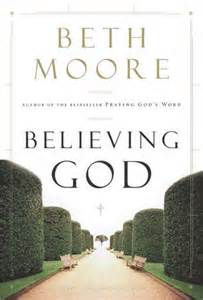
He began to say to me, ”I’m gonna tell you something right now, Beth; and boy, you write this one down. And you say it as often as I give you utterance to say it: ‘My Bride is paralyzed by unbelief. My Bride is paralyzed by unbelief.’” And He said, “Startin’ with you.” Excerpted from Beth Moore’s “Believing God” video (below)
The infamous “hairbrush story” in which Beth claims God told her to go up to a stranger in the airport and brush his hair.
In her blog article It’s Hunting Season for Heretics, Beth defends herself against those calling her to repent of believing and teaching extra-biblical revelation with this comment, displaying either her confusion or ignorance about God’s Word and His authority:
“Nothing equates with the Scriptures: no word of knowledge, no prophetic message, no insight, no revelation, no dream, no vision. Nothing. That doesn’t mean they can’t be valid. The New Testament says they can. But they must never supplant or be placed on the same level with the Scriptures.”
This makes absolutely no sense whatsoever. First of all, where – in context and rightly handled – does the New Testament say this, as she claims? It can’t. All of the dreams, visions, prophecies, etc. in the Bible from God to His people became Scripture once they were written down, and we know that all Scripture is breathed out by God. Know what that means? God Himself equates all of these types of revelation with Scripture.
When God speaks, God speaks. He doesn’t speak authoritatively in Scripture and non-authoritatively or less authoritatively outside of Scripture. Doing so would make Him imperfect and, thus, not God. People who claim to receive “words of knowledge, prophetic messages, insights, revelations, dreams, and visions” claim that these extra-biblical revelations are God speaking to them. If this is true, and this really is God speaking, then His spoken word to them is “on the same level as Scripture”. (And I won’t even go into the instances in which these folks, including Beth Moore, have said God has told them something that conflicts with Scripture or that God told them something was going to happen and it didn’t. I guess God just gets it wrong sometimes?) If it is not true, and it really isn’t God speaking to them, then why are we listening to them and why are they saying that their own ideas and imaginings are God speaking to them?
These are just a few of the numerous examples of Beth Moore supposedly receiving personal, direct revelation from God. Pick up any of her books or watch any video of her teaching, and count how many times she says, “God told me…” or “God said…” or “I think…” or “I believe…” or bases her teaching on a personal experience, story, or what God supposedly spoke to her rather than teaching what God’s all-sufficient word clearly says.
Beth Moore refuses correction
Beth preaching (to men, once again) at the 2014 Awaken Now conference.
Scripture teaches that the wise humble themselves and receive biblical correction. But in this video, Beth Moore preemptively strikes out at anyone who sees and hears what she will soon be teaching or doing and finds it to be in conflict with Scripture. Do you notice she does not quote or read a single passage of Scripture to back up what she is saying? Notice how many times she says “I believe…” This is all based on her own subjective ideations.
Instead of taking a step back and honestly evaluating where she is wrong on the biblical issues she has been called to account for, Beth Moore frequently doubles down as in this blog post striking out against people calling her a heretic or a false teacher for “disagreement” or “getting something wrong.” My comment to her on this article was:
At the end of this same blog post, in response to comments like mine calling her to repent for her false doctrine, Beth later wrote an addendum, the gist of which was, “I’m still right and anybody who disagrees with me is wrong.” This just further illustrates her inability to accept correction and her tendency to double down when reproved.
Another example of Beth’s refusing to accept correction (technically, it wasn’t even correction, but a request for her to clarify her position on homosexuality) came during 2019’s “Open Letter to Beth Moore” debacle (*see below).
Beth Moore is heading toward affirming homosexuality
In the summer of 2019, five women bloggers and Bible teachers and I, published An Open Letter to Beth Moore. It was subsequently signed by over 500 additional Christian women. The letter was merely a request for clarification of Beth’s views on homosexuality since she maintains public, adulatory friendships with well known homosexuality-affirming evangelicals such as Jen Hatmaker and Jonathan Merritt, and since she has been virtually silent on the issue of homosexuality in recent years while not hesitating to speak out on other heinous sins.
For two and a half weeks, *Beth ignored the letter, slandered the signers of the letter, and refused to make her position on homosexuality clear in any venue. It was then discovered that Beth had biblically addressed the sin of homosexuality in her book Praying God’s Word, but had later removed this section from the book because she felt she had “exceeded Scripture”. Finally, Beth wrote a blog post explaining why she had removed this passage and making a biblical statement on human sexuality, yet still not declaring homosexuality to be a sin. (You can read more about this series of events in my articles Questions about the Open Letter to Beth Moore and An Open Letter to Beth Moore – Timeline of Events.)
A few weeks after Beth’s blog post, on her LifeWay-sponsored TBN television show, in an episode entitled Staying Afloat on the Fellow Ship – Part 4, Beth admitted she had been looking into the arena of same sex attracted (SSA) Christianity
Though Beth’s words may not sound problematic to some, Elizabeth Prata explains in her article Listen carefully to what she is saying in this video…, exactly why Beth’s remarks signal her trajectory toward acceptance of homosexuality:
In her latest lesson video on unity and fellowship, Moore used many phrases and code words that indicate her stance toward same sex attraction, homosexuality, and their attendant issues, is aligned with the aforementioned folks she was supposed to be ministering to in love by warning against these very things.
Moore makes it sound as if homosexuals are doing Jesus a favor by choosing celibacy. Homosexually attracted people are no different in their sin than…any other flavor of sexual sin…touting their “tremendous sacrifice” makes it seem as if they are.
I believe this video and Moore’s recent handling of the homosexuality issue means Moore seems to be readying herself to ‘come out’ as it were, of affirming homosexuals in some way as believers.
Beth Moore is “going woke” and progressive
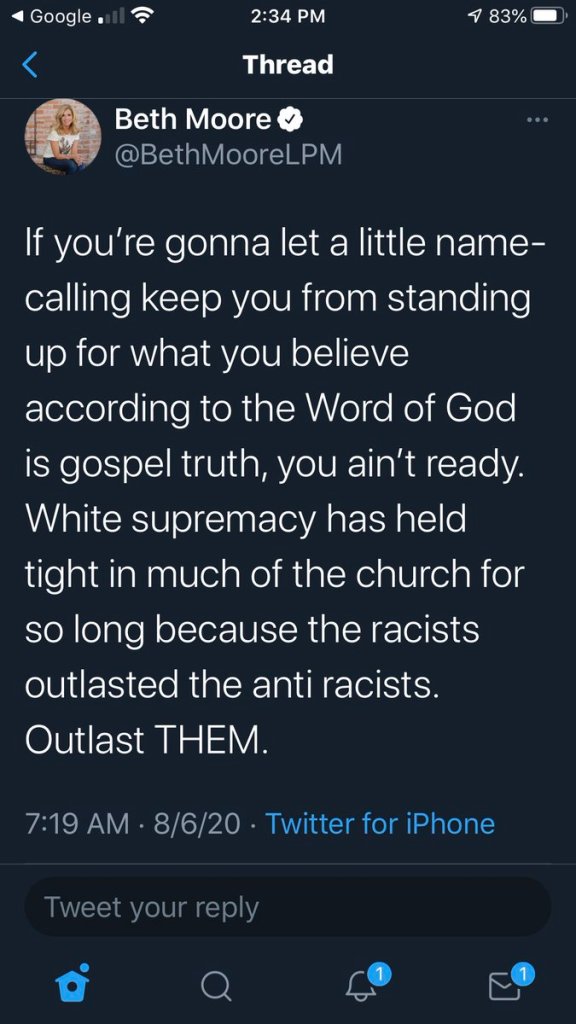
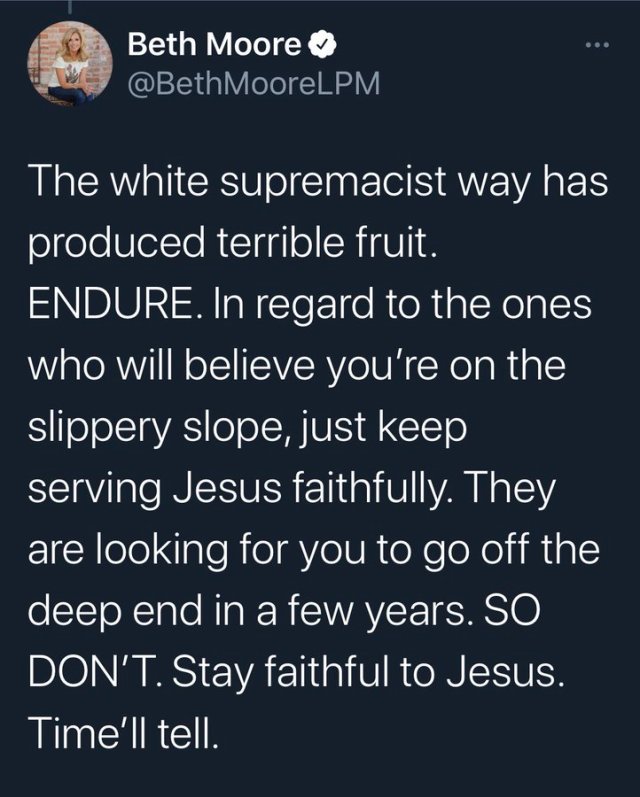
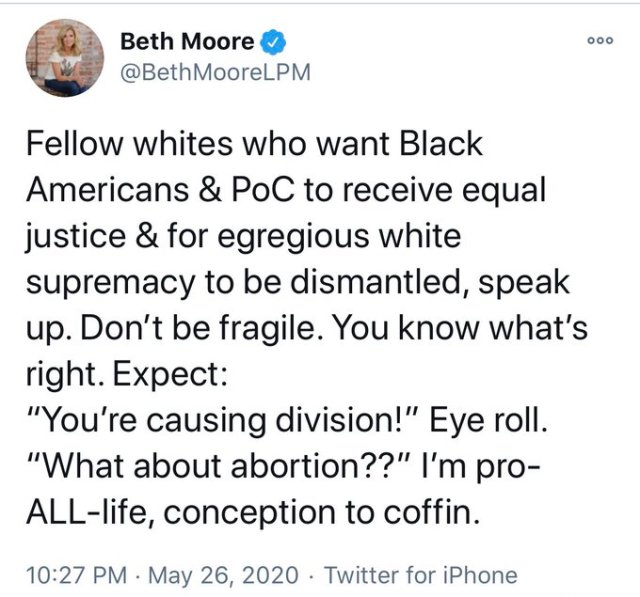
It’s difficult to give a precise definition for what “woke” means, but generally speaking, it’s basically what you see playing out in race relations in the U.S. right now: Critical Race Theory. White privilege. Reparations. Oppression. Repent of and renounce your whiteness. White people’s racism is so deep seated we’re not even conscious of it. White power, white privilege, and racism are inextricably embedded in politics, education, religion, economics- every single system in existence. It is a paradigm through which social justice issues are viewed and addressed, and “woke” means you’ve finally been “awakened” to these supposed truths. In addition to racial issues many would also include more general social justice issues such as illegal immigration, poverty, etc., under the banner of “wokeness”.
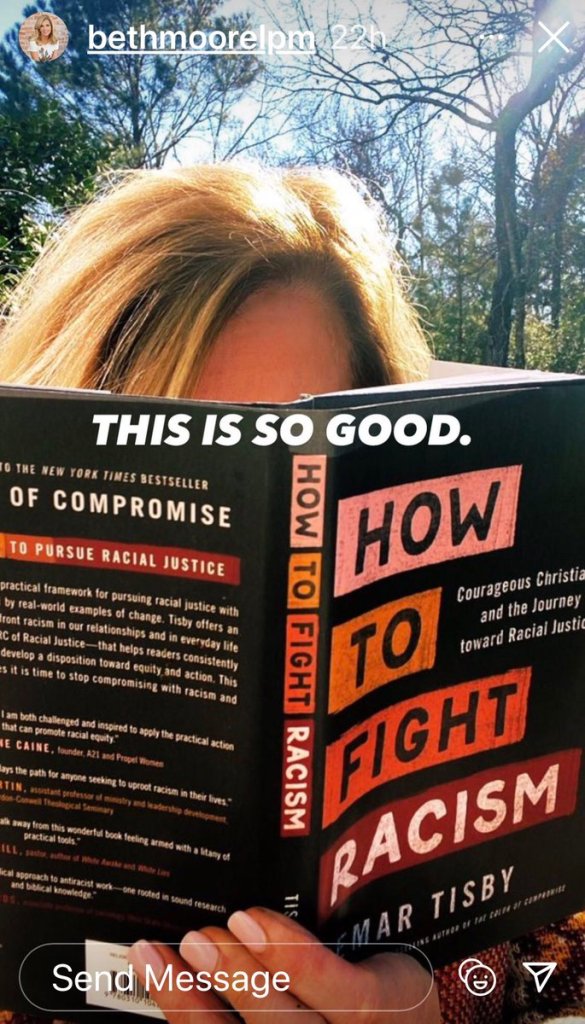
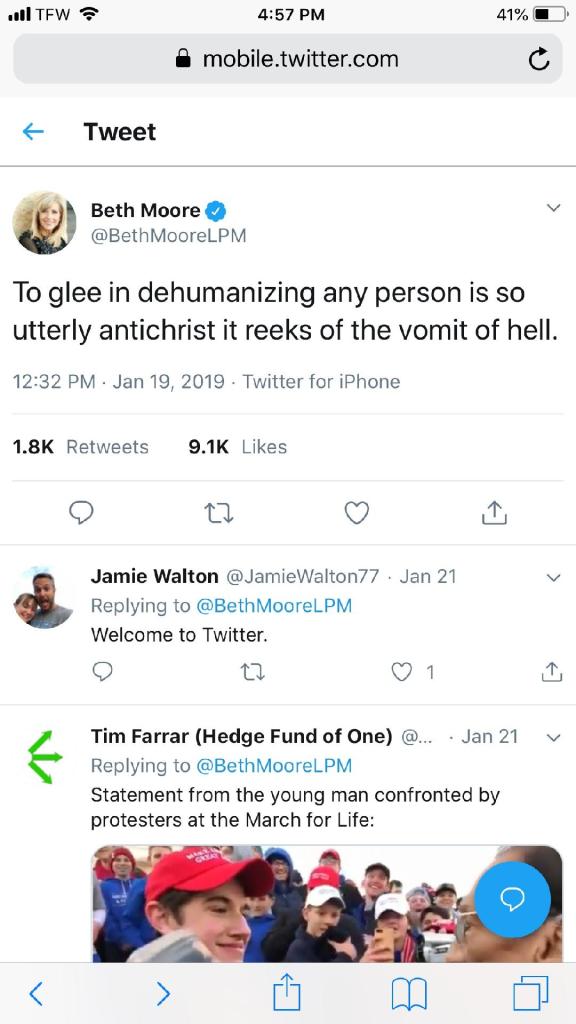
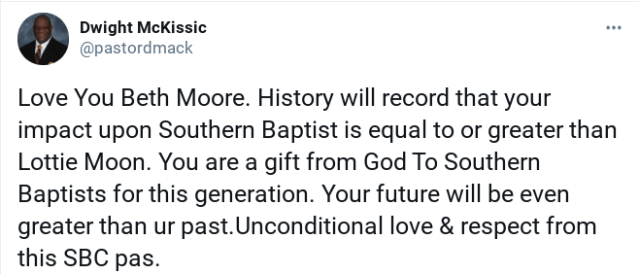
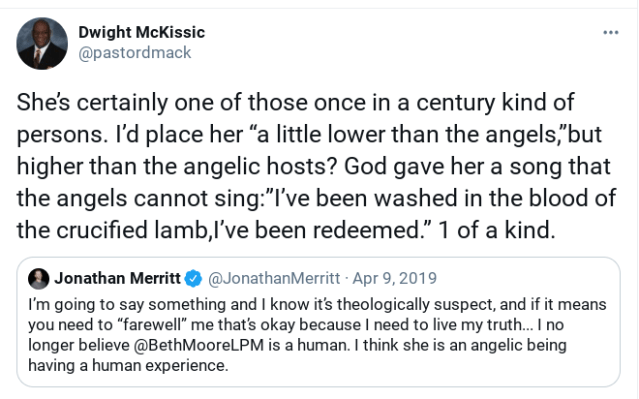
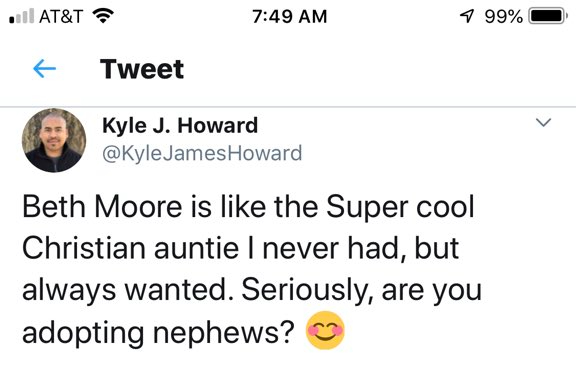
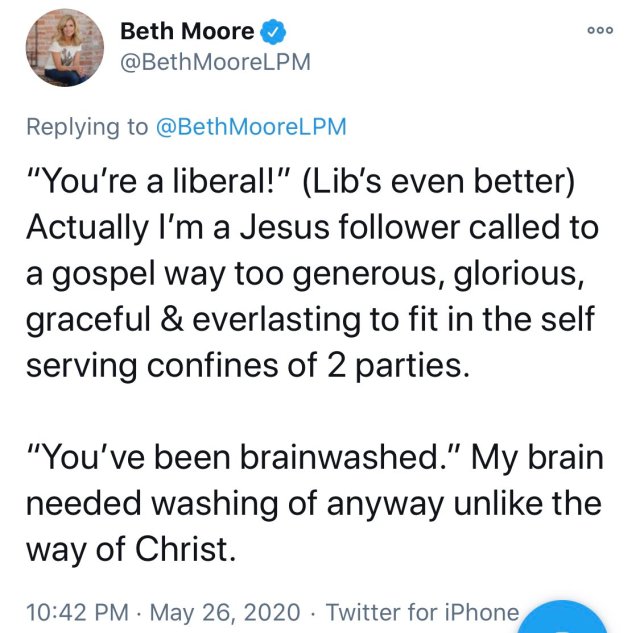
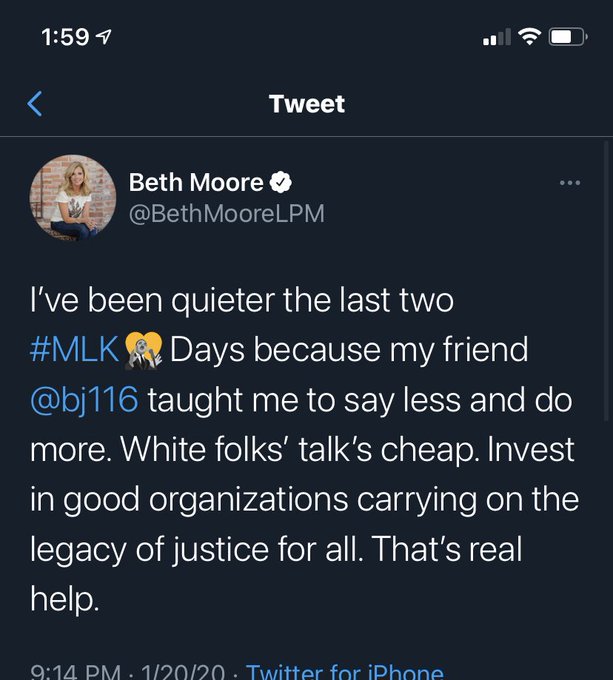
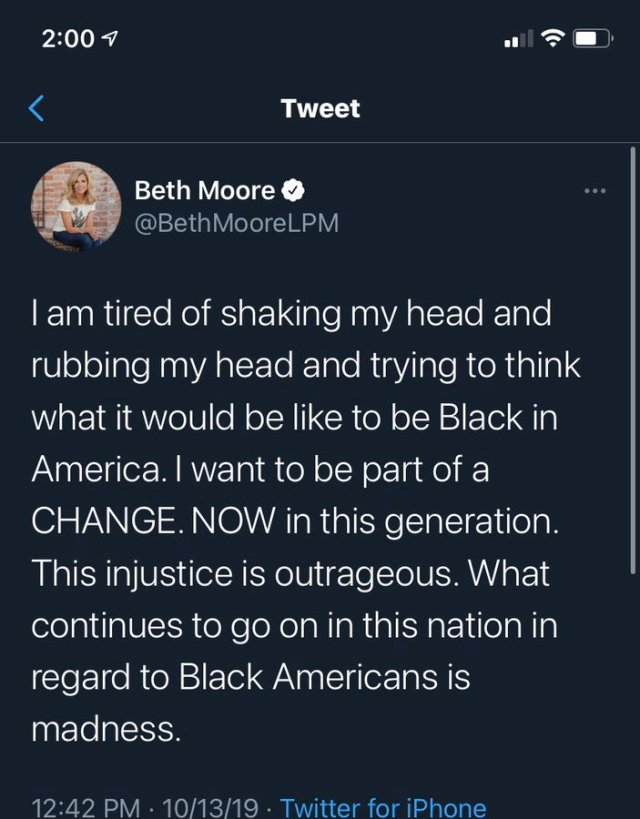
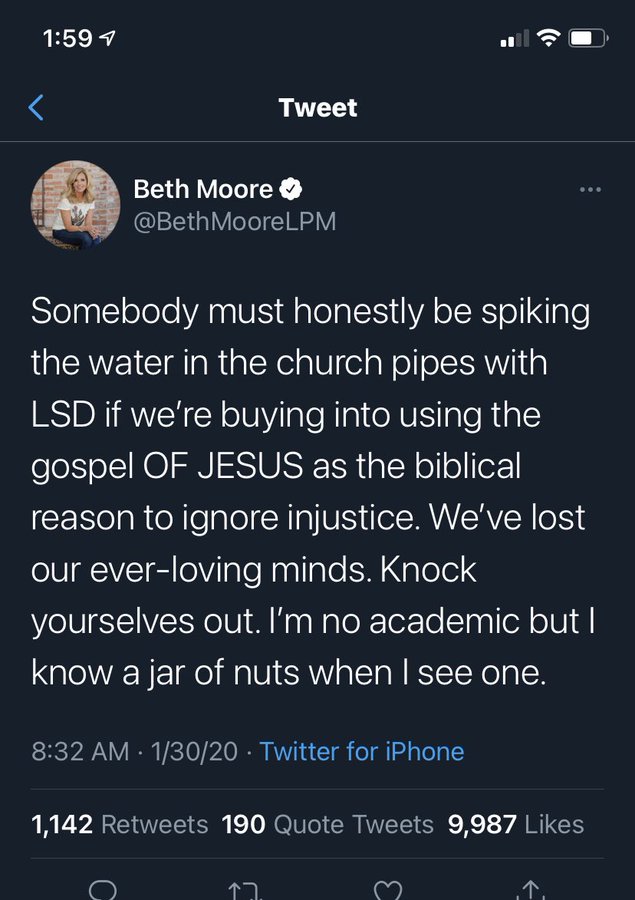
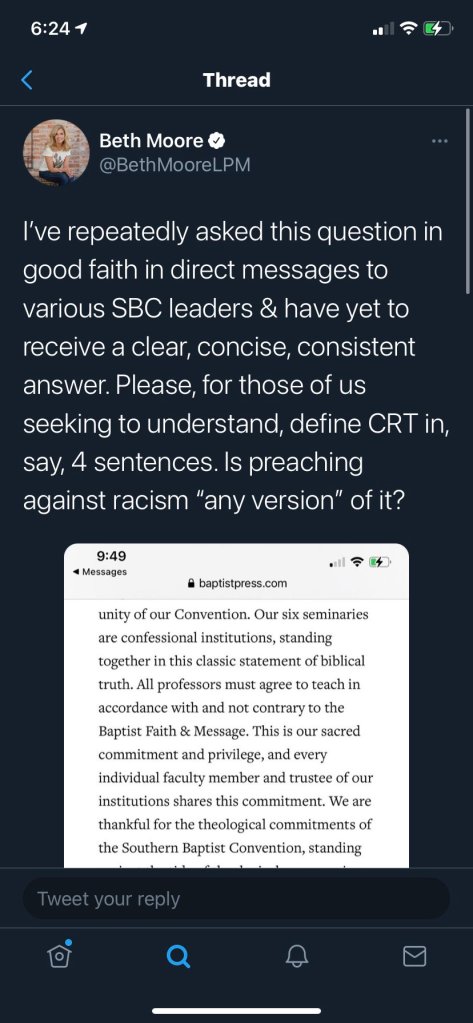
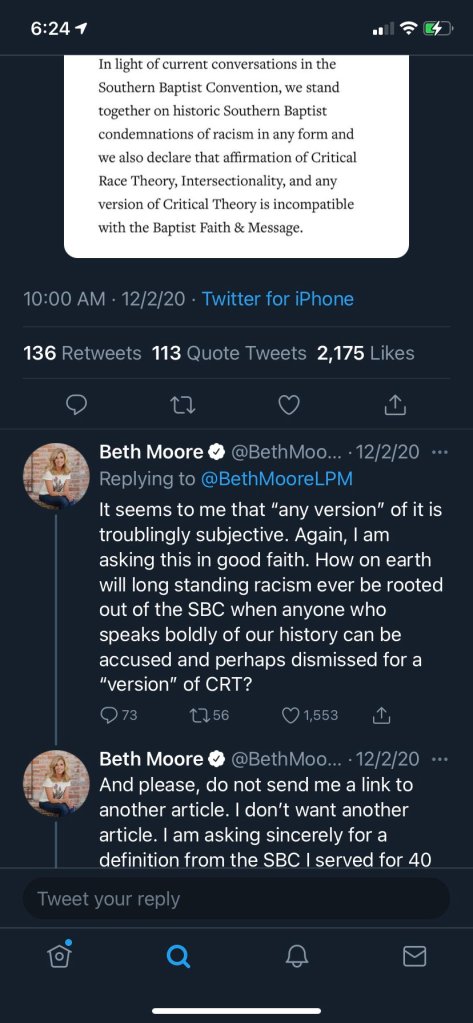
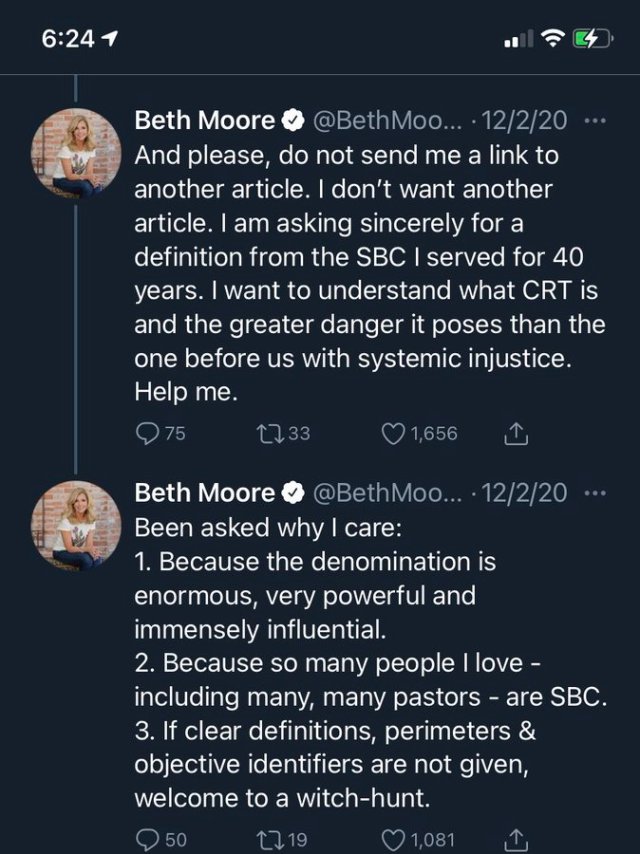
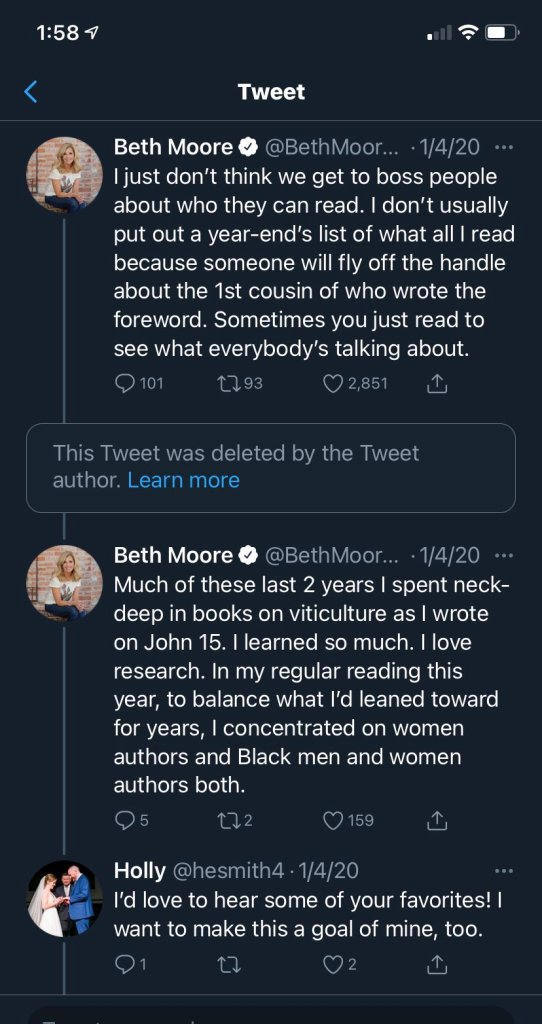
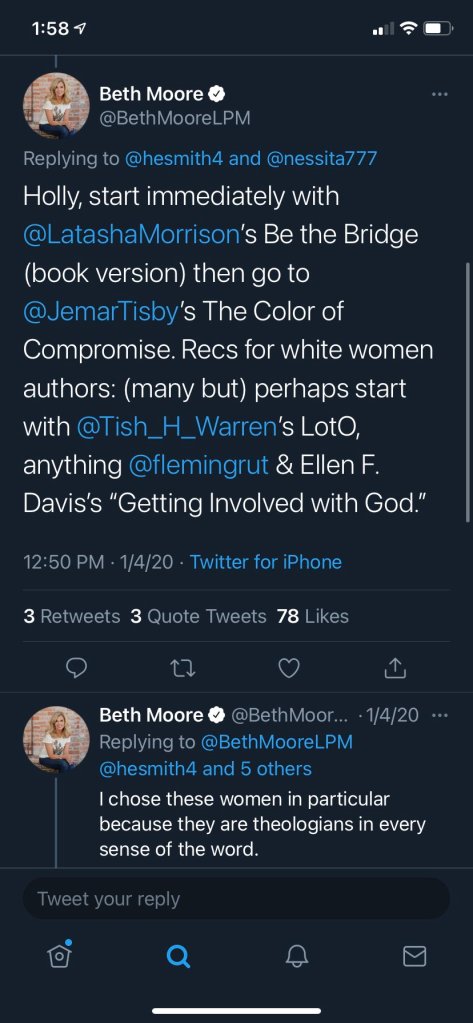
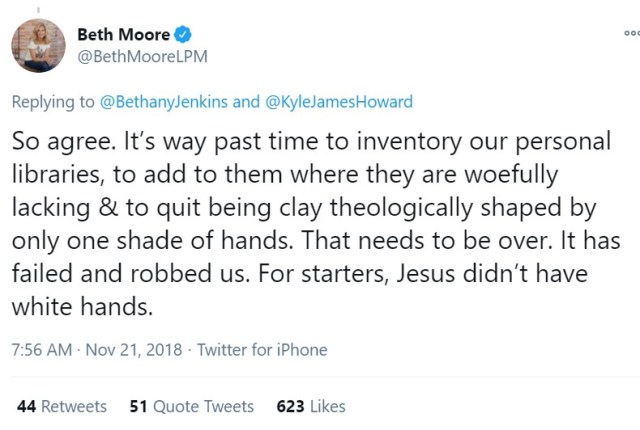
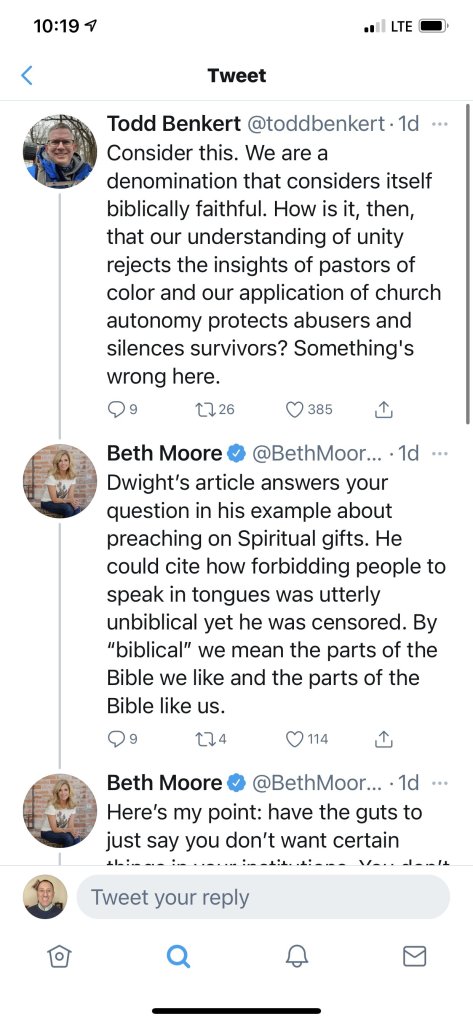
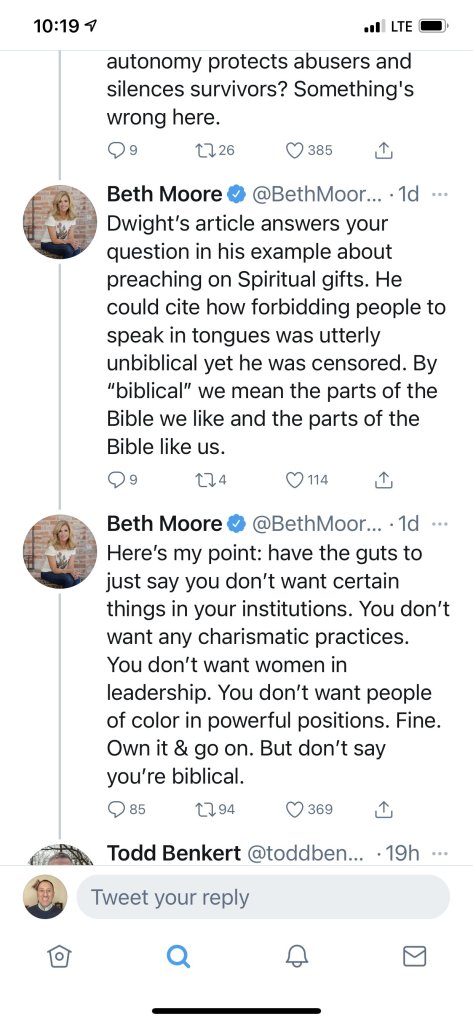
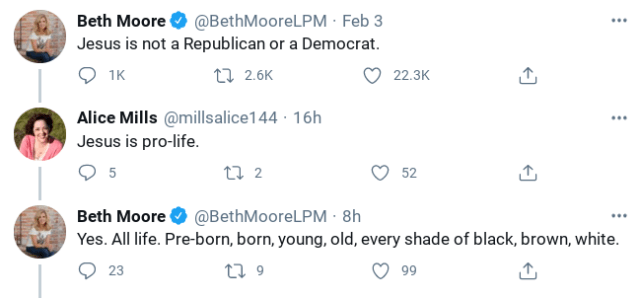
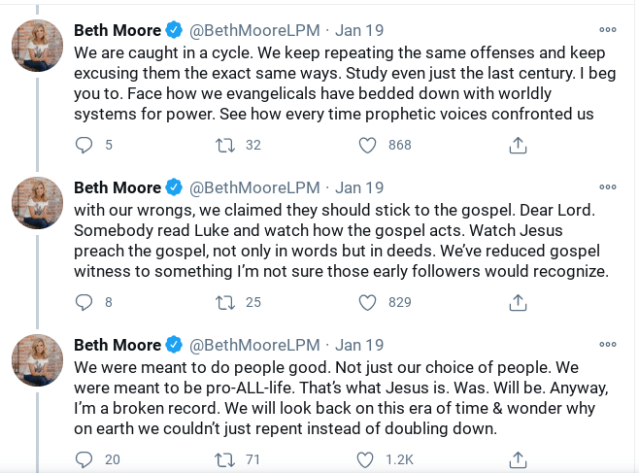
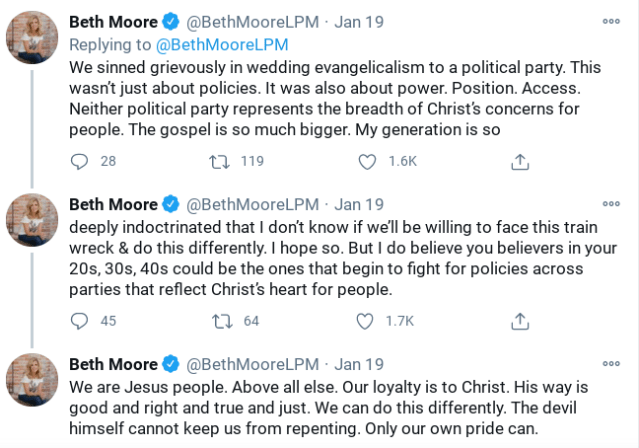
Over the past few years, Beth has been on more and more of a woke trajectory. Many of her tweets on Twitter indicate this, and she has not only befriended several who are leaders in the evangelical woke stream, she has also publicly praised them, recommended their books, and yoked with them in ministry, which is a violation of Scripture. Some of these include Jemar Tisby, Dwight McKissic, Charlie Dates (pastor of Progressive Baptist Church, where Beth has preached the Sunday sermon), “racial trauma counselor” Kyle J. Howard, and LaTasha Morrison, to name a few. You’ll also notice in the slideshow below that Beth now subscribes to the progressive “pro-all of life” version of “pro-life” – that in order to truly consider yourself “pro-life” you must also be pro-illegal immigration, pro-CRT, pro-intersectionality, and so on. In other words, you must be “pro-” anything and anyone liberals claim are being wronged or oppressed, regardless of whether or not it may be illegal or unbiblical.
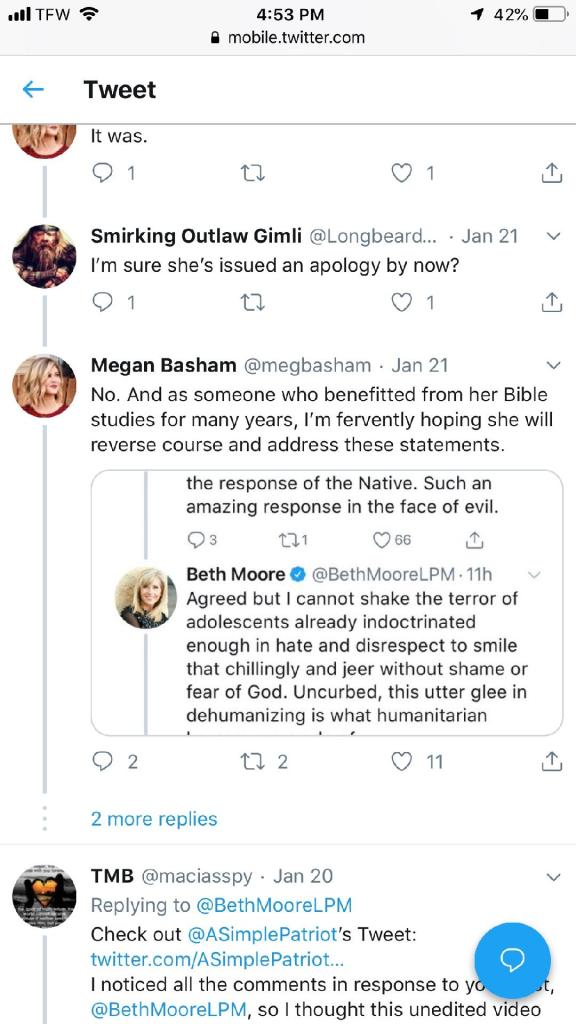
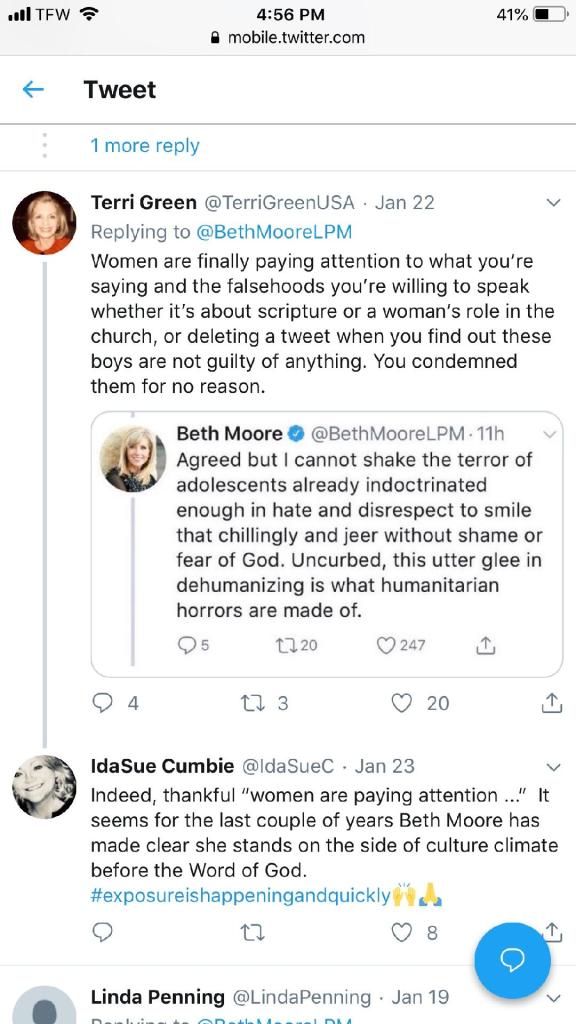
The Covington kids were exonerated, and Beth never retracted or apologized for this statement. She just quietly deleted the tweet.
Here’s Beth’s black square on Instagram for “Black Out Tuesday”.
Here, Beth recommends Jemar Tisby’s The Color of Compromise and LaTasha Morrison’s Be the Bridge. A couple of quotes from Morrison’s book:
“We won’t be agents of reconciliation until, like Ezra and Daniel, we take on the guilt and shame of our community and let it propel us toward confession.” p. 78
“Jesus didn’t just come to restore individual people; he came to break down systems of oppression, to provide a way for his kingdom to appear on earth as it is in heaven. He came so that we, his followers, could partner with him in restoring integrity and justice to broken systems, broken governments, and ultimately, broken relationships.” p. 180-181
Beth Moore uses intentionally and purposefully deceptive language
Beth often craftily couches her statements about controversial issues in such a way as to give her plausible deniability if she’s ever called on something she needs to back out of. In other words, her statements are just vague or non-committal enough to convince her followers who want to believe she’s biblical into thinking she’s notsaying what she’s actually saying. And at the same time if someone she’s accountable to says, “This statement contradicts Scripture,” she has enough wiggle room to say “That’s not what I meant. I meant something else.” A couple of the things I’ve mentioned in previous sections above are very good examples of this.
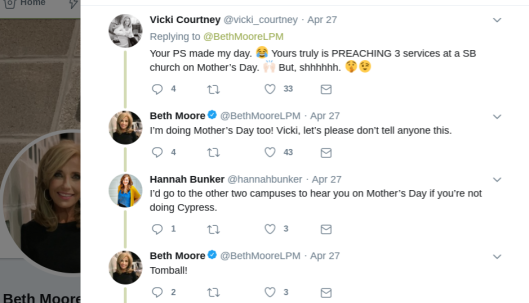
Let’s revisit the Mother’s Day 2019 preaching incident. Take a look at the conversation again:
Instead of coming right out and clearly announcing “I’m preaching the Sunday morning sermon at my church,” Beth’s response to Vicki was, “I’m doing Mother’s Day too!”. Several people in that tweet thread asked her if that meant she was preaching the sermon, and she ignored them.
That leaves reasonable doubt for Beth’s fans who actually understand that women preaching is wrong to think, “Well maybe she just means she’s giving her personal testimony or saying a few words of welcome and she’s not actually preaching the sermon.” Whereas people who know Beth’s history of preaching to men would know she means that she’s preaching the Sunday sermon. Do you see what I mean about this example of deceptive language? She’s announcing she’s preaching but wording it in such a way that people can choose to believe she’s not.
Another example of Beth’s “wiggle room wording” is the final response she gave in the Open Letter to Beth Moore discussed above. Here’s what she said in her blog post that was supposed to put an end to the questions and definitively state her position:
I hold firmly to a traditional Christian sexual ethic and continue to believe the Bible sets apart marriage as a covenant between a man and a woman. But I also believe that Scripture clearly teaches that all sex outside of marriage is contrary to God‘s will.
It’s not a bad statement on sexuality in general, and Beth’s followers who are undiscerning or don’t know their Bibles well probably thought it clearly said she thinks homosexuality is a sin. Which is exactly what she wants them to believe she said. But it doesn’t say that.
She still does not plainly say, “Homosexuality is a sin that must be repented of.” She didn’t even use the word “homosexuality” or other synonymous terms in this statement. And there’s still enough wiggle room in this statement that it leaves the door open for her, in the future, to validate homosexual orientation, identification, lust, or anything short of sexual acts or homosexual “marriage”.
She also added a Bible verse to back up this statement, Galatains 5:19-20:
Now the works of the flesh are evident: sexual immorality, impurity, sensuality, idolatry, sorcery, enmity, strife, jealousy, fits of anger, rivalries, dissensions, divisions, envy, drunkenness, orgies, and things like these. I warn you, as I warned you before, that those who do such things will not inherit the kingdom of God.
Again, to the average, church going Beth Moore follower who thinks she’s perfectly biblical, this sounds like Beth is pointing to the Bible and saying homosexuality is a sin. And that’s what she wants those people to think she’s saying. But she doesn’t want her homosexual followers to think she’s saying that.
That’s why Beth intentionally chose a verse that does not use any form of the word “homosexuality,” even though she is undoubtedly familiar with the ones that do, for example 1 Corinthians 6:9-10.
For those of us who are familiar with Galatians 5:19 and the Greek behind it, we already know that “sexual immorality” covers all sexual activity outside the monogamous heterosexual marriage bed, which does include homosexuality. Therefore, many of Beth’s followers from a conservative church background will take her quotation of this passage in Galatians 5 to mean, “Yes, I agree with the Bible that homosexuality is a sin.”
However, Beth also has many homosexual and homosexual affirming followers*, many of whom likely subscribe to the “gay Christian” movement’s idea that the verses in the Bible that condemn homosexuality are only speaking of homosexual temple prostitution and assorted other perversions, not loving, faithful, monogamous homosexual “marriages” or relationships.
*Take some time and let that sink in. How many doctrinally sound pastors, churches, and high profile Christians who clearly teach that homosexuality is a sin have homosexual and affirming followers or members? Go to the end of this article and note just how many homosexual and affirming followers Beth has and ask yourself why that is.
People who believe all of these errant ideas about homosexuality are not going to to see the term “sexual immorality” as applying to supposedly faithful homosexual relationships, so they will see Beth’s remarks as saying that she considers “sexual immorality” a sin, but not that that term includes supposedly “moral” homosexual relationships.
This use of language is intentionally and purposefully deceptive. It’s not an accident. It’s not being loving and kind. It’s speaking with the forked tongue of the devil. If that sounds harsh to you, I would encourage you to get out your Bible and consider how Satan craftily uses language in the Garden with Eve or when he’s tempting Jesus. Then compare Satan’s shrewd use of language to Beth’s. She’s being deceptive because she’s trying to keep all of her followers happy – the average evangelical woman who’s at church every Sunday and at the women’s Beth Moore Bible study class every Tuesday and the “gay Christians” and those who affirm them.
Christians are truth speakers. We speak the truth lovingly and kindly, but we speak it directly and clearly. We let our yes be yes and our no be no. We don’t use language like it’s an abstract painting that can mean whatever the person taking it in wants it to mean.
A final note that’s semi-related to Beth’s deceptive use of language: Many of Beth’s unbiblical statements, positions, behavior, attacks on others, etc., as you may have noticed from the links above, take place on Twitter, and occasionally, Instagram. If you only read Beth’s books, attend her conferences, watch her videos, or follow her on Facebook, you most likely aren’t going to see these kinds of things.
That, too, is purposeful and intentional. She is playing to her demographics. As many with online ministries have discovered, older, more conservative evangelicals generally tend to use Facebook. Younger, more progressive evangelicals generally tend to use Twitter, Instagram, and other more “cutting edge” social media platforms. Beth isn’t going to take a chance on offending the middle-aged and older women who follow her on Facebook (or aren’t on social media at all and only know her through her books and conferences), but she can get away with her more progressive comments on other platforms.
Beth Moore’s ministry produces rotten fruit
Beware of false prophets, who come to you in sheep’s clothing but inwardly are ravenous wolves. You will recognize them by their fruits. Are grapes gathered from thornbushes, or figs from thistles? So, every healthy tree bears good fruit, but the diseased tree bears bad fruit. A healthy tree cannot bear bad fruit,nor can a diseased tree bear good fruit. Every tree that does not bear good fruit is cut down and thrown into the fire. Thus you will recognize them by their fruits. Matthew 7:15-20
Beth’s followers and supporters are the fruit of her ministry. Are they good fruit or bad fruit? Is she a healthy tree or a diseased tree? Would a godly, doctrinally sound teacher have multiple followers who are homosexuals and homosexuality-affirming? Who rebel against the Bible’s teaching on gender roles? Who blithely blaspheme, spew profanity, and threaten Believers who object to Beth’s sins and false teaching? Who slander and make false accusations against Believers, and display every opposite of the Fruit of the Spirit?
Scroll down to the end of the “Saturday, July 6” section of An Open Letter to Beth Moore – Timeline of Events for comments from Beth’s homosexual and homosexuality-affirming followers, and examine Beth’s X (Twitter) threads for more examples of ungodly comments from her followers.
Disclaimer: The specific links below are provided and endorsed as evidence pertaining to this article only. I do not endorse any of these sites in so far as any of them might deviate from Scripture or conflict with my beliefs as outlined in the “Welcome” or “Statement of Faith” tabs at the top of this page.
Overviews/Series – Multiple Theological Problems with Beth Moore:
How Beth Moore Is Calling Down Pentecostal Fire at Charisma (Please note, this is an article praising Beth for doing unbiblical things and is provided only for evidence of such. Charisma promotes all sorts of false doctrine, and I definitely do not recommend or endorse it.)
Beth Moore preaches the Sunday sermon at Bayou City Fellowship Church: Mother’s Day 2016 (As with many other online evidences confirming Beth’s various sins, this has been deleted, but Beth confirmed in her own blog post, Just Something Silly I Wrote On Behalf of Moms on May 9, 2016 (Mother’s Day was May 8 that year) that she preached the Sunday sermon.)
(If you aren’t sure why the teachers I’ve mentioned below, or in the body of the article are false teachers, I’ve written articles like this one on many of them. Click the Popular False Teachers & Unbiblical Trends tab in the blue menu bar at the top of this page.)
Beth with Priscilla Shirer on Instagram (It would be impossible to document the hundreds of times Beth and Priscilla have done conferences together, endorsed one another’s books and materials, spent time together as friends, etc. As Beth says in the caption below: “That woman in that picture with me is one of the dearest people on this earth to me. I mean it. We’ve been in one another’s lives almost 20 years now. She occupies a spot in my heart all to herself.”)




 Have you ever wondered where Paul’s wife was when he was gallivanting all over the world preaching the gospel? Denny Burk explores Paul’s marital status through Scripture in this excellent article, Was the apostle Paul married? Yes, he was. Here’s how we know. (Also included: the audio to Denny’s sermon on this topic, in case you’d like to listen.
 “By God’s help may we not retreat from the fight for truth. May we be all the more invigorated by a love for our Lord, His truth, and His people. And may this commitment be evident to all as we discern with precision, humility, and sorrow.” Reagan Rose has a wonderful article about exercising love when practicing discernment over at TMS’s blog: The Danger of Loveless Discernment.