Mailbag

The Mailbag: Asked and Answered

Good morning, readers. It is an honor and a joy to serve you in Christ. Welcome to all the newbies and to you seasoned veterans of the blog.

Because some of y’all are new, you aren’t yet aware of all of the resources here to help you. Or maybe you’ve been around a while and haven’t noticed something that might be helpful. Let’s remedy that!

First, if you’re new (or if you’ve never read it), check out Blog Orientation for New Readers and Old Friends. It’s like a CliffsNotes intro to the blog.

Second, be sure to familiarize yourself with all of the tabs in the blue menu bar at the top of the page. That’s where I keep the info I’m most frequently asked about.

Third, there’s a search bar at the bottom of every page (and one in the blue menu bar at the top of every page) which might help you find what you need.

Fourth, if you don’t find your question answered in one of these ways or below, you might want to check previous Asked & Answered articles and The Mailbag: Top 10 FAQs.

And finally, let me get you new readers some answers to the questions several of you have asked. Some of you long time friends may have missed these along the way, so I hope they’ll be helpful to you, too!


[Instagrammer asks a question in the comments or DMs me a question]

I love my Instagram followers! Most of you are very sweet and kind, and you ask some really smart questions!

But a lot of you a) don’t seem to know that I have a blog, and b) aren’t familiar with how I use Instagram and how I do correspondence. I totally get that. A lot of you are new and Instagram seems to have a high turnover, and a much higher “hit or miss” with posts than other social media platforms. (Plus, I’m a weirdo and don’t use Instagram the way most influencers do. I mainly use it to tell you what’s on the blog each day.)

So, let me try to help. If you’ve commented or DM’d me a question and I haven’t answered, I would encourage you to watch “Questions” and “Get Info” in my highlights. (In fact, you might want to watch “Need a church?” “Warning,” and “New?” too.)

This is included in the “Questions?” highlight from a Mailbag article. I think it will be helpful to all of my social media and blog followers.

I’m in the market for a new Bible. What would you recommend? I really appreciate your ministry!

Thank you so much for your kind words. And thank you to all my followers who take a moment to encourage me with your comments. As you might imagine, and have probably witnessed, I catch a lot of flak via email and social media from people who don’t like or misunderstand things I’ve said and written. The encouragement is greatly needed and appreciated.

You’re right on time with your question! Amy and I answered it on a recent Glad You Asked episode of the podcast, and that answer was largely based on my blog article The Mailbag: Which Bible Do You Recommend?


God bless you, I wanted to reach out to see if you do Bible studies or if you know any through Zoom with other ladies.

It depends on what you mean by “do Bible studies”. If you’re asking whether or not I teach Bible studies in a video or livestream format, the answer is no, for two reasons. First, at the moment, I don’t have time. Second, I really think you should be meeting in person with a small group for Bible study – ideally with women from your own church and with oversight from your pastor. I understand there are situations in which that isn’t possible, but that is the ideal I want to encourage women toward. God’s plan is the in person assembling of the local church, not Zoom.

I do write Bible studies, though. They are all free, all suitable for groups or individuals, and all designed to teach you how to study or teach straight from the text of Scripture. If you’re new to that idea, I would encourage you to find a friend or a small group of friends, pick one of my studies, and work through it together.

You can find all of my studies and more helpful resources at the Bible Studies tab in the blue menu bar at the top of this page.

And speaking of Bible studies…

Are your Bible studies able to print off?!

Yes. Click the “Bible Studies” link above for all the info and instructions.

Can you recommend a good daily devotional book for a 17-year-old girl? Our granddaughter is having surgery in a few days and I was hoping to send her a little get well soon package and I would like to include a devotional.

What a blessing to have a godly grandma! I’m sorry, but, on principle, I don’t recommend what I call “canned” Bible studies and devotionals. I recommend that Christians read and study straight from the text of Scripture. (You can read more about why at the “Bible Studies” link above, and in my article The Mailbag: Can you recommend a good Bible study for women/teens/kids?.)

May I make a suggestion? Instead of a devotional, how about a new Bible? Or perhaps you could find a small “for those recovering from illness/surgery” gift book of selections from the Psalms, or a “coffee table” type book that is mostly artwork or photography, accompanied by Bible verses. There are also “Bibles” that are Psalms and Proverbs only. (Just make sure all of these books use a reliable translation of Scripture.) If you want to go a little higher tech, consider an iTunes gift card so she can download her favorite (doctrinally sound) Christian music, or a subscription to AGTV.


The womenโ€™s group of the church that we are attending will be doing a Priscilla Shirer simulcast. I have read your article about Ms. Shirer and have decided to abstain from attending the event. How do I lovingly but truthfully tell the women in this group why I am refusing to attend and why I feel this is not someone whom we should be promoting? (unless of course, Ms. Shirer has changed her stance since your article was written). My husband and I believe [our pastor] to be of sound doctrine [but] I am certain that he is oblivious to P. Shirer. [I] hope that you can help me โ€œfind the right wordsโ€ to discuss this with those involved.

I am so sorry this is happening in your church. I have been in exactly that situation, so I know what it’s like.

Here are a couple of articles I think will be of help:

The Mailbag: How should I approach my church leaders about a false teacher theyโ€™reย introducing? I would suggest approaching your women’s ministry leader (or whoever is most immediately in charge of the simulcast) first, then working your way up the chain of command until you’ve spoken to the pastor, if necessary.

The Mailbag: Should I attend the โ€œBibleโ€ study to correct falseย doctrine? (I know you’ve already decided not to attend the simulcast, but I think some of the info in this article will still be helpful.)

Just a note to all of my readers on the “unless she ‘has changed her stance since your article was written'” part: You’ll notice at the top of my article on Priscilla it says, “This article is kept continuously updated as needed.” (I think I’ve remembered to put this at the top of all of my articles on particular teachers? If I missed one, let me know.) Translation: “Yes, I originally wrote this article in 2015, but I go back and update it – fix links, add or delete info, etc. – whenever I feel it’s necessary.”.

If any teacher I’ve ever written an article about genuinely gets saved, repents of her false teaching, etc., I promise you, unless I’m somehow Providentially hindered, you will hear about it from me ASAP. That is not something I’m going to neglect to update you on (and rejoice with you about!) immediately. In the meantime, you can safely assume that the information in my articles is still accurate and applicable and that the teacher is either still status quo with the info in the article, or has gotten worse.


I have several Bible apps, and recently you gave info in one of your mailbags that YouVersion app is not recommended, and knowing now what I didn’t know then, I uninstalled it. I did find it easy to navigate and the search capability was good, but I no longer want anything to do with it. If you could kindly lead me to one that is as user friendly, I need an app that you recommend that is as simple as me. Lol

I like to keep things simple, too. I hope you’ll find my article My Favorite Bible & Studyย Apps to be helpful.


Our church has a mixed adult Sunday school. My conviction has been silence as I do not want the appearance of teaching men. I am discouraged as most of the responses in the hour of teaching is from the women in the group even though our church only allows men to be in teaching positions. I would genuinely like to hear your thoughts on this. I have appreciated your podcast and website information.

I know it can be discouraging when it seems like men are being less manly or exhibiting less leadership than we would hope. I would encourage you to kindly talk to your pastor or elders about your concerns and ask for some insight as well.

In this particular situation, it may be wise to answer fewer questions, or make fewer comments than you normally would, not because you would be teaching (or even giving the appearance of teaching), but because it might give the men more space to get a word in edgewise. If this dynamic is really problematic, I wonder if it might be helpful to split the class into a men’s class and a women’s class. Perhaps that way the men would feel more comfortable contributing. Maybe that’s something you can discuss with your pastor or elders.

I’ve explained why women answering questions and participating in the discussion in a co-ed Sunday School / Bible study class isn’t teaching men or a violation of Scripture in my article Rock Your Role FAQs #4.


If you have a question about: a Bible passage, an aspect of theology, a current issue in Christianity, or how to biblically handle a family, life, or church situation, comment below (Iโ€™ll hold all questions in queue {unpublished} for a future edition of The Mailbag) or send me an e-mail or private message. If your question is chosen for publication, your anonymity will be protected.
Christian women, Church, Southern Baptist/SBC

Is the SBC’s Tent Big Enough for ALL Marginalized Christian Women?

Originally published June 22, 2018

It started with Paige Patterson’s gobsmackingly horrible and unbiblical advice to an abused wife to return to her husband. Then it was the lurid remarks he made about a teenage girl, with which he regaled a congregation during a sermon. Next came the allegations of his mishandling of two separate sexual assault cases at two different seminaries.

In response to all this turmoil, Beth Moore added to the conversation some vague stories of various unnamed men in Christian circles who had, in her perception, condescended to her or otherwise not treated her as an equal, leaving the impression that there is widespread, systemic misogyny within modern evangelicalism. Jen Wilkin, from a more biblical – yet, troublingly, similarly vague – perspective, joined the chorus, and has been afforded a wider audience for the “they can’t be pastors, natch, but we need more women in church leadership” platform she has been advancing for the past several years. (Which leadership positions or roles? We’re still waiting for Jen to specify.)

And the icing on the cake was SBC pastor, Dwight McKissic, publicly declaring that the way to “heal” all of these woes against Christian women and “right historic patterns of wrong against women” is to elect Beth Moore as president of the Southern Baptist Convention.

So this nebulous idea has been introduced that Christian women are getting the short end of the stick across the board in evangelicalism (specifically in the SBC) and that the way to fix things – all the way from genuine abuse and rape on one end of the spectrum to women whose feelings have been hurt because they’re not seen as equal to pastors on the other end – is to make sure, somehow, that women’s voices are heard and validated.

That’s a pretty “big tent” idea. And if it’s going to be a big tent, there’s room under there for everybody, right? To be consistent, compassionate, and fair, wouldn’t these folks have to make space for the voices of, and give influential positions to, any Christian woman who feels she’s been diminished? Let’s find out.

Allow me to introduce you to a group of Christian women who have been silenced and brushed aside for years, often by the very same people who are now hypocritically crying out that women need to be heard in order to keep them from being marginalized.

I give you discerning, doctrinally sound, often Reformed, Christian women.

We are women who have been subjected to insults, and accusations of heresy and hatred of the lost, because we hold to the doctrines of grace. We are women who have been attacked by pastors, pastors’ wives, women’s ministry leaders, and fellow church members for pointing out the false doctrine of popular women’s “Bible” study materials and merely asking to properly be taught the Word of God in our own churches. We are women who have been shouted down or ruled “out of order” at denominational meetings for asking that our Christian retailers stop selling materials containing false teaching. We are women who have been forced out of our own churches for taking a biblical stand against women preaching to, teaching, or exercising authority over men in the church. We are women who have been called haters, legalistic, divisive, threats to unity, jealous, and all other manner of slander simply for holding to Scripture and refusing to budge from it.

All this mistreatment of women at the hands of Christian celebrities, denominational leaders, pastors and other church leadership, and fellow church members.

Do we qualify as marginalized? We’ve been hurt, and in many cases, sinned against outright. No church discipline. No redress or recourse. Nobody wants to make sure we have a voice or a place of power – quite the opposite, in fact. A lot of us saw our own pastors hand-wringingly share Beth Moore’s detailing of her grievances against Christian men even as they pushed us and our biblical concerns aside.

Everybody feels sorry for Beth Moore. Who will cry for us?

We don’t want much, just a return to what’s biblical.

We want sound doctrine in the church and solid preaching in the pulpit.

We want this nonsense about a female SBC President – especially a false teacher like Beth Moore – to stop. Not only is it not biblical, it’s a patronizing toss of a trinket or pat on the head attempting to dry the tears of fussy little girls, and it won’t work to solve any of the real problems that are going on.

We want false doctrine off the shelves of LifeWay, and for LifeWay, the ERLC, and others in leadership to stop organizing and promoting conferences and other events headlined by people they have already been informed (yea, as seminary trained pastors and leaders, should know without having to be told) are false teachers. Among the many things Jen Wilkin has rightly said is that we need to promote biblical and theological literacy among Christian women. When you go on a diet, the first thing you do is go through your kitchen and throw out all the junk food. You’ll never start eating healthy if you have an endless supply of candy bars in the pantry. The only way to begin to properly train women in Scripture and theology  is by “putting off” false doctrine in order to “put on” sound doctrine.

We want LifeWay to demonstrate that it actually cares about the spiritual health of women by putting its money where its mouth is. Ridding the shelves of false doctrine and the event docket of false teachers is going to cost LifeWay a lot of revenue. Women who want their itching ears scratched will quickly find another source of false teaching to pour their cash into. There’s not a lot of money to be made in encouraging women to study straight from their Bibles, sit faithfully under the teaching of a doctrinally sound pastor, and humbly serve the local church. Are Christian women worth it to you, LifeWay?

We want a strong doctrine of sin and church discipline to be understood and taught by our pastors and denominational leaders. The fact of the matter is that a woman who has been genuinely sinned against by a man who has abused her is in a different category from a woman whose feelings are hurt because she’s been told she can’t teach a co-ed adult Sunday School class. The first woman needs compassionate brothers and sisters in Christ to come alongside her and walk with her as God begins to heal her body and her heart. The abuser needs to be prosecuted to the full and appropriate extent of the law as well as to be placed under church discipline. The second woman is either in sin and rebellion (in which case she may need to be placed under church discipline) or she just hasn’t been taught God’s Word properly and someone needs to disciple her in that area. To put these two women underneath the same “big tent” just because they’ve both experienced some sort of hurt diminishes and confuses their situations and the solutions that would be biblically appropriate for each.

We want pastors and leaders to herald, praise, and validate the biblical role of women in the church. Women should not be taught only the things we cannot do in the church, we must also be taught what we must do in the church – what only women are uniquely and ontologically gifted by God to do. Women need to hear – particularly from the mouths of pastors and denominational leaders – the vital necessity of women discipling other women, women training the church’s children in the Scriptures, women serving in hospitality and mercy ministries, women properly using their administrative gifts, and so much more. Train us to teach. Equip us to serve. Encourage us to use our gifts in obedience to Scripture and for the glory of God.

We want men – from the heads of our denominations to the newly saved sinner in the pew – to step up and be godly men. We desperately need you to biblically and fearlessly lead the church. Don’t be afraid to stand up and put your foot down squarely on Scripture. Even if it makes you unpopular. Even if it rocks the boat at church. Even if people leave and never come back. As godly women, we can’t do our job if you’re not doing yours.

So how about it, brothers and sisters who are crying out for Christian women to be heard? Do doctrinally sound women get a seat at the table? Do we get to be heard? Will anything be done to correct the mistreatment we’ve received?

Do doctrinally sound women get a seat at the table? Do we get to be heard? Will anything be done to correct the mistreatment we’ve received?

Or are there only certain women you want to hear from? Women who fit the popular social narrative. Women the world and most of the church will applaud you for listening to. Solutions that do more to glorify people than to glorify God.

Just how big is that tent…really?

Complementarianism

Throwback Thursday ~ Toxic (Evangelical) Femininity

Originally published August 24, 2018

Toxic masculinity. It’s a buzzword that’s gaining momentum as it’s bandied about in pop culture like a shuttlecock over a badminton net. There’s a clinical definition of the term (which, in the ivory towers of the scholarly world is, properly, “hegemonic masculinity“):

Hegemonic masculinity is defined as a practice that legitimizes men’s dominant position in society and justifies the subordination of women, and other marginalized ways of being a man. Conceptually, hegemonic masculinity proposes to explain how and why men maintain dominant social roles over women, and other gender identities, which are perceived as “feminine” in a given society.

And then there’s the sort of similar working definition of the huddled masses: Anything a man does that others – especially women – don’t like that can, by any stretch of the imagination, be blamed on the fact that he’s a man.

If a man cuts you off in traffic, it’s not that he’s a jerk or didn’t see you, it’s toxic masculinity. If a man holds a door open for a woman, it’s not that he’s polite and helpful, it’s toxic masculinity. If a man leaves his socks on the bathroom floor, it’s not that he’s sloppy and has no home training, it’s toxic masculinity. In other words, he’s not doing these things because he’s a polite or rude or aggressive or helpful human being, it’s because he’s a man who just wants to keep women down and exercise dominance over them.

Pardon my French, but what a bunch of malarkey.

Yes, I’m sure there’s a fringe element of men out there who consciously think they’re better than women, that women shouldn’t have any rights or hold any positions of responsibility, blah, blah, blah. And you know what? They’re considered fringe kooks, and rightly so. But I’m not buying this business of these elitist gnostics telling us that every little move a man makes is a subconscious act of belittling women or exercising domination over them, and neither should you. It’s like the race-baiters who say that every single white person is racist, deep down, and this latent racism manifests itself in everything we do, from the way we tie our shoes to the breakfast cereal we buy at the store. We’re just not aware of it, supposedly.

Poppycock.

Want to know where this notion of toxic masculinity came from? It sprang from the loins of toxic feminism. Zoom out and look at the big picture. This is a manufactured concept, baptized in the (assumed) credibility of academia, designed to help women leverage power and control over men. How? By denigrating them at every turn, thereby convincing the world that men are intrinsically bad and women are good and must be elevated to prominence. Call me crazy if you want to, but it doesn’t take a prophet or the son of a prophet to look down the road and see that the feminist end game here is a matriarchal world where women rule and men drool. And there are plenty of brazen females out there who would openly and unashamedly admit this.

That, however, is not my concern. Sinners gonna sin, and God’s going to deal with them in His own way and in His own good time.

My concern is the way this attitude is fleshing (pun intended) itself out in Christian families and the visible church, and creeping into evangelical women’s (and men’s) hearts. Because, whether or not we’d like to admit it, this worldliness is advancing upon us, and we need to be aware of – and biblically approach – the facets of this issue that are already at our doorstep:

On the Top of the World Looking Down on Creation

I actually laughed out loud when reading some of the academic definitions of so-called toxic masculinity. There seemed to be an air of, “We just don’t understand it! This pattern of male dominance seems to transcend all cultures and time periods!”

Well here’s a really academic response to that: Duh.

I mean, you have to wonder if these researchers and scholars have ever said to  themselves, “I wonder if there’s a reason for that. I wonder if this tendency in men that defies time and culture can be traced back to a pinpointed source.”

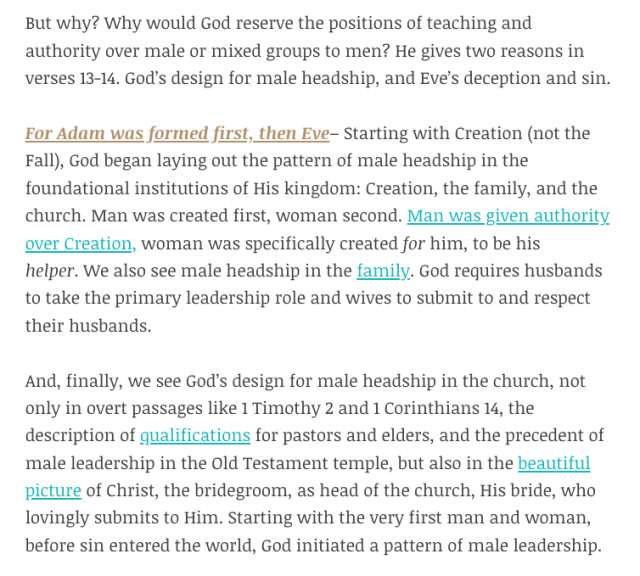
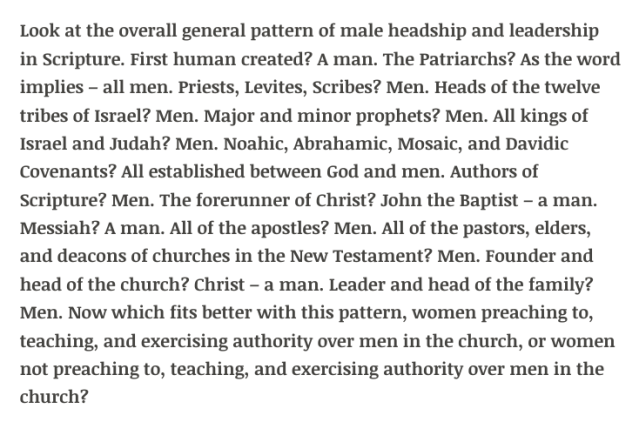
There is, and it can. It’s called Creation, and God is the one responsible. God created man first and then woman. God created husbands to lead and wives to be helpers. God set up the Old Testament patriarchal society that became the nation of Israel, which was led by male tribal heads and, later, male kings. God established male leadership in the temple, and subsequently, in the church. The major and minor prophets were male, Jesus was male, the apostles were male, the writers of Scripture were male. And all of this traces back to that one moment in Genesis 2 in which God decided to create man first and hard-wire him to lead, protect, and git ‘er done. Broadlyยน speaking, the reason we see a generalยน pattern of male leadership across time and culture is because God set those wheels in motion.

As Christians, we recognize that sinful men sometimes abuse the positions of leadership God has given them, but that doesn’t negate the entire pattern and call for us to turn it on its head. We study our Bibles and embrace and submit to the way God has instructed men and women to behave in the roles He has bestowed upon us.

Come on, Baby, (Don’t) Do the Woke-Emotion

One of the components of God’s creative work that adds inexplicable beauty to this world is the tender-heartedness, passion, and empathy He built into women in a uniquely feminine way. Emotions. Feelings. God created them, and they are good. What a dreary and heartless world this would be if women didn’t bring nurturing, caring, sympathy, and love to the table. God uses us to soften the hard edges of life and make the planet pleasantly inhabitable.

But along with that good gift comes the challenge to steward it wisely and in obedience to God so that we may use it to glorify Him rather than dishonoring Him.

I see Christian women wisely stewarding their emotions to the glory of God every day as they care for their husbands and families, friends and co-workers, and serve in their churches. It is a beautiful picture of the mature fruit of biblical womanhood.

Unfortunately, I also see the exact opposite. I see (ostensibly) Christian women who scream like banshees any time their pastor preaches on the passages of Scripture dealing with women’s roles in marriage or the church. I’ve seen women who claim to believe and follow the Bible throw an everloving fit when someone points out – from Scripture – that their favorite women’s “Bible” study author is a false teacher. I see women formulating their beliefs and practices about God, worship, the Bible, their own behavior, their families, and their churches based on their own personal opinions, experiences, and feelings rather than on rightly handled Scripture.

And, just like secular feminists demand domination over men because they feel oppressed, have experienced sexism, or resent the world’s history of male dominion, I see Christian women letting their emotions rule the day as they demand unbiblical solutions to their real or perceived personal experiences with men and male leadership.

The anger, the outrage, the hurt feelings, and being offended are nearly as evident in evangelicalism as they are in society at large.

Godly women are not ruled by their feelings. We are ruled by the Bible. We make our feelings submit to and obey God’s Word. We don’t make decisions based on what we like or don’t like, or what makes us feel good about ourselves. We base our decisions on what the Bible says. When our feathers get ruffled, we take a step back and evaluate the situation with rightly handled Scripture. Maybe we’re upset because someone actually sinned against us, but maybe we’re upset because our pride or vanity was wounded, or our unbiblical notions were biblically challenged, or because God used someone to expose an idol we’re worshiping. Maybe it’s not that the other person sinned, but that we’re in sin. Those hurt feelings could be a wake up call from God to humble ourselves and repent.

Ladies, we must learn to put our feelings aside and act on the objective truth of God’s Word instead of our fickle and deceptive emotions. If we display the same sorts of fleshly emotionalism as unsaved women, how are we being salt and light in the world, pointing the way to Christ? We’re supposed to be set apart and different from the world.

Why Can’t a Woman Be More Like a Man?

Because – speaking of salt and light – embracing and submitting to our biblical roles in the family and in the church sets us apart from the world. Now, more than ever, we have a unique opportunity to be counter-cultural – simply by obeying God’s Word.

Women being hired as pastors and teaching and exercising authority over men in the church and leading denominations and becoming popular evangelical conference speakers with co-ed audiences – that’s what the world expects because that’s the way they do things. But a Christian woman who happily puts her foot down and refuses to teach men in the church setting or joyfully insists on submitting to her husband? That’s different. It’s against the grain, not the norm.

Remember that out of the ordinary burning bush that caught Moses’ attention and he turned aside out of curiosity to investigate? And remember how, when Moses was watching it burn, wondering what in the world was going on, that God called to him out of that fiery shrub – “Follow Me.”? God can do the same thing with our obedience to Scripture.

Lost people see this anomaly of our “weird” behavior, and they want to know what in the world is going on. Why do we act differently than they do? And that’s when we get to explain it to them. We get to share the gospel. God can call to them out of our passionate burning for Christ and His Word, “Follow Me.”.

People in darkness gravitate toward light. Salt makes people thirsty. Do we care more about giving them the Light of the World and the Living Water or our own selfish and fleshly desires for power and position? Our embrace of and obedience to the biblical roles God has laid out for us as Christian women is one gateway to sharing the gospel with the lost.

Toxic femininity is worldly and fleshly. It has no place in Christian homes and churches. How do we combat it? We take up the sword. We submit to the authority and sufficiency of Scripture. We recognize that God is the authority in our lives, not self, and that we are to obey Him at any cost – even at the cost of our convenience and pleasure. We trade our desires for His.


ยนI’m well aware that there are plenty of exceptions to this generalization. I’m referring to a broad pattern across time and culture, here. There are many biblical ways women can contribute and lead in the family, society, and the church.

Complementarianism

Throwback Thursday ~ Putting on the “You Can!” of Complementarianism

Originally published October 18, 2019

It never really hit me until I started teaching the book of 1 Timothy how many instructions in the pastoral epistles pertain to women, and how weighty those instructions are. The pastoral epistles are the โ€œpolicy and procedure manualsโ€ for the church, and, far from relegating the ministry of women to nothing more than crafts and tea parties while the men do all the โ€œimportantโ€ stuff, you come away with the impression that a healthy, well-balanced church actually depends on godly women working hard to carry out the ministries that God has uniquely created and gifted us to fulfill, alongside men fulfilling their own ministries.

These epistles donโ€™t view โ€œwomanโ€™s workโ€ around the house of God as trivial or menial, but as a high and holy calling. Vital. Necessary. Honorable.

But is that the lofty perspective of the biblical role of women that the local complementarian church is conveying to its female and male members? Are we, especially those of us in womenโ€™s ministry, proactively teaching that the calling of motherhood or the task of discipling other women or serving those in need is qualitatively just as imperative and noble as the calling of pastor or elder?

Intentionally or not, the egalitarian movement has maneuvered biblical complementarians into constantly playing defense. Their offensive squad keeps moving the ball forward by offering women a no holds barred buffet of powerful and prestigious ministry positions. Our defensive line correctly and biblically pushes back with, โ€œNo, the Bible says women are not to โ€˜teach or to exercise authority over a manโ€™  in the church setting.โ€ But often, only two or three members of our offensive squad are dressed out to play, and they never get off the bench and into the game. And as any football fan knows, you have to have a good defense and a good offense if youโ€™re playing to win.

Egalitarians offer women โ€œyou can,โ€ but all too often all we complementarians have offered godly women yearning to serve is, โ€œyou canโ€™t.โ€ Where is the big, beautiful, biblical showcase of complementarian โ€œyou canโ€?

Not long ago, I was teaching a group of ladies the biblical process of putting off the old self and putting on the new self in Ephesians 4:20-32. We explored how interesting it was that every โ€œdonโ€™tโ€ in the passage was coupled with a โ€œdo.โ€ We donโ€™t just put off lying, we put on proactive truth-telling instead, and so on. Nature abhors a vacuum in the physical realm, and it would seem this is true in the spiritual realm as well. When we subtract the ungodly, we must replace it with the godly. If we donโ€™t, something will rush in to fill the void thatโ€™s been created, and that “something” isnโ€™t usually biblical or fruitful. 

So how can we shift the perspective in our churches from โ€œyou canโ€™tโ€ to โ€œyou can,โ€ and create an atmosphere, not merely of โ€œput off,โ€ but also โ€œput onโ€? How can we get our offensive team suited up, on the field, and moving the ball toward the goalpost while at the same time retaining a strong defense?

We can, so to speak, make complementarianism great again. 

As I studied 1 Timothy 5, I was struck by Paulโ€™s description of women who are โ€œtruly widows.โ€ These are women who have spent their lives being busy and intentional about the work of the Lord in their homes and in the church. They adorned themselves with the good works proper for women who profess godliness, and they were honored and revered for it by the church. I didnโ€™t come away from this passage with the feeling that these women were frustrated, oppressed, or seen as โ€œlesserโ€ by the church because they werenโ€™t allowed to teach or exercise authority over men. I came away from this passage thinking, โ€œThose women were awesome. Thatโ€™s the kind of woman I want to be.โ€

What would the climate in our churches look like if womenโ€™s ministries and the church at large recaptured that same reverential posture and purposefulness toward biblical womanhood? If, instead of teaching the biblical role of women strictly as, โ€œYou canโ€™t eat the fruit from this apple tree,โ€ we followed that admonition with a grand tour of the Garden, focusing on the delicious fruit of the pear tree, the cherry tree that needs a good pruning, the fig tree just waiting for the right woman to come along, harvest its fruit, and make some preserves, the banana tree that needs an expert in fertilizers, and the orange tree dying for someone to water it?

In my experience, what happens in churches of that climate is that – just like the godly widows of 1 Timothy 5 – women are so busy and fulfilled tending the other trees of the Garden, that they have neither the time nor the desire to go apple picking. 

May our churches strengthen themselves and grow to more robust spiritual health by proactively encouraging Christian women to joyfully throw ourselves into the godly โ€œgood works which God prepared beforehand, that we should walk in themโ€ – the biblical โ€œyou canโ€ of complementarianism.


Additional Resources

Rock Your Role: Jill in the Pulpit

Let Me Count the Ways: 75 Ways Women Can Biblically Minister to Others

Unforbidden Fruits: 3 Ways Women MUST Lead and Teach the Church

Servanthood

The Servanthood Survey

Complementarianism, Mailbag

The Mailbag: Women teaching men- Questions from a young reader

I received this very astute line of questioning from a young lady who left a comment on one of my articles. The comment and questions were rather lengthy, so I’ve broken it up into portions in order to answer it in an organized way. If you need to read the entire comment, uninterrupted, for context or ease of understanding, scroll down, reading only the portions in bold.


Hi! Just to let you know, though it may seem, I have no intention of being rude in this question, and genuinely want to know your response to this. I am only in 9th grade, so I have a lot to learn, and want to know what you think about my comment...Thank you, and I am very curious to find out what you think about my questions and things that I might have misunderstood or missed.

That’s awesome! I wish I had been thinking as deeply about these things as you are when I was in the ninth grade. And, rest assured, your questions didn’t seem rude to me at all. I’m so glad you want to learn! I hope you’ll understand that my answers aren’t meant to be rude either, although they may not be quite what you’re expecting or wanting to hear.

You didn’t mention whether or not you’re a Christian or what your church background, if any, is, so let me just start off by saying, if you’ve never been genuinely born again, my answers might not make much sense. I would encourage you, even if you’re pretty sure you’re saved, to examine the materials at the What must I do to be saved? tab in the blue menu bar at the top of this page before moving ahead.

I was just wondering, if women are not allowed to teach men, and you are a woman and this blog is public to men and women, then arenโ€™t you technically providing biblical insight and evangelizing to whatever gender is reading this to inform them of the Bible?

Nope. I’ve answered that question in detail in my article Are Female Bloggers Violating Scripture by โ€œTeachingโ€ Men?

Additionally, “evangelism” and “teaching” (“providing insight” isn’t really a biblical category) are two different, separate things. You might find our podcast episode Women Preaching the Gospel? helpful for understanding the distinction.

Also, the book of Timothy, like you said, was a letter written from Paul to Timothy, so this was just the teachings that Paul gave to Timothy as instructions for the churches, and not necessarily coming from God.

I’m afraid that’s one of the things you’ve misunderstood. This wasn’t just a letter from one human being to another. The words in 1 Timothy, just like every word of every book of the Bible are from the very lips of God Himself. Second Timothy 3:16 tells us that “All Scripture is breathed out by God.” There aren’t some parts of Scripture that are from God and others that aren’t. It all comes from God, from Genesis 1:1 to Revelation 22:21.

First and second Timothy and Titus are what we call the pastoral epistles (“epistle” means “letter”). That means they are God’s instructions, written through His human instrument, Paul, to Timothy and Titus and every pastor who came after them, about how to run the church.

I know Paul was a prophet and one argument could be that he got this information from God,

No, Paul was not a prophet, he was an apostle. And, as I discussed above, the Bible says that all Scripture is breathed out by God, so “Paul got his information from God” is the only argument that can be made, especially for Christians. Because, for Christians, the Bible is our authority on what to believe, not human arguments, opinions, and ideas.

but even prophets (besides Christ) make mistakes in their instructions to others,

I’m afraid that’s also incorrect. There’s not a single prophet in the Bible who, when speaking as a prophet to people on God’s behalf ever made one iota of a mistake about what He said. There were false prophets (who received the death penalty for saying they spoke for God when God had not really spoken to them), but none of God’s true prophets – like Isaiah, Jeremiah, Micah, Habakkuk, etc. – ever got anything wrong or “made mistakes in their instructions to others” when speaking on behalf of God.

such as Abraham, who instructed people to be stoned for certain sins,

I think you mean “Moses” here. Abraham wasn’t a prophet, and I don’t recall any instance in Scripture in which Abraham “instructed people to be stoned for certain sins”. Moses didn’t either. God did. God gave Moses the law on Mt. Sinai, and Moses wrote it down and taught it to the people.

and you can see that it was unlawful in Godโ€™s eyes

I’m sorry, but that’s incorrect as well. Since God is the One who gave the laws about stoning people for certain sins, He would never have said that someone properly obeying His law was doing something unlawful. That would be like God saying He was wrong when He made that law. And, of course we know that God is never wrong.

and you can see that it was unlawful in Godโ€™s eyes when Jesus told the priests about to stone Mary of Magdala that they should not stone her because they have sinned as well and God sees all sins as the same.

I think you’re talking about the story of the adulterous woman in Luke 7-8, right? Again, I’m sorry, but there are many things that need to be corrected here:

  • Stoning a woman caught in adultery was not “unlawful in God’s eyes”. It was lawful. God is the one who gave this law. The scribes and Pharisees correctly cited the law in 8:5.
  • Jesus wasn’t speaking to the priests, He was speaking to the scribes – experts in the law (which was an important point of this passage) – and Pharisees.
  • The text does not say the unnamed woman was Mary Magdalene.
  • Look carefully at the passage. In which verse does Jesus say “they should not stone her”? Answer: He didn’t say, “Don’t stone her.”. On the contrary, He said that they could commence with the stoning as long as whichever one of them was without sin cast the first stone.
  • He also didn’t say they couldn’t stone her because “they have sinned as well”. Every lawful stoning that has ever taken place on planet earth was carried out by sinners, because (except for Jesus) every human being is a sinner.
  • The Bible doesn’t say that God “sees all sins as the same” (In fact, we can see in the way that God deals with various sins in various ways throughout Scripture that this isn’t true.), so Jesus would never have said this nor given it as a reason that these men should not have stoned this woman.

Jesus didn’t say the law against stoning an adulteress was wrong. That would have been equal to saying God was wrong for giving that law. He didn’t tell the men not to obey the law, either. The key to understanding this story is in verses 4-7:

4 they said to him, โ€œTeacher, this woman has been caught in the act of adultery. 5 Now in the Law, Moses commanded us to stone such women. So what do you say?โ€ 6 This they said to test him, that they might have some charge to bring against him. Jesus bent down and wrote with his finger on the ground. 7 And as they continued to ask him, he stood up and said to them, โ€œLet him who is without sin among you be the first to throw a stone at her.โ€

They didn’t care about this woman or what happened to her. They didn’t care about the man who was sinning right along with her. They didn’t care that this sin wrecked the man’s and woman’s lives. They didn’t care that God’s law had been broken. They didn’t care that adultery grieves the heart of God. They didn’t care.

All of those things were just a means to an end for them. All they cared about was trying to get the advantage over Jesus. To trick Him into saying something they could use against Him so they could discredit Him or bring Him up on charges with the Sanhedrin (Jewish court). And they were using God’s precious and holy Word as a tool to accomplish this evil goal. They were blasphemously using God’s own Word against Him.

That is the entire point of this story. God’s Word is His representation of Himself to us. It is our lifeline to Him, because it is how we come to know Christ as Savior. It should be revered as high and holy, not twisted and abused for wicked purposes.

This is just one example of many things that Godโ€™s prophets have taught wrongly.

No, none of the things you’ve mentioned, nor the corrections I’ve given, have demonstrated that any true prophet of God has ever taught anything wrong when it comes to prophecy or commands of Scripture. Second Peter 1:20-21 tells us:

…knowing this first of all, that no prophecy of Scripture comes from someone’s own interpretation. For no prophecy was ever produced by the will of man, but men spoke from God as they were carried along by the Holy Spirit.

So, since times were different in the first century and women were not seen as important to men, couldnโ€™t this have been something Paul told Timothy to do based off of his own understandings culturally?

No. Again, 1 Timothy is a passage of God-breathed Scripture, not Paul’s personal human opinion. It was not based on Paul’s human understanding (see 2 Peter 1:20-21, above), culturally, or in any other way. This is God’s command to pastors, based solely on God’s reasons.

And God kindly shares those reasons with us in verses 13 and 14 of 1 Timothy 2:

11Let a woman learn quietly with all submissiveness. 12 I do not permit a woman to teach or to exercise authority over a man; rather, she is to remain quiet.

13 For Adam was formed first, then Eve; 14 and Adam was not deceived, but the woman was deceived and became a transgressor.

God gives us two reasons for His command that women are not to teach or exercise authority over men in the gathering of the church body: the creation order and pattern of male headship (13), and the fact that the woman was the one who was deceived into sin (14).

That’s why. Not culture, not Paul’s personal opinions, not because men didn’t value women at the time, not because the women in that particular church at that particular time were unruly or false teachers, not for any of the man-made theories that people have come up with. God tells us exactly why He made this rule for the church in verses 13-14. I’ve discussed this in greater detail in my articles Rock Your Role: Jill in the Pulpit and The Mailbag: Counter Arguments to Egalitarianism. Here are a few of the pertinent excerpts:

You’ve asked some really great questions here, and your reasoning skills are sharp. It was my pleasure to serve you by answering your comment. Keep asking questions, studying, and learning all God has to teach us through His authoritative, inspired, all-sufficient written Word.


If you have a question about: a Bible passage, an aspect of theology, a current issue in Christianity, or how to biblically handle a family, life, or church situation, comment below (Iโ€™ll hold all questions in queue {unpublished} for a future edition of The Mailbag) or send me an e-mail or private message. If your question is chosen for publication, your anonymity will be protected.