Christian women, Complementarianism, Mailbag

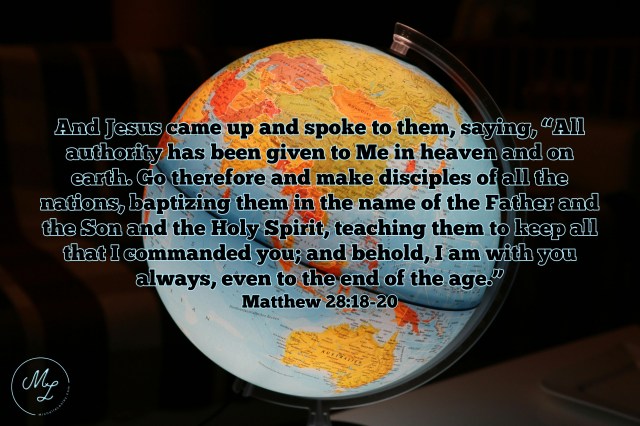
The Mailbag: Is it biblical for women to carry out The Great Commission?

Originally published June 18, 2018

Last week, I received some questions from a Facebook follower regarding my article Basic Training: The Great Commission. I thought they were very insightful and that other readers might have the same questions, so I’m sharing and expanding on my answers to her here. (I’ve edited/condensed the reader’s questions and comments {in bold type} for the sake of brevity.)

Given my understanding of what Jesus is commanding, and comparing it with other examples in the New Testament, it’s not for women to do the Great Commission. Our role is not to make disciples, teach, or baptize, but to keep the home, edify other women believers, etc. The Great Commission is for men, not women, to do because…

1. The Great Commission requires teaching and baptizing.

2. Jesus was speaking the Great Commission to His disciples, who were all male.

3. We don’t see any specific New Testament examples of women sharing the gospel with the lost through their own witness or example.

4. Because we don’t see any specific New Testament examples of women sharing the gospel or any explicit commands for women to share the gospel, it violates the regulative principle for women to share the gospel with the lost.

This reader’s questions really got me thinking and digging. I love questions that make me think hard and dig into Scripture and theology for answers!

First, let me briefly address the points of this issue that are not in dispute. As I understand her, the reader is in full agreement with Titus 2:3-5 and the example of Lois and Eunice. She agrees with the biblical principles of women training their own children in the gospel and discipling Christian women (already saved) inside the church. Her questions have mainly to do with sharing the gospel with the lost outside the church – evangelism.

Next, before we dive into the reader’s questions themselves, it is very important to distinguish between two types of Scripture:

Broadly speaking, there are two main types of Scripture: descriptive and prescriptive. Descriptive passages describe something that happened: Noah built an ark. Esther became queen. Paul got shipwrecked. These passages simply tell us what happened to somebody. Prescriptive passages are commands or statements to obey. Donโ€™t lie. Share the gospel. Forgive others.

If we wanted to know how to have a godly marriage, for example, we would look at passages like Ephesians 5:22-33, 1 Corinthians 7, and Exodus 20:14,17. These are all passages that clearly tell us what to do and what not to do in order to have a godly marriage.

What we would not do is look at Davidโ€™s and Solomonโ€™s lives and conclude that polygamy is Godโ€™s design for marriage. We would not read about Hosea and assume that God wants Christian men to marry prostitutes. We would not read the story of the woman at the well and think that being married five times and then shacking up with number six is OK with Jesus.

Descriptive passages may support, but never trump, the clear instruction of prescriptive passages.ยน

Now, let’s see if we can come to some biblical conclusions on her questions:

1. The Great Commission requires teaching and baptizing.

Teaching:
Often, when we’re looking at women’s roles in the church and being obedient to 1 Timothy 2:12, people conflate evangelism with teaching. Teaching Scripture to saved people inside the church gathering is not the same thing as sharing the gospel with lost people outside the church gathering. They are two separate, distinct things. First Timothy 2:12 (and other prohibitive passages) only prohibits the former, not the latter. The Great Commission, and the New Testament overall, commands the latter.

Teaching Scripture to saved people inside the church gathering is not the same thing as sharing the gospel with lost people outside the church gathering. They are two separate, distinct things.

As Christian women we want to be sure we keep these two things straight and carry out The Great Commission in the way God has prescribed for women to carry it out. May we share the gospel with a lost man or woman “as we are going”? Yes. If that person is a man, once he is saved is it biblically appropriate for a woman to teach and disciple him? No. If he is saved, he is supposed to be joined to a local church. Once inside the church body, he is to be taught Scripture and discipled by men.

As Christian women we want to be sure we keep teaching and evangelism straight and carry out The Great Commission in the way God has prescribed for *women* to carry it out.

Here are some resources which may be of further help:

Rock Your Role: Jill in the Pulpit

Rock Your Role FAQs (see #11 for using wisdom on sharing the gospel with men)

Basic Training: 7 Reasons Church is Not Optional and Non-Negotiable for Christians

Women Preaching the Gospel? at A Word Fitly Spoken (This is sort of the opposite {and unbiblical} argument: “Because the Bible says ‘preach the gospel’ -meaning, we’re to evangelize- that means women can preach in church, too!”. I thought you might find it interesting.)

Baptism:
When it comes to teaching inside the church, we have clear, prescriptive passages that specifically tell us what women are not to do. With evangelism, we also have clear commands in The Great Commission, and elsewhere, that disciples of Christ are to share the gospel.

But when it comes to baptism, we don’t have a clear “this or that person should or should not perform baptisms” passage, so we need to look at the principles and precedents surrounding baptism.

The people specifically named as personally performing baptisms in the New Testament were John the Baptist (who baptized Jesus), the twelve apostles, Philip the Evangelist, Paul and/or Silas, and Paul. All of these were men, and all held pastoral or pastoral/elder-type formal leadership positions in the embryonic or infancy stages of the church. All of them were commissioned, ordained, or set apart to their positions by God, Jesus, or the church. We do not see any New Testament instances of random church members – male or female – performing baptisms, only those in positions of church leadership.

Additionally, baptism is a formal, official, consecrated ordinance of the church, not a casual, personal, relational activity between individuals, friends, or loved ones. It should no more be administered by any church member who wants to do it than the Lord’s Supper should be. Both ordinances should be administered by an ordained pastor or elder of the church. That leaves out women as well as most men. Does the responsibility of pastors to baptize mean that men who aren’t pastors shouldn’t carry out the Great Commission? Of course not. We – men and women – share the gospel with someone, and if that person gets saved, part of our responsibility is to do what we can to get him plugged in to a local church where a pastor can baptize him. We don’t have to baptize him ourselves in order to be fulfilling The Great Commission.

Basic Training: Baptism

2. Jesus was speaking the Great Commission to His disciples, who were all male.
Yes, they were all male. They were all apostles, too. But first and foremost, they were all disciples – followers of Christ – just as Christians are today. Our identity in Christ – who we are, spiritually – trumps what we are, physically (male or female), and what we do (different roles and behaviors) as a result of who and what we are. Galatians 3:28 tells us:

There is neither Jew nor Greek, there is neither slave nor free, there is no male and female, for you are all one in Christ Jesus.

In Christ, there is only one type of being: Christian. There is only one kind of spiritual DNA. There’s no XX and XY. There’s just X. Ontologically, Christians are all the same kind of spiritual being.

The Great Commission is based on who the disciples, and we, are – followers of Christ – just as many of the other things that Jesus taught His disciples were. For example, when the disciples said, “Lord, teach us to pray,” and Jesus responded with the Lord’s Prayer, did Jesus mean that only the Twelve, or only men should use it as their model in prayer? When Jesus washed the disciples’ feet, did He mean that only the disciples or only men should serve one another in humility? When Peter asked Jesus how many times he had to forgive, did “seventy times seven” apply only to Peter, only to the disciples, or only to men? Of course not. Christ’s instructions to His followers apply to all who follow Him. It is in the way in which we carry these instructions out that Christ differentiates and delegates divergent and discrete responsibilities to men, women, and church leadership.

As disciples, we are to carry out The Great Commission. As Christian women, we carry it out in a different way from men and pastors.

As disciples, we are to carry out The Great Commission. As Christian women, we carry it out in a *different way* from men and pastors.

3. We don’t see any specific New Testament examples of women sharing the gospel with the lost through their own witness or example.
We don’t see any specific verses that say something along the lines of “Miriam shared the gospel with Simon, and he got saved,” that’s true. But how about these…

โœขThe woman at the well in John 4: “So the woman left her water jar and went away into town and said to the people, ‘Come, see a man who told me all that I ever did. Can this be the Christ?’ They went out of the town and were coming to him.” (28-30)

โœขThe widow (and townswomen) of Nain in Luke 7: “Fear seized them all, and they glorified God, saying, ‘A great prophet has arisen among us!’ and ‘God has visited his people!’ And this report about him spread through the whole of Judea and all the surrounding country.” (16-17)

โœขThe friends of Tabitha in Acts 9: ” And he gave her his hand and raised her up. Then, calling the saints and widows, he presented her alive. And it became known throughout all Joppa, and many believed in the Lord.” (41-42)

โœขLydia in Acts 16: “The Lord opened her heart to pay attention to what was said by Paul. And after she was baptized, and her household as well…” (14-15)

โœข1 Corinthians 7:12-16: “If any woman has a husband who is an unbeliever, and he consents to live with her, she should not divorce him. For the unbelieving husband is made holy because of his wife…For how do you know, wife, whether you will save your husband?”

โœข1 Peter 3:1-6: “Likewise, wives, be subject to your own husbands, so that even if some do not obey the word, they may be won without a word by the conduct of their wives.”

The first four examples imply that various women, to one degree or another, were pointing people to Jesus. But, again, these are descriptive passages. They lend a bit of support to the idea of women sharing the gospel with others, but we build doctrine on prescriptive passages like The Great Commission. The last two examples are prescriptive passages instructing women in sharing the gospel with their lost husbands. These passages are supportive of women sharing the gospel.

4. Because we don’t see any specific New Testament examples of women sharing the gospel or any explicit commands for women to share the gospel, it violates the regulative principle for women to share the gospel with the lost.
Well, as I mentioned above, we do see descriptive passages that at least hint at women sharing the gospel, and we also see prescriptive passages that explicitly instruct women in sharing the gospel with their lost husbands. But The Great Commission and other passages that are general commands to all followers of Christ to share the gospel are the strong and emphatic passages we draw doctrine from, not the more tangential passages. So even if the regulative principle did apply to evangelism, it would be supported by Scripture.

But the regulative principle doesn’t apply to evangelism as the full terminology – the regulative principle of worship – helps us to understand. The regulative principle applies to the corporate worship service, not evangelism, not marriage, not finances, not employment, not parenting, nor any other biblical issue. Just corporate worship.

Are women to carry out The Great Commission? Yes. We are to carry it out in the way Christ has prescribed for godly Christian women.

Are women to carry out The Great Commission? Yes. We are to carry it out in the way Christ has prescribed for godly Christian women.


ยนRock Your Role: Oh No She Di-int! Priscilla Didnโ€™t Preach, Deborah Didnโ€™t Dominate, and Esther Wasnโ€™t an Egalitarian

If you have a question about: a Bible passage, an aspect of theology, a current issue in Christianity, or how to biblically handle a family, life, or church situation, comment below (Iโ€™ll hold all questions in queue {unpublished} for a future edition of The Mailbag) or send me an e-mail or private message. If your question is chosen for publication, your anonymity will be protected.

Complementarianism, Mailbag

The Mailbag: Women teaching men- Questions from a young reader

Originally published March 14, 2022

I received this very astute line of questioning from a young lady who left a comment on one of my articles. The comment and questions were rather lengthy, so I’ve broken it up into portions in order to answer it in an organized way. If you need to read the entire comment, uninterrupted, for context or ease of understanding, scroll down, reading only the portions in bold.


Hi! Just to let you know, though it may seem, I have no intention of being rude in this question, and genuinely want to know your response to this. I am only in 9th grade, so I have a lot to learn, and want to know what you think about my comment...Thank you, and I am very curious to find out what you think about my questions and things that I might have misunderstood or missed.

That’s awesome! I wish I had been thinking as deeply about these things as you are when I was in the ninth grade. And, rest assured, your questions didn’t seem rude to me at all. I’m so glad you want to learn! I hope you’ll understand that my answers aren’t meant to be rude either, although they may not be quite what you’re expecting or wanting to hear.

You didn’t mention whether or not you’re a Christian or what your church background, if any, is, so let me just start off by saying, if you’ve never been genuinely born again, my answers might not make much sense. I would encourage you, even if you’re pretty sure you’re saved, to examine the materials at the What must I do to be saved? tab in the blue menu bar at the top of this page before moving ahead.

I was just wondering, if women are not allowed to teach men, and you are a woman and this blog is public to men and women, then arenโ€™t you technically providing biblical insight and evangelizing to whatever gender is reading this to inform them of the Bible?

Nope. I’ve answered that question in detail in my article Are Female Bloggers Violating Scripture by โ€œTeachingโ€ Men?

Additionally, “evangelism” and “teaching” (“providing insight” isn’t really a biblical category) are two different, separate things. You might find our podcast episode Women Preaching the Gospel? helpful for understanding the distinction.

Also, the book of Timothy, like you said, was a letter written from Paul to Timothy, so this was just the teachings that Paul gave to Timothy as instructions for the churches, and not necessarily coming from God.

I’m afraid that’s one of the things you’ve misunderstood. This wasn’t just a letter from one human being to another. The words in 1 Timothy, just like every word of every book of the Bible are from the very lips of God Himself. Second Timothy 3:16 tells us that “All Scripture is breathed out by God.” There aren’t some parts of Scripture that are from God and others that aren’t. It all comes from God, from Genesis 1:1 to Revelation 22:21.

First and second Timothy and Titus are what we call the pastoral epistles (“epistle” means “letter”). That means they are God’s instructions, written through His human instrument, Paul, to Timothy and Titus and every pastor who came after them, about how to run the church.

I know Paul was a prophet and one argument could be that he got this information from God,

No, Paul was not a prophet, he was an apostle. And, as I discussed above, the Bible says that all Scripture is breathed out by God, so “Paul got his information from God” is the only argument that can be made, especially for Christians. Because, for Christians, the Bible is our authority on what to believe, not human arguments, opinions, and ideas.

but even prophets (besides Christ) make mistakes in their instructions to others,

I’m afraid that’s also incorrect. There’s not a single prophet in the Bible who, when speaking as a prophet to people on God’s behalf ever made one iota of a mistake about what He said. There were false prophets (who received the death penalty for saying they spoke for God when God had not really spoken to them), but none of God’s true prophets – like Isaiah, Jeremiah, Micah, Habakkuk, etc. – ever got anything wrong or “made mistakes in their instructions to others” when speaking on behalf of God.

such as Abraham, who instructed people to be stoned for certain sins,

I think you mean “Moses” here. Abraham wasn’t a prophet, and I don’t recall any instance in Scripture in which Abraham “instructed people to be stoned for certain sins”. Moses didn’t either. God did. God gave Moses the law on Mt. Sinai, and Moses wrote it down and taught it to the people.

and you can see that it was unlawful in Godโ€™s eyes

I’m sorry, but that’s incorrect as well. Since God is the One who gave the laws about stoning people for certain sins, He would never have said that someone properly obeying His law was doing something unlawful. That would be like God saying He was wrong when He made that law. And, of course we know that God is never wrong.

and you can see that it was unlawful in Godโ€™s eyes when Jesus told the priests about to stone Mary of Magdala that they should not stone her because they have sinned as well and God sees all sins as the same.

I think you’re talking about the story of the adulterous woman in Luke 7-8, right? Again, I’m sorry, but there are many things that need to be corrected here:

  • Stoning a woman caught in adultery was not “unlawful in God’s eyes”. It was lawful. God is the one who gave this law. The scribes and Pharisees correctly cited the law in 8:5.
  • Jesus wasn’t speaking to the priests, He was speaking to the scribes – experts in the law (which was an important point of this passage) – and Pharisees.
  • The text does not say the unnamed woman was Mary Magdalene.
  • Look carefully at the passage. In which verse does Jesus say “they should not stone her”? Answer: He didn’t say, “Don’t stone her.”. On the contrary, He said that they could commence with the stoning as long as whichever one of them was without sin cast the first stone.
  • He also didn’t say they couldn’t stone her because “they have sinned as well”. Every lawful stoning that has ever taken place on planet earth was carried out by sinners, because (except for Jesus) every human being is a sinner.
  • The Bible doesn’t say that God “sees all sins as the same” (In fact, we can see in the way that God deals with various sins in various ways throughout Scripture that this isn’t true.), so Jesus would never have said this nor given it as a reason that these men should not have stoned this woman.

Jesus didn’t say the law against stoning an adulteress was wrong. That would have been equal to saying God was wrong for giving that law. He didn’t tell the men not to obey the law, either. The key to understanding this story is in verses 4-7:

4 they said to him, โ€œTeacher, this woman has been caught in the act of adultery. 5 Now in the Law, Moses commanded us to stone such women. So what do you say?โ€ 6 This they said to test him, that they might have some charge to bring against him. Jesus bent down and wrote with his finger on the ground. 7 And as they continued to ask him, he stood up and said to them, โ€œLet him who is without sin among you be the first to throw a stone at her.โ€

They didn’t care about this woman or what happened to her. They didn’t care about the man who was sinning right along with her. They didn’t care that this sin wrecked the man’s and woman’s lives. They didn’t care that God’s law had been broken. They didn’t care that adultery grieves the heart of God. They didn’t care.

All of those things were just a means to an end for them. All they cared about was trying to get the advantage over Jesus. To trick Him into saying something they could use against Him so they could discredit Him or bring Him up on charges with the Sanhedrin (Jewish court). And they were using God’s precious and holy Word as a tool to accomplish this evil goal. They were blasphemously using God’s own Word against Him.

That is the entire point of this story. God’s Word is His representation of Himself to us. It is our lifeline to Him, because it is how we come to know Christ as Savior. It should be revered as high and holy, not twisted and abused for wicked purposes.

This is just one example of many things that Godโ€™s prophets have taught wrongly.

No, none of the things you’ve mentioned, nor the corrections I’ve given, have demonstrated that any true prophet of God has ever taught anything wrong when it comes to prophecy or commands of Scripture. Second Peter 1:20-21 tells us:

…knowing this first of all, that no prophecy of Scripture comes from someone’s own interpretation. For no prophecy was ever produced by the will of man, but men spoke from God as they were carried along by the Holy Spirit.

So, since times were different in the first century and women were not seen as important to men, couldnโ€™t this have been something Paul told Timothy to do based off of his own understandings culturally?

No. Again, 1 Timothy is a passage of God-breathed Scripture, not Paul’s personal human opinion. It was not based on Paul’s human understanding (see 2 Peter 1:20-21, above), culturally, or in any other way. This is God’s command to pastors, based solely on God’s reasons.

And God kindly shares those reasons with us in verses 13 and 14 of 1 Timothy 2:

11Let a woman learn quietly with all submissiveness. 12 I do not permit a woman to teach or to exercise authority over a man; rather, she is to remain quiet.

13 For Adam was formed first, then Eve; 14 and Adam was not deceived, but the woman was deceived and became a transgressor.

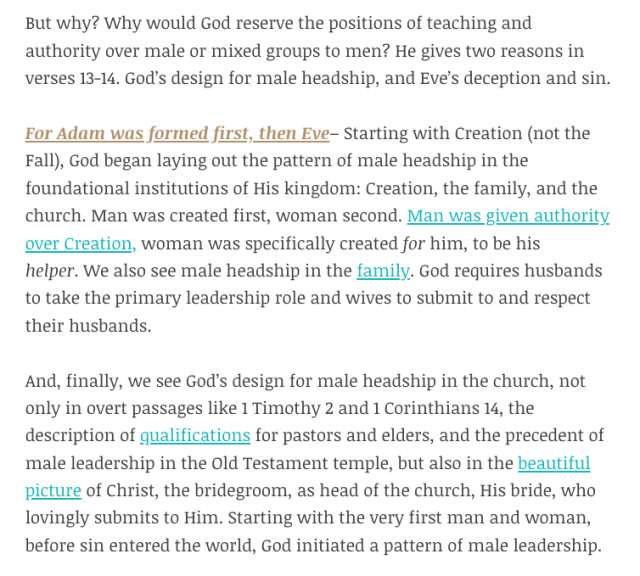
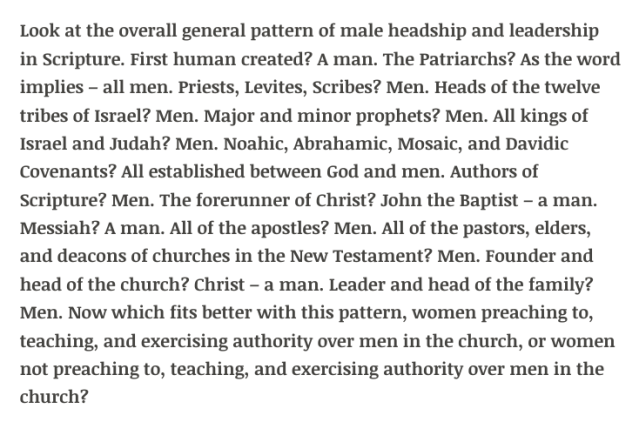
God gives us two reasons for His command that women are not to teach or exercise authority over men in the gathering of the church body: the creation order and pattern of male headship (13), and the fact that the woman was the one who was deceived into sin (14).

That’s why. Not culture, not Paul’s personal opinions, not because men didn’t value women at the time, not because the women in that particular church at that particular time were unruly or false teachers, not for any of the man-made theories that people have come up with. God tells us exactly why He made this rule for the church in verses 13-14. I’ve discussed this in greater detail in my articles Rock Your Role: Jill in the Pulpit and The Mailbag: Counter Arguments to Egalitarianism. Here are a few of the pertinent excerpts:

You’ve asked some really great questions here, and your reasoning skills are sharp. It was my pleasure to serve you by answering your comment. Keep asking questions, studying, and learning all God has to teach us through His authoritative, inspired, all-sufficient written Word.


If you have a question about: a Bible passage, an aspect of theology, a current issue in Christianity, or how to biblically handle a family, life, or church situation, comment below (Iโ€™ll hold all questions in queue {unpublished} for a future edition of The Mailbag) or send me an e-mail or private message. If your question is chosen for publication, your anonymity will be protected.

Scripture Memory

Proverbs 31 Memory Memes

Do you make it a practice to memorize Scripture? I hope you do. It’s important to put Scripture into your heart and mind so the Holy Spirit can use it to help you avoid temptation, convict you of sin, comfort you, give you biblical truth to meditate on, remind you of ways to minister to others, and so much more.

Not long ago, I memorized Proverbs 31:10-31 – the “excellent wife” passage – so I can meditate on it and ponder what it means to be a godly wife as I move through my day.

Whatever your age or marital status, it’s a great passage for women to memorize, because it’s all about godly character. You may not have a husband to be “known in the gates as he sits among the elders of the land” (23), but as a single woman, are you a good reflection on your church and pastor? As a teen, does your behavior show others that your mom and dad have parented you well? Perhaps you don’t have children to “rise up and call you blessed” (28) or a “household” (15, 21, 27) to care for, but what about the younger women you disciple? Your nieces and nephews, or children in your neighborhood?

As I was memorizing this passage, I created a meme for each verse. I’d like to encourage you to memorize these 22 verses, and I hope these “memory memes” will help. Grab them and use them as your wallpaper or screen saver on your phone or computer. Make them your cover photo or your pinned post on social media. Upload them to a digital picture frame. Print them out and tape them to your bathroom mirror.

Who’s up for the challenge?


Mailbag

The Mailbag: Potpourri (Women Bible Translators… Doctrinally sound deliverance ministry… Brain fog and Bible/book reading)

Welcome to another โ€œpotpourriโ€ edition of The Mailbag, where I give short(er) answers to several questions rather than a long answer to one question.

I like to take the opportunity in these potpourri editions to let new readers know about my comments/e-mail/messages policy. Iโ€™m not able to respond individually to most e-mails and messages, so here are some helpful hints for getting your questions answered more quickly. Remember, the search bar (at the very bottom of each page) can be a helpful tool!

Or maybe I answered your question already? Check out my article The Mailbag: Top 10 FAQs to see if your question has been answered and to get some helpful resources.


This was a wonderful article. I was curious how the question about women translating sermons would apply to people who translate the Bible into a new language. Usually they are in a team. But if a lady was working as part of a team would she not have to discuss Scripture with men and theology and doctrine in discussing proper word use? Would this be preaching to men and therefore not a job allowed women?

A very thoughtful question! It is always good to think about various applications of God’s Word.

I want to start my answer with a simple exercise that I hope will help all of my readers to distinguish “preaching” from “not preaching”. Assuming you attend any approximation of a doctrinally sound church, I want you to picture what your pastor does when he steps in front of the congregation during the worship service on Sunday morning. What does it look like? Is he holding a private small group discussion about doctrine or other biblical topics? Is he writing a blog article? Is he sharing the gospel one on one with a lost person? Is he posting a Bible verse on social media? Is he being interviewed? Is he recording a podcast?

No (And yet, women have been accused of “preaching to men” for doing all of these things). He is standing there, alone, exhorting, proclaiming, and teaching (hopefully expositorially) the written Word of God to the assembled local church body.

If you ever wonder whether someone is “preaching,” compare what he or she is doing to that mental picture of your pastor. Does it look basically the same? If not, it’s probably not preaching.

Let’s put a woman working on a Bible translation team through that grid. She’s working in some sort of office-type setting, using Bible translation software on her computer, doing research, interviewing native speakers, meeting with colleagues for discussions about various words, passages, etc. Does that look like what your pastor does on Sunday morning? I hope not, because that’s not what a pastor is supposed to be doing on Sunday morning. He’s supposed to be preaching the Word to the assembled local church.

Theย Bible prohibitsย women from pastoring, preaching to men, instructing men in the Scriptures, and holding authority over menย in the gathering of the Bodyย โ€“ the church โ€“ not in collaborative, non-preaching, situations like this outside the local gathering.

In fact, we have an example of this in Scripture, in Acts 18, where Priscilla and her husband, Aquila, took Apollos aside privately and โ€œexplained to him the way of God more accuratelyโ€. Priscilla is never rebuked or spoken negatively about in Scripture for having done this. In fact, Paul commends her and gives thanks for her as a helper to him and the church in Romans 16.

Are there some positions in Bible translation organizations that only qualified pastors should hold? Probably. Are there situations in which a doctrinally sound, biblically qualified pastor should make the final decision on doctrinal issues that may arise? Most likely. But generally speaking, most of the time there’s no biblical problem with a woman serving on a Bible translation team. And if there is, it’s not because Bible translation equals preaching.


I recently tried to leave the Word of Faith church, but experienced tough demonic problems.ย I have realized I have a spirit (not the Holy Spirit) moving in me.ย Are there any non NAR deliverance resources you can point me to?ย 

I have read the Bible 12 times cover to cover, just to share with you I am not a brand new believer and am familiar with the Scripture if you would like to share something in there.ย ย 

Yes, a doctrinally sound local church. I’m not trying to blow you off or oversimplify your problem. I’m telling you that when you experience problems like this, God’s solution is for you to go to your pastor for counsel, not to some parachurch “deliverance” ministry (even if it’s doctrinally sound, not that there is such a thing). Your pastor is responsible for shepherding your soul. Your pastor knows you, and he and your church family can walk with you through this situation 24/7.

Your pastor can also help you understand what the Bible says about what you’re experiencing. I have no doubt that you might be experiencing some sort of demonic oppression or harassment, but no one who is genuinely born again can be possessed by a demon because she is indwelt by the Holy Spirit. And reading the Bible does not equal being a Believer (I’m not saying you think it does.). There are plenty of atheists who have read the Bible numerous times. So, to come straight to the point, either you’re not genuinely saved and you might be possessed, or you are genuinely saved, and you’re misunderstanding what’s actually going on with you, spiritually. A good pastor can help you sort that out according to Scripture.

If you aren’t already in a doctrinally sound local church, find one today at the Searching for a new church? tab (in the blue menu bar at the top of this page) and make an appointment with the pastor. Explain your situation, and ask for help.

Additional Resources

What does the Bible say about demon possession? at GotQuestions

Am I Really Saved? A First John Check Up (Bible study)

Deliverance Deception playlist by Doreen Virtue


I am struggling with brain fatigue/fog and wonder if you have any advice to help me and others suffering from this frustrating problem. When I sit down to read the Bible, I canโ€™t read more than a few verses before I feel the fatigue, and I remember nothing. It is affecting my quiet time with God. I would appreciate what Scripture has to say about this and how I can work around or overcome it.


I have a short stack of Christian books I want to read. My issue is that I have very poor reading concentration and comprehension which turns an otherwise leisurely and enjoyable pastime into a laborious and frustrating trial. I would appreciate any Biblical insight into how to overcome this disabling problem so I can enjoy reading.

I thought it was interesting that I received these very similar questions from two different readers within just a few days of each other.

This is really less a theological question than a practical one, so let me offer you what I’ve got, and then, readers, leave your tips and suggestions of what has worked for you in the comments section:

  • If your issues are neurological, ask your neurologist for help and suggestions.
  • Eat right, and get plenty of rest and exercise.
  • Cut way back on your TV and social media time. TV and social media train your brain to have a short attention span and to be distractable.
  • When it’s time to focus on Scripture or your book, get alone in a quiet room with no distractions. Turn off your phone, music, TV, etc. Use a white noise app or video if you need to.
  • Use the audio option on your Bible app or listen to Justin Peters or Gabriel Hughes read the Bible to you.
  • Find the audio book version of the book you’re trying to read.
  • Once you’re able to build up your focus as you listen to the audio version of your Bible or book, try reading along for a certain portion of that time. You might want to start with a goal of 5 minutes of reading along, then increase it by a minute every few days or so.
  • When you’re able to read along with the audio for 15-30 minutes, gradually start weaning yourself off the audio a few minutes at a time.
  • Set small, achievable time limit goals for your listening, listening/read along, and reading, and gradually increase them.
  • Take notes as you listen. The quality of the notes doesn’t matter when you first start out. Listening for something (anything!) to write down will help you focus.
  • Memorize Scripture and meditate on it throughout the day.
  • Write Scripture. Just find a passage you like and copy it down word for word (handwritten) as many times as you like. It will help you memorize Scripture and also keep your focus on reading it as you’re copying it.

Readers, any other suggestions that have worked well for you? Comment below.


If you have a question about: a Bible passage, an aspect of theology, a current issue in Christianity, or how to biblically handle a family, life, or church situation, comment below (Iโ€™ll hold all questions in queue {unpublished} for a future edition of The Mailbag) or send me an e-mail or private message. If your question is chosen for publication, your anonymity will be protected.

Mailbag

The Mailbag: Potpourri (Teaching Dad the Bible… Event planning… Children’s Sunday School)

Welcome to another โ€œpotpourriโ€ edition of The Mailbag, where I give short(er) answers to several questions rather than a long answer to one question.

I like to take the opportunity in these potpourri editions to let new readers know about my comments/e-mail/messages policy. Iโ€™m not able to respond individually to most e-mails and messages, so here are some helpful hints for getting your questions answered more quickly. Remember, the search bar (at the very bottom of each page) can be a helpful tool!

Or maybe I answered your question already? Check out my article The Mailbag: Top 10 FAQs to see if your question has been answered and to get some helpful resources.


My parents have not attended a church as their home church for years. I have tried to encourage them to seek out a church family and how important it is but this has not happened for various reasons. My mom had been asking about Bible study and I offered to her I could study with her a few times a month at her home with one of your studies. Iโ€™m not sure where my Dad sits with Christ. If he decides he wants to sit at the table and listen is that ok or should I stop and say something- Iโ€™d be disobeying God?

I’m sorry. I know that’s a tough dilemma to be in with your parents because you care about them so much.

It’s wonderful that your mother is at least interested in Bible study! What could be better than God convicting and convincing her of the gospel, sin, the need for a good church, and so on. I would encourage you to jump on that opportunity right away!

If I might offer a suggestion, I would encourage you to start either by working through the Scriptures and materials at my gospel presentation page, What Must I Do to be Saved?, with her, or working through my Bible study on 1 John, Am I Really Saved?, or both.

There are two reasons for this: a) when someone has been out of church that long with little desire to return, the most likely reason is that she was never genuinely saved in the first place, and b) if she’s not saved, Bible study, for the purpose of growing in Christ, is not going to work, because she’s not yet in Christ. (You can and should still do Bible study with an unbeliever, though, if she’s willing, because God can use any part of His Word to draw her to Himself for salvation.)

All of the above is also true for your dad. If he’s unsaved, any Bible study he listens to would come under the heading of evangelism, and it is not unbiblical for a woman to share the gospel with a man (see #11 here).

If he is saved, what would be ideal is if your husband, brother, or another man who’s a Believer could disciple him and do Bible study with him, because he needs a godly man to teach him how to be a godly man. That’s not something you as a woman can do.

But if that’s not possible at this time, there’s no reason not to include him in the study you’re doing with your mother. The Bible prohibits women from pastoring, preaching to men, instructing men in the Scriptures, and holding authority over men in the gathering of the Body – the church – not in private, at home, family situations which, one way or the other, are almost certain to be temporary.

In fact, we have an example of this in Scripture, in Acts 18, where Priscilla and her husband, Aquila, took Apollos aside privately and “explained to him the way of God more accurately”. Priscilla is never rebuked or spoken negatively about in Scripture for having done this. In fact, Paul commends her and gives thanks for her as a helper to him and the church in Romans 16.

Enjoy your study time with Mom and Dad.


At our church which seems to be very theologically sound, my husband and I have got the OK to put together a marriage weekend. Various sessions. Please know I never actively seek a leading role however it seems if a person has an idea the job defaults to them. What are some safe parameters in this situation?

Great question. It’s always good to think these things through. When you say you’re “putting together” a marriage weekend, what that means to me is that you’re planning it. You’re deciding the date and time, making sure the sanctuary or other space at the church is available, making up fliers, finding a speaker(s), decorating, planning the menu, scheduling the caterer … you know – event planning.

Your pastor should certainly vet and approve the speaker(s) and all the other details, but event planning is not prohibited for women anywhere in Scripture.

If you’re asking me whether or not you should speak or teach at the conference, if you’re doctrinally sound, you know your Bible well, and you’re able to teach, there’s no reason why you shouldn’t teach the women at the conference. You should not teach the men. Those are really the only parameters you need. A couple of extra resources you might find helpful:

Rock Your Role: Jill in the Pulpit

Rock Your Role FAQs


I completely agree with simply teaching from the Bible vs. canned studies for adults, but what about children’s Sunday school? Various ages. Packaged curriculums have some fun bright coloured worksheets and applicable songs, etc., with the lessons. Answers in Genesis has small video clips. Not trying to make Sunday School a party but children enjoy music and visuals. Would love your thoughts.

I have taught every age from bed babies through adult women in Sunday School, so you’ve come to the right place! Appropriate hymns and songs – especially Scripture memory songs, in Sunday School – are great for any age class. For the youngest children, there’s certainly nothing wrong with coloring sheets or brief videos after the Bible lesson and to supplement the Bible lesson. All of those things can be a way of reinforcing the biblical concepts you’ve taught the children in the Bible lesson. But I would suggest gradually weaning them off the coloring sheets and videos once they hit about third or fourth grade, and replacing them with more time focused on discussing the passage, Scripture memory, prayer, etc.

When it’s time for the Bible lesson, read it to the children straight from the Bible, not a quarterly, booklet, photocopy, etc. You might want to use a children’s Bible for younger children, then move to a simply worded translation for older children, stopping along the way, of course to ask questions and make sure everyone understands. Even at the youngest ages, you want to model studying and teaching straight from the text of Scripture rather than relying on a “canned” study.


If you have a question about: a Bible passage, an aspect of theology, a current issue in Christianity, or how to biblically handle a family, life, or church situation, comment below (Iโ€™ll hold all questions in queue {unpublished} for a future edition of The Mailbag) or send me an e-mail or private message. If your question is chosen for publication, your anonymity will be protected.