Mailbag

The Mailbag: Potpourri (Female pastor in 2 John?โ€ฆ Pronouns for pre-schoolersโ€ฆ Women’s ministry “how to”โ€ฆ Video studies for women?)

Welcome to another โ€œpotpourriโ€ edition of The Mailbag, where I give short(er) answers to several questions rather than a long answer to one question.

I like to take the opportunity in these potpourri editions to let new readers know about my comments/e-mail/messages policy. Iโ€™m not able to respond individually to most e-mails and messages, so here are some helpful hints for getting your questions answered more quickly. Remember, the search bar (at the very bottom of each page) can be a helpful tool!

Or maybe I answered your question already? Check out my article The Mailbag: Top 10 FAQs to see if your question has been answered and to get some helpful resources.


Is the epistle of 2 John addressed to a female pastor? I just read a social media debate on this topic. One poster is focusing on the โ€œchildrenโ€ in the verse, seeing them as Godโ€™s spiritual children (the church) and only considering the โ€œchosenโ€ or โ€œelectedโ€ lady as the leader/pastor of the church. I took โ€œchosen or electโ€ to mean sheโ€™s a โ€œgodlyโ€ woman, one predestined (chosen by God) like other believers.

Great question! It is so important to pay attention to details like this in Scripture.

No, 2 John is not addressed to a female “pastor”. If it were, it would be a stern letter of rebuke because such a woman would be in egregious sin and rebellion. The verses that are being twisted in an attempt to argue this fallacy are parts of verses 1, 4-5, and maybe a bit of 13:

The elder to the elect lady and her children … some of your children … I ask you, dear lady … The children of your elect sister greet you.

Excerpted from 2 John 1, 4-5, 13

You are definitely on the right track in your thinking. Some people think 2 John was written to a church and John was riffing off the “church as the Bride of Christ” metaphor by using this female personification of the church. “Elect” or “chosen lady” would then mean elect or chosen in the sense that the church is elect or chosen out of the world. This “lady’s” “children” would, metaphorically, be the members of that church.

Others think 2 John was written to a particular woman in the church, namely the woman who had offered her home as a place for the church to meet. Verse 10 would be a good fit with this idea, warning her that, though it was customary and good Christian hospitality to open her home to godly pastors and teachers who were traveling around and needed a place to stay, that she should not extend hospitality to those preaching a false gospel. This individual woman would be elect or chosen in the sense that every individual Christian is elect or chosen. Her “children” would be understood to be her own biological children.

Personally, I can see where a good argument could be made for both of these perspectives, and that maybe John had both in mind as God moved him to write this letter.

But whichever perspective you lean toward, one thing we know for sure is that it was not written to a female “pastor”. John would not have commended someone that Paulโ€™s epistles rebuke. That would make Scripture contradict itself, and, thus, God contradict Himself, since He is the author of Scripture. And we know that can’t happen.


How would you respond (or how have you responded) when someone prefers to be called by the opposite gender?

I had a man correct my daughter (sheโ€™s only 2, almost 3) today because she referred to him as โ€œheโ€. I told him out of deep love for him I could not in good conscience refer to him as โ€œher,โ€ but how do I explain that to an almost 3 year old? How have you informed your kids about this? Would love any feedback you have on this.

I do not envy you young moms who are having to deal with things like this with your small children. My youngest child is 19, so this was not an issue when he or any of his older siblings were toddlers or even young teens. Isn’t it amazing how fast the world has plunged headlong into this depth of sin?

I think you handled the situation just fine, and with a two or three year old who likely had zero memory of this incident the next day, you probably don’t even need to broach the subject. But if you do, I would suggest keeping your focus broad and shallow. “Honey, you need to whisper to me when you have a question about another person, or wait until later to ask. That person’s feelings might get hurt, and we don’t want to hurt other people’s feelings if we can avoid it.”.

Honestly, for a two or three year old, even the part about hurting someone else’s feelings is going to go right over her head (as is the “wait until later” part, and she’s also unlikely to remember the “whisper to me” part for the future). Children that young rarely have the capacity to grasp the concept that another person even has feelings. They certainly aren’t going to understand the concept of adults “identifying” as the opposite sex. This is really not something you need to worry about trying to explain to her at this young age, and no amount of talking or explaining is going to keep a pre-schooler from verbalizing any and every thought that comes to mind. Ask any parent – that’s just what they do at that age.

In another year or two, if you encounter a person like this again and your daughter asks you why that man is dressed like a woman, you might say something like,

“Well, you know how sometimes you think you’d like to be a dog or a fairy princess instead of a little girl so that’s what you pretend to be? Do you ever see Mommy doing that? No? That’s because when we grow up, the Bible tells us we’re to put childish ways behind us. We’re to be happy with the way God made us and do our best to love Him and serve Him as the person He created us to be.

It’s really sad, but sometimes a boy [or vice versa for a girl] who doesn’t know God will grow up and think he would rather be a lady than a man, kind of like you think you’d rather be a fairy princess or a dog than a little girl. But instead of acting like a grown up and asking God to help him be happy with the way He made him, the man will dress up like a lady and pretend to be a lady. Let’s take a moment to pray for him, that He will come to know Jesus and be happy that God made him a man.”

Additional Resources:

The Mailbag: Whatโ€™s In a Name?

pride, pronouns & prodigals at A Word Fitly Spoken


My church is looking at getting our women’s ministry off the ground and I was asked to be on the team. Do you have any pointers for what works best for your women’s ministry? I definitely want the focus to be growing women in the Word, but Iโ€™m unsure how to go about structuring the meeting.

I’m going to give you some resources below that can help jump start your brainstorming, but first a few very simple suggestions:

  • Trust God and pray for wisdom and direction. God promises to give them to you if you ask, so why not take Him up on His offer?
  • Gather your ladies together (or create a survey and email it out) and ask them what sort of structure or class would be most helpful to them.
  • With their feedback in hand, talk things over with your pastor. He should be able to give you some guidance that’s tailor made for the ladies at your particular church.

Additional Resources:

Teach What Is Good: Discipling Younger Women in the 21st Century– Listen in to my teaching session from last year’s OHCW conference. In fact, you might find all of last year’s sessions to be helpful (you’ll find the links below the video).

Biblical Women’s Ministry- Part 1 at A Word Fitly Spoken

Practical Women’s Ministry Part 2

All Word and No Play: The Importance of Fun and Fellowship in the Doctrinally Sound Church

Guest Post: Building a Biblically Healthy Womenโ€™s Ministry (by a pastor, for pastors)


The small church I pastor in the process of launching a women’s ministry and I’m curious if there are any specific video studies led by women that you recommend. I hope to compose a menu of studies for them. Thanks for your assistance.

In case anyone is confused, this email is from a (male) pastor, not a woman pretending to be a pastor. Just wanted to clear that up, there. :0)

Brother pastor, my husband is a retired worship pastor, and God always had us at small churches too, so I not only sympathize with the challenges small churches face, but I also have a lot of experience with women’s ministry at small churches.

And still, I encourage women’s ministries (men’s ministries too, if that were my wheelhouse) not to use what I call “canned” studies (workbooks, videos, etc.) but to study and teach straight from the text of Scripture itself. That’s the primary reason why, on principle, I don’t make recommendations for any women’s Bible study materials other than the Bible itself. The second reason I don’t recommend “canned” studies is that, as you have probably discovered in your search, the overwhelming majority of women’s “Bible” studies are authored by false teachers and consist mainly of fluff and false doctrine. Even if I wanted to make recommendations, it would be nearly impossible.

What I would recommend instead is that you find at least one woman, and maybe up to five or six women, should your church be so blessed, who are spiritually mature and seem to have the gift of teaching, and begin training them to rightly handle and teach Scripture to other women, since this is the biblical instruction we’re given.

As they’re learning, you may wish to take them through or have them practice teaching some of the Bible studies I’ve written as “training wheels” to help them learn. My studies (all free) are designed to teach women how to study straight from the text of Scripture in a “learn by doing” way. Once they get the hang of it, they’ll never have to rely on anyone else’s materials again, even mine! Plus, they’ll eventually be able to teach other women how to teach the Bible. Here are some other resources I think will help:

Additional Resources:

Bible Studies

McBible Study and the Famine of Godโ€™s Word

4 Ways Weโ€™re Getting Womenโ€™s Discipleship Wrong, and How We Can Get it Right!

The Mailbag: Can you recommend a good Bible study for women/teens/kids?

The Mailbag: โ€œWe need to stop relying on canned studies,โ€ doesnโ€™t mean, โ€œWe need to rely on doctrinally sound canned studies.โ€.

Teach What Is Good: Discipling Younger Women in the 21st Century (Session 2 on video)

How to Study the Bible โ€“ and How Not To


If you have a question about: a Bible passage, an aspect of theology, a current issue in Christianity, or how to biblically handle a family, life, or church situation, comment below (Iโ€™ll hold all questions in queue {unpublished} for a future edition of The Mailbag) or send me an e-mail or private message. If your question is chosen for publication, your anonymity will be protected.


Discernment, False Teachers, Social Media

Throwback Thursday ~ Four Reasons Why It Matters Who We Share, Pin, and Re-Tweet

Originally published May 22, 2014

facebook-large

Scroll…scroll…wince…

Scroll…scroll…wince…

I find myself wincing a bit when I see people โ€“who I know genuinely love Jesusโ€”sharing, pinning, and re-tweeting quotes from false teachers such as Joel Osteen, Joyce Meyer, T.D. Jakes, and Christine Caine, just to name a few. Why? What’s wrong with the encouraging, even biblical, at times, things these people say?

First of all, let me back up a little. What is a โ€œfalse teacherโ€? A false teacher is someone who is billed as a Christian pastor or Bible teacher who habitually and unrepentantly writes, teaches, or preaches things that conflict with the clear teaching of Scripture. For example, all four of the people I listed above teach some version of the prosperity gospel, the false teaching that is most rampant in the Western church today. Additionally, T.D. Jakes adheres to the false doctrine of modalism, and Joyce Meyer and Christine Caine blatantly disobey the Bibleโ€™s teaching that women are not to be pastors or instruct men in the Scriptures in the church.

These days, it can be difficult to keep up with who teaches sound doctrine and who does not, especially when pastors and teachers we thought were theologically orthodox seem to be turning apostate at an alarming rate. I myself have been a fan of more than one popular writer/teacher/preacher that I later realized was a false teacher (Joyce Meyer was one of them.) as I delved into what they actually taught and believed and compared it to Godโ€™s word. I know first hand that itโ€™s easy to think that these people are good biblical teachers and preachers when what they say sounds good, makes us feel good, and has an occasional Bible verse sprinkled in.

th (1)

Because Iโ€™ve been there myself and know how easy it can be to be drawn in by false teachers, I donโ€™t have any less respect for folks who re-tweet the occasional Osteen-ism of the day. In fact, I have more respect for them, because I know they love the Lord, theyโ€™re making an effort to find biblical teaching to listen to, and they have the courage to try to share the gospel with their friends and family via social media. Those are all fantastically good things, and they are to be commended.

But, still, the quotes we share and the people who said them matter. Why?

The quotes we share and the people who said them matter. Here are four reasons why…

1.
Lost peopleโ€™s eternities are at stake.

Seriously? From hitting the โ€œshareโ€ button on a false teacherโ€™s status? Seriously. I donโ€™t think thatโ€™s overstating the gravity of the matter. Thereโ€™s no way to take the possibility of an eternity in hell too seriously.

Think about it: You have an unsaved Facebook friend. Sheโ€™s getting to the point in her life where she figures itโ€™s time to get her stuff together, so she starts looking into this whole Jesus thing. Where to start? Sheโ€™s never even set foot inside a church. Aha! She remembers youโ€™re a Christian. Maybe youโ€™ll have a good lead for her. As sheโ€™s thinking about all this, you share Joyce Meyerโ€™s status, and it appears in your friendโ€™s news feed. โ€œAh,โ€ your friend thinks, โ€œthis must be a good Bible teacher if my Christian friend follows her.โ€ So she โ€œlikesโ€ Joyce Meyerโ€™s Facebook page and follows her on Twitter. Then she starts watching her on TV. Buys some of her books. Maybe attends one of her conferences. Because your friend has zero knowledge of the Bible, she believes everything Joyce Meyer says. It sounds good. It makes her feel good. Sheโ€™s hearing a few out of context Bible verses here and there. But the problem is that Joyce Meyer doesnโ€™t teach the Jesus of the Bible. She teaches a false god of her own creation. And if your friend doesnโ€™t put her faith in the true Jesus of the Bible, sheโ€™s just as lost as she was before. Only now she thinks sheโ€™s a Christian. And you canโ€™t convince her otherwise.

Sound far fetched? Maybe. Maybe not. But if thereโ€™s even the slightest chance something like that could happen, is it really worth justifying that status share? Furthermore, is it worth even following a teacher who could lead someone you love to an eternity in hell?

2.
It gives false teachers free publicity and a broader platform.

One thing I was very surprised to learn when I first began the process of having my book published1 is that publishers want non-fiction writers to have a built in audience, or โ€œplatform,โ€ before they will publish your book. That means youโ€™re already doing speaking engagements and/or have a decent sized ministry, have lots of followers on social media, etc. As I once explained to someone, โ€œYou donโ€™t get your book published and then become [celebrity Bible teacher] you have to be [celebrity Bible teacher] in order to get published.โ€

human-334110_640

Social media stats are a big factor in a celebrity preacherโ€™s/teacherโ€™s platform. If T.D. Jakes suddenly lost the majority of his social media followers, you can bet the TV stations heโ€™s on and the conferences he gets invited to would be taking a serious look at whether or not theyโ€™d continue to affiliate with him, because it would indicate that his audience is shrinking.

Conversely, when we re-pin, re-post, or re-tweet these folks, their social media stats go up. They not only get a broader platform on social media from which to spread their unbiblical teaching, they continue to get more book, radio, TV, and other media deals, get invited to speak at more conferences, and even start exporting their false teaching overseas (โ€œmissionsโ€) to people who have never heard the gospel before and have no way of knowing theyโ€™re being lied to.

When we promote false teachers on social media, we bear some of the responsibility for the spread of their false doctrine.

If anyone comes to you and does not bring this teaching, do not receive him into your house or give him any greeting, for whoever greets him takes part in his wicked works.

2 John 10-11

When we promote false teachers on social media, we bear some of the responsibility for the spread of their false doctrine.

3.
It is disobedient to Scripture.

Often, when a Christian is told sheโ€™s following a false teacher, the common response is, โ€œOh, I just chew up the meat and spit out the bones,โ€ meaning that she takes to heart the โ€œgoodโ€ things the false teacher has to say and ignores the bad.

The question is: where does the Bible say this is the correct way to deal with false teachers? Answer: it doesnโ€™t. In fact Scripture says exactly the opposite.

For starters, Galatians 1:6-9 says that if anyone preaches a different gospel (such as the prosperity gospel) from the one thatโ€™s set down in Scripture, โ€œlet him be accursed.โ€ โ€œAccursedโ€ means โ€œdamned,โ€ sentenced to hell for eternity.

1 Timothy 4:7 and Titus 3:10 say that we are to have nothing to do with people who teach โ€œirreverent or silly mythsโ€ or cause division by teaching false doctrine.

2 Corinthians 6:14-16 tells us not to be joined together or partner with unbelievers, lawlessness, darkness, Belial (the devil), or idols.

1 Corinthians 5:7-13 tells us that when a person infiltrates the church who claims to be a Christian, yet is greedy, an idolater, or a swindlerโ€” all of which are things that prosperity preachers are guilty ofโ€” we are to โ€œcleanse out the old leaven.โ€ We are โ€œnot to associateโ€ with them. We are to โ€œpurge the evil person from among you.โ€

Titus 1:10-16 says of false teachers, โ€œThey must be silenced,โ€ because they teach โ€œfor shameful gain what they ought not to teach.โ€ Paul instructs Titus to โ€œrebuke them sharply,โ€ and that, โ€œthey profess to know God, but they deny him by their works. They are detestable, disobedient, unfit for any good work.โ€

The entire second chapter of 2 Peter paints a dismal picture of the motives, the behavior, and the fate of false teachers:

โ€œBecause of them, the way of truth will be blasphemed.โ€

โ€œIn their greed they will exploit you with false words.โ€

They will โ€œbe destroyed in their destruction, suffering wrong as the wage for their wrongdoing.โ€

โ€œThey are blots and blemishes, reveling in their deceptions, while they feast with you.โ€

โ€œThey entice unsteady souls.โ€

โ€œFor them the gloom of utter darkness has been reserved.โ€

โ€œThey promise them [people who listen to their false teaching] freedom, but they themselves are slaves of corruption.โ€

The entire epistle of Jude is dedicated to exhorting Christians to โ€œcontend for the faith that was once for all delivered to the saints.โ€ Of false teachers, Jude says:

โ€œCertain people have crept in unnoticed who long ago were designated for this condemnation, ungodly people, who pervert the grace of our God into sensuality and deny our only Master and Lord, Jesus Christโ€ฆWoe to them!โ€

Thereโ€™s more, because a large portion of the New Testament is dedicated to exhorting Christians to stay away from false doctrine and rebuke those who teach it, but I think you get the picture. Is it obedient to Christ and to His word to follow and promote someone He says is damnable? People who teach another gospel, such as the prosperity gospel, are the enemies of Christ. Who are we going to side with, Christ or His enemies?

People who teach another gospel, such as the prosperity gospel, are the enemies of Christ. Who are we going to side with, Christ or His enemies?

 4.
It is unloving and disloyal to our Master.

th

Think about the person you love the most in this world. Maybe itโ€™s your spouse, your child, a parent, or a friend. Next, think about your favorite celebrity, perhaps a movie star, a TV personality, or a famous author or athlete. Now try to imagine that that celebrity, in interviews with journalists, on talk shows he appears on, at personal appearances and speaking engagements, in books he writes, etc., routinely tells lies about the character of your dearest loved one. And thousands, maybe millions, of people believe him.

Would you continue to be a fan of that celebrity?

What if your loved one found out you were a fan of that celebrity? How would she feel to know you were a fan of someone who spreads lies about her?

If we wouldnโ€™t follow someone who lies about a loved one, how much less should we as Christians have anything to do with a celebrity preacher, teacher, or author who drags the name of our precious Savior through the mud and lies about the gospel?

How can we as Christians have anything to do with a celebrity preacher, teacher, or author who drags the name of our precious Savior through the mud and lies about the gospel?

Friends, for all of these reasons and more, letโ€™s stop promoting these false teachers on social media by publicizing their quotes and other materials. Looking for an encouraging quote to share? Thereโ€™s nothing better than a verse of Scripture. Because Scripture can offer people something that false teachers canโ€™t: truth and hope. As Jesus Himself said,

โ€œSanctify them in the truth; your word is truth.โ€ John 17:17


ยนMy book, Jacob, Journaling the Journey is no longer in print, and thatโ€™s a good thing! I wrote it before learning good hermeneutics and how to handle Godโ€™s Word properly. You can probably still find copies of it at online merchants, but I would not recommend that you buy or use it. If you want a good Bible study, the best thing is to simply pick up the Bible and study it for yourself. Right now, I have no plans to rewrite Jacob for future re-release.

Speaking Engagements

Report Back: Women Thriving God’s Way Retreat

What a joy it was, last weekend, to share with my sisters from Highland Bible Church of Woodland Park, Colorado at their fall retreat: Women Thriving God’s Way! Conferences are great for reaching out to women in your community and surrounding areas, but sometimes you need an event where it’s just family. Retreats provide an intimate atmosphere for the women of a local church to bond together as sisters in Christ. It was an honor to speak into HBC women’s family time.

I grew up in southern New Mexico, but I had never crossed our northern border into Colorado before, so it was exciting to touch down at the Colorado Springs airport.

First on the agenda was dinner with Pastor Jeff and his wife, Sharon (who kindly picked me up at the airport), and Adriana (who organized the retreat) and her husband Asa. In the body of Christ, you never meet a stranger, only extended family, and we had a wonderful time of fellowship together.

After dinner, Adriana and Asa checked me into the delightfully rustic Golden Bell Camp and Conference Center:

On Friday morning, Adriana and her daughter Jenny Lynn were so kind to take me around and show me some of the sights. The Colorado Springs area is home to a number of notable sites, including the U.S. Olympic and Paralympic Training Center, the United States Air Force Academy, Pike’s Peak, Focus on the Family, The Navigators, and their striking conference center, Glen Eyrie Castle.

Since our time was limited, we focused on two other sites I was particularly interested in, The Garden of the Gods, and Charis Bible College.

The Garden of the Gods is a beautiful area just outside of town, with huge sandstone rock formations set against Pike’s Peak as a majestic backdrop. It’s easy to ignore the evolutionary fairy tales about how the rocks and mountains were formed, because it’s more than obvious that God’s awesome creative hand was at work here!

After a great lunch at a local deli, we did a quick drive through tour of Charis Bible College. I know, kind of a weird choice for sightseeing if you know anything about the school. Or me.

Charis “Bible” College was founded by Andrew Wommack, a key figure in the New Apostolic Reformation / Word of Faith movement. If you’re at all familiar with Bethel’s School of Supernatural Ministry, Charis is kind of like that but with more of a “real” college atmosphere and approach. Still, students are required to take courses with titles like “Healing,” “Holy Spirit I & II,” “Establishing a Prosperous Soul,” and “Operating in God’s Best”. And yet the code of student conduct has the audacity to admonish:

“Spreading false doctrine is not allowed…it is not appropriate to…teach against the doctrines in Charis’ statement of faith.”

The campus is gorgeous and the surroundings enchanting.

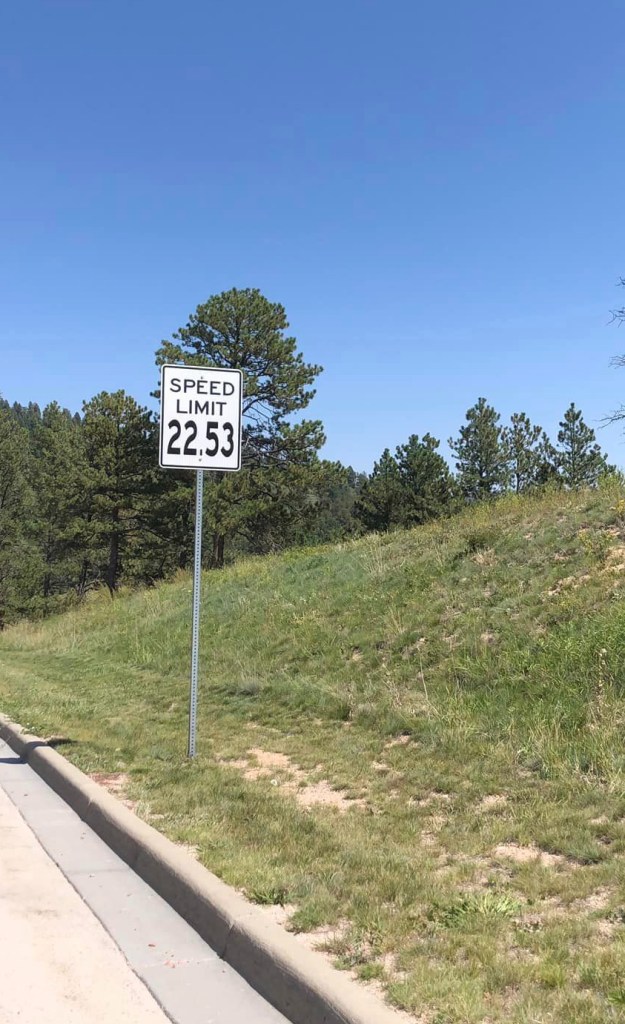
I was intrigued by this unique speed limit sign (below). No explanation was posted, and I searched Charis’ website and the internet extensively to no avail. At first I thought it was a reference for a Bible verse, but I looked at every chapter 22 in the Bible, and the only 22:53 references I found were:

1 Kings 22:53: He served Baal and worshiped him and provoked the Lord, the God of Israel, to anger in every way that his father had done.

Luke 22:53: When I was with you day after day in the temple, you did not lay hands on me. But this is your hour, and the power of darkness.

Pretty appropriate if you ask me, but I doubt Andrew Wommack would have chosen either of those verses.

The only other thing I found is that 22.53 km/hr is roughly equivalent to 14 mph, so…maybe that’s it? I don’t know. If you know, comment below. Curiosity is about to kill me! :0)

Not long ago, my friend Justin Peters was preaching at HBC, and he and Pastor Jeff took the time to visit a class. Needless to say, their questions weren’t welcome, and they were Kicked Out of Charis. I didn’t have time to do anything that would get me kicked out. :0) (You can see more of the opulent insides of the buildings in this video, too.)

We arrived back at Golden Bell in plenty of time to rest up for a fun and delicious dinner and “getting to know each other better” time of fellowship, followed by our first teaching session on biblical womanhood: Rock Your Role at Home and at Church.

Participant gift bags. Thanks, ladies! I really needed a new journal!

Saturday after breakfast, we got right down to business with our second session: Holy Mothers (and Others) of God’s Word, one of my favorites. We strolled through the Bible and took a brief look at the lives of several of our Old and New Testament sisters, and their examples of holiness to us.

Between teaching sessions and other activities, the ladies had the opportunity to craft these cute Christmas ornaments. They kindly gave me a couple to take home. What a treat!

Session 3, Practical Holiness, a look at practical ways to pursue holiness in our daily lives, came right after lunch. And after a fun afternoon of rest and recreation, capped off by a mouth-watering supper, we ended the day with teaching session 4, God’s Word: Our Foundation, addressing the necessity, authority, and sufficiency of Scripture.

I had to get up at 4 a.m. to catch my flight home the next morning, but it was worth it to be able to be with my own church family Sunday night. Flying on 9/11 was an interesting experience. The Colorado Springs airport asked us to observe a moment of silence in remembrance, and everyone respectfully complied.


Many thanks to Pastor Jeff, Sharon, Adriana, Jenny Lynn, Russ, Ely, and all of the HBC ladies who worked so hard to host a great retreat, took care of all my needs, and made me feel so welcome. If you’re ever in the Woodland Park area, be sure to stop in to Highland Bible Church for a visit!


If your church or organization is ever in need of a speaker for a womenโ€™s event, Iโ€™d love to come share with your ladies as well. Click here for more information.


Photo Credits

All photos marked with a white star were taken by retreat attendees.

All other photos by Michelle Lesley

Titus Bible Study

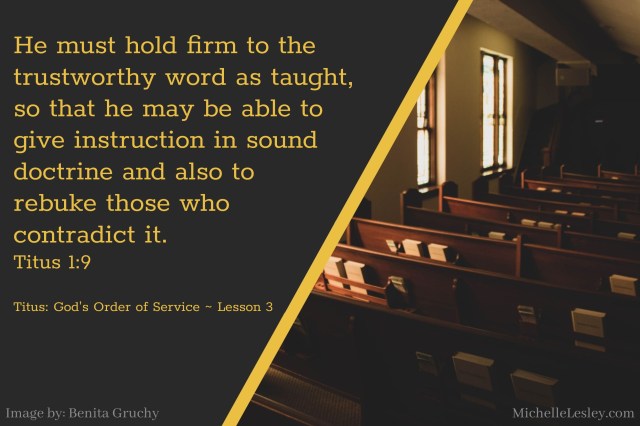
Titus: God’s Order of Service ~ Lesson 3

Previous Lessons: 1, 2

Read Titus 1:5-16

Questions to Consider

1. Review your notes from last weekโ€™s lesson. How does that passage carry over to, impact, and set the tone and context for this week’s passage?

2. Review question 6 from lesson 2: Take a look at v.5. Why did Paul leave Titus in Crete? What does Paul mean by โ€œput what remained into orderโ€? Whatโ€™s a phrase we might use in todayโ€™s vernacular to say the same thing? Why did Titus need to appoint elders โ€œin every townโ€? (You might want to review your notes from lesson 1 โ€“ link above.) How would appointing elders have given the churches in Crete structure and order?

3. Compare verses 5-9 with 1 Timothy 3:1-7. What word is used for the church leadership position in Titus 1:5? In 1 Timothy 3:1? Considering that Paul wrote both of these epistles and both of these passages are very similar in nature, is it fair to assume that these terms mean the same thing? What do we typically call an elder, overseer, or bishop in the local church today? Compare these terms in Titus 1:5 and 1 Timothy 3:1 in several reliable translations noting the footnotes and looking up the cross-references. What is a pastor / elder / overseer / bishop, according to Scripture? What does he do, according to these passages?

(If you have worked through my study on 1&2 Timothy, you may wish to review your notes on question 3, Lesson 4 for the following question.)

Make a 4-column chart. In the first column of each chart, list each qualification in Titus 1:6-9 and 1 Timothy 3:1-7 for the office of pastor / elder. In the second column, explain what that qualification means. (For example: What does it mean to be โ€œsober-mindedโ€ or โ€œhospitableโ€?) In the third column, explain why this qualification is important in the character of the man and/or in carrying out the duties of the office. In the fourth column, place a check mark if this is a requirement for pastor / elder in both passages. Which of the qualifications are common to both passages? Which are different? Why might Paul have included certain qualifications in one passage, but not the other? How is it beneficial to the church for men in the office of pastor / elder to have these qualifications?

Note the qualification “above reproach” in both the Titus and Timothy passages, paying special attention to the way Paul “bookends” Titus 1:6-7a with this term. How do all the qualifications listed between the two “above reproach bookends” (and after “above reproach” in Timothy) help us to understand what this term means? God could have tied “above reproach” to a man’s business dealings, the community’s or church’s opinion of him, or even his own personal character displayed to others, but what is “above reproach” most closely tied to in both of these passages? Why? Think about this statement: A man can hide his heart from others, but he can’t hide his family. Do agree or disagree in relation to the qualification of being above reproach?

4. How would you break down or outline the types or areas of qualifications in the Titus passage?

  • 6-7a –
  • 7b-8 –
  • 9 –

Why do you think God’s doctrinal requirements come last, after family requirements and personal character? Does it matter how sound and perfect a man’s doctrine is if he doesn’t have a godly heart that’s fleshed out in the fruit of his family and his character displayed to others? How would you answer the question of 1 Timothy 3:5: “for if someone does not know how to manage his own household, how will he care for God’s church?”

5. Note the “he must” vs. “he must not” qualifications in 6-9. How do these groups of qualifications paint the overall picture of a godly man versus a worldly man? Connect the overall picture of of the godly man above reproach in this passage to the Old Testament concept of blamelessness. We tend to break this passage down and evaluate a man in a “micro” sense on each individual trait, but could another purpose of this passage be to demonstrate the general “macro” type of man who’s qualified for the office rather than a man who is absolutely perfect in each trait mentioned?

6. What are the three doctrinal requirements in verse 9? How does “holding firm to the trustworthy word as taught” equip a pastor to both give instruction in sound doctrine and to rebuke those who contradict it? Some pastors only give instruction in sound doctrine. They refuse or are afraid to rebuke sin in the church, carry out church discipline, biblically address controversial issues (homosexuality, women preaching, etc.), or clearly teach against false teachers and false doctrine. Carefully consider verse 9 again. Are such men biblically qualified to be pastors?

7. Read verse 9 as the introduction to verses 10-16. Note that verse 10 begins with the word “for,” which, in this context means “because”. Why, according to verse 10-16 must a pastor hold to sound doctrine, instruct in sound doctrine, and rebuke those who contradict it? Connect the phrases “they must be silenced” (11) and “rebuke them sharply” (13) back to “rebuke those who contradict it” (9).

Consider the “some pastors only…” from question 6 above and verse 9’s admonition to rebuke those who contradict sound doctrine. How does Paul, in 10-16, set an example of how to “do” verse 9 for such pastors as well as for Titus?

8. Examine verses 10-16. What are the problems the false teachers – and/or the church members in Crete who believe their false doctrine – creating in the church? In what ways are these problems similar to the division and dissension created by false teachers and their followers in the church today?

Many professing Christians today consider it “unloving” or “unchristlike” to do exactly what this passage teaches – rebuke false teachers and their followers. Look carefully at the stringent language in this passage. What are some of the words and phrases these professing Christians would object to as “unloving” or “unchristlike” if someone applied them to false teachers today? How does God – Who, remember, is the One who breathed out these words – demonstrate via this passage, that it is His idea and instruction to use stark and stringent language in dealing biblically with false teachers and those who willfully and unrepentantly follow them?

How does instruction in sound doctrine and rebuking those who contradict it eradicate false doctrine, false teachers, and the division they create, and help create orderliness in the church’s fellowship and worship?


Homework

How does an orderly church structure (leadership, hierarchy, etc.) lead to orderly worship? This week, begin to consider how the order and structure in church leadership that God calls for in Titus 1:5-16 affects the order in the worship service that God calls for in 1 Corinthians 14:26-40. Also, compare and contrast the order and structure of the Old Testament system of worship – the leadership, feasts and festivals, rules for sacrifices and offerings, the architecture and design of the tabernacle and temple, etc. – compared to the order and structure of the New Testament church and worship.

Because order and structure in the church is a continuous theme throughout Titus, you may wish to make these comparisons (with 1 Corinthians 14 and with the OT system) each week of the study.


Suggested Memory Verse

Mailbag, Marriage

The Mailbag: My fiance and I don’t agree on theology

Originally published November 27, 2017

After struggling to find a solid local church, I finally found one that’s gospel-centered. I have been fellowshipping there for close to 6 months now and am planning to pursue membership soon. My fiancรฉ is a godly man, but he lives in another town, so he fellowships and serves in a church which he knows has some unbiblical doctrinal issues I won’t compromise on. After our wedding, we plan to live in the town he currently resides in. There are no Bible believing churches around (all are prosperity gospel churches). I am confused because I am not ready to listen to unsound teaching and later bring up my children in a community I don’t agree with theologically.

That’s such a difficult dilemma to be caught in, and I certainly do sympathize. An engagement period should be a joyful time of planning your wedding and your subsequent life together, not agonizing over major disagreements.

That said, it is good that you recognized this problem before the wedding rather than after, and I would strongly encourage you not to move ahead with the marriage unless and until the two of you have come to a biblical agreement on the matter.

Marriage can be challenging even when you agree on all the important stuff. But when you staunchly disagree on what should be the most important issue in your marriage – Christ, His Word, and His church – it can be devastating. Even if you think you are spiritually mature enough to work through the issue and remain committed to your vows, your husband might not be, and could decide he’d rather give up on the marriage than continue to struggle.

There are a couple of Scripture passages I’d encourage you to take a look at as you continue to work through this dilemma:

2 Corinthians 6:14-18: Though verse 14 of this passage clearly says, “Do not be unequally yoked with unbelievers,” (You said your fiancรฉ was a godly man, so I’m assuming he’s a Believer.) and though the context of this passage is more broadly about the church yoking with unbelievers than it is about marriage, there are still some important applications to your situation.

Get a good picture in your mind of two oxen being yoked together to pull a plow or wagon, because that’s the image the Holy Spirit is giving us in this passage. Even if you’re both oxen (i.e. both Believers) what’s going to happen if you’re pulling one direction and your husband is pulling the other direction? Or if you’re pulling one direction and he digs his hooves in and refuses to budge? To plow rightly, you’ve got to be pulling in the same direction together. What would happen if you yoked a full grown ox with a small calf? Even if you’re pulling the same direction, that yoke is going to rub one or both of you raw, cause blisters, etc. Prayerfully think about the words “yoked,” “partnership,” “fellowship,” “accord,” “share,” and “agreement” in this passage in light of the spiritual differences between you and your fiancรฉ.

Ephesians 5:22-33: Examine what this passage calls you to in your role as a wife: Submit to your husband. Respect your husband. Already you have an issue because when it comes to your husband requiring you to do something ungodly (such as attend and raise your children in a heretical “church”) you, as a Believer, must obey God rather than men.”

Now examine the role this passage calls your husband to. Is he giving himself up for you as Christ did for the church in order to make sure you grow and flourish in sound doctrine in your relationship with the Lord? (v. 25-27) Is he nourishing and cherishing your sanctification? Is he loving you as his own flesh?

In addition to praying and studying the Scriptures, it would be very helpful to make an appointment with your pastor (not his) for pre-marital counseling. He can lead the two of you to talk through the issue and determine whether or not you can resolve it in a biblical way. Your fiancรฉ’s responses should give you a clearer picture of what to do, and if he refuses pastoral counseling, that should also be an indicator about which direction your relationship should go.

Husbands and wives do not have to agree verbatim – although it’s wonderful if they do – on every teensy tinsy molecule of doctrine or the marriage is doomed. (My husband and I have a few minor theological disagreements, but we’re in agreement about 98% of the time, and certainly on all the most important tenets of doctrine.) But heresy versus sound doctrine is not a teensy tinsy molecule of doctrine. It is a major issue that will harmfully impact your marriage and your children – in more ways than you can now imagine – for the rest of your lives. I would strongly encourage you to put the wedding on hold until this issue is resolved in a biblical way. Your love for and loyalty to Christ must take precedence over your love for and loyalty to any man:

โ€œIf anyone comes to me and does not hate his own father and mother and wife and children and brothers and sisters, yes, and even his own life, he cannot be my disciple.”
Luke 14:26

โ€œDo not think that I have come to bring peace to the earth. I have not come to bring peace, but a sword. For I have come to set a man against his father, and a daughter against her mother, and a daughter-in-law against her mother-in-law. And a person’s enemies will be those of his own household. Whoever loves father or mother more than me is not worthy of me, and whoever loves son or daughter more than me is not worthy of me.” 
Matthew 10:34-37


If you have a question about: a Bible passage, an aspect of theology, a current issue in Christianity, or how to biblically handle a family, life, or church situation, comment below (Iโ€™ll hold all questions in queue {unpublished} for a future edition of The Mailbag) or send me an e-mail or private message. If your question is chosen for publication, your anonymity will be protected.