Basic Training

Basic Training: 5 Ways to Face Tests and Trials Biblically

For more in the Basic Training series, click here.
Your car breaks down and you don’t have the money to get it fixed.

Your child develops a behavior problem, and you have no idea how to help her.

Somebody royally messed something up at work and now you have to figure out how to fix it.

You’re smack dab in the middle of a tenuous situation at church instigated and exacerbated by THAT lady.

Anybody who tells you, “Come to Jesus and all of your problems will be over,” is selling something. The Christian life is not a stroll through a flowery meadow with never a bump in the road. In fact, sometimes it’s just one big pile of poo after another.

The truth is, if you come to faith in Christ, you’re going to continue to have some of the same kinds of general “that’s life” poo that you had before. People at work will keep messing up. Your child will still pour nail polish on your new white rug (Why do you have a white rug if you have children?). Your neighbor will back into your fence (again) and drag her feet about fixing it (again).

So what’s the point of coming to Christ if you’re just going to keep having problems?

Because the point of coming to Christ is not for Him to make all your problems disappear, it’s for Him to redeem you from your sin and propitiate God’s wrath against you. That’s why the symbol of Christianity is a cross, not a magic wand. So how does God want us to face those tests and trials of life in a biblical, Christian way?

1.
Recognize God’s Purpose in Testing You

There are scads of blessings and benefits that come along with repentance and faith in Christ, and one of them is that poo now has a purpose. (I sense some of you have had enough of the word poo. OK, moving on…)

What is the purpose of all these aggravations, sorrows, and worrisome circumstances that keep coming your way?

Count it all joy, my brothers, when you meet trials of various kinds, for you know that the testing of your faith produces steadfastness. And let steadfastness have its full effect, that you may be perfect and complete, lacking in nothing.
James 1:2-4

Not only that, but we rejoice in our sufferings, knowing that suffering produces endurance, and endurance produces character, and character produces hope,
Romans 5:3-4

Besides this, we have had earthly fathers who disciplined us and we respected them. Shall we not much more be subject to the Father of spirits and live? For they disciplined us for a short time as it seemed best to them, but he disciplines us for our good, that we may share his holiness. For the moment all discipline seems painful rather than pleasant, but later it yields the peaceful fruit of righteousness to those who have been trained by it.
Hebrews 12:9-11

Those difficult situations we face in life – whether they come as a consequence of our sin, a consequence of our Christlikeness, or simply a consequence of living in a post-Fall world – are the tools God uses to make us more like Jesus. Obediently bearing up during hard times develops steadfastness and maturity, endurance, character, and hope, holiness, peace, and righteousness.

You want those Christlike characteristics, don’t you?

I do too. But I’ll be honest – my flesh is not crazy about the fact that God often pulls a chisel out of His toolbag instead of a feather duster. And once again, we’re back to the cross versus the magic wand. We want God to “abracadabra” us into Christlike character. God points us to the cross.

2.
Look at Tests and Trials Through Jesus’ Eyes

…let us run with endurance the race that is set before us, looking to Jesus, the founder and perfecter of our faith, who for the joy that was set before him endured the cross, despising the shame, and is seated at the right hand of the throne of God.
Hebrews 12:1c-2

Jesus was not some crazy masochist who enjoyed being beaten, mocked, nailed to a cross, and having the wrath of God poured out on Him for our sin. That was not fun. It was not pleasant. It was such a unique kind of awfulness that a whole new word had to be invented to describe it: excruciating. It was such a horrifying specter that it caused Jesus to sweat blood as He prayed in Gethsemane, “My Father, if it be possible, let this cup pass from me.”

God does not require you to enjoy pain, suffering, inconvenience, stress, or aggravation any more than He required Jesus to enjoy it. What Jesus did was to focus on “the joy set before Him” – the results of His suffering and the great and glorious things it would accomplish – to help Him endure the suffering. That’s what God wants us to pattern our approach to suffering after – Jesus. We don’t look at the circumstance itself. We look past the circumstance to how God is going to be glorified, how He’s going to grow us in Christlikeness, what we’re going to see Him do in answer to prayer, and whom He might save as a result of the circumstance. We look at the finish line. The winner’s circle. We focus on those things to help us get through the pain and exhaustion.

3.
Remember the Nature and Character of God

Or which one of you, if his son asks him for bread, will give him a stone? Or if he asks for a fish, will give him a serpent? If you then, who are evil, know how to give good gifts to your children, how much more will your Father who is in heaven give good things to those who ask him!
Matthew 7:9-11

God is not some nasty bully sitting up there in Heaven arbitrarily messing your life up for His own personal entertainment like a kid setting ants on fire with a magnifying glass on a sunny day. He’s your Father. He loves and cares for you. Like any good parent, He wants what He knows is good for you more than He wants you to be fat and happy. He’s in complete control of what happens or doesn’t happen to you.

If something unpleasant comes into your life, go back to what you know to be true of God. God is not trying to harm or punish you. He has sovereignly allowed or caused this thing to happen because He is your Father who loves you and wants to do something good for you. He wants to work in your heart and life for your benefit, the benefit of others, and to glorify Himself through this circumstance.

4.
Don’t Worry

Yeah, right. If you’re anything like me, your first thought when faced with a problem is “Oh no. I’ll never get through this one. What if this happens? What if that happens?” Suddenly, in your mind, you’re ten miles down the road in Armageddon-land.

God does not sovereignly put circumstances into your life to give you a platform for worrying. It is never God’s will for you to worry. It is always God’s will for you to trust Him. If you’re worrying about your circumstances, you are not doing God’s will. God puts difficult circumstances into our lives to give us the opportunity to exercise our “trust muscles”. Worrying is just another way of saying, “God, I don’t trust you in this. I don’t believe you’re in control in this situation. I’ve got to be the one to figure this out and handle it.” If God is big enough and powerful enough to save you, He is big enough and powerful enough to carry you, protect you, provide for you, comfort you, and reassure you through whatever He places in your path. Trust Him.

(And a special note to my fellow Reformed brothers and sisters – as I preach this to myself – if anybody shouldn’t worry, it’s us. We are the “God is sovereign over everything” people! It is utterly ridiculous to believe that God is sovereignly in control of every aspect of salvation, that He providentially foreordains the activity of every atom of the universe, and then turn around and worry that He can’t or won’t handle something as measly as a repair bill or a surly co-worker.)

Trust in the Lord with all your heart,
and do not lean on your own understanding.
Proverbs 3:5

Fear Not: 9 Biblical Ways to Trade Worry for Trust

5.
An Opportunity for Obedience

In the same way that God doesn’t place situations in your life as an opportunity to worry but as an opportunity to exercise trust in Him, He does not place situations in your life in which you have no choice but to disobey Him, but rather, as opportunities to stretch, trust Him, and obey His Word in spite of how difficult it might be. Anybody can be obedient when things are awesome. Obedience during the hard times is what grows you.

No temptation has overtaken you that is not common to man. God is faithful, and he will not let you be tempted beyond your ability, but with the temptation he will also provide the way of escape, that you may be able to endure it.
1 Corinthians 10:13

In your struggle against sin you have not yet resisted to the point of shedding your blood.
Hebrews 12:4

In all your ways acknowledge him,
    and he will make straight your paths.
Proverbs 3:6

Commit your way to the Lord; trust in him, and he will act.
Psalm 37:5

Can’t find a doctrinally sound church nearby? Yes, that’s difficult, but God is not OK with you sitting down and resigning yourself to disobeying Him by giving up the search just because it’s hard. No man will step up and lead at church? They might be disobeying God, but we ladies don’t have God’s permission to violate His Word by teaching or exercising authority over the men of the church just because it would be a lot more convenient to do so.

Convenience, comfort, and smooth sailing are not the be all end all of life. The character that God wants to build in you, the glory He wants to bring Himself, the good He wants to do to others through your obedience during hard times is far more important. But you’ll never experience those amazing things if you take the easy way out by sinning. Have you stood against sin to the point of bloodshed? Have you prayed that God would provide you a way to resist temptation and obey Him? Are you committing your way to the Lord and trusting Him to work everything out? If you want God to accomplish His purposes through the sticky situations of your life, you’ve got to stand firm and obey Him no matter how great the challenge.

Basic Training: Obedience: 8 Ways To Stop Making Excuses and Start Obeying Scripture


We may not like difficult situations very much, but for those of us who know Christ, we can rejoice in knowing that God has a purpose for them. The highest purpose – to make us more like Jesus. He does that for us because He loves us. And while we might still wish for Him to bop us with a magic wand and instantly make us patient or steadfast or peaceful, God created us, and He knows that suffering and difficulties are the best way to accomplish those things. So just as Christ endured the cross for the joy set before Him, we can endure any difficult situation God blesses us with, knowing that He’s doing it for our good and His glory. And that’s definitely something to rejoice about.

Women of Genesis Bible Study

The Women of Genesis: Lesson 10

Previous Lessons: 1, 2, 3, 4, 5, 6, 7, 89

๐Ÿ“–๐Ÿ“–๐Ÿ“–๐Ÿ“–๐Ÿ“–

Read Genesis 13-15

๐Ÿ“–๐Ÿ“–๐Ÿ“–๐Ÿ“–๐Ÿ“–


Questions to Consider

1. Briefly review lesson 9 (link above) about Sarah. Other than 13:1, this week’s passage does not mention Sarah. But as you read 13-15, read it understanding that, even though she is not mentioned, Sarah is experiencing all these things in some form or fashion because she’s married to Abraham. So, we learn from 13:1 that Sarah again had to pack up and move. In 13:2-7, we learn that Sarah was wealthy and likely managed a large household. Write down what else you can – carefully and reasonably – surmise about Sarah from chapters 13-15.

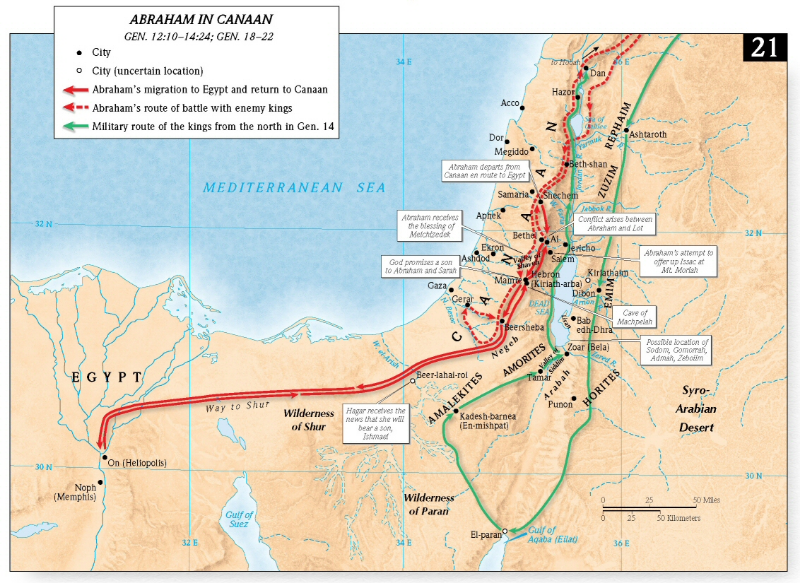
2. What/where was “the Negeb“? (13:1)? Trace Abraham’s, Sarah’s, and Lot’s trip from Egypt (13:1) back to “between Bethel and Ai” (13:2) on the map below. Find the remainder of the locations mentioned in 13-15 on the map.

3. Read Proverbs 3:5-6. How do we see Abraham trusting God and God directing Abraham’s paths in chapter 13? Canaan, where Abraham settled (13:12), eventually became known as what? How does chapter 13 demonstrate God’s sovereignty?

4. What does chapter 13 teach us about making wise and godly decisions? Can you look back on an incident in your life where you had to trust the Lord and make the wisest, most God-honoring decision you could? How did God “direct your paths” in that situation?

5. List all of the things God promised Abraham in chapters 13-15. Can you find the passages of Scripture where these promises came true?

6. Examine the instances in chapters 13-15 where Abraham worshiped the Lord. How would you characterize his worship? What caused him to worship?

7. Compare 15:6 to Romans 4 and Galatians 3. What does the Holy Spirit want New Testament Believers to understand about faith from Abraham’s example?

8. Compare and contrast Abraham’s interaction with God in chapter 15 about what God was promising him to Zechariah’s interaction with God about what God was promising him. How were Abraham’s and Zechariah’s reactions to God’s promises similar? How were they different? How and why did God react differently to Abraham’s questions than to Zechariah’s questions?


Homework

Compare Genesis 14:17-24 with Hebrews 7. How is Melchizedek a type of Christ? Why would the writer of Hebrews (14:13) refer his audience back to Melchizedek as an illustration of Christ as eternal high priest?


Suggested Memory Verse

And [Abram] believed the Lord, and he counted it to him as righteousness.
Genesis 15:6

Uncategorized

Just So URL Know…


Just a little announcement…

I’ve changed the blog’s URL from MichelleLesleyBooks.com to MichelleLesley.com. Same blog, same content, just drop the “books” and you’re good to go. For the next year, the old address will seamlessly automatically redirect you to the new address.

I’m trying to make my way around the web to change the site address anywhere I have it listed, but after seven years with the old address, I can’t begin to remember all the nooks and crannies I need to search out and correct.

If you happen to see my old web address listed somewhere, I surely would appreciate a heads up so I can get over there and update it to the new address.

And if you’ve been so kind as to link to my blog or any of my articles on your own web site, the old address will work just fine for the next year, but after that, the links will need to be changed to the new URL or they won’t work.

Why the change? I originally moved over to WordPress from Blogspot because I was told it was a better platform for marketing and publicity for my book which we were trying to get off the ground at the time. I wanted to use MichelleLesley.com when I was getting settled in at WP, but someone else had already purchased and was using that domain (Can you believe there are TWO of us? :0) So I stuck “books” on the end of the address because the blog was originally intended to be the vehicle for promoting and selling my first book and any to come in the future.

So now that my book is out of print, the “books” part is cumbersome and doesn’t make much sense, AND MichelleLesley.com is finally freed up for me to use, so, voila!

Discernment

Amputating Discernment Ministry from the Body of Christ

“There’s no place for Christian blogs and podcasts. Preaching, teaching, and encouragement should only be done by pastors and teachers in the local church.”

“Open air preaching ministry needs to go the way of the dinosaur.”

“Pro-life ministry organizations just cause too much strife. Lost people are going to reject the gospel because of them.”

“The Bible nowhere mentions Christian legal defense organizations.”

You’ve probably never heard someone give one of these statements as a reason for doing away with podcasts or street preaching or the ACLJ, but these days it seems like everybody –ย including doctrinally sound, discerning Christians – is screaming, “Off with its head!” about parachurch discernment ministries for these supposed reasons, and others. It’s become the bandwagon du jour. The popular whipping boy for Christian social media. The here-today-gone-tomorrow zeitgeist of online evangelicalism.

Among those who wish to amputate discernment ministry from the Body are good, solid, loving, godly brothers and sisters in Christ. I just wish they realized that there are many of us on this side of the discernment fence who areย also good, solid, loving, godly brothers and sisters in Christ.

It is a sad irony that the genuinely good guys who are clamoring for the death of discernment ministry are, in some cases themselves doing the very things they accuse discernment ministries of doing. While they may give a brief hat tip to “some discernment ministries aren’t so bad”, in calling for the disbanding of discernment ministry across the board, they effectively lump everyone who does any sort of discernment work – regardless of how infrequently or how biblically it’s done – into the same category as those who indiscriminately lob a constant barrage of truth-bending, vitriolic grenades at everyone from the rankest heretic to the reputable, doctrinally sound brother who has a slightly different take on their eschatological view. And in the same way it wouldn’t be fair to throw these brothers and sisters who speak from biblical love and concern for the church into the same bin as “Christians” who scream like banshees about discernment ministry because they just want to worship their idols in peace without their consciences being pricked, it’s not fair to unilaterally declare that discernment ministry should be banned, either.

Rebuke those doing discernment work whose character, behavior, and handling of Scripture is so egregious it disqualifies them from any ministry whatsoever (and, unfortunately, they do exist) butย encourage those who do discernment ministry right.

Just like you would with any other ministry.

Because if there were ever a direย need for discernment ministry done right and biblically, it’s now. Banishing the discerning altogether would be neither biblical nor beneficial to the Body.

Discernment: A Major Theme of the New Testament

The Old Testament is rife with idolatry, syncretism, and false prophets. Every book of the New Testament except Philemon deals in some way with false doctrine or false teachers and the importance of keeping them out of the church and away from Christians. It is aย major issue throughout the Bible, but particularly in New Testament theology and ecclesiology. Jesus dealt with it. Paul dealt with it. So did Peter, Jude, John, and other New Testament figures.ย  Part of the reason the 21st century church is so steeped in false doctrine and enamored with false teachers now is that we have been brushing discernment aside for so long instead of bringing it front and center like the Bible does.ย If the Holy Spirit – the author of Scripture – considers discernment to be so vital, shouldn’t we?

Amputating Body Parts

Nowย there are varieties of gifts, butย the same Spirit;ย andย there are varieties of service, butย the same Lord;ย and there are varieties of activities, but it isย the same God who empowers them all in everyone.ย To each is given the manifestation of the Spirit for the common good.ย For to one is given through the Spirit…the ability to distinguish between spiritsAll these are empowered by one and the same Spirit,ย who apportions to each one individuallyย as he wills…But as it is,ย God arranged the members in the body, each one of them,ย as he chose.ย If all were a single member, where would the body be?ย As it is, there are many parts,ย yet one body.ย The eye cannot say to the hand, โ€œI have no need of you,โ€ nor again the head to the feet, โ€œI have no need of you.โ€
1 Corinthians 12:4-8a, 10b, 11, 18-21 (emphasis mine)

Discernment (distinguishing spirits) is just as ontologically valid a spiritual gift – a manifestation of the Holy Spirit – as any of the others listed in 1 Corinthians 12. It is a biblically legitimate gift, service, and activity given for the common good of the church and empowered by the same Spirit, Lord, and God who gives and empowers the spiritual gifts of those who would do away with discernment ministry. Spiritual gifts are given by God and arranged in the Bodyย as He sees fit.ย It is not for one individual body part to say to another, “I have no need of you.” Selah.

Check Your Privilege

If you’re a discerning person who goes to a discerning church, has a discerning pastor and elders, and hangs out with discerning friends maybe you don’t see that there’s much of a need for discernment ministry.

And if you lived in Hawaii, you wouldn’t see much of a need for snow shovels, either.

But if you lived in Alaska, you would.

We each exist in our own little bubble of personal experience. And if your bubble is one where pretty much everybody is discerning, make sure you thank God profusely for that every day, because you are extremely blessed. You’re also an extremely rare anomaly, because the vast majority of the rest of Christianity has no clue what that’s like. The 99 per cent-ers live in a bubble that looks like the shelves of your local Christian retailer – some good stuff (if you know where to look) and a whole lot ofย skubalon.ย And most of them don’t know the difference because they’ve never been taught. Don’t assume your experience is the norm for everyone.

Of Course Pastors Should Be Leading the Way

One of the most common arguments I hear against discernment ministry is that it’s the job of the pastor, not discernment ministries, to teach discernment. And with that statement, I could not more heartily agree! Discernment work isย half of a pastor’s job description:

He mustย hold firm to the trustworthy word as taught, so that he may be able to give instruction inย soundย doctrine and also to rebuke those who contradict it.
Titus 1:9 (emphasis mine)

So let me ask you 99 per cent-ers: when was the last time you heard a pastor rebuke someone who contradicts sound doctrine? Or call a false teacher by name? Or teach about a currently popular false doctrine and warn against it? I am honored to know several pastors who aren’t afraid to faithfully perform this part of their job, and God bless them for it. We need far more pastors like them. Yes, pastorsย should be spearheading the work of discernment in their local churches. But by and large, they’re not. And the Bible doesn’t say thatย onlyย pastors have the gift and responsibility of discernment.ย It is insanity to tell ready, able, and willing laymen with garden hoses to stand down and watch a building burn to the ground while they wait…and wait…and wait…for the professional firemen who may never show up.

But Lost People Will Reject the Gospel!

Lost peopleย already reject the gospel. That’s why they’re lost. They don’t get any lost-er by seeing a discernment ministry critique a false teacher. In fact, I’ve known of lost people who have expressed theirย thanks to discernment ministries for denouncing the blasphemies of false teachers. Even in their spiritually blind state many unbelievers know a wolf when they see one. Sometimes – to our shame – even better than those who call themselves Christians. When someone rejects the gospel, it is no more the fault of a discernment ministry than it is the fault of a pro-life ministry, a ministry that disciples newly saved homosexuals, or any other type of biblical ministry. God is sovereign in salvation. He will save who He means to save, and no mere mortal is going to prevent Him from doing so.

Your Comfort Versus Their Souls

Whatever it is that bothers you about discernment ministries, is your state of botheration as important as the spiritual condition of the person that discernment ministry is reaching? Maybe you’re worried about those lost people out there who might reject the gospel because of discernment ministry conflict. Are you just as concerned about the lady in the pew next to you at church who’s every bit as lost as those people “out there” because she listens to false teachers who preach a false gospel that’s made her a false convert? What if a discernment ministry could help her understand the truth of the gospel? It’s happened. I’ve heard many stories of false converts Providentially “stumbling upon” a discernment ministry, hearing the unadulterated gospel for the first time, and getting saved.

What about the Christian woman who spends her quiet time in tears every day because she’s been falsely taught that God will talk to her if she just listens hard enough and has enough faith, and she’s in despair because she’s not hearing from God? What if a discernment ministry could set her free from that burden by teaching her what the Bible really says and steering her away from those who have deceived her? It’s happened. I know it has, because something similar happened to me. Is your annoyance at discernment ministries more important than her spiritual health?


There is absolutely a place – a good, God-ordained, nobody-puts-Baby-in-a-corner place – for discernment ministry in the Body of Christ. Inside the church, online, in parachurch ministry, from pastors, elders, and laymen alike. Yes, those who abuse their position of ministry – in any ministry – should be rebuked and removed. But we don’t do away with entire spiritual gifts and areas of ministry because of a few bad apples. Instead of amputating, maybe we should be excising gangrenous tissue instead. Otherwise we’ll just be shooting ourselves – the Body – in the foot.

Women of Genesis Bible Study

The Women of Genesis: Lesson 9- Sarah

Previous Lessons: 1, 2, 3, 4, 5, 6, 7, 8

๐Ÿ“–๐Ÿ“–๐Ÿ“–๐Ÿ“–๐Ÿ“–

Read Genesis 11:27-12:20

๐Ÿ“–๐Ÿ“–๐Ÿ“–๐Ÿ“–๐Ÿ“–


Questions to Consider

1. What facts can we glean about Sarah from this passage? What was her original name? (11:29) Who were her family members? (11:27-29, 31) Where was she originally from, and where did she move to? (11:28,31) What was her physical condition (11:30) and why is this “backstory” being given to us? (12:7) What was Sarah’s physical appearance like? (12:11,14)

Click for larger view

2. We can learn more about Sarah from other passages of Scripture. What does the name Saraiย (see footnote) mean? What was Sarah’s familial relationship to Abraham? How old did Sarah live to be? How does Paul use Sarah as an allegorical example in Galatians? How does Hebrews describe Sarah’s faith? How does Peter hold Sarah up as a godly example to Christian women? Overall, how does the Holy Spirit frame and describe Sarah’s character in the New Testament? Does this mean her thoughts and behavior were always flawless?

3. Consider that Sarah, though sinful and imperfect in many ways, is spoken of by the Holy Spirit in the New Testament as a woman of faith and godly character, and an example to be looked up to by Christian women. Does this bring you comfort and reassurance as a sinful and imperfect, yet faithful, follower of Christ? What are some ways you can set a godly example for other Christian women even though you sometimes stumble into sin? How will God speak of your faith and character at the end of your life?

4. While the events in Genesis 11-12 are told from Abraham’s perspective, Sarah, his wife was right there with him, experiencing those same events. Consider the following parts of the story from Sarah’s perspective:

Barrenness (11:30):ย In a patriarchal society in which women established status largely by bearing sons, what might Sarah have thought about being barren?

Traveling and relocating (12:1-9): Examine the map above. Strange lands she’d never been to before. Strange and possibly hostile people. How far would Sarah and her family have had to travel? What might have been some of Sarah’s concerns for her family?

God’s promises and instructions (12:1-3,7): What questions might Sarah have had about her role in God’s promises to Abraham, how her barrenness would affect God’s promise for offspring, and how it would all play out once God’s promises were fulfilled?

Trusting, obeying, and worshiping God (12:1-9): In instructing Abraham, God was also instructing Sarah, as his wife, to obey and follow Him. What were some ways Sarah would have had to obey God? How could she have served as a helper to her husband? How would she have needed to trust God? How would trusting and obeying God have led to worship for Sarah, right alongside her husband? (7,8) How might Sarah’s relationship with God have grown through this experience?

5. Examine 12:10-20. Summarize the story in your own words. What did Abraham ask Sarah to tell the Egyptians in verse 13? Why? Was this true? What can we learn from this story about honesty, deception, and half truths? How did Abraham’s deception put Sarah in danger? In what way did Abraham put his own needs ahead of Sarah’s well-being? How might Abraham’s actions have damaged his relationship with his wife?

6. Compare Abraham’s trust in God in 12:1-9 with his lack of trust in God in 12:10-20.

7. In what ways did Sarah have to trust God and trust her husband in 12:1-9? In what ways did she have to trust God and trust her husband in 12:10-20? Was Abraham acting in a trustworthy way in both of these instances? Why or why not?

8. Have you ever had to trust God through a situation in which your husband, parent, or someone else you depended on, wasn’t acting trustworthy? What did this teach you about God and His trustworthiness and dependability?

9. True or false: “In some ways and at some times Sarah may have had to trust God even more than Abraham did.”? Why?


Homework

How can trusting God through a difficult time lead you to worship Him? Describe a trial you’ve been through and how you trusted God in the midst of it. Take some time to worship God for the specific ways He carried you through that trial: how He provided for you, comforted you, strengthened you, and encouraged you.


Suggested Memory Verse

Then the Lord appeared to Abram and said, โ€œTo your offspring I will give this land.โ€ So he built there an altar to the Lord, who had appeared to him.
Genesis 12:7