1. Are you familiar with what is going on in the history of Israel and in the life and reign of David at this time? If not, use this synopsis (or another Bible Book Background) to bring you up to speed.
2. Break chapter 7 down into three major parts or events and write a one-sentence synopsis of the main action taking place in each part:
Verses 1-3:
Verses 4-17:
Verses 18-29:
3. What did David want to do? (2,5) How would you characterize David’s desire to build the temple, especially in light of his prayer in 18-29? Was his desire prideful, worshipful, godly, selfish, grateful, immoral, etc.? Why did David tell Nathan his desire? (2-3) What was Nathan, as a prophet, supposed to do (4,17) before giving David God’s reply? (3-4) How was David telling Nathan this desire similar to the way we might pray for God’s guidance today? How does Nathan, as an imperfect intermediary between God and man, point to Jesus, our perfect mediator and intercessor?
4. Examine God’s answer to David’s “prayer” (to build the temple) in verses 4-17. What was God’s overall answer – yes, or no? Go through each verse, making a list of the reasons or explanations God gives David for His answer. Which of the reasons/explanations have to do with it not being part of God’s overall plan for (OT) Israel’s history as a nation? Which of the reasons/explanations have to do with God’s plan for redemptive history and the future Messiah? Which of the reasons/explanations have to do with David personally, as an individual? When God says no to your perfectly biblical prayer, have you ever considered that there might be more to it than just saying no to you personally? That maybe it has something to do with God’s larger plan for your church, community, redemptive history, etc.?
5. Examine David’s prayer (in response to God’s answer) in 18-29.
What is the position of David’s body while he is praying? (18a) Think of some of the other body positions we see in Scripture when people are praying. Is there any special significance or meaning to these various body positions? Is there one particular position that’s “holier” than the rest, or does God hear and answer our prayers without regard to body position?
How does David react to God answering his prayer “no”? What character trait does David exhibit most in this section? Which attribute of God does David focus on the most in his prayer? How does David’s recognition of God’s sovereignty impact his humility and inform the way he reacts to God saying “no”? How does this same sovereignty/humility dynamic enable David to look past his own personal desires to the good of his nation, the good of his son Solomon, the good of redemptive history, and the good of God glorifying Himself by carrying out His own plans despite David’s desires?
When we talk about praying “in Jesus’ name” we often explain that this means praying in agreement with and in submission to God’s will. Explain how David’s prayer exemplifies praying “in Jesus’ name” even as he looks ahead to the Messiah yet to come.
6. Do you notice the gospel motif in this chapter? David wants to do what for God? (2,4) And God basically says, “I don’t need your good works (5-7, i.e. for you to build me a house of filthy rags). You, and all My people, need My good work of salvation, and I’m going to give them to you by building you a ‘house’ whose foundation and cornerstone are the Messiah, whom you all so desperately need.” We may desire to do great things for God, but we desperately need Him to do far greater things in us, for us, and to us, in saving and sanctifying us. Spend some time in prayer this week asking God to do those greater things in your heart and life.
Homework
Have you ever prayed for something or wanted to do something that was completely biblical, yet God did not give it to you or allow you to do it? What was your reaction? How did your reaction compare to David’s reaction? How would more humility and a greater view of God’s sovereignty have shaped your reaction? Write out a prayer of response to God saying “no” in which you humble yourself and honor and celebrate God’s sovereignty.
On today’s Testimony Tuesday,
several sisters in Christ share their stories.
Tiffany’s Story
My husband and I and family were first at a word of faith/prosperity church, and thankfully God granted us and we continually prayed for wisdom and discernment. We then moved on to an AG [Assemblies of God] church and again, just like the last church, we got heavily involved. The more we read and the more we talked, we realized they weren’t on the same page as us, and it’s only been 3 weeks but we have found a Reformed Bible church. I continually pray that the people in our old church will have their eyes open and begin seeing the truth in the Word. I’m so grateful and thankful to the Father for the journey He has us on. We continually learn and teach our children.
Latoya’s Story
As some other women on your site have said: “Yay, women like me! Who believe in The Word! I’m not weird!”
I was born and raised in a Pentecostal church…but have REALLY been having a relationship with God for over one year now.
Thank you for teaching me what a Godly, Bible-based church looks like. . .
One particular article spoke of expository versus topical sermons. I am reading though the Bible (for the first time ever) since last summer. Wow! I can’t say enough of how awesome The Word is! It’s my favorite thing to do: study His Word! Anyway, that article spoke to me. I thought: I’ve never been under an expository preacher, but it sounds amazing! So, out of curiosity (..and because I do feel led to be at another church…although I do not know where yet) I looked under the “searching for a new church?” tab. I found a church one hour away. The sermons are listed. Each Sunday they take a handful of verses in order from each chapter. ((Jumping up and down that this even exists!)). I never knew.
Christine’s Story
I grew up as a Catholic. I prayed to God but didn’t understand anything of the Bible or the significance of why Jesus had to die. I attended “church” weekly growing up, but knew nothing of the Bible. I lived a life with no clarity in why I needed a Savior and like so many, thought I was a pretty good person, so I would be fine. In the meantime, I met my husband in college. He also grew up Catholic and led a similar life of sin and confusion. Just before we got engaged, my husband was saved at a Christian service that I did not attend. We got married and continued to go to Catholic service while he was growing in his faith.
My husband then led us to a non-denomination church, which I reluctantly attended. They shared the Gospel regularly and taught from the Bible. It wasn’t until years later, after we had two boys and after my dad passed, that I was saved. It took several years of me hearing the Gospel before I truly accepted Christ and repented of my sins. I am beyond grateful for what Jesus did for me, opening my eyes to His Truth and saving me from my sin. I am also so thankful he saved my husband years earlier before I even realized what that meant. My husband and I have become passionate creationists and are looking forward to an upcoming trip with our boys to the Creation Museum and Ark in Kentucky! Although we continue to be sinners, I hope I can continue to live my life glorifying God and sharing the Gospel of what Jesus did for us, dying on the cross to save us from our sins and reconciling us back to our perfect God.
Michele’s Story
When my husband and I moved to a new city 13 years ago, we spent almost a year searching for a new church. We settled in a church that seemed to affirm the authority of Scripture while honoring the freedom we have in Christ. We attended faithfully and served in many different capacities. This past year, as we have grown in our knowledge and love of the Bible as well as in biblical discernment, we have realized we were in a purpose-driven, seeker-sensitive church.
We met with the pastor and associate pastor many times, but they were defensive and unhearing. After many months of continuing to serve, to cope, to adapt, we knew we had to leave.
I almost dreaded to process of finding a new church. In our small town, there didn’t seem to be many (if ANY!) realistic options, and I just didn’t want to church shop. I longed to be planted quickly into a fellowship of like-minded believers. I prayed, “You know my desires, Lord, but Your will be done.”
I clicked on your “searching for a new church” tab and scrolled through the items. There were few suggested churches for [my state], and none for our city. Then I clicked on “churches recommended by my readers” and saw the one listing for our area.
I would like to say that it was love at first visit! However, I had been so pampered and pandered to that I didn’t have much patience for the longer service and deep, expositional preaching. However, I was encouraged by the Lord to persist. Our first visit was in April and earlier this month we became members.
I am so very grateful to the Lord for directing us to this precious little church and to your resources. I mean, really.
Ladies, God is still at work in the hearts and lives of His people, including yours! Would you like to share a testimony of how God saved you, how He has blessed you, convicted you, taught you something from His Word, brought you out from under false doctrine, placed you in a good church or done something otherwise awesome in your life? Private/direct message me on social media, e-mail me (MichelleLesley1@yahoo.com), or comment below. Your testimony can be as brief as a few sentences or as long as 1500 words. Let’s encourage one another with God’s work in our lives!
Welcome to another “potpourri” edition of The Mailbag, where I give short(er) answers to several questions rather than a long answer to one question. I also like to take the opportunity in these potpourri editions to let new readers know about my comments/e-mail/messages policy. I’m not able to respond individually to most e-mails and messages, so here are some helpful hints for getting your questions answered more quickly. Remember, the search bar can be a helpful tool!
In these potpourri editions of The Mailbag, I’d also like to address the three questions I’m most commonly asked:
“Do you know anything about [Christian pastor/teacher/author] or his/her materials? Is he/she doctrinally sound?”
I’m wondering if the DivorceCare support groups are good?
I’ve never been to a DivorceCare group or been a part of a church that hosted a group or used its materials, so I’m strictly drawing on what I’m seeing on their website.
The format of meetings is for the group to watch “a video seminar featuring top experts on divorce and recovery subjects” and then discuss it, support group style. So, I took a look at the list of seminar experts. I don’t recognize half or more of the names, but of the names I do recognize, most are biblical counselors (the biblical counseling world has a reputation for being generally doctrinally sound), and two or three are pastors and Bible teachers I wouldn’t recommend but aren’t heretics either (if they’re teaching strictly on issues of divorce, I’m guessing what you’ll get from their videos is pretty much in line with Scripture).
So, all of that to say, as far as the materials DC provides, I don’t think you’re going to be taught major doctrinal error if you choose to participate. However, I’m guessing these groups vary widely depending on who is leading them and how good or bad that person’s/church’s theology is, so that’s a major component to take into consideration.
Having said all of that, I would not recommend that you participate in a parachurch organization for help getting through a divorce. It’s not their job to do that, it’s your local church’s job. Your pastor should be counseling you and/or your spouse to reconcile if that’s at all possible, and counseling you in other ways if not. Your Sunday School or Bible study class and other church family should be supporting you, helping you, and walking through this difficult time with you. When Galatians 6:2 says, “Bear one another’s burdens,” it’s talking to the church, not a parachurch organization or a support group. And you need real live, “Call me any time, day or night,” church family to do that, not a bunch of strangers, not an expert on a screen. I think people who choose a parachurch organization like this are going to miss out on a lot more than they realize.
Furthermore, while counseling people who are going through a divorce is a good and necessary thing, it concerns me that so many churches are putting so much emphasis on post-divorce programs when what they should be throwing most of their energy into is preventing divorce by:
preaching and teaching biblically about marriage and divorce
extensive pre-marital teaching and counseling
encouraging, strengthening, and enabling healthy marriages
intervening and helping couples in marital distress
treating initiating and pursuing divorce for unbiblical reasons as the sin the Bible says it is
commencing with church discipline for church members who are initiating and pursuing divorce for unbiblical reasons.
Churches that proactively support and protect marriage this way will rarely find the need for divorce counseling.
I agree that Scripture is clear about women not teaching men the Scriptures. At what age are males considered to be ‘men’?
It’s an insightful question, and one that there’s no hard and fast “exact age” answer to. I think most of us would probably agree that pre-teens and under are children, not men, and I hope that most of us could agree that males in their mid-20s and upward are men. It’s those pesky teens to early 20s ages that throw a monkey wrench into the question.
Males ages 18 to early 20s may, in some cases seem like boys, but for this question, I think the common grace of American law (if you’re an American) can help us feel confident defining any male over 18 as a man. If American law treats a person as an adult at age 18 with regard to crimes, voting, marriage, property, etc., should the church be treating them as children?
So now we’ve narrowed our window of potential “men” down to age 12 or 13 to 17. And for that narrow window of ages, I’m going to refer you to question 13 of my article Rock Your Role FAQs:
What about teaching the boys in my church’s youth group?
Women should not serve as youth pastors. The Bible restricts pastoral and elder roles to men.
As to teaching the Bible to co-ed groups of minors (in Sunday School, as a youth helper, etc.), there is no hard and fast rule, but my recommendation is that a good time for women to break from teaching boys at church is around the time they start middle school. In the Bible, boys traditionally moved from childhood to adulthood at age thirteen. Jesus exhibited growth toward manhood and engaged the rabbis in the temple at age twelve. Of course, these are both anecdotal and neither means this age is the basis of any sort of law for Christian women about teaching boys, but there seems to be some wisdom there- a good rule of thumb. Once they hit their early teens, boys really need the guidance of godly men who can lead by example and teach them what it means to grow into godly manhood. When it comes to teaching adolescent boys at church, it’s much less about what women are “allowed” to do and much more about the best way to grow godly men. Only men can train boys to be men.
Over the years when we have visited various cities, we have toured old churches, several of which have been Catholic churches. Our main interest has been the architecture of the buildings along with the historical aspect. We have never participated in a church service, only informational tours. I was wondering if you have an opinion of Christians touring Catholic churches.
For someone who is genuinely saved, and in no danger of being wooed toward false doctrine simply by walking through a beautiful building and listening to a tour guide, I don’t think that’s problematic at all. Simply being in a building and learning about its structure and history doesn’t mean you agree with what happened there. I mean, if you toured Auschwitz, that would not mean you agreed with or supported what happened there, right? When I was in Egypt several years ago, I toured (as far as women were allowed to tour) a mosque. If I were in Salt Lake City, I would certainly check out the Mormon Tabernacle. If I were in Rome I would visit the Vatican. There’s nothing sinful for you personally about going to places like these to view the architecture or learn something about the religion or customs any more than it would be wrong to read about those things in a book.
If your conscience doesn’t bother you about taking the tour itself, and you’re not worried about your theology veering off course, there are only two ways I can think of that this could be a problem, biblically. First, if there’s an admission fee to tour the church, what is that money supporting? Speaking for myself, I could not knowingly pay a fee that would, in any way, support a false religion or the spread of it. Second, would entering one of these buildings somehow hurt your witness or be a stumbling block to someone who knows you? That would really depend on the other person, the situation, etc., but that is something you should take into consideration.
I would suggest that you look for opportunities for evangelism during these tours. Leave a tract behind if there’s a way to do that without littering (the ladies’ room is usually a good spot). Before you leave, take a moment to silently pray for the salvation of the people who go to church there (or work there, or are on the tour with you). If there’s an opportunity to ask a simple gospel-centered question or make a biblical comment during the tour, take advantage of that (don’t interrupt or argue, don’t lecture or debate, don’t do “gotcha” questions, and be sweet – you’re scattering seed, not waging war).
Enjoy your trip, and I hope you learn a great deal.
Michelle, are you going to be at the G3 Conference in January 2020?
I wish! I’d love to be there, but I don’t think it’s going to happen this time. It’s a wonderful conference, and I highly recommend it for everyone who’s able to attend. Y’all have fun!
So there are women in my home who enjoy, unaware, the teachings of Rohr/Shirer/Enneagram/journaling/meditation/etc. I’m not sure I really have a voice anymore in their spiritual pursuit outside of prayer. Do you have any strategies or a playbook of sorts on how to navigate through this season of life?
(This question comes from a gentleman.)
I’m so sorry for the difficult situation you’re in. It is always sorrowful and frustrating to watch those we love chase after ungodly things.
You say “there are women in my home,” so I’m not really clear on whether these women are your wife, daughters, sisters, other relatives, female boarders, etc. I’m also unclear on whether or not you are the head of the home (husband/dad).
If you are not the head of the home (i.e. these women are your mother and sisters or other relatives or non-relations over whom you have no biblical authority), continue to pray for them and set up an appointment with your pastor for counsel on how best to handle this situation.
If you are the head of the home, I’m sure you know that God has given you the responsibility of being the spiritual leader of your household. I’m honored that you reached out to me for help, but learning to lead well is going to be a long road of face to face discipleship that must take place in your own local church with your pastor and brothers in Christ there. As a woman, I am neither equipped, nor would it be biblically appropriate for me to walk you through this long term and through a computer screen. There are no magic strategies for a quick fix, but your church family can help you work through the “playbook” – the Bible – as you grow in Christ and in spiritual leadership. I would strongly recommend that you set up an appointment with your pastor for counseling and, definitely continue to pray for these women.
If you have a question about: a Bible passage, an aspect of theology, a current issue in Christianity, or how to biblically handle a family, life, or church situation, comment below (I’ll hold all questions in queue {unpublished} for a future edition of The Mailbag) or send me an e-mail or private message. If your question is chosen for publication, your anonymity will be protected.
If you are considering commenting or sending me an e-mail objecting to the fact that I warn against certain teachers, please click here and read this article first. Your objection is most likely answered here. I won’t be publishing comments or answering emails that are answered by this article.
This article is kept continuously updated as needed.
I get lots of questions about particular authors, pastors, and Bible teachers, and whether or not I recommend them. Some of the best known can be found above at my Popular False Teachers tab. The teacher below is someone I’ve been asked about recently, so I’ve done a quick check (this is brief research, not exhaustive) on her.
Generally speaking, in order for me to recommend a teacher, speaker, or author, he or she has to meet three criteria:
a) A female teacher cannot currently and unrepentantly preach to or teach men in violation of 1 Timothy 2:12. A male teacher or pastor cannot allow women to carry out this violation of Scripture in his ministry. The pastor or teacher cannot currently and unrepentantly be living in any other sin (for example, cohabiting with her boyfriend or living as a homosexual).
b) The pastor or teacher cannot currently and unrepentantly be partnering with or frequently appearing with false teachers. This is a violation of Scripture.
c) The pastor or teacher cannot currently and unrepentantly be teaching false doctrine.
I am not very familiar with most of the teachers I’m asked about (there are so many out there!) and have not had the opportunity to examine their writings or hear them speak, so most of the “quick checking” I do involves items a and b (although in order to partner with false teachers (b) it is reasonable to assume their doctrine is acceptable to the false teacher and that they are not teaching anything that would conflict with the false teacher’s doctrine). Partnering with false teachers and women preaching to men are each sufficient biblical reasons not to follow a pastor, teacher, or author, or use his/her materials.
Just to be clear, “not recommended” is a spectrum. On one end of this spectrum are people like Nancy Leigh DeMoss Wolgemuth and Kay Arthur. These are people I would not label as false teachers because their doctrine is generally sound, but because of some red flags I’m seeing with them, you won’t find me proactively endorsing them or suggesting them as a good resource, either. There are better people you could be listening to. On the other end of the spectrum are people like Joyce Meyer and Rachel Held Evans- complete heretics whose teachings, if believed, might lead you to an eternity in Hell. Most of the teachers I review fall somewhere in the middle of this spectrum (leaning toward the latter).
If you’d like to check out some pastors and teachers I heartily recommend, click the Recommended Bible Teachers tab at the top of this page.
This information from my 2016 article on Shauna is from a pastor friend of mine who knows Shauna’s family personally:
“[Shauna is] the daughter of Bill Hybels, the founder and pastor of Willow Creek in Barrington, IL. Because of very personal experience with it, I will tell you that this stuff they peddle has proven to be the worst kind of Christianity, and probably a Matthew 23:14-15 type of situation, at least in my opinion.
Next, this post right here ought to really be enough.
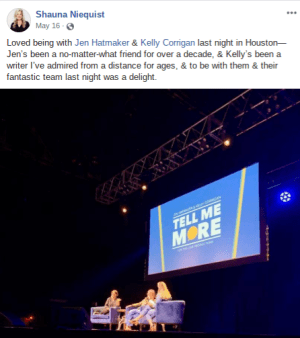
She is a friend of Rachel Held Evans. She is touring with Jen Hatmaker, who is a complete mess. Really, there is no other way to describe her than secularism covered with some Bible words.
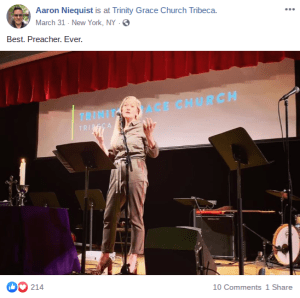
Aaron [Shauna’s husband] is a worship leader at Willow Creek. He began a HUGE movement with contemplative prayer a couple of years ago. Because of his music, he comes off as very spiritual and sound, but there is nothing inherently Christian about anything he says or does, really. Take a look at Aaron’s blog here, which will give you more insight. [Aaron has apparently removed the blog portion of his website. He is no longer with Willow Creek, and neither is Shauna.]
There is ZERO discernment with this family, they either promote or flock to whoever is popular, and they are all about using words that sound really great, but have no substance to them at all. They are on this big thing lately about “Holy Spaces”, which sounds great, but is so anti-biblical when you really think about it. You don’t create a space that is holy, only God can do that. Anyway…
This is the Willow Creek legacy, in a nutshell: their lack of sound doctrine, lack of Bible, lack of biblical discernment, and their false teaching and false gospel. Shauna and Aaron are simply products of what her dad has built, which is a huge gathering of people who neither know Christ, nor have reverence for His word.”
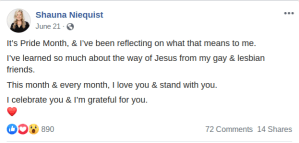
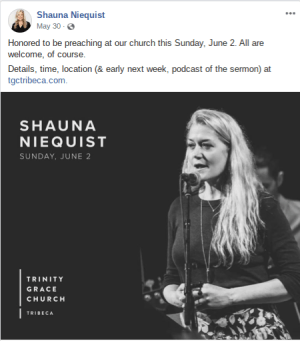
As I began re-researching Shauna to update this article on her, her most recent Facebook posts alluded to the fact that she hadn’t written anything in a while and that her family had gone through some “adjustments” and other issues. I was hoping this meant God had convicted her of past sin and false doctrine and was straightening out her theology. Unfortunately, a mere scroll back through the last several months of her Facebook posts demonstrates that Shauna remains a false teacher to avoid.
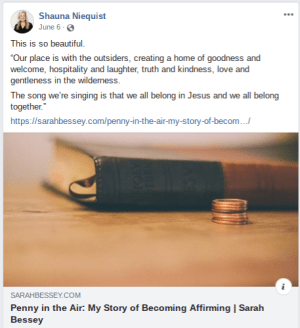
“This is so beautiful,” says Shauna about this blasphemous article from female “preacher” and feministSarah Bessey. The purpose of the article is for Sarah to explain to a young woman (who is on the fence about the inclusion of practicing, unrepentant homosexuals into church membership and wrote to Sarah asking for advice) how she became affirming. In addition to shamelessly twisting and abusing the Scriptures throughout the article, Sarah has the unmitigated temerity to suggest that Jesus Christ, the sinless, perfect Son of God, had to be taught by the Syro-Phonecian woman about His privilege and His prejudice against Gentiles. And Shauna says, “This is so beautiful.”
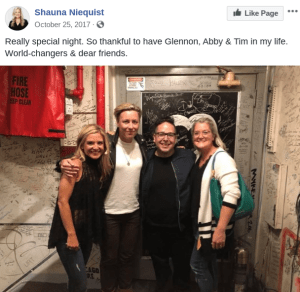
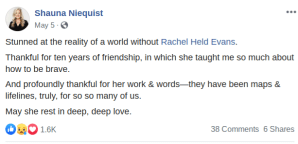
She continues to yoke with, affirm, and maintain close friendships with, some of the most egregious false teachers out there, including Jen Hatmaker, Glennon Doyle (The “Christian” mommy blogger who divorced her husband and “married” her lesbian partner, Abby. Shauna has recommended Glennon and spoken glowingly of her and Abby several times.), and the late Rachel Held Evans.
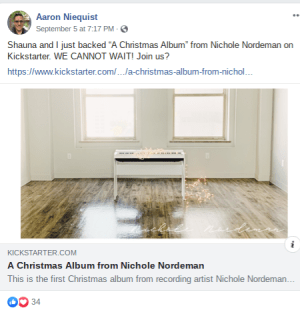
Here, Aaron says he and Shauna are helping Nichole Nordeman(homosexuality affirming, frequent associate of false teachers) fund her next album.
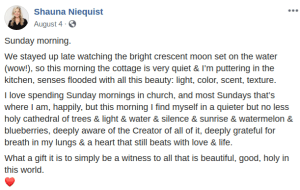
In addition to these (and so many more) glaringly unbiblical relationships, positions, and violations of Scripture, notably absent, or nearly so, from Shauna’s Facebook timeline is any meaningful mention of God, Jesus, or the Bible. Her post on “Holy Saturday” (the day before Easter) doesn’t even mention Jesus, the crucifixion, or the resurrection. And the benediction she wrote for her church’s Easter service barely does, in passing.
For a taste of Shauna’s theology, consider the following:
Shauna recently appeared on Oprah’s Super Soul Sunday to promote her book, Present Over Perfect, “a path away from frantic pushing and proving, and toward your essential self.” She does not mention Christ, the gospel, or the Bible, and only mentions God in the most generic (“God loves me”) of terms. When explaining what was most helpful to her in overcoming her stress and anxiety, Shauna credits centering prayer, an unbiblical, mystical, New Age practice.
Shauna’s website markets Present Over Perfect as a “Bible study.” You can download the first two chapters of the book, and view the teaching video for the first session of the study. I did both.
Shauna writes engagingly, there’s no doubt about that, but the first two chapters of the book read like a memoir of someone who is aching to know God but hasn’t found him yet. Christian-y words like “God,” “sin,” “grace,” and “baptism,” are sprinkled through the narrative, but there’s a palpable disconnect between Shauna’s artistic usage of these words and her grasp and internalization of what they truly, biblically mean. It’s almost like “stolen valor” – a guy desperately wants to be a soldier, so he dresses and talks the part, but he has never served and isn’t actually in the military, yet he hopes doing all these things will fulfill his yearning to actually be a soldier.
And, keeping in mind that this is supposed to be a “Bible study,” there is nothing from or about the Bible in the first two chapters of this book. No verses. No discussion of passages or books of the Bible that will be studied in subsequent chapters. It is all about Shauna and her thoughts and experiences.
The teaching video is very much the same, minus most of the sprinkling of Christian-y words. There is no Bible in this “Bible study” video. It’s all about Shauna’s opinions and anecdotes from her personal life. (Sharp listeners will also note her mention of her “friend, Glennon,” the aforementioned Glennon Doyle.)
In this benediction she wrote for her church in June 2019, Shauna waxes panentheistic: “May we walk through these doors and through this city intimately aware of the divinity all around us and within us and within each person we encounter.”
Shauna commends, “a wide vision for how people connect with God,” including “poetry, silence, sitting by the ocean…centering prayer, truth-telling with my closest friends…” (rather than studying your Bible, prayer, faithfully serving and being taught Scripture at your local church, etc.). “The tools [for connecting with God] that have been meaningful along the way for me have been books, poetry, counseling, friendship, spiritual direction, the Enneagram, centering prayer.”
She again promotes the “church is optional” idea when she states, “Some seasons [of spiritual growth] require poetry, and others preaching,” and “…in late high school and early college, I needed a little distance from church life. And so instead of going to church, I went to the ocean.”
Shauna also believes in extra-biblical revelation: “So I’d settle myself on a rock [at the beach] and I’d listen for God’s voice, or at least the sense of His spirit.”
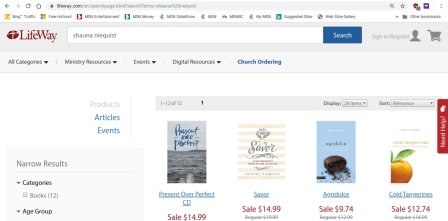
Southern Baptists should note that LifeWay, which purports not to carry authors who affirm homosexuality, at this time, carries four of Shauna’s five books.
Researching Shauna saddened me at every turn. Most of the false teachers I warn against proudly and brashly twist and defy God’s Word in order to build up their own kingdoms on earth of fame, fortune, and influence. That’s not the impression I get from Shauna, but rather of someone who acutely craves peace, purpose, and contentment, and is casting about for it everywhere except in the Christ of Scripture.
Is Shauna deeply steeped in sin and false doctrine? Yes. Should you and your church avoid her teaching and materials? Definitely. But there’s a subtle thread of sorrow and despair running through her writing that makes me want to hug her, sit and cry with her, and help her to embrace the truth of the gospel that will give her the peace she so desperately seeks after, the love of Christ that she’s looking for in all the wrong places, and the rest for her soul that only comes from intimately knowing as Savior the Jesus who is a stranger to her.
1. Briefly review lesson 2 (link above) to refresh your memory on the background and context of Hannah’s second prayer. Explain the events that led up to Hannah’s second prayer.
2. Compare Hannah’s second prayer with her first prayer in chapter 1 (lesson 2). What was the purpose of each of these prayers? Does the second prayer open the same way the first one did? Does it sound like one prayer is more private and the other is more public? How can you tell? Compare the length of the two prayers. How might the circumstances that led to each of these prayers have affected the length and the eloquence of each prayer? Think about the way you tend to pray, and the kind of phraseology you use when you’re praying privately in a time of desperate need versus praying publicly in a time of worship. How are your prayers different in these situations? Why?
3. Think about the components that typically make up our prayers today: praise, confession of sin, intercession, petition, etc. Which component is most prominent in Hannah’s second prayer? Which components are missing? Do the components we include or the components Hannah’s prayer is missing mean that we are praying wrong (or right), or that she was praying wrong (or right)? Why? Do we have to pray the same way, including the same components, every single time we pray?
4. While Hannah’s first prayer was a prayer of petition (asking God to provide for a need), her second prayer is a prayer of praise/exaltation and the proclamation of God’s attributes. Read through each verse of Hannah’s second prayer and make a list of each of the attributes of God (justice, mercy, sovereignty, compassion, etc.) she highlights, and the words she uses to do so. (Ex: 2- Holiness. “There is none holy like the Lord.”) Which of God’s attributes does this prayer focus on the most? Have you ever prayed a prayer like this that simply exalts the attributes of God?
5. Notice the words “but” and “and” in verses 4-7 and how the literary form of contrast is used in these verses (“The Lord does A BUT/AND does Z.”) How does this help drive home the point Hannah is making? Which attribute(s) of God does this format focus on? What do these contrasts tell us about the relationship between God and people?
6. Carefully examine verses 9-10, and think about the various genres of Scripture: historical narrative, wisdom literature, prophecy, poetry, didactic, apocalyptic, etc. Which category do 9-10 seem to fit into best? (Hint: At the time Hannah is saying this, has the Lord “judged the ends of the earth” yet? Does Israel have a “king” yet?)
7. Compare verses 1 and 10. Which phrase/imagery is used in both verses to “bookend” Hannah’s prayer? What does “my/his horn is exalted” mean (try to figure it out using your cross-references before clicking this link)? Who is “his king” and “his anointed” in verse 10? How does Hannah’s exalted “horn” of a miraculous conception and a first born son who is wholly dedicated to the Lord as a “priest“, prophet, and judge, point ahead to Christ, whose horn will ultimately be exalted? When you pray aloud with others, do your prayers exalt Christ and point people to Him?
Homework
•Put yourself in Hannah’s shoes in 1 Samuel 1. Imagine you’re at the house of the Lord worshiping Him for all He has done for you, and dropping off your child for the rest of his life. Write out what you would pray in that situation. Compare your prayer to Hannah’s second prayer. What are the similarities and differences, and what do you think are the reasons for those similarities and differences?
•This week, take some time each day to pray, simply focusing on the attributes of God.
Suggested Memory Verse
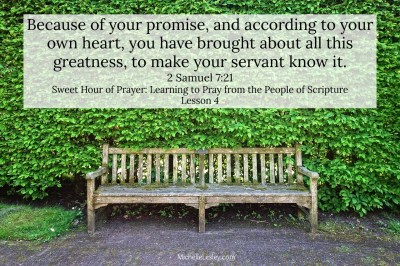
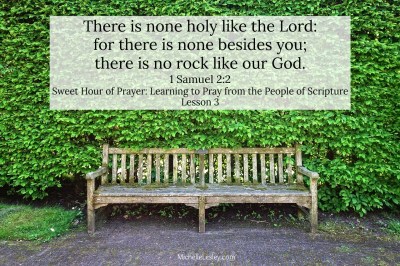
(Every week of our study, you’ll see a suggested memory verse like the one above. You are welcome to grab the memory verse pic to use as your screensaver or wallpaper on your phone or computer, print it out and stick it somewhere you’ll see it frequently, or use it in any other way you wish to help you memorize the verse.)


 Read 2 Samuel 7