Uncategorized

New Year, New Look (and where’s that search bar?)


By now (hopefully!), you’ve noticed that the blog has a bit of a new look to it. I like to “redecorate” every now and then. Many of you have offered kind words of encouragement on the new look. Thank you!

Just a couple of things to know as you’re cruising around…

•In addition to the new design, I upgraded from a free hosting plan to a hosting plan that removes those pesky ads you’re used to seeing if you don’t have an ad blocker. And that plan ain’t cheap. If you’d like to kick in a little spare change through PayPal or Patreon to help defray that cost, I’d be most grateful. (Just as a reminder, I don’t make any income from blogging, I don’t sell books or other resources, and I don’t put resources behind a paywall.)

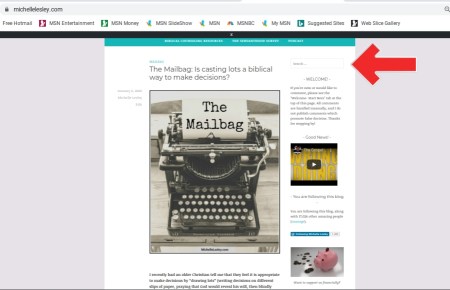
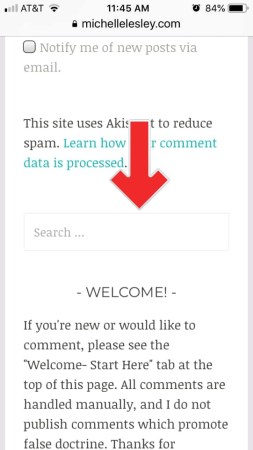
•Are you searching for the search bar? My apologies if you haven’t been able to find it. The configuration of the blog is different if you’re using a desktop/laptop than if you’re using a tablet or phone.

On the desktop/laptop layout, there’s a handy little sidebar with all kinds of helpful links running down the right side of the page. The search bar is at the very top of that sidebar:

On the tablet and phone layout, they have taken that sidebar and moved the whole thing (including the search bar) from the side of the page to the bottom of the page. Here’s what that looks like if you’re looking for the search bar:

But I thought that might be a little cumbersome to find, so I added a second search bar to hopefully make things a little easier. On all layouts, the second search bar is at the very bottom of the page, right above the social media icons:

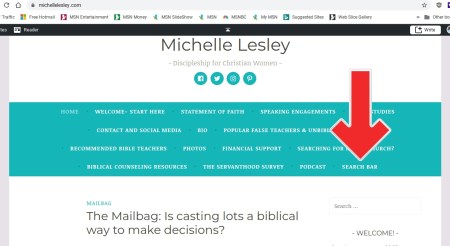
So just to recap, there are now two search bars on the blog for your searching convenience. For desktop/laptop users, there’s one at the top and one at the bottom. For phone/tablet users there’s one at the bottom and one almost at the bottom. And, in case you forget, I’ve added a search bar link in the blue menu bar at the top of this page to remind you:

Hope this helps solve the mystery of the missing search bar! :0)

Mailbag

The Mailbag: Is casting lots a biblical way to make decisions?


I recently had an older Christian tell me that they feel it is appropriate to make decisions by “drawing lots” (writing decisions on different slips of paper, praying that God would reveal his will, then blindly drawing one piece and choosing that decision). They justified this by saying that in Acts 1:26, the disciples did this to choose Matthias. How would you respond?

Super question! Whenever we see Bible characters doing something in Scripture, it’s always a good idea to figure out whether or not we should be doing the same thing.

My response would be to encourage the person to read Acts 1 in its entirety to get a better understanding of what took place when Matthias was chosen.

We need always to keep two things in mind when we read the book of Acts: 1) it is a historical narrative, and 2) it is transitional. 

A historical narrative is simply a report of what happened – like a newspaper article – not usually a command for us to do the exact same thing as the characters in the story. It is largely descriptive, not prescriptive. Acts reports that Peter raised Dorcas from the dead, but that does not mean that God is commanding you to raise people from the dead any more than Genesis reporting that Noah built an ark means that God is commanding you to build an ark. So the simple fact that Acts reports that Matthias was chosen by lot does not automatically mean that’s how we’re to make decisions.

Acts is also transitional. It records the events that took place as God’s people were transitioning from following Old Testament Judaism to establishing the New Testament church. And in the same way that when you’re building a house you only lay the foundation once, many of the events or issues in Acts were a “one and done” kind of thing (ex: the sign of speaking in foreign languages, the apostolic sign gift of miraculous healing, the question of circumcision, etc.)

It’s a little bit like opening up a brand new board game for the first time. You’ve got to assemble the spinner, punch the tokens out of the piece of cardboard, take the plastic wrap off the cards, and figure out what that poorly worded rule in the instructions means. But the second time you pull that game out to play it, you don’t have to do those things again, because you already did them the first time. You can just start playing the game.

Both the descriptive and transitional nature of the book of Acts should make us extremely cautious about blindly emulating the specific behaviors of its characters. When we want to know whether or not we should behave in a certain way, we need to look first to the prescriptive passages of Scripture which deal with that issue.

If we wanted to know how to have a godly marriage, for example, we would look at passages like Ephesians 5:22-33, 1 Corinthians 7, and Exodus 20:14,17. These are all passages that clearly tell us what to do and what not to do in order to have a godly marriage.

What we would not do is look at David’s and Solomon’s lives and conclude that polygamy is God’s design for marriage. We would not read about Hosea and assume that God wants Christian men to marry prostitutes. We would not read the story of the woman at the well and think that being married five times and then shacking up with number six is OK with Jesus.

So which prescriptive passages can we look at that teach us how to make decisions in a godly way?

If any of you lacks wisdom, let him ask God, who gives generously to all without reproach, and it will be given him. James 1:5

But be doers of the word, and not hearers only, deceiving yourselves. For if anyone is a hearer of the word and not a doer, he is like a man who looks intently at his natural face in a mirror. For he looks at himself and goes away and at once forgets what he was like. But the one who looks into the perfect law, the law of liberty, and perseveres, being no hearer who forgets but a doer who acts, he will be blessed in his doing. James 1:22-25

Trust in the Lord with all your heart, and do not lean on your own understanding. In all your ways acknowledge him, and he will make straight your paths. Be not wise in your own eyes; fear the Lord, and turn away from evil. Proverbs 3:5-7

(These are just a few verses, and of course there are others that would be pertinent to specific details about particular decisions. Read more about godly decision-making here.)

Ask God for wisdom, do what His Word says, turn away from evil, persevere, trust God and His Word above what you can see in your circumstances, and He will direct you. This is the Bible’s general instruction to us about making godly decisions. Christians are not instructed to cast lots in order to make decisions.

But is it a sin for Christians to cast lots, flip a coin, draw straws, etc., when making a decision? Maybe, but not necessarily.

You described your friend’s process of lot casting this way:

writing decisions on different slips of paper, praying that God would reveal his will, then blindly drawing one piece and choosing that decision

I realize you were probably trying to be brief with that description and there’s likely more to it than that. But if that’s an accurate description of how she makes most of her decisions – putting no more thought, wisdom, or effort to search the Scriptures into her decisions than that – then I would say that probably qualifies as the sin of laziness. Because God has been clear to us in His Word that we’re to make the effort to use the brains He gave us to dig into Scripture to see what He has to say about the issue, ask Him for wisdom and guidance, trust Him, and obey Him.

Additionally, I’m concerned that, if she doesn’t know her Bible well enough to make decisions based on Scripture rather than casting lots, and if she thinks making decisions this way is biblical simply because of a descriptive verse about Matthias, then she probably doesn’t have enough knowledge of Scripture to guarantee that all of the decisions she writes down on her pieces of paper are biblical. I mean, what if she has two pieces of paper and she writes down, “Leave my husband for my boyfriend,” and “Stay with my husband and be a godly wife.”? One of those choices isn’t biblical. Is she going to assume it is and that God wants her to leave her husband for her boyfriend if that’s the paper she draws?

On the other hand, let’s say your friend is a mature Christian who knows her Bible. She’s trying to decide between two job offers that would each be equally biblical for her to take. She has prayed and asked God for wisdom. She has compared each job, its requirements, and its logistics with Scripture. She has sought out godly counsel. She’s equally drawn to both jobs. Yet she still can’t bring herself to make a final decision. If the only way she can bring herself to make that final decision is to flip a coin or cast a lot, I can’t see any biblical problem with that. (Is that scenario likely to happen? Probably not. There’s rarely a situation in which both options are exactly equal. Life just doesn’t work like that, and that’s one way God guides us and gives us wisdom.)

Finally, I’d like to point out a few more things about the casting of lots for Matthias. Namely, that the way the disciples did it, and the circumstances in which they did it, are vastly different from your friend’s circumstances and the way she’s doing it. Again, let’s look at Acts 1 in its entirety.

• The casting of lots for Matthias took place before Pentecost and the coming of the Holy Spirit (Acts 2), which means that, with regard to receiving direction from God for a particular decision, the disciples were still operating in an “Old Testament” sort of way. This is why we see lot casting much more commonly in the Old Testament, and we never see it again in the New Testament after Acts 1. From Acts 2 on, we see Christians praying for the Holy Spirit’s guidance and direction. If your friend is a Believer, she, unlike the disciples in Acts 1, has the indwelling Holy Spirit to guide her.

• Look at the timeline (v. 6-11). Jesus had just ascended, like, five minutes ago. Not only was there no Holy Spirit (in the sense that we have the Holy Spirit now), there was no church, no New Testament to read for instruction, very few Believers, and no understanding of how to “do” Christianity. The disciples were doing the best they could with the knowledge that they had, and nearly all that knowledge was from the Old Testament. Your friend has the benefit of having  the entire New Testament, a pastor and fellow Believers to counsel her, and 2000 years of church history that has hammered out how to “do” Christianity.

• If your friend is simply writing two options on pieces of paper, praying God will help her pick the right one, and then blindly picking, she’s not casting lots the same way the disciples did for Matthias. Look at verses 12-26.

·This was not a personal, individual decision, this was a corporate decision for the embryonic church. The eleven remaining disciples (13), the women, Mary, and Jesus’ brothers (14), about 120 in all (15), were all gathered and taking counsel together.

·This body of Believers was gathered together for an extended time of corporate prayer for direction to make the right decision for the church, not a quick “God please help me pick the right piece of paper,” kind of thing.

·The disciples searched and knew the Scriptures that applied to this situation (15-20) and had a biblical set of parameters for making the decision about who would take Judas’ place. (21-22)

The way the disciples cast lots for Matthias was much more akin to the scenario I described above about your friend choosing between two jobs (which, as I said, would not be biblically problematic).

I think it would be much more beneficial and spiritually healthy for your friend to learn how to make decisions based on Scripture than to continue her practice of casting lots. I would strongly suggest she read my article Basic Training: 8 Steps to Finding God’s Will for Your Life.


If you have a question about: a Bible passage, an aspect of theology, a current issue in Christianity, or how to biblically handle a family, life, or church situation, comment below (I’ll hold all questions in queue {unpublished} for a future edition of The Mailbag) or send me an e-mail or private message. If your question is chosen for publication, your anonymity will be protected.


Top 10

Top 10 Articles of 2019

I always enjoy the annual “year in review” articles and TV shows that run in abundance in late December, so I thought I’d contribute my own. Several Mailbag articles were among this year’s most popular, so I decided to make two separate lists, the Top 10 Mailbag Articles of 2019, and the top 10 non-Mailbag articles of 2019. Here are my ten most popular non-Mailbag blog articles from 2019:

Answering the Opposition:
Responses to the Most Frequently Raised Discernment Objections

There are also occasional comments and messages from women who are disciples of the false teachers I warn against, who take me to task for doing so. The same unscriptural accusations are raised again and again against me and against others who take a biblical stand against false teachers and false doctrine. Here, in no particular order, are the most frequently raised objections to my discernment work and my answers to them…


 10 Biblically Sound Blogs and Podcasts by Christian Women

False teachers. You can’t throw a rock out the window these days without hitting one. But are there any “good guys” out there who are getting it right? Discipleship, Bible study,and theological issues bloggers who rightly divide God’s word? You bet…


Christine Caine: Have No Regard for the Offerings of Caine

Unfortunately, Christine’s teachings and some of her actions do not meet even these basic biblical standards, and it is my sad duty to recommend that you not sit under her teaching for the following reasons…


 A Few Good Men: 10 Doctrinally Sound Male Teachers

Let me introduce you to a few of my favorite male authors of Bible studies
and other great Christian books and resources…


An Open Letter to Beth Moore – Timeline of Events

Since the discussion of the events and commentary surrounding the open letter have mostly taken place on Twitter, and many who have an interest in these events and comments are not Twitter users, this article is intended to be a timeline outlining the sequence of events, beginning with the publication of the open letter.


Living Proof You Should Follow Beth (No) Moore

For these reasons it is my sad duty to recommend that you not follow Beth Moore or receive any teaching from her or anyone connected to Living Proof Ministries.


Guest Post: Why I Left Elevation Church

I was part of Elevation Church for about six years. At the time, I thought it was the greatest church on Earth..


Going Beyond Scripture:
Why It’s Time to Say Good-Bye to Priscilla Shirer and Going Beyond Ministries

Should she repent in these areas in which she has broken Scripture and align herself with biblical principles, she would have no bigger fan than I, and I would rejoice to be able to point Christian women to her as a doctrinally sound resource. Until that time, however, it saddens me to have to recommend that Christian women not follow Priscilla Shirer or any materials or activities from Going Beyond Ministries for the following reasons…


 An Open Letter to Beth Moore

We as female Bible teachers ourselves write this letter to you in hopes of receiving clarification of your views on an important issue: homosexuality.


Leaving Lysa:
Why You Shouldn’t Be Following Lysa TerKeurst or Proverbs 31 Ministries

For these reasons, plus her habitual mishandling of Scripture, unfortunately, I must recommend that women not follow, support, or receive teaching from Lysa TerKeurst or Proverbs 31 Ministries(including any writers or speakers affiliated with Proverbs 31 Ministries)…


What was YOUR favorite article of 2019?

Mailbag, Top 10

Top 10 Mailbag Articles of 2019

I always enjoy the annual “year in review” articles and TV shows that run in abundance in late December, so I thought I’d contribute my own. Several Mailbag articles were among this year’s most popular, so I decided to make two separate lists. Check out my top 10 non-Mailbag articles of 2019 tomorrow. Here are my ten most popular Mailbag blog articles from 2019:

Vaxxers, Anti-Vaxxers, and the Health of the Body

To vaccinate, or not to vaccinate? It’s a tough issue to discuss these days. 


Do You Recommend Angie Smith (“Seamless”)?

Wife of Todd Smith of the Christian music group, Selah, Angie started out as a blogger, then blossomed into a Christian author and speaker. Her best known book to date is a women’s study: Seamless: Understanding the Bible as One Complete Story


Potpourri (Todd Friel on Rick Warren, Enneagram, Should I stay or should I go?…)

Todd says Rick isn’t a heretic?…Sharply, yet gently, rebuking false teachers…What is an Enneagram?…Books vs. interactions…Should I leave my women’s Bible study group?


BSF (Bible Study Fellowship)

While I totally support the idea of delving deeply into the Scriptures with other women, there are a few of aspects of BSF that concern me… 


Should My Church Participate in Operation Christmas Child’s Shoebox Ministry?

Should my church participate in Operation Christmas Child? What are some other good international ministries my church could participate in instead?


Do you recommend these teachers/authors? Volume 1

Jennifer Kennedy Dean, Lisa Harper, Karen Kingsbury, Rebekah Lyons, Raechel Myers, Shauna Niequist, Jennifer Rothschild, Susie Shellenberger, Sheila Walsh, Amanda Bible Williams

(After today, I’ll be retiring this article. Thanks to Project Breakdown, I have completed updated, individual articles on each of these teachers which you may access at the Popular False Teachers and Unbiblical Trends tab at the top of this page, or by entering the teacher’s name in the search bar.)


Should Christians listen to “Reckless Love”?

Remember, everything we do should be governed by Scripture, not our opinions and preferences, or whether we happen to like a particular song or not…


Questions about the Open Letter to Beth Moore

Since the publication of the Open Letter to Beth Moore, several questions have arisen that I’d like to address…


Do you recommend these teachers/authors? Volume 3

Jill Briscoe, Lauren Chandler, Tony Evans, Rachel Hollis, Chrystal Evans Hurst, Brenda Leavenworth, Leslie Ludy, Bianca Olthoff, Wellspring Group, Jen Wilkin


Do you recommend these teachers/authors? Volume 2

Jennie Allen, Lisa Bevere, Rachel Held Evans, Heather Lindsey, Ann Graham Lotz, Kelly Minter, Nancy Leigh (DeMoss) Wolgemuth

(Project Breakdown begins on this list next!)


If you have a question about: a Bible passage, an aspect of theology, a current issue in Christianity, or how to biblically handle a family, life, or church situation, comment below (I’ll hold all questions in queue {unpublished} for a future edition of The Mailbag) or send me an e-mail or private message. If your question is chosen for publication, your anonymity will be protected.

Christmas, Mailbag

The Mailbag: Merry “X-mas”?

When people use the term “X-mas” instead of “Christmas,” isn’t that taking Christ out of Christmas? Should Christians use the term “X-mas”?

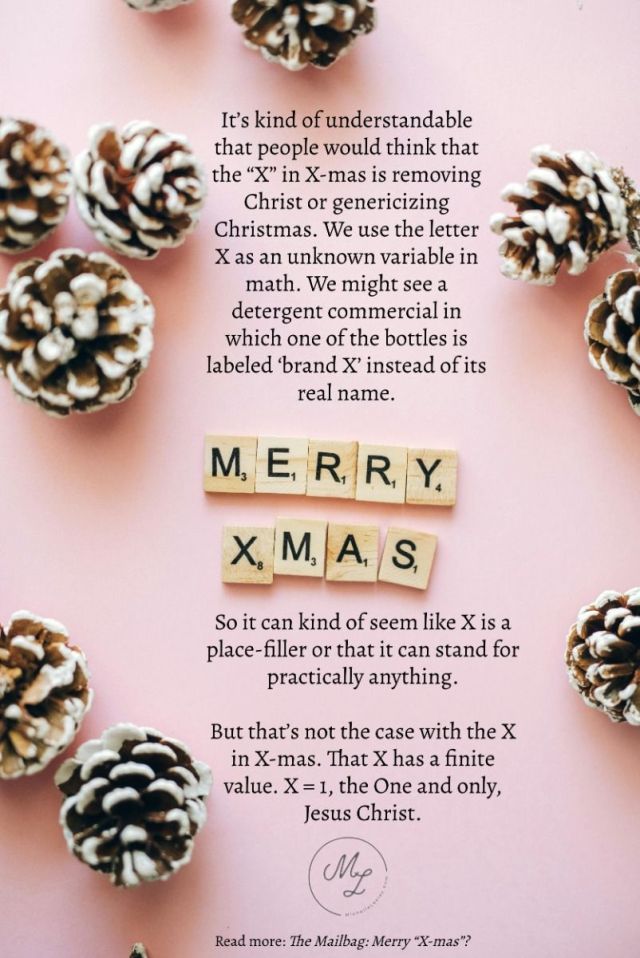
What a great Christmas time question! It’s kind of understandable that people would think that the “X” in X-mas is removing Christ or genericizing Christmas. We use the letter X as an unknown variable in math. We might see a detergent commercial in which one of the bottles is labeled ‘brand X’ instead of its real name. So it can kind of seem like X is a place-filler or that it can stand for practically anything. 

But that’s not the case with the X in X-mas. That X has a finite value. X = 1, the One and only, Jesus Christ. How do we know that?

The “X” in “X-mas” has a finite value. X = 1, the One and only, Jesus Christ.

First, let’s take a look at where the term “X-mas” came from. GotQuestions’ article Is it wrong to say Xmas instead of Christmas? provides us with a nice, succinct answer:

In Greek, the original language of the New Testament, the word for “Christ” is Χριστός, which begins with the Greek letter that is essentially the same letter as the English letter X. So, originally, Xmas was simply an abbreviation of Christmas. No grand conspiracy to take Christ out of Christmas. Just an abbreviation.

What this means is that, in the term X-mas, rather than the letter X taking Christ out of Christmas, the letter X actually stands for Christ. It is used in the same way that we might use “H.S.” to stand for “Holy Spirit” or “OT/NT” to stand for “Old Testament” or “New Testament” when we’re writing informally (I’ve never actually heard someone say X-mas, H.S., OT/NT, have you?), we’re pressed for space, and the people in our audience probably know what those letters mean.

Rather than the letter X in “X-mas” taking Christ *out* of Christmas, the letter X actually stands *for* Christ.

But it’s obvious from the number of people questioning the term “X-mas” as “taking Christ out of Christmas,” that most people – in any audience – don’t know what that letter means. So we need to go a bit further.

Is it possible that advertisers or atheists or others with an active, outward animosity toward the things of God are using the term “X-mas” as a way to mention Christmas without actually having to write the letters in the word “Christ”? To intentionally try to “take Christ out of Christmas”? Yes, it’s possible. But it’s a pretty silly thing to do if you think about it. Everybody who sees “X-mas” in their ad or e-mail or whatever they’ve written knows they mean Christmas, they know they mean Christmas, and, as we’ve just seen, the “X” means “Christ”. So what is the ever-lovin’ point? To parade their “Ooooo, I’m gonna stick it to Christians” pettiness and intolerance before the world?

Yes, such people exist, but I really believe, for the moment anyway, that, despite what it may look like on the news or social media, they’re still the fringe minority. It seems to me that most regular non-Christians who use the term “X-mas” simply do so to save time and space in whatever they’re writing. When I Googled “X-mas,” the two main uses I saw for the term were a) articles with titles like, “Why Do People Use X-mas Instead of Christmas?” and b) space-saving product descriptors (ex: xmas tee- red, LS/SS S,M,L) on sales websites.

But what about Christians using the term “X-mas”?

There is nothing fundamentally sinful or unbiblical about using the term “X-mas” (especially since the X stands for Christ) when necessary since there’s no Bible verse or principle that prohibits it. I have occasionally used both “Xmas” and “Xian” (Christian) on Twitter due to the character limit. My audience is mostly mature Christians (many of whom know what X-mas means), and my theology is an open book to the public, so no one could credibly accuse me of trying to take Christ out of Christmas (or Christian).

But there are a couple of other issues we should think about when it comes to the term “X-mas”.

The first issue is weaker brothers. If you’re not familiar with God’s admonition to us to lay down our Christian liberties so as not to wound the faith of new Christians or Christians who have a weakness of conscience in a particular area, I encourage you to study 1 Corinthians 8 and 1 Corinthians 10:23-33.

But take care that this right of yours does not somehow become a stumbling block to the weak.

1 Corinthians 8:9

If you know that a recipient of your annual Christmas newsletter or someone at church who sees your flier for the upcoming “X-mas Party” is going to be offended by your use of “X-mas” because they don’t understand that it’s not unbiblical, and that your’e not waging some sort of “war on Christmas,” just don’t use it. Why cause unnecessary offense over something so insignificant? Why not take a small, loving step toward living at peace with our weaker brothers and sisters? (I know it can be tough. I need a lot of improvement in this area, myself!)

The second issue has nothing to do with theology, but as an advocate for good writing, I feel I must mention it. Using “X-mas” in anything but the most informal pieces of writing (text messages, social media posts, a note to your husband, a label on your ornament storage container, etc.) looks sloppy and lazy, especially if your writing reaches a moderate to large audience. If you wouldn’t use abbreviations like “TBH” (to be honest) or “IMHO” (in my humble opinion) in what you’re writing, don’t use “X-mas”.

Merry Christmas!


If you have a question about: a Bible passage, an aspect of theology, a current issue in Christianity, or how to biblically handle a family, life, or church situation, comment below (I’ll hold all questions in queue {unpublished} for a future edition of The Mailbag) or send me an e-mail or private message. If your question is chosen for publication, your anonymity will be protected.