Mailbag

The Mailbag: Potpourri (Orange Curriculum, Jesus went to hell?, 1 Tim. 2:12 only for Ephesus?…)

Welcome to another โ€œpotpourriโ€ edition ofย The Mailbag, where I give short(er) answers to several questions rather than a long answer to one question. I also like to take the opportunity in these potpourrri editions to let new readers know about my comments/e-mail/messages policy. Iโ€™m not able to respond individually to most e-mails and messages, so here are someย helpful hintsย for getting your questions answered more quickly.ย Remember, the search bar can be a helpful tool!


In the Apostles Creed, there is a section that states Christ descended into hell and was resurrected. Isnโ€™t that what Joyce Meyer teaches? What about the part about the “holy catholic church: the communion of the saints”? Is that talking about Catholicism and the mass?

These are very common questions (I threw in the second part about Catholicism and the mass, since that’s also commonly asked.), and it’s good to ask, because if you’re confused, other people probably are, too.

The Apostles’ Creed says:

I believe in God, the Father Almighty,
the Creator of heaven and earth,
and in Jesus Christ, His only Son, our Lord:
Who was conceived of the Holy Spirit,
born of the Virgin Mary,
suffered under Pontius Pilate,
was crucified, died, and was buried.
He descended into hell.
The third day He arose again from the dead.
He ascended into heaven
and sits at the right hand of God the Father Almighty,
whence He shall come to judge the living and the dead.
I believe in the Holy Spirit, the holy catholic church,
theย communion of saints,
the forgiveness of sins,
the resurrection of the body,
and life everlasting.
Amen.

It’s a beautiful, basic reiteration of the gospel which many churches and ministries use as part of their official statement of faith. Some churches even recite the Apostles’ Creed during their worship services.

The earliest written record of the creed is from AD 390, in Greek, so you can imagine that some of the terminology used had different connotations back then than those terms have in 21st century America.

Providentially, my friend, Pastor Gabe Hughes, was also recently asked this same question and addressed it both on his podcast and in a WWUTT video, so I’m going to let him do the “heavy lifting” of Scripture and history in the resources below and just give you the short and sweet version:

๐Ÿ“œย You’re quite right in saying that Joyce Meyer teaches that Jesus went to hell between His death on the cross and His resurrection. The Bible doesn’t say this anywhere, and this is a heretical teaching. Just one of the multiple reasons no Christian should follow Joyce Meyer.

๐Ÿ“œย The word “hell” in the Apostles’ creed is based on a mistranslation or confusing translation. The literal meaning of the phrase is that he descended into theย grave or was buried.

๐Ÿ“œย You might have noticed that the word “catholic” in the creed starts with a lowercase “c” rather than a capital “C”. The noun “catholic” with a lowercase “c” simply means the universal church – all genuinely regenerated Believers across the globe, past, present, and future. Roman Catholicism is (or at least by rules of grammar is supposed to be) denoted by a capital “C”.

๐Ÿ“œย “Communion” in the creed does not refer to the Roman Catholic mass or even to the Protestant Lord’s Supper. A clearer word to us today would be “fellowship” or “unity”. The sense is that Believers commune with on another.ย 

Some churches have modernized and clarified the creed by replacing these phrases with “He descended into the grave” or “He descended to the dead” and “the holy Christian church.”

Additional Resources:

WWUTT Podcast #645– Gabe expands on the above video at the 30:15 mark

The Apostlesโ€™ Creed: Its History and Origins at Faithlife Blog


I was wondering if you could post your articles in a larger font. I have an old computer that messes up when I try to make the font bigger. My old eyes are a real struggle.

At first, I thought I was the only one having this problem, but I’ve gotten this question a couple of times, so I know it’s not just my own aging eyes :0)

I’m going to play around with the font a little bit and see if I can find one that’s bigger. Just a few things to understand as I’m working on it: WordPress gives me a limited number of fonts to choose from, and the sizes of those fonts are pre-set. In other words, I can’t set it to 12 point or 18 point, I can only choose from tiny, small, normal, large, and huge. (Right now it’s set on “normal” if you can believe that. “Tiny” is virtually invisible.)

Additionally, when I change the font size, it doesn’t just change the size of the font in the body of my articles, it also changes the size of things like the tags (to the immediate upper left of every article), the sidebar (far left of the page), and the tab titles (top of the page), which, as you can see, are already much larger than the font in the article body. When the font of those texts gets larger, it throws the layout of the whole page out of whack. You might not notice it on a desktop computer with a large monitor, but it can be problematic for people who are viewing the blog on a phone or tablet.

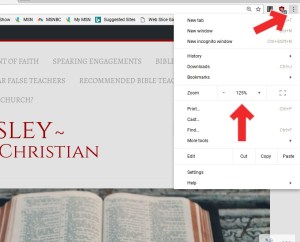
Like I said, I’ll play around with it and see what I can do, but if I’m not able to enlarge the font, there are two workarounds that may help:

1. The reader said she’s unable to change her screen magnification, but it works for me and might work for others. Here’s what it looks like on my computer. Maybe yours is similar:

2. If worse comes to worst, you can highlight and copy the body of the article, paste it into your word processing program, and enlarge the font accordingly.


I have been leading a womenโ€™s small group at our church for a couple of years now. My husband and I have decided to leave the church because, even after confronting leadership about the direction the church is being led doctrinally, they continue to espouse unsound doctrine. What do you think is a wise way to tell the ladies I will no longer be teaching? Do I tell them we are leaving? If so, do I tell them why? What do you think you would do?

It’s hard to say exactly what I would do because every situation and every church is different. But I can tell you that the first thing I would do is talk it through with my husband and ask his advice. There have been many times when he has had very good ideas about how to address (or not address) certain issues, and he will sometimes bring out an aspect of the situation that I hadn’t thought of before. I would encourage you to do that first, and also to make sure you’re submitting to your husband in whatever ways might be applicable in this situation.

My inclination is to advise you to take the “the less said, the better” route with regard to the whole class. (There may be other venues, such as you and your husband meeting with the elder board, in which you’ll need to clearly spell out all the problems, but let’s just focus on the class right now.)

I would probably wait until the end of the very last class and say something generic, like, “I’ve really enjoyed leading this class, but I wanted to let you know I won’t be teaching any more. I encourage you to continue studying God’s Word and growing in Christ. Class dismissed.” Then, go home fairly quickly.

The next level is going to be women coming up to you individually and asking why you won’t be teaching any more. Unless she’s a very close friend, I’d still keep it pretty generic: “We love our brothers and sisters at this church, but we’re finding we disagree with some of the doctrine that’s being taught here, and we’ll be going to a new church.”

For very close friends, you might wish to disclose more about the doctrinal problems, but do so wisely, making sure your focus is on doctrine, not on personal conflicts with the pastor or others. You don’t want people jumping to the wrong conclusion about why you’re leaving.

I really would not talk to people about leaving other than discreetly informing those who need to know. If you give details or talk about it a lot there could be an ugly blow up, and most people will make wrong assumptions about why you’re leaving.


Do you have any information on the Orange Curriculum for children’s Sunday School?

The main thing I know about the Orange Curriculum (or Orange Strategy) is that it is put out by Andy Stanley’s “church”. That’s enough for me to warn people to stay far, far away from it. Andy Stanley is a Scripture-twisting false teacher. You don’t want your children being taught by him or his disciples.

My friend Amy Spreeman over at Berean Research was asked the same question by a reader. I refer you to her article,ย Parents: If your church is โ€œTurning Orangeโ€ฆโ€ย for more details.


How would you respond to someoneโ€™s who says that [1 Timothy 2:12] was meant only for that time and culture?

It’s one of the most common arguments made by people who are looking for an acceptable way to rebel against God’s clear command, “I do not permit a woman to teach or to exercise authority over a man; rather, she is to remain quiet.” I have never had a woman who was humbly seeking to deny herself and obey Scripture make this argument, only those who stubbornly want to have their own way despite what the Bible says, yet simultaneously want to cloak themselves in the appearance of obeying Scripture.

God gave us His exact reasons for this command in verses 13 and 14 (almost as if He somehow knew this argument was coming!), and those reasons weren’t restricted to the women in the first century Ephesian church. The first reason was the Creative order – Adam was formed first, then Eve. The second reason is that Eve was deceived. Both of those reasons are universal (applying to all women and churches everywhere regardless of era or culture). It makes no sense that these two reasons related to Eve would apply only to first century Ephesus any more than it would make sense for them to apply only to tenth century Damascus or seventeenth century Paris.

Next, examine the context of 1 Timothy 2. There are all sorts of instructions to the church in that chapter. Was the instruction to pray for governmental leaders (1-2) limited to the first century Ephesian church? Were only the men of the first century Ephesian church to pray without quarreling (8)? Was modesty (9-10) only required of women in the first century Ephesian church? Then why pick out this one instruction in verse 12 and claim it was limited to that time and culture?

Finally, look at the overall general pattern of male headship and leadership in Scripture. First human created? A man. The Patriarchs? As the word implies – all men. Priests, Levites, Scribes? Men. Heads of the twelve tribes of Israel? Men. Major and minor prophets? Men. All kings of Israel and Judah? Men. Noahic, Abrahamic, Mosaic, and Davidic Covenants? All established between God and men. Authors of Scripture? Men. The forerunner of Christ? John the Baptist – a man. Messiah? A man. All of the apostles? Men. All of the pastors, elders, and deacons of churches in the New Testament? Men. Founder and head of the church? Christ – a man. Leader and head of the family? Men. Now which fits better with this pattern, women preaching to, teaching, and exercising authority over men in the church, or womenย notย preaching to, teaching, and exercising authority over men in the church?

But the truth is, you can have all the biblical evidence in the world, and it’s not going to convince someone who’s in rebellion against Scripture because self is reigning on the throne of her heart. She’s not concerned withย actuallyย obeying God’s Word, she just wants to be able toย claimย that Scripture supports whatย she wants to do, either to look good to others or to attempt to drown out the Holy Spirit’s conviction of her sin.

Additional Resources:

Jill in the Pulpitย 

Ten Things You Should Know About 1 Timothy 2:11-15 and the Relationship Between Men and Women in the Local Churchย atย The Council on Biblical Manhood and Womanhoodย (CBMW) This is a refutation of the most common egalitarian arguments against the plain meaning of 1 Timothy 2:11-15.


If you have a question about: a Bible passage, an aspect of theology, a current issue in Christianity, or how to biblically handle a family, life, or church situation, comment below (Iโ€™ll hold all questions in queue {unpublished} for a future edition ofย The Mailbag) or send me anย e-mail or private message. If your question is chosen for publication, your anonymity will be protected.

Mailbag

The Mailbag: Expository or Topical Preaching: Which is better?


I would like to read your thoughts on expositional vs. topical preaching. I know we can benefit from both but is one superior to the other and why?

Great question! You’re right, both forms of preaching can be beneficial as long as the pastor properly exegetes (rather than eisegetes) Scripture.

For readers who might not be familiar with the terms, expository preaching is basically when a pastor preaches through books of the Bible from beginning to end carefully explaining what each passage means. He might go through only a few verses each week, or maybe a chapter each week, so the time it takes to work through a book will vary from pastor to pastor.

The termย topicalย preaching can have a couple of different meanings depending on who you’re talking to and what she understands the term to mean. Some people understand “topical preaching” to mean a sermon series, usually in a seeker drivenย church, that centers around something in pop culture. (For example, popular moviesย or the Olympics.) Normally, these sermons are very shallow, biblically – sometimes nothing more than a pep talk or self-help tips. This type of preaching is unbiblical, and if it makes up the bulk of the preaching at your church, I’d recommend finding a new church.

There is, however, a biblical form of topical preaching that can be very helpful. If a doctrinally sound pastor sees an issue in the church that needs to be addressed, there is nothing wrong with his taking a break from preaching through a certain book (or when he’s between books) to teach on this issue from the pulpit.

For example, pastors in Parkland, Florida,ย might wish to take a few weeks right now to preach sermons on “Why does God allow tragedies to happen?”, “How can I biblically comfort the families of the victims?”, “Are the victims of the shooting in Heaven?”, and so on. One great topical sermon concept I’ve seen is for the pastor to give the congregation the opportunity to submit biblical questions and then preach sermons answering those questions. Other times a pastor might address a biblical topic for several weeks, such as peace, the gospel, the Fruit of the Spirit, or parenting. As long as these topics are driven by “let’s look at what the Bible says about X” and the pastor handles Scripture correctly and in context, topical preaching is both biblical and beneficial.

My personal opinion (this is not law and there may be plenty of perfectly doctrinally sound pastors who disagree) is that the majority of a pastor’s preaching should be expository with occasional breaks for (biblical) topical preaching as needed. Why?

โœข Expository preaching usually covers a wider spread of Scripture and a wider variety of topics. Topical preaching is, by definition, very narrowly focused on fewer passages and fewer topics.

โœข Expository preaching models for the congregation the proper way they should study the Bible at home. Most of the time, in your daily Bible study, you should be working your way through books of the Bible systematically. (That said, topical preaching done properly isย alsoย helpful for demonstrating to the congregation how to correctly find and apply Scripture to various topics and situations which arise in their lives. We need to know how to do both, but the former is primary.)

โœข Expository preaching helps a pastor better preach the whole counsel of God. He doesn’t have to worry that he’s neglecting to teach on a certain issue and wrack his brain trying to think of what that issue might be. With expository teaching, Scripture takes care of that for him.

โœข I have to think that expository preaching is easier than being forced to come up with a new topic or series every week or few weeks. I’m not a pastor, but the Bible studies I post each Wednesday are nearly always expository. The articles I post each Friday are nearly always topical. Hardly a week goes by that I don’t fret over coming up with a topic for the Friday article and struggle against writer’s block. But I know exactly what each week’s Bible study is going to cover: whatever the next passage of Scripture is in the book we’re studying. Exposition eliminates “forced creativity stress” for me, and I’m thinking maybe it’s similar for pastors.

โœข Expository preaching pushes pastors to tackle hard and unfamiliar passages as they come up in the text, making them more biblically knowledgeable and well-rounded, and allowing them the blessing of depending on God in prayer to open their eyes to understand His Word.

โœข Expository preachingย shouldย keep the Old Testament and certain books of the Bible from being neglected as much as they usually are. There are only 66 books in the Bible to preach through. Eventually you’re going to have to get to the minor prophets, Leviticus, Jude, Philemon, Song of Solomon, and the really long books of the Old Testament. Ostensibly. I’m sure there are expository pastors out there who have preached through the more neglected books, but I’ve never sat under a pastor who preached through Nahum or Zephaniah or Ezekiel. Just sayin’.

โœข Expository preaching gives the congregation a better grip on the overall story arc of the Bible and the culture of the period being studied. If your pastor preaches a topical sermon on leadership from Nehemiah one Sunday, you’re not going to understand the post-exilic period of Israel’s history or the culture of that time nearly as well as if he preached through the entire book over several weeks or months. That knowledge and insight is something you can stick in your pocket and hang on to for studying other post-exilic Scripture at home or in Sunday School, or listening to other sermons dealing with that period of Israel’s history.

โœข Expository preaching better lends itself to encouraging the congregation to prepare for Sunday worship during the week. If you know what passage your pastor is going to be preaching on this Sunday, you can study, and even memorize verses, ahead of time to prepare your heart to hear your pastor preach it.

I just have a couple of caveats (still just my personal opinions) about expository preaching:

I don’t think it’s wise for a pastor to be so rigidly stuck on expository preaching that he ignores the leading of the Holy Spirit to preach the occasional biblical topical sermon when it would be a benefit and a blessing to his congregation simply because he sees himself as an expository preacher. Preaching a topical sermon or series from time to time doesn’t mean you have to turn in your expository preaching card.

Also, while verse by verse preaching is an excellent way to teach the text thoroughly, I once heard someone talking about her (very good, doctrinally sound) pastor who had been preaching through a particular book of the Bible for seven years and still had several chapters to go. I don’t think it’s a good idea to take that long on a single book. At that point, several of the aforementioned benefits of expository preaching are gone: the pastor has ceased to preach the whole counsel of God, he’s neglecting bibilical topics not found in that book, he’s neglecting other books of the Bible, he’s not helping his congregation learn the whole storyline of Scripture and the customs of various historic periods and cultures, and he’s not covering as wide a spread of Scripture as he could if he’d limit himself to a year or two, max, to finish one book and move on to the next.

Expository and topical preaching are both helpful in their own ways, but the most important thing is that the pastor is “rightly handling the word of truth.”


Additional Resources

Why topical preaching can never build a healthy churchย by Mark Dever

The Sheer Weightlessness of So Many Sermonsโ€”Why Expository Preaching Matters by Albert Mohler

What is topical preaching? Does it have a place in the church? by John MacArthur

Can Topical Preaching Be Expository? by Timothy Warren


If you have a question about: a Bible passage, an aspect of theology, a current issue in Christianity, or how to biblically handle a family, life, or church situation, comment below (Iโ€™ll hold all questions in queue {unpublished} for a future edition ofย The Mailbag) or send me anย e-mail or private message. If your question is chosen for publication, your anonymity will be protected.

Mailbag

The Mailbag’s Top 5


While I’m out of town this week, let’s recapย The Mailbag’sย greatest hits. Here are the five most popular Mailbag articles:


Should Churches Use Praise Teams?

Itโ€™s a decision each individual pastor has to prayerfully make as he seeks to do what is
best, wisest, and most godly for his particular church.


What is Calvinism? Semi-Reformed?

Itโ€™s OK to hold those things in tension while weโ€™re here on earth. We believe what Scripture says God does, but, where the Bible is silent as to how He does it, His reasons for doing it, etc.,
well, we trust God and believe Scripture there, too.


Should Christians Do Yoga?

The reason the question โ€œShould Christians do yoga?โ€ is even being asked is because thereโ€™s doubt in the minds of the Christians asking the question that yoga is kosher with God.
Thatโ€™s a healthy doubt because yoga is a Hindu worship practice.


False Doctrine in Contemporary Christian Music

Are there any CCM groups, artists, or songs I should avoid?
Can you recommend any specific doctrinally sound artists or groups?


What is the New Apostolic Reformation?

Since thereโ€™s no official NAR creed or statement of faith, beliefs and practices can vary from church to church, but, loosely speaking, the NAR takes the Word of Faith (prosperity gospel) heresy andย kicks it up a notch with outlandish โ€œsupernaturalโ€ manifestations, blasphemously attributed to the Holy Spirit.


If you have a question about: a Bible passage, an aspect of theology, a current issue in Christianity, or how to biblically handle a family, life, or church situation, comment below (Iโ€™ll hold all questions in queue {unpublished} for a future edition ofย The Mailbag) or send me anย e-mail or private message. If your question is chosen for publication, your anonymity will be protected.

Mailbag

The Mailbag: I Have to Preach Because No Man Will Step Up

Iโ€™ve recently met a woman who is a โ€œpastorโ€ of a church. When asked why she is preaching to men, her response was this:

โ€œMen will not teach. None will stand up. We started as a congregation of women and slowly some husbands came, as well as their sons. But none will take responsibility. So if I do not speak truth and stand up, who will?โ€

This was in another country I recently visited where men do not take authority, nor do they desire it. Women are primary in every area.

This is a difficult situation to be in, and I do sympathize. I’ve been in church and family situations in which men were not being the godly leaders they were supposed to be. It’s very frustrating. Even more so in the case of your friend, because Scripture prohibits women from stepping in and taking over when a man will not lead the church.

But in addition to the fact that the Bible is very clear that your friend is not to preach to men, she’s doing a terrible job as “pastor” on several other counts:

โœข She doesn’t believe God’s Word.

โœข She doesn’t trust God enough to obey His Word.

โœข She doesn’t fear God enough to obey His Word.

โœข She doesn’t believe in the necessity of prayer, or in God’s provision, enough to ask Him to provide a pastor.

โœข She’s not teaching her “congregation” to cry out to the Lord and trust Him to provide. Instead, she’s teaching them to take matters into their own hands when they need something, even if it means disobeying God’s Word. (Kind of like Sarah did.)

โœข She’s teaching her “congregation” that they it’s OK to disobey God if it’s difficult or inconvenient to obey Him.

โœข She’s teaching the women that they don’t have to submit to God’s design for biblical womanhood.

โœข She’s teaching the men to continue to be lazy and shirk their God-given duty to lead. Why should they when a woman is all too willing to step in and do the work for them?

She asks, “If I do not speak truth and stand up, who will?โ€. My answer to that question is, “That’s God’s business to take care of, not yours.” Her business is to obey Him and trust Him to work out everything else. And besides, she’s not “standing up and speaking truth”, she’s standing up and speaking or demonstrating all the untruths I enumerated above.

My counsel to this woman would be to immediately step down as “pastor,” stop preaching to and instructing the men, and publicly repent to God and to everyone in the church for her sins of disobeying God’s Word and setting a bad example for the church. She should inform them that she will no longer be preaching but that she will be praying for God to raise up a pastor, either from among the men of the church or from outside the church.

The men and women can, and should, meet to pray and sing together every Sunday. One of the other women (the former “pastor” needs to sit out of leadership for a while) can certainly teach a women’s Bible study class. But if the men want a Bible teacher or pastor, one of them is going to have to step up and do it. And the women need to be sure they’re holding their ground and refusing to step into that role. What a godly testimony of obedience they will be to the men! Hopefully, it will shame the men over their own disobedience.

God doesn’t give anyone permission to disobey Him just because it’s hard or inconvenient. It was the hardest thing in the world for Jesus to go to the cross, but He did it anyway because He was obedient to His Father. He was willing to die rather than disobey. That is the example she needs to follow.

No temptation has overtaken you that is not common to man. God is faithful, and he will not let you be tempted beyond your ability, but with the temptation he will also provide the way of escape, that you may be able to endure it.
1 Corinthians 10:13

In your struggle against sin you have not yet resisted to the point of shedding your blood.
Hebrews 12:4

In all your ways acknowledge him,
    and he will make straight your paths.
Proverbs 3:6

Commit your way to the Lord; trust in him, and he will act.
Psalm 37:5

When we face tests of our faith, it is not time to take the easy way out and sin, it is God stretching us and giving us an opportunity to trust and obey Him so He can use that situation as a vehicle for growing us to greater maturity and Christlikeness.

This lady, and the rest of the church, has the opportunity here to cry out fervently to God to provide them with a pastor and then trust Him to act on their behalf.

Ask, and it will be given to you; seek, and you will find; knock, and it will be opened to you. For everyone who asks receives, and the one who seeks finds, and to the one who knocks it will be opened. Or which one of you, if his son asks him for bread, will give him a stone? Or if he asks for a fish, will give him a serpent? If you then, who are evil, know how to give good gifts to your children, how much more will your Father who is in heaven give good things to those who ask him!
Matthew 7:7-11

Which would bring more glory to God and be more of a testimony to His greatness: for this lady to have taken matters into her own hands and sinned, or for her and the rest of the women to obey God, for everyone to pray and trust God for a pastor, and then to have the awesome experience of God answering that prayer?

There’s nothing amazing, especially in that culture, about men being lazy and women stepping in and picking up the slack. Why have a Christian church that is supposed to be following the all powerful God of the universe be just one more example of that? Instead, they could have an incredible testimony of God providing a pastor and changing the hearts of the men of the church to take responsibility and lead. What kind of an impact would that have on the surrounding culture? How many doors might that open for that church to share the gospel?


Additional Resources

Rock Your Role: Jill in the Pulpit

Basic Training: Obedience: 8 Ways to Stop Making Excuses and Start Obeying Scripture

Basic Training: 5 Ways to Face Tests and Trials Biblically


If you have a question about: a Bible passage, an aspect of theology, a current issue in Christianity, or how to biblically handle a family, life, or church situation, comment below (Iโ€™ll hold all questions in queue {unpublished} for a future edition of The Mailbag) or send me an e-mail or private message. If your question is chosen for publication, your anonymity will be protected.

Mailbag, Speaking Engagements

The Mailbag: Potpourri (Joni’s testimony, “Messy”, Female seminary profs…)

Welcome to another โ€œpotpourriโ€ edition of The Mailbag, where I give short(er) answers to several questions rather than a long answer to one question. I also like to take the opportunity in these potpourrri editions to let new readers know about my comments/e-mail/messages policy. Iโ€™m not able to respond individually to most e-mails and messages, so here are some helpful hints for getting your questions answered more quickly. Remember, the search bar can be a helpful tool!


Our church has a ministry for the homeless where once a week, lunch is provided and a Bible Study is given usually by a woman, occasionally by a man to a mixture of both men and women. Some might be saved, probably most are not. What are your thoughts in regard to this situation from a Biblical perspective?

Great question! I’ve answered it in #11 of my article Rock Your Role FAQs.


We watched a video of Joni Eareckson Tada speaking at a recent Shepherds Conference. She gave her testimony and shared the meaning of Scripture and what some Greek words were so there was teaching going on as well as testimony. I know she is thought of highly but I was wondering about her speaking and teaching to groups of men.

Joni is not someone I follow closely, though I did read her first book, Joni, when I was a teenager. John MacArthur heads up the Shepherds Conference, which is a conference for men in church leadership, particularly pastors (“shepherds”).

Just to give a little background for anyone not familiar with him, Dr. MacArthur is a staunch complementarian and is a doctrinally sound pastor, teacher, and author I am happy to recommend to my readers. He would never invite a woman to preach at ShepCon nor invite a doctrinally unsound speaker. So I trust Dr. MacArthur’s judgment and reasons for inviting her to speak – that he was not inviting her to preach.

That foundation being laid, there are instances in which it is perfectly biblically appropriate for a woman to speak in front of a co-ed Christian group or a group of Christian men, and giving her testimony – so long as she does not veer off intoย preaching (instructing and/or exhorting men in the Scriptures) – is one of them. I’ve written more about that, giving examples, in these articles:

Rock Your Role FAQs (#7, 14)

The Mailbag: Should women give testimonies and reports, lead prayer and worship in church?

I have not listened to the talk Joni gave at ShepCon. It is possible that I would think her explanations of Scripture crossed the line into teaching, but it is also possible I would not. I just can’t say since I haven’t listened to it. (I would not consider giving the definition of a Greek word or two to be the type of biblical instruction prohibited by 1 Timothy 2:12.)

I would be more inclined to look at Joni’s history and intentions. Did she come to ShepCon with the intent of preaching or instructing men in the Scriptures? Does she have a track record of preaching sermons or giving Bible instruction to men at conferences? If the answer to both is no and she is normally very careful to stay within the parameters of biblical womanhood, I’d be inclined to extend grace on any bobbles she made during her testimony at ShepCon. It’s a very fine line to walk, and I’m sure I would probably make a few mistakes too if I were in that situation.

Update: Thanks to reader DebbieLynne (see comments section) for the heads up that Joni actually gave her testimony at the Strange Fire Conference (2013, also spearheaded by John MacArthur), not at the Shepherds Conference. Strange Fire was co-ed rather than men only. Whether or not women were in attendance at the conference doesnโ€™t really change my answer to the reader, but itโ€™s good to have the facts straight.


Is it OK for women to teach pastors-in-training at seminaries?

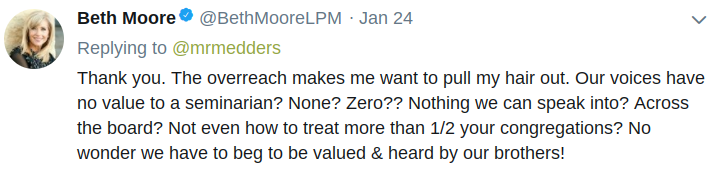
John Piper recently answered this question on an episode of Ask Pastor John. You should read his response for yourself (it’s not long), but, essentially his answer was that experienced pastor-mentors should be training up young pastors, and since it is unbiblical for women to serve as pastors themselves, they lack the experience necessary to mentor pastors-in-training. And, my word, the egalitarian world had a fit – including Beth Moore and her daughter Melissa (who helps run Beth’s ministry):

While I consider him to be a generally doctrinally sound brother in Christ, I’m not particularly a fan of John Piper, but I do want to say that I think his answer was taken wildly out of context by those pushing unbiblical agendas, that he was treated shabbily by many on social media, and that I thought his answer was very good, biblical, and just plain old made sense. Women are not qualified to serve as pastors. Why on earth would we want them training pastors? Moreover, what student wouldn’t want the most qualified and experienced professors he could get for his tuition money?

Let’s say you were the dean of the neurosurgery department at a medical school. A gentleman, totally blind from birth, comes in and applies for a position teaching surgical practicum (cutting, suturing, removing tumors, etc.). He has held positions teaching various subjects at other universities so his ability to impart information is not in question, but he has never performed surgery in his life because he’s blind. Would you hire him to train neurosurgeons to perform brain surgery?

The reason Dr. Piper’s answer caused a bit of a kerfuffle is that he limited his answer to the question he was asked. Imagine that. He was asked if women should train pastors and that’s the question he answered. The agenda-driven screaming neemies took his answer of “no” to mean that no woman should ever teach anything to anyone in any seminary anywhere ever. That is not what Dr. Piper said. He said women should not train men for the pastorate.

I would have answered the same way. However, if I were to expand on Dr. Piper’s answer, what I would further explain is that most seminaries (at least the ones I’m familiar with) do far more than simply train men for the pastorate. Take the seminary my husband attended for example, New Orleans Baptist Theological Seminary. If you’ll click on the “Academics and Admissions” tab at the top of the page and examine the various degree and non-degree programs, you’ll find that most of them are not strictly preaching programs. There are programs for women’s ministry and children’s ministry (Surely we wouldn’t say women are unqualified to teach in these areas?), college ministry, urban ministry, music ministry, missions, counseling, languages, and many more. There’s nothing wrong with women teaching things like music theory, finance, general education classes like math, history, and English, archaeology, legal issues, languages, business, etc., even in a seminary.

There are definitely some classes women shouldn’t be teaching in seminaries, but there are plenty of other classes that would be fine for them to teach.


Since we’ve become parents my husband and I have mostly attended churches that were larger and offered childcare. We were saved out of Mormonism eight years ago which has its own order of services and no childcare provided for the main service, but I don’t know what to expect from a Christian service that doesn’t offer childcare. I don’t know what will be expected of me and my family. I have a four-year-old and I worry that he will end up running around or asleep on the pew. Do we call ahead? Pack a busy bag? Are snacks alright? How do you ever get anything out of the service for yourself?

Before I answer, I want to encourage readers who are experienced church members to really let this precious sister’s question sink in and inform the way you respond to visitors and new members. Increasingly, the people who are new to your church will have very little church background. Church culture may be old hat to you, but it’s like landing on Mars to many of them. They have no idea where to go or what to do, and they don’t speak Christianese. Make sure you warmly welcome and encourage newbies and let them know that it’s OK to ask questions.

I think my article Churchmanship 101: Training Your Child to Behave in Church will help with some practical tips and expectations. You should not allow your child to run around the sanctuary during the worship service any more than you would allow him to run around a restaurant if you went out to eat, or a store if you were shopping, but I would not get overly stressed about him making a few minor noises or dropping the occasional Bible during church. If a church doesn’t offer childcare, they’re surely used to children making a little noise during the service from time to time. Sermon-time naps at four years old are not the end of the world, but you’ll want to curb those as he approaches school-age (if he can stay awake all day in school, he can stay awake for 30 minutes or an hour in church).

Until your child gets into the routine of attending worship and learns how you expect him to behave, you may not get very much out of the service. That’s just one of those parts of being a mom that we all have to accept – like stretch marks :0) But if you will be consistent and diligent as you train your child, he’ll get with the program soon enough.

When you ask if you should “call ahead”, if what you mean is calling the church office prior to Sunday and asking any questions you might have, that is a super idea! Most pastors I know would be delighted to chat on the phone or in person to welcome you to the church and help you feel at ease. That is the point at which I would ask about snacks. Different churches have different policies about food and drink in the sanctuary. I’ve never heard of one that wouldn’t allow a baby bottle, but some may not be keen on the idea of Cheerios ground into their carpet. You could also ask if they have a “cry room”. Some churches have set aside a room near the sanctuary where you can take a fussy baby or jumpy toddler. Many of them have the sermon “piped in” so you can listen until you go back into the worship service. You might also want to ask if the worship service is recorded and posted online so you can listen at home to any parts of the sermon you may have missed. Never be afraid to ask an honest and polite question.


I have been hearing the word messy a lot in reference to our lives..has this word replaced the word sin?

Well…I suppose it may have for those who are trying to sand off the sharp edges of the gospel, but the biblical term is sin, so that’s the correct word to use, despite how popular “messy”, or any other trendy word, might be.


Can you recommend any doctrinally sound female speakers for women’s events?

(I promise this is an actual question I recently received, not one I made up for promotional purposes! :0)

Yes, me. Click the “Speaking Engagements” tab at the top of this page for more information.

If I’m not really your cup of tea, or I’m too far away for your travel budget, I happily recommend any of the women listed under the “Recommended Bible Teachers” tab at the top of this page (although I’m not positive all of them do speaking engagements).


If you have a question about: a Bible passage, an aspect of theology, a current issue in Christianity, or how to biblically handle a family, life, or church situation, comment below (Iโ€™ll hold all questions in queue {unpublished} for a future edition of The Mailbag) or send me an e-mail or private message. If your question is chosen for publication, your anonymity will be protected.