
Mailbag, Marriage, Sanctification

The Mailbag: Can I share the gospel with my unsaved husband?

I was brought up to believe that women win their unsaved spouses by actions, not words, because of dissension in the the home and that sort of thing. Would love your thoughts.

One of the most difficult and stressful situations a Christian woman can walk through is being married to someone who is not saved. Sometimes this happens because husband and wife are both unsaved when they get married and the wife gets saved later. Sometimes it happens because the wife (and sometimes the husband, too) think the husband is saved and it later becomes obvious that he is a false convert. And sometimes what happens is that a spiritually immature Christian woman goes into marriage knowing her husband isnโ€™t saved, and she either doesnโ€™t care or she thinks sheโ€™ll change him right away.

Single ladies, please take heed and take this to heart: know your man well, spiritually, before you get married. While itโ€™s impossible to know with 100% certainty whether or not another person is saved, do your best. Make sure this is a man who can be the spiritual leader of your home – a man who will make wise and godly decisions, who intends to parent biblically, who is able and eager to lead your family in Bible study and prayer, and who is committed to faithfully attending and serving the local church. Many women who went into marriage thinking these things would somehow take care of themselves can tell you from sad experience that the issues you and your husband have before marriage will only get worse after marriage.

Thatโ€™s the best way to answer the readerโ€™s question: prophylaxis. Prevent the problem before it happens.

That said, God is the One who decides when you get saved, and if you and your husband werenโ€™t saved when you got married, but you are now, praise God for that! What a wonderful thing that He saved you and that He has placed a 24/7 witness to the gospel in your husbandโ€™s life!

If you ever feel alone in having an unsaved husband, take comfort and think about all the ladies in the first century when Christianity was brand new. Many, if not most, Christian women were in your situation. They worried and agonized over their husbandsโ€™ salvation just like you do. In fact, it was such a common situation in the early church that Paul and Peter each dedicated part of their writings to instructing and encouraging wives about walking out their faith in a marriage to an unsaved husband:

Likewise, wives, be subject to your own husbands, so that even if some do not obey the word, they may be won without a word by the conduct of their wives, when they see your respectful and pure conduct. Do not let your adorning be externalโ€”the braiding of hair and the putting on of gold jewelry, or the clothing you wearโ€” but let your adorning be the hidden person of the heart with the imperishable beauty of a gentle and quiet spirit, which in God’s sight is very precious. For this is how the holy women who hoped in God used to adorn themselves, by submitting to their own husbands, as Sarah obeyed Abraham, calling him lord. And you are her children, if you do good and do not fear anything that is frightening. 1 Peter 3:1-6


If any woman has a husband who is an unbeliever, and he consents to live with her, she should not divorce him. For the unbelieving husband is made holy because of his wife, and the unbelieving wife is made holy because of her husband. Otherwise your children would be unclean, but as it is, they are holy…For how do you know, wife, whether you will save your husband? Or how do you know, husband, whether you will save your wife? 1 Corinthians 7:13-14,16

I believe the readerโ€™s question focuses in on 1 Peter 3:1:

Likewise, wives, be subject to your own husbands, so that even if some do not obey the word, they may be won without a word by the conduct of their wives, when they see your respectful and pure conduct.

If we isolate this verse from its immediate context of surrounding verses, the context of the book of 1 Peter, and the context of the New Testament, it seems to say that a wife can win her husband to Christ simply by her Christlike behavior with no need to ever open her mouth and share the gospel with him. However, if we take a step back and even just think about it logically for a minute, we know that canโ€™t be what this verse is saying.

Think about how you came to saving faith. Did you get saved exclusively by watching someone act humbly, patiently, lovingly, etc.? Or did someone explain to you that you were a sinner in need of repentance, that Christ paid the penalty for your sin on the cross, that He rose again on the third day, and that if you placed your faith in Him, He would cleanse and forgive you and give you eternal life? Those are things you canโ€™t get just by watching someone behave kindly and lovingly. They have to be explained by a friend, a sermon, a tract, the Bible, or some other use of words. (This is whatโ€™s problematic with the old clichรฉ โ€œPreach the gospel at all times. Use words if necessary.โ€ Words are always necessary for explaining the gospel.)

Next, letโ€™s think about the context of the New Testament at large as well as 1 Peter. Can you think of any instances in which Christians are told to share the gospel with anybody simply by modeling good behavior? No. The iconic evangelism passage, the Great Commission, tells us to โ€œmake disciples…teaching them to observe all that I have commanded you.โ€ You have to talk to people, and maybe even use books or other written materials – with words – in order to teach and disciple. The theme of 1 Peter itself is largely, โ€œWalk in holiness, a) because itโ€™s the godly thing to do, and b) because it could open a door for you to share the gospel with others.โ€ Peter never suggests that godly behavior is the stopping point of evangelism, only the starting point.

Another great example is the account of Philip and the Ethiopian eunuch. The Ethiopian eunuch was actually reading a gospel passage from the Bible, when Philip arrived on the scene. โ€œDo you understand what youโ€™re reading?โ€ Philip asked. โ€œHow can I unless someone explains it to me?โ€ he answered. At that point, Philip did not put on a little skit of good works for the Ethiopian to watch, he climbed into the chariot beside him and explained the gospel from Scripture.

The 1 Corinthians 7 passage adds clarity as well, indicating that God has essentially placed a saved wife and mother in her family to be a missionary to her husband and children.

Now letโ€™s think about this verse in the context of 1 Peter 3:1-6. If you look at those six verses as a set, what is the main idea of the passage? Itโ€™s not witnessing, itโ€™s being winsome. Through Peterโ€™s pen, the Holy Spirit is helping women to see that godly behavior sets a gorgeous table from which the main dish of the gospel can be appetizingly served. Donโ€™t be confused – itโ€™s not about dressing like a supermodel dripping with jewels; thatโ€™s not whatโ€™s going to have the most profound impact on a husbandโ€™s heart – itโ€™s about being beautiful from the inside out. Your character, your demeanor, your submission and self-sacrifice, โ€œa gentle and quiet spirit.โ€ Thatโ€™s the focus of this passage – laying the foundation – so that when an opening presents itself to share Christ with your husband, the gospel is adorned with your grace and godliness instead of your behavior and attitude being an impediment to his receiving the good news.

The primary characteristic of having a โ€œgentle and quiet spiritโ€ is trusting God. And that plays into this passage too, because the scariest and weightiest thing youโ€™re going to have to trust God with is your husbandโ€™s salvation. God has to save your husband in His good time just like He saved you in His good time. You cannot convince, lecture, or nag him into the kingdom of God, even though it will be tempting to try because you want it so badly.

Thatโ€™s another application of this passage that can be very comforting and helpful. Maybe when you first got saved, you were so eager for your husband to know Christ that you harped at him constantly about it. You overwhelmed him with the gospel to the point that he said, โ€œPlease stop talking to me about that.โ€ This passage in 1 Peter reassures you that itโ€™s OK to back off. Youโ€™ve shared the gospel with your husband. Heโ€™s heard it. Until or unless a moment comes when you know beyond a shadow of a doubt that the Holy Spirit is intensely working on your husbandโ€™s heart, heโ€™s โ€œripe for the picking,โ€ and he needs you to pray with him or explain the gospel again, your job is over. Itโ€™s the Holy Spiritโ€™s turn. Stand aside and donโ€™t get in the way of the work Heโ€™s doing through the gospel seed youโ€™ve planted, your prayers for your husband, and your godly behavior.

God can save your husband even if youโ€™ve messed up and said the wrong thing. God can save your husband even if you donโ€™t say that โ€œone more thingโ€ you think will push him over the edge of salvation. Yes, share the gospel with your husband, but realize that God does not place the burden of saving your husband on your shoulders. Only Christ is strong enough to bear that burden. Rest in that, trust Him, and walk obediently. You are not responsible for saving your husband. God is.

“But what about the Bible’s prohibition against women teaching men?” some readers might be wondering. “Wouldn’t that preclude women from sharing the gospel with their unsaved husbands? Is it OK for Christian women to share something biblical or theological they’ve learned with their Christian husbands?”

This question refers to the prohibition in 1 Timothy 2:11-3:7 against women pastoring, preaching, instructing men in the Scriptures, and holding authority over men in the gathered body of the church. A private discussion at home between you and your husband is not the gathering of the church, so this passage does not apply. I’ve answered this question in more detail in this article (second question) and this article (second question).


If you have a question about: a Bible passage, an aspect of theology, a current issue in Christianity, or how to biblically handle a family, life, or church situation, comment below (Iโ€™ll hold all questions in queue {unpublished} for a future edition of The Mailbag) or send me an e-mail or private message. If your question is chosen for publication, your anonymity will be protected.


Holidays (Other), Mailbag

The Mailbag: Patriotism in Church

Every year on the Sunday closest to the 4th of July, our worship service turns very patriotic. All of the hymns and worship songs are replaced with patriotic songs like God Bless America, America the Beautiful, and the National Anthem. The choir and whoever is singing a solo that day sings a patriotic song. A color guard marches in with the American flag and we say the Pledge of Allegiance. Sometimes the sermon is even on a patriotic topic. It makes me uncomfortable because I think the worship service should focus on God, not America. What do you think?

Independence Day is one of my favorite holidays. I love the fireworks and picnics, the bands, and watching my favorite musical, Yankee Doodle Dandy.

I’m as red, white, and blue, rah rah America as the next guy, but there’s a time and a place for all that, and the Sunday morning worship hour isn’t it. You’re correct. The worship service is exactly that: worship and service. And who are Christians supposed to worship and serve when we go to church? God.

We are to sing to, and about, God. The pastor is to preach the Word of God. We pledge our allegiance in prayer, worship, and confession to God. Our thoughts are to be focused on God. Every element of the worship service – songs, symbols, readings, offerings, prayer, praise, everything – is to draw our attention to God. He is the only One worthy of our worship.

Patriotic songs, the Pledge, and all of those other things can take the focus off God and put it on something lesser. Sometimes God gets pushed aside in favor of what we want to focus on. That’s a very man-centered attitude in the very place and time when everything is supposed to be centered on God.

And really, if you think about the main reason America was founded – freedom of worship – what better way is there to honor our forefathers and celebrate the gift of freedom God has given us than to exercise our First Amendment right to worship God? Certainly, we could use the 4th of July as a reminder to take some time in corporate prayer to express gratitude to God for our country and our liberties and to pray for our country. Scripture tells us to present our requests to God with thanksgiving. We could also dedicate some time to praying for our governmental officials as 1 Timothy 2:1-4 instructs us to do. There’s a biblical, worshipful way to be thankful for the freedoms God has blessed us with and intercede for our country and our governing authorities. And it shouldn’t be limited to one Sunday a year.

But when it comes to patriotic hoopla, we can set aside another time for that and still celebrate with our brothers and sisters in Christ. If your church family wants to celebrate America’s birthday together, that’s great! Have a church-wide cookout on the 4th. Schedule an Independence Day patriotic sing-along or choir pageant. Meet up and head out to the county fireworks show together. Fellowship! Have fun!

But when it’s time to worship, let’s make sure we’re reserving that time for worship of the King of Kings and Lord of Lords. It’s fine to love America, but let’s demonstrate that we love Christ more by not letting anything take His place in His church.

It’s fine to love America, but let’s demonstrate that we love Christ more by not letting anything take His place in His church.

photo source

If you have a question about: a Bible passage, an aspect of theology, a current issue in Christianity, or how to biblically handle a family, life, or church situation, comment below (Iโ€™ll hold all questions in queue {unpublished} for a future edition of The Mailbag) or send me an e-mail or private message. If your question is chosen for publication, your anonymity will be protected.

Mailbag

The Mailbag: Potpourri (Calvinism, Baptism, Modesty…)

Welcome to another โ€œpotpourriโ€ edition ofย The Mailbag, where I give short(er) answers to several questions rather than a long answer to one question. I also like to take the opportunity in these potpourri editions to let new readers know about my comments/e-mail/messages policy. Iโ€™m not able to respond individually to most e-mails and messages, so here are someย helpful hintsย for getting your questions answered more quickly.ย Remember, the search bar can be a helpful tool!


I was very troubled by a recent stance the discernment ministry Lighthouse Trails has taken –ย calling Calvinism heresyย – and wondered if you had seen it. Itโ€™s one thing to just have a difference of opinion on Calvinism, but to put it this category?ยน

Yes, I saw it when they made the big announcement on social media a few months ago. I expressed my disappointment to LT and have decided, going forward, not to use their materials or point readers to them as a trustworthy resource. There are several reasons for this:

1. The tone used in most of the LT anti-Calvinist posts, comments, and articles was derisive and condemnatory at best. There is no place for that among Believers, regardless of their stance on Calvinism (frequent readers will note I don’t recommend Reformed resources that take this sort of tone either).

2. It was clear from the LT materials I read that they don’t even have a complete and accurate understanding of what Calvinism is. Indeed, some of what they addressed was not Calvinismย (which is biblical Christianity)ย but Hyper-Calvinismย (which is heresy). That does not speak well of a discernment ministry. You must have a correct understanding of a doctrine before attempting to address it biblically, especially if you’re going to come to the conclusion that something is “another gospel” (heresy) as LT did with Calvinism.

3. Addressing a doctrine they haven’t thoroughly researched, as well as anathematizing something that is clearly biblical Christianity (even if they don’t agree with it), calls the discernment and biblical understanding of the entire organization into question and casts doubt on LT’s previous and future evaluations of doctrine. In other words, if they’re going to make this egregious an error over such a simple – and settled – biblical construct, how can any of their conclusions on other, more nuanced aspects of theology be trusted?

Here are some additional resources you may find helpful:

What is Calvinism? by Maurice Roberts

Calvinism & the Bible by Brian Godawa

What’s the Difference Between Arminianism, Calvinism and Hyper-Calvinism?ย by Tom Ascol

Calvinism Is Not Hyper-Calvinism by Josh Buice


I had viewed the Gospel Message video embedded on your site and had concern for the presentation. It is apparent you have hermeneutical concern for today’s God study, so I wanted to clarify what your view may be on baptism.

I hold to a Reformed Southern Baptist, credo-baptist understanding of baptism. You can find further details at these links:

Statement of Faithย (tab at top of this page)

Basic Training: Baptism

(Remember, the search bar and the tabs at the top of the blog are your friends! :0)


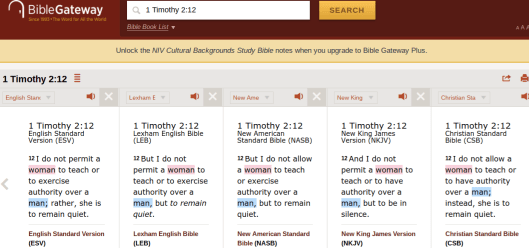
I have only recently come to understand 1 Timothy 2:12. However, why do we so passionately receive verse 12, yet neglect verse 9? Why do people choose which parts of the Bible to obey?

No Christian should be making a conscious choice to disobey any command(s) of Scripture that pertains to Christians. Willful disobedience is sin which needs to be repented of, and might even indicate that the person is not saved. Genuinely regenerated Christians desire from the heart to keep God’s commands.

I am not sure whether your question is based on your own church (or local churches you’re familiar with) in which women embrace their biblical roles but are dressing immodestly, or if you’re seeing a lot of attention focused on verse 12 (in books, online articles, conferences, organizations, sermons, social media, etc.) and not as much on verse 9.

If it’s the latter, I would say that you’re seeing a lot of attention focused on verse 12 rather than verse 9 for the same reason you see firemen hosing down a house that’s on fire rather than hosing down one that’s not. When the day comes that celebrity “Christian” women get up on stage dressed immodestly, write books about how dressing immodestly is perfectly biblical, form organizations to push the immodest dress agenda, hold conferences extolling immodest dress, and encourage other women to dress immodestly as they worship, I think you’ll see the same kind of pushback with verse 9 that you’re seeing now with verse 12.

If what you’re asking about is women at your church who embrace their biblical roles but seem not to be obeying verse 9, first make sure you have a correct understanding of what verse 9 is talking about:

likewise also that women should adorn themselves in respectable apparel, with modesty and self-control, not with braided hair
and gold or pearls or costly attire,

a) The context of 1 Timothy, including chapter 2, is instructions for the gathering of the church. So, while Christian women should dress in a way that glorifies God at all times simply because we belong to Christ, this particular verse is about how we dress for church, not for a gala, the beach, or the gym.

b) “Braided hair and gold or pearls” are examples – much like head coverings – of specific things that were considered immodest in the time and culture in which 1 Timothy was written. If a woman comes to your church with her hair in a French braid or wearing an understated pearl necklace, she is notย necessarily dressing immodestly. There is nothing intrinsically immodest about gold, pearls, or braids, but rather the meaning a culture attaches to them or the statement they make in a particular venue.

c) The term “modest” has more than one meaning in this verse. It does mean to dress in a way that is not sexually provocative (“respectable apparel”). But in the same way we would use the phrase “a modest income” or “a modest home”, it also means to dress in a way that’s not flashy (which, in the first century meant bling like gold, pearls, and extravagantly braided hairstyles), and that doesn’t attempt call attention to yourself or show off your wealth (“costly attire”).

So, in this sense, a woman who walks into the average American church wearing a dress she got at Target is probably not dressing immodestly, whereas a woman who walks in wearing uber-expensive designer clothes, shoes, and handbag, and dripping with jewels probably is, necklines and hemlines notwithstanding. That goes for outlandish apparel or clothing that’s meant to grab attention as well. If your hair is three shades of green and fashioned into a unicorn horn, that’s going to be immodest in most churches. If you walk into church wearing scuba gear or a space suit, that also fits what this verse means by immodest.

In a nutshell, we’re to fit in, not to beย a distraction from worship with our clothes and coifs.ย You are not supposed to be the center of attention in church, God is.

If this is an issue with the women of your church in general, or with one woman in particular, set up an appointment with your pastor and get some counsel from him on the best way to address the situation.


I have a bone to pick with you.

This is a verbatim quote of the opening line of the reader’s e-mail. Normally, I would just hit “delete” without giving such rudeness the time of day, but I thought I’d make an example of it instead. Ladies, rudeness and displays of self-centered anger dishonor Christ, and if you’re e-mailing someone like me who struggles against the sin of impatience, you’re not only tempting a sister in Christ to sin, but you’re probably not going to get a hearing.

I have personally known [female Bible teacher you’ve written about] for over 30 years.

The name of the teacher is irrelevant, but it is not someone I’ve warned against nor whom I consider a false teacher. Additionally, this reader bases her defense of said Bible teacher (below) on knowing her personally and on the reader’s personal opinions and experiences, not on what Scripture says, which does not speak well of what she has learned from the Bible teacher. I don’t think the reader’s rudeness or her lack of biblical understanding are a fair representation of this particular teacher, so that’s another reason I’m leaving her name out.

She gets permission from her husband and her pastor [and the male head of her ministry] before she teaches with men in the audience…I have met some of the men on the board and they have no problem [with her] lecturing with men in the audience.

Please point me to the passage of Scripture, chapter and verse, that says a husband, pastor, or ministry head or board can give a woman permission to do something God has prohibited.ย No one has the authority to say “yes” where God has said “no.” I’ve addressed in detail this idea of a woman teaching men “under her husband’s/pastor’s authority” in my articleย Fencing off the Forbidden Fruit Tree.

Additionally, it does not matter how many people give approval to something or how important they are – that is not what makes something right or biblical. God is the arbiter of right and wrong, biblical and unbiblical, not people.

When you see the men in audience she is giving a lecture not teaching.

But you just said in the previous sentence, “She gets permission from her husband and her pastor before she teaches with men in the audience.” Which is it?

Furthermore, it doesn’t matter whether you call it preaching, teaching, lecturing, sharing, proclaiming, exhorting, or delivering a soliloquy, if it’s instructing men in the Scriptures in the gathered body of Believers, it violates 1 Timothy 2:12, and it’s sin.

The men chose to listen to [her] lead the lectures.

That’s true. That means that they areย also guilty of violating 1 Timothy 2:12, not that they are guilty and she is not.

You need to come to [one of this Bible teacher’s events]. You will see what is actually being done and said.

When I wrote the article you read about this Bible teacher, I provided videos of her teaching, quotes from her materials, and other objective, verifiable evidence of what she says, does, and teaches. That’s not “what is actually being done and said”?

I am basing my evaluation of this teacher’s words and actions on Scripture, not on my personal experience. I don’t need to be physically present at one of her events in order to do that.

[This Bible teacher] and other teachers: When [this Bible teacher] gets an invitation to speak she asks God if she should do it or not. So you need to ask God if [she] is sinning because she only goes wherever God sends her.

I believe what the reader is addressing here is that I have pointed out as unbiblical that the Bible teacher in question has joined in ministry activities with demonstrably false teachers.

God has given us His written Word. Whatever He might subjectively “tell” us in prayer does not override what He has objectively told us in the Bible. God gave His answer to her question about 2,000 years ago in 2 John 9-11, Romans 16:17-18, 2 Corinthians 6:14-18, and many other passages. If someone is invited to partner in ministry with false teachers, her answer is to be “no.” God is not “sending her” to partner with false teachers because He has already instructed her not to do that in His written Word. And if she is so learned in the Scriptures that she’s qualified to be a Bible teacher, she should already know that without having to ask Him. And if you’ve known her for thirty years, she should have taught you that by now as well. I don’t need to “ask God if she is sinning,” I only have to open my Bible and read what He’s already said about it.

Before you say anything about a Christian speaker you need to do more research and go to that ministry personally.

“More research” meaning, “keep researching until you agree with me”? I did multiple hours of research on the article you read. I sufficiently substantiated every point I made with Scripture and accurate, verifiable evidence from the teacher’s own words and actions.

As I previously stated, my conclusions about the Bible teacher are not based on my personal experience, so there is no need for me to visit the ministry in person. If you’re alluding toย Matthew 18:15-20, that passage does not apply to commenting on and evaluating a teacher’s publicly available statements and materials as I’ve explained in detail in my articleย Answering the Opposition- Responses to the Most Frequently Raised Discernment Objectionsย (#1).


ยนPlease note, I do not participate in, nor provide a forum in the comments section for, Calvinism-Arminianism debates. Please refer to the Welcome tab (top of this page) for comment guidelines before commenting.

If you have a question about: a Bible passage, an aspect of theology, a current issue in Christianity, or how to biblically handle a family, life, or church situation, comment below (Iโ€™ll hold all questions in queue {unpublished} for a future edition ofย The Mailbag) or send me anย e-mail or private message. If your question is chosen for publication, your anonymity will be protected.
Christian women, Complementarianism, Mailbag

The Mailbag: Is it biblical for women to carry out The Great Commission?

Last week, I received some questions from a Facebook follower regarding my article Basic Training: The Great Commission. I thought they were very insightful and that other readers might have the same questions, so I’m sharing and expanding on my answers to her here. (I’ve edited/condensed the reader’s questions and comments {in bold type} for the sake of brevity.)

Given my understanding of what Jesus is commanding, and comparing it with other examples in the New Testament, it’s not for women to do the Great Commission. Our role is not to make disciples, teach, or baptize, but to keep the home, edify other women believers, etc. The Great Commission is for men, not women, to do because…

1. The Great Commission requires teaching and baptizing.

2. Jesus was speaking the Great Commission to His disciples, who were all male.

3. We don’t see any specific New Testament examples of women sharing the gospel with the lost through their own witness or example.

4. Because we don’t see any specific New Testament examples of women sharing the gospel or any explicit commands for women to share the gospel, it violates the regulative principle for women to share the gospel with the lost.

This reader’s questions really got me thinking and digging. I love questions that make me think hard and dig into Scripture and theology for answers!

First, let me briefly address the points of this issue that are not in dispute. As I understand her, the reader is in full agreement with Titus 2:3-5 and the example of Lois and Eunice. She agrees with the biblical principles of women training their own children in the gospel and discipling Christian women (already saved) inside the church. Her questions have mainly to do with sharing the gospel with the lost outside the church – evangelism.

Next, before we dive into the reader’s questions themselves, it is very important to distinguish between two types of Scripture:

Broadly speaking, there are two main types of Scripture: descriptive and prescriptive. Descriptive passages describe something that happened: Noah built an ark. Esther became queen. Paul got shipwrecked. These passages simply tell us what happened to somebody. Prescriptive passages are commands or statements to obey. Donโ€™t lie. Share the gospel. Forgive others.

If we wanted to know how to have a godly marriage, for example, we would look at passages like Ephesians 5:22-33, 1 Corinthians 7, and Exodus 20:14,17. These are all passages that clearly tell us what to do and what not to do in order to have a godly marriage.

What we would not do is look at Davidโ€™s and Solomonโ€™s lives and conclude that polygamy is Godโ€™s design for marriage. We would not read about Hosea and assume that God wants Christian men to marry prostitutes. We would not read the story of the woman at the well and think that being married five times and then shacking up with number six is OK with Jesus.

Descriptive passages may support, but never trump, the clear instruction of prescriptive passages.ยน

Now, let’s see if we can come to some biblical conclusions on her questions:

1. The Great Commission requires teaching and baptizing.

Teaching:
Often, when we’re looking at women’s roles in the church and being obedient to 1 Timothy 2:12, people conflate evangelism with teaching. Teaching Scripture to saved people inside the church gathering is not the same thing as sharing the gospel with lost people outside the church gathering. They are two separate, distinct things. First Timothy 2:12 (and other prohibitive passages) only prohibits the former, not the latter. The Great Commission, and the New Testament overall, commands the latter.

Teaching Scripture to saved people inside the church gathering is not the same thing as sharing the gospel with lost people outside the church gathering. They are two separate, distinct things.

As Christian women we want to be sure we keep these two things straight and carry out The Great Commission in the way God has prescribed for women to carry it out. May we share the gospel with a lost man or woman “as we are going”? Yes. If that person is a man, once he is saved is it biblically appropriate for a woman to teach and disciple him? No. If he is saved, he is supposed to be joined to a local church. Once inside the church body, he is to be taught Scripture and discipled by men.

As Christian women we want to be sure we keep teaching and evangelism straight and carry out The Great Commission in theย way God has prescribed forย *women* to carry it out.

Here are some resources which may be of further help:

Rock Your Role: Jill in the Pulpit

Rock Your Role FAQs (see #11 for using wisdom on sharing the gospel with men)

Basic Training: 7 Reasons Church is Not Optional and Non-Negotiable for Christians

Women Preaching the Gospel? at A Word Fitly Spoken (This is sort of the opposite {and unbiblical} argument: “Because the Bible says ‘preach the gospel’ -meaning, we’re to evangelize- that means women can preach in church, too!”. I thought you might find it interesting.)

Baptism:
When it comes to teaching inside the church, we have clear, prescriptive passages that specifically tell us what women are not to do. With evangelism, we also have clear commands in The Great Commission, and elsewhere, that disciples of Christ are to share the gospel.

But when it comes to baptism, we don’t have a clear “this or that person should or should not perform baptisms” passage, so we need to look at the principles and precedents surrounding baptism.

The people specifically named as personally performing baptisms in the New Testament were John the Baptist (who baptized Jesus), the twelve apostles, Philip the Evangelist, Paul and/or Silas, and Paul. All of these were men, and all held pastoral or pastoral/elder-type formal leadership positions in the embryonic or infancy stages of the church. All of them were commissioned, ordained, or set apart to their positions by God, Jesus, or the church. We do not see any New Testament instances of random church members – male or female – performing baptisms, only those in positions of church leadership.

Additionally, baptism is a formal, official, consecrated ordinance of the church, not a casual, personal, relational activity between individuals, friends, or loved ones. It should no more be administered by any church member who wants to do it than the Lord’s Supper should be. Both ordinances should be administered by an ordained pastor or elder of the church. That leaves out women as well as most men. Does the responsibility of pastors to baptize mean that men who aren’t pastors shouldn’t carry out the Great Commission? Of course not. We – men and women – share the gospel with someone, and if that person gets saved, part of our responsibility is to do what we can to get him plugged in to a local church where a pastor can baptize him. We don’t have to baptize him ourselves in order to be fulfilling The Great Commission.

Basic Training: Baptism

2. Jesus was speaking the Great Commission to His disciples, who were all male.
Yes, they were all male. They were all apostles, too. But first and foremost, they were all disciples – followers of Christ – just as Christians are today. Our identity in Christ – who we are, spiritually – trumps what we are, physically (male or female), and what we do (different roles and behaviors) as a result of who and what we are. Galatians 3:28 tells us:

There is neither Jew nor Greek, there is neither slave nor free, there is no male and female, for you are all one in Christ Jesus.

In Christ, there is only one type of being: Christian. There is only one kind of spiritual DNA. There’s no XX and XY. There’s just X. Ontologically, Christians are all the same kind of spiritual being.

The Great Commission is based on who the disciples, and we, are – followers of Christ – just as many of the other things that Jesus taught His disciples were. For example, when the disciples said, “Lord, teach us to pray,” and Jesus responded with the Lord’s Prayer, did Jesus mean that only the Twelve, or only men should use it as their model in prayer? When Jesus washed the disciples’ feet, did He mean that only the disciples or only men should serve one another in humility? When Peter asked Jesus how many times he had to forgive, did “seventy times seven” apply only to Peter, only to the disciples, or only to men? Of course not. Christ’s instructions to His followers apply to all who follow Him. It is in the way in which we carry these instructions out that Christ differentiates and delegates divergent and discrete responsibilities to men, women, and church leadership.

As disciples, we are to carry out The Great Commission. As Christian women, we carry it out in a different way from men and pastors.

As disciples, we are to carry out The Great Commission. As Christian women, we carry it out in a *differentย way* from men and pastors.

3. We don’t see any specific New Testament examples of women sharing the gospel with the lost through their own witness or example.
We don’t see any specific verses that say something along the lines of “Miriam shared the gospel with Simon, and he got saved,” that’s true. But how about these…

โœขThe woman at the well in John 4: “So the woman left her water jar and went away into town and said to the people, ‘Come, see a man who told me all that I ever did. Can this be the Christ?’ They went out of the town and were coming to him.” (28-30)

โœขThe widow (and townswomen) of Nain in Luke 7: “Fear seized them all, and they glorified God, saying, ‘A great prophet has arisen among us!’ and ‘God has visited his people!’ And this report about him spread through the whole of Judea and all the surrounding country.” (16-17)

โœขThe friends of Tabitha in Acts 9: ” And he gave her his hand and raised her up. Then, calling the saints and widows, he presented her alive. And it became known throughout all Joppa, and many believed in the Lord.” (41-42)

โœขLydia in Acts 16: “The Lordย opened her heart to pay attention to what was said by Paul.ย And after she was baptized,ย and her household as well…” (14-15)

โœข1 Corinthians 7:12-16: “If any woman has a husband who is an unbeliever, and he consents to live with her, she should not divorce him. For the unbelieving husband is made holy because of his wife…For how do you know, wife, whether you will save your husband?”

โœข1 Peter 3:1-6: “Likewise, wives, be subject to your own husbands, so that even if some do not obey the word, they may be won without a word by the conduct of their wives.”

The first four examples imply that various women, to one degree or another, were pointing people to Jesus. But, again, these are descriptive passages. They lend a bit of support to the idea of women sharing the gospel with others, but we build doctrine on prescriptive passages like The Great Commission. The last two examples are prescriptive passages instructing women in sharing the gospel with their lost husbands. These passages are supportive of women sharing the gospel.

4. Because we don’t see any specific New Testament examples of women sharing the gospel or any explicit commands for women to share the gospel, it violates the regulative principle for women to share the gospel with the lost.
Well, as I mentioned above, we do see descriptive passages that at least hint at women sharing the gospel, and we also see prescriptive passages that explicitly instruct women in sharing the gospel with their lost husbands. But The Great Commission and other passages that are general commands to all followers of Christ to share the gospel are the strong and emphatic passages we draw doctrine from, not the more tangential passages. So even if the regulative principle did apply to evangelism, it would be supported by Scripture.

But the regulative principleย doesn’tย apply to evangelism as the full terminology – the regulative principle of worship – helps us to understand. The regulative principle applies to the corporate worship service, not evangelism, not marriage, not finances, not employment, not parenting, nor any other biblical issue. Just corporate worship.

Are women to carry out The Great Commission? Yes. We are to carry it out in the way Christ has prescribed for godly Christian women.

Are women to carry out The Great Commission? Yes. We are to carry it out in the way Christ has prescribed for godly Christian women.


ยนRock Your Role: Oh No She Di-int! Priscilla Didnโ€™t Preach, Deborah Didnโ€™t Dominate, and Esther Wasnโ€™t an Egalitarian

If you have a question about: a Bible passage, an aspect of theology, a current issue in Christianity, or how to biblically handle a family, life, or church situation, comment below (Iโ€™ll hold all questions in queue {unpublished} for a future edition of The Mailbag) or send me an e-mail or private message. If your question is chosen for publication, your anonymity will be protected.

Mailbag, Sanctification

The Mailbag: How can I grow to love Jesus more?

I have been a born again Christian for many of years. But how do I get so in love with him?? Please can you help me.

This could possibly be my favorite Mailbag questionย ever. How can I love Jesus more?ย What a sweet and precious thought. I should be asking that question every day. We all should.

The first thing you will have to determine in your own heart, through prayer and study of the Word, is exactly what you mean by your question. Do you mean:

“I’m a Christian, but I consistently have no affection for Christ whatsoever. I just don’t really care about Him one way or the other, but I see other Christians who seem to genuinely love Him. How can I get those feelings for Jesus?”

or:

“I’m a Christian. I love Christ, but I want to develop an even greater love for Him. How do I do that?”.

If your meaning is closer to the first question, I would counsel you to examine yourself to see if you are truly saved as 2 Corinthians 13:5 instructs us. Except in extreme cases of emotional or mental disorders, someone who has genuinely been born again should have some sort of affinity, love, gratitude, and affection for Christ because of who He is and all He has done for her. If you honestly don’t give a flip about Jesus, that’s a big red flag signaling that you might not be saved, even if you think you are. I would strongly recommend working through my Bible studyย Am I Really Saved? A First John Check Upย as well as setting up an appointment with your pastor, a trusted, spiritually mature Christian friend, or a biblical counselor for counseling.

If you’ve compared your heart and life to Scripture and you’re certain you’re a genuinely regenerated Christian who wants to grow in the love she already has for Jesus, it’s simple. Just do what His Word says:

Study Your Bible

I would urge you to put away all of the “canned” studies (books, DVDs, etc. written by others) and simply pick up your Bible, choose a book, start at the beginning, and work your way through to the end. I cannot stress enough how much more rewarding studying the Bible for yourself is than relying on someone else’s materials, and how much closer it will draw you to Christ. If you’ve never studied the Bible on your own before, try taking notesย on the text, or use one of my studies (see the “Bible Studies” tab at the top of this page) as “training wheels” to get started. Here are a few other resources that may help:

Bible Study Articles and Resources

10 Simple Steps to Plain Vanilla Bible Study

Rightly Dividing: 12 Doโ€™s and Donโ€™ts for Effective Bible Study

Bible Reading Plans

Youโ€™re Not as Dumb as You Think You Are: Five Reasons to Put Down that Devotional and Pick Up the Actual Bible

Pray

You can’t grow in your love for Someone you’re not spending time with. Set aside a designated, uninterrupted time of prayer each day in which you can take all the time you need to pour out your heart to God, worship Him, praise Him, and thank Him. But talk to the Lord throughout the day, too. “Lord, I have to discipline my child right now. Help me do it in a godly way.” “Father, thank you that these peaches I needed were on special today!” “I see Julie coming toward my office. Lord, she’s so hard to love. Please help me show her Your kindness.”

Resources on Prayer

Basic Training: 8 Things You Need to Know about Prayer

After this Manner, Therefore Pray

Can We Talk?

Be a Faithful Church Member

Find a doctrinally sound church that preaches and teaches the Bible well. Become a member. Faithfully attend worship service and Sunday School (aka: small group, Bible study, etc.) each week unless an emergency comes up. Find a place to serve, and get plugged in. Make friends with other members of your church and spend time in fellowship with them outside of church activities. Being fed the Word, serving the Body of Christ, and bonding with brothers and sisters in Christ will build your love for Him.

Basic Training: 7 Reasons Church is Not Optional and Non-Negotiable for Christians

All Word and No Play: The Importance of Fun and Fellowship in the Doctrinally Sound Church

Preach the Gospel to Yourself

Remind yourself of what Jesus did for you – the sin He saved you out of, the forgiveness, cleansing, and peace He freely gave you, the power the indwelling Holy Spirit gives you to resist sin and walk in holiness, the home in Heaven He has promised you.

For while we were still weak, at the right time Christ died for the ungodly. For one will scarcely die for a righteous personโ€”though perhaps for a good person one would dare even to dieโ€” but God shows his love for us in that while we were still sinners, Christ died for us. Since, therefore, we have now been justified by his blood, much more shall we be saved by him from the wrath of God. For if while we were enemies we were reconciled to God by the death of his Son, much more, now that we are reconciled, shall we be saved by his life. More than that, we also rejoice in God through our Lord Jesus Christ, through whom we have now received reconciliation.
Romans 5:6-11

That’s what Jesus did for you.ย You. How could you not love Him more and more every time you think about that?

Basic Training: The Gospel

Be Thankful

Make it a habit to thank God for things throughout the day, especially the things you often take for granted. Can you read? Do you have enough food to eat and clean water to drink? Do you own a Bible in your native language? Do you have a car? Clothes to wear? Family and friends? Air conditioning? Chocolate?

Everything good in your life, every blessing you experience, comes to you straight from the hand of God. Think about what youย really deserve for your sin and rebellion against God. Then think about the fact that He not only sacrificed His precious Son for you, but that He continues to bless you abundantly. Every thing you thank God for is just another reason to love Him more deeply.

Top 10 Bible Verses on Giving Thanks

25 Things I Forgot to Thank God For

Give it Time and Be Patient

My husband and I have been married for over 25 years. Everything I feel about him – my love, trust, respect, admiration,ย everything – has grown deeper since the day I married him. But it has taken years of walking through “for better or for worse, for richer or for poorer, in sickness and in health” together to get to where I am in my love for him today. And if God blesses us with more years together, my love for my husband will continue to grow beyond where it is today.

It’s the same way with your love for Christ. Developing a deep, mature love for Him doesn’t happen overnight. It takes time. There are going to be “for better” days and “for worse” days, but if you continue walking with Him – studying His Word, praying, investing your life in the church, remembering all He has done for you, and being thankful – over the years, your love for Christ will continue to grow and grow.


If you have a question about: a Bible passage, an aspect of theology, a current issue in Christianity, or how to biblically handle a family, life, or church situation, comment below (Iโ€™ll hold all questions in queue {unpublished} for a future edition ofย The Mailbag) or send me anย e-mail or private message. If your question is chosen for publication, your anonymity will be protected.