
Mailbag, Prayer

The Mailbag: Help! Our ladies’ prayer meeting is a disaster!

I am married to a pastor of a small SBC church. Every Sunday evening I have a 30-minute prayer time for the ladies of the church. It feels like a disaster! Women ramble on and on with “prayer requests” that really seem to be either gossip or current news events. When it comes time to actually pray, I’m the one who is praying and everyone else is completely silent. Recently, the women were so out of control with talking that they didn’t even notice when I said it was time to pray, so I canceled the prayer meeting until further notice.

I know praying together as sisters couldn’t be a bad thing, but what do I do if it seems like no one else is actually praying? Am I giving up too soon? And just to be clear I’ve tried different “formulas” for the meeting (having specific scriptures that we pray, having a specific theme for the prayer, etc.).

Oh dear sister, I’m so sorry for your frustration! I have led a few ladies’ prayer groups myself, and I know it isn’t easy. If I could offer you one word of encouragement, though – your ladies are showing up! One of my dilemmas was having ladies who didn’t see prayer as important enough to even come to a prayer meeting. You’ve got them there – that’s a huge hurdle that’s out of your way.

But once you’ve got them there, what do you do with this gaggle of gals? Let’s see if we can figure that out together.

A few things I’m surmising from your e-mail:

First, I’m guessing you’re a sweet, younger lady and that at least some of the ladies in your group are 10+ years older than you are. (Even if I’m wrong, I’m going to go with this for a minute because there are probably some ladies reading this who are in that dynamic.)

Trying to lead ladies who are older than you are can be intimidating, especially when you have the added pressure of your husband being the pastor – you want to reflect well upon him and not be the cause of any issues he would have to deal with. If your personality is very easy going and less assertive, that’s going to add to the challenge and result in things like the ladies ignoring you when you say it’s time to start praying.

Another dynamic that’s probably affecting your group is that at least some of the ladies are there mainly because you’re the pastor’s wife, and they either feel a sense of duty to be there or they want to support you with their presence because they love you, or both. Neither of which are bad things, because it’s getting them to show up (and, hey, a little love and support never hurts, right?). But it may mean that prayer isn’t the primary reason some of them are there.

The way you describe the ladies’ talking, behavior, and “prayer requests” leads me to believe that they probably don’t know how to pray in a corporate prayer meeting, especially one that’s not an “organ recital” (all the prayer requests revolve around people who are sick, having surgery, etc.). Sadly, this is pretty typical for SBC churches in my experience.

The extensive conversing may also signal that these ladies are starved for meaningful fellowship with one another.

So taking all of that into consideration, here are a few thoughts I had:

๐Ÿ™ I think taking a hiatus was a good idea. It will give you time to regroup and reorganize your approach. My counsel would be that as long as you have ladies who are willing to attend, it’s too soon to give up (assuming, of course, that your husband is in agreement with that).

๐Ÿ™ Set aside a block of time to talk this through with your husband and ask his advice. Just by virtue of being a man, he has a different perspective than you do, and probably has some helpful ideas and suggestions. As your pastor, he likely has additional insight on the ladies in your group, as well as some leadership strategies and experiences that could be beneficial to you.

๐Ÿ™ When you start the group up again, you might want to consider, if it’s possible, having your husband lead for a couple of months. It’s just a fact of life that people act differently around pastors than they do around others. My guess is that your ladies will sit quietly and attentively for your husband. If you can develop that habit in them over the course of a couple of months, it will be easier for you to step in with more confidence and assertiveness when you resume leading the group.

๐Ÿ™ Find an older godly lady who has experience teaching and leading women’s classes and ask her to mentor you. 

๐Ÿ™ If that older godly lady is one of your church members, and you and she are both willing, maybe it would work for her to lead the group for, say, six months to a year while you attend as a participant. That could be helpful in two ways: a) You could learn by observing her leadership, and, b) You could model for the other ladies what it should look like to be a participant in this group, and they could learn from your example.

๐Ÿ™ It sounds like these ladies need to be discipled regarding what prayer is and how to do it. Instead of immediately diving back into praying when you start the group back up, consider taking a few months to study prayer together first. You’re welcome to use any of my articles on prayerย (I’d recommendย this one andย this one in particular.) Or, you could take them through my Bible study: Sweet Hour of Prayer: Learning to Pray from the People of Scripture. And be sure to check the bookstores atย GTYย andย Ligonier.

๐Ÿ™ It also sounds like your ladies need more structure and guidance. One thing you might want to do is dispense with the verbal sharing of prayer requests as it’s traditionally done and restructure that aspect of the meeting. There are several different ways you can do this:

โ‡’ You decide the prayer focus (praying for the lost, missionaries, revival, an upcoming church event, etc.) for each week. Write down specific things to pray for – nearly verbatim, if you have to – on an index card or piece of paper and hand one to each lady as she comes in. For example, if you’re praying for missionaries, give the name of the missionary and a few needs he has.

โ‡’ Homework assignments. At the end of each meeting, tell the ladies what the prayer focus will be for the next week, give each one a card with a different aspect of that topic, ask her to be praying about it during the week and to come prepared to pray aloud about it at the next meeting. For example, if you’re going to be praying about VBS next week, the cards might say things like leaders, teachers, students, gospel presentation, safety, etc.

โ‡’ “Conversation prayer“. This works really well with children and people who are inexperienced with corporate prayer. Basically, what you’re doing is replacing prayer request time with praying for the request as it’s mentioned. You open with a brief prayer. After that, the floor is open for anyone to pray about anything they would ordinarily have mentioned as a prayer request. The only catch is, they have to keep it to three sentences, max (You’ll want to stress this rule and remind them of it often). This keeps the prayer time from being dominated by long-winded people, and it introduces an idea others can build on in prayer which encourages more people to participate. Additionally, it takes the pressure off of those who are nervous about praying out loud. For example, one person might pray, “Lord, please comfort and strengthen Sally in the death of her husband,” which might prompt the next person to pray, “Please provide for her material needs now that she’s without George’s income,” and the next: “Please show us ways we can minister to Sally.” There are going to be long silences at first. That’s OK. Wait it out. When it’s time to wrap up, you lead the closing prayer.

โ‡’ Guided conversation prayer. Same as conversation prayer, but more structured. You choose a few areas of prayer focus and let the ladies know what they are before the prayer time begins. Open in prayer, introducing the first topic. The floor is now open for anyone to pray up to three sentences on that topic (and, of course, people can pray more than once if they want to, but only three sentences at a time). When it’s time to move on, announce the next topic or pray a brief prayer introducing it.

โ‡’ Small group prayer. If you have enough people, break them into groups of 2-4, and assign each group a topic to pray about. When the groups start getting quiet, hand them another topic to pray about. (Be sure you’re giving them plenty of time to pray, though. I’ve been in prayer meetings using this method where the leader hops from one topic to the next so fast that the first person in the group doesn’t even finish praying before the topic is changed.) For a 30 minute meeting and groups of 2-4, I’d recommend no more than 3-4 topics for each group.

๐Ÿ™ If you think lack of fellowship might be a factor in the ladies’ behavior, there is nothing wrong with making the last “prayer meeting” of each month a low key fellowship – a “three weeks on, one week off” kind of thing – where they have the unprogrammed space to just sit and talk (and snack – gotta have snacks!). Fellowship is vital to the life of the church, and, believe me, as they get to know each other better and bear one another’s burdens, they will bring more things to the table to pray about during the three weeks of prayer meetings.

๐Ÿ™ Most importantly, you pray. Pray for patience and confidence as you lead. Pray for each of the ladies in your group. Pray that God will grow them in maturity in prayer. Pray that He will help everyone stay focused. Pray that those who are timid will be emboldened and that God will rein in those who have a tendency to dominate. Prayer is an area of spiritual growth, and only God can produce that growth. Ask Him to.


If you have a question about: a Bible passage, an aspect of theology, a current issue in Christianity, or how to biblically handle a family, life, or church situation, comment below (Iโ€™ll hold all questions in queue {unpublished} for a future edition of The Mailbag) or send me an e-mail or private message. If your question is chosen for publication, your anonymity will be protected.


Mailbag

The Mailbag: Will you review my book?

I’ve written a book. Will you please read and review it or give me some feedback on it?

Every time I receive this e-mail from an author, I just want to reach through the screen and hug her. I’ve been in her shoes.

When my book, Jacob: Journaling the Journey, was in print I, too, had to write to bloggers and Christian newspapers and magazines asking them to write a review of my book. It’s a good way to introduce potential readers to your work and encourage them to buy a copy or twenty.

I never liked soliciting reviews for two reasons: First, it’s kind of like asking a boy out on a date – it’s an awkward and weird feeling that you’re essentially saying, “Do you like me enough to say ‘yes’ to me?”. Then, there’s the agonizing wait to see whether or not you’re going to be rejected. Second, I always felt like I was asking the person to invest an enormous amount of time and work, and all I was able to give her in return was my thanks and a copy of my book. It felt like asking someone for a huge favor that I’d never be able to repay.

So my heart goes out to those fledgling authors who are having to cold call bloggers for reviews. It ranks right up there with having a tooth pulled.

Now that the shoe is on the other foot and people are asking me to write reviews of their books, I have a much different perspective. Far from feeling like authors are asking me for a humongous favor, it would be my joy to serve and encourage each and every one of them by writing up shining and supportive reviews for all.

Unfortunately, for a number of reasons, I find that I can’t:

๐Ÿ“–ย There aren’t enough hours in the day to read and review, in a timely manner, all of the books I receive inquiries about. And, I can’t bring myself to say “yes” to some authors and “no” to others.

๐Ÿ“–ย I’ll just be perfectly transparent with y’all, I’m very undisciplined right now when it comes to book reading. I study my Bible. I read lots of articles. But for some strange reason, I’m not reading many books – even books of my own choosing – at this season of my life. I can’t really figure it out because I’ve lived my whole life with my nose in a book, but…there it is.

๐Ÿ“–ย Writing a book review (especially when you have a relationship with the author) is kind of like a friend showing you her new baby and saying, โ€œIsnโ€™t she cute?โ€. Fortunately, I happen to think all babies are cute, butโ€ฆwith books, not so much. And the last thing I want to have to do is tell a friend, or even a stranger, that her book has a face only a mother could love. Iโ€™m an author. I know what itโ€™s like to hear that. Itโ€™s no bueno.

Every once in a blue moon, I’ll write a brief recommendation of a book I’ve picked up of my own volition and taken my sweet time reading because I think it’s something my readers would enjoy or benefit from. I can do that without the pressure of a deadline or worrying about hurting an author’s feelings.

Also, I try to compensate for the fact that I don’t write book reviews myself by publishing reviews written by guest posters. If you would like to write a book review as a guest poster, or if you’re an author who has a blog-less friend ready to write a review but needing a platform to post it on, drop me an e-mail and let’s chat about it.

While Iโ€™m honored and humbled that anybody out there might want my opinion on her book, and I dearly wish I could write a review for everyone who asks, I’m afraid that – with rare exceptions for people I’m extremely close to or who have served as mentors to me – for this season of my life, the answer has to be an across the board “no”.


If you have a question about: a Bible passage, an aspect of theology, a current issue in Christianity, or how to biblically handle a family, life, or church situation, comment below (Iโ€™ll hold all questions in queue {unpublished} for a future edition ofย The Mailbag) or send me anย e-mail or private message. If your question is chosen for publication, your anonymity will be protected.
Mailbag

The Mailbag: Potpourri (Michelle’s a money-grubber, Still small voice, Husband of one wife…)

Welcome to another โ€œpotpourriโ€ edition ofย The Mailbag, where I give short(er) answers to several questions rather than a long answer to one question. I also like to take the opportunity in these potpourri editions to let new readers know about my comments/e-mail/messages policy. Iโ€™m not able to respond individually to most e-mails and messages, so here are someย helpful hintsย for getting your questions answered more quickly.ย Remember, the search bar can be a helpful tool!


Michelle, you’ve mentioned that your husband is previously divorced and also that he is a minister of music. How can this be? Isn’t he disobeying Scripture’s instruction that a pastor is to be “the husband of one wife“? Don’t you believe the Bible? Do you follow it? If so how do you justify your husbandโ€™s role in the church when compared to 1 Timothy 3?

Yes, of course, I believe and follow the Bible. I believe and follow theย rightly handled, in context, written Word of God, not popular misunderstandings of certain passages.

(And by the way, asking a fellow Believer a question like “Don’t you believe/follow the Bible?” in an accusatory way is rude and inflammatory.ย Furthermore, while I am happy to answer polite questions, it is not incumbent upon me to “justify” myself or my husband to whatever stranger might have the temerity to demand that I do so.

Rudeness and ugliness from people who call themselves Christians seems to have hit epidemic proportions. I’m going to be addressing it more frequently. Let’s play nice, folks.)

I have previously written about the “husband of one wife” clause in the 1 Timothy 3/Titus 1 qualifications for elders in my Mailbag articleย “Can a divorced man be a pastor?”

For a number of reasons, it would be inappropriate for me to go into the details of my husband’s divorce in a public forum like this, but you may rest assured that we have not been living in sin for the past 25 years, and that we have been up front about his divorce with the search committee of every church he has ever interviewed with. There are some churches who have a policy of refusing to consider for ministry positions anyone who has ever been divorced. Though we personally disagree with those types of policies (based on the biblical reasons in the article cited above), we certainly respect each church’s right to set its own hiring policies and have been grateful to the churches that have disclosed their policies from the outset.


I recently discovered your blog and am enjoying looking around and reading your posts. I do wonder at your use of your blog for promoting your own gain, your option to donate, and the near complete aligning of oneโ€™s salvation with the allegiance to a physical church organization. I wonder if you can share Bible verses that support both of those things?

“Promoting my own gain”? I think you might need to look around and read some more. All of my blog content is available for free, including the Bible studies I write and allow individuals and churches to print out and use free of charge.ย I don’t keep any content behind a paywall (such as Patreon) or charge any sort of subscription fee. I don’t sell any books, materials, or other merchandise. I don’t receive any remuneration from the ads that appear on my blog.ย My blog isn’t sponsored by any organizations. And, I don’t receive any sort of salary for writing this blog. How is that “promoting my own gain”?

There are only two instances in which I receive money for anything in connection with this ministry:

1. When kind and generous readers take it upon themselves to send me a gift through myย Financial Support page (I rarely mention this giving option, and I have neverย asked readers to send me money.). Few do, though I deeply appreciate the blessing those folks have been to my family. Most of the gifts I receive go toward paying household bills. (And when I say “bills” I mean electricity, water, rent, etc. I don’t have an extravagant wardrobe, a fancy car, or take luxury vacations.)

2. When I do a speaking engagement. If I could afford toย do these events for free, I would. I can’t. As you no doubt read at the Financial Support tab “my family lives frugally on one modest income.” We can rarely afford to go out to eat, never mind afford for me to drive or fly hundreds of miles from home, spend several days away from taking care of my family, and pay for food and lodging once I get there. Additionally, it takes dozens ofย hours to properly prepare speaking engagement material, and it isย work.ย I usually don’t do more than a few of these a year, and, so far, I haven’t spoken at any huge churches that can afford to pay me thousands of dollars. This money also usually goes towards bills.

It is absolutely Scripturally appropriate for me or any other Christian to receive financial gifts or compensation in these two instances. (Click on the words in red for related Scriptures.)

The first situation is the giving of a gift. The money I receive from time to time is not expected, asked for, owed, or required.ย Jesusย received monetary gifts. The early church gave financial gifts to Christians in need. The Philippians sent Paul gifts more than once. The Corinthian and Galatian Believers sent financial gifts to the church in Jerusalem. You give people gifts. I give people gifts. Christians give each other gifts.

The second situation is a) payment for work, and b) support of ministry. Jesus didn’t have a secular job. He received financial support of His earthly ministry. First Corinthians 9ย and 1 Timothy 5:17-18 are abundantly clear that “those who proclaim the gospel should get their living by the gospel.” Proverbs 31ย speaks of the wife and mother who crafts various things and sells them to bring in extra money for her household. My craft is writing and speaking. This is how I help bring in extra money for my household. These Scriptures are also why it would be completely fine for me to sell books, utilize Patreon, charge subscription fees, receive money from ads and sponsorships and any of the other things I mentioned in the first paragraph,ย just as it is fine for most other Christian bloggers and ministries who do.

Another excellent resource on this topic is Daniel Darling’s article No, All Christian Content Shouldn’t Be Free.

As to “the near complete aligning of oneโ€™s salvation with the allegiance to a physical church organization”, first of all, I’m not entirely clear on what you mean by that, but the New Testament couldn’t be plainer that Christians are to be joined to a local church and that one of the first signs that someone isn’t a Christian is when she leaves or refuses to be part of the church. I’ve covered this thoroughly, including the relevant Scriptures, in my articleย Basic Training: 7 Reasons Church is Not Optional and Non-Negotiable for Christians.


Our churchโ€™s womenโ€™s Bible study is using Priscilla Shirerโ€™s content (The Armor of God). I looked at your blog, but didnโ€™t find too many quotes from Shirer that I could use to draw an appropriate conclusion.ย 

Occasionally I will get this question from readers: “I know youโ€™ve written an article saying that _____ is a false teacher, but what about [this particular book she wrote]? Is it OK for me/our church to study?”

It seems like your question might be along those lines. I’ve answered it in this Mailbag article.ย 

Priscilla Shirer is a false teacher (see my articleย Going Beyond Scripture: Why Itโ€™s Time to Say Good-Bye to Priscilla Shirer and Going Beyond Ministries). The way Scripture instructs us to deal with false teachers is to avoid the person entirely, which would includeย all of her materials, merchandise, etc. This is not only the biblical way to do things, it is much less time-consuming than sifting through quotes from her books to find out if any of them might be passable for use in your church.

If your church is using Priscilla Shirer materials, you may also find my articleย How should I approach my church leaders about a false teacher theyโ€™re introducing?ย to be helpful.


I recently posted on Facebook about how Christians are easily fooled by the false teaching that God speaks to certain people. Someone commented, โ€œDonโ€™t discount the still small voice of the Holy Spirit who calls, guides, instructs, comforts.โ€. I have searched the Bible and I havenโ€™t found any verses confirming or refuting this statement. Can you shed some light on that thought? Is it in line with Scripture or is it more false verbiage that has encroached on the church?

I think the person who commented proved the point of your Facebook post. Is it “in line with Scripture”? “More false verbiage”? Yes and no.

Usually, when I see the phrase “the still, small voice” of the Holy Spirit,ย if the person using the phrase even knows she’s alluding to Scripture (many are just parroting what they think is a catch-phrase from pop-evangelicalism), it is based on a misunderstanding, or deliberate twisting, of 1 Kings 19:12:

And he said, โ€œGo out and stand on the mount before the Lord.โ€ And behold, the Lord passed by, and a great and strong wind tore the mountains and broke in pieces the rocks before the Lord, but the Lord was not in the wind. And after the wind an earthquake, but the Lord was not in the earthquake. 12 And after the earthquake a fire, but the Lord was not in the fire. And after the fire the sound of a low whisper. 13 And when Elijah heard it, he wrapped his face in his cloak and went out and stood at the entrance of the cave.
1 Kings 19:11-13

This is God talking to Elijah. (The King James Version translates the blue phrase in verse 12 as “a still, small voice”). It was normal for God to talk to Elijah. He was an Old Testament prophet.

You’ll notice that this is aย descriptive passage, not aย prescriptive passage (more on that here). That means it’s simply a passage telling us what happened withย Elijah at that moment. This passage doesn’t promise, imply, or even hint that God will speak to you, me, or anybody else in the same way. It’s just a report of what happened.

(Just an aside, but isn’t it interesting that people take descriptive passages like this and assume that God will speak to them the same way He spoke to Elijah, but no one ever reads about God turning Lot’s wife into a pillar of salt, God sending a whale to swallow a disobedient Jonah, or God causing the ground to open up and swallow the rebellious Korah, Dathan, and Abiram, and assumes God will do the same to them? No, we only want the good stuff!)

God does not speak this way to people any more. He speaks to us through His written Word. And who is the author of Scripture, God’s written Word? Second Timothy 3:16 tells us it is the Holy Spirit. So if you want the Holy Spirit to “speak to you in a still small voice,”ย read your Bible.ย I’ve covered this topic in greater detail in my articleย Basic Training: The Bible Is Sufficient. You may also find this resource from John MacArthur to be helpful:ย Does God give us personal direction through a still small voice?


I just wanted to drop you a quick note and tell you how much I am enjoying your study of Mark. I have been praying a lot about exactly HOW to study the Bible on my own. I love MacArthur’s method of reading the OT in a year and a book of the NT each month, but when I’d sit down to read great portions of Scripture, I didn’t have a solid grasp of what I’d just read. This month I knew it was time to start in another gospel and I decided to use your Bible study to help. Your method and questions are just right! Turns out, it’s better for me to slow down and really dig into a smaller number of verses at one time rather than digesting a great number of chapters in one sitting. And the result? I’ve been so excited about what I’m learning and often mull over throughout the day what the Holy Spirit is teaching me through His Word. Thank you for sharing these studies so selflessly! Truly, I am blessed! Indeed, your whole site is an encouragement to fight the good fight; I am grateful for you!

I get encouraging little e-mails, messages, and blog/social media comments like this all the time. And I wouldn’t trade them for all the money in the world. It thrills me beyond words to hear about Christian women who are growing in the grace and knowledge of Christ, digging into His Word, growing in discernment, and serving their families and churches.

And when I get to be a tool in God’s hands to help a sister with that in some small way, it absolutely astounds me and humbles me beyond words. Christ is soย good and soย kind to allow us the honor and joy of serving Him by helping others, whether that’s a sister in Christ, our husbands, our children, a co-worker, or a neighbor.

Thanks so much, truly, to all of you who have ever written me a little note of encouragement. It will one day be my joy to lay all of those e-mails and comments at the feet of my precious Jesus as a fragrant offering. All of this has always been…and will always be…all for Him.

(If you’d like to try one of my Bible studies or learn more about how to study the Bible for yourself, click the “Bible Studies” tab at the top of this page.


If you have a question about: a Bible passage, an aspect of theology, a current issue in Christianity, or how to biblically handle a family, life, or church situation, comment below (Iโ€™ll hold all questions in queue {unpublished} for a future edition ofย The Mailbag) or send me anย e-mail or private message. If your question is chosen for publication, your anonymity will be protected.
Mailbag, Marriage, Sanctification

The Mailbag: Can I share the gospel with my unsaved husband?

I was brought up to believe that women win their unsaved spouses by actions, not words, because of dissension in the the home and that sort of thing. Would love your thoughts.

One of the most difficult and stressful situations a Christian woman can walk through is being married to someone who is not saved. Sometimes this happens because husband and wife are both unsaved when they get married and the wife gets saved later. Sometimes it happens because the wife (and sometimes the husband, too) think the husband is saved and it later becomes obvious that he is a false convert. And sometimes what happens is that a spiritually immature Christian woman goes into marriage knowing her husband isnโ€™t saved, and she either doesnโ€™t care or she thinks sheโ€™ll change him right away.

Single ladies, please take heed and take this to heart: know your man well, spiritually, before you get married. While itโ€™s impossible to know with 100% certainty whether or not another person is saved, do your best. Make sure this is a man who can be the spiritual leader of your home – a man who will make wise and godly decisions, who intends to parent biblically, who is able and eager to lead your family in Bible study and prayer, and who is committed to faithfully attending and serving the local church. Many women who went into marriage thinking these things would somehow take care of themselves can tell you from sad experience that the issues you and your husband have before marriage will only get worse after marriage.

Thatโ€™s the best way to answer the readerโ€™s question: prophylaxis. Prevent the problem before it happens.

That said, God is the One who decides when you get saved, and if you and your husband werenโ€™t saved when you got married, but you are now, praise God for that! What a wonderful thing that He saved you and that He has placed a 24/7 witness to the gospel in your husbandโ€™s life!

If you ever feel alone in having an unsaved husband, take comfort and think about all the ladies in the first century when Christianity was brand new. Many, if not most, Christian women were in your situation. They worried and agonized over their husbandsโ€™ salvation just like you do. In fact, it was such a common situation in the early church that Paul and Peter each dedicated part of their writings to instructing and encouraging wives about walking out their faith in a marriage to an unsaved husband:

Likewise, wives, be subject to your own husbands, so that even if some do not obey the word, they may be won without a word by the conduct of their wives, when they see your respectful and pure conduct. Do not let your adorning be externalโ€”the braiding of hair and the putting on of gold jewelry, or the clothing you wearโ€” but let your adorning be the hidden person of the heart with the imperishable beauty of a gentle and quiet spirit, which in God’s sight is very precious. For this is how the holy women who hoped in God used to adorn themselves, by submitting to their own husbands, as Sarah obeyed Abraham, calling him lord. And you are her children, if you do good and do not fear anything that is frightening. 1 Peter 3:1-6


If any woman has a husband who is an unbeliever, and he consents to live with her, she should not divorce him. For the unbelieving husband is made holy because of his wife, and the unbelieving wife is made holy because of her husband. Otherwise your children would be unclean, but as it is, they are holy…For how do you know, wife, whether you will save your husband? Or how do you know, husband, whether you will save your wife? 1 Corinthians 7:13-14,16

I believe the readerโ€™s question focuses in on 1 Peter 3:1:

Likewise, wives, be subject to your own husbands, so that even if some do not obey the word, they may be won without a word by the conduct of their wives, when they see your respectful and pure conduct.

If we isolate this verse from its immediate context of surrounding verses, the context of the book of 1 Peter, and the context of the New Testament, it seems to say that a wife can win her husband to Christ simply by her Christlike behavior with no need to ever open her mouth and share the gospel with him. However, if we take a step back and even just think about it logically for a minute, we know that canโ€™t be what this verse is saying.

Think about how you came to saving faith. Did you get saved exclusively by watching someone act humbly, patiently, lovingly, etc.? Or did someone explain to you that you were a sinner in need of repentance, that Christ paid the penalty for your sin on the cross, that He rose again on the third day, and that if you placed your faith in Him, He would cleanse and forgive you and give you eternal life? Those are things you canโ€™t get just by watching someone behave kindly and lovingly. They have to be explained by a friend, a sermon, a tract, the Bible, or some other use of words. (This is whatโ€™s problematic with the old clichรฉ โ€œPreach the gospel at all times. Use words if necessary.โ€ Words are always necessary for explaining the gospel.)

Next, letโ€™s think about the context of the New Testament at large as well as 1 Peter. Can you think of any instances in which Christians are told to share the gospel with anybody simply by modeling good behavior? No. The iconic evangelism passage, the Great Commission, tells us to โ€œmake disciples…teaching them to observe all that I have commanded you.โ€ You have to talk to people, and maybe even use books or other written materials – with words – in order to teach and disciple. The theme of 1 Peter itself is largely, โ€œWalk in holiness, a) because itโ€™s the godly thing to do, and b) because it could open a door for you to share the gospel with others.โ€ Peter never suggests that godly behavior is the stopping point of evangelism, only the starting point.

Another great example is the account of Philip and the Ethiopian eunuch. The Ethiopian eunuch was actually reading a gospel passage from the Bible, when Philip arrived on the scene. โ€œDo you understand what youโ€™re reading?โ€ Philip asked. โ€œHow can I unless someone explains it to me?โ€ he answered. At that point, Philip did not put on a little skit of good works for the Ethiopian to watch, he climbed into the chariot beside him and explained the gospel from Scripture.

The 1 Corinthians 7 passage adds clarity as well, indicating that God has essentially placed a saved wife and mother in her family to be a missionary to her husband and children.

Now letโ€™s think about this verse in the context of 1 Peter 3:1-6. If you look at those six verses as a set, what is the main idea of the passage? Itโ€™s not witnessing, itโ€™s being winsome. Through Peterโ€™s pen, the Holy Spirit is helping women to see that godly behavior sets a gorgeous table from which the main dish of the gospel can be appetizingly served. Donโ€™t be confused – itโ€™s not about dressing like a supermodel dripping with jewels; thatโ€™s not whatโ€™s going to have the most profound impact on a husbandโ€™s heart – itโ€™s about being beautiful from the inside out. Your character, your demeanor, your submission and self-sacrifice, โ€œa gentle and quiet spirit.โ€ Thatโ€™s the focus of this passage – laying the foundation – so that when an opening presents itself to share Christ with your husband, the gospel is adorned with your grace and godliness instead of your behavior and attitude being an impediment to his receiving the good news.

The primary characteristic of having a โ€œgentle and quiet spiritโ€ is trusting God. And that plays into this passage too, because the scariest and weightiest thing youโ€™re going to have to trust God with is your husbandโ€™s salvation. God has to save your husband in His good time just like He saved you in His good time. You cannot convince, lecture, or nag him into the kingdom of God, even though it will be tempting to try because you want it so badly.

Thatโ€™s another application of this passage that can be very comforting and helpful. Maybe when you first got saved, you were so eager for your husband to know Christ that you harped at him constantly about it. You overwhelmed him with the gospel to the point that he said, โ€œPlease stop talking to me about that.โ€ This passage in 1 Peter reassures you that itโ€™s OK to back off. Youโ€™ve shared the gospel with your husband. Heโ€™s heard it. Until or unless a moment comes when you know beyond a shadow of a doubt that the Holy Spirit is intensely working on your husbandโ€™s heart, heโ€™s โ€œripe for the picking,โ€ and he needs you to pray with him or explain the gospel again, your job is over. Itโ€™s the Holy Spiritโ€™s turn. Stand aside and donโ€™t get in the way of the work Heโ€™s doing through the gospel seed youโ€™ve planted, your prayers for your husband, and your godly behavior.

God can save your husband even if youโ€™ve messed up and said the wrong thing. God can save your husband even if you donโ€™t say that โ€œone more thingโ€ you think will push him over the edge of salvation. Yes, share the gospel with your husband, but realize that God does not place the burden of saving your husband on your shoulders. Only Christ is strong enough to bear that burden. Rest in that, trust Him, and walk obediently. You are not responsible for saving your husband. God is.

“But what about the Bible’s prohibition against women teaching men?” some readers might be wondering. “Wouldn’t that preclude women from sharing the gospel with their unsaved husbands? Is it OK for Christian women to share something biblical or theological they’ve learned with their Christian husbands?”

This question refers to the prohibition in 1 Timothy 2:11-3:7 against women pastoring, preaching, instructing men in the Scriptures, and holding authority over men in the gathered body of the church. A private discussion at home between you and your husband is not the gathering of the church, so this passage does not apply. I’ve answered this question in more detail in this article (second question) and this article (second question).


If you have a question about: a Bible passage, an aspect of theology, a current issue in Christianity, or how to biblically handle a family, life, or church situation, comment below (Iโ€™ll hold all questions in queue {unpublished} for a future edition of The Mailbag) or send me an e-mail or private message. If your question is chosen for publication, your anonymity will be protected.

Holidays (Other), Mailbag

The Mailbag: Patriotism in Church

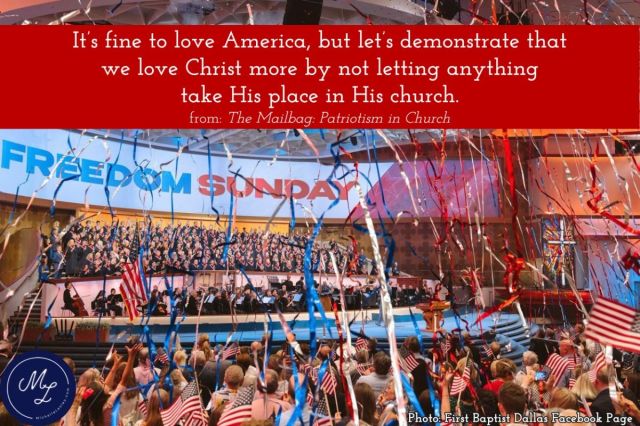
Every year on the Sunday closest to the 4th of July, our worship service turns very patriotic. All of the hymns and worship songs are replaced with patriotic songs like God Bless America, America the Beautiful, and the National Anthem. The choir and whoever is singing a solo that day sings a patriotic song. A color guard marches in with the American flag and we say the Pledge of Allegiance. Sometimes the sermon is even on a patriotic topic. It makes me uncomfortable because I think the worship service should focus on God, not America. What do you think?

Independence Day is one of my favorite holidays. I love the fireworks and picnics, the bands, and watching my favorite musical, Yankee Doodle Dandy.

I’m as red, white, and blue, rah rah America as the next guy, but there’s a time and a place for all that, and the Sunday morning worship hour isn’t it. You’re correct. The worship service is exactly that: worship and service. And who are Christians supposed to worship and serve when we go to church? God.

We are to sing to, and about, God. The pastor is to preach the Word of God. We pledge our allegiance in prayer, worship, and confession to God. Our thoughts are to be focused on God. Every element of the worship service – songs, symbols, readings, offerings, prayer, praise, everything – is to draw our attention to God. He is the only One worthy of our worship.

Patriotic songs, the Pledge, and all of those other things can take the focus off God and put it on something lesser. Sometimes God gets pushed aside in favor of what we want to focus on. That’s a very man-centered attitude in the very place and time when everything is supposed to be centered on God.

And really, if you think about the main reason America was founded – freedom of worship – what better way is there to honor our forefathers and celebrate the gift of freedom God has given us than to exercise our First Amendment right to worship God? Certainly, we could use the 4th of July as a reminder to take some time in corporate prayer to express gratitude to God for our country and our liberties and to pray for our country. Scripture tells us to present our requests to God with thanksgiving. We could also dedicate some time to praying for our governmental officials as 1 Timothy 2:1-4 instructs us to do. There’s a biblical, worshipful way to be thankful for the freedoms God has blessed us with and intercede for our country and our governing authorities. And it shouldn’t be limited to one Sunday a year.

But when it comes to patriotic hoopla, we can set aside another time for that and still celebrate with our brothers and sisters in Christ. If your church family wants to celebrate America’s birthday together, that’s great! Have a church-wide cookout on the 4th. Schedule an Independence Day patriotic sing-along or choir pageant. Meet up and head out to the county fireworks show together. Fellowship! Have fun!

But when it’s time to worship, let’s make sure we’re reserving that time for worship of the King of Kings and Lord of Lords. It’s fine to love America, but let’s demonstrate that we love Christ more by not letting anything take His place in His church.

It’s fine to love America, but let’s demonstrate that we love Christ more by not letting anything take His place in His church.

photo source

If you have a question about: a Bible passage, an aspect of theology, a current issue in Christianity, or how to biblically handle a family, life, or church situation, comment below (Iโ€™ll hold all questions in queue {unpublished} for a future edition of The Mailbag) or send me an e-mail or private message. If your question is chosen for publication, your anonymity will be protected.