Christian women, Church, Discernment

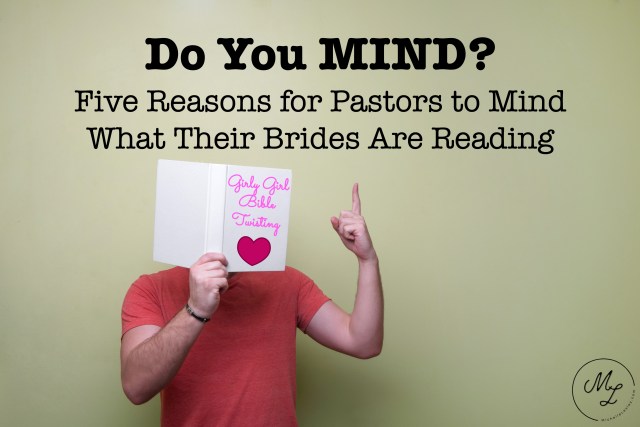
Throwback Thursday ~ Do You MIND? : Five Reasons for Pastors to Mind What Their Brides Are Reading

Originally published May 27, 2016

A while back, my husband and I were driving down the road on the way to the store discussing various aspects of ministry. At some point the conversation turned to a pastor with whom we were both vaguely familiar. Neither of us knew much about him, so we decided to look him up on Facebook to see if we could get a better handle on where he was coming from, theologically. Aside from a couple of mildly iffy posts that it wasn’t a stretch to extend the benefit of the doubt about, it didn’t seem as though there were any major doctrinal red flags. He just seemed like your average, Bible believing pastor who needed to brush up a little on his discernment. (Hey, who doesn’t, right?)

I was actually more interested in the pastor’s wife and what kind of ministries she was involved in that I might also like, so I clicked over to her page. I was pretty disappointed by what I saw. She had posted materials from several major false teachers- the female equivalents of people from Joel Osteen all the way down to Benny Hinn.

I remarked to my husband that I thought there might be some concerns about this pastor’s theology if he was OK with his wife following and sharing materials from high profile false teachers. And my husband gently reminded me that wasn’t necessarily the case:

“He probably doesn’t even know those women are false teachers.”

My husband went on to say that he wouldn’t have known that people like Beth Moore and Joyce Meyer are false teachers if I hadn’t done the research and filled him in. Not because he doesn’t care whether or not I read sound doctrine, but because pastors and Christian men in general don’t often pick up and read books written for Christian women to examine the theology we’re feeding on.

Until the last few decades, they haven’t always needed to. If your wife went shopping and came home with a book from LifeWay, it never crossed your mind to question whether or not it was biblical. It was LifeWay for heaven’s sake. LifeWay is run by pastors and theologians with years of experience and doctoral degrees from seminary. Of course it was biblical.

Well not any more, it isn’t. The majority (and that’s not an exaggeration) of the “Bible” studies and other materials marketed to Christian women by Christian retailers are authored by false teachers.

what rose reads_kindlephoto-19662398

Pastors, on behalf of Christian women everywhere, I plead with you: check out the theology of the authors and bloggers (including me) your wife is reading and the Christian personalities she follows and shares on social media. Please thoroughly vet the materials your Sunday School/small group/Bible study classes and women’s ministry are using. Find out about the speakers headlining the women’s conference or simulcast your ladies are attending. Make sure guest speakers appearing at your church’s women’s event teach sound doctrine.

Why?

It’s not my place to instruct you (and I’m sure you already know, anyway) in what the Scriptures say about being the spiritual leader of your family, responsible for its theological health or your obligations as a pastor to guard your church against false doctrine. I’ll leave that to godly men, fellow pastors, theologians, etc. What I’d like to do is to offer you some practical insights (in no particular order) from the pink side of the pew that you might find to be helpful tools as you think about and pray through how to handle vetting the teachers your wife or church ladies follow:

1. Your wife’s decision to follow false teachers could cost you a job. There are women out there like me who are familiar with the “twisted sisters” your wife is sharing on social media. If I could wrongly make assumptions about the theology of the aforementioned pastor based solely on his wife’s Facebook activity (because wives can be a reflection of their husbands’ spiritual leadership), others could do the same – maybe even those on a pulpit search committee – and that could impact your search for a pastoral position.

2. You don’t want to shoot yourself in the foot. A pastor’s wife can have a huge influence on her church. She is often the one teaching the women’s Bible study or heading up the women’s ministry, and even if she doesn’t, her input on curricula, guest speakers for women’s events, etc., is usually seen by the women of your church as carrying the weight of your approval or preferences. If you’re up in the pulpit preaching sound doctrine every week while your wife or women’s leader is importing false doctrine into the women’s ministry, it’s like bailing water out of a boat with a hole in the hull.

3. Your wife or (women’s ministry leader) may be chasing off spiritually healthy church members. (If you’ve stuck with me thus far, what follows is unlikely to describe your wife, but I’m going to go ahead and throw it out there for awareness’ sake.) I have heard the following prototypical scenario from dozens of Christian women (and experienced it myself):

“My pastor’s wife is in charge of our church’s women’s ministry, and is a big Beth Moore fan. We only do Beth Moore studies in our small groups, and last year our church hosted a Beth Moore simulcast. I participated in a couple of the studies, but they just seemed “off” biblically, so I started doing some research.

I discovered Beth Moore was teaching false doctrine, preaching to men, partnering with false teachers, and doing other unbiblical things. I went to the pastor’s wife and very kindly, humbly, and patiently showed her the scriptural evidence of Beth Moore’s false teaching. I couldn’t believe it when she flew into a rage, screamed at me, and accused me of trying to create disunity in the church! My husband and I tried to talk to the pastor about it, but he seemed completely unaware of what goes on in the women’s ministry or any problems with Beth Moore, and backed up his wife. We are now looking for a new church.”

This is not an exaggeration or isolated case. I don’t know what it is about Beth Moore’s disciples, but they (especially the ones who are pastors’ wives) seem to be some of the most vicious defenders of false teachers out there. And if your wife or women’s ministry leader acts like this it could cost you godly, spiritually mature church members.

4. Your children’s spiritual lives are at stake, both at home and at church. As with any dad who works long hours, your wife probably has more of an influence in the moment to moment aspects of your children’s lives than you do, even when it comes to training them in godliness. If her spiritual diet consists of false teaching, that’s what is being imparted to your children on a daily basis.

The same goes for the children at your church. The majority of children’s Sunday School teachers and children’s ministry workers are women. The false doctrine these women consume today will be taught to the children of your church on Sunday.

5. When women are spiritually healthy, the whole family benefits. Statistically, women make up about 60% of church attenders, and, of course, 50% of a marriage. That is an enormous influence on your own family and your church family. You want those women spiritually healthy. It’s not only biblical and good for them personally, but everyone they influence and interact with benefits.

When women are taught sound doctrine, they grow to Christlike maturity. They exhibit the fruit of the Spirit. They want to share the gospel. They walk in humility, patience, love, repentance, forgiveness, and biblical submission. They encourage their husbands toward godliness. And you know what else they do?

They teach other women to do the same. They train up children who are godly. They’re self-replicating.

Spiritually healthy, mature, godly women make your life easier, more peaceful, and more of a joy, both at home and at church, because they’re working with you, not against you.

But your wife and the women of your church are not going to get the pure milk of the Word they need to grow in Christlikeness from the pantheon of divangelistas lining the shelves of your local Christian bookstore. And most of those precious ladies you shepherd are completely unaware of that fact. So they need your help, Pastor. Your bride, and the Bride, desperately need you to mind what they’re reading.

Christmas, Church

Give a Church for Christmas

This Christmas season, I’d like to offer you an opportunity to help me give our brothers and sisters in Christ a gift – a gift that won’t cost you a dime.

If you’ve followed me for a while, you know I’m passionate about helping people find doctrinally sound churches to join. I’ve recently been updating my list of Reader Recommended Churches, but we can always use more recommendations for doctrinally sound churches, especially in the states that don’t have very many recommendations and in countries outside the United States. I’ve made the list, you check it twice. If recommendations are naught, be nice and make one! :0)

Please read this part…

Please read the guidelines here for submitting a church for consideration. If you have a personal connection to a solid church that’s not on the list, or if you have a recommendation for a doctrinally sound church search engine or church planting organization that’s not listed here, comment below with:

🎄The full, correctly spelled name of the church (or church search engine / planting org.)
🎄The city and state, or city and country it’s located in
🎄The church’s (or church search engine’s / planting org’s.) website. Churches and search engines / planting orgs. submitted without a website will not be considered.

Folks, I truly appreciate your recommendations, but PLEASE click the links above to see if your church or church search engine is already on the list. About a third of the recommendations I’ve received so far are already on the list, and it takes time to weed those out.

How many churches can we add to the list? Let’s add a bunch and make it a merry Christmas for our brothers and sisters who are searching for a new church! Thanks for your help!

(Just a reminder – as it says above the comment box, I handle all comments manually, so your comment will not appear immediately. When I add (or decline to add) your church to the list, I’ll post your comment.)

Christian women, Church

The 5 Church Ladies You Don’t Want to Be

Originally published September 21, 2018

It’s just as easy to fall into a ditch on the right side of the road as it is to fall into a ditch on the left side of the road.

The longer I walk with the Lord, the more I see how true this is in the Christian life. We can be legalistic or antinomian. Crushed by guilt over our sin, or hard-hearted about our sin. Extending too much grace to unrepentant sinners, or not extending enough grace to repentant sinners.

Abandoning the church altogether, or taking ownership of the church and using it for our own purposes.

The purpose of the local church is to glorify God through worship and discipling the saints. Proper, biblical church membership is not optional for Christians. It is not to be treated as unnecessary by “Lone Ranger” Christians, nor is it to be used as a means toward our own ends. We are to be faithful, invested church members, but we’re to do so in a humble, loving, serving, “others first” way.

I’ve talked about the “left ditch” of abandoning the church:

Basic Training: 7 Reasons Church is Not Optional and Non-Negotiable for Christians

Six Ways Not to Forsake the Assembly

You Don’t Need the Internet, You Need a Pastor

Today, let’s talk about avoiding the “right ditch” of doing church the wrong way. Here are five church ladies who use the church for their own purposes- to build their own little empires, to impress others, or to make themselves feel better. Church ladies you don’t want to be, and the Scriptures they need to embrace and obey:

Part-time Paula– Paula is involved in lots of different pursuits: travel, hobbies, volunteer work, her kids’ sports/activities/clubs, social events, political events, family gatherings, civic projects…and church is just one more activity on the list. And it’s not even at the top of the list. Paula comes to church when she has time, when she feels like it, and when church doesn’t conflict with one of her other activities, but she doesn’t have any leftover time, energy, or desire to get plugged in, commit to a place of service, or fellowship with her brothers and sisters in Christ. Paula keeps just enough of a foot in the door at church to assuage any guilt she would feel for quitting altogether, or to be able to keep it on her “resume” of activities to impress others.

Paula’s Scripture: And let us consider how to stir up one another to love and good works, not neglecting to meet together, as is the habit of some, but encouraging one another, and all the more as you see the Day drawing near. Hebrews 10:24-25

Screechy Sheila– Sheila knows how this church ought to be run: her way. And if you step out of line – not with Scripture, but with her personal preferences and methods – she’ll let you know. Sometimes she’s loud and vehement. Sometimes she’s quiet and threatening. Sometimes she’s nicey-nice and just educates you on the “right” way to handle things. But you’d better get with the program – her program – or else. Sheila uses the church as a platform for being bossy and exercising control.

Sheila’s Scripture: Do nothing from selfish ambition or conceit, but in humility count others more significant than yourselves. Let each of you look not only to his own interests, but also to the interests of others.
Philippians 2:3-4

Cotton Candy– Forget the meat and potatoes of church – sound doctrine and theology, studying the Bible, serving others, and giving sacrificially – Candy is only there for the fluff. She’ll be there for every fellowship, day trip, and fun-filled women’s ministry event, but she wants her “sermons” chock-full of jokes and stories, and her “Bible” studies to be positive, encouraging, self-esteem builders. Candy uses the church as entertainment or to make herself feel good.

Candy’s Scripture: But I, brothers, could not address you as spiritual people, but as people of the flesh, as infants in Christ. I fed you with milk, not solid food, for you were not ready for it. And even now you are not yet ready, for you are still of the flesh. 1 Corinthians 3:1-3a

Que Será Katie– Katie is a founding member of this church, doggone it, and she’s not going anywhere. Some Katies have been known to say to their less-favorite pastors, “I’ve been here for fifty years, and I’ll be here long after you’re gone.”. Others are more placid, unfazed by unbiblical pastors, faulty doctrine, or spiritually unhealthy practices in the church. They just go with the flow. There’s a lot to be said for a faithful church member who doesn’t cut and run at the least little problem and works hard to help the church become healthier. But that’s not why Katie sticks around. There are biblical reasons Katie should have left this church in the past, but her friends are here, her memories are here, she’s comfortable in these surroundings, and those things are more important to her than whether or not the church is operating biblically. So she stays, loving the church for sentimental reasons.

Katie’s Scripture: Christ loved the church and gave himself up for her, that he might sanctify her, having cleansed her by the washing of water with the word, so that he might present the church to himself in splendor, without spot or wrinkle or any such thing, that she might be holy and without blemish. Ephesians 5:25b-27

Ulterior-Motive Ursula– Ursula has an agenda and the church seems like a convenient gathering of good-hearted people to use for reaching her goal. Maybe she needs volunteers for a community project. Or she’s trying to get out the vote for the candidate she’s campaigning for. Or she needs a client base for multi-level marketing. Or she’s trying to become the next American Idol and needs a pre-fab audience. Whatever the end game, coming to church where a crowd of people is already assembled is easier than staging a rally or phone-blitzing or setting up a free concert. Maybe Ursula is a faithful member of the church. Maybe she isn’t. But she’s using the church to further her own goals.

Ursula’s Scripture: And Jesus entered the temple and drove out all who sold and bought in the temple, and he overturned the tables of the money-changers and the seats of those who sold pigeons. He said to them, “It is written, ‘My house shall be called a house of prayer,’ but you make it a den of robbers.” Matthew 21:12-13


The purpose of the local church is not to salve our emotional wounds, or to fill a void in our lives, or to further our own agenda. The purpose of the church is to focus our attention on Christ – how He gave His life for us, forgave us, and made us His disciples. It’s where we come together to praise Him, honor Him, worship Him, serve Him, serve our brothers and sisters, and get equipped in His Word. We’ve probably all been guilty of being Paula, Sheila, Candy, Katie, or Ursula at times. I know I have. But let’s strive to be the godly women at church – and everywhere else – Christ commands us to be.

Bible Study, Church

Throwback Thursday ~ 4 Ways We’re Getting Women’s Discipleship Wrong, and How We Can Get it Right!

Originally published November 2, 2018

In the days leading up to Wednesday’s observance of Reformation Day, I directed your attention, in part, to the brave and godly women who played a part in the Protestant Reformation. A few days ago, I shared this post on my Facebook page…

…and asked:

Is the women’s Bible study you’re attending preparing you for something like this?

Of course, when I say, “something like this,” I don’t mean only being executed for your faith. I mean something hard. Life-shattering. Devastating. The loss of your spouse. A stillbirth. Your adult child choosing the prodigal life. A terminal diagnosis. Losing your business or your job because you won’t compromise on Scripture.

And it isn’t just the big, life-altering things, either. What about “smaller” issues like humility, serving without resentment, gratitude, glorifying God instead of self, submitting to your husband, patience, and prioritizing your time in a godly way? What about daily life in general?

Praise God, many women can truthfully answer, “Yes,” to my question. Their churches are training them in the Scriptures and discipling them well so that they can face big or small issues in a godly, biblical way.

But if the best sellers shelf at LifeWay is anything to go by, far more women would have to answer, “No.” Something is wrong in women’s discipleship in the vast majority of evangelical churches. I see the product it creates every day: women who run their lives by their feelings instead of the Word of God, women who believe their own opinions and experiences over Scripture, women who attend every study, every simulcast, every conference, every women’s ministry activity, yet whose lives are devoid of the Fruit of the Spirit.

Our churches have far too many weak women, burdened with sins and led astray by various passions, always learning and never able to arrive at a knowledge of the truth. (2 Timothy 3:6b-7)

And if you’re consistently getting a defective product, you’ve got to trace the problem back down the manufacturing line to find out what’s wrong and fix it so your product won’t be defective any more.

So what’s going wrong on our discipleship assembly line, and what can we do to fix it?

1.
We’re creating false converts instead of true Believers

This is the main reason we see women who can’t or won’t deal with life’s issues – big or small – in a biblical way. They can’t because they’ve never been truly saved, despite what they may claim. And the reason many of them think they’re saved – because they’ve prayed a prayer, walked an aisle, or made a commitment to…something – is that their churches have not taught them the biblical gospel.

The biblical gospel is not “Jesus is a nice accessory to add to your life to make it prettier, like a new purse or bracelet,” or “Jesus will heal you, give you the money you need, or do cool signs and wonders for you,” or “Jesus will help you accomplish your dreams,” or “You’re worthy. You’re enough. Jesus loves you.”

The biblical gospel is raw and startling and offensive: You’re not worthy because you’ve offended a holy God with your sin and rebellion. You deserve death and Hell for your crimes against the King, and there’s nothing you can do to assuage His wrath against you. It is right and good for you to feel guilty and hopeless about that. But because God is good, and worthy, and kind, and merciful, He, in the person of Jesus Christ, took the wrath and punishment you so richly deserve by suffering humiliation and dying on the cross. He endured all of that so you wouldn’t have to. Then He rose again to conquer death so you could live. So He could give you the gift of repentance and faith and credit His righteousness to your account to forgive your sin and make you right with God. You’re not enough. Jesus is enough. And praise God for that!

The Fix:

We need our pastors and teachers to fearlessly and unashamedly proclaim the hard edges of the gospel. We need to train church members to share the gospel correctly. We need to stop reassuring people living in unrepentant sin that they’re saved. If it walks like an unsaved duck and quacks like an unsaved duck, it’s most likely an unsaved duck. And that duck needs to examine herself against Scripture, maybe with the help of a mature sister in Christ, to find out where she stands with the Lord.

Basic Training: The Gospel

Am I Really Saved?: A First John Check Up

2.
We’re dealing drugs instead of fostering joy

If you look out across the landscape of evangelicalism today, you’ll notice the dynamic between women’s ministry and Christian woman bears an eerie resemblance to the dynamic between drug dealer and addict.

Women are hurting or bored or discontent or unsaved, so they bounce from women’s Bible study to women’s ministry activity to women’s fellowship to women’s retreat to get their next hit of Christianese-laced dopamine so they’ll feel better and maybe get a little escape from their circumstances. And Christian retailers, conferences, and often even local churches are right there to peddle the latest designer drug to women who can’t get enough.

Now, don’t get me wrong. There’s nothing intrinsically bad about any of those activities. In fact, assuming they’re doctrinally sound, they can all be very good things! But if we’re using the emotional high we get from them as a substitute for biblical joy, or if we think those things are the source of joy because that’s the dime bag we’re being sold, that’s spiritually pathological.

The Fix:

Real, biblical, satiating joy doesn’t come from an outward activity. It comes from the inner working, shaping, and sanctification of the Holy Spirit – a concept we’ve got to get across to Christian women. Joy comes from gazing at Creation, the cross, the communion of the saints, and remembering – celebrating – all Christ has done, and will continue to do, for us and in us. Joy comes from repentance and forgiveness from sin. Joy comes from worshiping in spirit and in truth. Joy comes from unity with the brethren. Joy isn’t a temporary injection of happiness, it’s a congenital spiritual trait.

3.
We’re parking women in evangelical daycare
instead of giving them spiritual mothers

In most churches, “women’s discipleship” means the church has purchased a divangelista’s DVD and workbook package, and provided a room set up with chairs, a DVD player and monitor, and a woman to “facilitate” the class. It’s the spiritual equivalent of glorified babysitting. The kids might have some fun, be entertained, and enjoy spending time with their friends, but it’s not the same thing as having a mom.

Mom tucks you in at night. Mom listens to your stories. Mom makes you eat your vegetables. Mom kisses your bo-bos. Mom disciplines you when you’ve disobeyed. Mom pours her life into you. Mom is there.

That Christian celebrity on the screen doesn’t even know the women of your church exist. She doesn’t know their names. She can’t comfort them when they’re sad or rejoice with them in their blessings or advise them when they need counsel. And yet, by continually feeding women a diet of celebrity studies, we teach them to idolize and become disciples of this woman they’ll never meet. They’ll never watch her serve in their church. They’ll never observe her walk through trials. They’ll never be able to pour their heart out to her over a cup of coffee or feel her arms in a warm embrace.

Christian women don’t need evangelical daycare, they need spiritual moms.

The Fix:

I know this is going to sound like a bombshell to a lot of people, but you can have a strong, healthy, thriving women’s discipleship ecology in your church without ever setting foot in a Christian bookstore. Without DVDs. Without curricula and workbooks. Because women’s discipleship isn’t about parking them in front of a TV and hoping they get something out of it.

What we need is older women who are trained to teach the Bible and show other women how to study it on their own. Real life, flesh and blood, in-your-own-church spiritual moms who don’t have perfect hair and makeup and designer clothes or sparkle with charisma. Women with a few miles on them who know what it’s like to be broke or have a rebellious child or battle cancer or fight for their marriage, and can walk day by day with other women through their trials. Women who are spiritually mature and can set an example for their spiritual daughters of repentance, evangelism, servanthood, humility, prayer, and kindness. You know, the kind of women Titus 2:3-5 talks about?

McBible Study and the Famine of God’s Word

Women and False Teachers: Why Men Don’t Get It, and Why It’s Imperative That They Do

4.
We’re teaching idolatry of self
instead of slavery to Christ

I don’t agree with that.” “That’s just your interpretation.” “That teacher you’re calling a heretic has helped me so much!” “I don’t care what the Bible says, I like/dislike ___.”

IIIMememe. Sometimes it’s because they’re false converts. Sometimes it’s because that’s what the divangelista on the DVD is teaching them. Often, it’s a combination of both. Somewhere down the assembly line, we’re ratcheting up women’s self-esteem with how wonderful they are, that they’re God’s masterpiece, His princess, the pinnacle of awesomeness. By making them disciples of the celebrity they’re watching on the screen, we teach them to value worldly success and fame rather than humility, suffering, and serving. We appeal to women’s fleshly emotions, coddle their self-centered feelings, and in a total misunderstanding of Christian unity, validate their unbiblical opinions and experiences to make sure there’s no controversy or hurt feelings. Is it any wonder we have an abundance of Christian women for whom self reigns supreme? Who think their truth is the truth?

The Fix:

It’s totally natural for self to sit on the throne of an unsaved woman’s heart. If that’s the cause of her self-idolatry, the only solution is the gospel and God opening her heart to receive it.

But we’re doing genuinely regenerated Christian women no favors when we inundate them with homages to self. We already love ourselves too much. We don’t need the church encouraging that, we need the church to help us fight that. And the number one way the church can do that is to stop being afraid.

Stop being afraid of controversy. Stop being afraid to call the names of false teachers who are harming women. Stop being afraid to call sin, sin. Stop being afraid of hurting women’s feelings with biblical truth. Stop being afraid to correct unbiblical theology and opinions. Stop being afraid of an unscriptural definition of disunity and learn what good Christian factions are. Stop being afraid. Fear is not a Fruit of the Spirit nor an appropriate attribute of the church.

Teach women the biblical construct of being slaves of Christ, their good, kind, and merciful Master. Teach them that they are not entitled to any opinions other than their Master’s. They may not hold beliefs contrary to their Master’s Word. They may not think, feel, speak, or act in ways that displease their Master. They are to obey all that their Master has commanded them in His Word. He is the Master. He calls the shots. We are the slaves. We obey.

Basic Training: The Bible is Our Authority

Bad Fruit, Diseased Trees, and the Authority of God’s Word


There are so many ways we’re getting women’s discipleship wrong. These four points are just the tip of the proverbial ice berg. We’ve made women’s discipleship a pretty, pink tea party instead of the hard, bloody, call to die that it actually is.

Why aren’t supposedly Christian women prepared to die for Christ? We haven’t prepared them to live for Christ.

And yet…we can! There is hope! We can fearlessly teach women the whole gospel, the whole counsel of God. We can rehab spiritual euphoria addicts and reorient them to biblical joy. We can ditch the DVDs and divangelistas and give women the Christian mothers in their local churches whom they so desperately need. We can devalue self-idolatry and shape and sharpen slaves of Christ.

We can. And it’s guaranteed to work, too. All we have to do is start trusting and obeying God’s Word over man’s methods, and we’ll be getting women’s discipleship right.

Church, Mailbag

The Mailbag: How can I tell if a church is doctrinally sound?

Originally published March 11, 2019


How do I know if a church is doctrinally sound? Do I base it off their statement of faith?

This is such a great question in a day when you can’t really trust that a building with the word “church” on the sign out front actually teaches and practices sound doctrine.

Because it would be impossible to cover every single aspect of doctrine that churches need to handle biblically, and because many of my readers are new to some of the deeper points of theology, what I want to do is give you some “signposts” to look for as you’re checking out a new church that will help indicate whether or not that particular church is likely to be one that handles those harder to understand points of theology in a doctrinally sound way.

First, check out these resources (and others) under my Searching for a new church? tab in the blue menu bar at the top of this page. These should be helpful if you’re unfamiliar with the biblical issues that a church should be handling correctly:

Looking for a Church Home? by Tim Challies

Church shopping? 35 Key Questions to Ask the Church at Berean Research

4 Questions to Ask Before Joining a Church by Brian Croft

How Can I Find a Good Church? 

Finding a New Church: Starting from Scratch

Six Questions for a Potential Church

If you are a brand new Christian and you aren’t sure what the answers to the questions in these articles should be, ask the person who led you to Christ, a pastor you know to be biblically trustworthy, or a friend who’s a mature Christian to help. You can also use the search bar at the top of this page to see if I’ve addressed your question. And, make liberal use of Got Questions? It’s a wonderful website that gives simple, biblical answers to all kinds of questions about the Bible, church, theology and other issues.

A church’s stance on many of these theological issues can be found in their statement of faith, which most churches post on their websites (often under the heading “What We Believe,” “Doctrinal Distinctives,” or something similar). While you’re on the church website, here are some other things to look for that can give you a fuller picture of whether or not the church is likely to be doctrinally sound.

⛪ Be wary of a church with no statement of faith on their website at all, and be cautious if they have a very simplistic statement of faith with few or no Bible verses cited to support it. Generally speaking, in my experience, the longer and more detailed a statement of faith is, and the more Scripture references it has, the more likely it is to be a doctrinally sound church. (Here and here are some typical, good statements of faith, and this one is particularly detailed.)

⛪ A few things to look for in the statement of faith:

•The Trinity: You’re looking for language along the lines of, “We believe in one God in three persons.” If you see three “modes” or three “manifestations,” that’s the language of modalism, and it is not a doctrinally sound church.

•Some churches have a section of their statement of faith on spiritual gifts or the Holy Spirit and include wording indicating whether they are a continuationist (ex: “we believe all the spiritual gifts are in operation in the church today”) or cessationist (ex: “we believe supernatural gifts such as healing and tongues have ceased”) church. Generally speaking, a church is more likely to be doctrinally sound if it holds the cessationist view. (No, I am not saying every continuationist church is heretical. I’m strictly talking probabilities here.) If there is anything in the statement of faith that indicates that a Believer will or must speak in tongues in order to be saved or as a result of salvation, or that the “baptism of the Holy Spirit” occurs separately from salvation, it is not a doctrinally sound church.

•Some churches intentionally indicate that they are complementarian in the “Marriage and Family” or “Church Leadership” section of their statement of faith by stating that the husband leads the family and the wife submits to her husband, or by explaining that the roles of pastor and elder are limited to men. It’s usually a good sign when a church makes a point of saying these things.

⛪ If you find the pastor’s name listed here, it’s not a doctrinally sound church.

⛪ If a church subscribes to a creed/confession/catechism you know to be biblical (ex: 1689 London Baptist, Westminster, Heidelberg, etc.) there’s a better chance they’re a doctrinally sound church. 

⛪ Some churches have a page on their website where they recommend books, blogs, and other resources. If they’re recommending doctrinally sound materials by trustworthy authors and teachers (click here for a few), that can be a good sign.

If they have a women’s ministry page, check out who’s speaking at the next conference they’re going to and who is the author of the Bible study materials they use.

⛪ Check the staff page and make sure they don’t have women serving as pastors/elders. (Be aware that some churches are now using titles like “Coach,” “Director,” “Facilitator,” etc. to disguise the fact that women are serving in unbiblical positions of leadership. Regardless of the way the position title is worded, women are not to serve in pastoral or elder offices or in any position in which they will be teaching or exercising authority over men.)

⛪ Check the sermon archives for a couple of things: 1) to see if they invite women or false teachers as guest preachers, and 2) does the pastor preach mainly expositorily or topically?

Keep in mind, however, that there are lots of churches out there who look perfectly doctrinally sound “on paper” but are not practicing what their website preaches. Take a look at these statements of faith for example: Lakewood (Joel Osteen), North Point (Andy Stanley), and Bethel (New Apostolic Reformation). (You can find out more about these churches/pastors here.) On the surface, and especially to those newly saved or not very familiar with the Bible, these statements of faith look fairly decent (although…notice that no Scriptures* are listed, and they are short and/or somewhat vague), but the practices of these churches may be surprising in comparison. *(Update: Since I originally wrote this article about a year ago, Lakewood has actually beefed up their statement of faith with a few Scripture references.)

Because churches’ practices and teachings often differ – sometimes significantly – from what you see in their statement of faith, you’ll have to dig deeper in order to get a better feel for the church’s doctrine. If the website posts the audio or video of their worship services, listen to several sermons. Make an appointment to go in and talk to the pastor about what the church teaches and ask any questions you might have. And visit the church for a while before joining to see how things actually go. The most a church website can do is help you weed out the churches that are definitely bad. The website cannot tell you that a church is definitely good.

If you’re looking for a new church but you aren’t sure where to start, check the church search engines and churches recommended by my readers at the Searching for a new church? tab in the blue menu bar at the top of this page.


If you have a question about: a Bible passage, an aspect of theology, a current issue in Christianity, or how to biblically handle a family, life, or church situation, comment below (I’ll hold all questions in queue {unpublished} for a future edition of The Mailbag) or send me an e-mail or private message. If your question is chosen for publication, your anonymity will be protected.