Book Reviews, Guest Posts, Salvation

Guest Post: A Review of “From Death to Life: How Salvation Works”

If your theology pretty much matches up with mine (as outlined in the “Welcome” and “Statement of Faith” tabs) and you’d like to contribute a guest post, drop me an e-mail at MichelleLesley1@yahoo.com,
and let’s chat about it.
photo credit: Stephen J. Melniszyn

A Review of Allen S. Nelson IV’s
From Death to Life: How Salvation Works
by Katy B.

The most agonizing, frustrating experience in my ministry to women is the woman who claims to be “saved” but gives no evidence of it. No interest in talking about Jesus, no interest in holiness, reading the Bible, going to church, serving God’s people. She has a salvation testimony (often dramatic and self-glorifying) that is superficial, shallow, and devoid of any real repentance for her sin. I suspect she’s a false convert. And I find it exceptionally difficult to talk to false converts.

In From Death to Life, Pastor Allen Nelson confronts the disaster of false conversions, linking them to a false understanding of salvation: what it is, what it does, and how it works. He writes, “Ask fifteen people what it takes to be saved and it’s not out of the realm of possibility that you’ll get twenty different answers.” (Loc 173

He makes the bold statement that “there is no spiritual life in many who claim to be Christians in America.(Loc 247) He calls them the “walking dead”.

How does that happen? What would cause a person to wrongly believe he or she is a Christian? He lays some of the responsibility at the feet of churches that use methods such as external manipulation, diluted gospel presentations, the altar call, and the sinner’s prayer to lead the walking dead to their false professions of faith and their false assurances of salvation. He blisters easy-believism practices that, even if well-intentioned, have done damage to churches more influenced by a fallen culture than by God’s own Word.

So how does salvation work? The author has narrowed the answer down to five main points:

1. The gospel must be proclaimed.

2. God must move.

3. The sinner must respond in faith and repentance.

4. God justifies the sinner.

5. The sinner grows in the Lord over a lifetime.

Pastor Nelson not only unpacks, but folds, hangs up, and neatly puts away each of these main points in a few short chapters. In doing so, he poses and then answers questions such as, “What is the true gospel?”, “What is biblical repentance?”, “What is saving faith?”, and “What exactly is justification?” His answers are delivered in a direct, engaging, accessible style with plenty of biblical illustrations and scriptural references. No theological dictionary needed.

The book includes “howto’s” but doesn’t read like a “howto” manual. The tone is pastoral, sometimes comfortable, sometimes convicting, but never harsh. At times, the reading felt like sitting over coffee with Pastor Nelson, asking questions about various evangelistic situations, and receiving useful advice on how to respond.

A destitute woman in a homeless shelter, eyes pallid, needle tracks running down her arms, naturally incites my heart instinct to put my arms around her, tell her Jesus loves her, and give her some money. But Pastor Nelson reminds us:

“People need to hear more than “Jesus loves you,” What they need to hear today is what they’ve always needed: to know that they are sinners, that they need a Savior, that Jesus is that Savior, and until and unless they come to Him in faith, they will justly spend an eternity facing the punishment of their sins.” (Loc 2413)

He points out that it is vital that we all (not just the “trained professionals”) know what to say when the time comes to share the gospel of Christ. And while there is no formula, it is essential that the facts of the gospel are understood. The book helpfully guides the reader in a biblical understanding of how salvation happens and presents realistic examples of responses that can be used with unbelievers/false converts in evangelistic conversations.

The chapter “Plant, Water, Trust God, Repeat” is a compelling warning to stick to a biblical approach to evangelizing the lost. (Throughout the book he gives examples of unbiblical approaches.) In this encouraging chapter, he discusses applying how salvation works in real life scenarios, acknowledging that it is not always easy. He doesn’t present himself as a superhero evangelist.

This is a serious book, but the author can also be funny. I got a laugh out of his response to the command to “ask Jesus into your heart”. His tone, however, is utterly serious when discussing repentance:

“God doesn’t beg people to repent so they can be the star player on His team. He demands repentance. He owes mankind nothing. What a fearful and insolent game we play by making repentance an optional feature to becoming a Christian, refusing to properly define it in hopes of sneaking people into the kingdom, or by flat out dismissing it altogether.” (Loc 1164)

He spends a good bit of time parked on repentance, emphasizing that biblical repentance is necessary for any person to become a Christian. He asserts, “Remorse does not equal repentance” and goes on to give what he calls the bare necessities of repentance.

Is it possible to know if a person has actually been converted? In the chapter on sanctification, the author acknowledges that while we can’t see the heart, we can use the discernment God gives us to see evidence of true conversion. He provides a practical alliteration method to assist in discerning whether or not the gospel has actually taken root in a person’s heart and the changes we would expect to see in a truly converted person.

He warns the church against haphazardly affirming people as Christians without exercising grace-filled discernment:

“Often, we claim that the problem in our churches is that too many people are immature believers when the real problem is that many we call immature, actually have no life in Christ at all. They aren’t growing because they aren’t living.” (Loc 1878)

The sanctification chapter, my favorite, thrust me to a fresh examination of my own life using his alliteration template. What evidence of salvation would others see in me? What would they discern as my motivation for life? There is plenty of self-application for the reader.

The book has three appendices. Appendix 1: The Sinner’s Prayer, Appendix 2: Acts 2 is Not an Altar Call, Appendix 3: Putting “Baptist” Back in Your Church. In these appendices, the author makes some “say whaaaat?!? observations that will rock your world if your church endorses these practices.

This is a short book. Although the print version is only 200 pages, there is nothing shallow about the content. The reader will step into a deep pool. Did I know how salvation works before I read the book? Yes. Have I been guilty of using unbiblical methods to try to bring about a conversion? Yes. I finished the book with an unanticipated, heart wrenching reorientation to the gospel as the power of God unto salvation. I bet I’m not the only reader who closed the book and repented.

I began by saying I find it exceptionally difficult to talk to false converts. What do you say to someone who believes she is saved when it is clear that she is not? Pastor Nelson is immeasurably supportive in reinforcing that “we must proclaim the gospel. Without it, people will go to hell. It’s as simple as that.” (Loc 441)

The book left me feeling hopeful, energized, looking forward to my next evangelistic encounter. God saves sinners. God saves sinners. And he uses sinners like me to do so.

Pastor Nelson writes, “Every single one of us is charged with sharing the gospel with those God providentially places in our life.” What a calling, what a staggering privilege. God could sovereignly call His own to Himself without us, but He has chosen to work through us. This book will certainly help us in our evangelism. I recommend it for everyone.

¹Katy reviewed the Kindle edition of the book and used Kindle location numbers rather than page numbers.


Allen “Cuatro” Nelson, IV, author of From Death to Life, is the pastor of Perryville Second Baptist Church in Perryville, Arkansas, and co-host of The Rural Church Podcast. Contact Him directly via Twitter to receive a free study guide with your order of From Death to Life or a discount on bulk orders. You can also order from Amazon.

Katy can’t remember when she became a Christian but is assured that, by the grace of God alone, she is a Christian. She ministers to women in her OPC church, in homeless shelters, in a prison, and sometimes at the grocery store. She is an executive with a United States health care corporation and enjoys her work, although she would rather be reading. You can find Katy on Twitter at @KatyvonBora.
ALTHOUGH I DO MY BEST TO THOROUGHLY VET THE THEOLOGY OF THOSE WHO SUBMIT GUEST POSTS, IT IS ALWAYS POSSIBLE FOR THINGS TO SLIP THROUGH THE CRACKS. PLEASE MAKE SURE ANYONE YOU FOLLOW, INCLUDING ME, RIGHTLY AND FAITHFULLY HANDLES GOD’S WORD AND HOLDS TO SOUND BIBLICAL DOCTRINE.
Book Reviews, Guest Posts

Guest Post: A Review of Jennie Allen’s “Anything: The Prayer that Unlocked My God and My Soul”

If your theology pretty much matches up with mine (as outlined in the “Welcome” and “Statement of Faith” tabs) and you’d like to contribute a guest post, drop me an e-mail at MichelleLesley1@yahoo.com,
and let’s chat about it.

A Review of Jennie Allen’s
Anything: The Prayer that Unlocked My God and My Soul

by Carol Coppens

Many years ago, when I was in the 6th grade, I was taught that when doing a book report, even if I didn’t like the book, I should try to say something good about it. That was fine teaching at the time and I think it has made me a better writer, this trying to see both sides. I’m not in school any longer though and these days, I’m bound less by trying to see the good and more to pointing out the multiple errors of books like Anything. If you’re a Jennie Allen fan, you won’t like what I have to say but I can’t stay silent.

Anything is a poorly written book. It’s an irreverent book. It’s a book that will never help any woman discover the totality of God’s plan of redemption, His sovereignty, His wrath which rests on the unregenerate, nor His holy fury at those who presume to speak for Him. This is not a book that will help you to dive deep into the character of God and to know Him better but instead, Jennie’s book is a tedious, self absorbed, experience driven, hermeneutically unsound, over-stepper of scriptural boundaries, mish-mash of emotionalism and repetitive “wrecked-ness”. Here are some of the specific faults that I see.

Even in these days of relativity, where the only rule that seems to apply is that there are to be no rules at all, there are still a few that are necessary. One of the rules of basic English grammar is, if you’re going to use an adjective (remember that word from English class?) you’d better do your homework and find out exactly what that word means, in the context in which you plan to use it.

The word reckless is used multiple times in this book. Jennie describes childlike faith as living “simply, recklessly.” On pg. 97, she writes that she and her husband, “now lay in the hands of a reckless, invisible God.” Page 143 tells of her realization that people are going to think they are foolish for adopting, saying, “that goes with almost any act of recklessness, even reckless love.” Maybe she thought the word sounded powerful and kind of daring when she penned it but the definition of reckless is “without thinking or caring about the consequences of an action.”

Describe human beings as reckless as much as you like, because we all certainly can be, but when a writer uses the word reckless to describe almighty God, that person has crossed over into blasphemy and I would shudder to think that I had written such a thing about the God I will eventually have to give an account to. Some of the other words she uses to describe God are, “unsafe”, “wildly unpredictable”, “radical”, “ridiculously radical” and she also writes that “God is still not very practical.” Exactly where are the chapters and verses for these descriptions of God, Jennie?

In many places, Jennie adds words to Scripture that are not there. Space hinders me from listing them all, so one example will have to do. On page 184, she speaks for Jesus and writes, “as if he were letting us in on the secret, Jesus whispered back to his father, this will all be worth it. Wait till they are with us and see our glory. Just wait till all of this work and suffering and pouring out is over and we are in heaven together forever. Just wait.”

This conversation is, of course, recorded nowhere in Scripture but the words “do not exceed what is written”, definitely are. Jennie would do well to read and meditate deeply on that verse in 1 Corinthians 4. When we imagine that God is speaking to us apart from Scripture, we can easily be led to enter very dangerous territory.

An example of her flawed interpretations of Scripture is on page 37. Jennie quotes Hosea 2:14-17 but then she blatantly misinterprets God’s promise to restore Israel to Himself, as a “dramatic metaphor” about those of us who chase other loves. I say, leave Biblical interpreting to those who know about these things, Jennie. If you think that you’ve been given a new interpretation of these verses that no other person has ever had before, you’re just plain wrong. God was promising restoration to Israel in these verses and nothing else.

She also does emotional and hermeneutical callisthenics with God’s call to Abraham to sacrifice Isaac (pgs. 69-70). Jennie’s theory is that God was punishing Abraham for his overwhelming love for his son that, according to her, had usurped God as Abraham’s first love. If she had thoughtfully studied these Bible passages or, if she truly understood God’s plan to ultimately save His elect, she would know that the sacrifice of Isaac and the ram God substituted for the boy, was a shadow of God’s own sacrifice of His son Jesus Christ on the cross. There is no excuse for such lazy interpretation of the sacred Scriptures. In these current times, the proliferation of false and misleading doctrine abounds. Having the correct interpretation of Scripture is of paramount importance because our eternal futures depend on understanding correctly, what God is saying to us.

On page 102, Jennie asks “so how do we actually let God change us?” Finally, I thought, a good solid question after having read page after page of drivel. Can an explanation of justification and sanctification be far behind? Sadly, they weren’t even hinted at and she goes on to tell a rather horrific (as a mother I cringed) story of telling her two oldest children to climb up a cliff and jump off! For Jennie, jumping is the key. Either “jump or crawl down” and “the more we jump and see our God come alive around us, the more we jump without fear – and the bigger the cliffs get”, she says. As the Peanuts character Charlie Brown was known to exclaim, good grief!

In the final analysis, the biggest problem I had with this book (and I slogged through it twice) was my knowing that, from the time of her “vision” in the night that Jennie feels was definitely from God, the wheels of the IF: Gatherings began to turn. For those readers who still might be unfamiliar with IF, they are para-church organization, begun by Jennie, that has no scriptural basis or authority. The gatherings happen outside of the local churches and their oversight, supposedly to accomplish something, ie. discipling women, that only churches are charged to do, in Scripture. In this case, the ends do not justify the means.

Because all the women involved in IF cannot possibly be born again, spirit filled, doctrinally sound, mature women with the spiritual gift of teaching, the possibilities for unscriptural philosophies and practices entering in to local churches, families and society at large, are enormous. I see this movement as no less than a calculated move of Satan against women, a frontal attack on the sufficiency of Scripture and a throwing off of the direct commands of God, in His Word, for both married and single women. Jennie Allen might believe that her “call” to begin IF was of God, but I do not.

So, at the end of the day, would I recommend this book to anyone? Absolutely not! What I do recommend instead is simply this – read your Bible, always praying that God will illuminate your mind with His truth. Get involved with a biblically solid church and pray for God to open doors for you to serve there. There is no substitute for a godly, biblically saturated, discerning Christian woman and one only gets that way by hard work and study. The Scriptures do not open themselves to the slothful. When a woman is mature in Christ and can properly discern truth from error then and only then it will come to pass that the writings of the Jennie Allens of this world will be seen for what they truly are, rubbish.

With a grateful nod to my 6th grade English teacher, I suppose I could say one good thing about this book and that is, that it wasn’t any longer.


Carol and her husband Mike live in a small town, on the shores of Lake Erie, in Ontario, Canada. She was 49 years old when Christ called her to be His disciple. A love for the pure truth of God’s Word fuels her passion to expose false teaching and especially that kind which has women as its primary target.


ALTHOUGH I DO MY BEST TO THOROUGHLY VET THE THEOLOGY OF THose WHO SUBMIT GUEST POSTS, IT IS ALWAYS POSSIBLE FOR THINGS TO SLIP THROUGH THE CRACKS. PLEASE MAKE SURE ANYone YOU FOLLOW, INCLUDING ME, RIGHTLY AND FAITHFULLY HANDLES GOD’S WORD AND HOLDS TO SOUND BIBLICAL DOCTRINE.
Book Reviews

A Review of Justin Peters’ “Do Not Hinder Them”

As I’ve mentioned before, solicited book reviews are not part of my regular repertoire here at the blog. In fact, for a variety of reasons, I have a policy against writing them.

But when one of your heroes in the faith asks, you make an exception. And, for me, Justin Peters is one of those heroes in the faith (even more so because I’m sure he wouldn’t want me calling him that).

I introduced Justin this way in my article, A Few MORE Good Men: 10 Doctrinally Sound Male Teachers:

Justin Peters Ministries exists to preach the Gospel of Jesus Christ to the lost and to help equip the saved to ‘speak the truth in love’ (Ephesians 4:15). Great care is taken to preach and teach God’s Word in its proper context and simply let the text speak for itself.”

The first thing I ever noticed about Justin Peters is his striking example of biblical meekness. Justin is soft-spoken and peaceable, but firm in his gospel convictions and aflame with the desire for the lost to come to salvation. You must read Justin’s testimony of coming to know Christ after years in seminary and ministry as a false convert. What Justin is perhaps best known for is his teaching and discernment ministry exposing the Word of Faith movement. It started with a trip to a faith healer as a teen to have his own cerebral palsy healed and grew into Clouds Without Water, a seminar designed to educate the church on the history, growth, and metastasization of the Word of Faith heresy.

But Justin doesn’t limit himself to discernment ministry, and his new book, Do Not Hinder Them: A Biblical Examination of Childhood Conversion, opens the door to another of his theological interests- salvation and baptism, especially as they pertain to children.

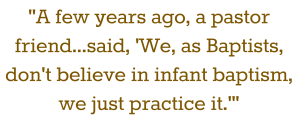
A simple, yet fundamental, point of theology which needs to be understood in order to grasp the concept of the book is the difference between credo-baptism and paedo-baptism. Credo-baptism is also called “believer’s baptism.” This means that a new believer stands before the church, professes her faith in Christ, and is then baptized out of obedience to Him- to demonstrate that she has passed from death unto life and now wishes to be identified as a follower of Christ. Credo-baptists believe strongly that baptism is only to be administered to professing believers.

Paedo-baptism is infant baptism. It is administered to all babies and children (by definition, unable to profess faith in Christ) by a number of Protestant denominations as a symbol that a child has been born into a covenant (believing) family who will raise her in the nurture and admonition of the Lord and the knowledge of the gospel.

There’s an angst that Bible believing credo-baptist parents often experience, which, undoubtedly, is foreign to paedo-baptist parents:

My young child has come to me claiming to have asked Jesus into her heart and wants to be baptized. How can I tell if she’s really saved and that it’s right for her to be baptized at this age?

It’s a long standing dilemma for Southern Baptists like Justin…and me. My mother happened to mention in passing a few years ago that I had begged to be baptized when I was about six. It made sense because that’s about the time all of my little friends were being baptized, but, I was very surprised to hear this story because, as an adult, I had no recollection of it whatsoever, and I can guarantee you I wasn’t saved at the time. My parents wisely said no.

As parents ourselves, my husband and I have faced the same struggle. Five of our six children were baptized as young children. One is not currently walking with the Lord and two of them were re-baptized later at their own request when they realized they had not been saved the first go round.

This is the central issue Justin tackles in Do Not Hinder Them.

But don’t be fooled by the title of the book. While it’s a must read for Christian parents, pastors, and those who work in children’s ministry, you also need to read this book if…

…you’ve ever wondered if you’re really saved.
…you’re wondering if that loved one (of any age) who claims to be a Christian is really saved.
…you’re a paedo-baptist wanting to get a better grip on credo-baptist beliefs and struggles
…you’re brand new to the study of theology and are looking for a resource that will easily help you to “dip a toe in the water” (so to speak)

In other words, though Justin addresses the issue of genuine conversion as it applies to children seeking baptism, the question of “How can I know if I/my loved one is really saved?” is one we all face at some point in our walk with Christ. So, while there may be a few parts of this book that don’t apply if you’re not a pastor, children’s ministry worker, or parent, most of it is helpful for every Christian.

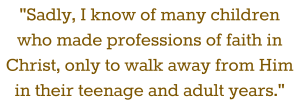
One of the foundational issues Justin cites as having gotten us into the muck and mire of baptizing unregenerate children, only to have them “walk away” from the Lord (though, indeed, they were never saved in the first place) as teens or young adults – sullying the name of Christ and His church – or to seek a second baptism once they realize they were unsaved the first time, is the fact that we have so watered down the gospel and the soteriology our churches subscribe to and practice. “Getting saved” has been reduced to parroting a sinner’s prayer, or mental assent to a simplistic set of facts that even the demons believe. There is little to no presentation of sin and rebellion, guilt before a holy God, God’s wrath toward the sinner, and the eternal punishment of sin. And when was the last time you heard a pastor urge someone contemplating following Jesus to count the cost of being His disciple? Instead, it’s, “Don’t you want to go to Heaven when you die?” or “Just believe A, B, and C, and you’re saved!” or “God loves you and has a wonderful plan for your life!” Rarely are young children mature enough in their thinking to be able to grasp the true nature and meaning of why they need a Savior and what repentance, regeneration, and discipleship really entail.

And that’s largely our fault. As Christian parents, we understandably want our children “in,” safe from an eternity in Hell. So we make it as easy as possible for them to complete the transaction. Instead of raising our children up to understand and attain to the high bar of the demands of the gospel, we lower the bar so far that even the youngest child can toddle right over it. In the end, the problem is not that we’re baptizing unsaved babes as our paedo-baptist brothers and sisters do, but that we’re presenting a false gospel that creates false converts who hang their eternity on having repeated a prayer and passed through the baptistry.

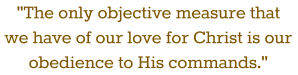
The second key issue Justin says has contributed to the epidemic of baptizing unregenerate children is the fact that we base our decision to baptize them solely on their verbal profession of faith rather than on the fruit of a changed life.

I remember all too well the worry over my own small children’s salvation in this regard. How could I tell if they were really saved or not? They had been in church and raised in a Christian home all their lives- they knew all the right answers to give when we questioned them about their salvation experiences.

As Justin wisely points out, this is often the case with “church kids.” They know how to repeat back what they’ve learned in Sunday School, and, because they’ve been raised in a godly atmosphere, they’re likely already good kids, outwardly behaving in what looks like a Christlike way. When they come to us and say, “I’ve asked Jesus into my heart,” how can we tell if it’s genuine saving faith?

Most of the time, the answer is- we can’t. Until, that is, that faith has been tested and their testimony proven true through the refining process of trial, temptation, and persecution. Until he is able to bear fruit in keeping with the repentance he claims. Does your child freely choose obedience to Christ over giving in to temptation? Does he cling to Christ during times of difficulty? Does he visibly stand for Christ when ridiculed for doing so by his peers? What five year old even faces such situations?

And that’s precisely Justin’s point. We rush our children through the baptismal waters as soon as they claim to have received Christ rather than waiting to see their faith prove out over the ensuing years. Your five year won’t face the temptation to use drugs or engage in sex. But your teenager will. It’s unlikely a gang of kindergartners will surround your child and mock his belief in Christ and biblical values. Sophomores and juniors do so gleefully. How does your young adult, who claims to be born again, handle these types of situations? When it’s his choice, not yours, does he consistently and unrepentantly go along with the worldly crowd or does he bear up and walk faithfully with Christ? Justin suggests, and I can’t help but agree, that the testing of our children’s faith that comes with age and independence, and the fruits of Christlikeness they bear – such as: godly sorrow over sin, personal holiness, hunger for the Word, and increasing discernment –  are a much more reliable barometer of their spiritual state than the “right answers” they are able to give as small children. It is for this reason that Justin suggests postponing baptism until the late teens or early 20s, while encouraging and nurturing our children’s faith as they grow and mature.

Do Not Hinder Them so effectively addresses these matters of concern to the church that I unhesitatingly recommend it to all Christians. Justin writes in a simple, unassuming style that even the newest believer would be comfortable with, and explains complicated theological terms and issues with ease. The book is chock full of helpful footnotes rife with Scripture references and supplementary resources, and is only 112 pages long, making it an easy evening’s read. Do Not Hinder Them is available in soft cover format (not available in e-book format at this time) and is endorsed by Dr. John MacArthur. You can purchase a copy at Justin’s web site or on Amazon.


All brown “pull quotes” in this article are taken from:
Peters, Justin. Do Not Hinder Them: A Biblical Examination of Childhood Conversion. Justin Peters Ministries, 2017.

Book Reviews, Guest Posts

Guest Post: A Review of “Wait and See”

If your theology pretty much matches up with mine (as outlined in the “Welcome” and “Statement of Faith” tabs) and you’d like to contribute a guest post, drop me an e-mail at MichelleLesley1@yahoo.com,
and let’s chat about it.

A Review of Wait and See by Wendy Pope

by Kirstin


The Author

Wendy Pope writes that she was minding her business in the early 2000s when God called her to teach the Bible and be active in women’s ministry. She then attended a She Speaks conference hosted by Proverbs 31 Ministries, and God confirmed her calling in “ways only God could arrange.”

For weeks after the She Speaks conference, Pope “lived and breathed nothing but bio sheets, messages, headshots, and marketing.” Her related expenses went over her family’s budget. But there was no demand for her as a speaker, and she ended up working for 12 years at the offices of Proverbs 31 Ministries (“God moved me to an office chair in a gray cubicle . . .). She served in her church and honed her writing skills. Today she is on the team of speakers at Proverbs 31 Ministries.

Wait and See: Finding Peace in God’s Pauses and Plans

The publisher’s overview of Wait and See states, “Every woman struggles with times of waiting – for a spouse, a child, a job. In Wait and See, Wendy Pope guides readers to focus on the person of their faith rather than the object of their wait. Pope draws on the story of King David, who was anointed king nearly twenty years before he took his throne.”

Pope seems to have written this book for the same audience of “Jesus girls” that has made Lysa TerKeurst of Proverbs 31 Ministries a popular author and speaker. Her writing style is informal and confidential, and the book is sprinkled with statements like these: “This is stinkin’ thinkin’, and it has got to go!” and, “Instead of the depressing turning dramatic, she was determined to find laughter in the yuck, and, “Whoa! I just blew my own mind.”

The book includes stories of seasons of waiting in the lives of ordinary Christians, including Pope and her family, and questions for reflection. Each chapter concludes with a “Digging Deeper with David” section based on a Davidic psalm. Pope writes, “David is an excellent example of how to prepare while we wait for what God has planned for our lives.”

Proverbs 31 Ministries offered an online Bible study based on the book in 2016. Dozens of readers have posted five-star reviews of Wait and See on Amazon and Goodreads. The book is encouraging, and its “bloom where you’re planted” message is good.

For me, however, the Bible exposition in Wait and See was unhelpful. Pope quotes from nine Bible translations, including The Message. Like TerKeurst and Beth Moore, she sometimes explains a verse by choosing a particular word in it, stating the word in the original language, and then stating its dictionary definition. In one instance, she simply writes, “Fret is the Hebrew word charah.” So what?

In addition, Pope seems to expect believers to hear from God apart from the Bible. Throughout Wait and See, she refers to the Holy Spirit calling, confirming, leading, nudging, prompting, tugging on the heart, and whispering in a still, small voice in the present day. She writes that young David “spent his days learning to recognize and obey God’s voice, two traits that would serve him greatly as king.” But where does the Bible state or even imply that David had to learn to recognize God’s voice? At the same time, Pope seems to be saying that personal revelation from God cannot be misunderstood. “I must not have heard God correctly” is “Misconception #1,” she writes.

Unfortunately, one of my main takeaways from Wait and See was that an unknown number of women are desperate to become famous Christian speakers and authors, the next Beth Moore or Lysa TerKeurst. “I believed saying yes to God would put me center stage in an arena filled with thousands of women who had just read my bestseller,” Pope writes.

As I sat in my gray cubicle, a severe case of the mines” attacked my heart. Near the same time, many of my friends in ministry enjoyed success. Publishing opportunities, consistent speaking engagements, and individual ministries seemed to fall into their laps, but not mine. I pasted on a halfhearted smile when they shared about their ministry growth, but inwardly I pouted and argued with God. What about me? I’ve been speaking longer than she has. When will my ministry grow? Why can’t my book be published?

That was then. “Neither center stage nor a bestseller matters to me any longer,” Pope assures us. But I wonder who these ministries really are for.

Final note: Seasons of Waiting by Betsy Childs Howard, who works with The Gospel Coalition, appears to be a better and deeper book on this topic, based on my reading of an excerpt available online and Aimee Byrd’s review.


Additional Resource:

Leaving Lysa: Why You Shouldn’t Be Following Lysa TerKeurst or Proverbs 31 Ministries


Kirstin lives in Southern California and works in the legal field. She has participated in women’s Bible studies for 20 years. “The fear of the LORD is the beginning of wisdom, and the knowledge of the Holy One is insight.” Proverbs 9:10 ESV


ALTHOUGH I DO MY BEST TO THOROUGHLY VET THE THEOLOGY OF THE BLOGGERS WHO SUBMIT GUEST POSTS, IT IS ALWAYS POSSIBLE FOR THINGS TO SLIP THROUGH THE CRACKS. PLEASE MAKE SURE ANY BLOGGER YOU FOLLOW, INCLUDING ME, RIGHTLY AND FAITHFULLY HANDLES GOD’S WORD AND HOLDS TO SOUND BIBLICAL DOCTRINE.
Book Reviews

Book Review ~ Reviving New England

rnecover_330x500

I’ve said it dozens of times: I don’t write book reviews. But I’m fortunate that there are awesome, godly people out there who do, and who do a bang up job of it. So today I wanted to share a great review of the book Reviving New England. The review was written by my friend Rachel Williams over at danielthree18.com, and the book was written by my other friend, Nate Pickowicz, pastor, podcaster, and blogger extraordinaire. They are both lovely, doctrinally sound people I’m proud to know, so I’m certain you’ll enjoy both the review and the book.

Reviving New England 
(Why Women Ministry Leaders Should Read This Book)

by Rachel Williams

I ordered Nate’s book, Reviving New England: The Key to Revitalizing Post-Christian America, and I sit down to enjoy a treatise on the history of liberalism in New England, and what pastors in New England need to do today to turn the churches back to Christ.

Instead, I spent the majority of my time reading chunks of the books out loud to my husband, whispering, “YES!,” and underlining massive sections of it, realizing that every woman who leads women’s ministries across the United States (and beyond) needs this book.

Today.

Pickowicz does start the book with a brief history of the rise (and fall) of Christianity in New England. For those of you not students of church history, he does an excellent job of making this information relevant to today and fast-paced. (Trust me, I’ve heard my fair share of less-than-exciting lectures on this topic. He does a great job keeping your interest.) However, the history lesson is brief, and this is where the book becomes, in my opinion, necessary for women’s ministry leaders today.

The rest of the book is written for pastors and centers on how to preach the Word of God. He does a masterful job of navigating the problems in so many pulpits and offering real practical solutions to guiding the church back to sound biblical principles.

So why do I think women’s ministry leaders need this?…

Click here to continue reading.