Apologetics, Bible

Without Apology: 7 Reasons Not to Be Ashamed of the Hard Parts of the Gospel

7-not-ashamed

I am not ashamed of the gospel…

Romans 1:16 is such a great verse, isn’t it? And one of the things that’s great about it is that we can all agree on it. I mean, no self-respecting Christian would dream of saying she’s ashamed of the gospel, would she? It’s a rallying cry for evangelism and for standing against persecution. Of course we’re not ashamed.

In theory. But in practice?

You see, the gospel is the good news of salvation. And, while we don’t tend to share the entire Bible when we share the gospel with someone, the good news starts in Genesis with a holy God who created a perfect world, and moves on to the first people who messed everything up with their sin, a whole bunch of subsequent people who couldn’t be faithful to God and keep His Law, Christ and His redemption of sinners, and the Revelation of the hope of His return at the end of time. So, “the gospel” really stretches from the front cover of your Bible to the back cover.

Are there any parts of it you shy away from in evangelism, discipleship, or teaching?

What about the atheist you’re witnessing to who denigrates your God for committing genocide in the Old Testament?

Were you afraid to speak up the last time you were the only Creationist in a room full of evolutionists?

Have you ever seen some poor pastor or male teacher tiptoe his way through the minefield of a passage on marital submission or the biblical role of women in ministry lest the wrath of church ladies befall him?

Are you reluctant to be known as someone who believes and will unequivocally say that homosexuality and other deviant sexual behavior is a sin?

Hey, we’ve all been there and failed. These are tough passages for sinners to hear, after all! When they come up, we should certainly approach them wisely and lovingly with people, but we should take care never to wish these things (and others) weren’t in Scripture, feel embarrassed about them, apologize for them, or act as though we have to make excuses for God about them. We need to be just as willing, bold, kind, and comfortable saying, “The world did not evolve, God created it,” and “You must repent of homosexuality along with all your other sin,” as we are saying, “God is love.” Why?

1. The Bible is God’s word.

Scripture is the very words of the God of the universe. It’s not a storybook or a policy and procedure manual dreamed up by men. Scripture is God speaking to us. To be ashamed of any part of His word is to be ashamed of Him, what He has done, and who He is. We dare not.

2. The Bible glorifies God.

The mere existence of Scripture brings honor and glory to God. No other god has spoken personally, so magnificently, and in a living and active book, to his people. The Bible brings glory to God when His people believe and obey it. We exemplify His goodness and holiness to a watching world. And even when the Bible isn’t believed and obeyed, God is glorified by showing us in His word that His way is right and perfect and man’s way is not.

3. The Bible is perfect.

God didn’t leave anything out of the Bible or put anything extra in that shouldn’t be there. The Bible is perfect just the way it is. God doesn’t need us to help Him out by editing it. If He wanted it to say something different, it already would.

4. The Bible is right.

When God’s word says something is a sin, it is right. When God’s word tells us He, in His holiness, did something we think is unfair or distasteful, it is right. When God’s word requires us to do something, it is right. When someone balks at what the Bible says, it’s not the Bible that’s wrong. It’s that person’s sinful flesh that thinks it knows better than God what is good, appropriate, loving and fair. If a person comes up against the Bible, the Bible does not bend. That person bends. The knee. To God. If you are standing on the rightly divided word of God, you can be confident that you are in the right because the Bible is right. There’s no need for reticence.

5. The Bible is a blessing.

If you’ve ever studied the history of how you got the Bible sitting on your coffee table, you know just how amazing it is that you own one. Thousands of years, scores of writers, so many people who were martyred for penning it, protecting it, and translating it. How could we be ashamed of such a precious gift from God Himself?

6. The Bible is good for us.

God put those tough passages in the Bible because they’re good for you. And they’re good for the person who’s foaming at the mouth over the one you’re trying to explain to her, right now, too, she just doesn’t know it yet. God is a kind and loving Father who always does what is best for us. Those difficult passages would not be in the Bible if God didn’t want them there to benefit us in some way.

7. The Bible is useful.

 I can’t say it better than Scripture itself does:

All Scripture is breathed out by God and profitable for teaching, for reproof, for correction, and for training in righteousness, that the man of God may be complete, equipped for every good work. 2 Timothy 3:16-17

God uses every verse of Scripture – even the hard ones – to save us, grow us, conform us to His will, equip us, and reveal Himself to us. Why would we deny those saving, growing words to people who desperately need to hear them by shying away from them just because they’re difficult to say or unpleasant to hear?

Steve Lawson* once said, “The Bible is not hard to understand. It is just hard to swallow.” And he’s so right. It’s not difficult to understand the concept that wives should submit to their husbands or that the God who sovereignly gave people life has every right to take it away. What’s difficult for us is to humble ourselves and cede control to Someone else. We think we know best. We want to run things and make the rules. We don’t want to submit to God’s authority.

*At the time this article was originally written, Steve Lawsonย wasย a doctrinally sound, trustworthy pastor and theologian. He has since committed disqualifying sin and is no longer in ministry. This mention of his name should not be construed as aย currentย endorsement of Steve Lawson.

In the end, there really aren’t any tough passages. There are only passages that come up against tough hearts. Tough hearts that need to be broken by the gospel, that they might repent of their sin and be forgiven by a great and merciful God.

And that’s nothing to be ashamed of.
ps-19-7-9

The Ten (10 Commandments Bible Study)

The Ten: Lesson 2

Previous Lessons: 1

Exodus 19:

On the third new moon after the people of Israel had gone out of the land of Egypt, on that day they came into the wilderness of Sinai. 2 They set out from Rephidim and came into the wilderness of Sinai, and they encamped in the wilderness. There Israel encamped before the mountain, 3 while Moses went up to God. The Lord called to him out of the mountain, saying, โ€œThus you shall say to the house of Jacob, and tell the people of Israel: 4 โ€˜You yourselves have seen what I did to the Egyptians, and how I bore you on eagles’ wings and brought you to myself. 5 Now therefore, if you will indeed obey my voice and keep my covenant, you shall be my treasured possession among all peoples, for all the earth is mine; 6 and you shall be to me a kingdom of priests and a holy nation.โ€™ These are the words that you shall speak to the people of Israel.โ€

7 So Moses came and called the elders of the people and set before them all these words that the Lord had commanded him. 8 All the people answered together and said, โ€œAll that the Lord has spoken we will do.โ€ And Moses reported the words of the people to the Lord. 9 And the Lord said to Moses, โ€œBehold, I am coming to you in a thick cloud, that the people may hear when I speak with you, and may also believe you forever.โ€

When Moses told the words of the people to the Lord, 10 the Lord said to Moses, โ€œGo to the people and consecrate them today and tomorrow, and let them wash their garments 11 and be ready for the third day. For on the third day the Lord will come down on Mount Sinai in the sight of all the people. 12 And you shall set limits for the people all around, saying, โ€˜Take care not to go up into the mountain or touch the edge of it. Whoever touches the mountain shall be put to death. 13 No hand shall touch him, but he shall be stoned or shot; whether beast or man, he shall not live.โ€™ When the trumpet sounds a long blast, they shall come up to the mountain.โ€ 14 So Moses went down from the mountain to the people and consecrated the people; and they washed their garments. 15 And he said to the people, โ€œBe ready for the third day; do not go near a woman.โ€

16 On the morning of the third day there were thunders and lightnings and a thick cloud on the mountain and a very loud trumpet blast, so that all the people in the camp trembled. 17 Then Moses brought the people out of the camp to meet God, and they took their stand at the foot of the mountain. 18 Now Mount Sinai was wrapped in smoke because the Lord had descended on it in fire. The smoke of it went up like the smoke of a kiln, and the whole mountain trembled greatly. 19 And as the sound of the trumpet grew louder and louder, Moses spoke, and God answered him in thunder. 20 The Lord came down on Mount Sinai, to the top of the mountain. And the Lord called Moses to the top of the mountain, and Moses went up.

21 And the Lord said to Moses, โ€œGo down and warn the people, lest they break through to the Lord to look and many of them perish. 22 Also let the priests who come near to the Lord consecrate themselves, lest the Lord break out against them.โ€ 23 And Moses said to the Lord, โ€œThe people cannot come up to Mount Sinai, for you yourself warned us, saying, โ€˜Set limits around the mountain and consecrate it.โ€™โ€ 24 And the Lord said to him, โ€œGo down, and come up bringing Aaron with you. But do not let the priests and the people break through to come up to the Lord, lest he break out against them.โ€ 25 So Moses went down to the people and told them.


The Holy Bible, English Standard Version. ESVยฎ Permanent Text Editionยฎ (2016). Copyright ยฉ 2001 by Crossway Bibles, a publishing ministry of Good News Publishers.


Questions to Consider:

1. Refresh your memory on the answers to the bullet point questions from Lesson 1 (link above). What are the major events that led Moses and Israel up to the point where they are now in chapter 19? Do you see the steps God has taken to call Israel out of slavery and begin establishing them as a nation? In what ways has God demonstrated that He has a right to rule over Israel? How does God’s right to rule Israel lay the foundation for God giving the 10 Commandments?

2. Briefly review Exodus 18:13-26. How would having a codified set of laws (i.e. the 10 Commandments) have helped the people as well as Moses and the elders as they judged cases? Do you see how this passage helps show the need for the 10 Commandments to be laid down?

3. In chapter 19, verses 3-6, which words and phrases show God’s goodness, kindness, tenderness, love, and care for His people? How do these verses indicate God’s authority over His people? Verses 5-6 outline what we now call the Mosaic Covenant. In this “if/then” pronouncement, what are the “ifs” required of the people and the “thens” God promises them in return? Is this a unilateral or bilateral covenant? What was the people’s response to the covenant? (7-8)

4. Did the Mosaic Covenant promise people right standing with God as long as they simply obeyed His laws with their outward behavior? How did faith and the attitude of the heart factor into Old Testament obedience and righteousness? How is this similar to God’s expectations of obedience for Christians today?

5. What actions were the people to take in preparation for God’s appearance on Mount Sinai? (10,14,15) How do verses 9-25 demonstrate God’s power and holiness? The seriousness and solemnity with which the people should treat His presence and His words? How did the people respond? Do you think the church today reveres God and His word as deeply as Israel did that day? Should we? Why or why not?

6. What does the word consecrate mean? How should physically consecrating themselves (10,14,15) have been an object lesson to Israel that they were to be spiritually consecrated to God as well? What does it mean for Christians to consecrate ourselves to the Lord?

7. How do verses 11, 16-17 give us a mini-foreshadowing of the resurrection of Christ?


Homework:

Ask God to reveal any areas of your life or worship in which…

…you do not treat Him or His word reverently and solemnly
or
…you need to consecrate yourself, or set yourself apart from worldliness, more for Him.

Repent where you have fallen short. Is there any tangible action you can take to help you revere God more or pursue holiness to a greater degree?

Apologetics, Evangelism, Movies

Movie Tuesday: The Atheist Delusion

It’s Movie Tuesday! Ever heard of atheist Richard Dawkins’ bookย The God Delusion? It was Dawkins’ attempt to prove that the concept of God is irrational and even harmful. In today’s movie,ย The Atheist Delusion, evangelist Ray Comfort of Living Waters, demonstrates how irrational and harmful it isย not to believe in God. Ray interviews several atheists, presenting the evidence to help them to see how their beliefs lack a logical foundation. But simply acknowledging the existence of God isn’t enough, and Ray transitions beautifully from apologetics to the gospel, pleading with sinners to trust Christ as Savior.

If you’ve ever been intimidated by the thought of witnessing to an atheist, The Atheist Delusionย is a tool that can help equip you. And, if you have friends or loved ones who are atheists, pass this along to them and ask them to watch. It’s a great way to share the gospel.

Calvinism/Arminianism, Mailbag

The Mailbag: What is Reformation Day?

The Protestant Reformation. Outside of biblically recorded events and the closing of the canon of Scripture, it is arguably the most important event in church history, and one of the most important events in world history as well, yet many Christians today are unaware of this landmark incident in their heritage which birthed the Protestant church.

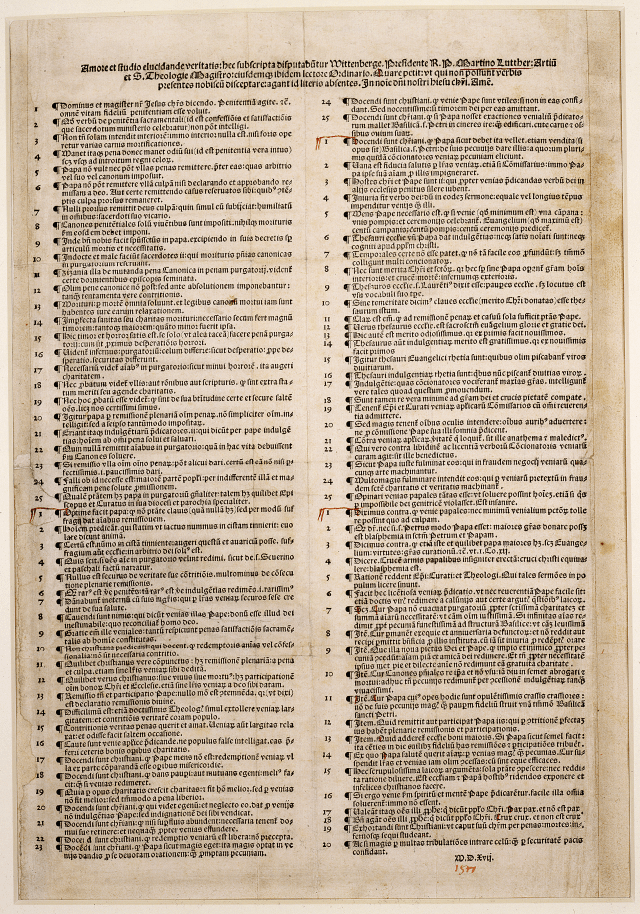
The year was 1517. A monk named Martin Luther gripped his hammer and nailed a list of biblical grievances against the Roman Catholic Church to the door of Castle Church in Wittenberg, Germany, much like we might post a notice to a community bulletin board today. These 95 Theses protested the Catholic Churchโ€™s unbiblical policy of selling indulgences, part of an effort to raise funds for the building of St. Peterโ€™s Basilica in Rome. The Catholic Church had created the idea of the Treasury of Merit, sort of a โ€œbank accountโ€ of merit deposited by Christ, Mary, the saints, and others as a result of their good works. When church members sinned, they could purchase an indulgence, which was akin to asking the Church to โ€œtransfer fundsโ€ from the Treasury of Merit to the sinnerโ€™s account. The indulgence basically excused the sinner from a certain amount of time in purgatory and/or temporal punishment for that sin.

In addition to protesting the sale of indulgences, Lutherโ€™s 95 Theses called the Catholic Church to conform to Scripture by abandoning its unbiblical practices and teachings regarding the doctrines of salvation, religious authority, the nature of the church, and the essence of Christian living.

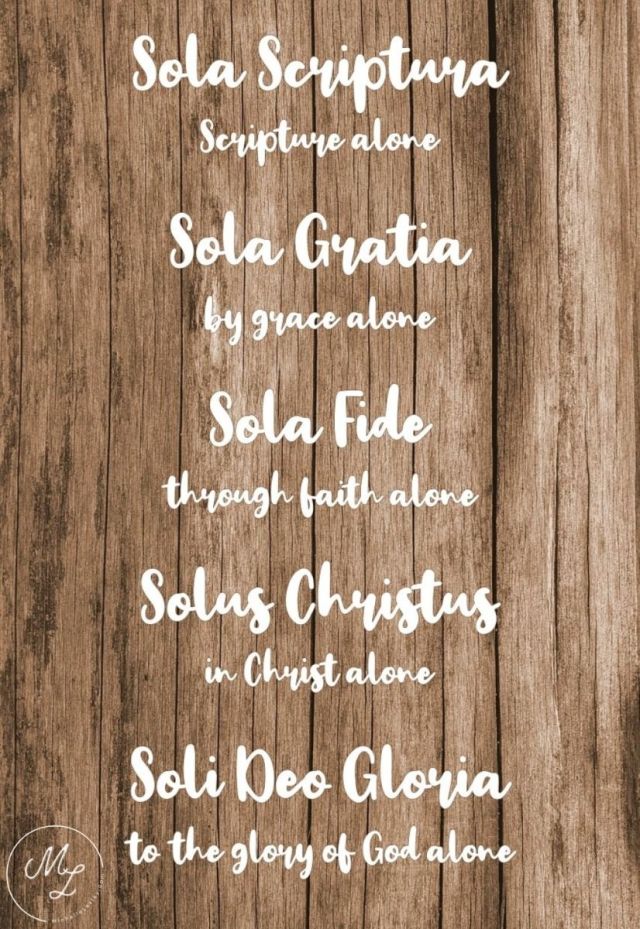
Lutherโ€™s calls for reform spread quickly throughout Europe, inspiring the likes of church fathers Ulrich Zwingli (Zurich), John Calvin (Geneva), and John Knox (Scotland) to join the effort in their own locales. As they worked to address the issues raised in Lutherโ€™s document, these men codified what we know today as the โ€œFive Solas of the Reformation,โ€ the basis of Protestant church doctrine. The five solas are:

1. Sola Scripturaโ€“ Scripture alone is the basis for all church doctrine, belief, and practice. (2 Timothy 3:16-17)

2. Sola Gratiaโ€“ Salvation is by grace alone. It is an unmerited gift of God based solely on His goodness, not our own (because we donโ€™t have any). (Ephesians 2:8-9)

3. Sola Fideโ€“ Salvation is through faith alone. Faith is a gift bestowed by God. We are saved only by placing that faith in Christโ€™s finished work on the cross, not by doing good works or by any other attempts to earn salvation. (Ephesians 2:8-9)

4. Solus Christusโ€“ Salvation is found in Christ alone. As Acts 4:12 says, โ€œAnd there is salvation in no one else, for there is no other name under heaven given among men by which we must be saved.โ€

5. Soli Deo Gloriaโ€“ God saves man for Godโ€™s glory alone, and Believers are to live our lives to glorify Him alone. (Romans 11:36)

One of Lutherโ€™s most cherished ideals, from which we still benefit today, was that common people should have access to both the Scriptures and worship services in their own language. Prior to the Reformation, the Bible was only available in Latin. Likewise, all masses and other church services were conducted in Latin. Luther translated the Bible into German, and was later followed by William Tyndale, Myles Coverdale, David Brainerd, and others who translated the Bible into various languages.

On Reformation Day, we commemorate the work, zeal, and sacrifices of Luther and the other reformers. Reformation Day is observed on October 31.


Additional Resources:

Why do we celebrate Reformation Day? – A Word Fitly Spoken

What are the 95 Theses of Martin Luther? – Got Questions

Why Weโ€™re Protestant: The Five Solas of the Reformation and Why They Matter by Nate Pickowicz

Luther: In Real Time (podcast)-  Ligonier Ministries

Politics

Revival: In America We Trust?

I don’t know about you, but I’ve had it up to here with politics. Any politics. I’m sick of hearing about the candidates, where they stand on the issues, what they’ve done wrong, why we should vote for this one instead of that one or not vote at all, and what celebrities (and everybody else on the planet) think about them. It’s a 24/7 barrage on TV, the radio, social media, and personal conversations. Yes, these issues are important (for the love of my sanity, y’all, please don’t write me comments and e-mails arguing for your candidate or position- I agree these things are important) but I’ve reached my saturation point. It would be great if somebody would capture the Loch Ness monster or find a cure for the common cold or something just so everybody would have something else to talk about for five minutes.

In the midst of this political fervor, pastors – from those in the national spotlight to those in rural obscurity – are applying theology to the election and current culture. Some of it has been very, very good. Encouraging. Refreshingly biblical. And some of it…well, not so much.

On the “not so much” side, one of the recurring themes I’ve heard from various pulpits is the prediction or expectation that America is going to make a comeback. Brighter days are just around the corner. The cultural morality of the 1950’s might even re-emerge, and we’ll all be able to breathe a sigh of relief that evil and debauchery have left the building.

Then some pastor, somewhere, decided to co-opt the word “revival,” paste it over this concept of America getting its moral act together, and offer the whole package to American Christians as hope.

A turnaround of American culture and morality wouldn’t be a bad thing. Personally, I think it would be great if America would start behaving itself like a courteous, rational adult instead of a pagan, hedonistic teenager. We are 240 years old, after all.

But that is not revival, and it is not where our hope lies.

Let me ask you something: What if America never turns around? What if things continue to get worse, morally, economically, militarily, and culturally until this country eventually implodes into anarchy or becomes a vassal state to a godless nation?

What if God destroys America instead of making her great again? Will your faith be destroyed, too?

Sadly, for many Americans whose faith has become a syncretistic mรฉlange of patriotism and pseudo-Christianity, the answer is yes. How many will lose heart and walk away forever when the “revival” their pastor promised fails to materialize? Uncle Sam is a cruel master and a lousy god.

Real revival is exactly the opposite. It can take place regardless of who wins the election, whether the United States is virtuous or villainous, rich or poor, enslaved or free or wiped off the face of the earth. It can take place even if you’re the only person in the world who wants it.

Biblical revival happens when Christians – thousands or dozens or one – bow the knee to Christ in repentance over their sin, forsake their worldliness, pursue holiness, act on their new-found zeal for evangelism, and live faithfully. It’s found when we stop fretting about who’s sitting in the Oval Office and start focusing on Who’s sitting on the Throne and how we might honor and please Him, regardless of what’s going on in society.

Real revival doesn’t always change the culture. Just ask Noah. Or the righteous remnant of the Old Testament exile. Or the martyrs of the early church. That’s not what it’s for. Revival isn’t supposed to change the world. It’s supposed to change your heart. It’s supposed to change your focus from temporal, elemental things to the Christ who bled and died for your sin.

That’s where our hope is found, sisters.

Not in the White House, but in Christ, regardless of who’s in the White House. Not in a moral society, but in Christ, whether society’s morals are Victorian or heathen. Not in laws and policies and freedoms that suit us, but in Christ.

Our hope is in Christ.

If Hillary wins,
our hope is in Christ.

If Donald wins,
our hope is in Christ.

If America re-emerges as that city on a hill,
our hope is in Christ.

If America runs swiftly toward her demise,
our hope is in Christ.

Our hope is in Christ, dear sisters. Let us never forsake our First Love for something as lowly as love of country, favor of the government, or an upright populace.

Our hope is in Christ.