The Ten (10 Commandments Bible Study)

The Ten: Lesson 1

If you grew up in church, you probably learned them by heart in Sunday School. There are even little songs (here’s my favorite) and mnemonics to help you memorize them.

The Decalogue. The two tables of the Law. The Ten Commandments.

Sure, you can recite them forward and backward, and, if you can’t, you can probably name most of them even if you don’t get the order right. But have you ever slowed down and really studied them? What would all these “thou shalts” and “thou shalt nots” have meant to Moses and the people of Israel? How are they relevant to Christians today? And how do these ten laws demonstrate God’s goodness? We’ll be taking a look at these questions and others over the course of this study.

Background

We never parachute into a book or passage we’re going to study without first setting the stage. God didn’t give the Ten Commandments in a vacuum. What was going on at the time? To whom were the Commandments given? When? Why? Who were the main characters in the story? It’s time to do some homework.

If you’ve never read the book of Exodus from beginning to end before (or if it’s been a while), take as long as you need and read the first eighteen chapters of the book word for word. If you’re already fairly well versed in the storyline of Exodus, skim back over the first eighteen chapters to refresh your memory. As you read or skim, bullet-point the major events and information.

  • Who is this book about? Who are the main characters in the storyline?
  • When did these events occur relative to other major biblical events?
  • What was God’s “big picture” plan for the people of Israel during this time frame? What were the steps He took to carry out that plan?
  • Where, geographically, did these events take place?
  • Why was there a need for God to give codified laws to His people at this point in their history?
  • How does this story point us to Christ?

Read and listen through these additional resources to help set a good foundation for our study of the Ten Commandments:

Do the Ten Commandments apply to Christians today? at Grace to You

What are the Ten Commandments? What is the Decalogue? at Got Questions

The Preeminence of God’s Moral Law by Phil Johnson

False Doctrine, False Teachers

Hillsong’s Theology of Music and Worship

c3banner1_fftf

Does your church use Hillsong music? Do you buy their songs or listen to them on the radio? Everย reallyย sat down and compared the words you’re singing or hearing to Scripture?

If not, this episode of Fighting for the Faith will be eye-opening. Listen in as Chris Rosebrough, Steve Kozar, and Amy Spreeman examine the lyrics of several popular Hillsong anthems for biblical theology. They’ll also give you a behind the scenes look at what goes into planning a Hillsong-esque worship set. And you’ll hear from Geoff Bullock, one of the “founding fathers” of Hillsong music, about why he left Hillsong and his regrets about the songs he wrote while there. Hear more of Geoff’s story here and below:


Click below to listen to this fascinating episode of Fighting for the Faith:

Heresy Hiding in Plain Sight

Mailbag

The Mailbag: My “Christian” Family Member Bears Rotten Fruit

mailbag


I have a family member, *Fran, who claims to be a Christian, but follows several major false teachers, drinks, habitually lies, is very proud, boastful, and manipulative. She has been shown that these teachers are false but chooses to follow them anyway.

Should I treat her as though she were a sister in Christ by going to her and rebuking her and going through the โ€œdisciplinaryโ€ steps in hopes of reconciliation? Or should I go about it as if she werenโ€™t a sister in Christ?ย  I have been praying for her and for wisdom for myself to handle this in a God honoring way.
(*Name changed)

It’s always difficult to watch a loved one choose sin over Christ and false doctrine over sound doctrine. Praying for Fran and for God’s wisdom and guidance are the first and best step.

You’ve asked about “going through the ‘disciplinary’ steps in hopes of reconciliation.” I believe what you’re referring to here is the process described in Matthew 18:15-17:

If your brother sins against you, go and tell him his fault, between you and him alone. If he listens to you, you have gained your brother. But if he does not listen, take one or two others along with you, that every charge may be established by the evidence of two or three witnesses. If he refuses to listen to them, tell it to the church. And if he refuses to listen even to the church, let him be to you as a Gentile and a tax collector.

This is the basic outline Christ has given us for disciplining sin in the local church. One thing to notice about that last step is that if the person sinning does not listen to the church, the church is to excommunicate (remove, or disfellowship) him from membership and regard him as someone who is lost and in need of the gospel. This brings us to the question of whetherย Fran is a member of your church or another church. A church obviously can’t excommunicate someone who isn’t a member of that church. This helps us to see that each local body is responsible for disciplining its own members.

If Fran is a member of your church, then, yes, the steps in the Matthew 18 passage should be applied. The wisest course of action, especially if you’ve never done something like this before, is to seek the counsel of your pastor or an elder as to the best way to approach Fran and handle the meeting. Set aside some one on one time to talk to Fran, and be sure you listen to her as well. Part of that one on one meeting is forย you– to make sure you are correctly assessing the situation, not, for example, reacting to a rumor you heard, a misunderstanding of an incident, etc. Lovingly and humbly point her to the Scriptures she has transgressed. Pray with her if she is willing.

After that initial meeting, give her some time to consider what you’ve said and to respond to the Holy Spirit’s work in her heart. Check back in with her at a later date and find out if she has repented. If not, prayerfully gather two or three others Fran likes and respects and repeat the process. If she still doesn’t repent, take those two or three people, meet with your pastor or the appropriate elder, and seek his guidance on the next step to take.

You didn’t specify in your e-mail, but it sounded as though Fran is not a member of your church. In this case, you really don’t have any ecclesiological redress (i.e. excommunication) to back you up. What you have is a family member who appears to be a false convert because she is bearing the fruit of someone who is unsaved rather than the fruit of someone who is saved.

I would again encourage you to meet with your pastor, an elder, or a godly, older, spiritually mature woman at your church for counsel as to the best way to proceed. It might be possible to carry out the first two steps of the process simply as an act of love and concern, considering what steps you would take in your personal relationship with Fran if she refuses to repent. First Corinthians 5:9-13 is a good passage to study as you consider this situation:

I wrote to you in my letter not to associate with sexually immoral peopleโ€” not at all meaning the sexually immoral of this world, or the greedy and swindlers, or idolaters, since then you would need to go out of the world. But now I am writing to you not to associate with anyone who bears the name of brother if he is guilty of sexual immorality or greed, or is an idolater, reviler, drunkard, or swindlerโ€”not even to eat with such a one. For what have I to do with judging outsiders? Is it not those inside the church whom you are to judge? God judges those outside. โ€œPurge the evil person from among you.โ€

This passage is also written to the church body regarding church discipline, but we can glean from it, as well as from the Matthew 18 passage, that there is to be some noticeable degree of separation between Christians and individuals who call themselves Christians yet unrepentantly persist in sin.

As you mentioned, the whole point of lovingly confronting someone you care for about her sin is to – for the good of her own soul – point her back to Christ so that she may first be reconciled with Him through repentance and forgiveness, and then be reconciled with her church family and others. Two good Scriptures to remember and take to heart when we have no other choice but to approach a sinning sister are:

And as you wish that others would do to you, do so to them. Luke 6:31

For with the judgment you pronounce you will be judged, and with the measure you use it will be measured to you. Matthew 7:2

It can be difficult, painful, and embarrassing to hear someone tell you you’re in sin. Put yourself in that sister’s shoes. Treat her as kindly and mercifully as you would want someone to treat you.ย Weย never confront another in her sin with the motive of shaming, punishing, seeking revenge, or proving her wrong and ourselves right. That is not the gospel. It is not how Christ treats us when we sin. If she repents when you approach her, forgive and rejoice with her in the good work Christ has done in her heart.

Additional Resources:

What is Excommunication in the Bible? at Got Questions

What does the Bible say about church discipline?ย at Got Questions

A Church Discipline Primerย at 9 Marks

In Order that You May Know at Grace to You


If you have a question about:ย a well known Christian author/leader, a Bible passage, an aspect of theology, a current issue in Christianity, or how to biblically handle a family, life, or church situation, comment below (Iโ€™ll hold all questions in queue {unpublished} for a future edition of The Mailbag) or send me an e-mail or private message. If your question is chosen for publication, your anonymity will be protected.

Marriage

9 Ways NOT to Fight with Your Husband

My twenty-fourth wedding anniversary is coming up in December. I am so thankful to God for bringing my husband into my life. He has been such a blessing to me. I adore Scott…most of the time. Scott and I are both very passionate people. That’s a polite way of saying we’re both prone to being hot-headed and overly emotional at times. And that’s sort of a secular way of saying we have both given in to sin and selfishness with each other over the years. We’ve had our share of arguments, and if you’re married, you probably have, too.

The Bible says:

Be angry, and do not sin. Psalm 4:4a

Know this, my beloved brothers: let every person be quick to hear, slow to speak, slow to anger; for the anger of man does not produce the righteousness of God. James 1:19-20

There is a godly way to iron out our differences in marriage. We pray for each other and about whatever it is we’re disagreeing about. We die to self, put the other person first, and act in humility and love. We exercise self control and refuse to be ruled by our emotions. Husbands love their wives and lead with a self-sacrificing heart, and, wives, we submit to and respect our husbands’ God-given leadership.

And then there are the ungodly ways to handle problems and arguments in our marriages. Younger ladies, as someone who has learned many of these things the hard way, allow me to Titus 2 you for a few moments. Here are nine ways not to fight with your husband*:

*As always, when I write articles like this about marriage, it is in the context of a relatively normal, healthy relationship. If you are being abused, get to safety and seek help. If you know someone who is being abused, do not place on her the burden of trying harder. Get her to safety and help her. Getting to safety and getting help is not the same thing as filing for divorce.

1.
Failure to leave and cleave

Your utmost loyalty is to your husband. When you and your husband have a disagreement, it is for the two of you to work out together. Do not run back to Mommy and Daddy (or your sister, best friend, etc.) and complain about your husband in hopes that he or she will take your side against him and fight your battles for you. That is the mark of a child, not a grown woman. (And, older moms, if your adult daughter or daughter-in-law attempts to do this with you, teach her that this is not the godly way to handle disagreements. Do not get involved. Send her back home to work things out with her husband.)

2.
Don’t negatively compare your husband to other men.

“You’re just like your mother/father!” “My father would never treat me like this!” “My ex-husband/former boyfriend/deceased spouse always _______. Why don’t you?” “Pastor Bob/your friend Joe would never treat his wife this way!” The fact of the matter is, your husband was created in the image of God as a unique individual. Thereย is no comparison to others.

3.
Don’t use Scripture as a weapon.

Yes, the Bible is a two-edged sword. No, that doesn’t mean to slice your husband to pieces with it. In the same way he doesn’t get to yell “You’re not being submissive!” (even though it may be true) as a way to win an argument, you don’t get to take the verses that tell husbands how to act and use them to belittle him. The best way you can use Scripture in the middle of an argument is to remember what it saysย to you about obedience to Christ, humility, patience, and extending grace, and obey it.

Yes, the Bible is a two-edged sword. No, that doesn’t mean to slice your husband to pieces with it.

4.
Don’t use sex as a weapon or a bribe.

God created sex as a good gift for husbands and wives to enjoy. He tells us we are to give our spouses theirย right to intimacy and that we are not to deprive each other except temporarily, by agreement, and for the purpose of devoting ourselves to prayer. Do not withhold sex as a way to punish your husband or hold it over his head as a way to get him to do what you want him to do.

Do not withhold sex as a way to punish your husband or hold it over his head as a way to get him to do what you want him to do.

5.
No personal attacks

Would you want your husband to call you ugly, a cow, a bad wife, a lousy mother? Of course not. Don’t call him lazy, weak, stupid, fat, etc.

Christ does not use our weaknesses as a weapon against us and we do not use our husbands’ weaknesses as a weapon against them.

6.
Don’t emasculate him.

Doย not attack your husband’s manhood. Berating him for his job performance, belittling him for not being as successful you think he should be (or as someone else is), throwing in his face how little money he makes, mocking his performance in the bedroom, denigrating him as a mama’s boy, making his kowtowing to you a test of his manhood, and saying things like, “Aย real man wouldn’t ____!”, are all great ways to tear down your house with your own hands. These kinds of remarks are some of the most hurtful things you can say to your husband. They make him feel the way you would feel if he said you were old, fat, and ugly and he was going to find someone else who was younger and beautiful. These are soul crushing things to say, and if you’re in the habit of saying them, your marriage isn’t going to last long. Stop.

Emasculating your husband is a great way to tear down your house with your own hands.

7.
Don’t be manipulative, passive aggressive, or play other emotional games.

No pouting, no slamming things around, no saying “NOTHING!” or “I’M FINE!” when he asks what’s wrong, no expecting him to read your mind and getting mad if he doesn’t, no making his giving in a test of his love for you, no holding things over his head, no maxing out the credit cards, flirting with other men, or sabotaging his work, hobbies, or relationships as a way to get back at him. None of these are godly ways to relate to anyone, and especially not to your husband. “The heart of her husband trusts in her,” the Bible says, “She does him good, and not harm,ย all the days of her life.” Throughout God’s word, we’re admonished to lovingly speak the truth with one another, not hide, shade, twist, or withhold things. If you’re playing any of these emotional games with your husband you’re being dishonest, unkind, unloving, and malicious.ย 

The heart of her husband trusts in her, and he will have no lack of gain. She does him good, and not harm, all the days of her life. Proverbs 31:11-12

8.
NEVER threaten divorce.

For Christians, divorce is never a solution to regular marital spats. You have taken a vow before God to stick with your husband through the bad times. Christ has said He will never leave you nor forsake youย despite the many times you’ve sinned against him. How, then, could you threaten to leave your husband for sinning against you? The only reason for such a threat is to hurt or scare the man you have pledged to love and honor for the rest of your life. That is not how a woman of God behaves.

The only reason to threaten divorce during an argument is to hurt or scare the man you have pledged to love and honor for the rest of your life. That is not how a woman of God behaves.

9.
Leave the past behind.

Don’t throw past sin in your husband’s face. When God forgives us, He puts that sin behind us. The Bible tells us we’re to forgive others the same way, and that we’re not to harbor a record of wrongdoing against others. Love and forgive your husband the way Christ has loved and forgiven you.

Love and forgive your husband the way Christ has loved and forgiven you.


But what if he doesn’t do a good job at work or hasn’t cut the apron strings or is being disobedient to Scripture? There’s a time and a place to kindly, lovingly, and rationally discuss those things. The middle of a heated argument isn’t it. Christ does not use our weaknesses as a weapon against us and we do not use our husbands’ weaknesses as a weapon against them. We treat our husbands fairly, kindly, compassionately, respectfully. The same way we want them to treat us.



Sin, Throwback Thursday

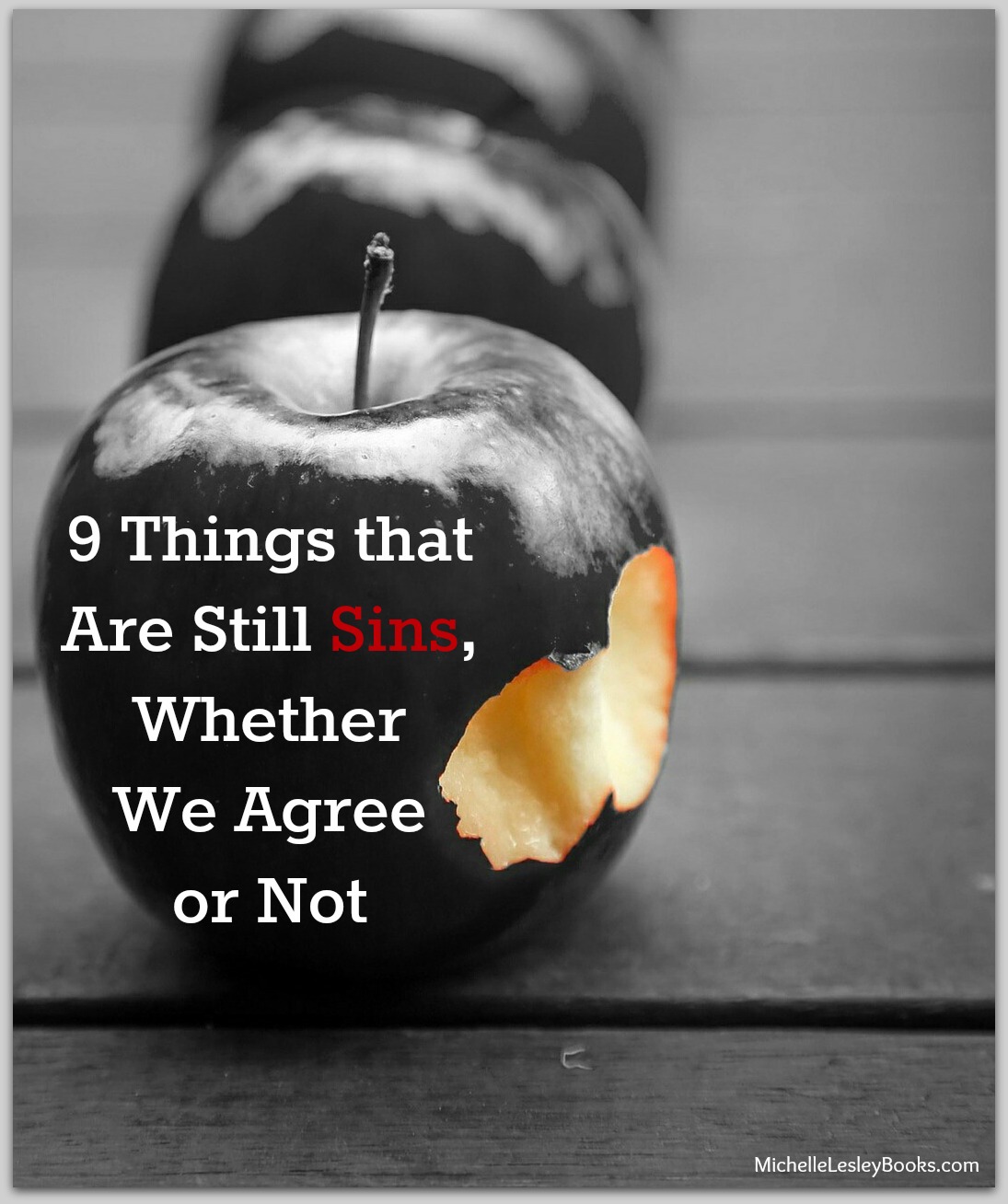
Throwback Thursday ~ 9 Things that Are Still Sins Whether We Agree or Not

Originally published June 19, 20159 still sins


I do it all the time, Mother, and I’ve decided something-
it’s not a sin.

I heard this line several years ago on a popular sitcom, spoken by an adult daughter to her Christian mother about a behavior the Bible unambiguously calls a sin. I mean, it’s right smack dab in the middle of the Big 10; “thou shalt not” and everything.

It’s one thing to say, “I know it’s a sin, but I don’t care. I’m going to do it anyway,” but how depraved is the world when they think they – in God’s place – are the ones who get to define what sin is? And what’s even worse is that the church has begun to adopt this audacious depravity as well, whether approving of sin by fiat or by simply ignoring God’s word and letting sin slide without rebuke.

When it comes to what’s a sin and what’s not, God made up His mind a long time ago. And He’s not changing it, regardless of what you or I or Joe Politician or Jane Celebrity might think. Maybe we all need a remedial course in hamartiology, so let’s start with the basics. These things are all still sins whether the world and the church agree with God or not:

1. Homosexuality

Let’s just get it out of the way right up front. I don’t care how many celebrity “pastors” and “Christian” authors twist God’s word to say otherwise, or how many people declare themselves to be (unrepentant, practicing) “gay Christians,” or how many homosexuals declare that God made them that way, God’s word is clear: homosexual lust and behavior are sins.

2. Abortion

Abortion is the taking of an innocent human life. We don’t murder people because they’re small or sick or inconvenient or will hinder our sucess. God didn’t say, “You shall not murder, except when…” He said, “You shall not murder.” Period.

3. Extra-Marital (Heterosexual) Sex

Adultery, fornication, whatever form it might take, if you’re not legally married to the person you’re engaging in sexual activity – up to and including actual intercourse – with, you’re sinning.

4. Cohabitation

See #3. And don’t try to whitewash it by saying you’re living together but not sleeping together. A) The Bible says we’re to flee temptation, not move in with it, and B) we’re supposed to avoid every form of evil, even the appearance of it. If you call yourself a Christian and you’re shacking up, you’re living in sin (that’s why they call it “living in sin”). Repent and move out or marry up.

5. Divorce

Yep, still a sin, except in two cases: unfaithfulness or an unsaved spouse leaving a saved spouse. In those two cases the spouse who was wronged is not sinning and is free to marry again.

6. Swearing

The air is saturated with it. Foul language coming from our TVs, music, movies, social media, and the people we’re around all day. But expletives have no place in the vocabulary of a Christian. Is your potty mouth on Saturday the same one you praise God with on Sunday?

7. Taking God’s Name in Vain

It’s gotten to the point where we think so little of casually punctuating our sentences with, “Oh my G-d,” ย or using the name of Jesus as an exclamation that pastors are even doing so from the pulpit these days. God’s name is high and holy and should be spoken only reverently and worshipfully. How can we look people in the eye and call them to repentance and faith in a Person whose name we use as a cuss word?

8. Gluttony

We have almost completely amputated gluttony from the spiritual realm by cordoning it off as merely a physical or medical issue. We’ve renamed it “overeating,” but that doesn’t change the fact that it’s a sin. God created good food for us to enjoy, but just as with all the other good gifts He gives us, He expects us to exercise Spirit-enabled self control when we receive it.

9. Female Usurpation

God makes it abundantly clear in His word that women are not to instruct men in the Scriptures or hold authority over them in the church. Women sin when they pastor churches, preach sermons in church, teach men in Sunday School classes, and hold other positions of authority over men in the church. Men, however, bear the primarily responsibility for this when they sin by failing to rebuke usurping women, or when women feel they have no other choice but to take on male responsibilities in the church because men are shirking their own duties before God.


We don’t get to decide what sin is. That’s God’s job. And all of us – whether we’ve committed one of these nine sins or not – are guilty of sinning against Him. That’s the bad news.

But, in Christianity, we never give the bad news without following it up with the good news. And, oh what wonderfully good news it is: forgiveness. Jesus paid for our sin at Calvary so that if we will only turn from it and trust Him, He will forgive us for all nine of these sins and countless others.

If we confess our sins, he is faithful and just to forgive us our sins and to cleanse us from all unrighteousness.
1 John 1:9