Recall the things from the introductory lesson that you wanted to keep in mind as you study the text of Psalm 119.
Don’t forget to read in complete sentences instead of stopping at the end of each verse.
Recall the themes you’ve been noticing in Psalm 119. Watch for those themes to be repeated in today’s and future passages. You may wish to make a list of those themes to refer to throughout this study.
Questions to Consider
1. Review your notes from last week’s lesson. Does that passage relate to this week’s passage? How? Do you notice any repeated words, thoughts, or themes?
2. Do you notice a difference in tone between this first section (49-56) and most of the previous sections we’ve studied? How would you characterize the tone of this section? The previous sections? How do our life circumstances impact our perspective of how God’s Word ministers to us? (For example: When you’re joyful, which aspect of God’s Word most ministers to you? Comfort, praise, encouragement, zeal, etc.? When you’re going through hard times?) Proverbs 25:11 tells us “A word fitly spoken is like apples of gold in a setting of silver.” How is Scripture a “word fitly spoken” to each of us, personally, no matter what we’re going through?
3. Anger is often sinful, but how is verse 53 an example of righteous, godly anger?
4. Which verses in these two sections speak to God’s attribute of dependability, being a “man of His word”? How does that bring comfort and stability to the psalmist and to us?
What is the psalmist’s response to God’s dependability? (49, 50, 57) How do you, or how should you, respond to God’s dependability to you?
As God’s people, we are to reflect to others God’s attribute of dependability. How are you doing at being dependable to others – a woman of your word? Are you punctual? Fulfill your commitments? Return correspondence in a timely manner? Follow through? What’s one practical way you could reflect God’s dependability this week? When God’s people aren’t dependable, what does that say to lost people about God?
How does the psalmist “hold God to His word” in prayer in 49, 50, and 58? It is always appropriate in our prayers to recall God’s promises to us (from Scripture) and ask Him to keep or fulfill them. How can we avoid demanding things from God that He never promised us in the first place? Have you noticed any verses or themes we’ve studied so far in Psalm 119 that speak to this?
How is asking God to keep His promises simply asking Him to be who He is?
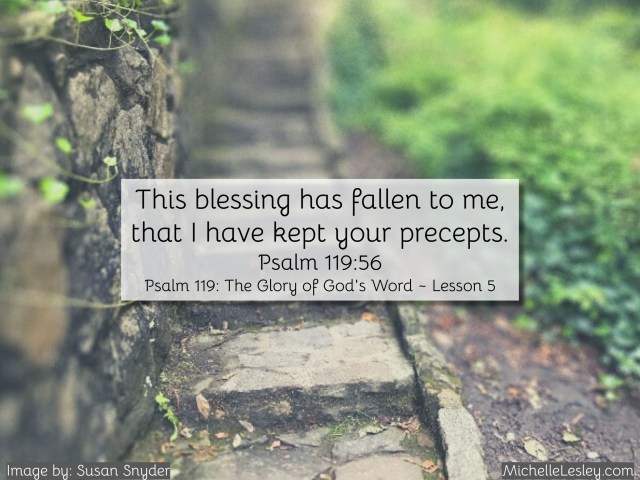
5. Does verse 56 refer to the blessings that are a consequence of obeying God’s Word, or does it mean that the ability and desire to obey God’s Word is a blessing in and of itself? (It might help to look at this verse in a few other reliable translations.) Why is it a blessing to desire and be able to obey God’s Word? How are we able and Who gives us that desire?
6. Carefully examine 59-60. What kind of “ways” is the psalmist talking about? What is the solution to temptation and sin in…
57, 59-60?
58, 64?
61?
62?
63?
How can you implement each of these in your own life to combat sin?
Consider how Jesus used the weapon of memorized Scripture to combat Satan’s temptations. Why is God’s Word such an effective weapon against temptation and sin? Why doesn’t just avoiding temptation alone – apart from God’s Word – work? Do you run to God’s Word when you’re tempted? What are some verses you could memorize and obey to help you fight temptation and avoid sinning?
Praying Psalm 119
Have you ever tried praying the psalms? I want to encourage you to try praying part of Psalm 119 back to God each week of this study. (If you’re familiar with my other studies, this will take the place of the weekly “Homework” section.)
The psalms are uniquely suited for praying back to God, both verbatim and conceptually, because they are often written as prayers – as though the psalmist is talking to God. Did you notice that about today’s passage? In which verses?
What is a concept or thought for your own life that the Holy Spirit impressed on your heart or convicted you about from today’s passage? Is there a particular verse(s), or maybe the whole passage, that you would like to pray back to God verbatim? Whatever your “prayer point” from today’s lesson, pray it at least daily until we get to the next lesson.
“You say that women shouldn’t teach men (1 Timothy 2:12), but what about men who read your blog or listen to your podcast? Aren’t you teaching them?”
It’s the canard that will not die. Complementarian women bloggers, authors, podcasters, and content creators are frequently asked this question, often by dissenters looking for a “gotcha” moment. Other times it’s a genuine concern from Christian women who want to write, speak, or create, but still be in obedience to God’s Word as it speaks to the role of women. But, whatever the motivation for asking, it’s a great question that needs to be answered. Biblically.
It is true that God has ordained different roles for Christian men and women. Both roles are needed and important, but different. Part of the role for women is outlined in 1 Timothy 2:11-15. Women are not to preach to or teach men in the gathering of the church or hold other positions of authority over men in the church body.
But notice that key phrase “in the church.” The context of all of the passages dealing with women refraining from teaching men refers to the teaching of God’s Word in the gathering together of the body of believers.
That’s not the same thing as writing or speaking in the public square. The gathering of the church body might take place within the four walls of a church building, at a park for a Resurrection Day sunrise service, at a Christian conference, at a chapel service at a Christian college or seminary, at a Bible study in someone’s home, or a myriad of other venues, but it’s just that – a physical gathering together of the body of Christ for the purpose of worship, studying the Word, sitting under the preaching of the Word, observing the ordinances, prayer, practicing the “one anothers,” and other “churchy” things.
You’re reading this blog right now. Are you practicing the “one anothers” with anyone? Is anyone standing in front of you preaching the Word? Are you actively worshiping? Do you see an offering being taken up? Baptism? Communion? Prayer? Do you consider yourself to be attending church right now? Of course not. You’re staring at a screen reading an article. This is a blog. Not the gathering of the church.
The Greek word for “church” in the New Testament is ἐκκλησία, or ekklesia. It literally means a gathering or assembly. No gathering, no church.1 And because of that, women bloggers and other content creators aren’t violating the Scriptures that prohibit them from teaching men in the gathering of the church. (And, by the way, this all applies to women on social media, too. That’s not the gathering of the church either, praise the Lord.)
When I explain this biblical distinction to the “gotcha” folks, the pushback (that’s a polite word for it) I often get is, “You’re just hypocritically splitting hairs and doing hermeneutical gymnastics to justify yourself!”. No, you’re just conflating things the Bible clearly distinguishes from one another.
Think of it this way: If I say that all sexual activity outside of marriage is sinful, but I joyfully fulfill my marital duty to my husband, am I a hypocrite? Am I splitting hairs or doing hermeneutical gymnastics? No. Because there are right and wrong contexts for sexual activity just like there are right and wrong contexts for women teaching the Bible, writing on biblical topics, and so on. The Bible has defined categories and contexts. The Bible draws lines of distinction. Conflating a biblical “do” with a biblical “don’t”? That’s what’s unbiblical.
But let’s consider something else, too. Even though Scripture doesn’t require it, most godly, doctrinally sound women bloggers and online content creators – including me – aim our content primarily at Christian women. I have set up parameters for my blog (and my book, when it was in print) and for my ministry to do everything I can to place myself under the umbrella of 1 Timothy 2:12. Look at the title of this page and my Facebook page. It specifically says “Discipleship for Christian Women“. My book was always labeled and marketed as a women’s Bible study. If you’ll take a look at the “Welcome” tab at the top of this page, you’ll see I explicitly say that this blog is for Christian women and that I’m a complementarian. When I address the readers of this blog I nearly always address them as “ladies,” both because my target audience is women, and also to remind the handful of men who follow me that they are not my audience; they are, in a sense, “eavesdropping” on what I’m saying to women. My speaking engagements are for women only. I ask men not to use my Bible studies. I’m not really sure what more I need to do to make it clear that my blog and my ministry are for women, not men.
Don’t men bear any responsibility here? Why should the entire burden for women not “teaching” men fall on the shoulders of women bloggers and content creators? Why don’t the Christian men who are ostensibly so concerned about men consuming content from women address the men who are reading our blogs and following our platforms?
But sometimes these “gotcha guys” – who often have ulterior motives of undermining complementarianism – will visit my blog, claim to have learned something, and then turn around and attack me as a hypocrite for “teaching” them. This is akin to a man listening at the door of a women’s Sunday school class, then bursting in and saying, “Aha! You taught a man.” To those men, I would ask a simple question- If a female blogger puts a fence around her blog and you jump over it and trespass on her property, how is she the one at fault?2
Along with Christian women, Christian men ought also to be obedient to 1 Timothy 2:12 by not seeking out female content creators for biblical instruction for themselves. While I welcome male readers – especially those who are vetting me for their wives and daughters or the women of their church, or to gain a better understanding of the issues affecting Christian women in order to lead and shepherd them better – I do not want men seeking me out for personal biblical instruction. All of my readers should look to the doctrinally sound teaching of their pastors and elders for biblical instruction. For women, my blog should only be a leisure time supplement to their sermons and classes at church.
Being a godly female blogger or content creator can be a tightrope walk. All of us have fallen off from time to time, and in those cases we ask that you extend us grace and forgiveness, knowing that we didn’t do it intentionally or rebelliously. Praise God for the “net” of God’s mercy and cleansing that catches us and puts us right back up on that tightrope so we can encourage and build up the lovely Christian ladies in our audience. You mean so much to each of us. We love you and want you to grow in the grace and knowledge of our Lord Jesus Christ. That’s why we do what we do.
1This is why it is impossible to “attend church” by watching an online church service. You are not “attending church” online, you are watching other people attend church.
2Brothers, this “trespassing” metaphor is addressed to the aforementioned “gotcha guys,” not solid, complementarian brothers who have stopped by the blog to read something to help them minister to the women in their lives and churches. You are welcome here!
This article is an updated and revamped version of the original article by the same title, published on October 23, 2015.
Additional Resources
Rock Your Role – a series examining the Scriptures governing the biblical role of women in the church
Recall the things from the introductory lesson that you wanted to keep in mind as you study the text of Psalm 119.
Don’t forget to read in complete sentences instead of stopping at the end of each verse.
Recall the themes you’ve been noticing in Psalm 119. Watch for those themes to be repeated in today’s and future passages. You may wish to make a list of those themes to refer to throughout this study.
Questions to Consider
1. Review your notes from last week’s lesson. Does that passage relate to this week’s passage? How? Do you notice any repeated words, thoughts, or themes?
2. Notice the structure of 33-39. How does each sentence start? Is it a declaration, a question, an exclamation, or an imperative (request or command)? Who is doing the requesting? To whom? For whom? (This will be easier to see if you’ll make a verse by verse list, starting with “Teach me…” in 33.) Does verse 40 start the same way? What about the end of 40? How is this passage “bookended” (beginning of 33, end of 40)? What is the main idea of these imperatives?
Now notice how each verse (33-39) concludes. We’ve seen the initial imperative (“Do this”) of each verse. The structure of the conclusion of each verse is “…so that ______.” How would you fill in that blank with a description of the conclusions of the verses? (Again, this is easier if you make a verse by verse list, starting with, “and I will keep it” in 33.) What is the main idea of these conclusions?
How does this passage demonstrate – both in content and in structure – that God must take the initiative in illuminating the psalmist’s understanding of the Word, and that, when God does this, blessings follow? How does the structure reinforce the content? Does the psalmist want God to take this initiative? Why? What are the blessings that result from God increasing the psalmist’s understanding of, love for, and obedience to His Word? What are your thoughts on God taking the initiative in illuminating your understanding of His Word? What are some blessings you’ve experienced as God has increased your understanding of, love for, and obedience to His Word?
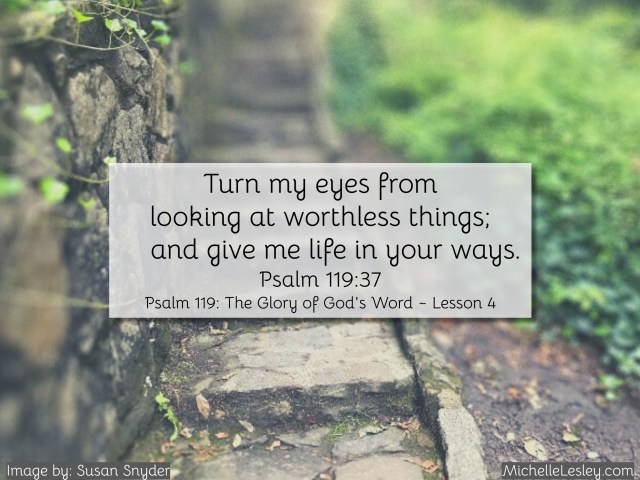
3. In verse 37, what might the psalmist have meant by “worthless things” in his life? Could they, in general, have been some of the same worthless things in your life? Think about the things on which you spend your time. What are some worthless things you need to ask God to turn your eyes from in order that He might give you a richer life in His ways? What would He need to turn your eyes and your focus to in order to accomplish this? Connect the thought in verse 37 with these verses in John.
4. What key word do verses 41, 47, and 48 all have in common? This is the first appearance of this word in Psalm 119. Notice how it bookends this section (41-48). Who is the initiator of love (41)? What is the psalmist’s response (47-48) to God’s love coming to him (41)? How does 1 John 4:19 echo this concept?
5. Until this section (41-48) the psalmist’s main focus has been on his own personal relationship to God’s Word, and, through God’s Word, to God Himself. He has focused primarily on God, and secondarily on himself (e.g. “teach me,” “lead me,” etc.). In this passage, he brings others into the mix. Who are the others he speaks of in 42 and 46?
42- How does the content of God’s Word help us to answer scoffers and taunters? How does the Christian character that studying the Word builds help us to answer scoffers and taunters?
46- How do both the content of God’s Word and the character His Word builds in us help us to answer or testify to His goodness before those who have more power or influence than we do, or are intimidating? Why is the psalmist confident he will not ultimately be put to shame (46-47- Remember, read all the way to the end of the sentence.)? What if the “king” ridicules (or worse) the psalmist’s beliefs and testimony, or mocks God?
Explain how our confidence and security hinges on Who or what we trust in.
6. Verse 43 is the psalmist’s first use of the word “hope”. Some people believe, and some religions teach that our only hope of Heaven or being right with God is in keeping God’s rules, being a “good person,” or for our good deeds to outweigh the bad. Is that what the psalmist is saying in this verse? Why or why not, and how do you know? If an unsaved friend tried to use this verse to justify her belief that God is happy with her because she keeps His rules, how would you answer her? Consider verse 43 in light of John 6:68.
7. What is the difference between the “wide place” in 44-45 and the “wide gate” in Matthew 7:13-14? Can you walk in the “wide place” if you enter through the “wide gate”?
8. What have you learned from today’s passage about God being the initiator of illumination and love? What about other spiritual matters? Can you think of any spiritual matter in which man is the initiator rather than God?
Praying Psalm 119
Have you ever tried praying the psalms? I want to encourage you to try praying part of Psalm 119 back to God each week of this study. (If you’re familiar with my other studies, this will take the place of the weekly “Homework” section.)
The psalms are uniquely suited for praying back to God, both verbatim and conceptually, because they are often written as prayers – as though the psalmist is talking to God. Did you notice that about today’s passage? In which verses?
What is a concept or thought for your own life that the Holy Spirit impressed on your heart or convicted you about from today’s passage? Is there a particular verse(s), or maybe the whole passage, that you would like to pray back to God verbatim? Whatever your “prayer point” from today’s lesson, pray it at least daily until we get to the next lesson.
Obviously, there are many, many serious issues in the church and world today, and if you’ve followed the blog for any length of time, you know I have a good track record of dealing with those issues on a regular basis in a serious way: Bible study…the gospel…sin…obedience to Scripture…discernment…and so on.
But sometimes, as human beings, we just need a momentary break from the serious to be silly and laugh. Ecclesiastes 3:4 says that just as there is a time to weep, there is an equally valid, and righteous, and good time to laugh. Sometimes I talk to Christians who seem to believe that we’re supposed to have our sense of humor amputated when we get saved, and that’s just not true. Proverbs 17:22 says:
A merry heart doeth good like a medicine: but a broken spirit drieth the bones. Proverbs 17:22
We need to laugh. We need moments of of refreshing.
If you disagree with any of that, or you just don’t like, or are easily offended by humor for whatever reason, this would be a good time to stop reading and go do something you enjoy, or tackle that “to do” list, or whatever. You’ve been warned. No complainies.
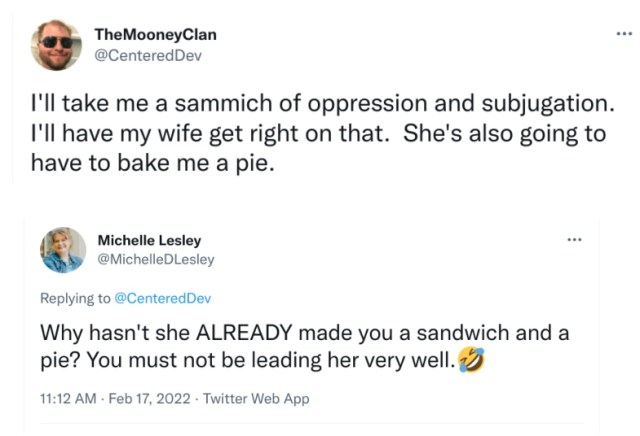
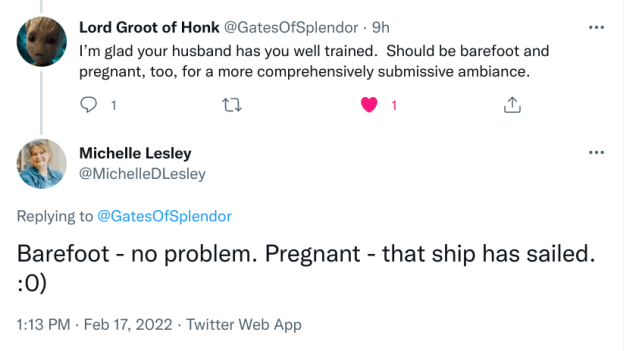
In case you’ve somehow managed to avoid them, there are feminists out there who can’t wrap their tiny little closed minds around the fact that godly women actually find joy in loving and serving our husbands and families. They seem to think – out loud, vociferously, and frequently, particularly on social media – that the only reason a woman might do such a thing is because she’s been brainwashed, downtrodden, or forced to.
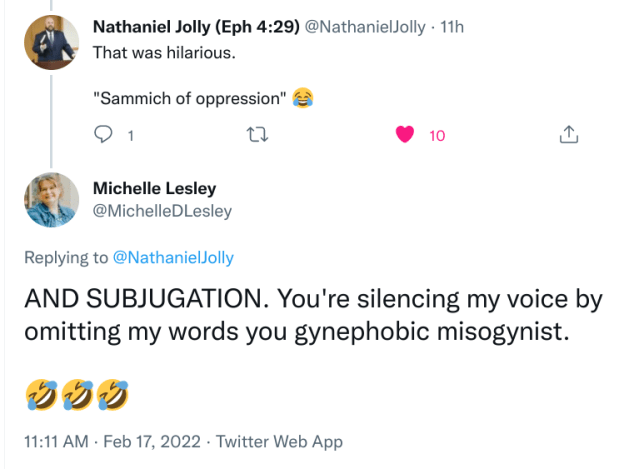
So, I did a thing on Twitter the other day, and I thought it might give you a smile…
Everything – I mean, everything – has to be caveated and explained to death these days (are y’all as sick of that as I am?)…
I kid you not, somebody asked me what my motive was for saying, “I *are* one,” instead of, “I *am* one.” Humor, my friend. Humor.
Of course, then everybody had to get in on the act. Back off, people. Can’t you tell I’m a humor professional?
Men. They’re just lost without a helper.
Leslie is usually so on the ball with these sorts of things. It’s not like her to leave out an ingredient.
I started to say, “That heifer is out of the barn,” but I’m sure that’s sexist…to somebody.
These men will never learn…
That’s right, just keep on wallowing in your wrongy-wrongness of manhood.
Yes, three slices. That’s why you’re still aspiring, honey.
Everybody’s a comedian. But since he’s a MAN, I’ll let him have the last word, as is fitting.
Now get in the kitchen and make your man a sammich of oppression and subjugation, ladies. (My husband said it was OK for me to say that. :0)
Good Monday morning, readers. It is an honor and a joy to serve you in Christ. Welcome to all the newbies and to you seasoned veterans of the blog.
Because some of y’all are new, you aren’t yet aware of all of the resources here to help you. Or maybe you’ve been around a while and haven’t noticed something that might be helpful. Let’s remedy that!
Second, be sure to familiarize yourself with all of the tabs in the blue menu bar at the top of the page. That’s where I keep the info I’m most frequently asked about.
Third, there’s a search bar at the bottom of every page (and one in the blue menu bar at the top of every page) which might help you find what you need.
And finally, let me get you new readers some answers to the questions several of you have asked. Some of you long time friends may have missed these along the way, so I hope they’ll be helpful to you, too!
I’m a man who wants to use one of your Bible studies for my personal quiet time. Is that OK?
Is it OK for a man to teach one of your Bible studies to a co-ed class?
I don’t get this question frequently – maybe a handful of times a year – but that’s enough that I’ve added this statement to the Bible Studies tab (in the blue menu bar at the top of this page):
“From time to time I receive inquiries from men about using my studies for their personal quiet time or for teaching a co-ed or men’s Bible study class. It is my personal conviction that it is more in keeping with the spirit (though not the letter) of 1 Timothy 2:12, Titus 2:3-5, and related passages for men to use Bible study materials authored by men rather than by women. Therefore, on the honor system, I would request that men please not use my studies for personal use, or when teaching a class with male members. (Vetting the studies for your wife, daughter, or the women of your church, is, of course, fine. Encouraged, actually.)”
Is it biblical for a woman to pray at the opening of the church service?
Is it biblical for women to participate in gathering the giving on Sunday morning?
Is it OK for women to ask questions in a co-ed class or group if the pastor or teacher invites those present to do so?
Great questions! I’ve answered all of them in my article Rock Your Role FAQs. Numbers 15, 22, and 4, respectively.
Is The Bible Project a doctrinally sound teaching resource?
You seem to be saying we should talk to God during prayer, but we should not try to listen for God’s guidance during prayer…But are we not supposed to pray about big decisions before we make them? If someone is deciding on taking a different job, or moving to another state, or getting married, isn’t that person supposed to pray about making the right decision? There isn’t a passage of Scripture that says “Jane Doe should marry John Smith in AD 2022.” What about pastors, who say God “called” them into ministry?
Do you think instead of praying specifically about a decision, we are supposed to pray for wisdom according to James 1 and then make our own decision, trusting God has given us the wisdom to choose correctly?
You’re circling the bullseye. I think my article Basic Training: 8 Steps to Finding God’s Will for Your Life will help. I didn’t specifically address pastors having some sort of Damascus Road-type “calling” to the ministry in that article, but the same principles apply. The Bible doesn’t say men will receive some sort of supernatural calling to the ministry. It says, “If any [man] aspires to the office of overseer, he desires a noble task,” (1 Timothy 3:1) and that he must meet certain biblical qualifications. If a man desires to be a pastor and he meets the biblical qualifications, he should start prayerfully putting the principles in that article into practice, trusting God to guide him in his pursuits.
As Christians, do we participate in celebratory life events of sin? For example- I had a family member (professes to follow Christ) throw a housewarming party for another family member living with her boyfriend. They bought a home together & are not married. I also had another family member (professor of Christ) become pregnant outside of marriage & naturally my family wanted to throw a big baby shower. How do those of us who honor Christ with our life handle such events?
It can be an uncomfortable invitation to receive, for sure. I’ve addressed the baby shower question in my article The Mailbag: Should I Attend the Baby Shower?. And let me just clarify a distinction between a shower for a woman who conceived out of wedlock and these other scenarios. A woman who conceived out of wedlock sinned – past tense. She may have since repented. Also, the purpose of a shower is to give her things she will need for the baby, not to celebrate or help perpetuate an ongoing sin such as the ones mentioned below. That is something to weigh if you’re trying to decide whether or not to attend a shower.
Let’s get things kicked off with a question that really came to the forefront a couple of years ago when same sex “marriage” became legal: Should Christians attend homosexual weddings?
And really, this answer also applies to any sort of event that celebrates, normalizes, or helps codify an ungodly union: events celebrating transsexualism, homosexual wedding receptions or showers, housewarming parties for a homosexual couple or even for a heterosexual couple that’s going to be living together, a celebration of adoption for a homosexual or non-married heterosexual couple, or even – I don’t know if these are still a thing or not, but divorce parties.
The short answer is, Christians should not be helping people celebrate their sin. We should be sharing the gospel with them so they can get saved out of their sin.
Attending a wedding or any of these other events implies that a person is in favor of the union or the sin that’s being committed, and no matter how much we love the person, Christ calls us to love Him more and not participate in or give approval to sin.
You regard John MacArthur as someone who is biblically sound – I beg to differ with you, as he claims (and directly answered a question asked of him) if after taking the mark of the beast, can a person change their mind (claim Christ) and still get to heaven….his response was “yes.” Absolute unbiblical doctrine….that’s all I’m bringing up at this point – he is leading people to HELL!
No he isn’t “leading people to HELL!” and you’re making a slanderous false accusation against (assuming you’re a genuinely regenerated Believer) a brother in Christ. Repent.
This claim against John MacArthur is the urban legend that will not die, no matter how many times it’s clearly and biblically refuted (I guess because people with this attitude want to discredit him and will grasp at any straw to do so, no matter how flimsy.). It’s been going on for over ten years now. I get some form of the screaming neemie “JOHN MACARTHUR IS A FALSE TEACHER!!!!!” email or message several times a year. I’ve heard it all before and it’s all still a lie. No need to send me any more messages about it.
I was wondering if you have any info on homeschooling on your site that is biblical?
Yep, on both of my sites. Amy and I recorded an A Word Fitly Spoken podcast episode on homeschooling called NOW are you ready to homeschool? And, a while back, my readers suggested some Christian homeschooling blogs here.
If you have a question about: a Bible passage, an aspect of theology, a current issue in Christianity, or how to biblically handle a family, life, or church situation, comment below (I’ll hold all questions in queue {unpublished} for a future edition of The Mailbag) or send me an e-mail or private message. If your question is chosen for publication, your anonymity will be protected.