Movies, Southern Baptist/SBC

Critical Race Theory Video Series, Parts 1-6

Originally published February 9, 2021

Below is a series of videos on Critical Race Theory created by my friend, Pastor Travis McNeely, and featuring LSU law professor, Randy Trahan. In this series, Randy, a former proponent of CRT, describes his journey into – and out of – critical theory, explains what CRT is, and why it’s a danger to the church, particularly to Southern Baptists.

I have posted this series in the past, and I’m running it again today in hopes of helping my fellow Southern Baptists prepare for the upcoming annual meeting of the Southern Baptist Convention in June. CRT/I has been a front and center issue at the convention since 2019, and I’m sure it will come into play again this year at the 2022 meeting.

If you are Southern Baptist, I encourage you to serve as a messenger to the Convention from your church and vote against any resolution or other propositions that would seek to further the godless, Marxist agenda of Critical Race Theory.

But even if you’re not Southern Baptist, it’s urgent that you understand what CRT/I is and make sure it doesn’t infiltrate your church.

Travis has developed a discussion guide to go with the videos, so as you watch, consider whether this might be a good series for your pastor to guide your church through, and pass it along to him.

Newly added- Be sure to check out the bonus video after parts 1-6. Travis interviews Samuel Sey on the topic of CRT.


Bonus Video!

Check out Travis’ interview with Samuel Sey on Travis’ podcast, “At the Crossroads”.

Be sure to subscribe to At the Crossroads on YouTube, Anchor, or Spotify.

Southern Baptist/SBC

The Mailbag: SBC Resolution 9- On Critical Race Theory and Intersectionality

Originally published June 17, 2019

What are your thoughts on Resolution 9 that recently passed at the 2019 annual meeting of the Southern Baptist Convention?

It seems like every year there’s that one controversial resolution that everybody’s talking about. This year, it’s Resolution 9: On Critical Race Theory And Intersectionality. 

If you don’t know what CRT and intersectionality are, you’re not alone. Far from it, in fact. There’s no way I can fully explain each of them, so I would encourage you to Google the terms and get ready for some heavy duty academic reading, some of which is going to conflict with itself depending on who and what you read. Also, see the “Additional Resources” section below.

Briefly and uber-broadly, what you see playing out in race relations in the U.S. right now is basically the end result of CRT: Privilege. Reparations. Oppression. Repent of and renounce your whiteness. White people’s racism is so deep seated we’re not even conscious of it. White power and privilege are inextricably embedded in politics, education, religion, economics- every single system in existence. It is a paradigm through which social justice issues are viewed and addressed.

Intersectionality is almost like saying: “On a scale of 1-10, how oppressed are you?” The fewer minority groups you fit into, the less oppressed you are, and vice versa. A white, male, heterosexual, educated, middle class, Christian would be on the “privileged” end of the scale. A poor, black, female, homosexual, transgender, Muslim would be on the “oppressed” end of the scale. The more oppressed you are, the more you are to be heard and taken seriously on the social issues of the day.

(People are going to say those are over-generalizations. I agree. Like I said, Google it and study the issue more thoroughly.)

In the Southern Baptist Convention, any messenger (a church member representing her church at the convention) can propose a resolution about almost anything (It’s actually pretty interesting to go back as far as 1845 and read past resolutions.). If her resolution is approved by the Committee on Resolutions, it’s voted on by everybody else in attendance (why, in 2019, we haven’t come up with some method of distance voting online is beyond me, but that’s for another article). Because of SBC polity and the autonomy of each local church, resolutions are non-binding. Generally speaking, no SBC church or church member is required to abide by a resolution that passes, and resolutions are often a merely an encouragement for SBC churches/members to affirm something biblical or to repudiate something that’s unbiblical anyway.

Such was the case with Resolution 9, which called on Southern Baptists to – in a nutshell – recognize that CRT and intersectionality are unbiblical ways of addressing “social justice” issues and that they are creeping in to SBC churches and entities, repudiate CRT/intersectionality, and affirm that the Bible is authoritative and sufficient for dealing with these and all other issues.

At least, that’s what the original resolution authored by Pastor Stephen Feinstein of Sovereign Way Christian Church called on Southern Baptists to do. But that’s not the resolution SBC messengers got to vote on.

You see, when a messenger submits a resolution to the Committee on Resolutions for approval, “The SBC Committee on Resolutions is vested with the authority to…reword submitted resolutions…”. And reword, they did. Not just the format, but the content. So much so that the revised resolution bears so little resemblance to the original that had I authored any resolution altered to this extent, I would have ended up voting against my own resolution. The committee’s rewording changed the meaning of the resolution from “The CRT/intersectionality paradigm is sinful at its foundation. We need to repudiate it altogether, keep it out of our churches and entities, and address these issues biblically,” to “Some people have used the CRT/intersectionality paradigm unwisely, but we can learn some things by using it, so as long as it doesn’t override Scripture, it’s fine,” and the revised version of the resolution passed.

So that’s the quick recap of the issues at play (as I have read about them – I was not able to attend the convention this year). What are my thoughts?

โ€ขMy first reaction to both versions of the resolution and the passage of the revised version was that most of the messengers likely did not understand what they were voting on for two reasons:

First, the format and wording of SBC resolutions tends to be somewhat formal and stilted. That’s not a bad thing in and of itself, and I’m certainly not saying any of my SBC brethren are unintelligent (I struggle to slog through them myself sometimes), but I look at the wording and format of both resolutions and I compare them to simply worded and formatted social media posts, blog articles, etc., that many people seem to have trouble understanding, and I have to think it would be helpful to begin each resolution with a simply worded four or five sentence summary of its main points so people have a better shot at knowing what they’re voting about.

Second, the vast majority of Southern Baptists (and probably Christians in general) do not keep up with current events in evangelicalism and probably have never heard of CRT or intersectionality – which are relatively new terms and concepts anyway – much less know what those terms mean well enough to make an informed decision on which way to vote. (I don’t blame them. It’s impossible to keep up with everything going on in the world of evangelicalism.) Neither version of the resolution offered much of an explanation as to what CRT and intersectionality are. They both seemed to carry the assumption that those reading the resolution would already know. My guess is that most did not.

I later discovered that my friend, Pastor Tom Buck had a similar takeaway. I thoroughly agree with him.

โ€ขTom also spoke against the revised resolution from the floor, and Tom Ascol, president of Founders Ministries, offered some clarifying amendments (which, unfortunately did not pass) to the revised resolution. I thought both were very helpful, and I wish the messengers had taken their remarks to heart.

โ€ขI am shocked and appalled at the changes the Committee on Resolutions made to Pastor Feinstein’s resolution. I realize that the committee has the right to “reword” resolutions, but I don’t think they ought to have the right to water down or change the meaning of the content of a resolution. Grammar, format, correcting objectively incorrect facts, eliminating redundancies – all fine. But for a revised version of a resolution to be so dramatically different from the original – no.

โ€ขI can only speculate as to why the revised version of the resolution differed so greatly – mainly in that the language seemed softened and the urgency and danger of the issue seemed watered down. Either the members of the Committee on Resolutions aren’t very familiar with CRT and intersectionality and the dangers they pose and watered down the language in order not to offend or alarm anyone, or the members of the committee are knowledgeable of, and at least somewhat favorably disposed to, CRT and intersectionality and are trying to fly them into the SBC under the radar.

As I said, this is only speculation and I am not making any accusations or casting aspersions. With the exception of Trevin Wax, I am not familiar with any of the members of the committee, but I will say this: I would be very surprised to encounter anyone on faculty or staff at an institution of higher learning (such as a seminary) that isn’t at least acquainted with the basics of CRT and intersectionality. I suppose it’s not impossible, but it would be very surprising to me.

โ€ขBig picture short term: Very few of the millions of Southern Baptists in the U.S. and around the globe will even know about this resolution since, proportionally, very few Southern Baptists attend the convention or keep up with convention business. Even most of those who were present and voted to approve the resolution will probably have forgotten about it within a month or so since it has no enforceability at the church or individual level and since many voters likely did not fully understand what they were voting about in the first place. While the adoption of the resolution is not a good sign, I don’t expect there to be an en masse mad rush of Southern Baptists into full blown CRT and intersectionality tomorrow.

โ€ขBig picture long term: Barring direct intervention from God Himself in the form of revival, the SBC will eventually go down the same path of theological liberalism as all the other major denominations. Doctrinally sound churches will split off and either form their own denomination or remain independent, autonomous churches. This resolution is only one of the the first steps down that road.

โ€ขIt is my hope that some good will come from this resolution in the form of awareness. That average people in the pew will hear the words “Critical Race Theory” and “intersectionality” and wonder what they mean and how they connect to the SBC. That they will study and research and be moved by a holy zeal, not only cry out to God to keep these and other unbiblical ideas out of the SBC, but to stand up and act – to contend for the faith once for all delivered to the saints.


Spring 2021 Update:ย (The 2020 convention was canceled due to COVID.) Pastor Mike Stone (anticipated nominee for SBC president) will be making a motion at this year’s annual meeting tentatively titled: Resolution on the Incompatibility of Critical Race Theory and Intersectionality with The Baptist Faith and Message, as something of an antidote to Resolution 9. Any Southern Baptist from a qualifying church can co-submit (sign on in support) this resolution, even if you’re not a messenger, even if you’re not attending the Convention. Click the link above, download the form, fill it out, have your pastor or church clerk sign it, and upload it by Thursday, May 27, 2021.

If you are Southern Baptist, I encourage you to serve as a messenger from your church and vote to support the above resolution and any other denunciation of Resolution 9 or Critical Race Theory.

Post-2021 Convention Update: Despite the fact that an unprecedented 1300+ Southern Baptists signed on to the above resolution, the 2021 Committee on Resolutions refused to let the resolution out of committee and bring it to the floor, denying the messengers the opportunity to vote on it.


Additional Resources

Overview of Critical Race Theory & Intersectionality at The Cripplegate

SBC19 – Resolution 9, Women in Mission, Mature Manhood & Critical Race Theory on The Sword and the Trowel

The Woke Tools of the SBC: A Review of Resolution 9 on Critical Race Theory and Intersectionality by Josh Buice

The Briefing (6-14-19) with Albert Mohler (Click on, or scroll down to, “Part III”)

Resolution 9 and the Southern Baptist Convention 2019 at Founders Ministries

Tom Buck on SBC 2019 on The Dividing Line (start at 32:30ish for Resolution 9 info.)

Gabriel Hughes on Resolution 9 (start at 20:47 for Resolution 9 info.)

What’s Up with Critical Theory at Sheologians

Critical Race Theory at Just Thinking

Critical Theory at Alpha and Omega Ministries

By What Standard from Founders Ministries

Critical Race Theory video series by Randy Trahan and Travis McNeely


If you have a question about: a Bible passage, an aspect of theology, a current issue in Christianity, or how to biblically handle a family, life, or church situation, comment below (Iโ€™ll hold all questions in queue {unpublished} for a future edition of The Mailbag) or send me an e-mail or private message. If your question is chosen for publication, your anonymity will be protected.

Discernment, False Doctrine, Southern Baptist/SBC

A Naked Emperor in the Southern Baptist Convention

Originally published April 6, 2018

Think back to your childhood. Remember the story, The Emperor’s New Clothes?

Once upon a time, there lived an emperor. One day two swindlers came to his palace and told him they could weave cloth for his royal robes that was magical: to those who were foolish or unfit for their jobs, it would appear invisible. Only the wise and worthy would be able to see this fine fabric. The emperor hastily agreed to pay the “weavers” an exorbitant amount of money to make him such an amazing garment, thinking he would use it to weed out anyone unfit for royal service.

The weavers set about pretending to weave. From time to time, the emperor sent various folk to check on the progress the weavers were making, and – though in reality, none of them could see the non-existent fabric – all reported back that the garments were coming along nicely and the cloth was beautiful. But strangely enough, when the emperor himself looked in on the weavers, they held up the magnificent fabric, and he could not see it. Not wanting word to leak out that he was unfit to serve as emperor, he pretended to examine the cloth and complimented the weavers lavishly on their fine work.

Finally, the weavers informed the emperor that the garments were finished. They had the emperor strip down to his skivvies and pretended to help him on with his fine new “garments”. Word had spread among the emperor’s subjects about the magical properties of the fabric, and as the royal procession made its way through town, all shouted out praise for the emperor’s fine new clothes.

All. Except for one little boy.

“But he hasn’t got anything on!” the boy shouted.

It took the innocent honesty of a simple child to shock the emperor’s subjects back to their senses. The truth spread like wildfire, and the crowd began to cry out: “The emperor is naked!” “The emperor has no clothes on!” “He’s not wearing anything!”

But did the emperor admit to his foolishness, return to the palace, and get dressed? No. Sadly the story ends this way:

“The Emperor shivered, for he suspected they were right. But he thought, ‘This procession has got to go on.’ So he walked more proudly than ever, as his noblemen held high the train that wasn’t there at all.”ยน

And so the “emperor” of leadership in the Southern Baptist Convention and those who carry its train march proudly on, despite the cries of simple peasants and innocent little children crying at the top of our lungs, “The emperor is naked!” “There are issues that need to be addressed, here!” “Listen to us!”

You’ll note that the story doesn’t say that the emperor was a cruel man, that he overtaxed the people, oppressed them into slavery, was a warmonger, or was in any other way an evil leader. In fact, one could argue that he had good intentions of making sure the people who served at various posts in his empire were of the finest caliber.

And while there are many issues that need to be addressed in my denomination, I think this could generally be said of the leadership of the Southern Baptist Convention as well. Call me a Pollyanna, but I have no reason to believe our denominational leadership – as a whole – is evil or has anything less than the best of intentions for the SBC.

There are many good and praiseworthy things going on in SBC life. We have hundreds of doctrinally sound pastors faithfully preaching the gospel week in and week out. Discernment and biblical literacy among Southern Baptist church members is slowly but steadily growing. The SBC takes a public, biblical stand on abortion and homosexuality while many other denominations do not. Our organizational structure for funding and sending out missionaries, while sometimes flawed in its execution, is without peer. Southern Baptist Disaster Reliefย is one of the finest relief organizations in the world. And there’s so much more. Find a godly Kingdom effort going on somewhere, and you’ll probably find a Southern Baptist involved in it. By the grace of God, while we’re far from perfect, we’re getting a lot of thingsย right.

But even benevolent emperors get things wrong sometimes, and, Southern Baptist leadership, your drawers are flapping in the breeze on this oneยฒ:

Sin. The public sin our leaders commit that we excuse and the public sin our leaders commit that we discipline, and the fact that there’s a discrepancy between the two.

Southern Baptist leadership, your drawers are flapping in the breeze on this one.

Recently, Frank Page, president and chief executive officer of the Executive Committee of the Southern Baptist Convention (one of the top positions of SBC leadership at the national level) resigned his position due to “a morally inappropriate relationship in the recent past,” which, we are left with little choice but to assume means “adultery”. (As an aside, Christians, when confessing sin, let’s knock off the the terminological hem-hawing and call a spade a spade. “I had a six month extra-marital romantic and sexual relationship with a married woman in my church,” or whatever. You don’t have to give all the gory details or name names, but, for crying out loud, if you’re going to confess, confess- don’t finesse.)

It was right and biblical for Dr. Page to publicly confess and express sorrow over his sin as well as to resign (it would also have been right and biblical for the SBC to remove him had he refused to resign, which, undoubtedly would have happened). He sinned against God, his family, the woman and her family, his church, his co-workers, and the entire denomination. He publicly embarrassed the Southern Baptist Convention and gave unbelievers fodder for scoffing when the report of his sin made the national news. This was a case of a well known Southern Baptist leader whose public, observable sin was handled biblically by SBC leadership. I am thankful for this witness to Christians and to the world that sin is not to be swept under the rug, but that sinners are to repent, be disciplined, and then be restored to fellowship (although, in cases like this, not leadership).

But we don’t handle all cases of public sin that way. Some public sin we reward by making the sinner into a wealthy, lauded celebrity.

“Impossible!” you say?

Check the shelves at LifeWay. Select twenty average SBC churches with women’s ministries and see whose books, DVDs, and simulcasts are being used again and again. Peruse the speakers at popular SBC conferences.

You’ll find names like Beth Moore, Priscilla Shirer, Lysa TerKeurst, Christine Caine, Ann Voskamp, Sarah Young, Andy Stanley, Steven Furtick, Rick Warren, and T.D. Jakes, just to name a few.

Have they committed adultery? Voiced approval of of homosexuality? Committed theft, abused their spouses, or promoted pornography? No. But those aren’t the only types of sins the Bible prohibits.

Every single one of them teaches false doctrine, from Sarah Young’s blasphemous “channeling” of Jesus, to T.D. Jakes’ denial of the Trinity, to Christine Caine’s Word of Faith heresy, to Lysa TerKeurst’s teaching of contemplative prayer.

All of these women who do speaking engagements unashamedly and unrepentantly preach to co-ed audiences. All of these men allow women to preach to co-ed audiences from their pulpits.

All of them who join in ministry with others have yoked or affiliated themselves with false teachers. Beth Moore and Joyce Meyer. Priscilla Shirer and T.D. Jakes. Steven Furtick and Joyce Meyer and T.D. Jakes. Rick Warren and the Pope.

Scripture plainly prohibits the teaching of false doctrine. It’s a major theme of the New Testament, for goodness sake. The Bible tells us that women are not to preach to men or exercise authority over them in the gathered body of Believers. And God’s Word makes very clear that we are to have nothing to do with false teachers, especially not partnering with them in “ministry”.

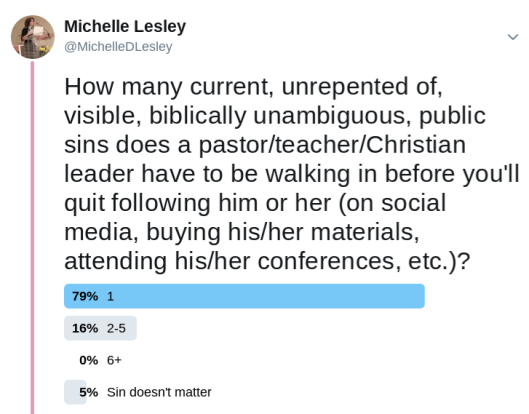
In the wake of Frank Page’s resignation, I asked this poll question on Twitter

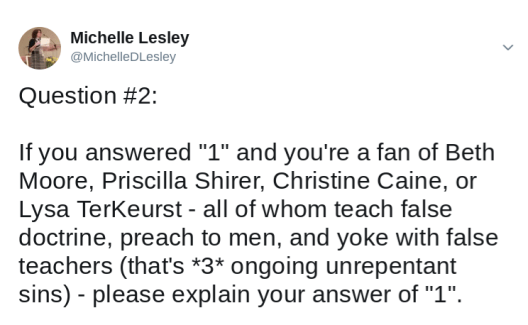
followed by this one

Why are Southern Baptists leaders so quick to – rightly and biblically – oust Frank Page for, as far as we know, one isolated sin which he publicly confessed to and repented of, and yet overlook three major – and much more publicly observable and harmful to Southern Baptists – ongoing sins from pastors and teachers who have been rebuked and refuse to repent? Why, instead of disciplining them for their sin, do those in leadership give them fat book deals, invite them to speak at all the cool conferences, fawn over them on social media, and make them into celebrities?

How many sins will it take to disqualify and discipline these people? Four? Eleven? Ninety-six? Is there any amount of sin these pastors and teachers, and those like them, can commit that will cause those in SBC leadership to pull their materials off the shelves of LifeWay, deny them a seat at the table, and urge them to repent and step down from their positions?

I’ve been a Southern Baptist from the day I was born. I’ve been taught since the cradle roll that if God’s Word says not to do something and you do it anyway, that’s a sin. If God’s Word says to do something and you don’t do it, that’s a sin. And that sin is sin in the eyes of God.

Well is it, or isn’t it, Emperor?

If sin is sin in God’s eyes, why aren’t you treating Beth Moore’s sin like Frank Page’s sin? Why are you rewarding her for her sin and disciplining him for his?

Why does the SBC reward some sins while disciplining others?

The Bible says in James 3:1:

Not many of you should become teachers, my brothers, for you know that we who teach will be judged with greater strictness.

Those who teach and lead bear more responsibility to teach sound doctrine and walk worthy because they are teaching and leading us by example.

Why are all the aforementioned pastors and teachers better examples to us in their rebellion and unrepentant sin than Frank Page was in his repentance of sin?

Why?

Southern Baptist peasants and little children see right through your foolishness on parade on this issue and we want answers. Biblical answers.

Don’t just stand there shivering, suspecting we are right, but thinking, “This procession has got to go on,” and walking more proudly than ever. Go back to the palace. Repent. Clothe yourselves with humility and obedience to Scripture, and come back and lead us rightly. Biblically.

Because the Emperor of Southern Baptist leadership has been naked for far too long.

The Emperor of Southern Baptist leadership has been naked for far too long.


ยนH.C. Andersen Centret (The Hans Christian Andersen Centre). The Emperor’s New ClothesAccessed April 5, 2018.

ยฒI am well aware that this is not the only problem in the SBC that needs to be addressed. It would be impossible to address every issue in one article, so this time I’ve chosen to focus on this one particular issue.

Southern Baptist/SBC

The 11th Commandment: 6 Principles for Boldly and Biblically Breaking It

Originally published July 12, 2019

Every organization has them. Those unwritten rules that everybody seems to know. That newcomers learn through whispered admonitions or perhaps by inadvertently breaking them. The Southern Baptist Convention – and probably a lot of other denominations and parachurch ministries – has them too, and one that more and more people are learning about has, tongue in cheek, been dubbed “The 11th Commandment”:

Thou shalt not publicly criticize
Southern Baptist leaders.

It seems to apply mostly to the upper echelons of SBC leadership: entity heads, celebrity pastors and authors, seminary leaders, the SBC president, the head of LifeWay. Basically anybody with power, position, or name recognition.

And we’re not talking about slandering or lying about someone. Naturally, that would be sinful and worthy of reproof. We’re talking about anything negative or critical even if it’s biblically correct and necessary.

I don’t know anyone personallyยน who has told me he’s/she’s been in this situation, but I’ve heard several stories from reliable sources over the past few years of pastors, people who work for LifeWay, SBC seminary employees, etc., who would like to speak publicly, biblically, and truthfully about sinful situations or unbiblical decisions in the SBC, but are reluctant to do so for fear of losing their jobs or positions. (On a smaller scale, I have heard from plenty of women who have been spiritually abused and bullied into silence, or out of their own churches, by church leadership for daring to speak out against LifeWay-endorsed false teachers.)

Think about that for a minute. This is a purportedly Bible-believing Christian organization in which doctrinally sound Christians are afraid to publicly stand for biblical truth for fear of retaliation from other Christians. Hush up. Cover up. Don’t shine the light of Scripture into the dark corners of the SBC.

Hush up. Cover up. Don’t shine the light of Scripture into the dark corners of the SBC.

This is an organization which, not so many years ago, battled to preserve the concepts of the inspiration, infallibility, and inerrancy of the Bible. A Bible which says:

Walk as children of light (for the fruit of light is found in all that is
good and right and true)

Take no part in the unfruitful works of darkness, but instead expose them. Ephesians 5:8b-9,11

If we truly believe these words are breathed out by God (inspiration), completely trustworthy (infallible), and without error (inerrant), how can there be a culture of back room intimidation in the SBC?

Why isn’t the Scripture we say we believe being obeyed?

Sin. People are sinning and it’s negatively impacting fellow Believers. Just like when I sin it negatively impacts fellow Believers. Just like when you sin it negatively impacts fellow Believers.

Anyoneยน who is helping to create a culture of intimidation against fellow Believers for speaking out in accordance with Scripture is in sin and needs to repent and be forgiven by the grace and mercy of Christ.

But, often, when we’re sinned against, even by brothers and sisters in Christ, the person sinning against us doesn’t repent right away (or sometimes, ever). She continues in her sin against us. Although we might be able to talk to the person and encourage her with Scripture to do what is right in the eyes of the Lord, we can’t change her heart. Only the Holy Spirit can convict someone of sin and give her the gift of repentance.

So, as leaders continue to attempt to enforce the “11th Commandment,” the only remaining decision to be made by those feeling pressured into silence is, “How do I respond to this? Do I speak out and risk my job, my reputation, my church, and a peaceful life for my family, or do I remain silent?”. I would encourage these folks to prayerfully consider the following biblical principles about this issue.

1.
Be Wise

As Ecclesiastes tells us,

For everything there is a season, and a time for every matter under heaven:…a time to keep silence, and a time to speak;

Don’t just let your default response be to keep your head down and your mouth shut regardless of the issue that comes your way. There are times when it is biblically valid to remain silent, but there are also times when we are required by Scripture to speak up, regardless of the personal cost. You must ask God for wisdom to discern how to respond biblically to each situation, and then you must act accordingly, trusting God with the outcome.


2.
Know the Issues

You’ve got to know your Bible and know where Scripture lands on various issues. That goes hand in hand with making a wise decision about whether to speak out or remain silent. Using wine versus grape juice for the Lord’s Supper isn’t a make or break New Testament issue for the church, so you probably won’t want to risk your job over something at that level of adiaphora, but false teachers who are wreaking spiritual havoc on your denomination and the church when you have the power and the platform to biblically denounce it? Speaking out on that issue is all over the Old and New Testament, and you’ll want to be sure you follow Scripture appropriately in your particular situation.


3.
Count the Cost

โ€œIf anyone comes to me and does not hate his own father and mother and wife and children and brothers and sisters, yes, and even his own life, he cannot be my disciple. Whoever does not bear his own cross and come after me cannot be my disciple. For which of you, desiring to build a tower, does not first sit down and count the cost, whether he has enough to complete it? Otherwise, when he has laid a foundation and is not able to finish, all who see it begin to mock him, saying, โ€˜This man began to build and was not able to finish.โ€™ Or what king, going out to encounter another king in war, will not sit down first and deliberate whether he is able with ten thousand to meet him who comes against him with twenty thousand? And if not, while the other is yet a great way off, he sends a delegation and asks for terms of peace. So therefore, any one of you who does not renounce all that he has cannot be my disciple. Luke 14:26-33

Have you counted the cost of being Jesus’ disciple? It’s high. Jesus says you “cannot be My disciple” if you aren’t willing to sacrifice relationships with your closest loved ones in favor of Christ and His Word. If you aren’t willing to sacrifice your physical life. If you aren’t willing to bear your own cross and follow after Him. If you don’t renounce all that you have. That includes your job, your reputation, comfort, ease, security for your family, your church, your friends, book deals, speaking engagements, and sitting at the cool kids’ lunch table with evangelical celebrities. Jesus was despised and rejected by men. Are you, His servant, greater than your Master?


4.
Don’t Miss Your Calling

Then Mordecai told them to reply to Esther, โ€œDo not think to yourself that in the king’s palace you will escape any more than all the other Jews. For if you keep silent at this time, relief and deliverance will rise for the Jews from another place, but you and your father’s house will perish. And who knows whether you have not come to the kingdom for such a time as this?โ€ Esther 4:13-14

Go back and read the entire book of Esther. One of the main ideas of this little book is this:

Any position, power or platform you have is given to you by God, and you are not merely to preserve and protect it, but to steward it for His purposes.

Just like God didn’t make Esther queen as an end in itself, God didn’t give you that job at LifeWay or that position at a seminary for you to protect it at any cost. He gave it to you as a means to an end – His glory, and the furthering of His Kingdom. Esther was willing to risk death, divorce, even banishment to speak up because she realized God had put her in the position of queen as a means of bringing about His purpose of delivering God’s people. Is it possible that’s why God put you in the position you’re in – to give you the voice and platform to speak out so others could be informed and inspired to stand up for biblical truth? Don’t let fear of the consequences rob you of the joy and honor of being used by God to bring about His purposes.


5.
In His Steps

Jesus. John the Baptist. Peter. Paul. Isaiah. Jeremiah. Samuel. Gideon. The Minor Prophets. All of these men (and more) spoke out against ungodliness among the people of God, and all of them paid dearly for it. Maybe some of them were afraid. Maybe some of them were concerned about their families and livelihoods. But all of them put God’s Kingdom and His people ahead of personal concerns and trusted that if they did what was right in God’s eyes, He would take care of them. And the same God who never failed them will never fail you.

Let the boldness and bravery of these men inspire you to be unwaveringly courageous. Let their unflagging resolve inspire you to forge ahead with no turning back. Let the depth of their faith inspire you to take God at His Word and believe Him for everything. We still need heroes of the faith today. Be the next one by following in the footsteps of the heroes of Scripture.

We still need heroes of the faith today. Be the next one by following in the footsteps of the heroes of Scripture.


6.
Share in Suffering

Share in suffering as a good soldier of Christ Jesus.
2 Timothy 2:3

Suffering for the name of Christ and the truth of His Word is such a major theme of the New Testament I couldn’t begin to list all the passages that address it. When you’re a servant of Christ, suffering the same reproach He suffered from the same kind of people for the same reasons isn’t an option. It goes with the territory.

Second Timothy 3:12-13 says:

Indeed, all who desire to live a godly life in Christ Jesus will be persecuted, while evil people and impostors will go on from bad to worse, deceiving and being deceived.

And not only is suffering the reproaches of Christ guaranteed, we need to grasp the fact that this kind of suffering is an honor for the Believer.

And when they had brought [Peter and the apostles], they set them before the council. And the high priest questioned them, saying, โ€œWe strictly charged you not to teach in this name, yet here you have filled Jerusalem with your teaching, and you intend to bring this man’s blood upon us.โ€ But Peter and the apostles answered, โ€œWe must obey God rather than men…and when they had called in the apostles, they beat them and charged them not to speak in the name of Jesus, and let them go. Then they left the presence of the council, rejoicing that they were counted worthy to suffer dishonor for the name. Acts 5:27-29, 40-41

Read the whole account in Acts 5:17-42. Men of God were threatened, imprisoned, and subsequently beaten, by their “denominational leadership” for boldly proclaiming the Word of God to the people of God in the house of God. And those men of God got back up, dusted themselves off, and rejoiced because God Himself had seen fit to bless them with this honor.

We’ve got to radically transform our perspective on suffering for the name and Word of Christ:

  • We need to internalize and embrace the prospect of suffering rather than fearfully kicking against it and avoiding it.
  • We’ve got to fully wrap our minds around the fact that we won’t just suffer at the hands of unbelievers outside the church, we’ll also be persecuted by unbelievers (and sometimes even Believers) inside the church.
  • And finally, we not only desperately need to see suffering the reproaches of Christ as an honor rather than an embarrassment, we need to support, encourage, and stand with fellow Believers who are being persecuted rather than being ashamed to be counted with them.

When you face an “11th Commandment” issue there are some hard questions you need to ask yourself: Am I embracing the prospect of suffering for Christ, or avoiding it? Am I grasping the fact that the attempt by other Christians to silence me on a biblical issue is persecution? Am I ashamed of God’s Word and ashamed of being counted with those who are standing for it? Am I choosing to stay silent because that is the biblically wise decision regarding an inconsequential matter or am I just being a coward? Am I fearing God or fearing earthly consequences? Those are questions only you can answer through prayer and by rightly dividing and applying God’s Word.

Am I choosing to stay silent because that is the biblically wise decision regarding an inconsequential matter or am I just being a coward?


Sometimes it is biblically wise to remain silent, but in the times when Scripture requires us to boldly take a stand for Christ and for His Word, we dare not seek to avoid suffering by caving in to the pressure of the 11th Commandment.

But if the watchman sees the sword coming and does not blow the trumpet, so that the people are not warned, and the sword comes and takes any one of them, that person is taken away in his iniquity, but his blood I will require at the watchman’s hand. Ezekiel 33:6


ยนI am not personally privy to specific examples of specific people intimidating others or being intimidated by someone, so this article is not aimed at any specific person/people. This article is about the principles surrounding the “11th Commandment”.
Christian women, Church, Southern Baptist/SBC

Is the SBC’s Tent Big Enough for ALL Marginalized Christian Women?

Originally published June 22, 2018

It started with Paige Patterson’s gobsmackingly horrible and unbiblical advice to an abused wife to return to her husband. Then it was the lurid remarks he made about a teenage girl, with which he regaled a congregation during a sermon. Next came the allegations of his mishandling of two separate sexual assault cases at two different seminaries.

In response to all this turmoil, Beth Moore added to the conversation some vague stories of various unnamed men in Christian circles who had, in her perception, condescended to her or otherwise not treated her as an equal, leaving the impression that there is widespread, systemic misogyny within modern evangelicalism. Jen Wilkin, from a more biblical – yet, troublingly, similarly vague – perspective, joined the chorus, and has been afforded a wider audience for the “they can’t be pastors, natch, but we need more women in church leadership” platform she has been advancing for the past several years. (Which leadership positions or roles? We’re still waiting for Jen to specify.)

And the icing on the cake was SBC pastor, Dwight McKissic, publicly declaring that the way to “heal” all of these woes against Christian women and “right historic patterns of wrong against women” is to elect Beth Moore as president of the Southern Baptist Convention.

So this nebulous idea has been introduced that Christian women are getting the short end of the stick across the board in evangelicalism (specifically in the SBC) and that the way to fix things – all the way from genuine abuse and rape on one end of the spectrum to women whose feelings have been hurt because they’re not seen as equal to pastors on the other end – is to make sure, somehow, that women’s voices are heard and validated.

That’s a pretty “big tent” idea. And if it’s going to be a big tent, there’s room under there for everybody, right? To be consistent, compassionate, and fair, wouldn’t these folks have to make space for the voices of, and give influential positions to, any Christian woman who feels she’s been diminished? Let’s find out.

Allow me to introduce you to a group of Christian women who have been silenced and brushed aside for years, often by the very same people who are now hypocritically crying out that women need to be heard in order to keep them from being marginalized.

I give you discerning, doctrinally sound, often Reformed, Christian women.

We are women who have been subjected to insults, and accusations of heresy and hatred of the lost, because we hold to the doctrines of grace. We are women who have been attacked by pastors, pastors’ wives, women’s ministry leaders, and fellow church members for pointing out the false doctrine of popular women’s “Bible” study materials and merely asking to properly be taught the Word of God in our own churches. We are women who have been shouted down or ruled “out of order” at denominational meetings for asking that our Christian retailers stop selling materials containing false teaching. We are women who have been forced out of our own churches for taking a biblical stand against women preaching to, teaching, or exercising authority over men in the church. We are women who have been called haters, legalistic, divisive, threats to unity, jealous, and all other manner of slander simply for holding to Scripture and refusing to budge from it.

All this mistreatment of women at the hands of Christian celebrities, denominational leaders, pastors and other church leadership, and fellow church members.

Do we qualify as marginalized? We’ve been hurt, and in many cases, sinned against outright. No church discipline. No redress or recourse. Nobody wants to make sure we have a voice or a place of power – quite the opposite, in fact. A lot of us saw our own pastors hand-wringingly share Beth Moore’s detailing of her grievances against Christian men even as they pushed us and our biblical concerns aside.

Everybody feels sorry for Beth Moore. Who will cry for us?

We don’t want much, just a return to what’s biblical.

We want sound doctrine in the church and solid preaching in the pulpit.

We want this nonsense about a female SBC President – especially a false teacher like Beth Moore – to stop. Not only is it not biblical, it’s a patronizing toss of a trinket or pat on the head attempting to dry the tears of fussy little girls, and it won’t work to solve any of the real problems that are going on.

We want false doctrine off the shelves of LifeWay, and for LifeWay, the ERLC, and others in leadership to stop organizing and promoting conferences and other events headlined by people they have already been informed (yea, as seminary trained pastors and leaders, should know without having to be told) are false teachers. Among the many things Jen Wilkin has rightly said is that we need to promote biblical and theological literacy among Christian women. When you go on a diet, the first thing you do is go through your kitchen and throw out all the junk food. You’ll never start eating healthy if you have an endless supply of candy bars in the pantry. The only way to begin to properly train women in Scripture and theology  is by “putting off” false doctrine in order to “put on” sound doctrine.

We want LifeWay to demonstrate that it actually cares about the spiritual health of women by putting its money where its mouth is. Ridding the shelves of false doctrine and the event docket of false teachers is going to cost LifeWay a lot of revenue. Women who want their itching ears scratched will quickly find another source of false teaching to pour their cash into. There’s not a lot of money to be made in encouraging women to study straight from their Bibles, sit faithfully under the teaching of a doctrinally sound pastor, and humbly serve the local church. Are Christian women worth it to you, LifeWay?

We want a strong doctrine of sin and church discipline to be understood and taught by our pastors and denominational leaders. The fact of the matter is that a woman who has been genuinely sinned against by a man who has abused her is in a different category from a woman whose feelings are hurt because she’s been told she can’t teach a co-ed adult Sunday School class. The first woman needs compassionate brothers and sisters in Christ to come alongside her and walk with her as God begins to heal her body and her heart. The abuser needs to be prosecuted to the full and appropriate extent of the law as well as to be placed under church discipline. The second woman is either in sin and rebellion (in which case she may need to be placed under church discipline) or she just hasn’t been taught God’s Word properly and someone needs to disciple her in that area. To put these two women underneath the same “big tent” just because they’ve both experienced some sort of hurt diminishes and confuses their situations and the solutions that would be biblically appropriate for each.

We want pastors and leaders to herald, praise, and validate the biblical role of women in the church. Women should not be taught only the things we cannot do in the church, we must also be taught what we must do in the church – what only women are uniquely and ontologically gifted by God to do. Women need to hear – particularly from the mouths of pastors and denominational leaders – the vital necessity of women discipling other women, women training the church’s children in the Scriptures, women serving in hospitality and mercy ministries, women properly using their administrative gifts, and so much more. Train us to teach. Equip us to serve. Encourage us to use our gifts in obedience to Scripture and for the glory of God.

We want men – from the heads of our denominations to the newly saved sinner in the pew – to step up and be godly men. We desperately need you to biblically and fearlessly lead the church. Don’t be afraid to stand up and put your foot down squarely on Scripture. Even if it makes you unpopular. Even if it rocks the boat at church. Even if people leave and never come back. As godly women, we can’t do our job if you’re not doing yours.

So how about it, brothers and sisters who are crying out for Christian women to be heard? Do doctrinally sound women get a seat at the table? Do we get to be heard? Will anything be done to correct the mistreatment we’ve received?

Do doctrinally sound women get a seat at the table? Do we get to be heard? Will anything be done to correct the mistreatment we’ve received?

Or are there only certain women you want to hear from? Women who fit the popular social narrative. Women the world and most of the church will applaud you for listening to. Solutions that do more to glorify people than to glorify God.

Just how big is that tent…really?