Mailbag

The Mailbag: Potpourri (Teaching hubby the Bible… Generational sin… Blood moons… God honors women preaching?… Remarriage forbidden)

Welcome to another โ€œpotpourriโ€ edition of The Mailbag, where I give short(er) answers to several questions rather than a long answer to one question.

I like to take the opportunity in these potpourri editions to let new readers know about my comments/e-mail/messages policy. Iโ€™m not able to respond individually to most e-mails and messages, so here are some helpful hints for getting your questions answered more quickly. Remember, the search bar (at the very bottom of each page) can be a helpful tool!

Or maybe I answered your question already? Check out my article The Mailbag: Top 10 FAQs to see if your question has been answered and to get some helpful resources.


A comment left on my Rock Your Role FAQs article…

How would this apply within marriage? My husband does not read the Bible..he claims to believe in God, but I donโ€™t actually see him seeking. Is it wrong for me to share with him what I learn or read in my Bible? Thank you for your advice!!

I know that having an unsaved or less spiritually mature husband can be really difficult. I’m sure this is a question many of my readers are struggling with.

When you say, “How would this apply within marriage?” I’m not really sure if “this” means a specific question and answer within that article or if “this” means the biblical prohibition against women teaching men, in general. I’m going to go with the latter since I can’t guess the former. :0)

The biblical prohibition against women teaching the Bible to men has a very specific context: the gathering of the church body. Your marriage is not the gathering of the church body.

It is perfectly fine and biblical for you to share what you’re learning from the Bible with your husband if he is open and receptive to it. But, and this is important, it is also perfectly fine and biblical for you not to share what you’re learning from the Bible with him if he is not open and receptive to it, if it makes him angry, or if he tells you to stop nagging or preaching at him.

A lot of women in the New Testament church were in the very same position. They were saved, and their husbands were not. First Peter 3:1-6 was written just for them, and for you. I would recommend studying that passage as well as 1 Corinthians 7:16, Ephesians 5:22-33, and Proverbs 31:10-31 to guide your own behavior as a godly wife. And, if you think it would be helpful, you may want to work through my Bible study on biblical womanhood.

My article The Mailbag: Can I share the gospel with my unsaved husband? is another good resource. If you need help presenting the gospel to your husband, check out the What must I do to be saved? tab in the blue menu bar at the top of this page.

One more suggestion: Think about making an appointment with your pastor for some biblical counsel on being a gospel influence on your husband. You may want to also ask him to point you to (or you may already know) a godly older woman in your church who has walked faithfully through the situation of having an unsaved husband, and who can disciple you through this.


Do you have any information about the generational sin/curses teaching? Iโ€™d love to understand if this is a false teaching and if it isโ€ฆunderstand what the Bible really says. I donโ€™t buy into the fact my great great grandma was sinful and that is why someone in the family is messed up.

You’re correct, this idea is diametrically opposed to what Scripture teaches. Certainly our children can be hurt or negatively impacted by the sins we commit. They can learn sinful behavior from watching us sin. And we are all sinners by nature. But children don’t genetically inherit a particular sin(s) – say, for example, profanity or adultery – from their parents. And God doesn’t punish us for the sins of our parents or ancestors.

The absolute best resource for refuting this false idea is Ezekiel 18. It is so beautifully clear and such a wonderful picture of the gospel smack dab in the middle of the Old Testament. Give it a good study.

Additionally, we released a podcast episode a while back called What Do We Do with the Guilt of Generational Sin? that may help.


Does โ€œThe moon turning to bloodโ€ refer to what we consider a โ€œblood moonโ€?

Not as it pertains to being a sign of Jesus’ return, no. I think you’ll find this article and this article to be helpful.


Do you think it’s possible for God to “honour” a women’s preaching that is bringing people to Christ?

This is really two separate questions about women preaching. Let’s break it down:

1. Can God graciously save someone, despite the fact that he’s sitting under a woman who’s sinning by pretending to be a pastor? Yes. He also saves people who are currently Mormons, currently being abused, etc. God can save anyone despite someone else’s sin.

2. Does the fact that God saves someone who’s under the influence or authority of someone who’s sinning mean that God approves of or honors the sin being committed? No. God doesn’t honor people for sinning.

God doesn’t honor or approve of Mormon false teachers just because someone happens to hear enough actual Bible to get saved while still in Mormonism. Mormonism is still idolatry, and that Mormon leader is still committing the sin of teaching false doctrine. Or, let’s say a pastor is secretly abusing his son. If the son gets saved during one of Dad’s sermons does that mean God honors or approves of the abuse? Of course not. It’s a display of God’s mercy and grace that God still saves people despite other people’s sin.

The same applies to someone who gets saved despite sitting under a woman who’s sinning by pretending to be a pastor.

Additionally, granting for argument’s sake that she’s actually preaching the biblical gospel, the fact that the woman “pastor” got that part right doesn’t excuse or make up for her sin of rebelling against God’s Word. If I work in a soup kitchen all week long, but every Saturday I go out and murder somebody, we know that my good works during the week don’t outweigh, excuse, or make up for the sin of murder. I still need to repent of being a murderer, and the woman “pastor” still has to repent from rebelling against God’s Word regarding her role in the church.


I was widowed a year ago, and a divorced man asked me to marry him but my pastor said it was absolutely forbidden. Can you please help me with this issue? The entire world is divorced!

Let me first offer my condolences for the loss of your husband. I can’t imagine how difficult that must be.

Have you asked your pastor to explain why* he said this? I’m not exactly sure of his reasoning, so let me just offer a few general thoughts.

One reason your pastor might have said this is that he holds to what’s called the permanence view of marriage. This view essentially says there are no biblical grounds for divorce (for anyone) and, thus, no biblical allowance for remarriage.

On the other hand, he may believe (as I, and many other Christians do) that, while reconciliation of a marriage is always the first and best goal, and that, in most cases, divorce is a sin, there are certain circumstances (chiefly adultery and abandonment) in which the Bible allows for divorce as a last resort. If that’s the case, depending on the circumstances of your gentleman friend’s divorce, your pastor may be saying that his divorce was not biblical, and, therefore, the two of you should not marry.

Finally, your pastor may have reasons aside from the divorce that would cause him to tell you not to marry this gentleman. Perhaps your pastor knows that he isn’t saved, that he is cheating on you, that he’s engaging in criminal activity, etc. I hope that’s not the case, but that’s the only other possibility I could think of.

I would suggest you talk to your pastor about this, hear him out on his reasoning, and compare his reasoning to rightly handled, in context Scripture. It could very well be that he’s offering you good, biblical counsel. Or…not.

*Readers, I’m not faulting anyone for asking me a question like this, but I often receive questions about why a certain person – whether it’s a false teacher, your husband, your pastor, a friend, whoever – did or said something, or what he meant by what he said or did. Generally speaking, I have no way of knowing why a particular person said or did a particular thing or what it meant. I can only speculate. If you want to know why someone did or said something, or what he meant, it’s best to go to that person and ask him or her directly.


If you have a question about: a Bible passage, an aspect of theology, a current issue in Christianity, or how to biblically handle a family, life, or church situation, comment below (Iโ€™ll hold all questions in queue {unpublished} for a future edition of The Mailbag) or send me an e-mail or private message. If your question is chosen for publication, your anonymity will be protected.

Bible, Bible Study

My Favorite Bible & Study Apps

Many of my readers have asked1 for recommendations of good apps for reading and studying the Bible. These aren’t the only good ones out there (I’m sure there are hundreds) but they’re a few of my favorites, and they’re all free.

BibleGateway– This app has the whole Bible in many different translations and languages. Several of the translations are also available in audio format so you can listen to the Bible as you drive or do other activities. Additional helpful features include footnotes, cross references, and parallel panes for viewing a passage in several different translations at once. There are Bible reading plans and other study resources such as commentaries, Bible dictionaries, encyclopedias, and study Bibles. Not all of the devotions and “translations” (e.g. The Message, The Voice) are trustworthy, but if you stay away from those, Bible Gateway is excellent.


Faithlife Study Bible– A wonderful study Bible with copious notes, charts, articles, maps, photos, and even videos. It comes with several free translations (the Lexham English Bible is their default translation, and a good one), an audio feature, and community groups you can join.


The Study Bible– A great little Bible study app from Grace to You. The entire text of Scripture (ESV, KJV, or NASB), search, audio, highlighting, notes, and you can synchronize your account across devices. Access John MacArthur’s daily devotional and tons of sermons. And, if you’ve always wanted a MacArthur Study Bible, but cost was an issue, all of the study Bible notes and features are available as an add on for just $5.99.


Bible Hub– Bible Hub has so many helpful resources I tend to forget that you can just read the full text of the Bible on it, too (in dozens of different translations – mostly decent ones). Tons of commentaries, sermons and thematic/topical outlines to accompany every Scripture reference, daily devotions from Spurgeon, Tyndale, and others, Strong’s lexicon, parallel passages and chapters, interlinear, Bible book overviews and outlines, a timeline of the Bible …and so much more. It’s like having a theological reference library on your phone. There are literally thousands of resources – impossible for me to vet them all – so if you choose a devotion, commentary, sermon, etc., be discerning.


Blue Letter Bible– Sort of the “diet” version of Bible Hub, but it still has a number of great features. Several translations and languages are available, notes, highlights, audio, parallel, reading plans, interlinear, sermons, commentaries, Bible dictionaries and encyclopedias, and much more. This one also has an interesting feature: you can auto scroll (instead of scrolling manually) as you read through the text of Scripture. I imagine this might be very helpful for folks with arthritis, tremors, or limited manual dexterity. Be discerning about any sermons, commentaries, etc. you might choose.


The Olive Tree Bible– A good, basic Bible app. The Bible portion of the app is ESV default, though there are other downloadable versions. Good cross references, audio Bibles, and a number of Bible reading plans are included along with standard notes, highlights, and other features.


Literal Word– Literal Word is a very simple, streamlined, NASB-only (New American Standard Bible) app. It has the typical notes and highlighting features, but that’s basically it, except for one handy feature: integrated Hebrew and Greek lexicons. What does that mean for you? Simply click on a word as you’re reading, and the info box will tell you the Greek or Hebrew word and its definition(s). A great app if NASB’s your jam, and you just want to read the Bible without all the bells and whistles.


Legacy Standard Bible– This one’s great if you’re an LSB geek. But even if you haven’t had the pleasure yet, this is a super, no-frills Bible reading app that will help you get acquainted with this new, rock solid translation. The full New and Old Testaments are now available (LSB only). In addition to standard notes and highlighting, the LSB app does have a unique interlinear feature available, as well as a handy word click Greek and Hebrew lexicon feature. Syncs with your Accordance account if you’ve got one.


ReadingPlanโ€“ All Bible reading plans, all the time. There are literally hundreds of plans to choose from (there was no way I could vet even a fraction of them, so be very discerning) in this great little app. Download the one you like, set your start date, link up your favorite online Bible, and start reading. You can even sync and share your progress and set a daily reminder for reading.


1Some of the requests were from readers who wanted an alternative to YouVersion (Bible.com) and The Bible Recap, neither of which I would recommend.

Complementarianism

Throwback Thursday ~ Putting on the “You Can!” of Complementarianism

Originally published October 18, 2019

It never really hit me until I started teaching the book of 1 Timothy how many instructions in the pastoral epistles pertain to women, and how weighty those instructions are. The pastoral epistles are the โ€œpolicy and procedure manualsโ€ for the church, and, far from relegating the ministry of women to nothing more than crafts and tea parties while the men do all the โ€œimportantโ€ stuff, you come away with the impression that a healthy, well-balanced church actually depends on godly women working hard to carry out the ministries that God has uniquely created and gifted us to fulfill, alongside men fulfilling their own ministries.

These epistles donโ€™t view โ€œwomanโ€™s workโ€ around the house of God as trivial or menial, but as a high and holy calling. Vital. Necessary. Honorable.

But is that the lofty perspective of the biblical role of women that the local complementarian church is conveying to its female and male members? Are we, especially those of us in womenโ€™s ministry, proactively teaching that the calling of motherhood or the task of discipling other women or serving those in need is qualitatively just as imperative and noble as the calling of pastor or elder?

Intentionally or not, the egalitarian movement has maneuvered biblical complementarians into constantly playing defense. Their offensive squad keeps moving the ball forward by offering women a no holds barred buffet of powerful and prestigious ministry positions. Our defensive line correctly and biblically pushes back with, โ€œNo, the Bible says women are not to โ€˜teach or to exercise authority over a manโ€™  in the church setting.โ€ But often, only two or three members of our offensive squad are dressed out to play, and they never get off the bench and into the game. And as any football fan knows, you have to have a good defense and a good offense if youโ€™re playing to win.

Egalitarians offer women โ€œyou can,โ€ but all too often all we complementarians have offered godly women yearning to serve is, โ€œyou canโ€™t.โ€ Where is the big, beautiful, biblical showcase of complementarian โ€œyou canโ€?

Not long ago, I was teaching a group of ladies the biblical process of putting off the old self and putting on the new self in Ephesians 4:20-32. We explored how interesting it was that every โ€œdonโ€™tโ€ in the passage was coupled with a โ€œdo.โ€ We donโ€™t just put off lying, we put on proactive truth-telling instead, and so on. Nature abhors a vacuum in the physical realm, and it would seem this is true in the spiritual realm as well. When we subtract the ungodly, we must replace it with the godly. If we donโ€™t, something will rush in to fill the void thatโ€™s been created, and that “something” isnโ€™t usually biblical or fruitful. 

So how can we shift the perspective in our churches from โ€œyou canโ€™tโ€ to โ€œyou can,โ€ and create an atmosphere, not merely of โ€œput off,โ€ but also โ€œput onโ€? How can we get our offensive team suited up, on the field, and moving the ball toward the goalpost while at the same time retaining a strong defense?

We can, so to speak, make complementarianism great again. 

As I studied 1 Timothy 5, I was struck by Paulโ€™s description of women who are โ€œtruly widows.โ€ These are women who have spent their lives being busy and intentional about the work of the Lord in their homes and in the church. They adorned themselves with the good works proper for women who profess godliness, and they were honored and revered for it by the church. I didnโ€™t come away from this passage with the feeling that these women were frustrated, oppressed, or seen as โ€œlesserโ€ by the church because they werenโ€™t allowed to teach or exercise authority over men. I came away from this passage thinking, โ€œThose women were awesome. Thatโ€™s the kind of woman I want to be.โ€

What would the climate in our churches look like if womenโ€™s ministries and the church at large recaptured that same reverential posture and purposefulness toward biblical womanhood? If, instead of teaching the biblical role of women strictly as, โ€œYou canโ€™t eat the fruit from this apple tree,โ€ we followed that admonition with a grand tour of the Garden, focusing on the delicious fruit of the pear tree, the cherry tree that needs a good pruning, the fig tree just waiting for the right woman to come along, harvest its fruit, and make some preserves, the banana tree that needs an expert in fertilizers, and the orange tree dying for someone to water it?

In my experience, what happens in churches of that climate is that – just like the godly widows of 1 Timothy 5 – women are so busy and fulfilled tending the other trees of the Garden, that they have neither the time nor the desire to go apple picking. 

May our churches strengthen themselves and grow to more robust spiritual health by proactively encouraging Christian women to joyfully throw ourselves into the godly โ€œgood works which God prepared beforehand, that we should walk in themโ€ – the biblical โ€œyou canโ€ of complementarianism.


Additional Resources

Rock Your Role: Jill in the Pulpit

Let Me Count the Ways: 75 Ways Women Can Biblically Minister to Others

Unforbidden Fruits: 3 Ways Women MUST Lead and Teach the Church

Servanthood

The Servanthood Survey

Psalm 119 Bible Study

Psalm 119: The Glory of God’s Word ~ Lesson 6

Previous Lessons: 1, 2, 3, 4, 5,

Read Psalm 119:65-80

Recall the things from the introductory lesson that you wanted to keep in mind as you study the text of Psalm 119.

Don’t forget to read in complete sentences instead of stopping at the end of each verse.

Recall the themes you’ve been noticing in Psalm 119. Watch for those themes to be repeated in today’s and future passages. You may wish to make a list of those themes to refer to throughout this study.

Questions to Consider

1. Review your notes from last week’s lesson. Does that passage relate to this week’s passage? How? Do you notice any repeated words, thoughts, or themes?

2. In lesson 5, we saw the psalmist “holding God to His promises”. What was the outcome of that according to 65?

3. Previously, the psalmist has said he “loves,” “treasures,” “desires,” etc. God’s commands. Verse 66 is the first and only place in Psalm 119 in which he says, “I believe in Your commands.”. What does it mean to “believe in” God’s Word? What is the posture of heart of someone who believes in God’s Word? Does believing God’s Word require accompanying action on the part of the believer? If we don’t act in response to and in accordance with God’s Word, do we really believe it? How do our actions demonstrate our belief in God’s Word?

4. Examine what the psalmist is saying about “affliction” in 67, 71, 75 in light of 69-70, 78. Is he talking about a) God disciplining him for his sin, b) the type of persecution from others that results from living a godly life, or c) “regular” life suffering (i.e. illness, being the victim of a crime, losing your job due to downsizing, etc.)? It may help to examine the Hebrew word ืขึธื ึธื” (สฟฤnรข), which is translated as “afflicted” here.

Why did the psalmist consider this affliction to be “good” for him? Because it was a pleasant experience? Because he was a martyr, or because his suffering earned him brownie points with God? Notice that he gives the reasons in the second half of verses 67 and 71. What did God accomplish in the psalmist’s life through this affliction? What did the affliction teach him about God’s Word and about how to respond to God’s Word?

What did the affliction teach the psalmist about God Himself (68)? Consider not only verse 68, but also these passages. What does suffering teach us about God and His Word? Respond to this statement in light of all of these passages: “Even in suffering, God is good, He is doing good, and the ultimate results are good.”

What is the psalmist’s response to the result of the good work (teaching him to learn and obey God’s Word) God did in his life? (72)

Notice the wording of 75. Some people think the existence of suffering and evil demonstrates that God is either powerless to stop it, or that He isn’t good because He doesn’t stop it. This is called theodicy, or “the problem of evil”. Others think everything “good” that happens is from God and everything “bad” that happens is from Satan. What does verse 75 tell us about God’s sovereignty, power, and goodness in affliction? Why did God cause the psalmist – obviously a godly man who loved the Lord and was pursuing holiness – to be afflicted? Why does He cause godly people today to be afflicted? How have you seen God’s goodness and sovereignty in your own suffering?

5. Notice the clear line of distinction between those who fear the Lord and “the insolent” (those who don’t fear the Lord) in this passage. Identify the verses that describe each of these groups. How does the psalmist characterize these two types of people? Have you found this characterization to be true in your own life?

6. Consider the concept of shame in verses 78 and 80. What role does sin play in shame? Compare what you’re seeing about shame in this passage to these passages. Why is it biblically appropriate for lost people to feel the weight of their shame before a holy God? Why is it biblically inappropriate for saved people striving for holiness to stand in shame before God? You may (especially if you’re saved and struggle with guilt and shame) wish to read my article Guilt and Shame- Burden or Blessing?


Praying Psalm 119

Have you ever tried praying the psalms? I want to encourage you to try praying part of Psalm 119 back to God each week of this study. (If you’re familiar with my other studies, this will take the place of the weekly “Homework” section.)

The psalms are uniquely suited for praying back to God, both verbatim and conceptually, because they are often written as prayers – as though the psalmist is talking to God. Did you notice that about today’s passage? In which verses?

What is a concept or thought for your own life that the Holy Spirit impressed on your heart or convicted you about from today’s passage? Is there a particular verse(s), or maybe the whole passage, that you would like to pray back to God verbatim? Whatever your “prayer point” from today’s lesson, pray it at least daily until we get to the next lesson.


Suggested Memory Verse

Complementarianism, Mailbag

The Mailbag: Women teaching men- Questions from a young reader

I received this very astute line of questioning from a young lady who left a comment on one of my articles. The comment and questions were rather lengthy, so I’ve broken it up into portions in order to answer it in an organized way. If you need to read the entire comment, uninterrupted, for context or ease of understanding, scroll down, reading only the portions in bold.


Hi! Just to let you know, though it may seem, I have no intention of being rude in this question, and genuinely want to know your response to this. I am only in 9th grade, so I have a lot to learn, and want to know what you think about my comment...Thank you, and I am very curious to find out what you think about my questions and things that I might have misunderstood or missed.

That’s awesome! I wish I had been thinking as deeply about these things as you are when I was in the ninth grade. And, rest assured, your questions didn’t seem rude to me at all. I’m so glad you want to learn! I hope you’ll understand that my answers aren’t meant to be rude either, although they may not be quite what you’re expecting or wanting to hear.

You didn’t mention whether or not you’re a Christian or what your church background, if any, is, so let me just start off by saying, if you’ve never been genuinely born again, my answers might not make much sense. I would encourage you, even if you’re pretty sure you’re saved, to examine the materials at the What must I do to be saved? tab in the blue menu bar at the top of this page before moving ahead.

I was just wondering, if women are not allowed to teach men, and you are a woman and this blog is public to men and women, then arenโ€™t you technically providing biblical insight and evangelizing to whatever gender is reading this to inform them of the Bible?

Nope. I’ve answered that question in detail in my article Are Female Bloggers Violating Scripture by โ€œTeachingโ€ Men?

Additionally, “evangelism” and “teaching” (“providing insight” isn’t really a biblical category) are two different, separate things. You might find our podcast episode Women Preaching the Gospel? helpful for understanding the distinction.

Also, the book of Timothy, like you said, was a letter written from Paul to Timothy, so this was just the teachings that Paul gave to Timothy as instructions for the churches, and not necessarily coming from God.

I’m afraid that’s one of the things you’ve misunderstood. This wasn’t just a letter from one human being to another. The words in 1 Timothy, just like every word of every book of the Bible are from the very lips of God Himself. Second Timothy 3:16 tells us that “All Scripture is breathed out by God.” There aren’t some parts of Scripture that are from God and others that aren’t. It all comes from God, from Genesis 1:1 to Revelation 22:21.

First and second Timothy and Titus are what we call the pastoral epistles (“epistle” means “letter”). That means they are God’s instructions, written through His human instrument, Paul, to Timothy and Titus and every pastor who came after them, about how to run the church.

I know Paul was a prophet and one argument could be that he got this information from God,

No, Paul was not a prophet, he was an apostle. And, as I discussed above, the Bible says that all Scripture is breathed out by God, so “Paul got his information from God” is the only argument that can be made, especially for Christians. Because, for Christians, the Bible is our authority on what to believe, not human arguments, opinions, and ideas.

but even prophets (besides Christ) make mistakes in their instructions to others,

I’m afraid that’s also incorrect. There’s not a single prophet in the Bible who, when speaking as a prophet to people on God’s behalf ever made one iota of a mistake about what He said. There were false prophets (who received the death penalty for saying they spoke for God when God had not really spoken to them), but none of God’s true prophets – like Isaiah, Jeremiah, Micah, Habakkuk, etc. – ever got anything wrong or “made mistakes in their instructions to others” when speaking on behalf of God.

such as Abraham, who instructed people to be stoned for certain sins,

I think you mean “Moses” here. Abraham wasn’t a prophet, and I don’t recall any instance in Scripture in which Abraham “instructed people to be stoned for certain sins”. Moses didn’t either. God did. God gave Moses the law on Mt. Sinai, and Moses wrote it down and taught it to the people.

and you can see that it was unlawful in Godโ€™s eyes

I’m sorry, but that’s incorrect as well. Since God is the One who gave the laws about stoning people for certain sins, He would never have said that someone properly obeying His law was doing something unlawful. That would be like God saying He was wrong when He made that law. And, of course we know that God is never wrong.

and you can see that it was unlawful in Godโ€™s eyes when Jesus told the priests about to stone Mary of Magdala that they should not stone her because they have sinned as well and God sees all sins as the same.

I think you’re talking about the story of the adulterous woman in Luke 7-8, right? Again, I’m sorry, but there are many things that need to be corrected here:

  • Stoning a woman caught in adultery was not “unlawful in God’s eyes”. It was lawful. God is the one who gave this law. The scribes and Pharisees correctly cited the law in 8:5.
  • Jesus wasn’t speaking to the priests, He was speaking to the scribes – experts in the law (which was an important point of this passage) – and Pharisees.
  • The text does not say the unnamed woman was Mary Magdalene.
  • Look carefully at the passage. In which verse does Jesus say “they should not stone her”? Answer: He didn’t say, “Don’t stone her.”. On the contrary, He said that they could commence with the stoning as long as whichever one of them was without sin cast the first stone.
  • He also didn’t say they couldn’t stone her because “they have sinned as well”. Every lawful stoning that has ever taken place on planet earth was carried out by sinners, because (except for Jesus) every human being is a sinner.
  • The Bible doesn’t say that God “sees all sins as the same” (In fact, we can see in the way that God deals with various sins in various ways throughout Scripture that this isn’t true.), so Jesus would never have said this nor given it as a reason that these men should not have stoned this woman.

Jesus didn’t say the law against stoning an adulteress was wrong. That would have been equal to saying God was wrong for giving that law. He didn’t tell the men not to obey the law, either. The key to understanding this story is in verses 4-7:

4 they said to him, โ€œTeacher, this woman has been caught in the act of adultery. 5 Now in the Law, Moses commanded us to stone such women. So what do you say?โ€ 6 This they said to test him, that they might have some charge to bring against him. Jesus bent down and wrote with his finger on the ground. 7 And as they continued to ask him, he stood up and said to them, โ€œLet him who is without sin among you be the first to throw a stone at her.โ€

They didn’t care about this woman or what happened to her. They didn’t care about the man who was sinning right along with her. They didn’t care that this sin wrecked the man’s and woman’s lives. They didn’t care that God’s law had been broken. They didn’t care that adultery grieves the heart of God. They didn’t care.

All of those things were just a means to an end for them. All they cared about was trying to get the advantage over Jesus. To trick Him into saying something they could use against Him so they could discredit Him or bring Him up on charges with the Sanhedrin (Jewish court). And they were using God’s precious and holy Word as a tool to accomplish this evil goal. They were blasphemously using God’s own Word against Him.

That is the entire point of this story. God’s Word is His representation of Himself to us. It is our lifeline to Him, because it is how we come to know Christ as Savior. It should be revered as high and holy, not twisted and abused for wicked purposes.

This is just one example of many things that Godโ€™s prophets have taught wrongly.

No, none of the things you’ve mentioned, nor the corrections I’ve given, have demonstrated that any true prophet of God has ever taught anything wrong when it comes to prophecy or commands of Scripture. Second Peter 1:20-21 tells us:

…knowing this first of all, that no prophecy of Scripture comes from someone’s own interpretation. For no prophecy was ever produced by the will of man, but men spoke from God as they were carried along by the Holy Spirit.

So, since times were different in the first century and women were not seen as important to men, couldnโ€™t this have been something Paul told Timothy to do based off of his own understandings culturally?

No. Again, 1 Timothy is a passage of God-breathed Scripture, not Paul’s personal human opinion. It was not based on Paul’s human understanding (see 2 Peter 1:20-21, above), culturally, or in any other way. This is God’s command to pastors, based solely on God’s reasons.

And God kindly shares those reasons with us in verses 13 and 14 of 1 Timothy 2:

11Let a woman learn quietly with all submissiveness. 12 I do not permit a woman to teach or to exercise authority over a man; rather, she is to remain quiet.

13 For Adam was formed first, then Eve; 14 and Adam was not deceived, but the woman was deceived and became a transgressor.

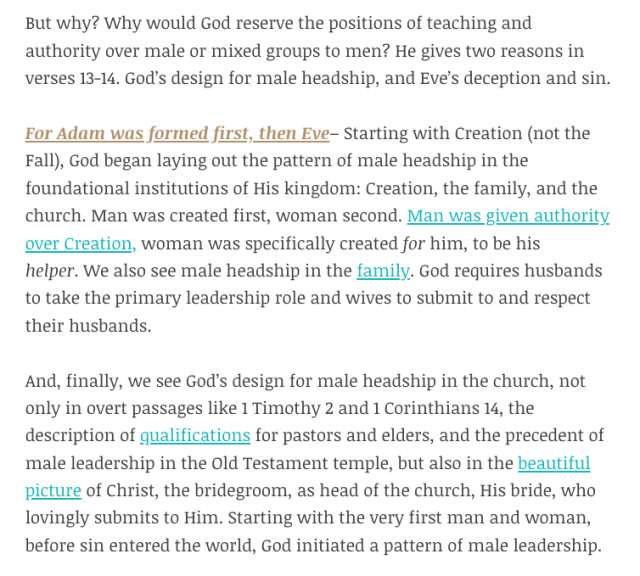
God gives us two reasons for His command that women are not to teach or exercise authority over men in the gathering of the church body: the creation order and pattern of male headship (13), and the fact that the woman was the one who was deceived into sin (14).

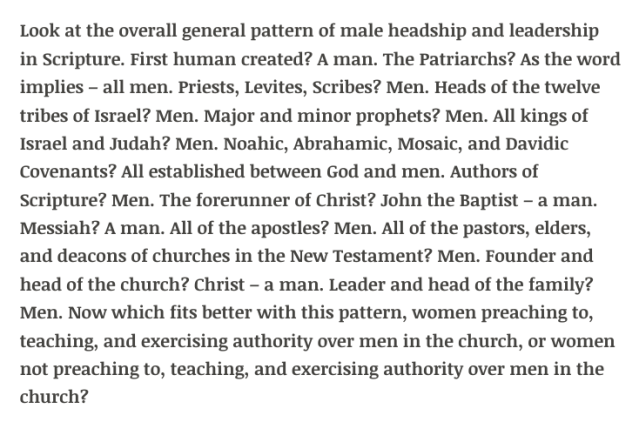
That’s why. Not culture, not Paul’s personal opinions, not because men didn’t value women at the time, not because the women in that particular church at that particular time were unruly or false teachers, not for any of the man-made theories that people have come up with. God tells us exactly why He made this rule for the church in verses 13-14. I’ve discussed this in greater detail in my articles Rock Your Role: Jill in the Pulpit and The Mailbag: Counter Arguments to Egalitarianism. Here are a few of the pertinent excerpts:

You’ve asked some really great questions here, and your reasoning skills are sharp. It was my pleasure to serve you by answering your comment. Keep asking questions, studying, and learning all God has to teach us through His authoritative, inspired, all-sufficient written Word.


If you have a question about: a Bible passage, an aspect of theology, a current issue in Christianity, or how to biblically handle a family, life, or church situation, comment below (Iโ€™ll hold all questions in queue {unpublished} for a future edition of The Mailbag) or send me an e-mail or private message. If your question is chosen for publication, your anonymity will be protected.