Favorite Finds

Favorite Finds ~ June 12, 2018

Here are a few of my favorite recent online finds…

I honestly teared up a couple of times listening to the Get Up and Eat! with Rachel Jankovic episode of Sheologians. Sometimes I feel like the lone voice in the wilderness crying out for women to ditch the canned Bible studies and simply pick up the Bible and study it for themselves. It was nice to hear somebody else saying it.


I love the designs Scripture Type creates for Bible verses and Christian quotes. They have lots of lovely items you can purchase, and they also have a Freely Given page where they post designs that are free to download for use as wallpapers, lock screens, and printable coloring pages. It’s a great way to help you memorize verses!


If you found helpful the put off – renew your mind – put on concept for changing behavior from my recent article The Christian Introvert: Putting Off Social Anxiety, Putting On Serving Others, then you’re really going to like Clint Archer’s recent article series over at The Cripplegate. In his Just Stop It articles, he applies the same biblical concept to various sins you might be struggling with:

Just Stop It: Instructions on how to repent

Just Stop it, Part 2: How To Repent Of Lying

Just Stop it, Part 3: How To Repent Of Anger

Just Stop it, Part 4: How to Repent of Stealing

Be sure to subscribe to or follow The Cripplegate for any future installments Clint might write.


Are you a Southern Baptist (or a curious onlooker) who couldn’t make it to the annual meeting in Dallas this year? Keep up with what’s going on via live stream or at your convenience on demand. And please don’t forget to fervently pray for the SBC. We are facing some serious issues in these days. The Southern Baptist Convention annual meeting is being held today and tomorrow (June 12-13).


One of those serious issues we’re currently dealing with in the SBC is that a vocal few are pushing the idea of electing a female president (Beth Moore’s name has been floated). Pastor Tom Buck has written a phenomenal series of articles dealing with this issue from Scripture. Even if you’re not Southern Baptist, you will find Pastor Buck’s careful exposition of 1 Timothy 2:11-15 extremely helpful in his articles Will the Next SBC Resurgence Include a Redefining of Complementarianism?

Part 1     Part 2     Part 3     Part 4 

Mailbag, Sanctification

The Mailbag: How can I grow to love Jesus more?

I have been a born again Christian for many of years. But how do I get so in love with him?? Please can you help me.

This could possibly be my favorite Mailbag question ever. How can I love Jesus more? What a sweet and precious thought. I should be asking that question every day. We all should.

The first thing you will have to determine in your own heart, through prayer and study of the Word, is exactly what you mean by your question. Do you mean:

“I’m a Christian, but I consistently have no affection for Christ whatsoever. I just don’t really care about Him one way or the other, but I see other Christians who seem to genuinely love Him. How can I get those feelings for Jesus?”

or:

“I’m a Christian. I love Christ, but I want to develop an even greater love for Him. How do I do that?”.

If your meaning is closer to the first question, I would counsel you to examine yourself to see if you are truly saved as 2 Corinthians 13:5 instructs us. Except in extreme cases of emotional or mental disorders, someone who has genuinely been born again should have some sort of affinity, love, gratitude, and affection for Christ because of who He is and all He has done for her. If you honestly don’t give a flip about Jesus, that’s a big red flag signaling that you might not be saved, even if you think you are. I would strongly recommend working through my Bible study Am I Really Saved? A First John Check Up as well as setting up an appointment with your pastor, a trusted, spiritually mature Christian friend, or a biblical counselor for counseling.

If you’ve compared your heart and life to Scripture and you’re certain you’re a genuinely regenerated Christian who wants to grow in the love she already has for Jesus, it’s simple. Just do what His Word says:

Study Your Bible

I would urge you to put away all of the “canned” studies (books, DVDs, etc. written by others) and simply pick up your Bible, choose a book, start at the beginning, and work your way through to the end. I cannot stress enough how much more rewarding studying the Bible for yourself is than relying on someone else’s materials, and how much closer it will draw you to Christ. If you’ve never studied the Bible on your own before, try taking notes on the text, or use one of my studies (see the “Bible Studies” tab at the top of this page) as “training wheels” to get started. Here are a few other resources that may help:

Bible Study Articles and Resources

10 Simple Steps to Plain Vanilla Bible Study

Rightly Dividing: 12 Do’s and Don’ts for Effective Bible Study

Bible Reading Plans

You’re Not as Dumb as You Think You Are: Five Reasons to Put Down that Devotional and Pick Up the Actual Bible

Pray

You can’t grow in your love for Someone you’re not spending time with. Set aside a designated, uninterrupted time of prayer each day in which you can take all the time you need to pour out your heart to God, worship Him, praise Him, and thank Him. But talk to the Lord throughout the day, too. “Lord, I have to discipline my child right now. Help me do it in a godly way.” “Father, thank you that these peaches I needed were on special today!” “I see Julie coming toward my office. Lord, she’s so hard to love. Please help me show her Your kindness.”

Resources on Prayer

Basic Training: 8 Things You Need to Know about Prayer

After this Manner, Therefore Pray

Can We Talk?

Be a Faithful Church Member

Find a doctrinally sound church that preaches and teaches the Bible well. Become a member. Faithfully attend worship service and Sunday School (aka: small group, Bible study, etc.) each week unless an emergency comes up. Find a place to serve, and get plugged in. Make friends with other members of your church and spend time in fellowship with them outside of church activities. Being fed the Word, serving the Body of Christ, and bonding with brothers and sisters in Christ will build your love for Him.

Basic Training: 7 Reasons Church is Not Optional and Non-Negotiable for Christians

All Word and No Play: The Importance of Fun and Fellowship in the Doctrinally Sound Church

Preach the Gospel to Yourself

Remind yourself of what Jesus did for you – the sin He saved you out of, the forgiveness, cleansing, and peace He freely gave you, the power the indwelling Holy Spirit gives you to resist sin and walk in holiness, the home in Heaven He has promised you.

For while we were still weak, at the right time Christ died for the ungodly. For one will scarcely die for a righteous person—though perhaps for a good person one would dare even to die— but God shows his love for us in that while we were still sinners, Christ died for us. Since, therefore, we have now been justified by his blood, much more shall we be saved by him from the wrath of God. For if while we were enemies we were reconciled to God by the death of his Son, much more, now that we are reconciled, shall we be saved by his life. More than that, we also rejoice in God through our Lord Jesus Christ, through whom we have now received reconciliation.
Romans 5:6-11

That’s what Jesus did for you. You. How could you not love Him more and more every time you think about that?

Basic Training: The Gospel

Be Thankful

Make it a habit to thank God for things throughout the day, especially the things you often take for granted. Can you read? Do you have enough food to eat and clean water to drink? Do you own a Bible in your native language? Do you have a car? Clothes to wear? Family and friends? Air conditioning? Chocolate?

Everything good in your life, every blessing you experience, comes to you straight from the hand of God. Think about what you really deserve for your sin and rebellion against God. Then think about the fact that He not only sacrificed His precious Son for you, but that He continues to bless you abundantly. Every thing you thank God for is just another reason to love Him more deeply.

Top 10 Bible Verses on Giving Thanks

25 Things I Forgot to Thank God For

Give it Time and Be Patient

My husband and I have been married for over 25 years. Everything I feel about him – my love, trust, respect, admiration, everything – has grown deeper since the day I married him. But it has taken years of walking through “for better or for worse, for richer or for poorer, in sickness and in health” together to get to where I am in my love for him today. And if God blesses us with more years together, my love for my husband will continue to grow beyond where it is today.

It’s the same way with your love for Christ. Developing a deep, mature love for Him doesn’t happen overnight. It takes time. There are going to be “for better” days and “for worse” days, but if you continue walking with Him – studying His Word, praying, investing your life in the church, remembering all He has done for you, and being thankful – over the years, your love for Christ will continue to grow and grow.


If you have a question about: a Bible passage, an aspect of theology, a current issue in Christianity, or how to biblically handle a family, life, or church situation, comment below (I’ll hold all questions in queue {unpublished} for a future edition of The Mailbag) or send me an e-mail or private message. If your question is chosen for publication, your anonymity will be protected.


Christian women, Complementarianism

Solving Misogyny- You’re Doing It Wrong

Not an endorsement for this movie, just illustrative of the point of this article.

If God is the God of Romans 8:28…

And we know that for those who love God all things work together for good, for those who are called according to his purpose.

…then Satan is the god of the anti-Romans 8:28. He wants to twist anything and everything that’s the least little bit good into harm, especially for those who are called according to God’s purpose.

Several very good things have come out of the #MeToo and #ChurchToo movements. Many victims who previously kept silent out of fear and shame have found the courage to tell their stories and begin healing. We’ve had the opportunity to offer them comfort and encouragement through the gospel. Churches have become more aware of how widespread the problem of abuse is and have begun to respond accordingly. In several cases, abusers have been exposed and brought to justice.

Unfortunately, Satan has also used this movement to harm people. False accusations have been made against innocent individuals. Sweeping accusations have been made against Christian men in general. And now, perhaps worst of all, there are rumblings afoot to right the wrongs of real, and imagined, misogyny by “empowering” Christian women and giving us greater, often unbiblical, positions of church and denominational leadership, either as reparations for past mistreatment of women or prophylaxis against future mistreatment of women, or both. (Pastor Tom Buck wrote an excellent series of articles on this – part 1, part 2, part 3, part 4 – which I urge you to read for more details.)

Don’t fall for it, ladies. This is Eden all over again.

Don’t fall for it, ladies. This is Eden all over again.

In the same way that God created a very good tree, planted it in the midst of the Garden, and put a “do not eat” fence around it, God also created the very good “tree” of Christian leadership, planted it in the midst of the church, and put a 1 Timothy 2:12 fence around it.

God’s restrictions about the tree of the knowledge of good and evil were minimal: don’t eat from it. Eve was free to sit in its shade, admire its beauty, fertilize it, plant flowers around it, pretty much anything, except eat from it. And that one restriction is what Satan used to tempt her to sin.

For women, God’s restrictions on church leadership are also minimal: don’t instruct men in the Scriptures and don’t exercise authority over men. That’s literally all there is to it. There are scrillions of ways women can – and must – serve the Body of Christ without getting anywhere near that fence. But these two small restrictions are what Satan is using to tempt us to sin. And, unfortunately, this time, instead of approaching Eve in the form of a serpent, he’s approaching Christian women in the form of the sinful or misinformed words and ideas of pastors and Christian leaders. “Did God really say you can’t have that particular position of leadership?”

But there’s another issue at play here that needs some airing out.

Power. Leadership. These are the ideals that are being touted as the way to lift women up. Is that what Jesus taught? Is that the example He set? No. Jesus taught and exemplified humility, lowliness, and servanthood:

But they kept silent, for on the way they had argued with one another about who was the greatest. And he sat down and called the twelve. And he said to them, “If anyone would be first, he must be last of all and servant of all.”
Mark 9:34-35

But Jesus called them to him and said, “You know that the rulers of the Gentiles lord it over them, and their great ones exercise authority over them. It shall not be so among you. But whoever would be great among you must be your servant, and whoever would be first among you must be your slave, even as the Son of Man came not to be served but to serve, and to give his life as a ransom for many.”
Matthew 20:25-28

When he had washed their feet and put on his outer garments and resumed his place, he said to them, “Do you understand what I have done to you? You call me Teacher and Lord, and you are right, for so I am. If I then, your Lord and Teacher, have washed your feet, you also ought to wash one another’s feet. For I have given you an example, that you also should do just as I have done to you.
John 13:12-15

God doesn’t think the way we think. We think that the only way someone can be valued and heard is if she has power and prestige in the eyes of her fellow humans. That’s where this “empower women and give them positions of leadership” idea is coming from. It is a worldly way of thinking.

God’s way of thinking about this is that we are already intrinsically valuable in His eyes because we are made in His image. Being valued by God is so infinitely more significant than being valued by other humans, that how we look to others shouldn’t even register on our radar. Letting go of what other people think of us frees us up to live in the holy gratitude to God that says, “It is my joy to serve You because I love You. I will live like Jesus no matter what I have to give up, no matter how much I suffer, no matter how humbling it is. You are worthy of my self-abasement.”

He must increase, but I must decrease.
John 3:30

I would rather be a doorkeeper in the house of my God than dwell in the tents of wickedness.
Psalm 84:10b

In God’s economy, the way to greatness is to be a slave. The way to fame is anonymity. The way to exaltation is humility. Why are Christian women being encouraged to stand up and demand the seat at the head of the table instead of being encouraged to give up their seats for others, serve those at the table, even clean up after the meal? What do these Christian leaders want for women – that they find favor with man or that they find favor with God? Orchestrating outward appearances, such as giving women positions of unbiblical leadership, is merely attempting to fix the very real problem of women being sinned against by putting another coat of whitewash on the outside of a tomb that’s full of dead men’s bones. You don’t fix one sin by creating another. You clean out the tomb.

Orchestrating outward appearances is simply putting another coat of whitewash on the outside of a tomb that’s full of dead men’s bones. You don’t fix one sin by creating another. You clean out the tomb.

In any instance in which women are being sinned against by men, the answer is not to “elevate” women to improper places of leadership. The answer is to exercise biblical church discipline against the men and disciple both the men and the women to humbly serve Christ and the church in accordance with God’s Word. Broken, sinful men do not need to hear what broken, sinful women think about how women should be treated. They both need to hear what the holy, almighty God who created men and women has to say about how women should be treated. And the way God has structured leadership in the church, the responsibility of teaching what God’s Word says about this or any other issue falls primarily to the pastor.

Broken, sinful men do not need to hear what broken, sinful women think about how women should be treated. They both need to hear what the Creator of men and women has to say about how women should be treated.

That’s especially of note in this particular situation. Why would these Christian leaders further burden women they consider mistreated with any part of the responsibility of fixing their mistreatment? Why aren’t they instead urging pastors to step up to the plate and properly train the men of their churches to regard and treat women in a godly way?

Encouraging women who have already been victimized to act in ungodly ways is just victimizing them all over again; this time, spiritually.

This whole idea of solving the problem of alleged misogyny in the church with an “I am woman, hear me roar” groundswell is backwards, wrong, and – ironically – man-centered. And encouraging women who have already been victimized to act in ungodly ways is just victimizing them all over again, this time; spiritually. As the Body of Christ, we must be Christ-centered. God has given us all of the necessary instructions for handling problems in the church and between Believers in His Word. We need only to follow them. And Him. Let’s do this right, church.

Women of Genesis Bible Study

The Women of Genesis: Lesson 25

Previous Lessons: 1, 2, 3, 4, 5, 6, 7, 89, 10, 11, 12, 13, 14, 15, 16, 17, 18, 19, 20, 21, 22, 23, 24

📖📖📖📖📖

Read Genesis 32-33

📖📖📖📖📖


Questions to Consider

1. Briefly review lesson 24 (link above). What events precipitated the journey we see Jacob and his family taking in today’s passage?

2. Examine 32:3-21. How had Jacob and Esau left things the last time they had seen each other that would have caused Jacob to act this way? Approximately how many years had it been since they had seen each other? How was Jacob expecting Esau to act? (6-7) Why do you think Jacob arranged/organized his present (14-15) to Esau the way he did (16)?

3. In what ways was the “wrestling with God” incident (32:22-32) a turning point in Jacob’s life? What was the significance of God re-naming Jacob? What phase of his life was Jacob turning from, and what phase was he turning to? Think about the land he was coming from and the land he was entering (33:18). How does this serve not only as a reminder of Abram leaving his homeland to go to the Land of Promise, but also hint ahead to the Israelites leaving Egypt and entering the Promised Land? How do both of these things reinforce that God is keeping His promises in the Abrahamic Covenant?

4. How did God answer, in chapter 33, Jacob’s prayer from chapter 32? What does this answer to prayer teach us about God’s character and nature? In what ways have you seen these attributes of God when He has answered your own prayers?

5. Examine the words and behaviors of Jacob and his servants, wives, and children in chapter 33. What can we learn about the customs and culture of that time and place from this passage?

6. What are some specific ways Jacob demonstrates humility and dependence on God in chapters 32-33?

7. Compare 32:1-2 with Genesis 28:10-12,19, and 32-33 with 28:10-22. In what ways has Jacob come full circle? How has God kept his promises to Jacob? How has Jacob kept his vow to God?

8. What does 33:20 tell us Jacob did to bring closure to all that has transpired in his life? Using your footnotes, what does the name of the altar mean? Who is Jacob focusing on? Why is worship always an appropriate response to God’s work in our lives, whether that work brings joy or suffering? What is God doing in your life right now that should lead you to worship Him?


Homework

Analyze Jacob’s prayer in 32:9-12. Write down the purpose (ex: praise, request, etc.) of each of the statements he makes. What are some spiritual characteristics (ex: faith, humility, etc.) we can see in Jacob through this prayer? In verse 12, Jacob recites back to God a promise God made to Him. What is the purpose of praying God’s promises back to Him? Spend some time in prayer about an issue in your own life, using Jacob’s prayer as a model. What are some of God’s promises that you can pray back to Him demonstrating that you trust Him and believe His Word? (Hint: Make sure it’s a promise directly from rightly handled, in context Scripture, and make sure it’s a promise to Christians, not to Israel, a specific Bible character, etc.)


Suggested Memory Verse

There he erected an altar and called it El-Elohe-Israel.
Genesis 33:20

Book Reviews, Guest Posts, Salvation

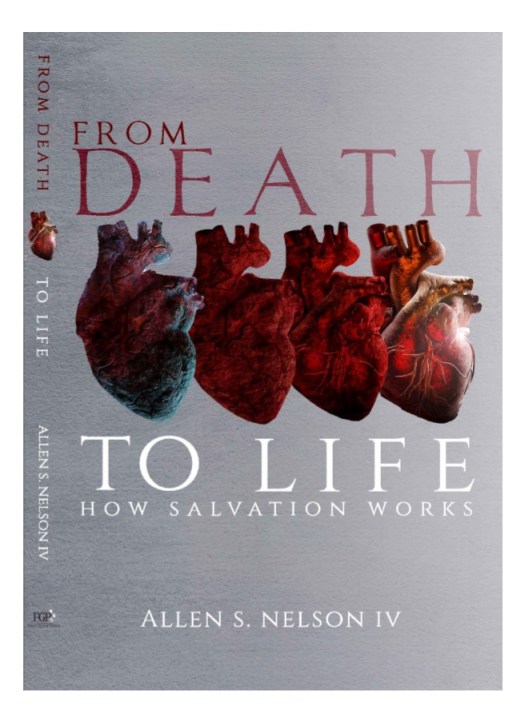
Guest Post: A Review of “From Death to Life: How Salvation Works”

If your theology pretty much matches up with mine (as outlined in the “Welcome” and “Statement of Faith” tabs) and you’d like to contribute a guest post, drop me an e-mail at MichelleLesley1@yahoo.com,
and let’s chat about it.

photo credit: Stephen J. Melniszyn

A Review of Allen S. Nelson IV’s
From Death to Life: How Salvation Works
by Katy B.

The most agonizing, frustrating experience in my ministry to women is the woman who claims to be “saved” but gives no evidence of it. No interest in talking about Jesus, no interest in holiness, reading the Bible, going to church, serving God’s people. She has a salvation testimony (often dramatic and self-glorifying) that is superficial, shallow, and devoid of any real repentance for her sin. I suspect she’s a false convert. And I find it exceptionally difficult to talk to false converts.

In From Death to Life, Pastor Allen Nelson confronts the disaster of false conversions, linking them to a false understanding of salvation: what it is, what it does, and how it works. He writes, “Ask fifteen people what it takes to be saved and it’s not out of the realm of possibility that you’ll get twenty different answers.” (Loc 173

He makes the bold statement that “there is no spiritual life in many who claim to be Christians in America.(Loc 247) He calls them the “walking dead”.

How does that happen? What would cause a person to wrongly believe he or she is a Christian? He lays some of the responsibility at the feet of churches that use methods such as external manipulation, diluted gospel presentations, the altar call, and the sinner’s prayer to lead the walking dead to their false professions of faith and their false assurances of salvation. He blisters easy-believism practices that, even if well-intentioned, have done damage to churches more influenced by a fallen culture than by God’s own Word.

So how does salvation work? The author has narrowed the answer down to five main points:

1. The gospel must be proclaimed.

2. God must move.

3. The sinner must respond in faith and repentance.

4. God justifies the sinner.

5. The sinner grows in the Lord over a lifetime.

Pastor Nelson not only unpacks, but folds, hangs up, and neatly puts away each of these main points in a few short chapters. In doing so, he poses and then answers questions such as, “What is the true gospel?”, “What is biblical repentance?”, “What is saving faith?”, and “What exactly is justification?” His answers are delivered in a direct, engaging, accessible style with plenty of biblical illustrations and scriptural references. No theological dictionary needed.

The book includes “howto’s” but doesn’t read like a “howto” manual. The tone is pastoral, sometimes comfortable, sometimes convicting, but never harsh. At times, the reading felt like sitting over coffee with Pastor Nelson, asking questions about various evangelistic situations, and receiving useful advice on how to respond.

A destitute woman in a homeless shelter, eyes pallid, needle tracks running down her arms, naturally incites my heart instinct to put my arms around her, tell her Jesus loves her, and give her some money. But Pastor Nelson reminds us:

“People need to hear more than “Jesus loves you,” What they need to hear today is what they’ve always needed: to know that they are sinners, that they need a Savior, that Jesus is that Savior, and until and unless they come to Him in faith, they will justly spend an eternity facing the punishment of their sins.” (Loc 2413)

He points out that it is vital that we all (not just the “trained professionals”) know what to say when the time comes to share the gospel of Christ. And while there is no formula, it is essential that the facts of the gospel are understood. The book helpfully guides the reader in a biblical understanding of how salvation happens and presents realistic examples of responses that can be used with unbelievers/false converts in evangelistic conversations.

The chapter “Plant, Water, Trust God, Repeat” is a compelling warning to stick to a biblical approach to evangelizing the lost. (Throughout the book he gives examples of unbiblical approaches.) In this encouraging chapter, he discusses applying how salvation works in real life scenarios, acknowledging that it is not always easy. He doesn’t present himself as a superhero evangelist.

This is a serious book, but the author can also be funny. I got a laugh out of his response to the command to “ask Jesus into your heart”. His tone, however, is utterly serious when discussing repentance:

“God doesn’t beg people to repent so they can be the star player on His team. He demands repentance. He owes mankind nothing. What a fearful and insolent game we play by making repentance an optional feature to becoming a Christian, refusing to properly define it in hopes of sneaking people into the kingdom, or by flat out dismissing it altogether.” (Loc 1164)

He spends a good bit of time parked on repentance, emphasizing that biblical repentance is necessary for any person to become a Christian. He asserts, “Remorse does not equal repentance” and goes on to give what he calls the bare necessities of repentance.

Is it possible to know if a person has actually been converted? In the chapter on sanctification, the author acknowledges that while we can’t see the heart, we can use the discernment God gives us to see evidence of true conversion. He provides a practical alliteration method to assist in discerning whether or not the gospel has actually taken root in a person’s heart and the changes we would expect to see in a truly converted person.

He warns the church against haphazardly affirming people as Christians without exercising grace-filled discernment:

“Often, we claim that the problem in our churches is that too many people are immature believers when the real problem is that many we call immature, actually have no life in Christ at all. They aren’t growing because they aren’t living.” (Loc 1878)

The sanctification chapter, my favorite, thrust me to a fresh examination of my own life using his alliteration template. What evidence of salvation would others see in me? What would they discern as my motivation for life? There is plenty of self-application for the reader.

The book has three appendices. Appendix 1: The Sinner’s Prayer, Appendix 2: Acts 2 is Not an Altar Call, Appendix 3: Putting “Baptist” Back in Your Church. In these appendices, the author makes some “say whaaaat?!? observations that will rock your world if your church endorses these practices.

This is a short book. Although the print version is only 200 pages, there is nothing shallow about the content. The reader will step into a deep pool. Did I know how salvation works before I read the book? Yes. Have I been guilty of using unbiblical methods to try to bring about a conversion? Yes. I finished the book with an unanticipated, heart wrenching reorientation to the gospel as the power of God unto salvation. I bet I’m not the only reader who closed the book and repented.

I began by saying I find it exceptionally difficult to talk to false converts. What do you say to someone who believes she is saved when it is clear that she is not? Pastor Nelson is immeasurably supportive in reinforcing that “we must proclaim the gospel. Without it, people will go to hell. It’s as simple as that.” (Loc 441)

The book left me feeling hopeful, energized, looking forward to my next evangelistic encounter. God saves sinners. God saves sinners. And he uses sinners like me to do so.

Pastor Nelson writes, “Every single one of us is charged with sharing the gospel with those God providentially places in our life.” What a calling, what a staggering privilege. God could sovereignly call His own to Himself without us, but He has chosen to work through us. This book will certainly help us in our evangelism. I recommend it for everyone.

¹Katy reviewed the Kindle edition of the book and used Kindle location numbers rather than page numbers.


Allen “Cuatro” Nelson, IV, author of From Death to Life, is the pastor of Perryville Second Baptist Church in Perryville, Arkansas, and co-host of The Rural Church Podcast. Contact Him directly via Twitter to receive a free study guide with your order of From Death to Life or a discount on bulk orders. You can also order from Amazon.

Katy can’t remember when she became a Christian but is assured that, by the grace of God alone, she is a Christian. She ministers to women in her OPC church, in homeless shelters, in a prison, and sometimes at the grocery store. She is an executive with a United States health care corporation and enjoys her work, although she would rather be reading. You can find Katy on Twitter at @KatyvonBora.

ALTHOUGH I DO MY BEST TO THOROUGHLY VET THE THEOLOGY OF THOSE WHO SUBMIT GUEST POSTS, IT IS ALWAYS POSSIBLE FOR THINGS TO SLIP THROUGH THE CRACKS. PLEASE MAKE SURE ANYONE YOU FOLLOW, INCLUDING ME, RIGHTLY AND FAITHFULLY HANDLES GOD’S WORD AND HOLDS TO SOUND BIBLICAL DOCTRINE.