Titus Bible Study

Titus: God’s Order of Service ~ Lesson 2

Welcome, ladies! Just a reminder,ย please do not skip Lesson 1ย (link below). Not only will it answer any questions you may have about the study itself, but if you want to study Titusย properly, you must do the background work contained in Lesson 1.
Previous Lessons: 1

Read Titus 1:1-5

Questions to Consider

1. Review your notes from last weekโ€™s introductory lesson. What are some things to keep in mind as you begin to study the text of Titus today?

As we study the book of Titus, I will sometimes refer to the author as Paul (e.g. “What was Paul teaching pastors in v.6?”) and, often, as God (e.g. “How does God encourage church members in v.7?”). I don’t mean for this to be confusing. My purpose is two-fold: 1) To combat the popular false teaching that anything a biblical author wrote that we don’t like was simply that author’s human opinion, not God’s, 2) To constantly remind us that all Scripture was breathed out by God, not fallible humans, and, as Christians, we are obligated to believe and obey every word of it. If you’re confused, it might help to think of it this way: God is the author of Titus; Paul is the writer of Titus.

2. Examine verses 1-3. Recall from the introductory lesson which genre of biblical literature Titus is (Law? Prophecy? Poetry? etc.). Today, when we write a letter, especially a business letter, we normally close it with our signature and credentials. For example:

Sincerely,

Joe Smith
Acme Widgets, Inc.
Vice President of Doohickeys – Southeastern Division

In first century culture, the style was to open the letter with one’s name and credentials. Compare verses 1-3 with these greetings of other epistles. What are some similarities and differences you notice?

Even our abbreviated modern signatures/credentials, like the example above, give the reader some very important information about the person writing the letter. What type of information can you glean about “Joe Smith” from the signature/credentials above? In what ways is it similar to the type of information in verses 1-3?

Go back to verses 1-3, and break them down. What information do you learn about Paul from his opening signature/credentials?

  • Who is the letter from? (1a)
  • What is his position, and why is he qualified to write this letter? (1a, 3b)
  • What are his three general purposes for this letter? (1b, 2a)
  • By Whose authority does he write this letter? (2-3)
  • What is his view of God’s nature and character, God’s authority, and his relationship to God? (1-3)

3. Let’s go back (see #2 above) to God’s three general purposes for having Paul write this letter. Explain each of these purposes in your own words. How do each of these purposes apply to pastors and elders today?

You’re obviously not a pastor or an apostle, training pastors, or leading a church, but as you’re discipling your children or other women or children in the church, are there biblically appropriate ways in which you can apply each of these purposes? How do you disciple them…

  • for the sake of their faith
  • in their knowledge of the truth, which accords with godliness, and
  • in the hope of eternal life?

4. Revisit verses 1-3 and meditate on the vastness and depth of the faith, the truth, the hope of eternal life, and God’s sovereignty these verses describe. Then consider Paul’s statement, “the preaching with which I have been entrusted by the command of God our Savior”. Do you think Paul felt the weight of that responsibility? Do you feel a similar weight of responsibility when discipling your children or other women and children?

5. Examine Paul’s greeting in verse 4. To whom is this epistle addressed? What is Paul’s relational dynamic with Titus? Notice the picture God paints of that relational dynamic. He doesn’t characterize it as a “master (Paul) / slave (Titus)” relationship or “boss / employee” or even “teacher / student,” but as what? Why do you think that is? What does that metaphor indicate about Paul? About Titus? How does this connect back to Paul’s authority and credentials (see #2 above) for writing this letter?

Go back to verses 1-2. Is it fair to say that this epistle is also addressed to the church? Why or why not?

Why does God use the metaphor of family (“my child in the faith,” “brothers and sisters,” today, we even speak of “my church family,” etc.) in Scripture to characterize the church? Do you have a “true child in the faith” relationship with someone? How does that relationship compare to Paul’s relationship with Titus?

How does “Grace and peace from God the Father and Christ Jesus our Savior” set the tone for the letter, reiterate Paul’s God-given authority in writing the letter, and reference part of the Trinity?

6. Take a look at v.5. Why did Paul leave Titus in Crete? What does Paul mean by “put what remained into order”? What’s a phrase we might use in today’s vernacular to say the same thing? Why did Titus need to appoint elders “in every town”? (You might want to review your notes from lesson 1 – link above.) How would appointing elders have given the churches in Crete structure and order?


Homework

Orderliness. Structure. Hierarchy. This is a major underlying theme of the book of Titus. Spend some time before our next lesson meditating on God’s orderliness, and the structures and hierarchies He has set up in nature, the family, the church, government, etc. Why is orderliness important to God? Why does He think orderliness is so necessary for us that He built it into the fabric of the universe? Jot down your thoughts. Make a list of at least five verses or passages of Scripture that talk about orderliness, structure, or hierarchy. Consider these verses and your thoughts on God’s orderliness in relationship to the church. Why is it important to God that our churches be orderly? Is your church orderly? Does it need to be more orderly? How could it be more orderly according to Scripture?


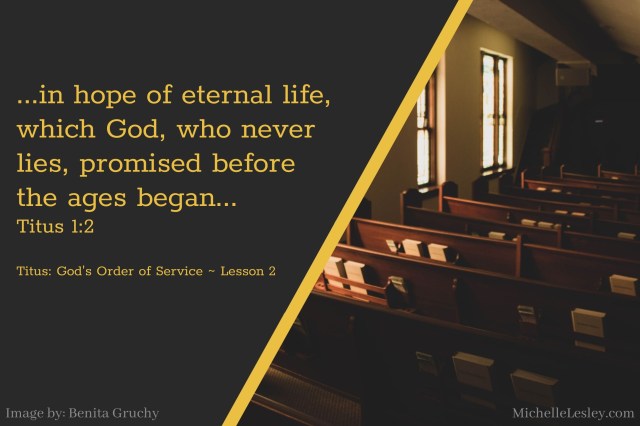
Suggested Memory Verse
Titus Bible Study

Titus: God’s Order of Service ~ Lesson 1- Introduction

Welcome to our new study, Titus: God’s Order of Service!

What does God think about the way His church should operate? What are the qualifications and character traits of godly pastors, elders, and church members? What is your role in the Body, and why is it so crucial? God is a God of order, and He wants the church to operate in an orderly way โ€“ to glorify Him โ€“ as we worship, work, and witness.

Titus is the New Testament’s third and final pastoral epistle. The pastoral epistles are Godโ€™s instructions to pastors about the way His church should run (kind of like the weekly “order of service,” or bulletin at your church describes how that week’s worship service will run). But pastors arenโ€™t solely responsible for the smooth sailing of the church. We all contribute to glorifying God by learning and robustly filling out our roles in the church in a godly and orderly way. Over the course of approximately 5-8 lessons, weโ€™ll learn how to do that from the book of Titus.

The attractive title image for our study was designed by Benita Gruchy. I liked Benita’s use of the photo of the church sanctuary because the book of Titus is about the gathered body of the church. The word “service” in the title of the study is meant both in the sense of “worship service” – our corporate worship of God – and our “serving” the church body. When I imagine brothers and sisters in Christ assembled together in the pews in that photo, that’s what I think of: worship and service. Finally, the main theme of Titus is “setting things in order” (1:5) in the church, and I thought the rows of pews, with hymnals neatly in their racks, as well as the sleek design and the lines and sections on the left side of the image evoked that sense of orderliness quite nicely. Great job, Benita!

Many thanks to all of those who worked so hard on your entries for our title pic contest. You ladies were very creative and did some outstanding work! 

There were too many entries to share all of them with you, but here are a few “honorable mentions”:

Teressa Campbell
Emily Smith
Melany Goblirsch

If you’re new to using my Bible studies, just a few housekeeping items and helpful hints:

The studies Iโ€™ve written (you can find all of them at the Bible Studies tab in the blue menu bar at the top of this page) are like โ€œtraining wheelsโ€. Theyโ€™re designed to teach you how to study the Bible for yourself and what kinds of questions to ask of the text so that, when you get the hang of it, you wonโ€™t have to depend on other peopleโ€™s books and materials โ€“ even mine โ€“ any more. To that end, I do not provide answers for the study questions in the studies Iโ€™ve written.

My studies are meant to be extremely flexible and self-paced so that you can use them in the way that works best for you. You can do an entire lesson in one day or work on the questions over the course of the week (or longer). You do not need to feel obligated to answer all (or any) of the questions. If the Holy Spirit parks you on one question for several days, enjoy digging deep into that one aspect of the lesson. If He shows you something I haven’t written a question about that captures your attention, dive in and study it! Those are ways the Holy Spirit speaks to us through His Word. This is your time to commune with the Lord, not a school assignment or work project you are beholden to complete in a certain way by a certain deadline.

I will post a new lesson on the blog every other Wednesday, so there is nothing to sign up for or commit to. Simply stop by the blog every other week, or subscribe to the blog via e-mail to have the lessons delivered to your inbox.

I use hyperlinks liberallyThe Scripture passage for each lesson will be linked at the beginning of the lesson. As you’re reading the lesson, whenever you see a word in a different color text, click on it, and it will take you to a Scripture, article, or other resource that will help as you study.

All of the studies Iโ€™ve written are suitable for groups or individuals. You are welcome to use them as a Sunday school or Bible study class curriculum (for free) with proper attribution.

You are also welcome to print out any of my Bible studies (or any article Iโ€™ve written) for free and make as many copies as youโ€™d like, again, with proper attribution. Iโ€™ve explained more about that in this article (3rd section).

From time to time I receive inquiries from men about using my studies for their personal quiet time or for teaching a co-ed or men’s Bible study class. It is my personal conviction that it is more in keeping with the spirit (though not the letter) of 1 Timothy 2:12, Titus 2:3-5, and related passages for men to use Bible study materials authored by men rather than by women. Therefore, on the honor system, I would request that men please not use my studies for personal use, or when teaching a class with male members. (Vetting the studies for your wife, daughter, or the women of your church, is, of course, fine. Encouraged, actually.)


Introduction to Titus: God’s Order of Service

Before we begin studying a book of the Bible, itโ€™s very important that we understand some things about that book. We need to knowโ€ฆ

Who the author was and anything we might be able to find out about him or his background.

Who the audience of the book is: Jews or Gentiles? Old Testament Israelites or New Testament Christians? This will help us understand the authorโ€™s purpose and approach to what heโ€™s writing.

What kind of biblical literature weโ€™re looking at. We approach books of history differently than books of wisdom, books of wisdom differently than books of prophecy, etc.

What the purpose of the book is. Was it written to encourage? Rebuke? Warn?

What the historical backdrop is for the book. Is Israel at war? At peace? In exile? Under a bad king? Good king? Understanding the historical events surrounding a piece of writing helps us understand what was written and why it was written.

When the book was written. Where does the book fall on the timeline of biblical history? This is especially important for Old Testament books which are not always arranged in chronological order.

So this week, before we start studying the actual text of the book of Titus, we need to lay the foundation to understanding the book by finding the answers to these questions.

Read the following overviews of the book of Titus, taking notes on anything that might aid your understanding of the book, and answer the questions below:

Bible Introductions: Titus at Grace to You

Overview of the Book of Titus at Reformed Answers

Summary of the Book of Titus at Got Questions

1. Who wrote the book of Titus? How do we know (or why do we not know) this?

2. Approximately when was Titus written? What is the geographical setting of the book of Titus? Here are some maps (scroll down to โ€œTitusโ€) that may be helpful as you study through the book of Titus.

3. Who is the original, intended audience of the book of Titus? Describe the historical setting (historic events, politics, sociology of the time, etc.) of Titus.

4. Which genre of biblical literature is the book of Titus: law, history, wisdom, poetry, narrative, epistles, or prophecy/apocalyptic? What does this tell us about the approach we should take when studying from this book versus our approach to books of other genres?

5. What is the theme or purpose of the book of Titus?

6. What are some of the major topics of instruction or exhortation in the book of Titus? How do these topics relate to the theme of Titus?

7. What are some ways Titus points to and connects to Jesus?

8. What else did you learn about the setting of this book that might help you understand the text of the book better?

Take some time in prayer this week to begin preparing your heart for this study. Ask God to give you wisdom both to understand the text, and to apply what you learn from Titus as a member of your own church, as we study Titus together.

Our next lesson will be two weeks from today.

Titus Bible Study

New Bible Study Kickoff and Title Pic Contest

Happy Wednesday, Ladies! It’s time to kick off our next Bible study:

…..with a fun title pic contest!

What does God think about the way His church should operate? What are the qualifications and character traits of godly pastors, elders, and church members? What is your role in the Body, and why is it so crucial? God is a God of order, and He wants the church to operate in an orderly way – to glorify Him – as we worship, work, and witness.

…that you would set in order what remains…

Titus 1:5

In 1&2 Timothy: The Structure and Spirit of the Church, we studied the first two of the pastoral epistles. Titus: God’s Order of Worship brings us to the third and final pastoral epistle. The pastoral epistles are God’s instructions via Paul to pastors Timothy and Titus – and subsequently to all pastors – about the way His church should run. Sort of a “policy and procedure manual,” if you will. But pastors aren’t solely responsible for the smooth sailing of the church. We all contribute to glorifying God by learning and robustly filling out our roles in the church in a godly and orderly way. Over the course of approximately 5-8 lessons, we’ll learn how to do that from the book of Titus.

But before we get started studying next Wednesday, how about a little fun?

You’ve probably noticed that I design a title picture for most of the Bible studies I write. Here are a few past title pics I’ve designed myself:

But sometimes, I like for us all to share in your creativity. Y’all have sent in some beautiful and creative entries in our past title pic contests – indeed, the title pics for The Sermon on the Mount, The Women of Genesis, Living Stones, and Imperishable Beauty, and other studies, were all designed by readers – so, once again, I wanted to get some of you involved in the design process for our new study.

You can see the rest of my Bible study title pics as well as those designed by my readers at the Bible Studies tab in the blue menu bar at the top of this page. Take a moment to look them over to get a feel for my style and the general appearance I like my title pics to portray.

If you enjoy and have a knack for photo editing, or you know someone who does, I’m accepting submissions for title pictures for the Titus study. If your submission is chosen it will be used each week of the study, and you’ll be credited (name or website) by watermark. I’d love to be able to offer a huge cash prize, but, hey, we’re small potatoes here. This is just for fun and maybe a little publicity for your site, if you have one.

Contest Guidelines

โ˜™ Ladies only. Sorry guys! :0)

โ˜™ย You must use images that don’t require attribution. Pictures you’ve taken yourself are fine, as are images from sources such as Pixabay, Pexels, Freely, Unsplash, StockSnap, or other free stock photo web sites. Please include the image source web sites you use along with your submission. (You cannot just grab and use any old picture off the internet. Photographers own their images and usually require permission, attribution, and often a fee, for their use.)

โ˜™ Title pics should be landscape (a horizontal rectangle) with a width of 2000-4000 pixels and proportionate height. I prefer JPG images, but PNG is fine, too, if necessary.

โ˜™ย Your title pic must contain the full title of the study: Titus: God’s Order of Service (Be sure to double check your spelling and punctuation. You can leave the colon after “Titus” out if “Titus” and “God’s Order of Service” are not on the same line. See my image above.).

โ˜™ย Since I use the title pic background image for each lesson’s suggested memory verse, please send a blank copy (no words on it) of the picture you’re using along with the title pic you design.

โ˜™ If your submission is selected, I’ll be glad to watermark it with your website address (please submit your picture without any watermarks) if you have one, as long as your web site doesn’t conflict with my statement of faith or my beliefs outlined in the Welcome tab.

โ˜™ย Deadline for submissions is 11:59 p.m., Monday, August 8, 2022.ย 

โ˜™ E-mail your title pic submission along with a blank copy of your image, your full name, web site address (if any), and the source(s) you used for your image(s) to MichelleLesley1@yahoo.com. You are welcome to submit as many images as you like.

โ˜™ Please don’t be offended if your submission isn’t selected. If I peruse all the submissions and I’m just not “feeling it,” I may still elect to design one of my own.

โ˜™โ˜™โ˜™โ˜™โ˜™

Feel free to share this around with friends who have an interest in photo editing. If you want to take a whack at it for fun but don’t know where to start, play around with Be Funky, PicMonkey, or Canva and see which one works best for you.

Think about – maybe even read – Titus and try to capture in your image the theme of the epistle or a key truth expressed by a certain verse.

Happy designing!

Discernment, False Doctrine, Southern Baptist/SBC

A Naked Emperor in the Southern Baptist Convention

Originally published April 6, 2018

Think back to your childhood. Remember the story, The Emperor’s New Clothes?

Once upon a time, there lived an emperor. One day two swindlers came to his palace and told him they could weave cloth for his royal robes that was magical: to those who were foolish or unfit for their jobs, it would appear invisible. Only the wise and worthy would be able to see this fine fabric. The emperor hastily agreed to pay the “weavers” an exorbitant amount of money to make him such an amazing garment, thinking he would use it to weed out anyone unfit for royal service.

The weavers set about pretending to weave. From time to time, the emperor sent various folk to check on the progress the weavers were making, and – though in reality, none of them could see the non-existent fabric – all reported back that the garments were coming along nicely and the cloth was beautiful. But strangely enough, when the emperor himself looked in on the weavers, they held up the magnificent fabric, and he could not see it. Not wanting word to leak out that he was unfit to serve as emperor, he pretended to examine the cloth and complimented the weavers lavishly on their fine work.

Finally, the weavers informed the emperor that the garments were finished. They had the emperor strip down to his skivvies and pretended to help him on with his fine new “garments”. Word had spread among the emperor’s subjects about the magical properties of the fabric, and as the royal procession made its way through town, all shouted out praise for the emperor’s fine new clothes.

All. Except for one little boy.

“But he hasn’t got anything on!” the boy shouted.

It took the innocent honesty of a simple child to shock the emperor’s subjects back to their senses. The truth spread like wildfire, and the crowd began to cry out: “The emperor is naked!” “The emperor has no clothes on!” “He’s not wearing anything!”

But did the emperor admit to his foolishness, return to the palace, and get dressed? No. Sadly the story ends this way:

“The Emperor shivered, for he suspected they were right. But he thought, ‘This procession has got to go on.’ So he walked more proudly than ever, as his noblemen held high the train that wasn’t there at all.”ยน

And so the “emperor” of leadership in the Southern Baptist Convention and those who carry its train march proudly on, despite the cries of simple peasants and innocent little children crying at the top of our lungs, “The emperor is naked!” “There are issues that need to be addressed, here!” “Listen to us!”

You’ll note that the story doesn’t say that the emperor was a cruel man, that he overtaxed the people, oppressed them into slavery, was a warmonger, or was in any other way an evil leader. In fact, one could argue that he had good intentions of making sure the people who served at various posts in his empire were of the finest caliber.

And while there are many issues that need to be addressed in my denomination, I think this could generally be said of the leadership of the Southern Baptist Convention as well. Call me a Pollyanna, but I have no reason to believe our denominational leadership – as a whole – is evil or has anything less than the best of intentions for the SBC.

There are many good and praiseworthy things going on in SBC life. We have hundreds of doctrinally sound pastors faithfully preaching the gospel week in and week out. Discernment and biblical literacy among Southern Baptist church members is slowly but steadily growing. The SBC takes a public, biblical stand on abortion and homosexuality while many other denominations do not. Our organizational structure for funding and sending out missionaries, while sometimes flawed in its execution, is without peer. Southern Baptist Disaster Reliefย is one of the finest relief organizations in the world. And there’s so much more. Find a godly Kingdom effort going on somewhere, and you’ll probably find a Southern Baptist involved in it. By the grace of God, while we’re far from perfect, we’re getting a lot of thingsย right.

But even benevolent emperors get things wrong sometimes, and, Southern Baptist leadership, your drawers are flapping in the breeze on this oneยฒ:

Sin. The public sin our leaders commit that we excuse and the public sin our leaders commit that we discipline, and the fact that there’s a discrepancy between the two.

Southern Baptist leadership, your drawers are flapping in the breeze on this one.

Recently, Frank Page, president and chief executive officer of the Executive Committee of the Southern Baptist Convention (one of the top positions of SBC leadership at the national level) resigned his position due to “a morally inappropriate relationship in the recent past,” which, we are left with little choice but to assume means “adultery”. (As an aside, Christians, when confessing sin, let’s knock off the the terminological hem-hawing and call a spade a spade. “I had a six month extra-marital romantic and sexual relationship with a married woman in my church,” or whatever. You don’t have to give all the gory details or name names, but, for crying out loud, if you’re going to confess, confess- don’t finesse.)

It was right and biblical for Dr. Page to publicly confess and express sorrow over his sin as well as to resign (it would also have been right and biblical for the SBC to remove him had he refused to resign, which, undoubtedly would have happened). He sinned against God, his family, the woman and her family, his church, his co-workers, and the entire denomination. He publicly embarrassed the Southern Baptist Convention and gave unbelievers fodder for scoffing when the report of his sin made the national news. This was a case of a well known Southern Baptist leader whose public, observable sin was handled biblically by SBC leadership. I am thankful for this witness to Christians and to the world that sin is not to be swept under the rug, but that sinners are to repent, be disciplined, and then be restored to fellowship (although, in cases like this, not leadership).

But we don’t handle all cases of public sin that way. Some public sin we reward by making the sinner into a wealthy, lauded celebrity.

“Impossible!” you say?

Check the shelves at LifeWay. Select twenty average SBC churches with women’s ministries and see whose books, DVDs, and simulcasts are being used again and again. Peruse the speakers at popular SBC conferences.

You’ll find names like Beth Moore, Priscilla Shirer, Lysa TerKeurst, Christine Caine, Ann Voskamp, Sarah Young, Andy Stanley, Steven Furtick, Rick Warren, and T.D. Jakes, just to name a few.

Have they committed adultery? Voiced approval of of homosexuality? Committed theft, abused their spouses, or promoted pornography? No. But those aren’t the only types of sins the Bible prohibits.

Every single one of them teaches false doctrine, from Sarah Young’s blasphemous “channeling” of Jesus, to T.D. Jakes’ denial of the Trinity, to Christine Caine’s Word of Faith heresy, to Lysa TerKeurst’s teaching of contemplative prayer.

All of these women who do speaking engagements unashamedly and unrepentantly preach to co-ed audiences. All of these men allow women to preach to co-ed audiences from their pulpits.

All of them who join in ministry with others have yoked or affiliated themselves with false teachers. Beth Moore and Joyce Meyer. Priscilla Shirer and T.D. Jakes. Steven Furtick and Joyce Meyer and T.D. Jakes. Rick Warren and the Pope.

Scripture plainly prohibits the teaching of false doctrine. It’s a major theme of the New Testament, for goodness sake. The Bible tells us that women are not to preach to men or exercise authority over them in the gathered body of Believers. And God’s Word makes very clear that we are to have nothing to do with false teachers, especially not partnering with them in “ministry”.

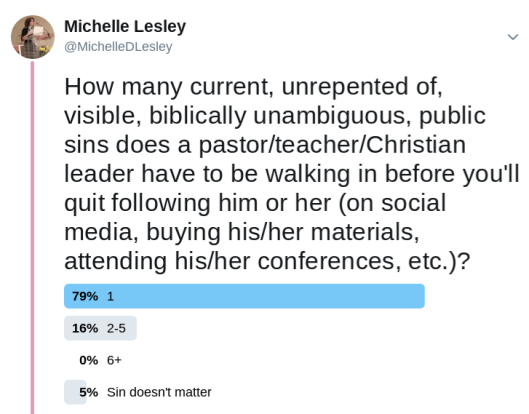
In the wake of Frank Page’s resignation, I asked this poll question on Twitter

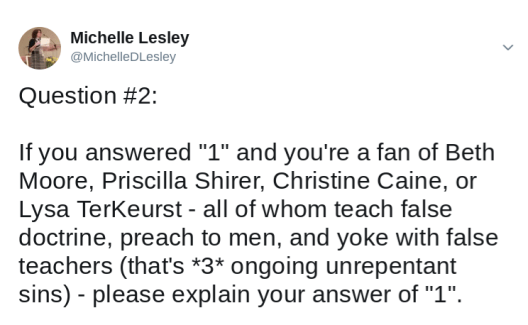
followed by this one

Why are Southern Baptists leaders so quick to – rightly and biblically – oust Frank Page for, as far as we know, one isolated sin which he publicly confessed to and repented of, and yet overlook three major – and much more publicly observable and harmful to Southern Baptists – ongoing sins from pastors and teachers who have been rebuked and refuse to repent? Why, instead of disciplining them for their sin, do those in leadership give them fat book deals, invite them to speak at all the cool conferences, fawn over them on social media, and make them into celebrities?

How many sins will it take to disqualify and discipline these people? Four? Eleven? Ninety-six? Is there any amount of sin these pastors and teachers, and those like them, can commit that will cause those in SBC leadership to pull their materials off the shelves of LifeWay, deny them a seat at the table, and urge them to repent and step down from their positions?

I’ve been a Southern Baptist from the day I was born. I’ve been taught since the cradle roll that if God’s Word says not to do something and you do it anyway, that’s a sin. If God’s Word says to do something and you don’t do it, that’s a sin. And that sin is sin in the eyes of God.

Well is it, or isn’t it, Emperor?

If sin is sin in God’s eyes, why aren’t you treating Beth Moore’s sin like Frank Page’s sin? Why are you rewarding her for her sin and disciplining him for his?

Why does the SBC reward some sins while disciplining others?

The Bible says in James 3:1:

Not many of you should become teachers, my brothers, for you know that we who teach will be judged with greater strictness.

Those who teach and lead bear more responsibility to teach sound doctrine and walk worthy because they are teaching and leading us by example.

Why are all the aforementioned pastors and teachers better examples to us in their rebellion and unrepentant sin than Frank Page was in his repentance of sin?

Why?

Southern Baptist peasants and little children see right through your foolishness on parade on this issue and we want answers. Biblical answers.

Don’t just stand there shivering, suspecting we are right, but thinking, “This procession has got to go on,” and walking more proudly than ever. Go back to the palace. Repent. Clothe yourselves with humility and obedience to Scripture, and come back and lead us rightly. Biblically.

Because the Emperor of Southern Baptist leadership has been naked for far too long.

The Emperor of Southern Baptist leadership has been naked for far too long.


ยนH.C. Andersen Centret (The Hans Christian Andersen Centre). The Emperor’s New ClothesAccessed April 5, 2018.

ยฒI am well aware that this is not the only problem in the SBC that needs to be addressed. It would be impossible to address every issue in one article, so this time I’ve chosen to focus on this one particular issue.

Psalm 119 Bible Study

Psalm 119: The Glory of God’s Word ~ Lesson 13 – Wrap Up

Previous Lessons: 1, 2, 3, 4, 5, 6, 7, 8, 9, 10, 11, 12

Wrap Up

Questions to Consider

1. Was there anything new God taught you in this study that particularly impacted you? What was it, and why was it so significant?

2. How is your walk with the Lord different after this study than it was before?

3. What did you learn from this study about what your relationship with, and response to God’s Word should be like?

4. What did this study teach you about obeying God’s Word?

5. What did this study teach you about the nature and character of God?

6. Have there been any passages or concepts in this study that God used to convict you of disobedience and lead you to repentance? How will you walk differently in this area from now on?

7. What did this study teach you about prayer?

8. Describe one specific, practical way you will apply to your life something you learned in this study.


Homework

Spend some time in prayer this week asking God to show you how to put into practice one thing you learned from this study.

Recite all of your memory verses from this study. Which one is most meaningful to you right now?