Mailbag, Top 10

Top 10 Mailbag Articles of 2019

I always enjoy the annual “year in review” articles and TV shows that run in abundance in late December, so I thought I’d contribute my own. Several Mailbag articles were among this year’s most popular, so I decided to make two separate lists. Check out my top 10 non-Mailbag articles of 2019 tomorrow. Here are my ten most popular Mailbag blog articles from 2019:

Vaxxers, Anti-Vaxxers, and the Health of the Body

To vaccinate, or not to vaccinate? It’s a tough issue to discuss these days. 


Do You Recommend Angie Smith (“Seamless”)?

Wife of Todd Smith of the Christian music group, Selah, Angie started out as a blogger, then blossomed into a Christian author and speaker. Her best known book to date is a women’s study: Seamless: Understanding the Bible as One Complete Story


Potpourri (Todd Friel on Rick Warren, Enneagram, Should I stay or should I go?…)

Todd says Rick isn’t a heretic?…Sharply, yet gently, rebuking false teachers…What is an Enneagram?…Books vs. interactions…Should I leave my women’s Bible study group?


BSF (Bible Study Fellowship)

While I totally support the idea of delving deeply into the Scriptures with other women, there are a few of aspects of BSF that concern me… 


Should My Church Participate in Operation Christmas Child’s Shoebox Ministry?

Should my church participate in Operation Christmas Child? What are some other good international ministries my church could participate in instead?


Do you recommend these teachers/authors? Volume 1

Jennifer Kennedy Dean, Lisa Harper, Karen Kingsbury, Rebekah Lyons, Raechel Myers, Shauna Niequist, Jennifer Rothschild, Susie Shellenberger, Sheila Walsh, Amanda Bible Williams

(After today, I’ll be retiring this article. Thanks to Project Breakdown, I have completed updated, individual articles on each of these teachers which you may access at the Popular False Teachers and Unbiblical Trends tab at the top of this page, or by entering the teacher’s name in the search bar.)


Should Christians listen to “Reckless Love”?

Remember, everything we do should be governed by Scripture, not our opinions and preferences, or whether we happen to like a particular song or not…


Questions about the Open Letter to Beth Moore

Since the publication of the Open Letter to Beth Moore, several questions have arisen that I’d like to address…


Do you recommend these teachers/authors? Volume 3

Jill Briscoe, Lauren Chandler, Tony Evans, Rachel Hollis, Chrystal Evans Hurst, Brenda Leavenworth, Leslie Ludy, Bianca Olthoff, Wellspring Group, Jen Wilkin


Do you recommend these teachers/authors? Volume 2

Jennie Allen, Lisa Bevere, Rachel Held Evans, Heather Lindsey, Ann Graham Lotz, Kelly Minter, Nancy Leigh (DeMoss) Wolgemuth

(Project Breakdown begins on this list next!)


If you have a question about: a Bible passage, an aspect of theology, a current issue in Christianity, or how to biblically handle a family, life, or church situation, comment below (I’ll hold all questions in queue {unpublished} for a future edition of The Mailbag) or send me an e-mail or private message. If your question is chosen for publication, your anonymity will be protected.

Prayer Bible Study

Sweet Hour of Prayer: Lesson 12- Wrap Up

Previous Lessons: 1, 2, 3, 4, 5, 6, 7, 8, 9, 10, 11

Wrap Up

As we wrap up our study today, think about the things God has taught you through His Word and how you might apply them to your prayer life.

Questions to Consider

1. Was there anything new God taught you that particularly impacted you? What was it, and why was it so significant?

2. How is your personal prayer life different after this study than it was before?

3. Has this study helped you to notice things about the way your brothers and sisters at church pray that would strengthen your own personal prayer time and/or the way you pray in public (ex: leading your children in prayer, leading prayer in your Bible study class)?

4. What have you learned about prayer that you could implement in your public prayers so that others could learn things to strengthen their own prayer lives from your example?

5. What have you learned about God and how He wants to be approached in prayer?

6. What have you learned about your heart’s motives as you approach God in prayer?


Homework

Spend some time in prayer this week asking God to show you how to put into practice one thing you learned from this study.

Recite all of your memory verses from this study. Which one is most meaningful to you right now?


Additional Resources

Additional Scriptures on prayer: Part 1  Part 2 (Be sure to study these in context.)

Basic Training: 8 Things You Need to Know about Prayer

“Can We Talk?”

Praying the ABC’s of Jesus

Priming Your Prayer Wall

The Mailbag: What is Contemplative Prayer?

The Mailbag: Help! Our ladies’ prayer meeting is a disaster!

More resources on prayer

Prayer Bible Study

Sweet Hour of Prayer: Lesson 11

Previous Lessons: 1, 2, 3, 4, 5, 6, 7, 8, 9, 10

Additional Prayers

There are so many wonderful prayers in Scripture that we could have examined during this study. I am listing several here (I’m sure there are many more) in case you would like to continue studying the prayers of the people of Scripture.

2 Kings 19: Hezekiah’s Prayer for Deliverance

2 Kings 20:1-11: Hezekiah’s Prayer for Healing

2 Chronicles 20:1-19: Jehoshaphat’s Prayer for Deliverance

Ezra 9: Ezra Confesses Israel’s Sin of Intermarriage

Nehemiah 1: Nehemiah’s Initial Prayer

Nehemiah 9: Israel’s Confession of Sin

Daniel 9:1-19: Daniel Intercedes for the People

Jonah 2: Jonah Cries Out to the Lord

John 17: Jesus’ High Priestly Prayer


Questions to Consider

1. To acclimate yourself to the book containing the prayer you’ve chosen to study, choose a Bible Book Background to review.

2. Who is offering this prayer? What do you know about him? What is his position in Israel, the temple, or the Kingdom? Why is he offering this prayer?

3. Is this an individual prayer or a corporate (group) prayer? Is the person praying interceding for a certain group of people? Who? Why is he interceding for them?

4. How does this prayer address God? What does it say about God, His character and His attributes? How can you extol these attributes of God in your own prayer time?

5. How does this prayer point us to Jesus or the gospel?

6. Carefully examine the context of the prayer. Is there anything in it that does not apply to Christians today? Which parts do apply to Christians today that could inform the way you and your church pray?

7. Consider some of the main components of prayer: praise, worship, petition for God’s provision, help, or action, confession of sin, thanksgiving, recitation of God’s promises or past actions, etc. Which of these components does this prayer have, and how can they serve as an example to you in your own prayers?

8. How does this prayer reflect the relationship this person has with God? How do your prayers reflect your relationship with God?


Homework

This week, study at least one of the prayers above and apply what you’ve learned to your own prayer time.


Suggested Memory Verse

Prayer Bible Study

Sweet Hour of Prayer: Lesson 10

Previous Lessons: 1, 2, 3, 4, 5, 6, 7, 8, 9

Read Acts 4:24-31

A Prayer of the Early Believers

Questions to Consider

1. To acclimate yourself to the book of Acts, choose a Bible Book Background to review. In today’s Scripture link, the entirety of chapter 4 is provided for context. Today’s questions will mostly pertain to the Believers’ prayer in 24-31.

2. Briefly summarize the events leading up to the Believers’ prayer. (1-23)

3. Is this an individual prayer or a corporate (group) prayer? (24)

4. How does this prayer address God? (24) Which words and phrases in this prayer demonstrate God’s sovereignty? Considering the events (1-23) that inspired this prayer why do you think the Believers would focus on God’s sovereignty in their prayer?

5. Explain the connection between verses 25-26 and 27-28. How do prophecy and the fulfillment of prophecy each demonstrate God’s sovereignty? What are some prophecies you see being fulfilled today? Have you ever prayed about them in the way the Believers did in their prayer?

6. Clearly the church was already experiencing persecution at this time. Did the Believers ask God to take the persecution away? What did they ask God for? (29-30) Why? Did God answer their prayer? (31) How? What did God’s answer to their prayer enable them to do? (31)

7. Did the Believers spend more time praying about God’s sovereignty and prophecy or more time presenting their request to Him?

8. What are some ways this prayer can inform our corporate prayers at church? How does this prayer teach us to view, and pray about, persecution?


Homework

This week, declare God’s sovereignty in your prayers and present your requests to Him through the “filter” of His sovereignty.


Suggested Memory Verse


Discernment

Amanda Bible Williams and She Reads Truth

If you are considering commenting or sending me an e-mail objecting to the fact that I warn against certain teachers, please click here and read this article first. Your objection is most likely answered here. I won’t be publishing comments or answering emails that are answered by this article.


This article is kept continuously updated as needed.

I get lots of questions about particular authors, pastors, and Bible teachers, and whether or not I recommend them. Some of the best known can be found above at my Popular False Teachers tab. The teacher below is someone I’ve been asked about recently, so I’ve done a quick check (this is brief research, not exhaustive) on her.

Generally speaking, in order for me to recommend a teacher, speaker, or author, he or she has to meet three criteria:

a) A female teacher cannot currently and unrepentantly preach to or teach men in violation of 1 Timothy 2:12. A male teacher or pastor cannot allow women to carry out this violation of Scripture in his ministry. The pastor or teacher cannot currently and unrepentantly be living in any other sin (for example, cohabiting with her boyfriend or living as a homosexual).

b) The pastor or teacher cannot currently and unrepentantly be partnering with or frequently appearing with false teachers. This is a violation of Scripture.

c) The pastor or teacher cannot currently and unrepentantly be teaching false doctrine.

I am not very familiar with most of the teachers I’m asked about (there are so many out there!) and have not had the opportunity to examine their writings or hear them speak, so most of the “quick checking” I do involves items a and b (although in order to partner with false teachers (b) it is reasonable to assume their doctrine is acceptable to the false teacher and that they are not teaching anything that would conflict with the false teacher’s doctrine). Partnering with false teachers and women preaching to men are each sufficient biblical reasons not to follow a pastor, teacher, or author, or use his/her materials.

Just to be clear, “not recommended” is a spectrum. On one end of this spectrum are people like Nancy Leigh DeMoss Wolgemuth and Kay Arthur. These are people I would not label as false teachers because their doctrine is generally sound, but because of some red flags I’m seeing with them, you won’t find me proactively endorsing them or suggesting them as a good resource, either. There are better people you could be listening to. On the other end of the spectrum are people like Joyce Meyer and Rachel Held Evans- complete heretics whose teachings, if believed, might lead you to an eternity in Hell. Most of the teachers I review fall somewhere in the middle of this spectrum (leaning toward the latter).

If you’d like to check out some pastors and teachers I heartily recommend, click the Recommended Bible Teachers tab at the top of this page.


Amanda Bible Williams
Not Recommended

Amanda Bible Williams is co-founder and CCO (Chief Content Officer) of She Reads Truth (SRT), “a worldwide community of women who read God’s Word together every day. Founded in 2012, She Reads Truth invites women of all ages to engage Scripture through curated daily reading plans, as well as online conversation led by a vibrant community of contributing writers.” Amanda’s co-founder of SRT is CEO, Raechel Myers. Amanda and Raechel have co-authored two books and collaborated on the She Reads Truth Bible and the He Reads Truth Bible.

I first learned of Amanda and SRT a few years ago through my friend Elizabeth Prata’s excellent blog. Check out part 1 and part 2 of her article She Reads Truth, IF: Gathering, and Women Bible Teachers.

Though SRT’s “What We Believe” section boldly proclaims, “we believe God’s Word is Truth,” Amanda has disregarded the Bible’s truths about false doctrine and the biblical role of women in the church by inviting female “pastors” and false teachers such as Sharon Hodde Miller (more on Sharon here), Erin Rose, and Lisa Harper (more on Lisa here) to be SRT contributing writers.

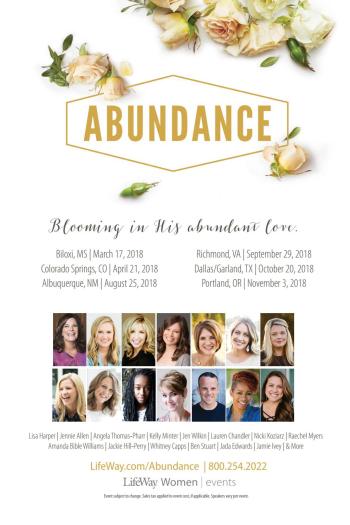
Amanda has appeared at several of LifeWay Women’s Abundance Conferences alongside the likes of Christine Caine, Jennie Allen,  Lisa Harper, Lysa Terkeurst and Curtis Jones (Beth Moore’s son-in-law/pastor who allows her to preach on Sunday mornings) and others.
Amanda has been featured on IF: Gathering’s YouTube channel. Amanda’s and Raechel’s book, She Reads Truth, is sold on IF’s website.

On Twitter, Amanda has retweeted and/or shown public affinity for several false teachers including Beth Moore (tweet, tweet), Ann Voskamp (tweet), Eugene Peterson, and Rachel Held Evans.
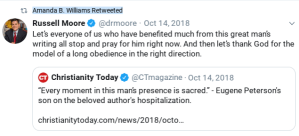
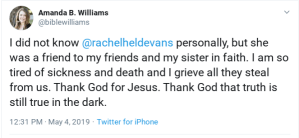
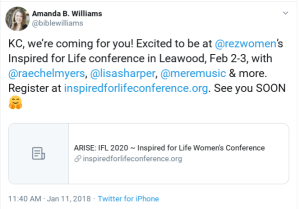
In 2018, Amanda’s SRT partner, Raechel, was a featured speaker at the Inspired for Life Conference alongside an advocate for female pastors and a social justice activist. (See article on Raechel for more details.) Amanda both attended and helped promote the event on Twitter:
For someone with such a well known ministry, Amanda has a very small online footprint, so it was difficult to find pertinent information on her for this article. She doesn’t seem to have a blog or website separate from the SRT website (which has minimal information about her). She doesn’t post often on social media, and when she does, it’s usually about her family, which, frankly, I find charming and refreshing. But that means there’s scant information on events she speaks at or participates in and her ministry associations with others. This could be a positive sign. Perhaps we’re not seeing online evidence of her, for example, preaching to men, because she’s not. On the other hand, perhaps she is associating with or following far more false teachers than we know of but she isn’t posting about it on social media, so there’s no evidence of it. It’s simply impossible to tell.

With so little information available on Amanda, and with very little knowledge of her own theology and handling of God’s Word, I want to give her the benefit of the doubt and withhold the label of “false teacher” until such time as more evidence is available that would support that label. That being said, I believe there is enough evidence that Amanda is sorely lacking in discernment that it would not be wise to follow her, use her materials (and certainly not SRT’s materials, considering their contributors), or attend her speaking engagements.

Furthermore, consider her ties to female “pastors” and false teachers. As I said in the introduction to this article, it is reasonable to assume Amanda’s doctrine is acceptable to these female “pastors” and false teachers and that she is not teaching anything that would conflict with their doctrine. If she were, they would not associate with her. If she were, she would not associate with them.