Mailbag, Marriage

The Mailbag: My fiance and I don’t agree on theology.

After struggling to find a solid local church, I finally found one that’s gospel-centered. I have been fellowshipping there for close to 6 months now and am planning to pursue membership soon. My fiancรฉ is a godly man, but he lives in another town, so he fellowships and serves in a church which he knows has some unbiblical doctrinal issues I won’t compromise on. After our wedding, we plan to live in the town he currently resides in. There are no Bible believing churches around (all are prosperity gospel churches). I am confused because I am not ready to listen to unsound teaching and later bring up my children in a community I don’t agree with theologically.

That’s such a difficult dilemma to be caught in, and I certainly do sympathize. An engagement period should be a joyful time of planning your wedding and your subsequent life together, not agonizing over major disagreements.

That said, it is good that you recognized this problem before the wedding rather than after, and I would strongly encourage you not to move ahead with the marriage unless and until the two of you have come to a biblical agreement on the matter.

Marriage can be challenging even when you agree on all the important stuff. But when you staunchly disagree on what should be the most important issue in your marriage – Christ, His Word, and His church – it can be devastating. Even if you think you are spiritually mature enough to work through the issue and remain committed to your vows, your husband might not be, and could decide he’d rather give up on the marriage than continue to struggle.

There are a couple of Scripture passages I’d encourage you to take a look at as you continue to work through this dilemma:

2 Corinthians 6:14-18: Though verse 14 of this passage clearly says, “Do not be unequally yoked with unbelievers,” (You said your fiancรฉ was a godly man, so I’m assuming he’s a Believer.) and though the context of this passage is more broadly about the church yoking with unbelievers than it is about marriage, there are still some important applications to your situation.


Get a good picture in your mind of two oxen being yoked together to pull a plow or wagon, because that’s the image the Holy Spirit is giving us in this passage. Even if you’re both oxen (i.e. both Believers) what’s going to happen if you’re pulling one direction and your husband is pulling the other direction? Or if you’re pulling one direction and he digs his hooves in and refuses to budge? To plow rightly, you’ve got to be pulling in the same direction together. What would happen if you yoked a full grown ox with a small calf? Even if you’re pulling the same direction, that yoke is going to rub one or both of you raw, cause blisters, etc. Prayerfully think about the words “yoked,” “partnership,” “fellowship,” “accord,” “share,” and “agreement” in this passage in light of the spiritual differences between you and your fiancรฉ.

Ephesians 5:22-33: Examine what this passage calls you to in your role as a wife: Submit to your husband. Respect your husband. Already you have an issue because when it comes to your husband requiring you to do something ungodly (such as attend and raise your children in a heretical “church”) you, as a Believer, must obey God rather than men.”

Now examine the role this passage calls your husband to. Is he giving himself up for you as Christ did for the church in order to make sure you grow and flourish in sound doctrine in your relationship with the Lord? (v. 25-27) Is he nourishing and cherishing your sanctification? Is he loving you as his own flesh?

In addition to praying and studying the Scriptures, it would be very helpful to make an appointment with your pastor (not his) for pre-marital counseling. He can lead the two of you to talk through the issue and determine whether or not you can resolve it in a biblical way. Yourย fiancรฉ’s responses should give you a clearer picture of what to do, and if he refuses pastoral counseling, that should also be an indicator about which direction your relationship should go.

Husbands and wives do not have to agree verbatim – although it’s wonderful if they do – on every teensy tinsy molecule of doctrine or the marriage is doomed. (My husband and I have a few minor theological disagreements, but we’re in agreement about 98% of the time, and certainly on all the most important tenets of doctrine.) But heresy versus sound doctrine is not a teensy tinsy molecule of doctrine. It is a major issue that will harmfully impact your marriage and your children – in more ways than you can now imagine – for the rest of your lives. I would strongly encourage you to put the wedding on hold until this issue is resolved in a biblical way. Your love for and loyalty to Christ must take precedence over your love for and loyalty to any man:

โ€œIf anyone comes to me and does not hate his own father and mother and wife and children and brothers and sisters, yes, and even his own life, he cannot be my disciple.”
Luke 14:26

โ€œDo not think that I have come to bring peace to the earth. I have not come to bring peace, but a sword. For I have come to set a man against his father, and a daughter against her mother, and a daughter-in-law against her mother-in-law. And a person’s enemies will be those of his own household. Whoever loves father or mother more than me is not worthy of me, and whoever loves son or daughter more than me is not worthy of me.” 
Matthew 10:34-37


If you have a question about: a Bible passage, an aspect of theology, a current issue in Christianity, or how to biblically handle a family, life, or church situation, comment below (Iโ€™ll hold all questions in queue {unpublished} for a future edition of The Mailbag) or send me an e-mail or private message. If your question is chosen for publication, your anonymity will be protected.


Mailbag

The Mailbag: Potpourri (Female officiant, JMac attack, Google 101…)


Welcome to another “potpourri” edition of The Mailbag, where I give short(er) answers to several questions rather than a long answer to one question. I also like to take the opportunity in these potpourrri editions to let new readers know about my comments/e-mail/messages policy. Iโ€™m not able to respond individually to most e-mails and messages, so here are some helpful hintsย for getting your questions answered more quickly. Remember, the search bar can be a helpful tool!


I noticed you’ve written lists of recommended teachers and false teachers. Just curious if you could help in the same way with Contemporary Christian music and artists.

I took a stab at that in my articleย False Doctrine in Contemporary Christian Music. I will add any CCM artists I stumble across in the future that I think need to be warned against or recommended, but I’m afraid that article is going to be the extent of any “list” of doctrinally sound or unsound Christian musicians. It’s not an issue I research much, and CCM isn’t a music genre I enjoy listening to. I’m really more of a podcast gal. I would, however, highly recommend the Additional Resources I’ve listed at the end of that article as well as the comments section.


I was recently invited to a wedding where the officiant will be a female “pastor”.ย I’m not close to the bride, but I honestly can’t bear the thought of attending even if we were close. Your thoughts, please?

This is really less of a biblical question than it is an etiquette question. Fortunately for all of us, I have read a lot of Miss Manners in my day :0)

Since you’re not close to her, that makes things a lot easier than if it were a family member or close friend. If the invitation contains an RSVP card, you can just send it back with “regrets” or “will not attend” (or whatever) marked and not say anything else about it.

If it’s a situation like she’s a co-worker you see face to face frequently and she asks point blank if you’re coming, you could say something, like “I’m so sorry, but I have a conflict that prevents me from attending.” It’s not necessary to go into any further detail.

If she’s pushy and presses you about it, you could either say something like, “I’m sorry, it’s personal,” or you could kindly, gently, and briefly get into the actual theology of why a woman shouldn’t be serving in the position of pastor, explain that this conflicts with your beliefs as a Christian, and that you wouldn’t feel comfortable attending. Ask God to give you wisdom as to what is the best approach with this particular person.

Just bear in mind, a social invitation isn’t a subpoena and it’s really nobody’s business why you won’t be attending.


Can a church use Hillsong or Bethel/Jesus Culture music in the worship service as long as the lyrics of the particular songs that are selected don’t conflict with the Bible?

If I were queen of the evangelical world and it were up to me to make a binding law about this, my answer would be no. No church would use any music by any heretical organization or doctrinally unsound musician. I briefly addressed my reasons for this in my articleย False Doctrine in Contemporary Christian Music:

Itโ€™s imperative for churches to be discerning about the CCM they use in worship. If Jane Churchmember hears a CCM song in church and likes it, sheโ€™s likely to Google the song (probably right there in church- Iโ€™ve done it!), find out who sings it, and begin following that artist. Worship pastors who use CCM have a responsibility to vet the artists who perform the songs they select for the worship service to make sure theyโ€™re not sending Jane into the arms of a heretic. Additionally, music costs money, and you donโ€™t want your churchโ€™s offerings supporting false doctrine.

I think the principles and Scriptures in this article generally apply to this question as well:ย Four Reasons Why It Matters Who We Share, Pin, and Re-Tweet


Today on Facebook, I saw a post saying John MacArthur is a false teacher. Can you enlighten me please? After being part of your blog and being more discerning of who I read, I’m bummed. I even purchased the John MacArthur ESV Study Bible on your recommendation and also read the Grace To You blog.

Let me start by saying this: Just because someone (including me) says a certain teacher is a false teacher doesn’t mean you should automatically believe her.

I can assure you that John MacArthur is not a false teacher. In fact, he is one of the finest and most doctrinally sound teachers out there today, and I highly recommend him. But you shouldn’t just blindly take my word for that any more than you should just blindly take the word of the Facebook post you saw that says he is a false teacher. You shouldn’t believe anything in Christianity because a person says so, but because the Bible says so. Every Christian should be discerning about every sermon she listens to, every book she reads, and every pastor or teacher she follows, including the pastor at her own church. Weย must each practice biblical discernment for ourselves, comparing everything to rightly handled Scripture and discarding anything that doesn’t match up to what the Bible says in context.

I’m not familiar with the Facebook page you mentioned by name in your e-mail, but my guess is that it is a group that incorrectlyย and unbiblically believes that Reformed theology (or Calvinism) is false doctrine. John MacArthur is a Calvinist, so naturally they believe he is a false teacher. They’re judging his sound doctrine by their own false doctrine. That’s what people who hold to false doctrine do. Extreme anti-Calvinists believe Calvinists are false teachers, New Apostolic Reformationists believe doctrinally sound cessationists are false teachers, Catholics believe that Protestants are false teachers, and so on. It helps to know what kind theology (or false theology) someone is coming from when he labels a person as a false teacher.

I would encourage you to do the biblical work of discernment for yourself. Compare John MacArthur’s materials to Scripture and be convinced by God’s written Word whether or not you should follow him.

Here are a couple of articles I think you will find helpful on this issue:

Clinging to the Golden Calf: 7 Godly Responses When Someone Says Youโ€™re Following a False Teacher

Is She a False Teacher? 7 Steps to Figuring it Out on Yourย Own


You had this Google result that talks about Kelly Minter supporting gay marriage:

I have searched the Internet and your website and I can’t find it. I’m thinking of doing her Bible study on Nehemiah but don’t want to do it if this information is true so I need to see her exact quote myself in order to decide.

This is the first time I’ve received a question like this, but it concerns me that a lack of understanding of how Google works might lead someone to think I’ve said something I haven’t, and if there are others out there who are drawing the same kinds of conclusions as this reader just because they need a little help understanding the mechanics of Google, I’m glad to give a little tutorial.

It looks like you may have Googled something like “Does Kelly Minter support homosexual marriage?” but didn’t click on my article that popped up.

(Here’s the top result I got when I Googled the phrase “Does Kelly Minter support homosexual marriage”.)

When you Google something, Google pulls the key words from your search and that’s what it displays in boldtype in the result. You have to click on the article and read it to get the full picture.

Here is the direct link to my article that contains information about Kelly Minter. My article doesn’t say Kelly Minter supports homosexual marriage, but there is another teacher in the article who does. Your Google result pulled Kelly Minter’s name from the section on her and the “supports homosexual marriage” phrase from the section on Rachel Held Evans.

To my knowledge, Kelly Minter does not support homosexual marriage, however, I would still urge you not to use her materials for the reasons given in the article. Just because someone doesn’t support homosexual marriage doesn’t mean everything else she’s teaching is biblical, and this is certainly the case with Kelly Minter. Her materials would be detrimental to your spiritual growth. I would strongly recommend that you simply pick up the Bible and study it for yourself rather than relying on someone else’s book.

You might find the “Popular False Teachers” tab, “Recommended Bible Teachers” tab, and “Bible Study” tab (all at the very top of this page) helpful.


If you have a question about: a Bible passage, an aspect of theology, a current issue in Christianity, or how to biblically handle a family, life, or church situation, comment below (Iโ€™ll hold all questions in queue {unpublished} for a future edition of The Mailbag) or send me an e-mail or private message. If your question is chosen for publication, your anonymity will be protected.

Christian women, Church

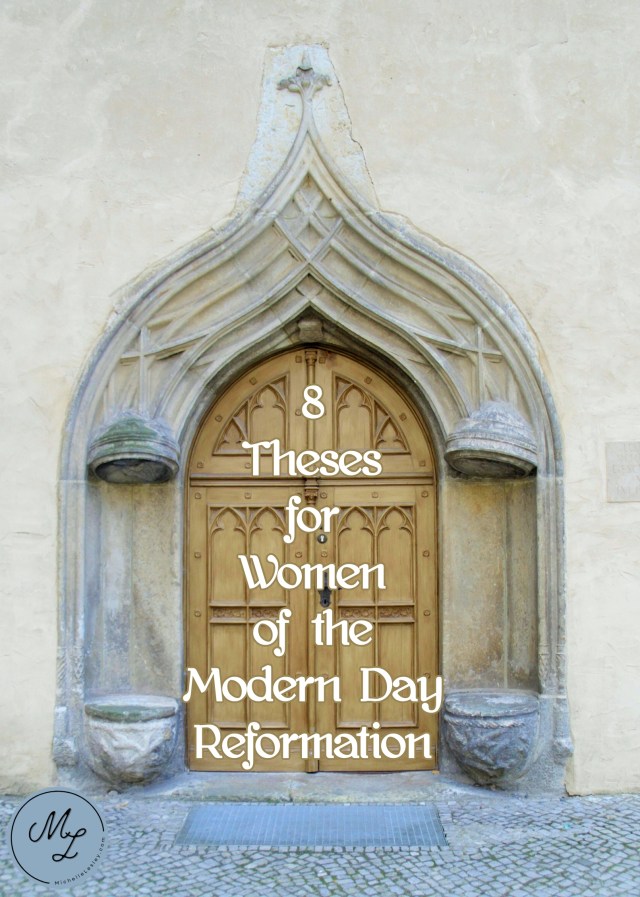
8 Theses for Women of the Modern Day Reformation

October 31, 2017, marks the 500th anniversary of the beginning of the Protestant Reformation, and because I’m all theme-y and whatnot, I’m in the midst of a fantastic book called Reformation Women by Rebecca VanDoodewaard who I dearly wish were on social media so I could shamelessly fangirl her and make a general nuisance of myself by asking too many questions. Normally, I would actually finish a book before slobberingly commending it to you, but in case you like being all theme-y and whatnot too, and because time is of the essence, I’m throwing caution to the wind and telling you:

Get this book. Now. You’re welcome.

Normally, when we read about the Reformation, we’re reading about great preachers and leaders like Luther, Calvin, Zwingli, and Hus, but preaching was not the only work of the Reformation. And that’s one of the things that has captivated me about Rebecca’s book. All of the women included therein were strikingly courageous, tireless laborers, who contributed greatly  to the success of the Reformation, and they did it all while coloring inside the lines of biblical womanhood – doing vital work godly women are uniquely equipped by Christ to do. They opened their homes as a refuge to scores of Protestants (often including those aforementioned notable preachers and other integral leaders) fleeing for their lives from Catholic marauders. They set up prison ministries and fed and clothed the poor. They nursed their communities through the Plague. Those who were queens and princesses used their power to protect Reformers and change persecutory laws. Those who were married to pastors and leaders helped in their ministries and edited their books and papers. And they wrote. Poetry. Position papers. Booklets. Letters. What a happy discovery (for me, anyway) to find sisters of the quill from so long ago.

All of these women were strikingly courageous, tireless laborers, who contributed greatly  to the success of the Reformation, and they did it all while coloring inside the lines of biblical womanhood.

But these great ladies were not our only foremothers in the faith. For as long as God’s people have been God’s people, God’s people have rebelled and needed to be reformed. In fact, that’s the entire, overarching theme of the Old Testament- the need for Israel to reform from its idolatry. And all along the way we see faithful women like Deborah, Jael, Esther, Jehosheba, Jedidah, Huldah, Samson’s mother, and others willing to buck the trend of sin and rebellion and point the way back to God and holy living by their deeds and the example of their lives.

The New Testament gives us extraordinary examples such as the women who ministered to Jesus during His earthly ministry, stood by Him at the cross, and were the first ones at His tomb. Priscilla, Lydia, Dorcas, Eunice, Lois, Phoebe and other believing women soon followed, all lending their aid in their own unique ways to reforming dead, legalistic Judaism into biblical Christianity.

All of these great women of God, serving Him through thousands of years as only godly women can, laying the foundation with their blood, sweat, and tears, for the church we know today.

But have we “arrived”? Is the need for women to work for reform in the church a fast fading dot in the rear-view mirror of modern day evangelicalism? Judging from the articles I read and the e-mails I receive about the problems in the church, the answer to that question would be a big, fat “no.”

Perhaps armies of the Catholic “church” no longer hunt down fleeing Protestants. And, maybe Nero isn’t using Christians as torches for his garden parties any more (although there are certainly areas of the world where our brothers and sisters in Christ face similar threats every day). But the stealth, guerrilla warfare Satan has been waging against the Western church in recent decades might be even more damaging. Certainly, it’s more diffuse and wider spread. Instead of raping the bride of Christ, Satan has chosen instead to seduce her. Why forge an enemy when you can woo a lover?

Instead of raping the bride of Christ, Satan has chosen instead to seduce her. Why forge an enemy when you can woo a lover?

False teachers. Word of Faith heresy. The New Apostolic Reformation. Abuse in the church. Biblical illiteracy. “Lone Ranger” Christians. Idolatry. Irreverence in the sanctuary.

It is easy to see why the heart of the Protestant Reformation was Semper Reformanda– “always reforming.” The work of fighting for sound doctrine, biblical worship, and pure hearts and hands never, never, never ends.

So what does it look like to be a woman of the modern day Reformation? What can we church ladies do to help turn the tide of apostasy in Christendom? Permit me to nail eight theses to the door of your church.

What does it look like to be a woman of the modern day Reformation? What can we church ladies do to help turn the tide of apostasy in Christendom? Permit me to nail eight theses to the door of your church…

1.
Realize You Can’t Change the World

None of the women named earlier in this article changed the world or the entire church. Not a single one of them. In fact some of them brought about great changes in their locales that were overturned in the years after their deaths.

The problems facing the church today are overwhelming. You’re one person. You can’t fix everything (and God doesn’t expect you to). Maybe you can’t even fix everything in your own church. But what you can do is determine to be faithful to Christ and His Word in your sphere of influence. Bloom where you’re planted. “Brighten the corner where you are“, as the old gospel song says. You can’t do everything, but what’s something you can do?

2.
Color Inside the Lines

One of the major problems plaguing the church today is Christian women who rebel against God’s word by stepping outside the boundaries God has drawn for women in the family and the church. Don’t shoot yourself in the foot by following suit in your zeal to reform. There’s plenty of work to be done by godly women – work that we’re better equipped for than men – without violating Scripture.

3.
Mind Your Demeanor

No, we shouldn’t be wishy washy milksops or mealy-mouthed shrinking violets. But we also shouldn’t be loud-mouthed harpies, brashly marching into hell with a water pistol (just trust my own failures on this one). We need to be velvet-covered bricks: soft on the outside, firm on the inside. We should attain to all the Christlike virtues of demeanor: patience, kindness, compassion, mercy, and grace mingled with an unyielding stand on Scripture and an uncompromising commitment to Christ. For some of us, the former comes easier. For some of us, the latter. But we must seek that godly balance as we go about the work of the Kingdom.

4.
Serve the Local Church

If you have rejected the mere idea of local church membership and think you’re going to bring about change from the outside as an unchurched (or functionally unchurched) writer, speaker, or Christian celebrity, you’re part of the problem, not part of the solution. The church is God’s plan for Christianity, not evangelical gurus. Do whatever you have to do to find a doctrinally sound one, join it, and get to work serving.

The church is God’s plan for Christianity, not evangelical gurus.

5.
Pray

When it comes to the church, fixing what’s broken doesn’t rest on your shoulders. Spiritual problems require spiritual solutions, and only God can bring those about. You can defend Scripture til you’re blue in the face or explain all day long why someone is a false teacher, but only God can lift the veil and enlighten the eyes of the heart. Be faithful in your efforts, but be more faithful in prayer. Like the persistent widow, grab hold of the Lord on behalf of the church and don’t let go.

6.
Teach Other Women

In my experience, the number one way false doctrine enters the church is through women’s ministry and women’s “Bible” study. You want to work for reform in the church? Work on reforming your church’s women’s ministry. Explain to your sisters why that divangelista is a false teacher. Request Bible study classes that study the actual Bible. Volunteer to organize the next women’s conference or retreat and schedule doctrinally sound speakers. Teach a women’s or girls’ Sunday School class. Transform the church by transforming the hearts and minds of women.

Transform the church by transforming the hearts and minds of women.

7.
Help

The book of Exodus tells the story of Israel’s battle with Amalek. When Moses held up his arms, Israel prevailed. When he let down his arms, Amalek prevailed. Eventually, Aaron and Hur came alongside Moses and held up his arms for him so that Israel could win the battle. Who was more important to Israel’s victory in this story- Moses or Aaron and Hur? If you answered “both,” you’re correct. Israel couldn’t have won without Moses holding up his hands, but Moses couldn’t have held up his hands without Aaron and Hur. Most of the women of the Old Testament, New Testament, and Protestant Reformation who effected godly change among God’s people were not Moseses. They were Aarons and Hurs. What can you do to hold up the arms of your pastor, your elders, your husband, your church?

8.
Stand

Make sure you know your Bible backwards, forwards, and upside down in context. Know right from wrong, the biblical from the unbiblical. Learn what God’s word says, and stand. Don’t back down. Do it with a godly demeanor, but do it. Refusing to budge from the truth of Scripture might cost you your “church”. It might cost you your family and friends. It might cost you your job, your reputation, and your finances (as we’ve seen in recent years with Christians in the business world who have refused to cave to the homosexual agenda). But as our brothers and sisters who went to the fiery stake, the dank prison cell, and the gallows would tell you, fidelity to God’s Word is worth it. Loyalty to Christ is worth anything it might cost you. Stand.

As our brothers and sisters who went to the fiery stake, the dank prison cell, and the gallows would tell you, fidelity to God’s Word is worth it. Loyalty to Christ is worth anything it might cost you. Stand.

Whether your women’s ministry is using a book by a false teacher, there’s a faction of backbiters in the church that needs to be quelled, or your pastor is overwhelmed and needs some help, there’s something in your church that you can pray about, help with, or work on to help it move toward spiritual health. The church needs discerning, biblically knowledgeable, mature Christian women to step up and fight ungodliness whenever and wherever we’re able. Will you be a courageous laborer in the modern day Reformation?

The church needs discerning, biblically knowledgeable, mature Christian women to step up and fight ungodliness whenever and wherever we’re able. Will you be a courageous laborer in the modern day Reformation?

Mailbag

The Mailbag: Potpourri (NBCS, Homeschool resources, Piper…)


Welcome to another “potpourri” edition of The Mailbag, where I give short(er) answers to several questions rather than a long answer to one question. I also like to take the opportunity in these potpourrri editions to let new readers know about my comments/e-mail/messages policy. Iโ€™m not able to respond individually to most e-mails and messages, so here are some helpful hints for getting your questions answered more quickly. Remember, the search bar can be a helpful tool!


I see many people on my Facebook news feed that are sharing innocuous or biblical sounding content (memes, Facebook posts, blog posts, etc.) from false teachers/ministries. I didnโ€™t find an article on your web site and was wondering if you have already written one. I thinking it would be helpful to help share with others that itโ€™s now necessary to understand the ramifications of sharing (boosting the authorโ€™s credibility, clicks, $, inadvertently sharing false doctrine or non-biblical philosophy, etc.)

I see the same thing in my Facebook feed, and it worries me for the people who, with the best of intentions, I’m sure, are following false teachers themselves and pointing others to false teachers by sharing those posts.

I have, indeed, written an article about this (it does pop up if you use the search bar, but you have to scroll down a ways to get to it since I wrote it a few years ago- sorry about that):

Four Reasons Why It Matters Who We Share, Pin, and Re-Tweet


What do you think of National Back to Church Sunday (NBCS)?

The concept is OK at the surface level, I guess. If all it is is a particular Sunday on the calendar when unchurched people are encouraged to go back to church, and churched people are encouraged to invite unchurched people to church, and churches are encouraged to find out why their supposedly churched members haven’t shown up for weeks, months, or years, I see no problem with the concept itself.

The problem comes when you move from the “on paper” concept to the actual churches that are participating and how those churches are attempting to get unchurched people in the door. If it’s a doctrinally sound church and the pastor says, “Hey- everybody invite an unchurched friend to come with you next week,” great. But we do not want unchurched people putting one toe over the threshold of an apostate or heretical church, and sadly, it appears as though at least some of the participating churches that have registered with the NBCS “Find a Church” page may fall into those categories. And if these “churches” are using unbiblical means and enticements to get lost people in the doors, that’s an additional problem.

The reader also included a link to encounter.com in her question. It’s clear encounter.com is in some way connected to NBCS, but I’m unclear as to how. The material on the “Invited to Belong” page is nauseatingly and blatantly seeker driven and man-centered. It’s all about how worthy you are rather than how worthy Christ is. There is no gospel presentation. Of the four people quoted, none are doctrinally sound Christians. One of the final sentences is a good summary of the whole page: “No church will be perfect, because no person is perfect, but we invite you to find a local church where you will belong.” Not a doctrinally sound church. Not a church that proclaims the biblical gospel. Not a church that preaches Christ and Him crucified. Not a church that teaches the Bible. It’s all about you, baby. If this encounter.com page is in some way NBCS’s mission statement or statement of faith, then I would certainly not recommend the NBCS organization.


I am looking for a solid but very simple Bible study for a loved one who struggles with understanding complicated concepts and words. Maybe even a kids study that is rich in theology. I was wondering if you had any ideas or advice on this?

It’s wonderful that your dear one loves the Lord and wants to study her Bible. Thank you so much for trying to help her!

Since you are a long time reader, you’ve probably heard me say that I don’t recommend “canned” studies, but that people should pick up the actual Bible and study it for themselves. In this case, may I suggest that might even be more important for someone like your loved one? I imagine that her poor reading skills may have made her more dependent on others in many areas of her life than she would like to be, and that studying the Bible for herself would not only be the best way to learn it, but would also give her a greater sense of confidence and independence. An “ownership” of her study of the Bible, if you will.

There are several good children’s and “easy reader” Bibles out there. I’ve suggested a few here: Children’s Bible Recommendations. You might wish to sit down with her and come up with a list of simple questions she can answer as she finishes reading a chapter, such as:

๐Ÿ“– Who is this passage about?
๐Ÿ“– What is the main idea of this passage?
๐Ÿ“– Why did God – the author of the author of the Bible Who says all Scripture is useful – put this passage in the Bible? 

๐Ÿ“– What can I learn about God from this passage?
๐Ÿ“– Is this passage telling me to do/not to do something? How can I obey it?
๐Ÿ“– Is there something in this passage I need to pray about?

Or, if you like, you could suggest that she read one of the books of the Bible I’ve written a study on (out of her own, new, easy to read Bible), take some of the questions I’ve written and send her a simplified version of the ones you think she can handle.

And, perhaps you could be “on call” via phone or e-mail to answer any questions she might have about what she’s studying. What a great opportunity to do one on one discipleship with someone who’s dear to your heart!


Do you know of any good Christian homeschooling blogs?

I homeschool, so I’m asked from time to time about homeschooling resources, but to be honest, it’s just not something I really read about. I recently asked my readers to recommend some good, doctrinally sound online homeschool blogs and resources, and here’s what they suggested (Please note, I have not vetted any of these. You will need to do the research yourself to discover whether or not they’re doctrinally sound.)

โœ Family Renewal
โœ Reformed Homeschoolin’ Mamas
โœ Durenda Wilson
(author of The Unhurried Homeschooler)
โœ Half-A-Hundred Acre Wood
โœ The Kingdom Driven Family
โœ Annie & Everything


I really enjoyed reading A Few Good Men and A Few MORE Good Men, but how come John Piper (or another pastor) isn’t included? Is he a false teacher? 

Please understand that these two lists of godly male teachers aren’t exhaustive. Praise God, there are scores of preachers and teachers out there who faithfully teach and rightly handle God’s Word. I couldn’t list all of them if I tried, though I plan to add more articles like this in the future. These were just the teachers I was most familiar with at the time I wrote the articles. The mere fact that your favorite teacher doesn’t appear on these lists does not make him a false teacher, and I hope the articles don’t imply that (I don’t think they do).

John Piper’s books, sermons, and blog are mostly fine, and while I disagree with him on several points of theology, I certainly do not consider him to be a false teacher. But he’s not somebody I’m going to proactively recommend, either. Here’s how I’ve answered readers in the past who have asked me about John Piper:

While I consider Dr. Piper to be a generally doctrinally sound Christian brother and agree with him in many aspects of theology, he is not someone I proactively recommend for a few reasons:

1. Dr. Piper is a continuationist. I usually limit my endorsements to cessationists  because I believe this is the biblical view of the gifts. (I do not consider otherwise doctrinally sound continuationists to be false teachers, however.)

2. Iโ€™m concerned about Dr. Piper’s associations and partnerships with false teachers (which violates 2 Corinthians 6:14-18, Romans 16:17-18, and 2 John 9-11). First he appeared to embrace Rick Warren when he interviewed him and invited him to speak at the Desiring God conference in 2010. More recently, he has been a featured speaker at events like the Passion conferences where he has shared the stage with Christine Caine, Priscilla Shirer, Beth Moore, and Judah Smith.

3. Dr. Piper’s complementarianism seems muddled at best. On the one hand he will go so far as to say that Christian women should not be drill sergeants (the Bible mentions nothing of the sort), yet on the other hand he joins in ministry with the aforementioned Caine, Shirer, and Moore who โ€“ in addition the the false doctrine they preach โ€“ all actively and unrepentantly violate clear Scripture by preaching to men. It’s quite confusing.

Iโ€™m not going to warn people away from John Piper as a false teacher, but I canโ€™t, in good conscience, recommend him either.


If you have a question about: a Bible passage, an aspect of theology, a current issue in Christianity, or how to biblically handle a family, life, or church situation, comment below (Iโ€™ll hold all questions in queue {unpublished} for a future edition of The Mailbag) or send me an e-mail or private message. If your question is chosen for publication, your anonymity will be protected.

Discernment, Mailbag

The Mailbag: My Discernment Is Distracting Me from Worship


Since discovering and learning more in depth about the vast amount of false teaching in the church, I now find myself questioning everything to the point that it has affected my ability to worship. We attend a very small, relatively biblically solid church, but when we sing, for example, a Hillsong song, Iโ€™m so focused on the atrocities of Hillsong that I am unable to enjoy the time of worship. How are you, with all your knowledge of current day church apostasy, able to overcome that knowledge and just enjoy all aspects of a church service? We are a body of mature believers, but even our little church isnโ€™t perfect.

This is a dilemma a lot of us face at some point, so thanks for asking. I think the linchpin of your question – and my answer – is your last statement. Your church isn’t perfect. My church isn’t perfect. No church is perfect. It’s unreasonable to expect any church to be perfect, just like it would be unreasonable to expect your spouse or child to be perfect.

I’ve had to muddle through this question myself on more than one occasion at more than one church, and to be perfectly honest, many times I’ve done so with all the grace of an inebriated elephant on roller skates and the forbearance of an annoyed cat (or maybe just “a cat”). I think I’ve mentioned before that I’m what they used to call a “Type A” personality. Very task oriented. Workaholic-prone. High strung. When I see a problem, it’s, “Here’s the solution. Let’s implement it, like, yesterday. Get on board or get left behind. What’s next?”

Guess what I’ve learned? Most people aren’t like that. Or at least most church people aren’t. Or they aren’t like that about the same things I’m like that about. And you know what? That’s actually been good for me. God has used those situations as a tool in my sanctification, to make me more understanding, patient, and compassionate with others, just as I want them to be with me. Of course, He’s still got a long way to go with me!

So, having “been there, done that” here are a few suggestions and things to keep in mind:

โœข There’s such a thing as “cage stage” discernment. It’s when your eyes have recently been opened to false teaching/teachers, you’re drinking from the discernment fire hose, and you don’t understand why everybody isn’t as freaked out and on board as you are. Are you theologically right? Probably. Are you going to win friends and influence people with immersion therapy? Nope. There’s really nothing you can do about this phase of your life except to realize it exists and make a concerted effort to rein yourself in until you’ve mellowed a bit.

โœขย Pray. I am convinced that one of the reasons God puts discerning people into churches that need a little (or a lot) sharpening in the area of discernment is for those discerning people to be warring on their knees every day for their churches, their pastors, their teachers. God can do more to straighten out the problems at your church than any human action can, because only God is able to change people’s hearts. You start praying fervently, and I guarantee you, over time, you’ll see God working in your church.

โœข Immerse yourself in the Word. If you know your Bible forwards and backwards, you’re not going to question every word your pastor says, or every page of that book your reading, or every lyric of every song because God’s Word will be “hidden in your heart,” and you’ll know whether what you’re hearing is biblical or not.ย 

โœข If you’re married, discuss the issue(s) with your husband and make sure you’re submitting to his leadership. Likewise, if you’re a minor child living under your parents’ authority.

โœข Understand the nature of the average church member/pastor/staff at the average, reasonably doctrinally sound church. They’re just like you were before you found out about discernment. They’re not trying to introduce heretical materials into your church. They don’t want to follow false teachers. Theyย simply don’t know any better. It has never occurred to them that something that labels itself “Christian” might not be biblical Christianity, because they’ve never been taught this.ย Should every Christian know these things and have at least a modicum of discernment? Yes. But we have to deal with things the way theyย are, not the way theyย should be.

โœข Meditate on and memorize this passage (and any others that are helpful to you about your situation):

Andย the Lord’s servantย must not be quarrelsome butย kind to everyone,ย able to teach, patiently enduring evil,ย correcting his opponentsย with gentleness. Godย may perhaps grant them repentanceย leading to a knowledge of the truth,ย and they may come to their senses and escape fromย the snare of the devil, after being captured by him to do his will.
2 Timothy 2:24-26

This passage has been extremely helpful to me to remember not onlyย how we do discernment work, butย why we do it. We must be patient and compassionate. We’re attempting to rescue people with spiritual Stockholm Syndrome.

โœข Take action wisely, kindly, and patiently. Of all the things that are distressing you discernment-wise at your church, whichย one is the one that distracts you most or is most urgently in need of being addressed? Devote some serious time to praying about it, praying for all the people involved, and praying that God will make your heart Christlike about it: weeks, at a minimum. Maybe months. God may resolve the situation without you having to do anything about it.

As you’re praying there may be some participation adjustments you might wish to consider. For example, if the problem at your church was that the women’s ministry was constantly using “Bible” study materials authored by false teachers, you might adjust your behavior this way. If you cannot sing the Hillsong songs in good conscience, just stand (or sit) silently and respectfully with the rest of the congregationย until the song is over. Due to a series of various circumstances a while back, my church had a female interim music director for several months. I could not, in good conscience, affirm that decision by my participation, so I did not participate in the music portion of the worship service during her tenure. I stood silently and respectfully and used that time to pray for her, my pastor, my church, and our future minister of music.

But if things don’t improve or seem to get worse, someone may need to talk to the person at the center of the problem. This article may be helpful in that eventuality.

โœขโœขโœขโœขโœข

Discernment can be a difficult gift to grapple with. Stay on your knees, stay in the Word, and Christ will carry you through.


If you have a question about: a Bible passage, an aspect of theology, a current issue in Christianity, or how to biblically handle a family, life, or church situation, comment below (Iโ€™ll hold all questions in queue {unpublished} for a future edition ofย The Mailbag) or send me anย e-mail or private message. If your question is chosen for publication, your anonymity will be protected.