Basic Training, Bible Study, Sermons

Basic Training: Bible Studies and Sermons

For more in the Basic Training series, click here.
When I started the Basic Training series, I thought I’d be writing about foundational theological concepts and practices in Christianity. You know, like baptism or the sufficiency of Scripture. It never occurred to me that I might someday need to explain something so basic that most lost people could define it as well as (sometimes better than) many professed Christian leaders.

But the more “Bible” studies and sermons I take in, the more I think a remedial course in exactly what those things are supposed to consist of might be very beneficial to the church at large, and an unfortunate necessity for many pastors, teachers, and Christian celebrities.

I could be way off base here, but I’d almost bet that if you went up to ten random people on the street and asked them what a Bible study class is supposed to do, at least nine out of ten of them would answer, “Study the Bible.” If you asked those same people what a sermon is, you might get more varied answers, “It’s when the preacher explains what the Bible says,” or “It’s a pastor telling you how to be a good person,” (remember these are random, probably unsaved, people) or “A sermon tells you about God.” But I’m guessing none of them would answer, “It’s when a preacher gives a stand up comedy routine,” or “A sermon is mostly stories about the preacher, his family, and other people,” or “A sermon is when you watch a movie and then the preacher adds a few remarks at the end about what you can learn about God or life from the movie.”

Yet, that’s pretty much where way too many churches are these days.

So let’s take a look at what Bible studies and sermons are and aren’t supposed to be.

It’s All About The Bible

This is supposed to be a “duh” moment for Christians, pastors, teachers, and churches. If someone is teaching a Bible study or a pastor is preaching a sermon, the first thing he should reach for is his Bible. He is to be preaching or teaching God’s written Word. It’s right there in black and white in 2 Timothy 4:1-2:

I charge you in the presence of God and of Christ Jesus, who is to judge the living and the dead, and by his appearing and his kingdom: preach the word; be ready in season and out of season; reprove, rebuke, and exhort, with complete patience and teaching.

That’s a very solemn and weighty charge to pastors. In today’s vernacular, it’s almost like placing your right hand on the Bible, raising your right hand, and saying, “As God is my witness, I swear to God I will ______.” (and actually understanding the gravity of that and meaning it). God is witnessing this charge to you pastor – you’d better take seriously your duty to preach His Word.

And notice, there are only two times when a pastor is supposed to preach the Word: in season and out of season. When his people want to hear it and when they don’t. When he feels like it and when he doesn’t. When he’ll be persecuted and when he won’t. When it’s easy and when it’s hard. When it’s a pleasant, encouraging passage, and when it’s a passage that offends people. Pastors, and, by extension teachers, are to preach and teach the written Word of God in every sermon and teaching opportunity. Always.

It’s Not About the Preacher/Teacher/Author

There are a lot of awesome pastors, teachers, and authors out there who labor faithfully to rightly teach God’s Word to His people. I am unspeakably grateful to them and for them.

But let’s face it, there are also a lot of narcissistic gas bags out there who use the pulpit and the pages to pump up their already over-inflated egos by endlessly blathering on and on about themselves, their families, their friends, and their experiences. You can tell by the ratio of personal stories to Scripture who they love best and are most interested in.

I’ve read books and heard sermons that I walked away from thinking, “I know more about that pastor or author, his family, his trips, the charity work he does, and who his important friends are than I do about God and His Word.” (I’ll tell you this, he’s received his reward.)

Pastors, teachers, authors aren’t to preach themselves, they’re to preach the Word.

It’s Not About Gimmicks and Entertainment
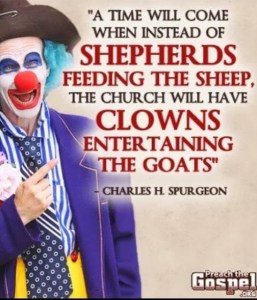
A sermon series based on movies. A pastor riding a motorcycle into church. Ziplining during the sermon. Rock concerts and light shows. Raffles and giveaways of cars and other big ticket items. The pastor and his wife promoting a sermon series on sex. On the news. From a bed. On the roof of the church.

Pastors and teachers aren’t charged to entertain people or get them in the doors of the church and keep them there by any means necessary. Pastors and teachers are charged – with God as their witness – to faithfully preach and teach His written Word. Jesus said shepherds who love Him will feed His sheep, not entertain them.

Newsflash – the world isn’t going to find that interesting enough to get out of bed for on Sunday morning. Newsflash – That’s fine. The gathering of the church isn’t for the world. The gathering of the church is for the church – the people who have been saved out of the world and into the body of Christ – to give them an opportunity to worship the Savior they love with their brothers and sisters, to disciple them in God’s Word, and to equip them with God’s Word to go out and share the gospel with the world.

It’s Not About You, Either

The flip side of “it’s all about the Bible” is, it’s not about you. What does that mean? The sermon or the Bible study lesson should not teach us to look down in narcissistic navel-gazing, it should teach us to look up at God, who He is, what He has done, and what He says in His written Word.

Over the years, I’ve had the discouraging duty of reviewing various women’s “Bible” studies. Though some have been better than others, the theme running through the majority of them is “it’s all about you” – your feelings, your hurts, your ego, your opinions, your personal experiences. It’s evident in the way authors insert long stories about their own lives and base their ideas, agendas, and assertions on those personal experiences rather than on Scripture. It’s evident in the questions the reader is supposed to answer at the end of each lesson: “Have you ever experienced _____?” “How does ____ make you feel?” “If you could ____, how would you do it?” “What do you think others’ opinion of you is?”

Good Bible studies give you rightly handled, in context Scripture until it’s coming out of your ears, and then they ask questions like, “What are the attributes of God listed in this passage?” “Verse 3 talks about lying. What are some other verses that talk about lying, and how can we tell from these verses how God views lying and why?” “How does this passage point us to Christ?”

Is there a need for introspection during Bible studies and sermons? Sometimes. But the focus is not you and your feelings and experiences. The focus is on reflecting on the glory of God in the passage you’ve just heard, repenting of the sin the passage you’ve just read has convicted you about, obeying the command in the passage you’ve just heard, and things like that. It’s Bible-focused, driven, and governed, not me-focused, driven, and governed.

Context, Context, Context

It’s not just important to preach and teach the Bible, it’s important to handle the text of the Bible correctly and in context.

You’ve probably heard the old joke about the guy who wants God to tell him what he should do with his life. So he opens up the Bible to a random spot, closes his eyes, puts his finger down on the page, and looks at the verse he’s pointing at. It’s a New Testament verse: “Judas went and hanged himself.” “Hmm,” he thinks, “that doesn’t make much sense.” He shuts his Bible and tries the process again. This time, it’s an Old Testament verse, “Go and do thou likewise.”

We laugh at the silliness of this little story, but it hits frighteningly close to home for far too many pastors and teachers.

Perhaps you’ve read a devotional that quotes a Bible verse (or maybe even just part of a verse) at the top of the page. The author then goes on to teach on that verse or tell a personal story. When you look up the verse and read a little more of the chapter it’s in, you discover it has nothing to do with the author’s story or doesn’t mean what the author was teaching.

Or maybe you’ve sat in a church service where the pastor reads a verse or two at the beginning of the sermon and then basically closes his Bible and shares personal thoughts and stories for the rest of the sermon time that have nothing to do with the verses he read at the beginning. Or a sermon in which the pastor hopscotches all over the Bible (often using a myriad of translations) reading a verse here, half a verse there, in an effort to prove his homespun thesis or support the agenda he’s crafted.
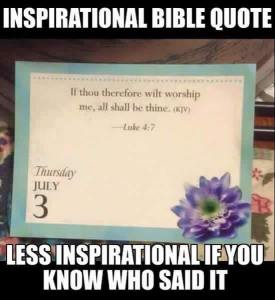
Yes, technically, there’s Bible in all of those teachings, but none of those methods handle Scripture properly or in context. That’s called eisegesis, and it basically means reading your own ideas into the text of Scripture, or twisting Scripture to get it to say what you want it to mean.

The proper method of teaching Scripture is exegesis. Exegesis is taking a passage of Scripture in context, and “leading out” of it- teaching what the passage means. That’s nearly always going to require reading several verses from the passage to catch the reader or listener up on what’s going on in the story she’s just parachuted into.

Good pastors and teachers read and teach the biblical text in an organized way. When you sit down to study, say, a history book, you start at the beginning of the book and you work your way through to the end. You don’t start by reading two paragraphs out of the middle of chapter 7, then move on to the last three sentences of chapter 49, then the first half of chapter 1. That’s how people preach, teach, and “study” the Bible sometimes, and it’s just as crazy to read the Bible that way as it would be to study a history book, or math book, or science book that way, or even to read a novel or a magazine using that helter-skelter method.

Expository vs. Topical

This section is a brief, modified excerpt from my article The Mailbag: Expository or Topical Preaching: Which is better?.

For readers who might not be familiar with the terms, expository preaching and teaching is basically when a pastor preaches (or a teacher teaches) through books of the Bible from beginning to end carefully explaining what each passage means. (Ezra is an example of an expository Bible study.)

Topical preaching can have a couple of different meanings depending on who you’re talking to and what she understands the term to mean. Some people understand “topical preaching” to mean a sermon series, usually in a seeker driven church, that centers around something in pop culture. (For example, popular movies or the Olympics.) Normally, these sermons are very shallow, biblically – sometimes nothing more than a pep talk or self-help tips. This type of preaching and teaching is unbiblical, and if it makes up the bulk of the teaching at your church, I’d recommend finding a new church.

There is, however, a biblical form of topical preaching and teaching that can be very helpful, occasionally. If a doctrinally sound pastor sees an issue in the church that needs to be addressed, or a biblical topic to explore, there is nothing wrong with his taking a break from preaching through a certain book (or when he’s between books) to teach on this issue from the pulpit. (Imperishable Beauty: A Study of Biblical Womanhood is an example of a biblical, topical Bible study.)

In my opinion, the majority of a pastor’s preaching and a Bible study’s teaching should be expository with occasional breaks for (biblical) topical preaching and teaching as needed. There are a variety of reasons for this (more in the linked article):

• Expository preaching models for the congregation the proper, systematic way they should study the Bible at home.

• Expository preaching helps a pastor better preach the whole counsel of God.

• Expository preaching pushes pastors to tackle hard and unfamiliar passages as they come up in the text.

• Expository preaching should keep the Old Testament and certain books of the Bible from being neglected as much as they usually are.

• Expository preaching gives the congregation a better grip on the overall story arc of the Bible and the culture of the period being studied.

Expository and topical preaching are both helpful in their own ways, but the most important thing is that the pastor is “rightly handling the word of truth.”


There’s a lot of lousy preaching and teaching out there these days, but if you’ll look for good, solid biblical preaching and teaching (check the Recommended Bible Teachers and Bible Studies tabs above for ideas) God can use it mightily in your spiritual life to grow you to greater Christlikeness.

Top 10

Top 10 Articles of 2018

I always enjoy the annual “year in review” articles and TV shows that run in abundance in late December, so I thought I’d contribute my own. Several Mailbag articles were among this year’s most popular, so I decided to make two separate lists, the Top 10 Mailbag Articles of 2018, and the top 10 non-Mailbag articles of 2018. Here are my ten most popular non-Mailbag blog articles from 2018:

Christine Caine: Have No Regard for the Offerings of Caine

Unfortunately, Christine’s teachings and some of her actions do not meet even these basic biblical standards, and it is my sad duty to recommend that you not sit under her teaching for the following reasons…

Women Preaching: It’s Not a Secondary Doctrinal Issue

The violation of God’s command that women are not to instruct men in the Scriptures nor hold improper authority over men is a sin like any other. It is not a doctrinal issue in the same sense that other second and third tier doctrines are… 

Answering the Opposition:
Responses to the Most Frequently Raised Discernment Objections

There are also occasional comments and messages from women who are disciples of the false teachers I warn against, who take me to task for doing so. The same unscriptural accusations are raised again and again against me and against others who take a biblical stand against false teachers and false doctrine. Here, in no particular order, are the most frequently raised objections to my discernment work and my answers to them…

A Naked Emperor in the Southern Baptist Convention

And so the “emperor” of leadership in the Southern Baptist Convention and those who carry its train march proudly on, despite the cries of simple peasants and innocent little children crying at the top of our lungs, “The emperor is naked!” “There are issues that need to be addressed, here!” “Listen to us!”…

Women and False Teachers:
Why Men Don’t Get It, and Why It’s Imperative That They Do

There’s at least one biblical issue women respond to differently at the core level of their spiritual DNA than men do. And men, it’s crucial that you get it on this one. You’re the pastors. The elders. The husbands. The fathers. The ones responsible before God for leading your churches and your families in doctrinally sound spiritual growth. You’ve got to get this for the sake of the girls and women you lead…

 A Few Good Men: 10 Doctrinally Sound Male Teachers

Let me introduce you to a few of my favorite male authors of Bible studies
and other great Christian books and resources…

 10 Biblically Sound Blogs and Podcasts by Christian Women

False teachers. You can’t throw a rock out the window these days without hitting one. But are there any “good guys” out there who are getting it right? Discipleship, Bible study,and theological issues bloggers who rightly divide God’s word? You bet…

Five Reasons It’s Time to Start Exercising “Moore” Discernment

This is not a request for you to believe me or agree with my personal opinion. I’m asking you to take a discerning look at the evidence and compare with Scripture what Beth Moore is currently doing and teaching. If you do, I think it will be obvious to you that, whatever she may have taught in the past, something is seriously wrong now…

Going Beyond Scripture:
Why It’s Time to Say Good-Bye to Priscilla Shirer and Going Beyond Ministries

Should she repent in these areas in which she has broken Scripture and align herself with biblical principles, she would have no bigger fan than I, and I would rejoice to be able to point Christian women to her as a doctrinally sound resource. Until that time, however, it saddens me to have to recommend that Christian women not follow Priscilla Shirer or any materials or activities from Going Beyond Ministries for the following reasons…

Leaving Lysa:
Why You Shouldn’t Be Following Lysa TerKeurst or Proverbs 31 Ministries

For these reasons, plus her habitual mishandling of Scripture, unfortunately, I must recommend that women not follow, support, or receive teaching from Lysa TerKeurst or Proverbs 31 Ministries(including any writers or speakers affiliated with Proverbs 31 Ministries)…

What was YOUR favorite article of 2018?

Guest Posts

Guest Post: Moving Off the Sure Foundation

If your theology pretty much matches up with mine (as outlined in the “Welcome” and “Statement of Faith” tabs) and you’d like to contribute a guest post, drop me an e-mail at MichelleLesley1@yahoo.com,
and let’s chat about it.

Moving Off The Sure Foundation
by Kerri Sheldon

The authoritative rule for Christian belief and practice is Scripture – pure and sound. It should be the church’s first say, only say, and final say. If the truth within Scripture is compromised, then by default, the new norm will become muddled thinking and false teaching. Such a compromise will transpire when biblical truths are subtly displaced by other ideas that perhaps on the surface appear innocuous, but with further consideration are found to be a diversion from truth.

Unfortunately, such a shift is happening today among evangelical circles at an increasing rate. A prime illustration is seen when a church has a statement of faith that includes something like, “We believe in the sole authority of Scripture for faith and practice,” yet they have practically abandoned that stance by allowing false teachings to enter in, whether deliberately or indirectly. If Scripture is really their authority, as they say, it should be in actuality, not just in statement. Sometimes it can be more telling to view a church’s list of current studies to know if they truly adhere to God’s Word.

Let’s turn our attention to a few specific examples of untrue teachings that have entered the visible church, making way for a foundational swing.

Hearing God’s Voice

It is quite possible you have heard the phrase “hearing God’s voice,” whether from some teacher or in conversation. Upon hearing such an expression, we should ask ourselves what the person means. Are they saying they were reading the Bible and the Holy Spirit illuminated the truth meaning of the text to their minds? Perhaps that is what they mean. But generally when the phrase is used it means something quite different. Authors Henry and Richard Blackaby, as well as teachers Beth Moore and Priscilla Shirer, to name a few, typically use it to convey the concept that God’s voice is heard when one opens themselves up or learns through experience apart from and outside of Scripture. Keep in mind they might affirm that God’s voice is heard only in Scripture. However, in reality, usually the idea is that one should hear fresh inner promptings or whispers that are not found in the Bible. In fact, they suggest that to hear God’s voice immediately and directly is fresher and greater than simply reading and studying His Word. Do you see why this teaching is so deceptive? It is not because of what is actually stated – to hear God’s voice, but because of what is not stated – how, when, and where to hear God’s voice. The truth is that Christians are commanded to read, study, memorize, believe, and obey God’s Word, not to listen for a voice. It is in the hearing and illumination of the Word that the Spirit then promises to be with us, guiding and empowering us, as we simply walk by faith.

Experiencing God

“Experiencing God” is another commonly heard theme. The idea is associated with having fresh encounters with God. An example can be seen in the book Jesus Calling by Sarah Young. Young states, “I knew that God communicated with me through the Bible, but I yearned for more…” (p. xi) What is this “more” for which Young longs? Is it for more of the Bible? It is not presented that way. Implicit in her statement is the desire for a personal encounter or direct experience with the Living God that is beyond, or other than through, the Word of God.

Should Christians desire to personally encounter God based on their own devices or whims? Is this even attainable? Mystics would answer “yes.” They believe that direct knowledge of God, spiritual truth, or ultimate reality can be attained through subjective experience as intuition or insight. But the believers’ “experiencing” of God is a knowing of God through His means – the Word of God and the Spirit of God. The eternal invisible God is unknowable to fallen and rebellious sinners apart from His own provision for them. Unfortunately, when someone wishes to experience God directly they will be operating from worldly or sensual desires. Let’s remember what one of the more prolific writers and theologians of the 20th century, Francis Schaeffer, said: “We must stress that the basis for our faith is neither experience nor emotion, but the truth as God has given it: in verbalized, propositional form in the Scripture and which we first of all apprehend with our mind – though, of course, the whole man must act upon it.”

Benjamin Warfield, a professor at Princeton Theological Seminary, explained the difference between biblically “experiencing” God and mystical experience, in The Biblical Review, Volume 2, 1917: “Evangelical Christianity interprets all religious experience by the normative revelation of God recorded for us in the Holy Scriptures, and guides, directs, and corrects it from these Scriptures, and thus molds it into harmony with what God in His revealed Word lays down as the normal Christian life. The mystic, on the other hand, tends to substitute his religious experience for the objective revelation of God recorded in the written Word, as the source from which he derives his knowledge of God, or at least to subordinate the expressly revealed Word as the less direct and convincing source of knowledge of God to his own religious experience. The result is that the external revelation is relatively depressed in value, if not totally set aside.”

One of the more prominent people who introduced experience-based emphases and techniques into the visible church was author Richard Foster. His book Celebration of Discipline: The Path to Spiritual Growth took the church world by storm when first published in 1978 (from which the below quotes are taken). It is about the quest for spirituality based on the inner workings of the soul and spiritual techniques. Interestingly, Foster was raised a Quaker. They believe in the “inward light.” To give you a taste of Foster’s book the following quotes are given:

The inner world of meditation is most easily entered through the door of the imagination. (p. 22)

Another meditation aimed at centering oneself begins by concentrating on breathing…become silent outwardly and inwardly. Be attentive to the inward living Christ…then listen once again. (p.25)

You can see Foster believes that imagination, meditation, and the quest for the “inward Christ” are the new mediation before God. Of course that is absolutely not biblical, and is in contrast to the “outward” light who invaded our world of darkness in the person of Jesus Christ, who is the Way, the Truth and the Life. He and His Word are the Light having come into our darkened lives. Not long after Foster’s book, a new seminary category of study was born – spiritual formations. It is quite a conglomeration of teachings in most seminaries these days.

The Cosmic Christ

Another false thought that has entered into evangelicalism is that of a Romantic and/or Cosmic Christ. It says God comes to us “in stuff” (like the creation) and that we need “spiritual eyes” to see Him there. But does Christ make Himself known personally through the creation? No, the true God reigns transcendent over His creation and made Himself personally known in the Person of the Lord Jesus Christ as revealed in Scripture. Yet many are flocking to such authors as Ann Voskamp who writes in her book One Thousand Gifts, “Do I have eyes to see His face in all things…” (p.112). This is a new-age concept in that there is an ever present deity in the creation. It is not talking of the real Jesus, the One who became flesh and dwelt among us and died and was raised again and is seated at the right hand of God the Father. If you want that Christ, you should stick with only the Scriptures.

The End of this Present Evil Age

Unfortunately, the introduction of many false teachers and false doctrines as mentioned here has been “winked at” by most evangelical leaders. This is not ok. If we move even slightly off a biblical foundation, where does that take us? In Acts 20:17-38 we read of Paul’s ministry to the elders of Ephesus and his emphasis in that ministry. True shepherds warn the flock of such impending dangers just like Paul. In light of this, we must not overlook the very nature of the end of this present evil age. Remember what Paul says in 2 Thessalonians 2. He warns that there would be a falling away from the faith led by the man of sin. In the midst of the church at the end of the age a beast will arise and be the catalyst of a false church and the world’s final rebellion against the God of the Scriptures. The spirit of antichrist starts in the visible church and the final apostasy will be no exception. For saints who are alive, it will be very costly to maintain a faithful testimony to the Lord Jesus Christ in the environment of both the visible apostate church and the fallen world.

But our ultimate hope is eternal and will be revealed when the Lord Jesus Christ Himself returns on that glorious day of His revelation! Until then, we should be on guard even while sitting in a church pew and wait patiently with watchful eye and prayerful hearts.


This article is drawn, in part, from Resolute: An Unwavering Stance on the Truth of God’s Word by Kerri Sheldon and her father, David Sheldon. Kerri and David believe that making true disciples of Jesus Christ can only happen when one is presented with sound theological doctrine, and their desire is to help Christians guard against deception and ignite a stance on the Word of God alone. Check out Kerri and David’s website, 4 Truth Ministry and follow them on Facebook and Twitter.

Check out the 4 Truth Ministry Facebook page to find out how
you could win a free copy of Resolute!

Mailbag

The Mailbag: Potpourri (A rabbi, Rosaria, and a boy mom walk into a blog…)

Welcome to another “potpourri” edition of The Mailbag, where I give short(er) answers to several questions rather than a long answer to one question. I also like to take the opportunity in these potpourri editions to let new readers know about my comments/e-mail/messages policy. I’m not able to respond individually to most e-mails and messages, so here are some helpful hints for getting your questions answered more quickly. Remember, the search bar can be a helpful tool!


Do you have any recommendations for mothers raising Godly men? I became a believer after I was married and my husband is not a believer yet.

As a mom to five boys myself, the best advice I can offer you is this: If you want to raise godly men, be a godly woman. Model godliness for your boys. Study your Bible, and teach them to study their Bibles. Pray, and teach them to pray. Be faithful to your church, find a way to serve there, and teach them to do the same. Obey God’s Word, and teach them to be obedient. When you sin, use it as an opportunity to teach them about repentance and forgiveness. Ask God for wisdom, strength, guidance, and patience. Pray for your boys’ salvation. Submit to your husband. Pray for him and for his salvation.

Some other resources you may find helpful:

Your pastor – Set up an appointment with your pastor to get some counsel. This is part of his job in shepherding you. It would also be very helpful to find an older, doctrinally sound sister in Christ at your church (preferably one who has raised boys) and ask her to mentor/disciple you.

Imperishable Beauty: A Study of Biblical Womanhood – If you’d like to learn more about being a godly woman, join our current Bible study here on the blog.

Bringing Up Boys by James Dobson – Although I wouldn’t endorse everything from Dobson, I found this book to be helpful years ago when my sons were young. (I have an older edition of the book, so I can’t vouch for any revisions in this newer edition.)

Six Ways to Raise a Godly Man

Parenting Articles


Are you preaching to men here? Are you instructing them?

This has been my frustration with this whole issue. I read the Bible a lot and can see so very much deception here in the West but feel like I am not allowed to say anything to the males who are deceived. And there are many, many false teachers who are male.

I’m not preaching to men or instructing them in that article. As I stated in the conclusion:

…in the end, this article is not meant to be a castigation of pastors or other Christian men, but an impassioned plea from a church lady who wants to see her sisters make it out alive. Help us. Please.

But even if that article had been instructive to men, that’s not a violation of Scripture. What the Bible prohibits is women preaching to men, instructing men in the Bible, and holding authority over men in the gathered body of Believers – the church setting. A blog is not the church. I think these articles may help as you study through this issue:

Rock Your Role: Jill in the Pulpit
Rock Your Role FAQs
Are Female Bloggers Violating Scripture by “Teaching” Men?
The Mailbag: Is it OK for Christian men to read Christian women’s blogs?

The Bible also does not prohibit you from having a conversation with a male friend or relative to scripturally discourage him from following a false teacher or being a false teacher. (Obviously, you should use biblical wisdom about appearances and temptation when meeting with someone of the opposite sex, though.) That’s essentially what Priscilla and Aquila did when they corrected Apollos – they took him aside privately and explained the gospel more accurately to him.

I would just encourage you to think about your relationship with the man you’re considering talking to. Are you the best person for the job? Not because you’re a woman, but perhaps there’s someone he’s closer to or looks up to as a mentor whose correction might make more of an impact. What about you and your husband (if you’re married and he’s biblically able) approaching this man together as Priscilla and Aquila did? Just some things to consider.


Could you recommend your most trusted watchdog or heresy sites? I’m trying to find info on [a certain rabbi] as my mom has asked me to watch his teachings.

Well…if he’s a rabbi, he is – by definition – not a Christian, so you should not believe anything he says about God, Jesus, the Bible, church, theology, etc. If any Christian discernment sites have anything on him it will probably be Berean Research, Pirate Christian’s Blogs, or Fighting for the Faith. These are the sites I most often use for researching false teachers. I’ve listed a few other helpful discernment sites here (see #6).


In a recent article you said, “I’ve often cited the false teaching that prayer is a ‘two-way conversation’ (you talk to God and then He talks back to you).”

Are you saying that God never “talks” to us in reply to our prayers/talking to Him? Or are you saying that the idea of God talking to us as we talk to each other is wrong? (Thanks so much, in advance, for taking time to answer. I really think assuming things makes us vulnerable to misunderstanding…. May God bless you!)

May God bless you too, and thanks for your question.

The answer to both of your questions is “yes”. God does not “talk” to us, and the idea that He talks to us is biblically incorrect. God has already spoken to us, and even went so far as to have His words written down for us – it’s called the Bible. I’ve explained more about this in my article Basic Training: The Bible is Sufficient.


“You made a bunch of allegations in this article but didn’t back them up with any evidence.”

“You mentioned [a particular word, phrase, or concept] in your article. I don’t understand what that is. Can you please explain?”

Hyperlinks, y’all. They’re called hyperlinks. And you need to click on them to find the information you’re looking for.

If you’re reading one of my articles and you see a word in red that’s underlined when you hover over it (other sites might use other colors), clicking on it will take you to another article or resource that will provide you with more information. It’s a little bit like a footnote in a book.

If I stopped to explain every concept I thought people might not understand, gave the full details of every incident I allude to, or wrote out every Scripture that supports the point I’m making, my articles would be tediously long (even more so than usual!). Hyperlinks are a convenient way to provide you with the details, information, or Scriptures you need without adding unbearable length to the article.

All you have to do is click on them.


Our church recently did a book study on “The Gospel Comes with a House Key” by Rosaria Butterfield. The book’s theme is “radical hospitality”. She and her husband invite non-believing people into their home for meals etc. They place no boundaries on this, many are strangers to them.

Concerns my husband and I had were the lack of safety for their family, and the spiritual danger of being yoked together with unbelievers. When we expressed our concerns, no one else spoke up in agreement with us. We have no problem inviting non-believers into our home, we just want to have some idea of who they are. What is your opinion of this book?

I haven’t read the book, but I have listened to two or three interviews with Rosaria in which she talked about the book and the way she and her husband practice hospitality, so I’ve heard her explain how they open their home to those in their neighborhood whom they may not necessarily know. (For those who aren’t familiar with Rosaria – I do not follow her closely, but from what I know of her, and the people who endorse her, she is doctrinally sound.)

The Butterfields’ Method The Bible tells us to practice hospitality, but it doesn’t specify precisely how we are to do that. That’s because the Bible has to be applicable to all people across all cultures, contexts, and time. Hospitality will look different even between two families in the same church who are next-door neighbors.

You and your husband are not the Butterfields. You do not live in their town or neighborhood. Your family is different from theirs. And all of that is perfectly fine. God does not call or expect Christians to be carbon copies of each others. That means the way you practice hospitality may not look exactly like the way the Butterfields practice hospitality. And that’s perfectly fine, and biblical, too.

I don’t think the purpose of Rosaria’s book was to say, “This is the definition of hospitality and this is how every Christian has to practice it.”. I think the purpose was to explore the topic of hospitality and stress its importance. Her description of the specific way her family practices hospitality serves as an example of one way to practice it if that would be a fit for your family.

The Butterfields’ Safety I can understand why, in this day and age, you would be concerned about their safety and the security of their home. They have chosen to accept this risk and practice hospitality this way.

There are two “no-no’s” that go along with your concern and their decision. Your concern does not mean they have to change their decision (not saying you think that, but a surprising number of Christians do), and their decision does not get to dictate the way your family practices hospitality. That we practice hospitality is a biblical command. The way we practice hospitality is a matter of Christian liberty and wisdom for each individual family.

Yoking with Unbelievers The mere act of inviting unbelievers to your home for a meal or social event is not a violation of Scripture, especially when the end game is to share the gospel with them. This is the kind of hospitality Jesus practiced with unbelievers, except He didn’t have a home to invite them to. He went to their homes.

The only danger of yoking with unbelievers that could come with practicing this kind of hospitality is getting too intimate with unbelieving friends you’ve made and allowing them to pull you away from Christ and into disobedience. For Christians who are mature enough to stand firm in the faith and keep a wise amount of distance with unbelieving friends, the Butterfields’ method of hospitality should not present a problem in this respect. If your family is more spiritually vulnerable, it would probably be wise to consider other ways of practicing hospitality.


It’s wonderful that you’re considering ways to practice hospitality. I would suggest you and your husband pray for wisdom and guidance. Brainstorm some ways you could tweak what the Butterfields do so it’s a fit for your family, or come up with your own unique way of practicing hospitality.


If you have a question about: a Bible passage, an aspect of theology, a current issue in Christianity, or how to biblically handle a family, life, or church situation, comment below (I’ll hold all questions in queue {unpublished} for a future edition of The Mailbag) or send me an e-mail or private message. If your question is chosen for publication, your anonymity will be protected.

Doctrinally Sound Teachers

A Few Good Men, Again!: 10 Doctrinally Sound Male Teachers

This article has been updated and moved. You can now find it at:

Doctrinally Sound Christian Men to Follow -3