Great balls of fire, the world has gone ya ya and we haven’t had a 4R since last July. Goodness. Well, we’ll fix that faster than a Costco shopper on a pallet of toilet paper.
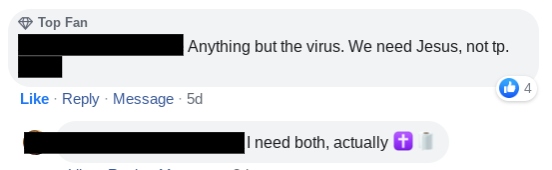
The other day I asked on Facebook if y’all wanted an article about Christians and the Coronavirus or something else. The overwhelming response was, “Something else! Anything else!” It seems many of us have reached out saturation point when it comes to hearing about the virus: But there were a few hardy souls who wanted to hear a Christian perspective on how we and our churches should be reacting to all the ramifications of quarantines, social distancing, and church closures. So here are a few brief thoughts I had:
😷Wash your hands like your life depends on it, because it might. Instead of singing a song while you’re washing your hands, recite your memory verses. Or if you’re in a public restroom, share the gospel with the poor sap lady who’s washing her hands in the sink next to you. You know she’s going to be there a while- captive audience!
😷You shouldn’t have to be told to cover your mouth when you cough or sneeze. You should already be doing it. That is basic home training and basic loving and serving your neighbor.
😷Stay home if at all possible (I thought this was just called “being normal, but it turns out I’m an introvert. Or a hermit.). The sooner this thing stops spreading, the sooner we can all get back to church, work, and normal life (which, for me, is staying home if at all possible – it’s the circle of life. Or something.).
😷Christians are not hoarders. Christians are sharers. It’s one thing to lay in a reasonable supply. It’s a whole ‘nother animal to buy into the mindset that purchasing huge amounts of supplies will somehow magically ward off harm. It won’t. That’s superstition. It is failing to trust God to provide for you. Do business with God and discern whether or not you’ve been hoarding. If you have, repent, and make like Zacchaeus and give it away to people who need it.
😷If you have a godly pastor, he has probably agonized over whether or not to cancel worship service or modify your church’s regular activities. It doesn’t matter what decision he makes, somebody is going to be unhappy about it and give him an earful. Don’t be that person. Give him some love and encouragement (from a safe social distance). He probably needs it now more than usual. And on that same note, whatever decision he makes, just roll with it for the time being, OK? We’re all playing this thing by ear right now, including your pastor. Don’t make me go all Hebrews 13:17 on y’all.
😷If you think nothing of skipping church for frivolous reasons, it’s hypocritical to complain now about your church’s services being canceled or modified for a much more important reason. (I’m not talking about First Amendment stuff here, I’m talking about your heart.)
😷”Online church” can be a blessing in an emergency situation like this, but this virus is going to pass and things are going to get back to normal. Do not fall into the fleshly mindset of, “Online church worked out just fine during the crisis, so I’ll just keep doing that instead of physically going back to church.” Uh uh. That’s spiritually lazy, and it’s sinfully forsaking the assembly. For Christians, Church is Not Optional, and that’s Non-Negotiable.
😷Have you ever stopped to think that this whole quarantine and limiting of meeting sizes thing could be God giving us a dry run of what it’s going to be like when real persecution comes, our church buildings are shuttered for good, and we have to meet in small groups in secret? That’s already real life for many of our brothers and sisters across the world. Maybe we should quit complaining and use this as a drill.
😷Where are Benny Hinn, Todd White, Bethel, and the rest of the faith healing crowd in all this? Time to put up or shut up.
😷Take reasonable precautions, but look for opportunities to help others and to share the gospel. Let your faith in God be greater than your fear of illness.
That’s pretty much my take on the whole shebang. If you haven’t had enough of all things Coronavirus, here are some more good resources:
Kudos to one of my followers, Camille, who has been hard at work curating the best Coronavirus memes on the web, part 1 and part 2. (This is meant to be lighthearted and funny. If you only do serious, please don’t click.)
Get Your Worship On
This kind of goes along with my TBT article from yesterday, God’s Not Like “Whatever, Dude,” About The Way He’s Approached in Worship. (Also meant to be lighthearted and funny, so please don’t click if that’s not your bag.). And some of you youngsters wonder why us old codgers like hymns so much!
The Real Deal, or the Fake Heal?
I was reading Acts 3, the story of Peter and John healing the lame beggar, and it struck me how starkly different this account is from the chicanery of New Apostolic Reformation “faith healers” today…
💥Peter and John didn’t have a “healing ministry”, they had a “preaching the gospel ministry.”
💥The lame beggar didn’t show up at “church” (i.e. the temple) to be healed, and didn’t seek Peter and John out for healing.
💥The lame beggar asked them for money rather than them asking him for money.
💥Peter and John had no silver, no gold, no Rolexes, no mansions, no private jets…
💥Peter said, “…what I have, I give to you.” The beggar was not asked to “sow a seed” into Peter and John’s ministry.
💥Faith isn’t mentioned once prior to the healing. Peter didn’t tell the beggar that if he just had enough faith, God would heal him.
💥No faith or money was required. The beggar played no part in “earning” his healing with his own good works. God healed him for His own glory.
💥The beggar was healed from a lifelong, obvious, eyewitnessed disability, and his healing was immediate and permanent.
💥Peter downplays both himself and the miracle and points to the Miracle Worker, Jesus.
💥Peter uses the opportunity of the gathered crowd to preach the gospel.
💥The gospel Peter preached was not, “Come to Jesus for miracles,” but “Jesus came to you, and you killed Him. Repent.”
💥Peter didn’t make crazy prophecies that didn’t come true. He pointed to the prophets of Scripture, and their prophecies fulfilled in Christ.
NAR preachers and faith healers want us to think they’re just like the apostles – even calling themselves “apostles” – but their words and actions don’t match up with what the apostles said and did.
They Aren’t Heretics Because You Disagree with Them
Of course not. So I’m not going to call Jared Wilson – who I have no reason to believe is anything other than a good, solid brother in Christ – a heretic because I disagree with the thrust of his article, They Aren’t Heretics Because You Disagree with Them. But, with genuine respect, I am going to call him “perhaps under educated” and “possibly somewhat lacking in experience” when it comes to the depth of the seemingly bottomless pit of false teaching and heresy out there.
Or perhaps our experiences are just different. Perhaps, in his world, there are throngs of people running around calling Presbyterians heretics because they believe in paedo-baptism. Or who cry “Heretic!” on anyone with a different eschatalogical view from their own.
That’s not the world I – and I would guess, most Christians – live in. In my world, the people who get called heretics and false teachers have generally earned the label by their biblically demonstrable false teaching and sinful behavior. There might be a few Baptists calling Presbyterians heretics and vice versa, but in my experience they are the rare exception, not the rule Jared’s article – putting the best possible construction on it – seems to be trying to address. And I get the feeling I swim in these particular waters much more frequently than he does.
I would certainly agree with Jared that the aforementioned types of issues are not matters of heresy, they are secondary issues on which Christians in good standing can disagree. But he lumps in some other issues (the role of women, extra-biblical revelation, yoking in ministry with “people who teach wacky things”) we cannot “agree to disagree” on because they are sin or false teaching that undermine the authority of Scripture, the sufficiency of Scripture, and the spiritual health of the church.
Jared has made the same categorization error regarding “secondary issues” that I believe Al Mohler made in his article on “theological triage” (which Jared links to in his article) – namely, that issues of sin (disobedience to clear Scripture) are not the same thing as secondary theological issues. Sin belongs all in its own category: sin. (I discussed this categorization error at length in my article Women Preaching: It’s Not a Secondary Doctrinal Issue.)
Jared uses no Scripture used to back up his opinions, making them no more valid than the “opinions” he critiques. He cites the Baptist Faith and Message (the statement of faith of the Southern Baptist Convention), but the BFM is not Scripture, and we are Christians first, Baptists second. We are Bible first, BFM second. So anywhere the BFM might contradict Scripture, go beyond Scripture, or not rise to the level of Scripture (and it does not rise to the level of Scripture regarding the role of women in the church, restricting only the office of pastor, but not the function of preaching), it is moot and useless.
Does Jared not recall that Scripture says, “A little leaven leavens the whole lump.”? And that we are to “cleanse out the old leaven…and celebrate with the unleavened bread of sincerity and truth“? Yet the thrust of his article seems to be akin to saying, “Don’t worry about that little misshapen mole on your arm. It’s just your arm having a ‘different view’ of skin. Only rampant, stage 4 cancer should be called cancer and treated.” That is not a biblical approach to false teaching.
As much as many Christians would like us all to get along and play nice with anyone and everyone who names the name of Christ, we cannot do that and still be faithful and obedient to the Word of God that tells us to contend for for the faith and silence false teachers. False teaching, even non-soteriological false teaching, is a big deal to God, and it should be to us, too.
If you are considering commenting or sending me an e-mail objecting to the fact that I warn against certain teachers, please click here and read this article first. Your objection is most likely answered here. I won’t be publishing comments or answering emails that are answered by this article.
This article is kept continuously updated as needed.
I get lots of questions about particular authors, pastors, and Bible teachers, and whether or not I recommend them. Some of the best known can be found above at my Popular False Teachers tab. The teacher below is someone I’ve been asked about recently, so I’ve done a quick check (this is brief research, not exhaustive) on her.
Generally speaking, in order for me to recommend a teacher, speaker, or author, he or she has to meet three criteria:
a) A female teacher cannot currently and unrepentantly preach to or teach men in violation of 1 Timothy 2:12. A male teacher or pastor cannot allow women to carry out this violation of Scripture in his ministry. The pastor or teacher cannot currently and unrepentantly be living in any other sin (for example, cohabiting with her boyfriend or living as a homosexual).
b) The pastor or teacher cannot currently and unrepentantly be partnering with or frequently appearing with false teachers. This is a violation of Scripture.
c) The pastor or teacher cannot currently and unrepentantly be teaching false doctrine.
I am not very familiar with most of the teachers I’m asked about (there are so many out there!) and have not had the opportunity to examine their writings or hear them speak, so most of the “quick checking” I do involves items a and b (although in order to partner with false teachers (b) it is reasonable to assume their doctrine is acceptable to the false teacher and that they are not teaching anything that would conflict with the false teacher’s doctrine). Partnering with false teachers and women preaching to men are each sufficient biblical reasons not to follow a pastor, teacher, or author, or use his/her materials.
Just to be clear, “not recommended” is a spectrum. On one end of this spectrum are people like Nancy Leigh DeMoss Wolgemuth and Kay Arthur. These are people I would not label as false teachers because their doctrine is generally sound, but because of some red flags I’m seeing with them, you won’t find me proactively endorsing them or suggesting them as a good resource, either. There are better people you could be listening to. On the other end of the spectrum are people like Joyce Meyer and Rachel Held Evans- complete heretics whose teachings, if believed, might lead you to an eternity in Hell. Most of the teachers I review fall somewhere in the middle of this spectrum (leaning toward the latter).
If you’d like to check out some pastors and teachers I heartily recommend, click the Recommended Bible Teachers tab at the top of this page.
Jen Wilkin Not Recommended
Jen is a women’s Bible study author, blogger, and conference speaker, and until 2023, when she left to focus on her own ministry, was on staff at The Village Church as the Executive Director of Next Gen Ministries (TVC’s ministry to “children and students ages 0–18”).
Jen’s older books and Bible study materials have a reputation for being generally doctrinally sound. I’ve published a review of Jen’s book, Women of the Word, and here is one reader’s take on her book 1 Peter: A Living Hope in Christ:
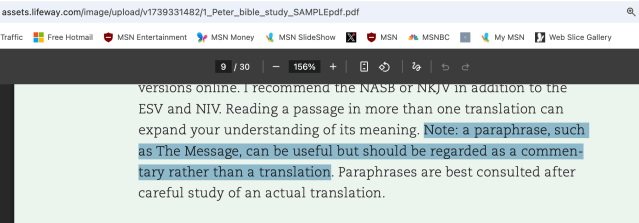
“…in the foreword Jen wrote, ‘a paraphrase, such as the NLT or The Message,* can be useful but should be regarded as a commentary rather than a translation.’ However, aside from that, I have found no other problems with the book at all. It is an eight week long study of 1 Peter based on the method of Bible study that she writes about in Women of the Word. My favorite thing about this study is that it causes us to focus on what the text is telling us about God. I love how Jen Wilkin is teaching women to study the Bible properly. I wish she would be more discerning about who and what she endorses though. There are so few women who bring us solid teaching and discernment.”
*Please see “February 2026 Update” at the end of this article. Jen Wilkin herself brought to my attention that in later editions of this book, she removed her reference to the NLT from this sentence. She did not explain why, but my guess would be (and she has thus far not corrected me) that she removed “the NLT” because The New Living Translation is considered to be a translation, and Jen mistakenly referred to it as a “paraphrase”.
The reader’s concern (and mine, too) in mentioning this quote, however, is not that Jen mistakenly called the NLT a paraphrase, but that Jen recommended The Message as an acceptable paraphrase. You need only to click on the link above to see why this is concerning.
Also in the past, Jen limited her speaking engagements and teaching to audiences of women, which is the biblical parameter for Christian women teachers. And although her website speaking engagement request form says she is a “teacher who helps women…” she has been increasingly preaching to and instructing men in recent years.
For example, Jen’s former staff position as TVC’s “Executive Director” of children’s and student ministries, depending on the exact nature of her job responsibilities, probably (I am making a reasonable inference, as TVC’s website does not explicitly say) required her to teach Scripture to, or exercise improper authority over young men in the student ministry (which includes students through age 18) and men who teach or volunteer in the student ministry. The title “Executive Director” makes it sound as though she was over the entire ministry and everyone in that ministry was under her purview.
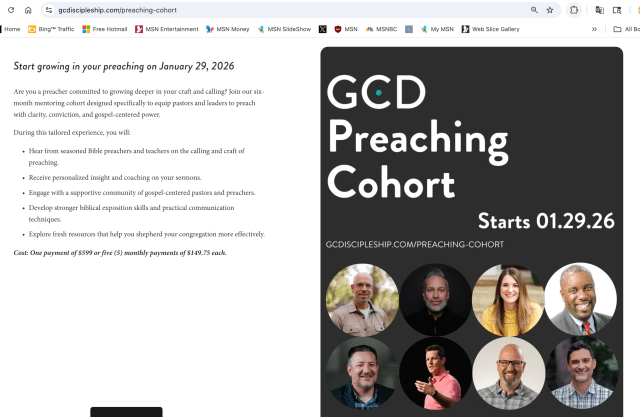
A more recent example demonstrating Jen’s increasing rebellion against Scripture regarding the role of women in the church is the Gospel Centered Discipleship “Preaching Cohort” in which Jen is a “Coach”. She (along with the other coaches) is described as a “seasoned Bible preacher and teacher,” and will be coaching pastors“on the calling and craft of preaching”.
In the past, there have also been questions about exactly where Jen stood on the biblical role of women in the church. She presented herself -and still does- as a complementarian, stating clearly that women are not to hold the office of pastor. What she did not make clear in the past, but what has become abundantly clear in recent years, is that she is (or has developed into) what’s often called a “soft” or “narrow” complementarian. This is the belief that women can do anything men can do in the gathering of the church body except hold the office of “senior pastor” – women can preach the Sunday sermon, hold any other office in the church (for many that includes the office of elder, “associate pastor,” etc.), exercise authority over men in the church, and so on. This is unbiblical. And what’s dangerous here is that Jen doesn’t call herself a “soft/narrow” complementarian, she just calls herself a complementarian, leading Christians who haven’t kept up with her to think she holds a biblical position and practice of the role of women, when she, in fact, does not.
As an example of Jen’s murkiness on the role of women, in the video* below (~32:05), she says:
“We need [women’s] visible leadership. How visible? As visible as your church’s complementarianism allows.”
This remark is at best, unhelpful, and at worst, opens the door for women and pastors to rebel against Scripture. The biblical answer to this question (aside from the fact that the church should be far more focused on servanthood than leadership) is: Women may serve in any position in the church that does not require them to preach to, teach Scripture to, or exercise authority over men, and which does not violate any other principles of Scripture.
Whatever position on the role of women Jen may have held in the past, she is now a “soft/narrow complementarian,” which is, in reality, a functional egalitarian.
In addition to the aforementioned preaching cohort in which Jen instructs pastors, she has spoken at several co-ed conferences in recent years. Give the first 15 minutes of the video below a listen*. Despite the fact that Jen’s very first remark is that she is not teaching the Bible in this session for pastors and church planters, she almost immediately goes on to quote and allude to the opening chapters of Genesis (and later in the video, other passages) and teach on them. I would challenge you to listen to what she says and ask yourself, “If I heard a pastor give this type of instruction, would I consider it a sermon/Bible lesson?” I think most of us could easily answer, “yes”. *(Unfortunately, the full length video of Jen’s complete teaching session has been removed from the internet. The video below is an excerpt of the full length video.)
(This is also the teaching session in which Jen made her infamous remarks about menstruation helping women to understand the gospel differently from men, which is not only a private and potentially uncomfortable subject to address in public – especially for an audience of men – it’s a patently ridiculous teaching. Menstruation teaches us nothing about the gospel. The two subjects are completely unrelated. Also, aside from Jen, I’ve never heard a single woman say her period helped her better understand the shedding of Christ’s blood.)
In another instance of preaching to a co-ed audience, Jen has been featured as a speaker multiple times at The Gospel Coalition’s national conference* at least as far back as 2017. (In the opening seconds of this 2017 TGC conference session, Why It’s Good that God Is Different from Us, Jen acknowledges and welcomes the men in her audience.) TGC, as many have noted, has been on a woke / social justice trajectory for years. Jen has been featured on TGC’s site numerous times.
*Jen has also been a featured speaker at TGC’s women’s conference (TGCW), not to be confused with TGC’s national conference, which is co-ed.
Again, one of the reasons it’s especially problematic for Jen to be teaching men, or to even to seem to be teaching men, is that she openly and unashamedly wears the label of complementarian. Boldly proclaiming complementarianism while teaching men muddies the waters and confuses the women who follow her as to what the Bible truly teaches about the role of women in the church. Are there times when it is technically not a violation of Scripture for a woman to speak with men in the audience? Yes (see #7 here). But weigh the impact Jen has on the church by speaking to men against the counter-evangelicultural impact someone of her stature could have by flagrantly refusing to teach men. Which would cause more people to sit up and take notice, set a better example for Christian women, and have a more biblical influence on the church?
Another concern about Jen is that she seems to be increasingly associating and appearing with false or problematic teachers.
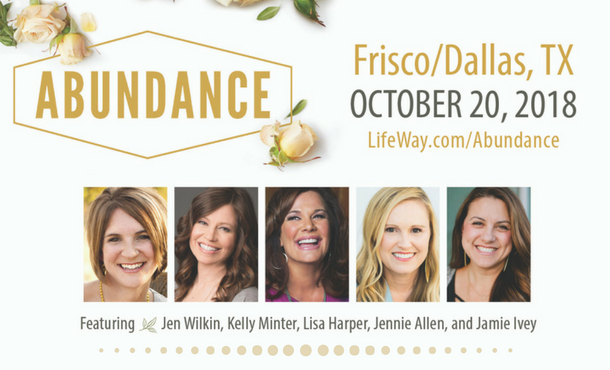
Several years ago, Jen was added to LifeWay Women’s stable of Women’s “Bible” study authors including many of the aforementioned teachers and others. In addition to my normal concerns about someone yoking with false teachers (i.e. the Bible says not to, and disobeying God’s Word is a sin), I’m guessing LifeWay Women may have initially signed Jen in order to use her – that is, her reputation for being a doctrinally sound teacher and a complementarian – to lend credibility to the false teachers they promote. And, of course, Jen’s previously perceived good reputation has suffered by being associated with these false teachers.
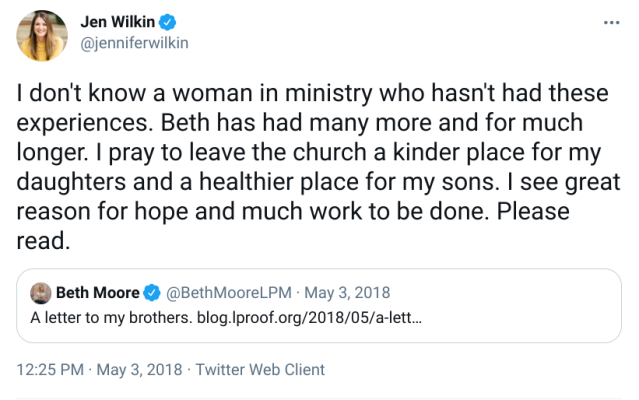
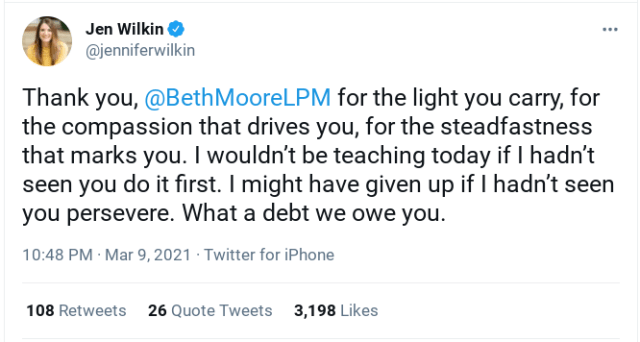
In March 2021, when Beth Moore cut ties with the Southern Baptist Convention, Jen offered this glowing farewell…
In a strange irony, in the midst of unbiblically partnering with these false teachers, in her session, The Gospel and The Future of Bible-Centered Discipleship at the 2018 Southern Baptist Convention Pre-Conference (also to a co-ed audience), Jen teaches the following…
[Biblical literacy] guards against false teaching…Basic comprehension-level mastery of the text guards against false teaching. (~30:12)
You know what our [discipleship] formula has been for the last 20 years? [We’ve said], ‘We’re going to keep making [the level of biblical teaching] lower and lower’…It is our high calling, in the face of a biblical literacy crisis, to raise the bar in an age of low expectations. (~43:40…44:39)
And yet, Jen’s level of “mastery of the text” – to the point that she is instructing people in the text and teaching them how to improve discipleship – has not sufficiently guarded her against partnering with women who are largely responsible for the bulk of false teaching aimed at women today, who don’t teach “basic comprehension-level mastery of the text,” and who have continued to lower the bar and perpetuate low expectations for biblical literacy. Jen has associated with, talked to, and listened to the teaching of these women far more than I have, I’m certain. How does she not see this?
(February 2026 UPDATE- I’ve removed a small section of this article {unrelated to the paragraph above or below} that previously appeared here. Please scroll down to the “Additional Resources” section for an explanation, and for additional extra information.)
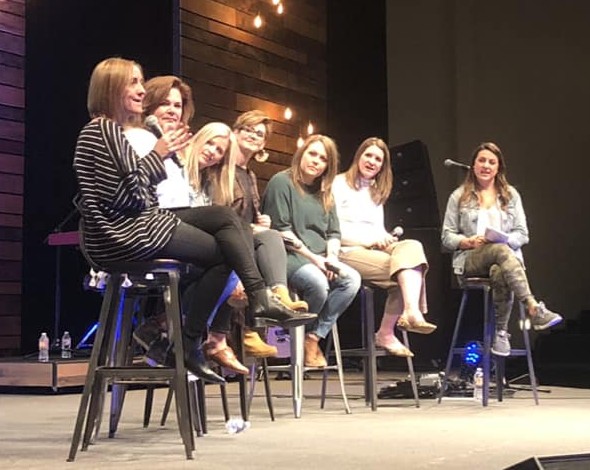
Finally, in the same way that the influence Steven Furtick has on Lysa TerKeurst as her pastor is worrisome, I’ve seen some things over the years with Jen’s pastor, Matt Chandler, and his wife, Lauren Chandler (with whom Jen has appeared at conferences; screenshot), that have given me pause.
As a member of The Village Church, Jen is pastored by Matt, and as a ministry leader there (though no longer a staff member), she works under his direction and influence. Over the past few years, Matt has publicly praised or affirmed false teachers like Ann Voskamp, Beth Moore, and Jesus Culture. He has raised some questions about the extent of his continuationism with His notorious “pirate ship prophecy“. He allows Bethel and Israel Houghton (Joel Osteen’s former worship leader) music to be used for worship at his church. Matt allows his wife, a worship leader at TVC, to select this music, and to yoke with and be influenced by numerous false teachers. Matt and Lauren and their associations with false teachers have undoubtedly influenced Jen. Additionally, Matt’s character and personal integrity were sullied in 2022 when he had to take a leave of absence after admitting to an “inappropriate” texting relationship with another woman.
In summary, I would urge you not to follow Jen Wilkin, attend her conferences, or use her materials due to her trajectory of increasingly unbiblical teaching and behavior.
Prior to February 14, 2026, this small section appeared in the above indicated area of this article:
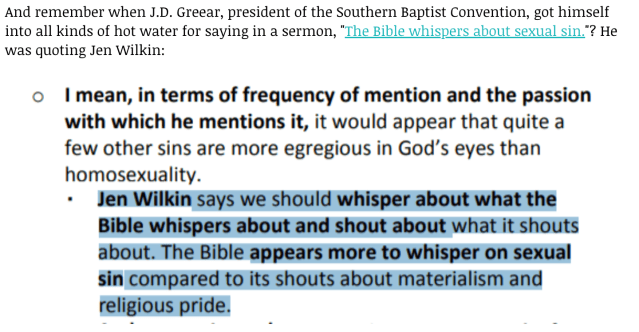
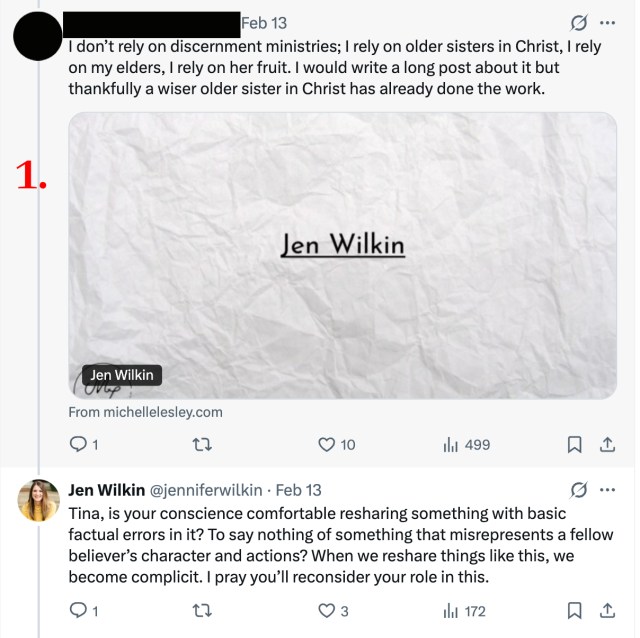
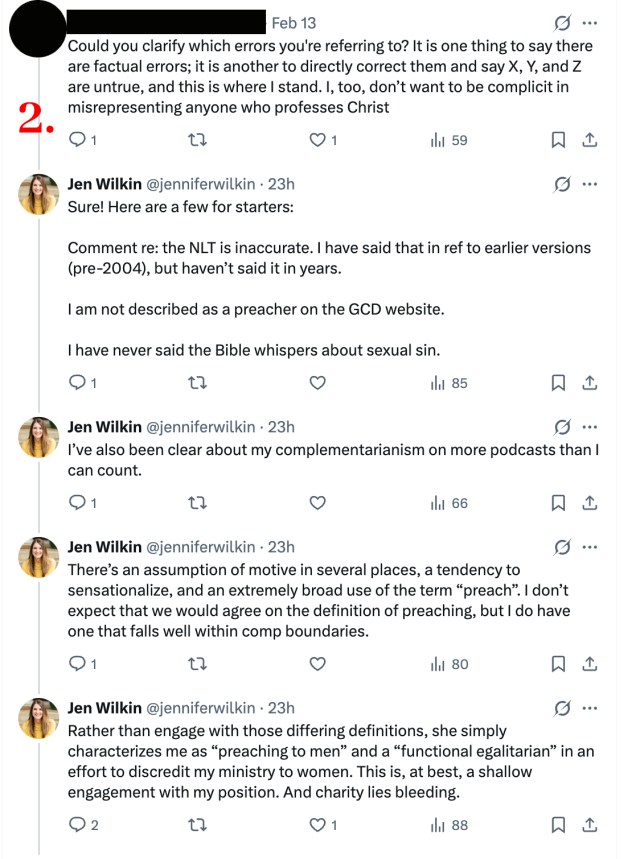
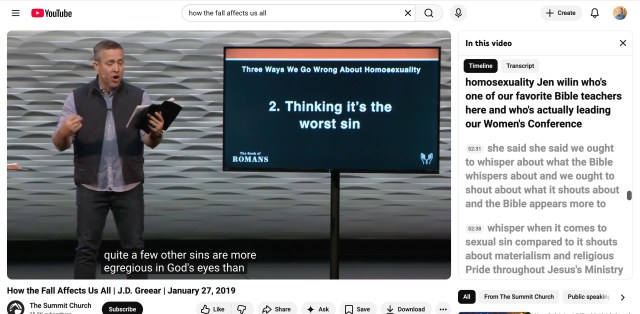
On February 13-14 Jen Wilkin and I had an exchange on X in which she said, “I have never said the Bible whispers about sexual sin.” (see image 2 below)
The first part of J.D.’s statement, “We ought to whisper about what the Bible whispers about and we ought to shout about what it shouts about,” was a quote of Jen. J.D. then added his own opinion, “…and the Bible appears more to whisper when it comes to sexual sin…” to the end of the quote of Jen, making it sound like the entire quote was something she said.
I apologize – to Jen and to my readers – for making this mistake, and ask your forgiveness. I hope my character speaks for itself when I assure you that this was simply a misunderstanding of an unclear statement. It was not a fabrication, nor was it done maliciously. But I am still sorry for making the mistake and for any negative consequences it resulted in for Jen or anyone else.
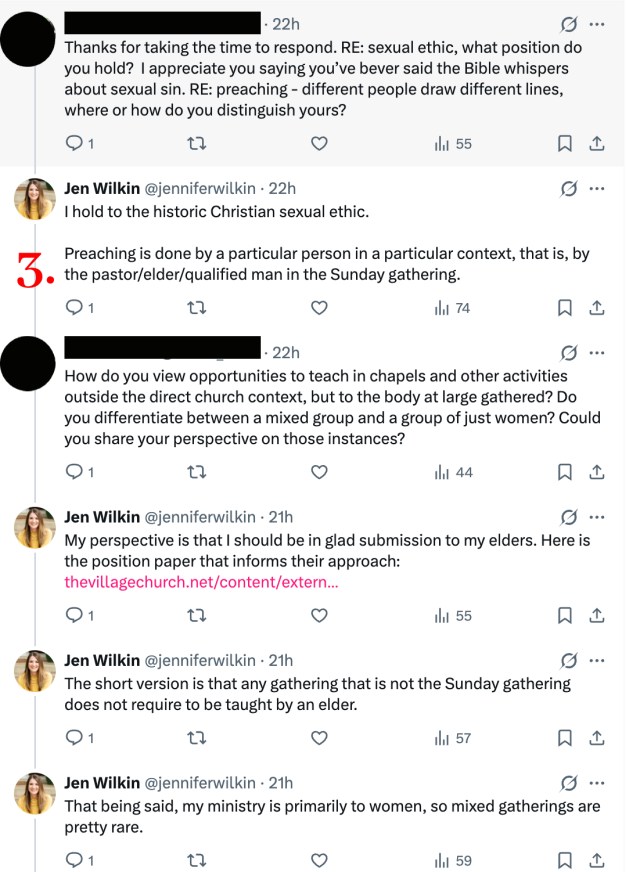
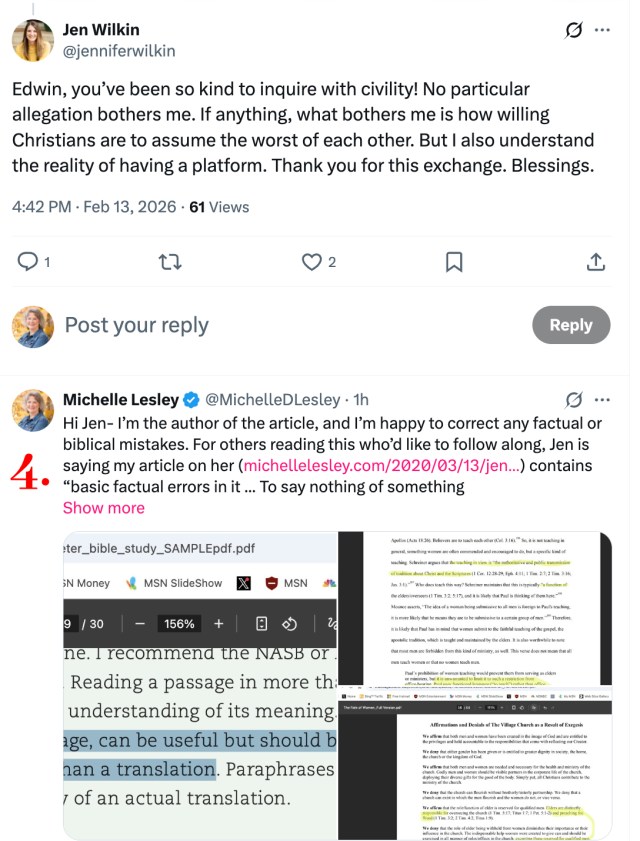
This point, however, was not the only thing Jen took issue with about this article, as you can see from the images in the slideshow above. Here is the original exchange. My response to Jen’s allegations is below in article format for ease of reading:
Hi Jen- I’m the author of the article, and I’m happy to correct any factual or biblical mistakes. For others reading this who’d like to follow along, Jen is saying my article on her contains “basic factual errors in it … To say nothing of something that misrepresents a fellow believer’s character and actions”.
I apologize for the length of this answer, but I wanted to address all of your concerns clearly, accurately, biblically, and citing sources:
“Comment re: the NLT is inaccurate. I have said that in ref to earlier versions (pre-2004), but haven’t said it in years.”
First, this is a quote from an email I received from a reader commenting on your book 1 Peter: A Living Hope in Christ. I introduced the quote by saying, “Jen’s older books and Bible study materials have a reputation for being generally doctrinally sound.” (I also linked to a positive review on my blog of your book Women of the Word in which I actually recommended [at that time] that my readers buy themselves a copy of it. The reader’s quote begins:
“…in the foreword Jen wrote, ‘a paraphrase, such as the NLT or The Message, can be useful but should be regarded as a commentary rather than a translation.’…”
I checked the most recent version of your book (2024 edition; sample on Amazon), of 1 Peter: A Living Hope in Christ, and you’re correct, you’ve removed the part about the NLT. The quote now says, “a paraphrase, such as The Message, can be useful but should be regarded as a commentary rather than a translation.”.
My guess is that you removed “the NLT [New Living Translation]” because it’s considered a translation, not a paraphrase. Is that correct? If not, please feel free to explain. I’m glad to add a note to the article saying that you’ve removed the phrase “the NLT” from that sentence in later editions, and if you have a link to an article or other material that explains why you removed it, I’ll be happy to add that link as well.
So just to clarify here, the quote from your book (in which you mistakenly called the NLT a “paraphrase”) actually is accurate. You are the one who changed it in later editions, presumably to correct your error. So this is not, in fact, a “factual error”. The reader’s quote was accurate.
However, the primary concern here is not that you mistakenly called the NLT a “paraphrase” instead of a translation (if that’s why you removed the part about the NLT), or even that you recommended the NLT. The primary concern is that you recommended – and, apparently, STILL recommend- The Message, one of the worst, most grossly inaccurate “paraphrases” out there, written by Eugene Peterson, who, along with mangling the text of Scripture, wrote a cover endorsement for the heresy-laden book, “The Shack,” and said he would officiate a same sex wedding.
But you still cite The Message as an acceptable paraphrase to use. So that part is factually correct.
Your next concern was: “I am not described as a preacher on the GCD website.”
Here, you’re misquoting me and either misunderstanding or misrepresenting what the article actually says (so you’re the one guilty of a “basic factual error” in this case).
The article contains a screenshot of the GCD (Gospel Centered Discipleship) web page picturing you and describing the event, and quotes directly from that web page. This is the actual quote from my article:
“…the Gospel Centered Discipleship “Preaching Cohort” in which Jen is a “Coach”. She (along with the other coaches) is described as a “seasoned Bible preacher and teacher,” and will be coaching pastors “on the calling and craft of preaching”.
The point of these two sentences is that you will be instructing pastors on how to be better pastors/preachers, when this is unbiblical and you have no place doing so. Neither of these sentences says that GCD called you, specifically, a “preacher”. (Additionally, albeit tangentially: just from a logical perspective, why would GCD engage someone who isn’t a pastor and isn’t qualified to be a pastor to instruct pastors about being better pastors? That’s like a hospital hiring someone who isn’t a doctor and isn’t qualified to be a doctor to instruct doctors about being better doctors.)
Finally, you said, “I have never said the Bible whispers about sexual sin.”
In this instance, you’re correct. Here’s what I said in the article: “And remember when J.D. Greear, president of the Southern Baptist Convention, got himself into all kinds of hot water for saying in a sermon, “The Bible whispers about sexual sin.“? He was quoting Jen Wilkin…”
My statement was based on a misunderstanding of JD’s quote in the video of his sermon. He was quoting you when he said, “We ought to whisper about what the Bible whispers about and we ought to shout about what it shouts about,” but then added HIS OWN thought to the end of that quote, and HE stated his opinion that “the Bible appears more to whisper when it comes to sexual sin compared to it shouts about materialism and religious Pride”.
I apologize for getting that wrong. I’ll be glad to remove that small section entirely. I’ll make a note in the article, and explain publicly on social media, how I got that wrong, along with a public apology to you, both in the article and on my other social media platforms. I’m very sorry for my mistake there.
“I’ve also been clear about my complementarianism on more podcasts than I can count.”
Yes, you’ve said you’re a complementarian, but as I accurately explained in the article, you’re not using the original definition of “complementarian”. You’re using the current, twisted definition of complementarian, i.e. women can do anything in the church that men can do except hold the office of pastor. That’s what used to be called “soft complementarianism” or “narrow complementarianism” and it is functional egalitarianism. I’m not the one in “factual error” here.
Calling yourself a “complementarian” and using that twisted definition is -whether you intend it to be or not, and I’m assuming “not”- deceptive and misleading. It’s similar (I’m using this strictly as an analogy, not accusing you of heresy) to Mormons saying, “We believe in Jesus,” when the Mormon version of Jesus is very different from what Scripture says about Jesus.
Furthermore, as a Southern Baptist, I’m sure you’ve heard (as have I), our leadership say regarding women preaching to men, “The function IS the office,” meaning that a woman functioning in the role of pastor -i.e. preaching- is usurping the office of pastor, as Dr. Albert Molher explains here in refutation of the definition of “complementarianism” you espouse, namely, that “a woman ought to be able to do…or authorized to do everything a non-ordained man can do.”
“There’s an assumption of motive in several places, a tendency to sensationalize…”
This is your personal, subjective opinion, not a “factual error”.
You’ll need to specifically quote at least one of these “several places”. And I would remind you that what you characterize as “assumption of motive” the Bible would likely characterize as, “out of the abundance of the heart, the mouth speaks” (Luke 6:45) and/or “You will know them by their fruit” (Matthew 7:16,20). But until you cite a specific “assumption of motive/tendency to sensationalize” we can’t know for sure, I can’t apologize if something is, in fact, an unbiblical “assumption of motive,” or “sensationalism,” and this is an unsubstantiated accusation.
“an extremely broad use of the term “preach”
No broader than the Bible’s definition. The actual prohibition in 1 Timothy 2:12, as I’m sure you know, is against women “teaching” men. Preaching is just one form of teaching.
“I don’t expect that we would agree on the definition of preaching, but I do have one that falls well within comp boundaries.”
As evidenced by the fact that you preach to men, your definition of preaching falls well within the aforementioned current twisting of “complementarian” boundaries: functional egalitarianism, which unbiblically allows women to preach to men.
There is no definition of women preaching to men that falls within traditional complementarian boundaries because traditional complementarianism – which simply describes what the Bible says about the role of women in the church- does not allow women to preach to men.
“Rather than engage with those differing definitions,”
I did “engage with those differing definitions”. I compared your so-called “complementarian” definition of preaching to men – i.e. “it’s OK for women to preach to men” – to Scripture. Scripture forbids this. Engagement over.
“she simply characterizes me as ‘preaching to men’”
I didn’t “characterize” you as preaching to men, I flat out stated a fact: You preach to men. There’s plenty of evidence of it in the article. If you’re going to preach to men why not just proudly and unashamedly say so and clearly enumerate your reasons for doing so, rather than preaching to men and then going around and saying, “I’m not really preaching to men, I’m really a complementarian.”? If it’s OK for you to preach to men, you should be able to easily back up that assertion with clear, rightly handled (2 Timothy 2:15), in context Scripture.
“and a ‘functional egalitarian’”
You are. When you function like an egalitarian by preaching to men, you’re a functional egalitarian.
“in an effort to discredit my ministry to women.”
Your “ministry to women” should be discredited because you’re teaching them to disobey Scripture. Every time you stand up and preach to men, your behavior is teaching women (and men) that if they come to a command of Scripture they don’t like (like 1 Timothy 2:12), they’re free to ignore it and disobey it. That teaching is false doctrine and a defiance of Scripture, and should, therefore, be discredited (and that’s only one of the points in the article – I’ve cited many other reasons why your ministry should be discredited).
“This is, at best, a shallow engagement with my position.”
No it isn’t. Your position is in direct conflict with the plain and clear teaching of Scripture. Concisely demonstrating that (and linking to two other articles refuting your position and explaining at length what the Bible says about the role of women in the church) is not “shallow engagement”.
“Preaching is done by a particular person in a particular context, that is, by the pastor/elder/qualified man in the Sunday gathering.”
Where does the Bible specifically say that, rightly handled and in context? Chapter and verse, please.
Christians are first and foremost to be in glad submission to Scripture, because Scripture is infallible and perfect, and elders – as your pastor, Matt Chandler, has amply demonstrated over the last several years – are not.
So if your elders are not upholding what Scripture teaches, and you are submitting to them, both you and your elders are in disobedience to Scripture, which is the standard for Christians.
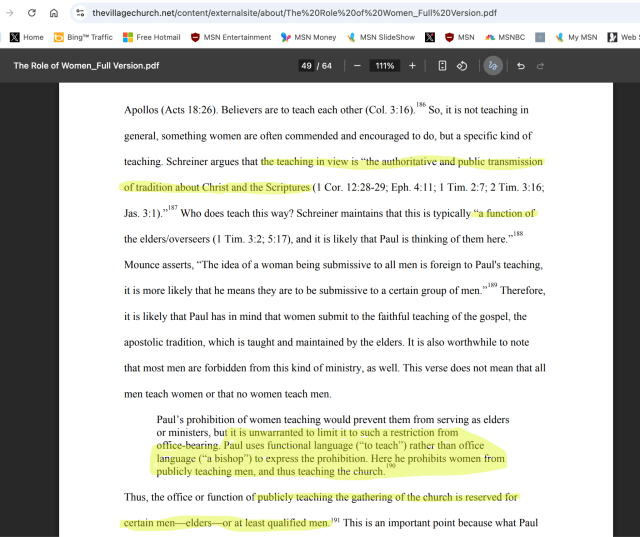
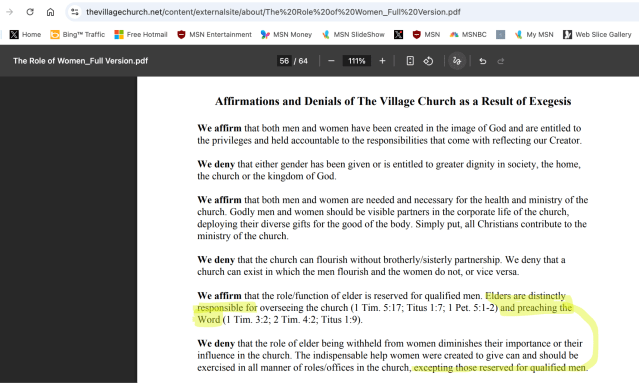
Nevertheless, in the document you cited, your own elders say this:
So your own elders say that publicly preaching the Word to the gathering of the church is restricted to men.
We often have to clarify to Believers and unbelievers alike that the “church” is not the building we meet in, it’s the people – Christians. So whenever Christians are gathered for the purpose of worship, instruction in the Scriptures, etc., it is a gathering of the church, and the prohibition of women teaching men applies.
But, in any event, the document makes clear on p. 55 that this is the position of “the role of women at The Village Church.” My article doesn’t deal with you preaching at TVC, but at other gatherings of the church outside TVC, so TVC’s policy for TVC is irrelevant to those events.
“The short version [of the TVC document] is that any gathering that is not the Sunday gathering does not require to be taught by an elder.”
I didn’t see that statement or any statement similar to that in the document, but I may have missed it. What page is that on?
“That being said, my ministry is primarily to women, so mixed gatherings are pretty rare.”
1. “Rare” does not equal “not sinful”. You still need to repent of preaching to men and stop doing it.
2. It doesn’t look “rare” considering all of the instances I’ve cited in the article (and including any instances I may have missed and haven’t included).
3. It isn’t “rare,” as though you used to preach to men and no longer do. This is something you’re continuing to do and currently doing. The GCD Cohort in which you’ll be unbiblically instructing pastors started less than three weeks ago.
So, to summarize, you found one actual error of fact in this entire, lengthy article (which I apologized for and will gladly delete and explain to my audience). The remainder of the article – dealing with far more than you’ve brought up here – is correct and is not “basic factual errors” or a “misrepresentation” of your “character and actions”.
And by implying that the article, overall, consists of “basic factual errors” and “misrepresents [your] character and actions,” you have actually misrepresented my character and actions.
But all of that aside, what’s more important here is you. I care about you, and I hate to see you going down the same road that so many of your Lifeway Women compatriots – like Beth Moore, Lysa TerKeurst, Priscilla Shirer, etc. – have gone.
I have taken a moment to pray for you, and, in love, I urge you to repent of the sins of preaching to men, yoking with false teachers, and the other things I’ve cited in the article, for the glory of God, for the good of your own soul before Christ, and for the biblical discipleship of your followers.
I was saved at an early age and always had a heart for the things of God, reading His Word, memorizing it, and prayer. As an adult I was very active in my Baptist church, in children’s ministry or leading Bible studies for women, which I realize now were not actually Bible studies, but rather studying a book about someone’s interpretation of Scripture. I was very intrigued by Henry Blackaby’s book Experiencing God, and began to wonder how I might recognize God at work in my own life, how I might hear his voice. I read books on prayer and fasting by Bill Bright, learning of the “coming revival”.
It wasn’t until I began to read God Chasers by Tommy Tenney, though, that I thought perhaps I was missing something, since I had never felt the “manifest” presence of God. A friend loaned me Surprised by the Power of the Holy Spirit by Jack Deere, A Final Quest by Rick Joyner, and I was off into the world of the NAR (The New Apostolic Reformation), inhaling every book I could on intercessory prayer, especially enjoying Prayer Shield, written by C. Peter Wagner himself, the father of the NAR. I read about past revivals, about The Toronto Blessing. I had no understanding of the history or doctrines behind the movement, but was drawn in by the incredible experiences with God those in the movement seemed to have. Prophetic words, words of knowledge, Holy Spirit manifestations – they all seemed so much more exciting than what I had experienced in my Christian life. Much to my shame, I even went to see Todd Bentley when he was in town. I became convinced revival was on its way.
I thought perhaps I was missing something..
I was especially fascinated by listening prayer. Although I continued to read my Bible and memorize scripture, my focus became my time of contemplative prayer, listening to what I felt God was saying to me personally. This quote from my prayer journal shows the idol that listening prayer had become in my life. “I could die for you right now God, die for more of you.”
I began to assist a Baptist deliverance minister in town as well, in what was called “discernment,” listening to what God told me about the spirits that were impacting a person. I would also listen for a personal prophetic word for each person in ministry.
As my family was now in a Pentecostal church, it was very accepted to be hearing from God personally; I was just “prophetic”. Although I had previously written devotionals for the Proverbs 31 Homemaker, I now felt called to begin typing up my prayer journal notes into devotionals, much in the style of Sarah Young, who wrote her devotionals because she wanted more of God than the Bible. I had 400 in all, hoping to get them published and support different missions organizations.
The Pentecostal church we were attending became progressively more NAR, even having a church plant patterned after Bethel. It wasn’t uncommon to have a pastor from Bethel speak at our church’s conferences. I had never agreed with the doctrine that it was God’s will to heal everyone, which Bethel emphasized, but I had no idea that they actually were preaching a false gospel.
I had no idea they were preaching a false gospel.
Last fall I happened upon a YouTube video on Bethel’s theology by Mike Winger, which God used to begin to remove the scales of deception from my eyes. However, it was reading Angels of Light; False Prophets and Deceiving Spirits at Work Today in the Church & World by Eddie Hyatt, specifically his chapter on contemplative prayer, which made me realize I had been wading in dangerous waters. As I watched the Strange Fire Conference on the internet, I was terribly convicted by the true Holy Spirit. This propelled me into an incredibly intense, painful season of soul-searching – questioning what I believed against biblical doctrine – and a time of repentance. As I listened to YouTube videos of Doreen Virtue and Melissa Dougherty, two wonderful women God has brought out of the New Age, I realized that my “Listening Prayer” had more in common with hearing from Spirit Guides, that my getting “prophetic words” for people had more in common with cold readings, than with either prayer or the gifts of the Holy Spirit.
I was convicted by the true Holy Spirit…
Psalm 116 has become very precious to me, especially verse 6: “The Lord protects the unwary; when I was brought low, he saved me.” Although it truly sickens me that I could have been so deceived, I am very aware of how God’s hand was protecting me and my whole family through the whole process, and know that God is able to use my experience to bring about good.
Classes on listening prayer are becoming rampant in the church today, even in mainstream churches. The following is taken from a non-charismatic church offering such a class. “Learning to hear God’s voice and learning to use the gift of prophecy will be taught in alignment with biblical principles…” “loving and safe community to learn how to hear God’s voice for oneself and for others….designed to provide opportunities to encounter Father God, Jesus and Holy Spirit through a variety of worship experiences and listening exercises.”
If you are practicing listening prayer, or contemplative prayer, I beg you to look into its history, and examine scripture – see that Christ never told us to pray in such a way, either by example or as a teaching. You may think that you are practicing listening prayer, but still holding God’s Word as His revelation to you higher. From experience, I believe it is impossible to practice listening prayer and not have it erode your view of the sufficiency of Scripture as well as erode and distort your view of Jesus, God the Father, and the Holy Spirit. In the past I believed that what I was hearing from God was completely in line with Scripture. However, not only was it incredibly narcissistic, it began to reflect more and more the NAR teaching I was receiving.
In my spiritual journey, I believed that I was experiencing “revival” when I became involved in contemplative prayer, and extra biblical practices. But in God’s word, biblical revival was accompanied by a renewed love for God through the Scripture. I can honestly say that coming out of the NAR, with all of its deception, as painful as it has been, has brought with it true revival. I have never had such a profound sense of being “saved”, along with a growing hunger for Scripture and true knowledge of God. I realize that I was in NAR lite for several years, even in my Baptist church.
I have never had such a profound sense of being “saved”…
If you diligently seek scripture, you will not lose anything that is true; you will only lose the false. Please, don’t allow fear or pride to keep you from researching thoroughly. I only wish there had been someone to warn me earlier. Although in many NAR books you will be warned away from biblical discernment by being taught that thinking critically is a “critical spirit” or that if you compare a teaching to Scripture you are “religious or have a religious spirit” please follow scripture.
“Dear friends, do not believe every spirit, but test the spirits to see whether they are from God, because many false prophets have gone out into the world.” 1 John 4:1
Just a gentle word of caution. Do balance your research with time spent in God’s Word. It is easy to become almost obsessive in your quest for truth, in wanting to root out any lies of deception you believe, to be hyper-sensitive about being deceived again. Coming out of deception is a very painful experience. Have patience for yourself, and grace. God is a tremendous rescuer and he will lead you to freedom in His truth, as laid out in Scripture, as you seek Him.
Ladies, God is still at work in the hearts and lives of His people, including yours! Would you like to share a testimony of how God saved you, how He has blessed you, convicted you, taught you something from His Word, brought you out from under false doctrine, placed you in a good church or done something otherwise awesome in your life? Private/direct message me on social media, e-mail me (MichelleLesley1@yahoo.com), or comment below. Your testimony can be as brief as a few sentences or as long as 1500 words. Let’s encourage one another with God’s work in our lives!
My family recently left a church that was embracing more and more New Apostolic Reformation false doctrine. However, we have many friends and family still attending. I’ve tried to lovingly point out that the church is teaching false doctrine, but I have been completely shut down. I don’t want to leave my loved ones where they are, but I feel they don’t want to see or hear the truth. They tell me they’ve searched the Scriptures and feel they are right. They also talk a lot about the feelings and experiences they have had and that, in their eyes, proves it’s God moving. My question is, how much should I engage with them? Should I just walk away and pray or keep talking with them about it?
It’s so heart-wrenching to love someone who blindly rejects the truth. We kind of “get it” on a spiritual level when that person is an atheist or just your run of the mill lost person, but if the person is a self-professed Christian – who is supposed to believe, love, and submit to God’s Word – it can seem especially baffling and difficult.
So how do we handle situations like this? Let’s back all the way up to the very foundation of the issue for those who haven’t yet faced this situation.
We have to start by making sure we have the correct understanding of what’s going on here. Every human being, whether he knows it or not, lives in two worlds: the physical world of everyday “real life” (tangible things, people, and decisions we consciously see,) and the spiritual world (where God moves and works and where demons try to thwart Him by stirring up chaos in the world) that we can’t see and that most people aren’t even aware of.
So the first thing we have to recognize in a situation like this, is that this is primarily a spiritual battle, rather than a tangible one. The fact that, in the physical realm, you clearly recognized the false doctrine in this church and acted upon that knowledge by leaving is the fruit of what God did in your heart in the spiritual realm. The things your loved ones have said to you and their decision to stay in an apostate church in the physical realm is the fruit of the fact that they are deceived, hard of heart, and probably unsaved, in the spiritual realm.
Now the Spirit expressly says that in later times some will depart from the faith by devoting themselves to deceitful spirits and teachings of demons, through the insincerity of liars whose consciences are seared,
1 Timothy 4:1-2
A spiritual realm problem requires a spiritual realm solution, and only God – not us – can effect true change in the spiritual realm. He must change the hearts of your loved ones. And until or unless He does, you can talk to them until you’re blue in the face and they will continue to dig their heels in.
No one can come to me unless the Father who sent me draws him.
John 6:44a
The natural person does not accept the things of the Spirit of God, for they are folly to him, and he is not able to understand them because they are spiritually discerned.
1 Corinthians 2:14
So the number one thing you should be doing in this situation is to pray. Ask God to intervene and do the work in their hearts that only He can do. Ask Him to open their eyes. Ask Him to woo them toward studying His Word. Ask Him to save them if they aren’t saved.
And while you’re down there on your knees, pray for yourself and ask God to help you study hard to understand His Word about this situation, and to give you the wisdom to know when to speak up and when to keep silent. Because, while God is the One doing the work, He works through His Word, using instruments like you and me to accomplish His work, much like a doctor uses instruments to perform surgery.
For everything there is a season, and a time for every matter under heaven…a time to keep silence, and a time to speak;
Ecclesiastes 3:1,7a
Once you’ve asked God to guide you and give you wisdom, believe His Word and trust Him to do so. If you’re with one of these loved ones, and the time seems right to say an appropriate, biblical word, take a second to get your demeanor and tone in order, and then say it.
But, as you’ve said, you’ve already tried to talk biblical sense into your loved ones and they have rejected it. Now what? Should you just walk away and pray, or keep talking with them about it? Yes. There’s actually room for both in situations like this. Let’s take a look at a few biblical passages:
And behold, a man came up to [Jesus], saying, “Teacher, what good deed must I do to have eternal life?” And he said to him, “Why do you ask me about what is good? There is only one who is good. If you would enter life, keep the commandments.” He said to him, “Which ones?” And Jesus said, “You shall not murder, You shall not commit adultery, You shall not steal, You shall not bear false witness, Honor your father and mother, and, You shall love your neighbor as yourself.” The young man said to him, “All these I have kept. What do I still lack?” Jesus said to him, “If you would be perfect, go, sell what you possess and give to the poor, and you will have treasure in heaven; and come, follow me.” When the young man heard this he went away sorrowful, for he had great possessions. And Jesus said to his disciples…
Matthew 19:16-23a
Likewise, wives, be subject to your own husbands, so that even if some do not obey the word, they may be won without a word by the conduct of their wives, when they see your respectful and pure conduct.
1 Peter 3:1-2
If any woman has a husband who is an unbeliever, and he consents to live with her, she should not divorce him. For the unbelieving husband is made holy because of his wife, and the unbelieving wife is made holy because of her husband. Otherwise your children would be unclean, but as it is, they are holy. But if the unbelieving partner separates, let it be so. In such cases the brother or sister is not enslaved. God has called you to peace.
1 Corinthians 7:13-15
What do these passages have in common? They all help us to understand that:
not everybody we share the gospel with or impart biblical truth to is going to accept it.
we are under no obligation to chase people down or badger and nag them to death with biblical truth once we’ve shared it (and this may even do more harm to our cause than good).
it’s OK to share the truth and then back off for a while while, praying fervently, loving well, and setting a godly example.
it’s OK to let people to walk away from the truth once you’ve shared it.
It is perfectly OK to say to people who are hostile to the truth, “I love you and I’d like to share more of what the Bible says about this with you. If you’d ever like to talk more about it, just let me know. Now how about a piece of pie?”
And Jesus even goes further than that:
Do not give dogs what is holy, and do not throw your pearls before pigs, lest they trample them underfoot and turn to attack you.
Matthew 7:6
In Jesus’ day, dogs were not the cute little domesticated pooches we smooch on today. They were wild beasts more akin to a pack of coyotes or wolves. Pigs were the epitome of unclean animals and can be pretty violent when provoked. Jesus used these animals’ violence and uncleanness to represent lost people (regardless of whether or not they call themselves Christians) who respond in blasphemy, unbelief, and anger to the Pearl of Great Price. He’s saying that if you know a person has a history of acting this way and is likely to act this way again (e.g. Paul, prior to conversion), or if you’ve laid out biblical truth to someone and she responds with blasphemy, anger, and unbelief (e.g. your loved ones) it’s OK to climb out of the pig pen or the dog pound (or don’t get in there in the first place), take your pearls, and go home. God is demonstrating to you through this person’s behavior that He has not, at this particular time, softened this particular person’s heart to hear and receive what you’re saying. If He does soften that person’s heart in the future (as evidenced by her distinctly undoglike and unpiglike behavior) you can share the truth with her then.
Every person is different. Every situation is different. There’s no one-size-fits-all answer to the question of when to engage and when to keep silent. And that’s actually a good thing. That keeps us in prayer, completely dependent on the Lord and His Word for guidance.
If you have a question about: a Bible passage, an aspect of theology, a current issue in Christianity, or how to biblically handle a family, life, or church situation, comment below (I’ll hold all questions in queue {unpublished} for a future edition of The Mailbag) or send me an e-mail or private message. If your question is chosen for publication, your anonymity will be protected.
“Why is the doctrine of justification by faith alone so important? Luther said that sola fide is ‘the article upon which the church stands or falls.’ As R. C. Sproul puts it, ‘We are either justified by a righteousness that is in us or by a righteousness that is apart from us. There is no third way.’ This short work surveys the main tenets of the doctrine of justification in Roman Catholicism and evangelicalism.”
Have you ever wondered where Paul’s wife was when he was gallivanting all over the world preaching the gospel? Denny Burk explores Paul’s marital status through Scripture in this excellent article, Was the apostle Paul married? Yes, he was. Here’s how we know. (Also included: the audio to Denny’s sermon on this topic, in case you’d like to listen.
Some of God’s attributes are communicable and some are incommunicable. Which of God’s attributes do humans, made in the imago dei (image of God) possess, and which attributes belong only to God? Check out this helpful resources from CARM (Christian Apologetics & Resource Ministry), What are the communicable and incommunicable attributes of God?
“By God’s help may we not retreat from the fight for truth. May we be all the more invigorated by a love for our Lord, His truth, and His people. And may this commitment be evident to all as we discern with precision, humility, and sorrow.”Reagan Rosehas a wonderful article about exercising love when practicing discernment over at TMS’s blog: The Danger of Loveless Discernment.
What’s the difference between Baptists and Presbyterians and Lutherans and Methodists and all the other Protestant denominations out there? Dr. Gregory Wills of Southern Baptist Theological Seminary explains the basic similarities and differences in What’s the Difference between Christian Denominations?.
The resources listed above are not to be understood as a blanket endorsement for the websites on which they appear, or of everything the author or subject of the resource says or does. I do not endorse any person, website, or resource that conflicts with Scripture or the theology outlined in the Statement of Faith and Welcome tabs at the top of this page.





 But there were a few hardy souls who wanted to hear a Christian perspective on how we and our churches should be reacting to all the ramifications of quarantines, social distancing, and church closures. So here are a few brief thoughts I had:

 Or perhaps our experiences are just different. Perhaps, in his world, there are throngs of people running around calling Presbyterians heretics because they believe in paedo-baptism. Or who cry “Heretic!” on anyone with a different eschatalogical view from their own.









 Have you ever wondered where Paul’s wife was when he was gallivanting all over the world preaching the gospel? Denny Burk explores Paul’s marital status through Scripture in this excellent article,
 “By God’s help may we not retreat from the fight for truth. May we be all the more invigorated by a love for our Lord, His truth, and His people. And may this commitment be evident to all as we discern with precision, humility, and sorrow.”