Christian women, Church, Holidays (Other), Reformation Day

8 Theses for Women of the Modern Day Reformation

Reformation Day is Friday, October 31.

Originally published October 20, 2017

October 31, 2017, marked the 500th anniversary of the beginning of the Protestant Reformation, and because I’m all theme-y and whatnot, I’m in the midst of a fantastic book calledย Reformation Women by Rebecca VanDoodewaard who I dearly wish were on social media so I could shamelessly fangirl her and make a general nuisance of myself by asking too many questions.

Get this book. Now. You’re welcome.

Normally, when we read about the Reformation, we’re reading about great preachers and leaders like Luther, Calvin, Zwingli, and Hus, but preaching was not theย onlyย work of the Reformation. And that’s one of the things that captivated me about Rebecca’s book. All of the women included therein were strikingly courageous, tireless laborers, who contributed greatlyย  to the success of the Reformation, and they did it all while coloring inside the lines of biblical womanhoodย – doing vital work godly women are uniquely equipped by Christ to do. They opened their homes as a refuge to scores of Protestants (often including those aforementioned notable preachers and other integral leaders) fleeing for their lives from Catholic marauders. They set up prison ministries and fed and clothed the poor. They nursed their communities through the Plague. Those who were queens and princesses used their power to protect Reformers and change persecutory laws. Those who were married to pastors and leaders helped in their ministries and edited their books and papers. And theyย wrote. Poetry. Position papers. Booklets. Letters. What a happy discovery (for me, anyway) to find sisters of the quill from so long ago.

All of these women were strikingly courageous, tireless laborers, who contributed greatly  to the success of the Reformation, and they did it all while coloring inside the lines of biblical womanhood.

But these great ladies were not our only foremothers in the faith. For as long as God’s people have been God’s people, God’s people have rebelled and needed to be reformed. In fact, that’s the entire, overarching theme of the Old Testament- the need for Israel to reform from its idolatry. And all along the way we see faithful women like Deborah, Jael, Esther, Jehosheba, Jedidah, Huldah, Samson’s mother, and others willing to buck the trend of sin and rebellion and point the way back to God and holy living by their deeds and the example of their lives.

The New Testament gives us extraordinary examples such as the women who ministered to Jesus during His earthly ministry, stood by Him at the cross, and were the first ones at His tomb. Priscilla, Lydia, Dorcas, Eunice, Lois, Phoebe and other believing women soon followed, all lending their aid in their own unique ways to reforming dead, legalistic Judaism into biblical Christianity.

All of these great women of God, serving Him through thousands of years as only godly women can, laying the foundation with their blood, sweat, and tears, for the church we know today.

But have we “arrived”? Is the need for women to work for reform in the church a fast fading dot in the rear-view mirror of modern day evangelicalism? Judging from the articles I read and the e-mails I receive about the problems in the church, the answer to that question would be a big, fat “no.”

Perhaps armies of the Catholic “church” no longer hunt down fleeing Protestants. And, maybe Nero isn’t using Christians as torches for his garden parties any more (although there are certainly areas of the world where our brothers and sisters in Christ face similar threats every day). But the stealth, guerrilla warfare Satan has been waging against the Western church in recent decades might be even more damaging. Certainly, it’s more diffuse and wider spread. Instead of raping the bride of Christ, Satan has chosen instead to seduce her. Why forge an enemy when you can woo a lover?

Instead of raping the bride of Christ, Satan has chosen instead to seduce her. Why forge an enemy when you can woo a lover?

False teachers. Word of Faith heresy. The New Apostolic Reformation. Abuse in the church. Biblical illiteracy. “Lone Ranger” Christians. Idolatry. Irreverence in the sanctuary.

It is easy to see why the heart of the Protestant Reformation was Semper Reformanda– “always reforming.” The work of fighting for sound doctrine, biblical worship, and pure hearts and hands never, never, never ends.

So what does it look like to be a woman of the modern day Reformation? What can we church ladies do to help turn the tide of apostasy in Christendom? Permit me to nail eight theses to the door of your church.

What does it look like to be a woman of the modern day Reformation? What can we church ladies do to help turn the tide of apostasy in Christendom? Permit me to nail eight theses to the door of your church…

1.
Realize You Can’t Change the World

None of the women named earlier in this article changed the world or the entire church. Not a single one of them. In fact some of them brought about great changes in their locales that were overturned in the years after their deaths.

The problems facing the church today are overwhelming. You’re one person. You can’t fix everything (and God doesn’t expect you to). Maybe you can’t even fix everything in your own church. But what you can do is determine to be faithful to Christ and His Word in your sphere of influence. Bloom where you’re planted. “Brighten the corner where you are“, as the old gospel song says. You can’t do everything, but what’s something you can do?

2.
Color Inside the Lines

One of the major problems plaguing the church today is Christian women who rebel against God’s Word by stepping outside the boundaries God has drawn for women in the family and the church. Don’t shoot yourself in the foot by following suit in your zeal to reform. There’s plenty of work to be done by godly women – work that we’re better equipped for than men – without violating Scripture.

3.
Mind Your Demeanor

No, we shouldn’t be wishy washy milksops or mealy-mouthed shrinking violets. But we also shouldn’t be loud-mouthed harpies, brashly marching into hell with a water pistol (just trust my own failures on this one). We need to be velvet-covered bricks: soft on the outside, firm on the inside. We should attain to all the Christlike virtues of demeanor: patience, kindness, compassion, mercy, and grace mingled with an unyielding stand on Scripture and an uncompromising commitment to Christ. For some of us, the former comes easier. For some of us, the latter. But we must seek that godly balance as we go about the work of the Kingdom.

4.
Serve the Local Church

If you have rejected the mere idea of local church membership and think you’re going to bring about change from the outside as an unchurched (or functionally unchurched) writer, speaker, or Christian celebrity, you’re part of the problem, not part of the solution. The church is God’s plan for Christianity, not evangelical gurus. Do whatever you have to do to find a doctrinally sound one, join it, and get to work serving.

The church is God’s plan for Christianity, not evangelical gurus.

5.
Pray

When it comes to the church, fixing what’s broken doesn’t rest on your shoulders. Spiritual problems require spiritual solutions, and only God can bring those about. You can defend Scripture til you’re blue in the face or explain all day long why someone is a false teacher, but only God can lift the veil and enlighten the eyes of the heart. Be faithful in your efforts, but be more faithful in prayer. Like the persistent widow, grab hold of the Lord on behalf of the church and don’t let go.

6.
Teach Other Women

In my experience, the number one way false doctrine enters the church is through women’s ministry and women’s “Bible” study. You want to work for reform in the church? Work on reforming your church’s women’s ministry. Explain to your sisters why that divangelista is a false teacher. Request Bible study classes that study the actual Bible. Volunteer to organize the next women’s conference or retreat and schedule doctrinally sound speakers. Teach a women’s or girls’ Sunday School class. Transform the church by transforming the hearts and minds of women.

Transform the church by transforming the hearts and minds of women.

7.
Help

The book of Exodus tells the story of Israel’s battle with Amalek. When Moses held up his arms, Israel prevailed. When he let down his arms, Amalek prevailed. Eventually, Aaron and Hur came alongside Moses and held up his arms for him so that Israel could win the battle. Who was more important to Israel’s victory in this story- Moses or Aaron and Hur? If you answered “both,” you’re correct. Israel couldn’t have won without Moses holding up his hands, but Moses couldn’t have held up his hands without Aaron and Hur. Most of the women of the Old Testament, New Testament, and Protestant Reformation who effected godly change among God’s people were not Moseses. They were Aarons and Hurs. What can you do to hold up the arms of your pastor, your elders, your husband, your church?

8.
Stand

Make sure you know your Bible backwards, forwards, and upside down in context. Know right from wrong, the biblical from the unbiblical. Learn what God’s word says, and stand. Don’t back down. Do it with a godly demeanor, but do it. Refusing to budge from the truth of Scripture might cost you your “church”. It might cost you your family and friends. It might cost you your job, your reputation, and your finances (as we’ve seen in recent years with Christians in the business world who have refused to cave to the homosexual agenda). But as our brothers and sisters who went to the fiery stake, the dank prison cell, and the gallows would tell you, fidelity to God’s Word is worth it. Loyalty to Christ is worth anything it might cost you. Stand.

As our brothers and sisters who went to the fiery stake, the dank prison cell, and the gallows would tell you, fidelity to God’s Word is worth it. Loyalty to Christ is worth anything it might cost you. Stand.

Whether your women’s ministry is using a book by a false teacher, there’s a faction of backbiters in the church that needs to be quelled, or your pastor is overwhelmed and needs some help, there’s something in your church that you can pray about, help with, or work on to help it move toward spiritual health. The church needs discerning, biblically knowledgeable, mature Christian women to step up and fight ungodliness whenever and wherever we’re able. Will you be a courageous laborer in the modern day Reformation?

The church needs discerning, biblically knowledgeable, mature Christian women to step up and fight ungodliness whenever and wherever we’re able. Will you be a courageous laborer in the modern day Reformation?

Entertainment, Movies, Sanctification

Don’t Get Your Theology from the Movies

Originally published March 24, 2017

I recently received the kindest e-mail from a sweet lady at a movie subscription service – sort of a “family-friendly” version of Netflix – asking me to write an article pointing my readers to the movie subscription service (hereafter: “MSS”) as a resource for whatever issue I was addressing in the article:

I am hoping to hear your advice on some ways to relay valuable lessons to others in a post on your page. Maybe you have used a book or a movie to help someone better understand how to deal with bullying. Or maybe you have used parables from the Bible to demonstrate how to deal with a tough situation. We would love our movies to be a resource for your readers to utilize as a tool, since we have many relevant Christian movies and shows.”

This is a brilliant and creative marketing/publicity strategy, and I really admire whoever it was at the MSS who came up with and implemented this idea. It’s grassroots, it reaches their target audience, they get to harness the creativity and energy of the bloggers they contact, and it’s free. Very smart.

Nice people, smart marketing, a variety of attractive products, the desire to help others, a company built on wholesome morality- what’s not to endorse, right? And if they were selling hand cream or light bulbs or waffle irons, I’d agree.

The thing is, when you sell something, that product is supposed to correctly fill a need your potential customers have. You sell hand cream to people with dry hands, light bulbs to people wondering why they’re sitting around in the dark, and waffle irons to people who want to enjoy breakfast in their jammies rather than driving across town to IHOP.

But this MSS is not selling you the right tool for your problem. Though I’m sure they have the noblest of intentions, they’re attempting to sell you a waffle iron to rake your yard with: movies as theology.

Though I’m sure they have the noblest of intentions, they’re attempting to sell you a waffle iron to rake your yard with: movies as theology.

I like movies. I watch them all the time with my family (at home- have you seen the price of a movie ticket lately?!?!). But movies are for leisure time fun and entertainment, not for proper instruction on how to live a godly life or the way to solve personal problems, and certainly not for what to believe about God, as we’ve recently seen with The Shack debacle. When Christians have issues, questions, and problems, we don’t go to the movies, we go to the Bible.

When Christians have issues, questions, and problems, we don’t go to the movies, we go to the Bible.

God’s word is the primary source document for Christians. It is the authority that governs our thoughts, words, and deeds. It is the sufficient answer to any question we might have about life and godliness. Above any other advice, instruction, help, or input, we need the Bible, and we can rest assured that its counsel is always right and trustworthy since its words come straight from the lips of God.

But just for the sake of argument, let’s try it the MSS’s way. Let’s say you do have the problem of being bullied. And let’s say this MSS has a good movie about a character in similar life circumstances to yours who overcomes being bullied. So you watch it, hoping to get some advice on how to handle your own problem. You’re a Christian, so, by definition, you want to address the situation without sinning, in a way that pleases God, and, hopefully, in a way that is conducive to sharing the gospel with the bully.

How do you know whether or not the character in the movie overcame her bullying problem in a godly way? That’s right- you have to open your Bible, study it, and compare what she did in the movie with rightly handled, in context Scripture. So why not just go straight to the Source and spend the hour and a half you invested in the movie studying Scripture instead?

Another issue with watching movies to learn how to solve your problems or teach you how to live rightly is that doing so subtly trains you in poor hermeneutics. It trains you to follow the example of a character who is just as broken, sinful, and unwise as you are instead of looking directly to the perfect, holy, infallible instruction of God Himself. Which is often the way people incorrectly read the Bible.

As I’ve previously mentioned, there are two main types of Scripture: descriptive and prescriptive. Like a movie, descriptive passages describe something that happened: Noah built an ark. Esther became queen. Paul got shipwrecked. These passages simply tell us what happened to somebody. Prescriptive passages are commands or statements to obey. Donโ€™t lie. Share the gospel. Forgive others.

If we wanted to know how to have a godly marriage, for example, we would look at passages like Ephesians 5:22-33, 1 Corinthians 7, and Exodus 20:14,17. These are all passages that clearly tell us what to do and what not to do in order to have a godly marriage.

What we would not do is look at Davidโ€™s and Solomonโ€™s lives and conclude that polygamy is Godโ€™s design for marriage. We would not read about Hosea and assume that God wants Christian men to marry prostitutes. We would not read the story of the woman at the well and think that being married five times and then shacking up with number six is OK with Jesus. All of which is the same reason we should not be watching movies – even “Christian” movies – as a resource for godly living.

“But,” the kind MSS lady would probably reassure me, “our MSS also has non-fiction videos of pastors and Bible teachers that could be helpful.” And indeed they do. There are a handful of documentaries on missionaries, some of the Reformers, current moral and societal issues, and Bible teaching that look like they could be solid. The problem is, they’re mixed in with the likes of Joyce Meyer, John Hagee, Henri Nouwen, Greg Laurie, a plethora of Catholic leaders, and even those who don’t claim to be Christians like Betty White, Frank Sinatra, and Liberace. The few videos with good teaching are combined with many that teach worldly ideas, signs and wonders, mysticism, Bible “codes” and “secrets,” false prophecy, faulty eschatology, and other false doctrine.

It’s a great example of why God tells Christians we’re not to receive false teachers nor to partner with them, as, sadly, this MSS has chosen to do. Mixing biblical truth with false teaching confuses people. A little leaven leavens the whole lump.

When a little bit of truth is mixed in with the false, how are we to know which is which? We have to do exactly what the Bereans did with Paul- examine the teachings against Scripture, accept what matches up and reject what doesn’t. Again, why spend the time and confusion searching for, hoping you’ve found, and watching a video you’re not sure will teach you biblical truth when you could simply pick up your Bible, study it, and confidently believe what God says about the issue instead?

There are some good, clean movies on this MSS that would make for an enjoyable evening of family fun, and there’s certainly nothing wrong with that. But for instruction in holy living and resolving the dilemmas of life in a godly way, we need to use the right tool for the job: the Bible.

Rake your yard with a rake, not a waffle iron.

Rake your yard with a rake, not a waffle iron.

Christian women, Complementarianism, Ministry, Sin

Women Preaching: It’s Not a Secondary Doctrinal Issue

Originally published August 3, 2018

When it comes to Christianity, are the specifics of what people believe important?

I think most of us would answer a resounding “yes” to that question. Of course, the various concepts we believe are important. You can’t just believe anything you like and still be a Christian. There are certain things you must believe in order to become a Christian at all, and there are certain things you will come to believe because you are a genuinely regenerated Christian. But what are those things, and how do we know which is which?

You can’t just believe anything you like and still be a Christian.

Maybe you’ve heard the terms “essential doctrines” or “primary, secondary, and tertiary theological issues” or “first, second, and third tier levels of doctrine”? For years, theologians have been attempting to organize beliefs of the Christian faith – all drawn from the Bible, naturally – into nice neat categories in order to make things a little simpler. As someone who thrives on organization and categories, I’m grateful for their efforts. But if you begin to study this categorization of beliefs, you’ll find that we haven’t reached an across the board consensus yet.

Generally speaking, “essential”, “primary”, or “first tier” doctrines are those which you, biblically, have to believe in order to become a Christian and/or be considered a Christian. For example:

โœข Sin is a thing, and I am a sinner.

โœข God exists and is the supreme authority of the universe.

โœข Jesus was God in human flesh.

โœข Jesus rose bodily from the grave.

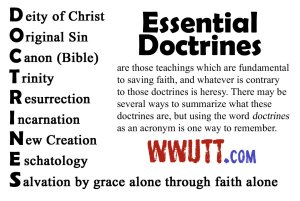
See how this works? If you don’t believe you’re a sinner, you’re not saved. If you don’t believe in the bodily resurrection of Christ, you’re not saved. Here’s how our friend, Pastor Gabriel Hughes, briefly outlines essential doctrines:

(Gabe later tweaked the acrostic a little and added an “S”, which I think is helpful.)

The vast majority of brand new Christians have only the most basic understanding of most of these tenets at the moment of salvation. But it’s not an issue of fully understanding – or else we’d all have to be theologians in order to get saved – it’s an issue of believing. Someone who is genuinely regenerated may not completely understand how the Trinity works (honestly, no one does), but when she’s introduced to the biblical idea of the Trinity, she believes it, learns more about it, and does not reject it.

There is typically agreement among most reputable theologians regarding what constitutes first tier doctrine. Scripture is clear about these things, and several of these issues were settled long ago by the church fathers in assorted church councils (Nicea, Chalcedon, etc.)

Secondary issues are routinely defined as non-salvific but still extremely biblically important, if not quite as biblically clear-cut as primary issues. Doctrines surrounding baptism (credo versus paedo, affusion versus immersion), for example, are usually cited as a secondary issue. A disagreement on a secondary issue doesn’t mean one person is saved and another isn’t, but it normally prevents close partnership in ministry activities involving these issues. For example, my Presbyterian friends and I can join together in pro-life ministry, but we would most likely not plant a church together.

Tertiary issues are non-salvific, less immediately urgent, biblical issues in which the Bible is even less clear-cut and open to wider (yet still biblical) interpretation. These are issues over which Christians can disagree and still maintain close doctrinal fellowship, even in the same church, if they’re in agreement on first and second tier doctrine. Eschatology – the order and timing of events at Jesus’ second coming – is a doctrine that’s often considered third tier. Someone can hold a different eschatological view than mine, yet, for the most part, it shouldn’t affect our ability to worship together, work together, or participate in the ordinances together in the same church.

Some theologians add a fourth category – issues of adiaphora, conscience, or Christian liberty. Usually these are issues of much less importance that the Bible either doesn’t specifically address, or doesn’t give commands about one way or the other. Individual Christians may use biblical principles to inform their consciences and decide for themselves. These would be things like whether or not to take your child trick-or-treating or deciding whether to dress formally or casually for church.

While theologians are largely in agreement about primary doctrines, there is wider spread disagreement on which doctrines are secondary and tertiary (many consider eschatology to be a second tier doctrine, for example) and whether or not there is a need for a category of adiaphora, since such issues are normally not considered to be “doctrinal” issues. In fact, there’s enough space for disagreement that pastors and theologians often wisely refrain from making concrete lists of secondary and tertiary doctrines.

But when we’re talking about the different levels of doctrine, what you won’t find is questions like these: Is murder a first, second, or third tier doctrine? What about gossip? Rape? Adultery? Lying? Gluttony? Pride?

And it’s not because these issues aren’t important or because the Bible doesn’t address them. It’s because they’re in a different category from the other issues: the category of sin. They aren’t doctrines upon which salvation hinges, they aren’t open to interpretation, and the Bible is clear that we are absolutely not to do these things.

The category of doctrine deals with beliefs. The category of sin deals with behavior.

In 2005, Dr. Albert Mohler wrote an excellent article about the different levels of doctrine entitled A Call for Theological Triage and Christian Maturity. He carefully explains the importance of each level of doctrine and what it covers in a plea to keep each level’s urgency in its proper place of significance during discussion, debate, and decision-making.

It was a helpful article to which I always refer people who have questions about tiers of doctrine, and I agree with Dr. Mohler’s thoughts in the article wholeheartedly1 …except on one point:

“In recent years, the issue of women serving as pastors has emerged as another second-order issue.”

Women serving as pastors, women preaching, women teaching men Scripture, and women exercising authority over men in the gathering of the Body is not a secondary issue. Nor is it a primary or tertiary issue. It does not belong in the category of “doctrine” in the same way baptism and eschatology do. It belongs in the category of sin in the same way murder, gossip, and adultery do. Let’s take a look at the reasons for this.

Women serving as pastors, preaching, teaching men Scripture, and exercising authority over men in the gathering of the Body is *not* a secondary issue. Nor is it a primary or tertiary issue. It is a sin.

I do not permit a woman to teach or to exercise authority over a man; rather, she is to remain quiet. 1 Timothy 2:12

(The preponderance of Scripture supports and affirms this concept, so to keep things simple, we’ll use this verse as an exemplar.)

โœข The prohibition in 1 Timothy 2:12 is a clear command against a certain behavior. And when we behave in a way God has prohibited, that is called “sin”. All of the tenets in the three levels of doctrine are affirmative statements regarding beliefs (you must believe in the resurrection of Christ, we believe in baptism by immersion, etc.). None of them are commands, in the negative, against sinful behavior (Thou shalt not murder, I do not permit a woman to teach… etc.)

โœข Secondary and tertiary doctrines can be open – to varying degrees – to biblical interpretation. Every stripe of non-heretical eschatological thought can provide you with chapter and verse passages that can, depending on the angle from which you approach the subject, be biblically plausible and scripturally supported. There is no biblical support for anything God prohibits. No one can cite a properly handled, in context Bible verse in which God says, “It’s OK to commit adultery,” or “Women are allowed to preach.” There can be multiple views on a secondary or tertiary issue that can all be considered biblical, but there can only be one view of sin that is biblical.

โœข Differing beliefs on true secondary and tertiary issues are not sin. My Presbyterian friends have a different view of baptism than I do. That doesn’t mean either of us is sinning. I may think their interpretations of the verses they believe support paedo baptism are incorrect, but they are not breaking any of God’s commands. Differing behavior (again, we see the distinction between doctrinal belief and sinful behavior) on issues of sin is sin. If someone behaves differently from God’s command about lying, she is sinning. If a woman behaves differently from God’s command in 1 Timothy 2:12, she is sinning.

โœข Differing beliefs on secondary and tertiary issues are not born of disobedience and rebellion toward God. Usually, it’s quite the opposite. When someone has studied a theological issue enough to hold a particular position on it, it’s usually because she is striving to please God and to be biblical in her beliefs. Differing behavior on issues of sin is born out of disobedience and rebellion toward God. Someone who steals has already decided in her heart that her desires are better than God’s command. A woman who knowingly holds improper authority over men in her church is doing so because she has already decided to defy God’s clear command against such.

โœข Because different beliefs on secondary and tertiary issues are not born of rebellion and are not sin, they do not require church discipline. Sin does require church discipline. If someone in your church is openly dishonoring her parents, she is sinning and should be subject to church discipline. If a woman is pursuing a career as a pastor, she is sinning and should be subject to church discipline. 

Since the publication of Dr. Mohler’s article (and perhaps as a result of others teaching the same thing) the idea of the violation of 1 Timothy 2:12 being a “secondary doctrine” has spread in a most unhelpful way, leading many Christians to treat the issue in a c’est la vie, “We can just agree to disagree on this,” manner.

No, we cannot.

The idea of the violation of 1 Timothy 2:12 being a “secondary doctrine” has spread in a most unhelpful way, leading many Christians to think “We can just agree to disagree on this.”. No, we cannot.

We would not say, “We can agree to disagree,” on lying or adultery or homosexuality or abortion, and we cannot say it about women preaching, teaching men, or holding unbiblical authority, either. We disciple and teach a sister in Christ who is unaware of what the Bible says on these matters, and if she is committing any of these sins, we begin the process of church discipline. But it would not be loving toward her, or honoring God, to allow her to continue in biblical ignorance or in willful sin.

Furthermore, the violation of 1 Timothy 2:12 brings with it dangers to the church that true secondary and tertiary issues, and even many sins, do not…

The violation of 1 Timothy 2:12 brings with it dangers to the church that true secondary and tertiary issues, and even many sins, do notโ€ฆ

She may not say it with her lips, but when a woman preaches to men in defiance of Scripture, sheโ€™s teaching false doctrine through her behavior. What is the false doctrine sheโ€™s teaching? โ€œI donโ€™t have to obey Godโ€™s Word, and neither do you. If thereโ€™s a part of the Bible you donโ€™t like, youโ€™re free to disregard it.โ€ If your pastor stood up in the pulpit on Sunday morning and said that in words, youโ€™d run him out of town on a rail, and rightly so. Neither should a woman be able to teach that same false doctrine via her actions.

Additionally, I have mentioned several times when dealing with this issue that women preaching to men is highly correlated with women teaching other forms of false doctrine. I have researched scores of women teachers. Every single one of them who unrepentantly teaches men also teaches false doctrine in some other aspect of her theology (usually progressivism, Word of Faith, or New Apostolic Reformation). In other words, if a woman teaches men, you can just about take it to the bank that she also teaches additional false doctrine. False doctrine and heresy are infecting the church – via female preachers – at an alarming rate.

We dare not simply “agree to disagree” on this.

The violation of God’s command that women are not to instruct men in the Scriptures nor hold improper authority over men is a sin like any other. It is not a doctrinal issue in the same sense that other second and third tier doctrines are. If left undisciplined, however, it can lead to first tier doctrinal issues infiltrating a church and eventually destroying it. It is detrimental to the church to label and treat any sin as a secondary doctrinal issue.

Additional Resources

Is Women Preaching a Secondary Issue? on A Word Fitly Spoken

What Are Essentials and Non-Essentials? on A Word Fitly Spoken

Christian Liberty on A Word Fitly Spoken

The importance of Primary and Secondary Doctrines on the Truth Be Known Podcast


1In the years since 2018, when this article was originally written, Dr. Mohler has said, done, and supported various biblically questionable things, leading some to question whether or not he has “gone woke”. While I don’t support his stance on those questionable things, I also don’t believe he has reached the point at which I need to warn against him (although I don’t proactively recommend him, either). To my knowledge, at this time, he is still generally doctrinally sound.

Christian women, Ministry

Mary and Martha and Jesus and Women’s Ministry

Originally published March 11, 2016

You remember the story. Jesus comes to Mary and Martha’s house. Martha’s Pinteresting up the place while Mary sits at Jesus’ feet to listen to Him teach. Martha gripes to Jesus that Mary should help her and Jesus says no because it’s better for her to listen to Him than fold napkins into the shape of swans or whatever. Moral of the story- Martha needs to relax and not let other things distract her from Jesus.

Thatโ€™s a good, true, and important takeaway from this passage, and one that we would all do well to heed.

But did you ever stop to think that Mary and Martha arenโ€™t the main characters in this story? Jesus is. Jesus is the main character in every Bible story, so our primary focus should always be on Him: what He said and did and was like.

Did you ever stop to think that Mary and Martha arenโ€™t the main characters in this story? Jesus is.

What was Jesus teaching that day at Mary and Marthaโ€™s house? The passage doesnโ€™t tell us the topic He was speaking about, but we are privy to a very important lesson He imparted through the scenario with Mary and Martha. A lesson about the way God loves and values women.

Remember how women were generally regarded at that time? They didnโ€™t have much more value than livestock, furniture, or a manโ€™s other possessions. They were considered intellectually inferior, they werenโ€™t formally educated, and their legal and social standing were often tenuous at best. They could not go beyond the Court of the Women at the temple for worship. There was even a traditional prayer Jewish men recited in which they thanked God for not making them a woman, a Gentile, or a slave. Women were low man on the totem pole, so to speak.

And thatโ€™s where we find Martha. She wasnโ€™t doing anything wrong that day. In fact, in her culture, she was doing everything right. If anything, Mary would have been the one viewed as being in the wrong because the teaching was for the men, and it was the womenโ€™s job to bustle around taking care of all the hospitality duties. Martha knew this. Mary knew this. Jesus knew this. Everyone else present knew this. Martha must have wondered why someone hadnโ€™t yet shooed Mary out of the living room and into the kitchen. So her statement to Jesus in verse 40, โ€œLord, do you not care that my sister has left me to serve alone? Tell her then to help me,โ€ was probably not just, โ€œI need another pair of hands,โ€ but also a bit of, โ€œMary is forgetting her place. This isnโ€™t what proper women do.โ€

Oh yes, it is.

Whatever else He might have been lecturing about that day, that was one of the lessons Jesus taught Mary, Martha, the rest of their guests, and Christendom at large.

Women arenโ€™t second class citizens in the Kingdom of God. We are precious and valuable to Him. He has important, worthwhile work for us to do โ€“ His way – in the body of Christ. And He wants us trained in His Word in order to carry out that work.

How did Jesus teach that lesson?

First, He allowed Mary to stay and receive His teaching (39). (We see this echoed in Godโ€™s instruction to the church in 1 Timothy 2:11: โ€œLET a woman learnโ€ฆโ€) It hadnโ€™t slipped Jesusโ€™ mind that she was sitting there. He could have told her to leave, but He had no intention of doing so. Jesus wanted Mary there. He wanted to teach her and to have her learn Godโ€™s word from Him.

Next, when someone tried to take Mary away from hearing and being trained in Godโ€™s word, Jesus โ€“ God Himself โ€“ answered with a resounding NO. This โ€œwill not be taken away from her,โ€ Jesus said. Mary, and Martha too (41), could arrange centerpieces or turn a cookie into a work of art any time or never. But this, the teaching of Godโ€™s Word, was urgent. Vital. Jesus didnโ€™t want either of them to miss it by focusing on the trivial things they thought they should be pursuing.

And He doesnโ€™t want us to miss it either, ladies.

Jesus pulled women out of the craft room and into the study. Is the womenโ€™s ministry at your church trying to pull them back?

Jesus pulled women out of the craft room and into the study. Is the womenโ€™s ministry at your church trying to pull them back?

Is the womenโ€™s events page on your churchโ€™s web site filled exclusively with painting parties, fashion shows, ladiesโ€™ teas, and scrapbook sessions?

Does your womenโ€™s ministry do canned โ€œBibleโ€ studies authored by women who offer nothing but personal stories, experiences, and false doctrine?

Are the Marys in your church who want to sit at the feet of Jesus and hear His word rightly handled and taught being scolded by the Marthas for not staying in their place and embracing the banality the womenโ€™s ministry is doling out?

Are the Marys in your church who want to sit at the feet of Jesus and hear His word rightly handled and taught being scolded by the Marthas for not staying in their place and embracing the banality the womenโ€™s ministry is doling out?

Is this it? Is this all women are good for in the church- fluff and false doctrine?

Jesus didnโ€™t think so.

Letโ€™s have our women’s ministries train women in the full scope of biblical womanhood. Let’s be serious students of Godโ€™s Word by picking it up and studying it like mature women. Letโ€™s get equipped to teach and disciple other women who are babes in Christ. Letโ€™s share the gospel with the lost. Letโ€™s learn how to train our own children in the Scriptures and be the ones to raise the bar for what the kids at our church are being taught. Letโ€™s roll up our sleeves and get our hands dirty ministering to those who are ill, in prison, lonely, poor, elderly, considering abortion, experiencing crisis; who have wayward children, problems in their marriages, a parent with Alzheimerโ€™s, or have lost a loved one.

Is this it? Is this all women are good for in the church- fluff and false doctrine?

Women are worth more and capable of more than the bill of goods theyโ€™re being sold by โ€œChristianโ€ retailers suggests. More than cutesy crafts and fairy tales masquerading as biblical teaching. Letโ€™s put the โ€œministryโ€ โ€“ ministry of the Word and ministry to others โ€“ back in โ€œwomenโ€™s ministry.โ€

Women are worth more and capable of more than the bill of goods theyโ€™re being sold by โ€œChristianโ€ retailers suggests.

Podcast Appearances

Guest Appearance – The Plumb Line Radio Show

Not long ago, I had the pleasure of appearing as a guest on The Plumb Line Radio Show with Jay Rudolph for a wonderful discussion about how to vet the teachers we listen to. What makes someone a false teacher? What are some ways to be more discerning about the teachers we listen to? And how about some practical tips to quickly weed out about 95% of the teachers you shouldn’t be following?

Listen in to these two brief interviews!

The Plumb Line, episode 717- How to Recognize False Teachers 1- Michelle Lesley

The Plumb Line, episode 718- How to Recognize False Teachers 2- Michelle Lesley

If you’re in the vicinity of Des Moines, Omaha/Lincoln, Phoenix, Pittsburgh, San Diego, New York City, Jacksonville, Chicago, or Kansas City, you can listen to The Plumb Line on your local Christian radio station. Click here to find out which radio stations carry The Plumb Line and when. If you don’t live near one of those markets, you can always follow and listen on Spotify.


Additional Resources:

Is She a False Teacher? 7 Steps to Figuring it Out on Your Own

Popular False Teachers & Unbiblical Trends

Joyce Meyer

Are Female Bloggers Violating Scripture by โ€œTeachingโ€ Men?

Leaving Lysa: Why You Shouldnโ€™t Be Following Lysa TerKeurst or Proverbs 31ย Ministries


Got a podcast of your own or have a podcasting friend who needs a guest? Need a speaker for a womenโ€™s conference or church event? Click the โ€œSpeaking Engagementsโ€ tab in the blue menu bar at the top of this page, drop me an e-mail, and letโ€™s chat!