
Wednesday's Word

Wednesday’s Word ~ Hosea 1

hosea 1 10Hosea 1

The word of the Lord that came to Hosea, the son of Beeri, in the days of Uzziah, Jotham, Ahaz, and Hezekiah, kings of Judah, and in the days of Jeroboam the son of Joash, king of Israel.

When the Lord first spoke through Hosea, the Lord said to Hosea, “Go, take to yourself a wife of whoredom and have children of whoredom, for the land commits great whoredom by forsaking the Lord.” So he went and took Gomer, the daughter of Diblaim, and she conceived and bore him a son.

And the Lord said to him, “Call his name Jezreel, for in just a little while I will punish the house of Jehu for the blood of Jezreel, and I will put an end to the kingdom of the house of Israel. And on that day I will break the bow of Israel in the Valley of Jezreel.”

She conceived again and bore a daughter. And the Lord said to him, “Call her name No Mercy, for I will no more have mercy on the house of Israel, to forgive them at all. But I will have mercy on the house of Judah, and I will save them by the Lord their God. I will not save them by bow or by sword or by war or by horses or by horsemen.”

When she had weaned No Mercy, she conceived and bore a son. And the Lord said, “Call his name Not My People, for you are not my people, and I am not your God.”

10  Yet the number of the children of Israel shall be like the sand of the sea, which cannot be measured or numbered. And in the place where it was said to them, “You are not my people,” it shall be said to them, “Children of the living God.” 11 And the children of Judah and the children of Israel shall be gathered together, and they shall appoint for themselves one head. And they shall go up from the land, for great shall be the day of Jezreel.


The Holy Bible, English Standard Version Copyright © 2001 by Crossway Bibles, a publishing ministry of Good News Publishers.


Questions to Consider:

1. Who wrote Hosea? What is the theme or purpose of the book? Which genre of biblical literature (wisdom, epistle, prophecy, history, etc.) is Hosea? What important background information about Hosea and this book can we glean from verse 1?

2. In verses 2-3 is God telling Hosea to commit a sin by marrying “a wife of whoredom”? (see interpretive challenges for help) Does this passage give Christians permission to sin in order to carry out God’s plans or proclaim His word?

3. How was Hosea’s marriage a picture of Israel’s sin? (2) Whom did Hosea represent in this picture? Whom did Gomer represent? What was the sin Israel had committed that God called “whoredom”? Do you see evidence of this sin in your life that you need to repent of? Do you see how God considers it “adultery” against Him?

4. Which attributes of God are portrayed in the names of the three children? (4-9) What was God saying to Israel through each of the names of the children? Do these attributes and messages conflict with other attributes we know to be true of God, such as mercy, forgiveness, compassion, and love?

5. Why does Paul quote from Hosea 2:23 and 1:10 in Romans 9:19-28? How does he tie the two passages together, and what is the point he’s trying to make?

Wednesday's Word

Wednesday’s Word ~ Ezekiel 18

For further study on the book of Ezekiel, try my study, Ezekiel.

ez 18 23

Ezekiel 18

The word of the Lord came to me: “What do you mean by repeating this proverb concerning the land of Israel, ‘The fathers have eaten sour grapes, and the children’s teeth are set on edge’? As I live, declares the Lord God, this proverb shall no more be used by you in Israel. Behold, all souls are mine; the soul of the father as well as the soul of the son is mine: the soul who sins shall die.

“If a man is righteous and does what is just and right— if he does not eat upon the mountains or lift up his eyes to the idols of the house of Israel, does not defile his neighbor’s wife or approach a woman in her time of menstrual impurity, does not oppress anyone, but restores to the debtor his pledge, commits no robbery, gives his bread to the hungry and covers the naked with a garment, does not lend at interest or take any profit, withholds his hand from injustice, executes true justice between man and man, walks in my statutes, and keeps my rules by acting faithfully—he is righteous; he shall surely live, declares the Lord God.

10 “If he fathers a son who is violent, a shedder of blood, who does any of these things 11 (though he himself did none of these things), who even eats upon the mountains, defiles his neighbor’s wife, 12 oppresses the poor and needy, commits robbery, does not restore the pledge, lifts up his eyes to the idols, commits abomination, 13 lends at interest, and takes profit; shall he then live? He shall not live. He has done all these abominations; he shall surely die; his blood shall be upon himself.

14 “Now suppose this man fathers a son who sees all the sins that his father has done; he sees, and does not do likewise: 15 he does not eat upon the mountains or lift up his eyes to the idols of the house of Israel, does not defile his neighbor’s wife, 16 does not oppress anyone, exacts no pledge, commits no robbery, but gives his bread to the hungry and covers the naked with a garment, 17 withholds his hand from iniquity, takes no interest or profit, obeys my rules, and walks in my statutes; he shall not die for his father’s iniquity; he shall surely live. 18 As for his father, because he practiced extortion, robbed his brother, and did what is not good among his people, behold, he shall die for his iniquity.

19 “Yet you say, ‘Why should not the son suffer for the iniquity of the father?’ When the son has done what is just and right, and has been careful to observe all my statutes, he shall surely live. 20 The soul who sins shall die. The son shall not suffer for the iniquity of the father, nor the father suffer for the iniquity of the son. The righteousness of the righteous shall be upon himself, and the wickedness of the wicked shall be upon himself.

21 “But if a wicked person turns away from all his sins that he has committed and keeps all my statutes and does what is just and right, he shall surely live; he shall not die. 22 None of the transgressions that he has committed shall be remembered against him; for the righteousness that he has done he shall live. 23 Have I any pleasure in the death of the wicked, declares the Lord God, and not rather that he should turn from his way and live? 24 But when a righteous person turns away from his righteousness and does injustice and does the same abominations that the wicked person does, shall he live? None of the righteous deeds that he has done shall be remembered; for the treachery of which he is guilty and the sin he has committed, for them he shall die.

25 “Yet you say, ‘The way of the Lord is not just.’ Hear now, O house of Israel: Is my way not just? Is it not your ways that are not just? 26 When a righteous person turns away from his righteousness and does injustice, he shall die for it; for the injustice that he has done he shall die. 27 Again, when a wicked person turns away from the wickedness he has committed and does what is just and right, he shall save his life.28 Because he considered and turned away from all the transgressions that he had committed, he shall surely live; he shall not die. 29 Yet the house of Israel says, ‘The way of the Lord is not just.’ O house of Israel, are my ways not just? Is it not your ways that are not just?

30 “Therefore I will judge you, O house of Israel, every one according to his ways, declares the Lord God. Repent and turn from all your transgressions, lest iniquity be your ruin. 31 Cast away from you all the transgressions that you have committed, and make yourselves a new heart and a new spirit! Why will you die, O house of Israel? 32 For I have no pleasure in the death of anyone, declares the Lord God; so turn, and live.”


The Holy Bible, English Standard Version Copyright © 2001 by Crossway Bibles, a publishing ministry of Good News Publishers.


Questions to Consider:

1. What is the book of Ezekiel about? Which genre (history, poetry, wisdom, etc.) is the book of Ezekiel? What is the overall theme of chapter 18?

2. How do verses 5-9 describe a righteous man? What kind of heart would such a man have to have in order to consistently live this way? (9)

3. Who is the “he” in verses 11 and 12 referring to? Is this man to be punished for the sins of his son? (13) If the sinful man (14) fathers a righteous son (14-17) is the righteous son to be punished for his father’s sin? (17-18) Which verse(s) in this chapter sum up the principle of individual responsibility for sin? How does this chapter refute the false teaching of generational curses?

4. What can we learn about repentance from verses 21-32? In which does God take delight, pouring out His wrath on the wicked or pouring out His forgiveness on the repentant? (23, 32) How does this passage compare to 2 Peter 3:9?

5. Consider this chapter in light of the gospel. Is any person truly righteous? Where does the Christian’s righteousness come from? How does the New Testament describe Jesus, the righteous Son, being punished for our sin? What effect does this have on verse 4 (“the soul who sins shall die”)?

Old Testament, Wednesday's Word

Wednesday’s Word ~ 2 Chronicles 15

2 chron 15 15

2 Chronicles 15

The Spirit of God came upon Azariah the son of Oded, and he went out to meet Asa and said to him, “Hear me, Asa, and all Judah and Benjamin: The Lord is with you while you are with him. If you seek him, he will be found by you, but if you forsake him, he will forsake you. For a long time Israel was without the true God, and without a teaching priest and without law, but when in their distress they turned to the Lord, the God of Israel, and sought him, he was found by them. In those times there was no peace to him who went out or to him who came in, for great disturbances afflicted all the inhabitants of the lands. They were broken in pieces. Nation was crushed by nation and city by city, for God troubled them with every sort of distress.But you, take courage! Do not let your hands be weak, for your work shall be rewarded.”

As soon as Asa heard these words, the prophecy of Azariah the son of Oded, he took courage and put away the detestable idols from all the land of Judah and Benjamin and from the cities that he had taken in the hill country of Ephraim, and he repaired the altar of the Lord that was in front of the vestibule of the house of the Lord. And he gathered all Judah and Benjamin, and those from Ephraim, Manasseh, and Simeon who were residing with them, for great numbers had deserted to him from Israel when they saw that the Lord his God was with him. 10 They were gathered at Jerusalem in the third month of the fifteenth year of the reign of Asa.11 They sacrificed to the Lord on that day from the spoil that they had brought 700 oxen and 7,000 sheep.12 And they entered into a covenant to seek the Lord, the God of their fathers, with all their heart and with all their soul, 13 but that whoever would not seek the Lord, the God of Israel, should be put to death, whether young or old, man or woman. 14 They swore an oath to the Lord with a loud voice and with shouting and with trumpets and with horns. 15 And all Judah rejoiced over the oath, for they had sworn with all their heart and had sought him with their whole desire, and he was found by them, and the Lord gave them rest all around.

16 Even Maacah, his mother, King Asa removed from being queen mother because she had made a detestable image for Asherah. Asa cut down her image, crushed it, and burned it at the brook Kidron. 17 But the high places were not taken out of Israel. Nevertheless, the heart of Asa was wholly true all his days. 18 And he brought into the house of God the sacred gifts of his father and his own sacred gifts, silver, and gold, and vessels. 19 And there was no more war until the thirty-fifth year of the reign of Asa.


The Holy Bible, English Standard Version Copyright © 2001 by Crossway Bibles, a division of Good News Publishers.


Questions to Consider:

1. Who was Asa? Was he a godly or ungodly man? What are the two alternatives and their consequences that Asa was given by Azariah in verse 2?

2. Why did Azariah recite Israel’s history for Asa in verses 3-6? Why was Israel “without the true God, and without a teaching priest and without law” (3) for a long time? (Hint- see verse 8). What happened when Israel repented? (4)

3. Why was it so important to get rid of all the idols (8) to the point that the death penalty was imposed on anyone who would not seek the Lord (13)? Does God really take idolatry that seriously? If God considers idolatry so awful, how does this apply to the church, and individual Christians, today?

4. Getting rid of all the idols was an act of r_______. This was followed by sacrifices to God and an oath that the people would seek only Him. These were acts of w_______. How do the “big picture” ideas in this chapter of sin, followed by repentance and faith, followed by forgiveness and worship, foreshadow the gospel?

5. How do verses 12 and 15 connect to Matthew 22:34-38? How do Asa’s actions in verse 16 relate to Matthew 10:34-37?

Wednesday's Word

Wednesday’s Word ~ 1 Chronicles 21

1 chron 21 241 Chronicles 21

Then Satan stood against Israel and incited David to number Israel. So David said to Joab and the commanders of the army, “Go, number Israel, from Beersheba to Dan, and bring me a report, that I may know their number.” But Joab said, “May the Lord add to his people a hundred times as many as they are! Are they not, my lord the king, all of them my lord’s servants? Why then should my lord require this? Why should it be a cause of guilt for Israel?” But the king’s word prevailed against Joab. So Joab departed and went throughout all Israel and came back to Jerusalem. And Joab gave the sum of the numbering of the people to David. In all Israel there were 1,100,000 men who drew the sword, and in Judah 470,000 who drew the sword.But he did not include Levi and Benjamin in the numbering, for the king’s command was abhorrent to Joab.

But God was displeased with this thing, and he struck Israel. And David said to God, “I have sinned greatly in that I have done this thing. But now, please take away the iniquity of your servant, for I have acted very foolishly.” And the Lord spoke to Gad, David’s seer, saying, 10 “Go and say to David, ‘Thus says the Lord, Three things I offer you; choose one of them, that I may do it to you.’” 11 So Gad came to David and said to him, “Thus says the Lord, ‘Choose what you will: 12 either three years of famine, or three months of devastation by your foes while the sword of your enemies overtakes you, or else three days of the sword of the Lord, pestilence on the land, with the angel of the Lord destroying throughout all the territory of Israel.’ Now decide what answer I shall return to him who sent me.” 13 Then David said to Gad, “I am in great distress. Let me fall into the hand of the Lord, for his mercy is very great, but do not let me fall into the hand of man.”

14 So the Lord sent a pestilence on Israel, and 70,000 men of Israel fell. 15 And God sent the angel to Jerusalem to destroy it, but as he was about to destroy it, the Lord saw, and he relented from the calamity. And he said to the angel who was working destruction, “It is enough; now stay your hand.” And the angel of the Lord was standing by the threshing floor of Ornan the Jebusite. 16 And David lifted his eyes and saw the angel of the Lord standing between earth and heaven, and in his hand a drawn sword stretched out over Jerusalem. Then David and the elders, clothed in sackcloth, fell upon their faces. 17 And David said to God, “Was it not I who gave command to number the people? It is I who have sinned and done great evil. But these sheep, what have they done? Please let your hand, O Lord my God, be against me and against my father’s house. But do not let the plague be on your people.”

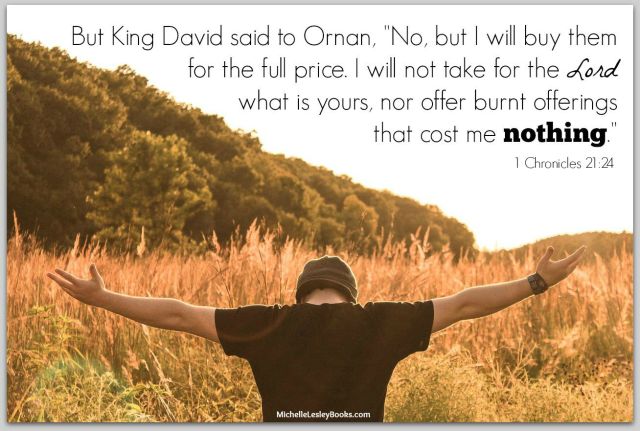
18 Now the angel of the Lord had commanded Gad to say to David that David should go up and raise an altar to the Lord on the threshing floor of Ornan the Jebusite. 19 So David went up at Gad’s word, which he had spoken in the name of the Lord. 20 Now Ornan was threshing wheat. He turned and saw the angel, and his four sons who were with him hid themselves. 21 As David came to Ornan, Ornan looked and saw David and went out from the threshing floor and paid homage to David with his face to the ground. 22 And David said to Ornan, “Give me the site of the threshing floor that I may build on it an altar to the Lord—give it to me at its full price—that the plague may be averted from the people.” 23 Then Ornan said to David, “Take it, and let my lord the king do what seems good to him. See, I give the oxen for burnt offerings and the threshing sledges for the wood and the wheat for a grain offering; I give it all.” 24 But King David said to Ornan, “No, but I will buy them for the full price. I will not take for the Lord what is yours, nor offer burnt offerings that cost me nothing.” 25 So David paid Ornan 600 shekels of gold by weight for the site. 26 And David built there an altar to the Lord and presented burnt offerings and peace offerings and called on the Lord, and the Lord answered him with fire from heaven upon the altar of burnt offering. 27 Then the Lord commanded the angel, and he put his sword back into its sheath.

28 At that time, when David saw that the Lord had answered him at the threshing floor of Ornan the Jebusite, he sacrificed there. 29 For the tabernacle of the Lord, which Moses had made in the wilderness, and the altar of burnt offering were at that time in the high place at Gibeon, 30 but David could not go before it to inquire of God, for he was afraid of the sword of the angel of the Lord.


The Holy Bible, English Standard Version Copyright © 2001 by Crossway Bibles, a division of Good News Publishers.


Questions to Consider:

  1. Verse 1 says that Satan “incited” (other reliable translations say “moved,” “urged,” and “provoked”) David to sin by numbering Israel. Did David have a choice in the matter? Was he forced to sin? What are some ways you can resist Satan when he tempts you?

2. First Corinthians 10:13 says God will always provide us a way of escape from temptation. What was one way of escape God provided to David? (3)

3. What was David’s response to God’s wrath over his sin- did he attempt to justify himself or did he repent? (8) Even though God would be pouring out His wrath on Israel, which attribute of God did David focus on and depend on in making his choice? (13)

4. How did David’s sin as a leader affect those under his authority? (14) Why is it extremely important for Christians in leadership (in the home, at work, at church, etc.) to walk in obedience to the Lord? Can you think of an example of how your sin has affected those around you or under your authority? What should you have done differently in that situation?

5. What were David’s first (16) and second (26) responses to God staying His hand? Did God accept David’s worship and forgive him? Why did David insist on paying Ornan for the site and materials for the sacrifice? (23-25) Is it really a sacrifice if it doesn’t cost you anything?
1 John Bible Study

Am I Really Saved?: A First John Check Up ~ Lesson 9: Wrap Up

Am I Really Saved? A First John Check Up
Lesson 9: Wrap Up

Previous Lessons: 1, 2, 3, 4, 5, 6, 7, 8

Examine yourselves, to see whether you are in the faith. Test yourselves. Or do you not realize this about yourselves, that Jesus Christ is in you?—unless indeed you fail to meet the test!
2 Corinthians 13:5

It’s been quite a journey through the book of 1 John! I hope you have taken the time to honestly examine your heart and your behavior against Scripture to discover whether or not you are truly in Christ.

I want to be sure that I stress once again that the checkpoints we’ve covered in the previous lessons are not things to strive to accomplish in order to earn salvation or to work your way onto God’s good side. You can’t do that. It’s impossible. Salvation is by grace through faith in Christ alone. All of the things we have looked at are the naturally occurring fruit of a person who has already been born again. (Remember our little oak tree/apple tree illustration from lesson 3?)

If you think you might be unsaved or a false convert (someone who thought she was saved, or claimed to be saved, but actually isn’t), you can know Christ as Savior today. Confess to God that you are a sinner, and turn away from your sin. Ask Christ to forgive you for your sin. Believe in Christ’s death, burial, and resurrection as payment for your sin so that you would not have to pay for it yourself with an eternity in Hell, and ask God to save you. You might wish to watch this video and the “Good News” video in the sidebar to your left. And, of course, you’re welcome to contact me with any questions.

I also want to be sure to stress to those who genuinely are born again that you are not going to be perfect in any of these areas this side of Heaven. And that doesn’t mean you aren’t saved. John’s intent in writing this letter was not for you to freak out over the sin you committed yesterday or the fact that your progress in one area seems to be slower than in other areas. He wants you to look back over the direction of your life since you were saved and see if you’re generally growing in holiness and towards more Christlikeness.

I’ve mentioned before that, when I was a kid, a popular question for youth leaders to ask was, “If you were arrested for being a Christian, would there be enough evidence to convict you?” I think that’s a good schematic to use for 1 John. As you come to the conclusion of the study, realize that you aren’t “convicted” on the basis of one or two isolated checkpoints. Rather, ask yourself, does the preponderance of the “evidence” gleaned from the checkpoints point me, beyond a shadow of a doubt, to a verdict of “saved” or a verdict of “not saved”? How would you vote if you were on the jury that was deciding the case of “Am I Really Saved?”

Here, for your convenience, are the 19 checkpoints we’ve looked at in the previous lessons:

Checkpoint 1: Do I walk in the light or the darkness? (1 John 1:6-7)

Checkpoint 2: Do I confess or deny my sin? (1 John 1:8-10)

Checkpoint 3: Do I keep God’s commands? (1 John 2:3-6)

Checkpoint 4: Do I hate others? (1 John 2:9-11)

Checkpoint 5: Do I love worldliness? (1 John 2:15-17)

Checkpoint 6: Do I want to be faithful to a doctrinally sound church? (1 John 2:18-20)

Checkpoint 7: Do I believe in the Jesus of Scripture? (1 John 2:21-25)

Checkpoint 8: Do I practice righteousness? (1 John 2:29)

Checkpoint 9: Do I make a practice of sinning or righteousness? (1 John 3:4-10)

Checkpoint 10: Do I love my brothers? (1 John 3:10-15)

Checkpoint 11: Am I bearing the fruit of love? (1 John 3:18-22)

Checkpoint 12: Do I keep the ultimate commandment? (1 John 3:23-24)

Checkpoint 13: Do I follow false teachers? (1 John 4:1-6)

Checkpoint 14: Is my motivation for love Christocentric? (1 John 4:7-12)

Checkpoint 15: Do my words and actions confess Christ? (1 John 4:13-15)

Checkpoint 16: Am I afraid of God’s judgment? (1 John 4:16-21)

Checkpoint 17: Do my love for God and my love for His people testify to each other? (1 John 5:1-3)

Checkpoint 18: Have I “overcome the world”? (1 John 5:4-5)

Checkpoint 19: Do I have God’s testimony of Christ and eternal life in my heart? (1 John 5:6-12)

It’s my prayer that, as you walk away from this study today, you will do so in full assurance and joy that you do, indeed, know Christ as Savior. Remember, that’s the whole point of the book of 1 John:

I write these things to you who believe in the name of the Son of God that you may know that you have eternal life. 1 John 5:13

Additional Resources:

The Character of Genuine Saving Faith by John MacArthur

How Do I Know If I Am Really Saved? by Costi Hinn

Assurance: “How Can I Know I’m Really Saved?” at Things Above Us