Christian women, Complementarianism, Ministry, Sin

Women Preaching: It’s Not a Secondary Doctrinal Issue

Originally published August 3, 2018

When it comes to Christianity, are the specifics of what people believe important?

I think most of us would answer a resounding “yes” to that question. Of course, the various concepts we believe are important. You can’t just believe anything you like and still be a Christian. There are certain things you must believe in order to become a Christian at all, and there are certain things you will come to believe because you are a genuinely regenerated Christian. But what are those things, and how do we know which is which?

You can’t just believe anything you like and still be a Christian.

Maybe you’ve heard the terms “essential doctrines” or “primary, secondary, and tertiary theological issues” or “first, second, and third tier levels of doctrine”? For years, theologians have been attempting to organize beliefs of the Christian faith – all drawn from the Bible, naturally – into nice neat categories in order to make things a little simpler. As someone who thrives on organization and categories, I’m grateful for their efforts. But if you begin to study this categorization of beliefs, you’ll find that we haven’t reached an across the board consensus yet.

Generally speaking, “essential”, “primary”, or “first tier” doctrines are those which you, biblically, have to believe in order to become a Christian and/or be considered a Christian. For example:

โœข Sin is a thing, and I am a sinner.

โœข God exists and is the supreme authority of the universe.

โœข Jesus was God in human flesh.

โœข Jesus rose bodily from the grave.

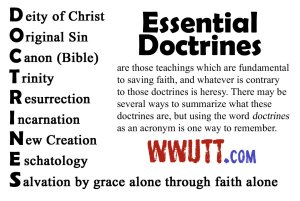
See how this works? If you don’t believe you’re a sinner, you’re not saved. If you don’t believe in the bodily resurrection of Christ, you’re not saved. Here’s how our friend, Pastor Gabriel Hughes, briefly outlines essential doctrines:

(Gabe later tweaked the acrostic a little and added an “S”, which I think is helpful.)

The vast majority of brand new Christians have only the most basic understanding of most of these tenets at the moment of salvation. But it’s not an issue of fully understanding – or else we’d all have to be theologians in order to get saved – it’s an issue of believing. Someone who is genuinely regenerated may not completely understand how the Trinity works (honestly, no one does), but when she’s introduced to the biblical idea of the Trinity, she believes it, learns more about it, and does not reject it.

There is typically agreement among most reputable theologians regarding what constitutes first tier doctrine. Scripture is clear about these things, and several of these issues were settled long ago by the church fathers in assorted church councils (Nicea, Chalcedon, etc.)

Secondary issues are routinely defined as non-salvific but still extremely biblically important, if not quite as biblically clear-cut as primary issues. Doctrines surrounding baptism (credo versus paedo, affusion versus immersion), for example, are usually cited as a secondary issue. A disagreement on a secondary issue doesn’t mean one person is saved and another isn’t, but it normally prevents close partnership in ministry activities involving these issues. For example, my Presbyterian friends and I can join together in pro-life ministry, but we would most likely not plant a church together.

Tertiary issues are non-salvific, less immediately urgent, biblical issues in which the Bible is even less clear-cut and open to wider (yet still biblical) interpretation. These are issues over which Christians can disagree and still maintain close doctrinal fellowship, even in the same church, if they’re in agreement on first and second tier doctrine. Eschatology – the order and timing of events at Jesus’ second coming – is a doctrine that’s often considered third tier. Someone can hold a different eschatological view than mine, yet, for the most part, it shouldn’t affect our ability to worship together, work together, or participate in the ordinances together in the same church.

Some theologians add a fourth category – issues of adiaphora, conscience, or Christian liberty. Usually these are issues of much less importance that the Bible either doesn’t specifically address, or doesn’t give commands about one way or the other. Individual Christians may use biblical principles to inform their consciences and decide for themselves. These would be things like whether or not to take your child trick-or-treating or deciding whether to dress formally or casually for church.

While theologians are largely in agreement about primary doctrines, there is wider spread disagreement on which doctrines are secondary and tertiary (many consider eschatology to be a second tier doctrine, for example) and whether or not there is a need for a category of adiaphora, since such issues are normally not considered to be “doctrinal” issues. In fact, there’s enough space for disagreement that pastors and theologians often wisely refrain from making concrete lists of secondary and tertiary doctrines.

But when we’re talking about the different levels of doctrine, what you won’t find is questions like these: Is murder a first, second, or third tier doctrine? What about gossip? Rape? Adultery? Lying? Gluttony? Pride?

And it’s not because these issues aren’t important or because the Bible doesn’t address them. It’s because they’re in a different category from the other issues: the category of sin. They aren’t doctrines upon which salvation hinges, they aren’t open to interpretation, and the Bible is clear that we are absolutely not to do these things.

The category of doctrine deals with beliefs. The category of sin deals with behavior.

In 2005, Dr. Albert Mohler wrote an excellent article about the different levels of doctrine entitled A Call for Theological Triage and Christian Maturity. He carefully explains the importance of each level of doctrine and what it covers in a plea to keep each level’s urgency in its proper place of significance during discussion, debate, and decision-making.

It was a helpful article to which I always refer people who have questions about tiers of doctrine, and I agree with Dr. Mohler’s thoughts in the article wholeheartedly1 …except on one point:

“In recent years, the issue of women serving as pastors has emerged as another second-order issue.”

Women serving as pastors, women preaching, women teaching men Scripture, and women exercising authority over men in the gathering of the Body is not a secondary issue. Nor is it a primary or tertiary issue. It does not belong in the category of “doctrine” in the same way baptism and eschatology do. It belongs in the category of sin in the same way murder, gossip, and adultery do. Let’s take a look at the reasons for this.

Women serving as pastors, preaching, teaching men Scripture, and exercising authority over men in the gathering of the Body is *not* a secondary issue. Nor is it a primary or tertiary issue. It is a sin.

I do not permit a woman to teach or to exercise authority over a man; rather, she is to remain quiet. 1 Timothy 2:12

(The preponderance of Scripture supports and affirms this concept, so to keep things simple, we’ll use this verse as an exemplar.)

โœข The prohibition in 1 Timothy 2:12 is a clear command against a certain behavior. And when we behave in a way God has prohibited, that is called “sin”. All of the tenets in the three levels of doctrine are affirmative statements regarding beliefs (you must believe in the resurrection of Christ, we believe in baptism by immersion, etc.). None of them are commands, in the negative, against sinful behavior (Thou shalt not murder, I do not permit a woman to teach… etc.)

โœข Secondary and tertiary doctrines can be open – to varying degrees – to biblical interpretation. Every stripe of non-heretical eschatological thought can provide you with chapter and verse passages that can, depending on the angle from which you approach the subject, be biblically plausible and scripturally supported. There is no biblical support for anything God prohibits. No one can cite a properly handled, in context Bible verse in which God says, “It’s OK to commit adultery,” or “Women are allowed to preach.” There can be multiple views on a secondary or tertiary issue that can all be considered biblical, but there can only be one view of sin that is biblical.

โœข Differing beliefs on true secondary and tertiary issues are not sin. My Presbyterian friends have a different view of baptism than I do. That doesn’t mean either of us is sinning. I may think their interpretations of the verses they believe support paedo baptism are incorrect, but they are not breaking any of God’s commands. Differing behavior (again, we see the distinction between doctrinal belief and sinful behavior) on issues of sin is sin. If someone behaves differently from God’s command about lying, she is sinning. If a woman behaves differently from God’s command in 1 Timothy 2:12, she is sinning.

โœข Differing beliefs on secondary and tertiary issues are not born of disobedience and rebellion toward God. Usually, it’s quite the opposite. When someone has studied a theological issue enough to hold a particular position on it, it’s usually because she is striving to please God and to be biblical in her beliefs. Differing behavior on issues of sin is born out of disobedience and rebellion toward God. Someone who steals has already decided in her heart that her desires are better than God’s command. A woman who knowingly holds improper authority over men in her church is doing so because she has already decided to defy God’s clear command against such.

โœข Because different beliefs on secondary and tertiary issues are not born of rebellion and are not sin, they do not require church discipline. Sin does require church discipline. If someone in your church is openly dishonoring her parents, she is sinning and should be subject to church discipline. If a woman is pursuing a career as a pastor, she is sinning and should be subject to church discipline. 

Since the publication of Dr. Mohler’s article (and perhaps as a result of others teaching the same thing) the idea of the violation of 1 Timothy 2:12 being a “secondary doctrine” has spread in a most unhelpful way, leading many Christians to treat the issue in a c’est la vie, “We can just agree to disagree on this,” manner.

No, we cannot.

The idea of the violation of 1 Timothy 2:12 being a “secondary doctrine” has spread in a most unhelpful way, leading many Christians to think “We can just agree to disagree on this.”. No, we cannot.

We would not say, “We can agree to disagree,” on lying or adultery or homosexuality or abortion, and we cannot say it about women preaching, teaching men, or holding unbiblical authority, either. We disciple and teach a sister in Christ who is unaware of what the Bible says on these matters, and if she is committing any of these sins, we begin the process of church discipline. But it would not be loving toward her, or honoring God, to allow her to continue in biblical ignorance or in willful sin.

Furthermore, the violation of 1 Timothy 2:12 brings with it dangers to the church that true secondary and tertiary issues, and even many sins, do not…

The violation of 1 Timothy 2:12 brings with it dangers to the church that true secondary and tertiary issues, and even many sins, do notโ€ฆ

She may not say it with her lips, but when a woman preaches to men in defiance of Scripture, sheโ€™s teaching false doctrine through her behavior. What is the false doctrine sheโ€™s teaching? โ€œI donโ€™t have to obey Godโ€™s Word, and neither do you. If thereโ€™s a part of the Bible you donโ€™t like, youโ€™re free to disregard it.โ€ If your pastor stood up in the pulpit on Sunday morning and said that in words, youโ€™d run him out of town on a rail, and rightly so. Neither should a woman be able to teach that same false doctrine via her actions.

Additionally, I have mentioned several times when dealing with this issue that women preaching to men is highly correlated with women teaching other forms of false doctrine. I have researched scores of women teachers. Every single one of them who unrepentantly teaches men also teaches false doctrine in some other aspect of her theology (usually progressivism, Word of Faith, or New Apostolic Reformation). In other words, if a woman teaches men, you can just about take it to the bank that she also teaches additional false doctrine. False doctrine and heresy are infecting the church – via female preachers – at an alarming rate.

We dare not simply “agree to disagree” on this.

The violation of God’s command that women are not to instruct men in the Scriptures nor hold improper authority over men is a sin like any other. It is not a doctrinal issue in the same sense that other second and third tier doctrines are. If left undisciplined, however, it can lead to first tier doctrinal issues infiltrating a church and eventually destroying it. It is detrimental to the church to label and treat any sin as a secondary doctrinal issue.

Additional Resources

Is Women Preaching a Secondary Issue? on A Word Fitly Spoken

What Are Essentials and Non-Essentials? on A Word Fitly Spoken

Christian Liberty on A Word Fitly Spoken

The importance of Primary and Secondary Doctrines on the Truth Be Known Podcast


1In the years since 2018, when this article was originally written, Dr. Mohler has said, done, and supported various biblically questionable things, leading some to question whether or not he has “gone woke”. While I don’t support his stance on those questionable things, I also don’t believe he has reached the point at which I need to warn against him (although I don’t proactively recommend him, either). To my knowledge, at this time, he is still generally doctrinally sound.

Abortion, Gospel

Planned Parenthood: There, But for the Grace of God…

Originally published August 15, 2015

You walk into your doctorโ€™s office for your annual check upโ€”flu shot, cancer, cholesterol and blood sugar screening, blood pressure checkโ€”you know, routine maintenance on the olโ€™ bod. Youโ€™ve chosen this doctor because you donโ€™t have health insurance and heโ€™s kind enough to lower his prices and work with you on a payment plan. His office is clean and bright, beautifully decorated, and the staff is always friendly. You even get a lollipop at the end of each visit.

But this year, as youโ€™re walking down the hall to exam room four, you happen to notice that in exam room three, thereโ€™s a playpen in the corner with an adorable baby girl in it, cooing away and playing with a toy.

โ€œOdd,โ€ you think, since this is not a pediatricianโ€™s office. You continue to your own room, don that scratchy paper gown, and wait for the doctor. By the time he comes in and begins the exam, you can no longer contain your curiosity. Whose baby is it? Why is there even a baby in the office?

โ€œOh, yes,โ€ the doctor says matter of factly, โ€œthat baby was abandoned by her parents. Nobody wants her, so when I get finished with your check up, Iโ€™m going to torture her to death and then sell her organs to medical researchers.โ€

Your jaw hits the floor. Your stomach turns. You canโ€™t believe the monstrous words youโ€™ve just heard.

โ€œHow could you do such a horrible thing?โ€ you scream over your revulsion. The doctor looks surprised that you should ask.

โ€œItโ€™s really no big deal,โ€ he says. โ€œWe only do a few of those a week. The vast majority of my practice is providing health care and counseling for patients like you.โ€

Let me ask you somethingโ€”would you use that doctor and think that the care he provides you mitigates his atrocious behavior? I hope not. Yet I have heard people defend Planned Parenthood (an organization which has been torturing babies to death for decades, and,ย we recently learned, profits from the sale of their organs) because Planned Parenthood ostensibly performs a minimum number of abortions and mainly provides health services, such as the ones mentioned above, to women who need them. Somehow, in these peopleโ€™s minds, the health care Planned Parenthood provides makes up for the heinous murders they commit day after day.

Does it really all balance out? Of course not.

In fact, letโ€™s say, Planned Parenthood had only ever tortured fifty babies to death (instead of the millions theyโ€™ve actually killed). And letโ€™s say they provided free health care to everyone on the planet, cured cancer, and brought about world peace. Those are some wonderful things, but does it erase the fact that they brutally ended fifty innocent lives? Do all those good deeds make up for even one murder?

No. They donโ€™t. Good deeds can never make up for heinous crimes. Planned Parenthoodโ€™s hands are drenched in blood that all the free health care in the world canโ€™t wash away.

Theyโ€™re hopelessly guilty. Just like we are.

Apart from Christ, we are Planned Parenthood. We come before God with blood on our hands. Not the blood of millions of babies, but the blood of one child. Godโ€™s child. Jesus. We are responsible for His death. It was our sin that caused Him to be tortured to death. Our sin that brutally murdered Him.

We come before God with blood on our hands. Not the blood of millions of babies, but the blood of one child. Godโ€™s child. Jesus.

โ€œOh, but itโ€™s no big deal. Iโ€™m mainly a good person. The vast majority of my life is spent doing good things and helping people. That totally makes up for those few sins Iโ€™ve committed. My good deeds outweigh the bad.โ€

No. They donโ€™t. Good deeds can never make up for heinous crimes.

But, graceโ€ฆ But, mercyโ€ฆ But the goodness and loving kindness of God our Savior intervenes and wipes away the guilt. Washes our hands of Christโ€™s blood. Cleanses us from all unrighteousness, if we only turn to Him in the repentance and faith that He is gracious enough to give us.

Good deeds can never make up for heinous crimes, but the grace of God can.

But when the goodness and loving kindness of God our Savior appeared, he saved us, not because of works done by us in righteousness, but according to his own mercy, by the washing of regeneration and renewal of the Holy Spirit, whom he poured out on us richly through Jesus Christ our Savior, so that being justified by his grace we might become heirs according to the hope of eternal life.

Titus 3:4-7

Good deeds can never make up for heinous crimes, but the grace of God can.

Relationships, Sanctification

Throwback Thursday ~ In Defense of Offense: Why Christians Need to Stop Worrying About Offending People

Originally published January 18, 2019

“You’re a liar,” he said dryly, the passion in his eyes gleaming through.

“What?!?! HOW DARE YOU call me a liar!” his fellow church member fumed.

“You’re a liar, Joe. You show up at church for an hour a week and claim to be a Christian, yet you’ve been living with your girlfriend for over a year, you’ve told me you use pornography, and I’ve talked to five different people with incontrovertible evidence that you’ve cheated in your business dealings with them. When you say you’re a Christian, you’re lying. Just admit it.”

Have you ever had a conversation like this with someone? Have you ever witnessed a conversation like this?

Most of us would never dream of calling someone a liar who claims to be a Christian yet walks in disobedience to Christ. Goodness, no! It might offend the person or cause her to question her salvation! She might leave the church or walk away from the faith!

You know who wouldn’t be afraid of offending such a person or causing her to doubt her salvation? Someone who would dream of calling a professed Christian walking in disobedience a liar?

The Holy Spirit – via the Apostle John – that’s who.

Whoever says โ€œI know [Jesus]โ€ but does not keep his commandments is a liar, and the truth is not in him, but whoever keeps his word, in him truly the love of God is perfected. By this we may know that we are in him: whoever says he abides in him ought to walk in the same way in which [Jesus] walked.

1 John 2:4-6

Take a moment and let that really sink in. People who claim to be Christians yet habitually and unrepentantly make a practice of sinning are not saved.

People who claim to be Christians yet habitually and unrepentantly make a practice of sinning are not saved.

To the Holy Spirit and John that’s as plain and simple and uncontroversial as saying, “The sky is blue, and water’s wet.” But to a false convert, them’s fightin’ words.

And we know it.

So we refrain from lovingly speaking hard, biblical truths to people who need to hear them, usually for one of a handful of reasons:

โ€ข We don’t want this person’s wrath aimed at us because it’s a hassle or because we don’t want to lose the relationship with her.

โ€ข We don’t actually believe the Bible and trust God’s sovereignty. We’d rather lean on our own understanding, desperately clinging to the irrational hope that this person is truly a Christian who’s hanging by a thread, and we don’t want to be the one responsible for saying anything that might clip that thread.

โ€ข We’re worried about how we’ll look to others and that they’ll accuse us of being unloving, unchristlike, and harming the unity of the church.

What do those reasons have in common?

Me. Me me me me me me me.

I want to keep my relationship with this person in tact. I don’t want others to blame me for this person’s reaction to biblical truth or call me unloving or divisive. I don’t want to deal with the aggravation of this person’s emotional blow up.

It’s not exactly the greater love of laying down one’s life for a friend, is it? We’re not even willing to lay down our comfort or our reputation in order to tell someone her walk doesn’t match her talk and call her to repentance. Is that love at all, or is it just plain, old fashioned selfishness? We bow and scrape at the idol of not hurting other people’s feelings while those people careen down the road paved with our good intentions straight toward the gates of Hell. How is that love? 

We bow and scrape at the idol of not hurting other people’s feelings while those people careen down the road paved with our good intentions straight toward the gates of Hell. How is that love?

Love is valuing, and acting on, what is best for another person over and above our own self interests. You know, kind of like Jesus did during His life, death, and resurrection:

By this we know love, that he laid down his life for us, and we ought to lay down our lives for the brothers.

1 John 3:16

You know, it’s interesting that the Holy Spirit speaks a lot of hard, “you’re not saved if…” truths in a book (1 John) whose purpose is to give true Christians assurance of their salvation. The Third Person of the Trinity – the embodiment of perfect love – doesn’t seem to think it’s unloving to tell false converts they aren’t saved, while at the same time reassuring young, shaky-kneed saints.

But us? We can’t seem to get our act together and do both from a heart of love the way the Holy Spirit does.

Weโ€™ve focused so much attention on reassuring anyone who claims the label “Christian” of their eternal security that weโ€™ve lost sight of the fact that there are a great many false converts in our midst who should be questioning their salvation. The gate is wide that leads to destruction, Jesus said. It is the narrow gate that leads to life, and few are those who find it. Test yourself to see if you’re in the faith. How will they know these things if we don’t tell them?

The Bible has hard, sharp edges. It’s a sword, for crying out loud, not a feather duster. The primary purpose of a sword is to cut.

The gospel divides. Jesus – the creator of Christian unity – said, “I have not come to bring peace, but a sword. For I have come to set a man against his father, and a daughter against her mother, and a daughter-in-law against her mother-in-law.” Jesus – perfectly kind, perfectly loving Jesus – called those claiming to be God’s people yet walking in disobedience hypocrites, vipers, and sons of the Devil. Jesus – the Jesus who was more compassionately evangelistic than we could ever hope to be – didn’t beg, plead, or hand-wringingly water down Kingdom requirements so the rich young ruler would keep a toe in the door of God’s house. Jesus held high the standard of the gospel and let him walk away. Jesus wasn’t a nerdy little wimp offering people a cheap plastic heavenly trinket if they would only be His friend. This almighty King demanded perfection, the highest love, loyalty unto death. And, by the way, you’d better count the cost before deciding to follow Him. Jesus wasn’t worried about offending people with biblical truth.

We need to stop worrying that the Bible is going to offend people who need to be offended by its demands, requirements, and judgments so that they might repent and be reconciled to Christ. Whether it’s a sinner in need of a Savior or a saint in need of sanctification, the ministry of reconciliation Christ has called us to begins with confronting sin.

We need to stop worrying that the Bible is going to offend people who *need* to be offended by its demands, requirements, and judgments so that they might repent and be reconciled to Christ.

Every person we would potentially approach with biblical truth is either saved or lost.

If a person is genuinely one of Christ’s sheep, she will hear the voice of her Shepherd calling to her from the truths of His Word, turn from her sin, and follow Him. It may take time. It may take help. It may take teaching and many tears. But sheep love the Shepherd and follow Him. They grow toward Him, not away from Him.

If a person is lost, she isn’t going to get any “loster” when you biblically call her to repentance. Lost is lost, even if that lost person claims to be, or thinks she is, a Christian. There’s no such thing as a genuinely regenerated Christian who’s just barely hanging on to Jesus by her fingernails and you come along and push her out of the faith by confronting her sin with biblical truth. Uh uh. If she abandons Christ in favor of her sin, she was never saved in the first place, I don’t care what she claims to the contrary.

If a person is lost, she isn’t going to get any “loster” when you biblically call her to repentance.

All of this nonsense floating around these days about “de-converting” from Christianity, or “I used to be a real, genuine, bona fide Christian, but I’m not anymore.” Hogwash and poppycock. The Bible says if you leave the body of Christ, you were never a member of it to begin with. That God is greater than all (including you) and no one (not even yourself) is able to snatch you out of His hand if you belong to Him. That those who are saved will endure to the end. That Jesus will not lose a single one of those the Father has entrusted to Him. Dare we believe the words of sinners about themselves over what the Word of God says about them? No matter what you say or do, you don’t have the power to be responsible for someone leaving the faith. Whatever circumstance or person they might use as a scapegoat, people “leave” Christianity because they don’t know or love Christ and they’ve gotten tired of pretending like they do.

The people we love enough to lovingly, yet firmly, speak hard biblical truths to are either Christians who will come to love and embrace those truths (and love us for caring enough to speak them), or theyโ€™re lost or false converts who need to be confronted with the mirror of God’s Word so they can face up to the fact that theyโ€™re lost. Where the Bible speaks plainly and definitively, we must not be ashamed of the gospel and shrink from speaking plainly and definitively in agreement with it.

Stop being afraid of offending people by speaking hard, biblical truths. Sometimes the most loving thing you can do for someone is offend her.

Stop being afraid of offending people by speaking hard, biblical truths. Sometimes the most loving thing you can do for someone is offend her.

Church, Sin

Dis. Grace.: Responding Biblically to Church Scandal

Originally published June 30, 2015


The last time I re-ran this article was in September of 2024 (only about eight months ago), when Steve Lawson was caught in sin. Today, I’m re-running it because another well known pastor, and president of G3 Ministries, Josh Buice, has been caught in sin. As Josh is under church discipline, I have removed him from my list of recommended pastors and teachers. G3 itself is still a trustworthy ministry, and my hearty recommendation of it continues. Please read the statement from G3 here.

If you are registered for the G3 Women’s Expository Teaching Workshop at the end of May, any of the other workshops, or the national conference this fall, please check the email address you registered with for further information on your registration. I’m so sorry I won’t get to see those of you who were going to be at the women’s workshop.

I’m going to take the rest of this week off from blogging, not just due to this, but primarily due to some other things I’ve got going on as well (mostly good things๐Ÿ™‚).

Please keep G3 Ministries and Prays Mill Baptist Church (Josh’s church) in your prayers as they navigate this difficult time.


It happened again last week. Another scandal. Another high profile pastor stepping down from the ministry in disgrace. Another family broken. Another church stunned and bereft.

And itโ€™s not just the money grubbing televangelists anymore, either. This was one of the theological good guys. Sadly, pastors and Christian leaders โ€“ both those in the public eye and those right around the corner โ€“ seem to be dropping like flies these days. Adultery. Financial sin. Pornography. Abuse. Fraud. The list of sinful behavior goes on and on, leaving a wake of destruction in its path and giving Christ and His bride a black eye in the process.

So, what is the biblical response to scandals like these for Joe and Jane Christian? We view the situation through the lenses of Romans 8:28:

And we know that for those who love God all things work together for good, for those who are called according to his purpose.

How can God use this scandal, awful as it is, for my good and the good of my brothers and sisters in Christ? Itโ€™s an opportunity to learn, teach, and minister in so many ways:

Fully grasp the destructive power of sinโ€ฆ

Imagine the agony the pastorโ€™s sin is creating in so many lives. What must his wife be going through? His children? His church? What about his own relationship with God? What about the lost people he was trying to win to Christ? What about the fact that his career may be over and he may lose his house?

Itโ€™s been said that sin destroys completely and completely destroys. Itโ€™s a good time to reflect on the fact that sin is not something to be trifled with. Count the cost. Would it be worth it to you to commit the same sin in your own life?

Itโ€™s been said that sin destroys completely and completely destroys. Itโ€™s a good time to reflect on the fact that sin is not something to be trifled with.

Realize your need for Christโ€ฆ

โ€œThere, but for the grace of God, go I.โ€ โ€œTherefore let anyone who thinks that he stands take heed lest he fall.โ€ (1 Corinthians 10:12) โ€œPride goes before destruction, and a haughty spirit before a fall.โ€ (Proverbs 16:18)

Donโ€™t fall into the trap of thinking youโ€™re better or holier than the person who sinned, therefore, you would never do what he did. Instead, let his sin push you towards the cross, realizing that youโ€™re just as weak and susceptible to temptation as he is. Let it amp up your prayer life and drive you to cling to Christ and His word lest you fall into sin.

Let his sin push you towards the cross, realizing that youโ€™re just as weak and susceptible to temptation as he is.

Dive into Godโ€™s wordโ€ฆ

What does the Bible say about the sin in question? Learn what Godโ€™s word says. Apply it to your life, your work, or your marriage. Teach it to your children. Share it with those in your circle of influence. Build up your brothers and sisters in Christ so they might stand firm against temptation.

Implement safeguardsโ€ฆ

People donโ€™t just wake up one day and decide to commit adultery or embezzlement or whatever. Every sin starts with a wayward thought, which, when left unchecked (or entertained), snowballs into action. What could the scandalized pastor have done, practically, to prevent his sin? What are some concrete, proactive steps you can take to guard against sin in your life? Maybe your husband should hold the credit cards or you should cut ties with that certain male friend. Donโ€™t wait for sin to find you. Build some walls before it arrives.

Use the scandal as a springboard for prayerโ€ฆ

Pray for those involved in the scandal. Ask God to protect you, your husband, and your loved ones from that particular sin. Realize that your own pastor and church staff are tempted to sin every day, pray for them regularly, and let them know youโ€™re praying for them.

Practice the Golden Ruleโ€ฆ

What if you were the one who sinned? How would you want people to talk about and treat you and your family? Call a sin a sin, but letโ€™s remember, when it comes to scandals, to watch our words and actions, and treat others the way we would want to be treated.

Use the scandal as an opportunity to share the gospelโ€ฆ

Inevitably, some lost people will see pastoral sin as one more candle in their โ€œChristians are just a bunch of hypocritesโ€ cake. Donโ€™t be embarrassed if an unbeliever approaches you with this line of fire (and whatever you do, don’t try to make light of or justify the pastorโ€™s sin). Own it. Admit it. โ€œYouโ€™re right. This guy sinned. He needs to repent and be forgiven by Christ. He needs to make things right with the people around him. Just like me. Just like you. By the way, Christ was crucified for sinners like him and me and you. Have you ever repented of your own sin and trusted in Christโ€™s death, burial, and resurrection as the payment for your sin? Mind if I tell you how?โ€

Repent and Forgiveโ€ฆ

Itโ€™s hurtful when someone you trust and look up to lets you down. But because weโ€™re sinful humans living in a broken world, itโ€™s going to happen. The pastor who sinned needs to repent. When he does, the people around him need to forgive, even though there will probably still be disciplinary consequences to his actions. Is there sin in your life that you need to repent of and face the consequences for? Is there someone who has sinned against you that you need to forgive? God extends the grace of forgiveness to repentant sinners and the grace to forgive to their victims. Repent. Forgive.


Scandals among Christian leaders are heartbreaking, disappointing, embarrassing. But the God who sent His only Son to the cross to turn sinners into saints has a wonderful way of taking offenses and turning them into opportunities for His kingdom.

Scandals among Christian leaders are heartbreaking. But the God who sent His only Son to the cross to turn sinners into saints has a wonderful way of taking offenses and turning them into opportunities for His kingdom.


Additional Resources

Pastoral Propriety with Church Ladies, and 7 Ways Women Can Help

Sin Feels Like Death, Because it Is by Amy Spreeman

โ€œDisqualifiedโ€: What it means and how a pastor gets there at The Cripplegate

Discernment, Mailbag

The Mailbag: Potpourri (Shack up shenanigans… Church library discernment… Adding recommended teachers)

Welcome to another โ€œpotpourriโ€ edition of The Mailbag, where I give short(er) answers to several questions rather than a long answer to one question.

I like to take the opportunity in these potpourri editions to let new readers know about my comments/e-mail/messages policy. Iโ€™m not able to respond individually to most e-mails and messages, so here are some helpful hints for getting your questions answered more quickly. Remember, the search bar (at the very bottom of each page) can be a helpful tool!

Or maybe I answered your question already? Check out my article The Mailbag: Top 10 FAQs to see if your question has been answered and to get some helpful resources.


I have a friend who is living with someone she is not married to. She professes to be a Christian. I donโ€™t see or talk to her much as she lives a couple of hours away. I have been invited to spend the weekend with her. I donโ€™t want to go as I donโ€™t want her to think I condone her living situation. How do I graciously bring up this violation of Godโ€™s instructions to us regarding sexual immorality?

I’m so sorry your friend’s sin has put you in this difficult situation. I know it’s uncomfortable and awkward, and you’re probably afraid you’re going to offend her and maybe even lose your relationship with her as a result of this situation.

But I want you (and all of my readers who are in awkward situations similar to this) to remember that your friend is the one at fault here for all of this awkwardness and potential hurt feelings, not you. She caused this situation by her sin, and if she doubles down on that sin when you talk to her about it, she will also be at fault for any other negative results that transpire, not you. That’s what sin does. It ruins everything it touches, it impacts areas of our lives we never dreamed it would, and it affects our relationships with the people we love.

I agree it would probably be wisest not to stay overnight with your friend and her shack up. It will seem to her as though you have no problem with her sinful living arrangement. However, accepting or declining the invitation may not be your only two options. What about the possibilities of either making it a day trip (and not spending the night at all), or accepting the invitation, but staying in a hotel or somewhere else besides under her roof? That way, you could spend time with your friend and have the opportunity to call her to repentance, face to face.

This would also give you the chance to share the gospel with her. I know she professes to be a Christian, but it’s important that we believe God over sinful human beings, and God says:

And by this we know that we have come to know Him, if we keep His commandments. The one who says, โ€œI have come to know Him,โ€ and does not keep His commandments, is a liar, and the truth is not in him; but whoever keeps His word, truly in him the love of God has been perfected. By this we know that we are in Him: the one who says he abides in Him ought himself to walk in the same manner as He walked.

1 John 2:3-6

Yes, Christians fall into sin, but Christians also repent. We do not gleefully jump into the pool of sin and swim around in it for extended periods of time. We hate our sin. We feel guilt and conviction over our sin. And we repent. That’s one of the fruits of genuine conversion. Likewise, living in sin without conviction, repentance, etc., is the fruit of someone who is lost, regardless of what she might claim, because God says so.

I would encourage you to go and spend some time with your friend (without spending the night at her house) if at all possible. The Lord has put you – someone who cares for her and knows the Truth – into her life to be salt and light to her.

How to do it graciously? Reassure her of your love for her and that if you didn’t truly love her, you wouldn’t be addressing this with her. And then just tell her the truth. She claims to be a Christian. She’s living in direct violation of God’s Word. She needs to repent and change her ways.

Saying all of this graciously and kindly doesn’t mean she won’t get mad at you and break off the relationship. She might do just that because she loves her sin more than she loves you and certainly more than she loves Christ. No amount of graciousness and kindness on your part can prevent that.

And as strong, godly Christian women, we have to be OK with that. We serve a Savior who was despised and rejected by men. Is a disciple above his teacher or a slave above his master?

โ€œA disciple is not above his teacher, nor a slave above his master. It is enough for the disciple that he become like his teacher, and the slave like his master. If they have called the head of the house Beelzebul, how much more the members of his household!

โ€œTherefore do not fear them, for there is nothing concealed that will not be revealed, and hidden that will not be known. What I tell you in the darkness, speak in the light; and what you hear whispered in your ear, proclaim upon the housetops. And do not fear those who kill the body but are unable to kill the soul; but rather fear Him who is able to destroy both soul and body in hell. Are not two sparrows sold for an assarion? And yet not one of them will fall to the ground apart from your Father. But the very hairs of your head are all numbered. So do not fear; you are more valuable than many sparrows.

โ€œTherefore everyone who confesses Me before men, I will also confess him before My Father who is in heaven. But whoever denies Me before men, I will also deny him before My Father who is in heaven.

โ€œDo not think that I came to bring peace on the earth; I did not come to bring peace, but a sword. For I came to set a man against his father, and a daughter against her mother, and a daughter-in-law against her mother-in-law; and a manโ€™s enemies will be the members of his household.

โ€œHe who loves father or mother more than Me is not worthy of Me; and he who loves son or daughter more than Me is not worthy of Me. And he who does not take his cross and follow after Me is not worthy of Me. He who has found his life will lose it, and he who has lost his life for My sake will find it.

Matthew 10:24-39

The gospel divides. And we are always called to stand with Jesus on His side of the divide.


I am wondering if you lead or have a ladies discernment class/group at your church? How do you handle discernment in your own church – formally or informally? The pushback Iโ€™m getting as I clear out our library (Iโ€™m the recent Library Chairwoman) has been a surprise to me. Iโ€™m wondering if I need to request to my Pastor to start a discernment group either as a Sunday School offering or as a study. I have no idea what resources outside of the Bible I would need, and any direction/ suggestions you could give would be great! ๐Ÿ’œ Thank you so much for all you do!

It’s always a challenge when the pastor wants to move the church in a more discerning direction, and sometimes the pushback isn’t pleasant.

We do not have standing groups or classes at my church specifically centered around discernment. It’s just part of our regular sermons, Sunday School lessons, and discipleship classes whenever it comes up in the biblical text we’re studying, just like forgiveness or patience or prayer or any other biblical principle.

But if your church has really had no instruction in discernment, it’s probably best to spend some focused time on it. It would be best and most biblical if your pastor took the lead on this. It’s in his job description / qualifications, after all:

He mustย hold firm to the trustworthy word as taught, so that he may be able to give instruction inย soundย doctrine and also to rebuke those who contradict it.

Titus 1:9

It’s up to him how he addresses it – a sermon series, a discipleship seminar, maybe invite Justin Peters in to teach, or whatever. My only suggestion would be that it shouldn’t be framed as a “discernment group“. That makes it sound like a special group only for those who are interested (like a knitting group or a bowling group), when this is an important biblical principle and command for every Christian, “interested” or not. Everyone in your church needs to be instructed in discernment. It’s not optional.

Once your pastor decides how he’d like to handle If you’d like to undergird with the women what he’s doing with the whole congregation, I have two suggestions:

โ—ฆ I’ve written a Bible study on discernment. It’s called Choose What Is Right: A Study in Discernment, and you can find it (along with all the other studies I’ve written) at the Bible Studies tab in the blue menu bar at the top of this page. All of my studies are free, available 24/7, and suitable for groups or individuals.

โ—ฆ How about making it fun and letting me do the heavy lifting? If you’d like to set up a women’s conference at your church, I’d be delighted to come and teach on the topic of discernment (other topics available too!). Just go back up to the blue menu bar at the top of this page and click on the Speaking Engagements tab for all the details.

One more piece of advice that’s probably a little too late for you but might spare another reader and/or her pastor: the church library can be a bit of a golden calf for some church members, and for various reasons. When a solid pastor friend of mine decided to finally pull the trigger on cleaning out his church’s years’ neglected library of all the fluff and false doctrine, he went about it in a very wise way.

He told none of the church members about it. He went into the library, assessed it, and assigned one of the other pastors’ wives (who was discerning and had been itching to get in there and clean house) to the task. He told her what he wanted removed and told her to come to him with anything else questionable. It was done quickly, quietly, and most importantly, with little to no pushback. That’s what I’d recommend.


Thank you for your list of Recommended Bible Teachers, Authors,ย etc.! This is great! Can you please add Pastor _____ from _____ Church?

You’re welcome! I’m glad that’s a helpful resource.

Typically, when this kind of request is made, it’s about a pastor, author, etc. that I’ve never heard of. And let me just say, I’m thrilled – THRILLED – that there are so many good ones out there that I haven’t heard of most of them. There are good, doctrinally sound teachers out there, it’s just that most of them are not well known. Don’t be discouraged, thinking there’s nothing out there but false teachers!

But just as a general answer to this question, no, I probably won’t add the person you’re suggesting. The people on the recommended teachers list are people I feel comfortable proactively recommending because I know them personally and/or I’ve personally listened to them long enough (think: years) to know, from first hand experience, that they’re solid.

You’re welcome to keep suggesting people. I might listen to them. But if I do add them, it’s going to be a while.


If you have a question about: a Bible passage, an aspect of theology, a current issue in Christianity, or how to biblically handle a family, life, or church situation, comment below (Iโ€™ll hold all questions in queue {unpublished} for a future edition of The Mailbag) or send me an e-mail or private message. If your question is chosen for publication, your anonymity will be protected.