Church, Obedience

Neo-Pharisaism

Originally published May 3, 2019

Has anyone ever called you a Pharisee? I’ve lost count of the number of times I’ve been called that name by professing Christians from all walks of life. And let’s not try to sugar coat it, when somebody uses that term, it’s not meant as a compliment. It can be anything from rage-fueled “Christian profanity” to a well-intentioned but biblically misinformed attempt to quash perfectly scriptural words or actions  – but it’s a pejorative term, whatever the motive behind this name-calling might be.

The Bible first introduces us to the Pharisees in the gospels, during the ministry of John the Baptist, and right away, it’s clear that anybody who’s truly on God’s side of the aisle is going to have a problem with these dudes. “You brood of vipers!” is the first sentence spoken to or about the Pharisees.

But why? Why was this group of respected Jewish leaders and Bible scholars consistently painted in such a negative light by John, Jesus, and the Apostles?

Because the Pharisees were the false teachers of Jesus’ day. They were teaching the false doctrine of legalism – the idea that Jews could earn right standing with God by obeying His laws. And because they didn’t want to even come close to disobeying God’s law, they came up with their own man-made laws that were way more restrictive than God’s laws. The Pharisees required the people to obey those man-made laws and said people who broke them were sinning.

It was kind of like having a pool in your back yard with a fence around it. The pool was sin. The fence around it was God’s law. The Pharisees came along and put an additional fence around the perimeter of the property, keeping people out of the back yard altogether. Only God didn’t say we couldn’t use and enjoy the yard, He just said, “Stay out of the pool.”

And then Jesus arrived on the scene and put His foot down – God’s law reigns supreme, not man’s law. For those who follow God from the heart, His commands are not burdensomenot a yoke of slavery. And by burdening the people with laws God had not commanded, and setting those laws on equal footing with God’s laws, the Pharisees were the ones in sin.

But this just didn’t compute to the prideful, hypocritical, self-righteous Pharisees. They were so set in their ways and ensconced in their power and position that they doubled down on their false doctrine to the point that their self-deception led them to view simply obeying God’s law as written – nothing added, nothing taken away – as sin.

This is why we see the Pharisees losing their cotton-pickin’ minds over Jesus and the disciples plucking and eating (harvesting and threshing to the Pharisees) kernels of grain on the Sabbath, and Jesus healing (“working”) on the Sabbath, both of which – eating and doing acts of charity – were lawful.

The legalist Pharisees saw Jesus and His followers as antinomians – those who were a threat to the people of God by preaching license, disobedience, and “everybody can do what’s right in his own eyes.”

My, how the pendulum has swung in the other direction.

Today what we have is antinomians calling some of Jesus’ followers Pharisees because these modern-day antinomians believe that striving to obey God’s Word as written – nothing added, nothing taken away – is legalism.

Is it wrong to label everyone an antinomian who has called a brother or sister in Christ a Pharisee? After all, antinomianism is heresy. It’s a pretty serious charge – not one that should be casually and superficially flung around. Well, so is the charge of legalism, which these folks are leveling every time they call someone a Pharisee. If they’re going to dish out charges of heresy, they ought to be man or woman enough not to cry foul when that same charge is leveled against them.

But the truth is, among average, professing Christians, there are very few actual full-blown legalists or full-blown antinomians. As with nearly every other aspect of Christianity, there’s a spectrum of antinomianism and legalism with heresy on either end, and the majority of Christians falling somewhere in the middle. Most genuinely born again Christians hover somewhere around that sweet spot in the middle that we would call obedience to Scripture, but we all have a general fleshly tendency toward legalism or antinomianism. And furthermore, we can tend toward one or the other in various issues in our lives. There are issues in my life in which I tend toward antinomianism out of fear of man, or because I want to give in to the desires of my flesh. And, there are issues in my life in which I tend toward legalism out of pride or a lack of trust in God. We can all fall into the ditch of antinomianism or legalism depending on the circumstances and our personal weaknesses and sins.

So when I say that Christians today who call their brothers and sisters in Christ Pharisees are antinomians, I don’t mean that the vast majority of them are full-on heretics who think Christians can go out and sin as much as they want and nobody has to obey Scripture. Honestly, I’ve never even met anybody like that. I’m talking about Christians who tend toward antinomianism when it comes to the specific area of ecclesiology. What does that look like in the life of the church? Often, it takes the shape of overlooking sin instead of dealing with it biblically in order not to make waves or hurt someone’s feelings. It can also find itself in those who get on the bandwagon of the latest Christian – or worldly – fad, method, celebrity, or worldview, and chiding those who rightly deem it unbiblical. A few examples I’ve experienced or been told of:

Do you expect Christians to be at church every week unless Providentially hindered? That’s legalism. You’re a Pharisee.

Dare to speak up against false teachers? That’s legalism. You’re a Pharisee.

Think worship should be reverent and orderly rather than evangeltainment hoopla? That’s legalism. You’re a Pharisee.

Do you believe it’s sin when women preach/teach the Scriptures to men or hold unbiblical authority over men in the gathered body of Believers? That’s legalism. You’re a Pharisee.

Have you ever asked why your church doesn’t practice church discipline? That’s legalism. You’re a Pharisee.

Do you warn your friends in apostate churches of the false doctrine they’re being taught? That’s legalism. You’re a Pharisee.

But who’s really the Pharisee today? Well, just like in Jesus’ day, it’s people who might (or might not) know Scripture, but they’re not handling it correctly. Sometimes, it’s well-known Christian leaders protecting their position and power. Sometimes it’s the people in the pew who like the status quo in evangelicalism, their church, or their family just fine, thank you very much, and they don’t want you bringing the Bible in and messing everything up.

Who’s today’s Pharisee? It’s often the person calling other Christians Pharisees.

Who’s today’s Pharisee? It’s often the person calling other Christians Pharisees.

As you might expect, the legalist Pharisees of Jesus’ day had hundreds of very specific, clearly defined laws you had to obey: You could only walk so many steps on the Sabbath. You had to wash your hands in a certain manner. You probably even had to fold your underwear a specific way.

Our modern-day antinomian-leaning “neo-Pharisees” have just a few nebulous, loosely defined rules of which they, not Scripture, are the final arbiters:

  • You can’t be unloving.
  • You can’t hurt people’s feelings.
  • You can’t rock the boat.
  • Why can’t we all just get along?

The modern day neo-Pharisees’ rules? You can’t be unloving, hurt people’s feelings, or rock the boat. And “Why can’t we all just get along?”.

And though it was relatively easy to count the number of steps you took on the Sabbath or make sure your underwear stacked up at a 90ยฐ angle so you could stay on the right side of the legalistic Pharisees’ rules and regulations, it’s much harder to tell whether or not you’re obeying the neo-Pharisees’ laws.

Their laws, though few in number, are subjective, broadly interpreted and applied, and constantly changing. Charges of being “unloving,” for example, are not supported by Scripture passages in their proper context clearly defining biblical love, but are based on the personal feelings and opinions of the person leveling the charge. A “peace, love, and harmony” definition of “unity” is frequently prized over fidelity to Scripture. What was right last month could suddenly be wrong next week because it has upset someone.

It’s not easy to hit such a fast-moving target, and practically anything you say or do (even if it’s straight from Scripture) that rubs the neo-Pharisee the wrong way is going to break one of these rules – man-made rules that they insist other Christians keep or those other Christians either aren’t saved or are sinning. So while the quality of their rules is antinomian-ish, the application of their rules is legalistic. This is fleshing itself out in dozens of different ways in evangelicalism.

Though the quality of their rules is antinomian-ish, the application of their rules is legalistic

Case in point: progressive Christians who have taken up the social justice cause, particularly as it relates to race. One recent example – if you don’t see whiteness (whatever that means) as wicked and something you need to renounce, you’re not being loving to people who have darker skin than yours, and you’re hurting their feelings, and you’re refusing to get along with them. So because you’re breaking these laws the neo-Pharisees have made, you’re sinning at best and not saved at worst. But what is whiteness, precisely? How can I tell whether or not I’ve fully renounced it? What if I’ve fully renounced it in the eyes of one person but not another? Who is supposed to pronounce me absolved of this so-called sin? And daring to ask any of these questions or push back against these ideas can earn you the label of Pharisee.

Another example I’m hearing more and more people say they’ve been taken to task about is tone. For some neo-Pharisees, it doesn’t matter how gently, kindly, and patiently you state a difficult biblical truth, if it hurts someone’s feelings or rocks the boat, you’ve been unloving and said it in a harsh tone. And you’ll probably get called a Pharisee.

But who is the judge of my tone or yours? One person’s “harsh tone” is another person’s “matter of fact tone”. One person’s “loving tone” is another person’s “spineless tone”. I once wrote an article about a certain false teacher about which I was told my tone was too harsh by some and too nice by others – about the same article! We all have different personal, subjective opinions about tone. The problem is that the neo-Pharisee is elevating her opinion about what constitutes an acceptable tone to the level of Scripture. Because if you use what she thinks is the wrong tone, you’re sinning.

The neo-Pharisee elevates her opinion about what constitutes an acceptable tone to the level of Scripture. Because if you use what she thinks is the wrong tone, you’re sinning.

So what is the solution to this messy morass of legalism, antinomianism, and neo-Pharisaism we suddenly find ourselves in in evangelicalism?

The Bible.

We must become good students of the Bible so we know exactly what it says – and doesn’t say. The Bible doesn’t condemn anyone as wicked based on the shade of her skin. But it does tell me I’m to love my brothers and sisters in Christ. It tells me that God shows no partiality and I shouldn’t either. The Bible doesn’t qualify which tones of voice are harsh and which are acceptable. When it talks about speaking the truth in love, it’s talking about motivation of heart – which only I can know and only God can judge – not tone of voice. Am I motivated by love? Does the Bible say we need to be faithful to the gathering of Believers or not? Does it really say women can’t preach to men or not? Is that person actually a false teacher according to Scripture or not? We need to know Scripture, so we can rightly obey Scripture, so that no one will actually be a Pharisee.

We need to *know* Scripture, so we can rightly *obey* Scripture, so that no one will actually *be* a Pharisee.

We’ve all got to do our best to present ourselves to God “as one approved, a worker who has no need to be ashamed, rightly handling the word of truth.” (2 Timothy 2:15) When I lean too far toward legalism, I need Scripture to pull me back to that sweet spot of simple biblical obedience. When you lean too far toward antinomianism, you need the Bible to bring you back to center on diligent biblical obedience. We need to help each other, iron sharpening iron, not call each other names.

Let’s get rid of Pharisaism once and for all and simply spur one another on toward holiness and obedience to God’s Word.

Let’s get rid of Pharisaism once and for all and simply spur one another on toward holiness and obedience to God’s Word.


Additional Resources:

Sacrificing Truth on the Altar of Tone

What Does it Mean to “Play the Pharisee Card”?

Basic Training: Obedience: 8 Ways To Stop Making Excuses and Start Obeying Scripture

Pull Over – Its the Tone Police! at A Word Fitly Spoken

Have You Been Dealt the Pharisee Card? at A Word Fitly Spoken

Holidays (Other), Obedience, Sanctification

40 Things to Give Up for Lent

Originally published March 3, 2017

Although, as a Louisiana girl, I’ve had a decades long love affair with king cake, and I totally support the increased availability of fish entrรฉes at local restaurants and getting a few days off school or work, I’m not a big fan of Mardi Gras and Lent.

The intrinsic philosophy behind Mardi Gras – a day of revelry, indulgence, and debauchery to get it all out of your system before you have to start “being good” for Lent – is patently unbiblical.

The practice of Lent often is, as well. Lent is the forty day period, beginning with Ash Wednesday and ending with Easter Sunday, observed by Catholics and some Protestants. Originally, it was simply a time of fasting, prayer, and worship in anticipation of Easter, and for Christians who continue to observe it this way, it can be a valuable and meaningful time of respite and renewal with the Lord.

For many, however, Lent – particularly the aspect of giving something up for Lent in an act of self-denial – is nothing more than an empty religious ritual, or worse, works righteousness. Giving something up for Lent because, “I’m Catholic and that’s what good Catholics do,” or to atone for your sins, or to curry favor with God, or to flaunt your self-righteousness flies in the face of grace alone, faith alone, Christ alone biblical Christianity.

If you give something up for Lent, why do you do so? If it’s for one of the aforementioned unbiblical reasons (or others), or even if you don’t observe Lent at all, I’d like to challenge us all to give up the things below for Lent:

1. Give up Lent for Lent.

2. Give up attending any church that requires the observance of Lent in a sacramental way and find a doctrinally sound one.

3. Give up thinking your good behavior earns you right standing with God.

4. Give up the idea that there’s any such thing as truly good behavior.

5. Give up thinking your good deeds could ever outweigh your sins.

6. Give up willfully indulging in sin as long as you “make up for it” later.

7. Give up the notion that penance or self-denial can pay for your sins.

8. Give up thinking that penance or self-denial curries favor with God.

9. Give up the idea that repentance and obedience belong to a certain season on the calendar. We are to walk in repentance every day.

10. Give up the concept that Christmas and Easter are Christian “high holy days.” We celebrate Christ’s incarnation and resurrection every Sunday, and should prepare ourselves all during the week. Every Sunday is a high holy day for the Christian.

11. Give up rote participation in church rituals. Search the Scriptures and see if they’re biblical first.

12. Give up thinking God concerns Himself strictly with your external behavior rather than the condition of your heart.

13. Give up “sounding a trumpet before you” with humblebrags on social media and in real life about giving things up for Lent, fasting, giving offerings, or any other good works you might do. You just lost your reward, baby.

14. Give up approaching church attendance as punching the time clock for God. The Christian’s entire life, our very beings, belong to Christ, not just a couple of hours on Sunday.

15. Give up the delusion that you’re basically a good person. You’re not.

16. Give up biblical ignorance and become a good student of God’s word.

17. Give up forsaking the assembly and become a faithful, serving member of your local church.

18. Give up thinking that everyone and everything that calls itself “Christian” actually is.

19. Give up the desire to have your itching ears scratched and long for the truth of God’s word. Even when it’s hard to hear.

20. Give up neglecting the daily study of God’s word.

21. Give up rejecting parts of the Bible you don’t agree with. We don’t sit in judgment over Scripture. Scripture sits in judgment over us.

22. Give up neglecting your prayer life.

23. Give up making excuses for failing to memorize Scripture. You can do it!

24. Give up being a non-serving member of your church.

25. Give up being a non-giving member of your church.

26. Give up thinking you’re hearing God speak to you. If you want to hear God speak to you, open your Bible and study it. God has spoken in His word and many are largely ignoring what He has already said.

27. Give up following false teachers and be a good Berean.

28. Give up being afraid to share the gospel and just do it.

29. Give up thinking you can please God apart from faith in Christ.

30. Give up basing your doctrine and beliefs on your own (or anyone else’s) opinions, experiences, and feelings, and base them on correctly handled Scripture instead.

31. Give up following your wicked and deceitful heart, take up your cross daily, and follow Christ.

32. Give up thinking you have to do big things for God in order for Him to be pleased with you and “aspire to live quietly, and to mind your own affairs, and to work with your hands.”

33. Give up worrying and trust God.

34. Give up neglecting to fear God’s wrath if you don’t know Christ.

35. Give up fearing God’s wrath if you do know Christ.

36. Give up the idea that “God is love” means God is a pushover who won’t judge you.

37. Give up thinking you’ve been so bad that God could never forgive you.

38. Give up thinking you’re so good that you don’t need God to forgive you.

39. Give up refusing to forgive others when Christ has forgiven you so much.

40. Give up everything and be saved by grace alone, through faith alone, in Christ alone, and walk in His ways, all the days of your life, to the glory of God alone.

Christian women, Complementarianism, Ministry, Sin

Women Preaching: It’s Not a Secondary Doctrinal Issue

Originally published August 3, 2018

When it comes to Christianity, are the specifics of what people believe important?

I think most of us would answer a resounding “yes” to that question. Of course, the various concepts we believe are important. You can’t just believe anything you like and still be a Christian. There are certain things you must believe in order to become a Christian at all, and there are certain things you will come to believe because you are a genuinely regenerated Christian. But what are those things, and how do we know which is which?

You can’t just believe anything you like and still be a Christian.

Maybe you’ve heard the terms “essential doctrines” or “primary, secondary, and tertiary theological issues” or “first, second, and third tier levels of doctrine”? For years, theologians have been attempting to organize beliefs of the Christian faith – all drawn from the Bible, naturally – into nice neat categories in order to make things a little simpler. As someone who thrives on organization and categories, I’m grateful for their efforts. But if you begin to study this categorization of beliefs, you’ll find that we haven’t reached an across the board consensus yet.

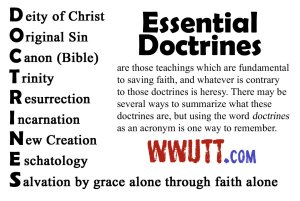
Generally speaking, “essential”, “primary”, or “first tier” doctrines are those which you, biblically, have to believe in order to become a Christian and/or be considered a Christian. For example:

โœข Sin is a thing, and I am a sinner.

โœข God exists and is the supreme authority of the universe.

โœข Jesus was God in human flesh.

โœข Jesus rose bodily from the grave.

See how this works? If you don’t believe you’re a sinner, you’re not saved. If you don’t believe in the bodily resurrection of Christ, you’re not saved. Here’s how our friend, Pastor Gabriel Hughes, briefly outlines essential doctrines:

(Gabe later tweaked the acrostic a little and added an “S”, which I think is helpful.)

The vast majority of brand new Christians have only the most basic understanding of most of these tenets at the moment of salvation. But it’s not an issue of fully understanding – or else we’d all have to be theologians in order to get saved – it’s an issue of believing. Someone who is genuinely regenerated may not completely understand how the Trinity works (honestly, no one does), but when she’s introduced to the biblical idea of the Trinity, she believes it, learns more about it, and does not reject it.

There is typically agreement among most reputable theologians regarding what constitutes first tier doctrine. Scripture is clear about these things, and several of these issues were settled long ago by the church fathers in assorted church councils (Nicea, Chalcedon, etc.)

Secondary issues are routinely defined as non-salvific but still extremely biblically important, if not quite as biblically clear-cut as primary issues. Doctrines surrounding baptism (credo versus paedo, affusion versus immersion), for example, are usually cited as a secondary issue. A disagreement on a secondary issue doesn’t mean one person is saved and another isn’t, but it normally prevents close partnership in ministry activities involving these issues. For example, my Presbyterian friends and I can join together in pro-life ministry, but we would most likely not plant a church together.

Tertiary issues are non-salvific, less immediately urgent, biblical issues in which the Bible is even less clear-cut and open to wider (yet still biblical) interpretation. These are issues over which Christians can disagree and still maintain close doctrinal fellowship, even in the same church, if they’re in agreement on first and second tier doctrine. Eschatology – the order and timing of events at Jesus’ second coming – is a doctrine that’s often considered third tier. Someone can hold a different eschatological view than mine, yet, for the most part, it shouldn’t affect our ability to worship together, work together, or participate in the ordinances together in the same church.

Some theologians add a fourth category – issues of adiaphora, conscience, or Christian liberty. Usually these are issues of much less importance that the Bible either doesn’t specifically address, or doesn’t give commands about one way or the other. Individual Christians may use biblical principles to inform their consciences and decide for themselves. These would be things like whether or not to take your child trick-or-treating or deciding whether to dress formally or casually for church.

While theologians are largely in agreement about primary doctrines, there is wider spread disagreement on which doctrines are secondary and tertiary (many consider eschatology to be a second tier doctrine, for example) and whether or not there is a need for a category of adiaphora, since such issues are normally not considered to be “doctrinal” issues. In fact, there’s enough space for disagreement that pastors and theologians often wisely refrain from making concrete lists of secondary and tertiary doctrines.

But when we’re talking about the different levels of doctrine, what you won’t find is questions like these: Is murder a first, second, or third tier doctrine? What about gossip? Rape? Adultery? Lying? Gluttony? Pride?

And it’s not because these issues aren’t important or because the Bible doesn’t address them. It’s because they’re in a different category from the other issues: the category of sin. They aren’t doctrines upon which salvation hinges, they aren’t open to interpretation, and the Bible is clear that we are absolutely not to do these things.

The category of doctrine deals with beliefs. The category of sin deals with behavior.

In 2005, Dr. Albert Mohler wrote an excellent article about the different levels of doctrine entitled A Call for Theological Triage and Christian Maturity. He carefully explains the importance of each level of doctrine and what it covers in a plea to keep each level’s urgency in its proper place of significance during discussion, debate, and decision-making.

It was a helpful article to which I always refer people who have questions about tiers of doctrine, and I agree with Dr. Mohler’s thoughts in the article wholeheartedly1 …except on one point:

“In recent years, the issue of women serving as pastors has emerged as another second-order issue.”

Women serving as pastors, women preaching, women teaching men Scripture, and women exercising authority over men in the gathering of the Body is not a secondary issue. Nor is it a primary or tertiary issue. It does not belong in the category of “doctrine” in the same way baptism and eschatology do. It belongs in the category of sin in the same way murder, gossip, and adultery do. Let’s take a look at the reasons for this.

Women serving as pastors, preaching, teaching men Scripture, and exercising authority over men in the gathering of the Body is *not* a secondary issue. Nor is it a primary or tertiary issue. It is a sin.

I do not permit a woman to teach or to exercise authority over a man; rather, she is to remain quiet. 1 Timothy 2:12

(The preponderance of Scripture supports and affirms this concept, so to keep things simple, we’ll use this verse as an exemplar.)

โœข The prohibition in 1 Timothy 2:12 is a clear command against a certain behavior. And when we behave in a way God has prohibited, that is called “sin”. All of the tenets in the three levels of doctrine are affirmative statements regarding beliefs (you must believe in the resurrection of Christ, we believe in baptism by immersion, etc.). None of them are commands, in the negative, against sinful behavior (Thou shalt not murder, I do not permit a woman to teach… etc.)

โœข Secondary and tertiary doctrines can be open – to varying degrees – to biblical interpretation. Every stripe of non-heretical eschatological thought can provide you with chapter and verse passages that can, depending on the angle from which you approach the subject, be biblically plausible and scripturally supported. There is no biblical support for anything God prohibits. No one can cite a properly handled, in context Bible verse in which God says, “It’s OK to commit adultery,” or “Women are allowed to preach.” There can be multiple views on a secondary or tertiary issue that can all be considered biblical, but there can only be one view of sin that is biblical.

โœข Differing beliefs on true secondary and tertiary issues are not sin. My Presbyterian friends have a different view of baptism than I do. That doesn’t mean either of us is sinning. I may think their interpretations of the verses they believe support paedo baptism are incorrect, but they are not breaking any of God’s commands. Differing behavior (again, we see the distinction between doctrinal belief and sinful behavior) on issues of sin is sin. If someone behaves differently from God’s command about lying, she is sinning. If a woman behaves differently from God’s command in 1 Timothy 2:12, she is sinning.

โœข Differing beliefs on secondary and tertiary issues are not born of disobedience and rebellion toward God. Usually, it’s quite the opposite. When someone has studied a theological issue enough to hold a particular position on it, it’s usually because she is striving to please God and to be biblical in her beliefs. Differing behavior on issues of sin is born out of disobedience and rebellion toward God. Someone who steals has already decided in her heart that her desires are better than God’s command. A woman who knowingly holds improper authority over men in her church is doing so because she has already decided to defy God’s clear command against such.

โœข Because different beliefs on secondary and tertiary issues are not born of rebellion and are not sin, they do not require church discipline. Sin does require church discipline. If someone in your church is openly dishonoring her parents, she is sinning and should be subject to church discipline. If a woman is pursuing a career as a pastor, she is sinning and should be subject to church discipline. 

Since the publication of Dr. Mohler’s article (and perhaps as a result of others teaching the same thing) the idea of the violation of 1 Timothy 2:12 being a “secondary doctrine” has spread in a most unhelpful way, leading many Christians to treat the issue in a c’est la vie, “We can just agree to disagree on this,” manner.

No, we cannot.

The idea of the violation of 1 Timothy 2:12 being a “secondary doctrine” has spread in a most unhelpful way, leading many Christians to think “We can just agree to disagree on this.”. No, we cannot.

We would not say, “We can agree to disagree,” on lying or adultery or homosexuality or abortion, and we cannot say it about women preaching, teaching men, or holding unbiblical authority, either. We disciple and teach a sister in Christ who is unaware of what the Bible says on these matters, and if she is committing any of these sins, we begin the process of church discipline. But it would not be loving toward her, or honoring God, to allow her to continue in biblical ignorance or in willful sin.

Furthermore, the violation of 1 Timothy 2:12 brings with it dangers to the church that true secondary and tertiary issues, and even many sins, do not…

The violation of 1 Timothy 2:12 brings with it dangers to the church that true secondary and tertiary issues, and even many sins, do notโ€ฆ

She may not say it with her lips, but when a woman preaches to men in defiance of Scripture, sheโ€™s teaching false doctrine through her behavior. What is the false doctrine sheโ€™s teaching? โ€œI donโ€™t have to obey Godโ€™s Word, and neither do you. If thereโ€™s a part of the Bible you donโ€™t like, youโ€™re free to disregard it.โ€ If your pastor stood up in the pulpit on Sunday morning and said that in words, youโ€™d run him out of town on a rail, and rightly so. Neither should a woman be able to teach that same false doctrine via her actions.

Additionally, I have mentioned several times when dealing with this issue that women preaching to men is highly correlated with women teaching other forms of false doctrine. I have researched scores of women teachers. Every single one of them who unrepentantly teaches men also teaches false doctrine in some other aspect of her theology (usually progressivism, Word of Faith, or New Apostolic Reformation). In other words, if a woman teaches men, you can just about take it to the bank that she also teaches additional false doctrine. False doctrine and heresy are infecting the church – via female preachers – at an alarming rate.

We dare not simply “agree to disagree” on this.

The violation of God’s command that women are not to instruct men in the Scriptures nor hold improper authority over men is a sin like any other. It is not a doctrinal issue in the same sense that other second and third tier doctrines are. If left undisciplined, however, it can lead to first tier doctrinal issues infiltrating a church and eventually destroying it. It is detrimental to the church to label and treat any sin as a secondary doctrinal issue.

Additional Resources

Is Women Preaching a Secondary Issue? on A Word Fitly Spoken
What Are Essentials and Non-Essentials? on A Word Fitly Spoken
Christian Liberty on A Word Fitly Spoken
The importance of Primary and Secondary Doctrines on the Truth Be Known Podcast


1In the years since 2018, when this article was originally written, Dr. Mohler has said, done, and supported various biblically questionable things, leading some to question whether or not he has “gone woke”. While I don’t support his stance on those questionable things, I also don’t believe he has reached the point at which I need to warn against him (although I don’t proactively recommend him, either). To my knowledge, at this time, he is still generally doctrinally sound.

Abortion, Gospel

Planned Parenthood: There, But for the Grace of God…

Originally published August 15, 2015

You walk into your doctorโ€™s office for your annual check upโ€”flu shot, cancer, cholesterol and blood sugar screening, blood pressure checkโ€”you know, routine maintenance on the olโ€™ bod. Youโ€™ve chosen this doctor because you donโ€™t have health insurance and heโ€™s kind enough to lower his prices and work with you on a payment plan. His office is clean and bright, beautifully decorated, and the staff is always friendly. You even get a lollipop at the end of each visit.

But this year, as youโ€™re walking down the hall to exam room four, you happen to notice that in exam room three, thereโ€™s a playpen in the corner with an adorable baby girl in it, cooing away and playing with a toy.

โ€œOdd,โ€ you think, since this is not a pediatricianโ€™s office. You continue to your own room, don that scratchy paper gown, and wait for the doctor. By the time he comes in and begins the exam, you can no longer contain your curiosity. Whose baby is it? Why is there even a baby in the office?

โ€œOh, yes,โ€ the doctor says matter of factly, โ€œthat baby was abandoned by her parents. Nobody wants her, so when I get finished with your check up, Iโ€™m going to torture her to death and then sell her organs to medical researchers.โ€

Your jaw hits the floor. Your stomach turns. You canโ€™t believe the monstrous words youโ€™ve just heard.

โ€œHow could you do such a horrible thing?โ€ you scream over your revulsion. The doctor looks surprised that you should ask.

โ€œItโ€™s really no big deal,โ€ he says. โ€œWe only do a few of those a week. The vast majority of my practice is providing health care and counseling for patients like you.โ€

Let me ask you somethingโ€”would you use that doctor and think that the care he provides you mitigates his atrocious behavior? I hope not. Yet I have heard people defend Planned Parenthood (an organization which has been torturing babies to death for decades, and,ย we recently learned, profits from the sale of their organs) because Planned Parenthood ostensibly performs a minimum number of abortions and mainly provides health services, such as the ones mentioned above, to women who need them. Somehow, in these peopleโ€™s minds, the health care Planned Parenthood provides makes up for the heinous murders they commit day after day.

Does it really all balance out? Of course not.

In fact, letโ€™s say, Planned Parenthood had only ever tortured fifty babies to death (instead of the millions theyโ€™ve actually killed). And letโ€™s say they provided free health care to everyone on the planet, cured cancer, and brought about world peace. Those are some wonderful things, but does it erase the fact that they brutally ended fifty innocent lives? Do all those good deeds make up for even one murder?

No. They donโ€™t. Good deeds can never make up for heinous crimes. Planned Parenthoodโ€™s hands are drenched in blood that all the free health care in the world canโ€™t wash away.

Theyโ€™re hopelessly guilty. Just like we are.

Apart from Christ, we are Planned Parenthood. We come before God with blood on our hands. Not the blood of millions of babies, but the blood of one child. Godโ€™s child. Jesus. We are responsible for His death. It was our sin that caused Him to be tortured to death. Our sin that brutally murdered Him.

We come before God with blood on our hands. Not the blood of millions of babies, but the blood of one child. Godโ€™s child. Jesus.

โ€œOh, but itโ€™s no big deal. Iโ€™m mainly a good person. The vast majority of my life is spent doing good things and helping people. That totally makes up for those few sins Iโ€™ve committed. My good deeds outweigh the bad.โ€

No. They donโ€™t. Good deeds can never make up for heinous crimes.

But, graceโ€ฆ But, mercyโ€ฆ But the goodness and loving kindness of God our Savior intervenes and wipes away the guilt. Washes our hands of Christโ€™s blood. Cleanses us from all unrighteousness, if we only turn to Him in the repentance and faith that He is gracious enough to give us.

Good deeds can never make up for heinous crimes, but the grace of God can.

But when the goodness and loving kindness of God our Savior appeared, he saved us, not because of works done by us in righteousness, but according to his own mercy, by the washing of regeneration and renewal of the Holy Spirit, whom he poured out on us richly through Jesus Christ our Savior, so that being justified by his grace we might become heirs according to the hope of eternal life.

Titus 3:4-7

Good deeds can never make up for heinous crimes, but the grace of God can.

Relationships, Sanctification

Throwback Thursday ~ In Defense of Offense: Why Christians Need to Stop Worrying About Offending People

Originally published January 18, 2019

“You’re a liar,” he said dryly, the passion in his eyes gleaming through.

“What?!?! HOW DARE YOU call me a liar!” his fellow church member fumed.

“You’re a liar, Joe. You show up at church for an hour a week and claim to be a Christian, yet you’ve been living with your girlfriend for over a year, you’ve told me you use pornography, and I’ve talked to five different people with incontrovertible evidence that you’ve cheated in your business dealings with them. When you say you’re a Christian, you’re lying. Just admit it.”

Have you ever had a conversation like this with someone? Have you ever witnessed a conversation like this?

Most of us would never dream of calling someone a liar who claims to be a Christian yet walks in disobedience to Christ. Goodness, no! It might offend the person or cause her to question her salvation! She might leave the church or walk away from the faith!

You know who wouldn’t be afraid of offending such a person or causing her to doubt her salvation? Someone who would dream of calling a professed Christian walking in disobedience a liar?

The Holy Spirit – via the Apostle John – that’s who.

Whoever says โ€œI know [Jesus]โ€ but does not keep his commandments is a liar, and the truth is not in him, but whoever keeps his word, in him truly the love of God is perfected. By this we may know that we are in him: whoever says he abides in him ought to walk in the same way in which [Jesus] walked.

1 John 2:4-6

Take a moment and let that really sink in. People who claim to be Christians yet habitually and unrepentantly make a practice of sinning are not saved.

People who claim to be Christians yet habitually and unrepentantly make a practice of sinning are not saved.

To the Holy Spirit and John that’s as plain and simple and uncontroversial as saying, “The sky is blue, and water’s wet.” But to a false convert, them’s fightin’ words.

And we know it.

So we refrain from lovingly speaking hard, biblical truths to people who need to hear them, usually for one of a handful of reasons:

โ€ข We don’t want this person’s wrath aimed at us because it’s a hassle or because we don’t want to lose the relationship with her.

โ€ข We don’t actually believe the Bible and trust God’s sovereignty. We’d rather lean on our own understanding, desperately clinging to the irrational hope that this person is truly a Christian who’s hanging by a thread, and we don’t want to be the one responsible for saying anything that might clip that thread.

โ€ข We’re worried about how we’ll look to others and that they’ll accuse us of being unloving, unchristlike, and harming the unity of the church.

What do those reasons have in common?

Me. Me me me me me me me.

I want to keep my relationship with this person in tact. I don’t want others to blame me for this person’s reaction to biblical truth or call me unloving or divisive. I don’t want to deal with the aggravation of this person’s emotional blow up.

It’s not exactly the greater love of laying down one’s life for a friend, is it? We’re not even willing to lay down our comfort or our reputation in order to tell someone her walk doesn’t match her talk and call her to repentance. Is that love at all, or is it just plain, old fashioned selfishness? We bow and scrape at the idol of not hurting other people’s feelings while those people careen down the road paved with our good intentions straight toward the gates of Hell. How is that love? 

We bow and scrape at the idol of not hurting other people’s feelings while those people careen down the road paved with our good intentions straight toward the gates of Hell. How is that love?

Love is valuing, and acting on, what is best for another person over and above our own self interests. You know, kind of like Jesus did during His life, death, and resurrection:

By this we know love, that he laid down his life for us, and we ought to lay down our lives for the brothers.

1 John 3:16

You know, it’s interesting that the Holy Spirit speaks a lot of hard, “you’re not saved if…” truths in a book (1 John) whose purpose is to give true Christians assurance of their salvation. The Third Person of the Trinity – the embodiment of perfect love – doesn’t seem to think it’s unloving to tell false converts they aren’t saved, while at the same time reassuring young, shaky-kneed saints.

But us? We can’t seem to get our act together and do both from a heart of love the way the Holy Spirit does.

Weโ€™ve focused so much attention on reassuring anyone who claims the label “Christian” of their eternal security that weโ€™ve lost sight of the fact that there are a great many false converts in our midst who should be questioning their salvation. The gate is wide that leads to destruction, Jesus said. It is the narrow gate that leads to life, and few are those who find it. Test yourself to see if you’re in the faith. How will they know these things if we don’t tell them?

The Bible has hard, sharp edges. It’s a sword, for crying out loud, not a feather duster. The primary purpose of a sword is to cut.

The gospel divides. Jesus – the creator of Christian unity – said, “I have not come to bring peace, but a sword. For I have come to set a man against his father, and a daughter against her mother, and a daughter-in-law against her mother-in-law.” Jesus – perfectly kind, perfectly loving Jesus – called those claiming to be God’s people yet walking in disobedience hypocrites, vipers, and sons of the Devil. Jesus – the Jesus who was more compassionately evangelistic than we could ever hope to be – didn’t beg, plead, or hand-wringingly water down Kingdom requirements so the rich young ruler would keep a toe in the door of God’s house. Jesus held high the standard of the gospel and let him walk away. Jesus wasn’t a nerdy little wimp offering people a cheap plastic heavenly trinket if they would only be His friend. This almighty King demanded perfection, the highest love, loyalty unto death. And, by the way, you’d better count the cost before deciding to follow Him. Jesus wasn’t worried about offending people with biblical truth.

We need to stop worrying that the Bible is going to offend people who need to be offended by its demands, requirements, and judgments so that they might repent and be reconciled to Christ. Whether it’s a sinner in need of a Savior or a saint in need of sanctification, the ministry of reconciliation Christ has called us to begins with confronting sin.

We need to stop worrying that the Bible is going to offend people who *need* to be offended by its demands, requirements, and judgments so that they might repent and be reconciled to Christ.

Every person we would potentially approach with biblical truth is either saved or lost.

If a person is genuinely one of Christ’s sheep, she will hear the voice of her Shepherd calling to her from the truths of His Word, turn from her sin, and follow Him. It may take time. It may take help. It may take teaching and many tears. But sheep love the Shepherd and follow Him. They grow toward Him, not away from Him.

If a person is lost, she isn’t going to get any “loster” when you biblically call her to repentance. Lost is lost, even if that lost person claims to be, or thinks she is, a Christian. There’s no such thing as a genuinely regenerated Christian who’s just barely hanging on to Jesus by her fingernails and you come along and push her out of the faith by confronting her sin with biblical truth. Uh uh. If she abandons Christ in favor of her sin, she was never saved in the first place, I don’t care what she claims to the contrary.

If a person is lost, she isn’t going to get any “loster” when you biblically call her to repentance.

All of this nonsense floating around these days about “de-converting” from Christianity, or “I used to be a real, genuine, bona fide Christian, but I’m not anymore.” Hogwash and poppycock. The Bible says if you leave the body of Christ, you were never a member of it to begin with. That God is greater than all (including you) and no one (not even yourself) is able to snatch you out of His hand if you belong to Him. That those who are saved will endure to the end. That Jesus will not lose a single one of those the Father has entrusted to Him. Dare we believe the words of sinners about themselves over what the Word of God says about them? No matter what you say or do, you don’t have the power to be responsible for someone leaving the faith. Whatever circumstance or person they might use as a scapegoat, people “leave” Christianity because they don’t know or love Christ and they’ve gotten tired of pretending like they do.

The people we love enough to lovingly, yet firmly, speak hard biblical truths to are either Christians who will come to love and embrace those truths (and love us for caring enough to speak them), or theyโ€™re lost or false converts who need to be confronted with the mirror of God’s Word so they can face up to the fact that theyโ€™re lost. Where the Bible speaks plainly and definitively, we must not be ashamed of the gospel and shrink from speaking plainly and definitively in agreement with it.

Stop being afraid of offending people by speaking hard, biblical truths. Sometimes the most loving thing you can do for someone is offend her.

Stop being afraid of offending people by speaking hard, biblical truths. Sometimes the most loving thing you can do for someone is offend her.