Complementarianism, Movies, Southern Baptist/SBC

Movie Time: Battle for the Minds

Originally published May 21, 2019

Ladies- have you read my Mailbag article, Counter Arguments to Egalitarianism? If not, I would encourage you to read it before watching today’s movie. And if you’re new to the complementarian vs. egalitarian kerfuffle, I would encourage you to read, not only that article, but all of the articles in the “Additional Resources” section of that article as well.

Why?

Because today’sย movie, Battle for the Minds, approaches the issue from the egalitarian perspective, and you need to be sure you’re firmly grounded in the biblical perspective so that “no one takes you captive by philosophy and empty deceit, according to human tradition, according to the elemental spirits of the world, and not according to Christ.”

Also, today’s movie is kind of like a homework assignment. How would you apply the complementarian apologetics you learned in the Mailbag article as well as your knowledge of Scripture to the egalitarian arguments and pronouncements being made in this movie?

Battle for the Minds was released on PBS in 1997. It presents the egalitarian viewpoint on the stage of Southern Baptist Theological Seminary’s transition from theological liberalism to biblical theological conservatism under the then-new leadership of Dr. Albert Mohler, and delves into a bit of the Conservative Resurgence in the Southern Baptist Convention around that time as well. (As an aside, I am not familiar with any of the people in the film presented as being on the egalitarian side except for Anne Graham Lotz. I’m only familiar with a few of those on the complementarian side: Albert Mohler, David Miller, and Paige Patterson.)

If you are Southern Baptist, I strongly encourage you to watch and carefully consider these events from our history in light of the battle we are now facing in the SBC concerning the role of women in the church and in the Convention. Because what Nancy Ammerman says at the 37:04 mark is correct. Since all SBC churches are autonomous, many Southern Baptists only concern themselves with their own churches and don’t trouble themselves to worry about what’s going on at the national level. But when you do this, you fail to take into consideration that what’s going on at the national level trickles down to your local church in the form of what’s being taught to your next pastor or staff member at our seminaries; the authors, musicians, and other content creators being sold (and not being sold) at LifeWay; the theology in the Sunday School and VBS curriculum your church uses, etc. It also affects the theology and ecclesiology our IMB and NAMB missionaries and church planters use and teach. And finally, the leadership and issues at the national level are the face the Southern Baptist Convention presents to the world.

But even if you’re not Southern Baptist, you will probably still find this movie informative to the way your own church or denomination is responding to the issue of the biblical role of women in the church.

A couple of things to be on the lookout for, and give consideration to, as you watch Battle for the Minds:

โ€ขNotice the amount of Scripture presented in the movie. Is any Scripture presented that backs up the egalitarian view? Is egalitarianism vs. complementarianism presented as a biblical and spiritual issue or an “our position vs. their position” issue?

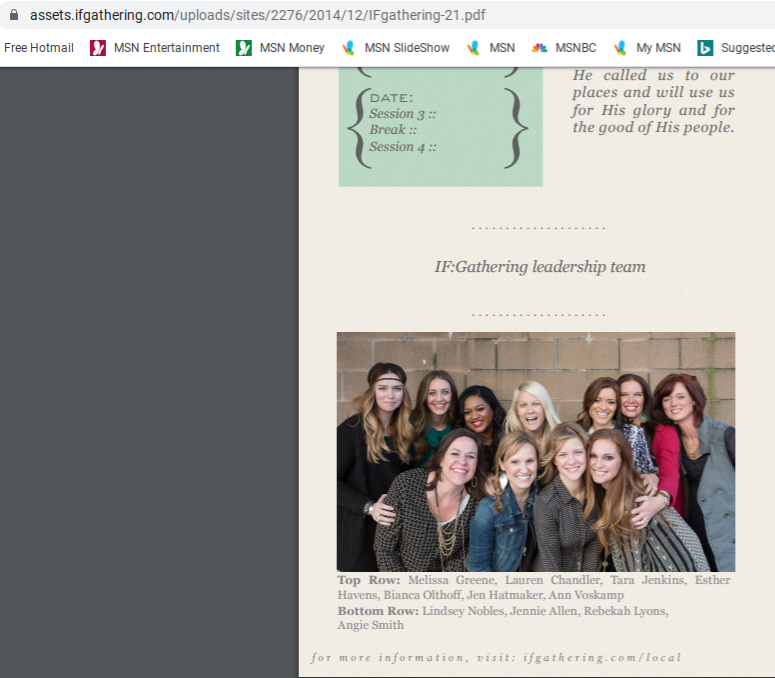
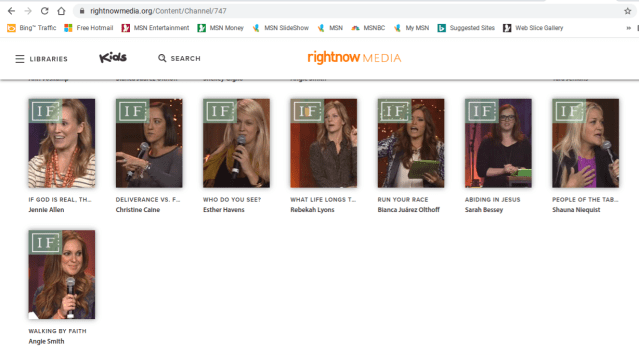
โ€ขNote the sex of each person on the egalitarian side and the sex of each person on the complementarian side. Are any complementarian women presented? Do you think there were absolutely no women on the complementarian side of the issue when these events were transpiring? Do you see how the exclusion of complementarian women in this film gives the subtle illusion that a) all women are egalitarian, and b) the reason men are complementarian is because they’re sexist and trying to protect their power and position – the same argument people like Beth Moore are attempting to make today?* Do you think it was sexist to exclude women from the complementarian side?

*(Screenshot 1, 2)

Christian women, Complementarianism, Holidays (Other)

The Mother of All Rebellions: Having a Woman Preach on Mother’s Day

Originally published May 10, 2019

When you gaze out across the landscape of the visible church through an earthly, superficial lens, you’ve got to scratch your head and wonder, “Has evangelicalism lost its ever-lovin’ mind?”.

And the answer is to take off those inch-deep dollar store glasses, fire up the electron microscope of Scripture, look long and deep into God’s Word, and reply to yourself, “Of course it has, silly rabbit. What did you expect?”. The Bible is perfectly clear about these things and why they happen.

Exhibit A: The trend in recent years to invite a woman to preach the Sunday morning sermon in church, to the whole congregation (including men) just because it’s Mother’s Day. Not a brief personal testimony,ย the sermon. This isn’t anything brand new. Lisa Harper has done it at Max Lucado’s church. Christine Caine has done it.ย Lisa Bevere has done it. Lysa TerKeurst has done it. Priscilla Shirer has done it. And a host of other famous and unfamous women at famous and unfamous churches have been doing it for years, even at churches that normally obey Scripture and don’t let women preach.

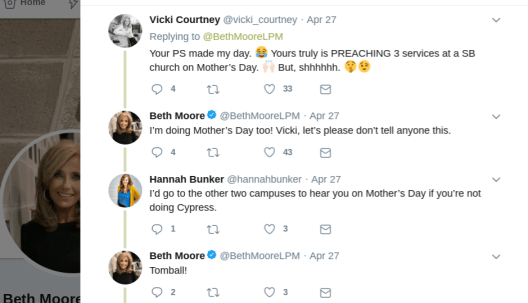
This year (2019), Beth Moore has caused quite the stir by hiding in plain sight the fact that she will be preaching the sermondoing Mother’s Day” this coming Sunday, presumably at the Tomball, Texas, campus of the church she attends (founded and pastored by her son-in-law Curtis Jones1) Bayou City Fellowship:

I say “hiding in plain sight” because she has given enough of an impression here that she is preaching the sermon to test the waters and see what the reaction will be, but has worded her tweet vaguely enough that if she meets too much resistance she can still decide to back out of preaching, give a brief word of biblically appropriate Mother’s Day greeting or encouragement to the ladies at another point during the service, and come back and claim with wide-eyed innocence that that’s what she meant all along by saying she was “doing” Mother’s Day. (Someone asked Beth point blank, in a subsequent tweet if Beth’s tweet meant that she would be preaching the Sunday service and Beth did not answer her. If she’s not, why not just say so? And if she is and isn’t ashamed of it, why not just say so?)

I say “presumably” at BCF-Tomball because, even though she publicizes specific details about time and place with other speaking engagements, she has not mentioned (at least not anywhere I can find as of the time I’m writing this) the specific church she’s preaching at on Sunday, and the church hasn’t mentioned on their website that she’ll be the guest preacher. Additionally, unlike other speaking engagements Beth does, this speaking engagement is not listed on the calendar of events at her website and she hasn’t mentioned it (other than the tweet above) on social media. With all this “open secrecy” I will be surprised if the video or audio of her sermon is posted on YouTube and/or the church website.

Why all this cloak and dagger about the highest profile woman in the Southern Baptist Convention2, possibly in the entirety of evangelicalism, preaching the Mother’s Day sermon?

Because she knows it’s unbiblical. Because we know it’s unbiblical. And it doesn’t take an electron microscope to see it. It’s right there, in black and white, jumping off the pages of Scripture:

I do not permit a woman to teach or to exercise authority over a man; rather, she is to remain quiet. 1 Timothy 2:12

It couldn’t be more clear. And for pastors who ought to know better to either fall prey to or intentionally perpetuate the serpentine seduction of “Did God really say you can’t preach?”, using Mother’s Day as an excuse to induce a woman to sin by having her deliver the sermon is a slap in the face – to God, to the church, and to women.

Using Mother’s Day as an excuse to induce a woman to sin by having her deliver the sermon is a slap in the face – to God, to the church, and to women.

What do his actions say to God? “I don’t like Your way and I won’t submit to it. I don’t trust that Your way is right regardless of what the world says. I’ll do what’s right in my own eyes.” It’s the lesson his church learns from his actions as well.

But why is inviting a woman to preach an affront to Christian women? Take a stroll down to verse 15 of 1 Timothy 2:

Yet she will be saved through childbearingโ€”if they continue in faith and love and holiness, with self-control.

Not only does the pastor who invites a woman to preach adulterate the role God has set aside specifically for men, he also denigrates one of the good and holy roles God has specifically and intentionally set aside for women: the role of literal, and spiritual, mother.

Eve shattered God’s perfect, unique design for women by allowing herself to be seduced into rebellion. But are we daughters of Eve forever doomed to bear the shame and guilt of her sin, never to have a role in building the Kingdom? Pariahs, to be shunned and shut out of God’s plan? No, praise God! Through the cross, the good works Christ has ordained for Christian women to do – including mothering our own children and being spiritual mothers to our daughters in the faith – redeem the prestige of women. Mothering, in every sense in which God intended it, raises the role of women back to its rightful place in God’s plan.

And we don’t need men – especially men who are supposed to be rightly leading God’s people – to come along and entice us to mess that all up again.

But that’s exactly what’s happening.

When a pastor invites a woman to sin by taking over the pulpit, he drags her and the women of his church right back to post-Fall Eden. He trashes the rank and repute of our God-given high and holy role of mother and implicitly says Being a woman isn’t good enough. You have to steal the role of men to be valued and esteemed. 

When a pastor invites a woman to sin by taking over the pulpit, he implicitly says, “Being a woman isn’t good enough. You have to steal the role of men to be valued and esteemed.”

Ladies, he’s wrong.

We don’t need to be second rate imitations of men in order to “count”. We need to be first rate, full throttle, take it to the limit women of God. God loves us and values us so much more than to give men a special and amazing role and leave us without an equally special and amazing, yet totally distinct, role. The God who spoke the universe into existence and planned out an unparalleled purpose for every single plant, animal, bacterium, and every other atom of the cosmos, did not leave the queen of His creation roleless. He did not bring us into being only to toddle along after the Hairy Ones trying to copy their every move. How unloving of God, and devaluing to women, would that be? Why would you want to act like a man when God blessed you with the gift of being a woman?

If, by God’s good Providence, you’ve “stumbled across” this article and you’re a woman who has been invited to preach, I plead with you: don’t buy the lie. Say no. Your Savior has a whole treasure chest of good works for you to do as a woman. You are worth infinitely more to Him as the woman He created you to be than you are to the world, or a worldly church, as a cheap knock-off of a man.

The practice of denigrating women, devaluing our God-given role, disobeying God, and darkening the understanding of the church by inviting women to sinfully take the pulpit must stop in the house of God.

Let us be the mothers our own children need, raising up a godly seed unto the Lord. Let us be the spiritual mothers longed for by younger women in the faith, daughters orphaned by Christian women who have abandoned them to take on the role of men. The practice of denigrating women, devaluing our God-given role, disobeying God, and darkening the understanding of the church by inviting women to sinfully take the pulpit must stop in the house of God and be replaced by strong godly women, unafraid and unashamed to flourish in the precious role our Lord has blessed us with.

Especially on Mother’s Day.


Updates to this article:

1Curtis Jones (Beth Moore’s son-in-law) resigned his pastorate at BCF in July 2020.

2Beth Moore has left the Southern Baptist Convention and is now attending an Anglican church where – surprise, surprise – she preaches from time to time.


Additional Resources:

Beth Moore vs. Owen Strahan on WWUTT Podcast
(Related links):
โ€ขMichelle Lesley’s Twitter thread on Beth’s Sunday sermon preaching
โ€ขBeth Moore’s Twitter response to Midwestern Seminary professor Owen
Strahan’s article on biblical complementarianism

โ€ขDivine Order in a Chaotic Age: On Women Preaching by Owen Strahan

Why Asking Women to Preach Is Spiritual Abuse by Josh Buice

Complementarianism

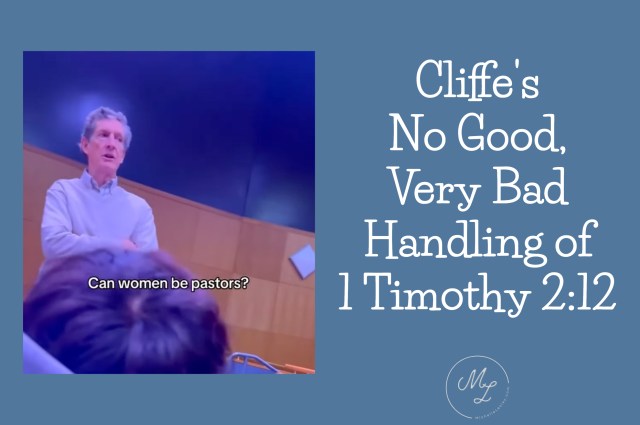
Cliffe’s No Good, Very Bad Handling of 1 Timothy 2:12

I had no idea who “Cliffe” in this video is, until I reposted it on X (thanks to Jon Root for the original) with my comments, and followers informed me that this is Cliffe Knechtle, who (along with his son, Stuart) seems to be an open air apologist with a large following on YouTube.

I’m hoping Cliffe just had a no good, very bad day on the day this was recorded and that he goes back, examines the pertinent texts more carefully (and in context), repents, and publicly corrects his errors.

Because, for someone who – I’ve been told – is a respected apologist, this is embarrassingly bad, not to mention, deceptive, even if he didn’t mean it to be.

Let this be an example of how to critically evaluate teaching according to Scripture. And, in case any of your friends and loved ones hold some of these same errant beliefs, here’s how you can help them see the truth of Scripture.

So, ladies, let this be an example to you of how to critically evaluate teaching according to Scripture. And, in case any of your friends and loved ones follow Cliffe or hold some of these same errant beliefs, let me offer a biblical corrective you can use to help them see the truth of Scripture. Open your Bible and follow along with the video. Cliffe’s words below are in bold. (I’ve also interspersed some additional helpful resources.)

“Paul writes that women are not to be pastors.”

No, “God writes…”. Paul penned it, but 1 Timothy 2:11-3:7 is God’s Word. God’s idea, not Paul’s. Paul wrote down what the Holy Spirit breathed out.

Now I’m guessing Cliffe would probably agree with me about that, and I, myself, use that kind of phraseology sometimes, too, but it’s important to remind ourselves – especially with passages of Scripture that broken, sinful human beings have made controversial, like this one – that this is God speaking, not Paul, the sinful human being dreaming this up and imposing it on the church.

“I don’t think that’s a fair translation.”

Then how come every single trustworthy translation of the Bible (and even a lot of the untrustworthy ones) translate it that way? Is Cliffe an expert in the biblical languages and knows better than all the expert Bible translation teams who translated it the way he disagrees with?

Furthermore, although it’s a true summary of what he did write, Paul didn’t write, “Women are not to be pastors.” It’s important to rightly handle and accurately quote the actual text when you’re teaching a biblical concept.

It’s important to rightly handle and accurately quote the actual text when you’re teaching a biblical concept.

“He does write, ‘I do not permit a woman to have authority over a man.'”

No, He (God) writes, “I do not allow a woman to TEACH OR exercise authority over a man…”. Again, it’s important to rightly handle and accurately quote the actual text when you’re teaching a biblical concept.

It’s also important to incorporate the entire body of text that applies to the issue you’re dealing with. In this case, that would be not just 1 Timothy 2:12, but 1 Timothy 2:11-3:7 and Titus 1:5-9. The pastoral qualifications in 1 Timothy 3 and Titus 1 are also crystal clear (“Husband of one wife,” and male pronouns throughout, anyone?) that pastors must be men.

“And yet Paul had a partner in ministry named Priscilla…”

Not in the sense that she was a pastor or taught or exercised authority over men in the gathering of the body, or he would have been the biggest hypocrite in the Bible, because that would have violated God’s breathed out Word – which Paul wrote – in 1 Timothy and Titus. Scripture nowhere characterizes Priscilla as a pastor or any sort of egalitarian “partner in ministry” to Paul that in any way violated clear, New Testament, didactic passages on the role of women in the church.

“…who taught the great preacher Apollos.”

Read the actual passage in Acts 18:24-28. It’s not like she was his seminary professor and she trained him for the pastorate. She and Aquila heard him preach an incomplete gospel and pulled him aside privately and corrected him. Once. Briefly. We have no idea how much of the correcting Priscilla herself did, but even if she did all of it, this does not violate 1 Timothy 2:11-3:7 because that passage prohibits women from pastoring, teaching, and exercising authority over men in the gathering of the Body.

In the Acts 18 passage, Priscilla was not a pastor, nor was she teaching or exercising authority in the gathering of the Body. This was a private meeting, possibly even led by her husband.

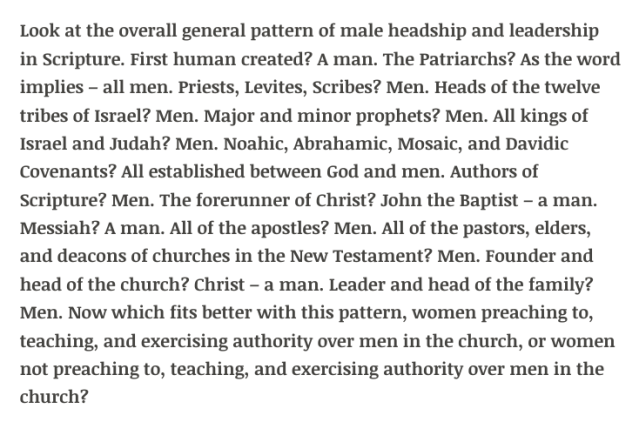
There isn’t a woman in Scripture whose actions prove that it’s biblically OK for women to pastor, preach to, or exercise authority over men in the church. Not a single one. Check out:
Oh No, She Di-int! Priscilla Didn’t Preach, Deborah Didn’t Dominate,
and Esthers Wasn’t an Egalitarian.

“So what on earth is he saying when he says, ‘I don’t allow a woman to have authority over a man’? I would argue…that he’s pointing out that in Ephesus… there was a goddess, Diana of the Ephesians, so there was massive confusion about sexual roles…”

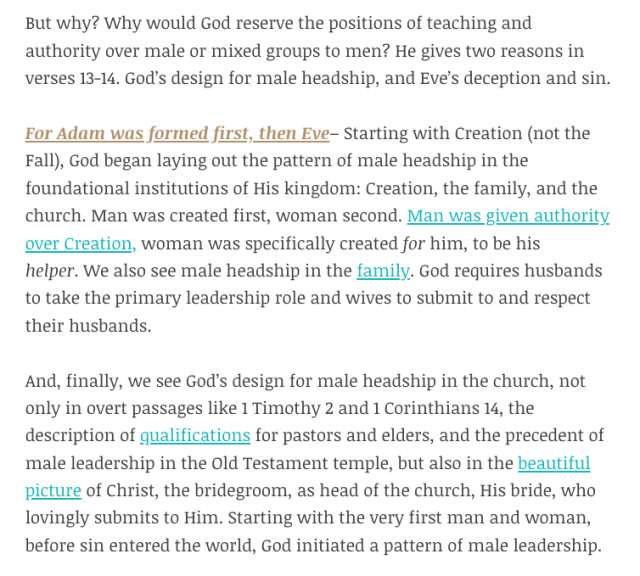
Why would you argue that, brother? God plainly tells us His reason for prohibiting women from pastoring, teaching, or exercising authority over men in verse 12. It’s right there in verses 13-14…

For it was Adam who was first formed, and then Eve. And it was not Adam who was deceived, but the woman being deceived, fell into trespass.

1 Timothy 2:13-14

…and it has nothing to do with Ephesus, Diana, confusion about sexual roles, women abusing their freedom in Christ, or education (which he mentions later in the video). God clearly and unequivocally tells us His reasons for this command: the Creative order and the woman’s deception.

And when you replace God’s reasons in verses 13-14 with any other reason or explanation, you’re calling God a liar. You’re saying His reasons are wrong and yours are right. That you know better than God. That is a very dangerous and blasphemous statement to make.

What then? If some did not believe, does their unbelief abolish the faithfulness of God? May it never be! Rather, let God be true and every man a liar, as it is written,
โ€œThat You may be justified in Your words,
And overcome when You are judged.โ€

Romans 3:3-4

What does 1 Timothy 2:12 actually teach? Check out: Jill in the Pulpit?

“That’s [massive confusion about sexual roles due to the goddess, Diana of the Ephesians,]…” why he says in 1 Corinthians 11 and 14, he says, ‘I don’t allow a woman to teach a man’.”

That’s not what 1 Corinthians 11 and 14 say, that’s what 1 Timothy 2:12 says. First Corinthians 11:1-16 is about male headship and authority. It makes no mention of women teaching men. First Corinthians 14:26-40 is about keeping order in the worship service. It makes no mention of women teaching men.

Furthermore, while God may have, indirectly, been addressing some sort of “confusion about sexual roles” in 1 Corinthians 11 and 14, this sexual confusion had nothing to do with the “goddess, Diana of the Ephesians” because this is in Corinth, not Ephesus.

And again, 1 Timothy 2:12 is the verse that prohibits women from teaching men, and the reason for this prohibition is not “massive confusion about sexual roles due to the goddess, Diana of the Ephesians,” the reason is the Creative order and the woman’s deception, as verses 13-14 clearly tell us.

This kind of confusion and conflation is what happens when you depend on your memory instead of opening the Bible and reading the text, especially if it’s a passage you haven’t dealt with recently. (Trust me. I know. I’ve done it myself.)

“Some very strong Christians, whom I respect highly, disagree with me.”

That’s because what you’re saying is a completely unbiblical mangling of the text. Anyone with third grade reading comprehension skills should disagree with you.

“Paul had partners, who were women, in ministry.”

No he didn’t. Not in the egalitarian sense he’s trying to make these kids believe. (See above about Priscilla.) And if he’s referring to women besides Priscilla, there’s even less information about them in Scripture, so any pronouncement that these other women were pastors or egalitarian “partners” is not only pure conjecture, but also eisegesis of the highest order.

“If God gives a woman gifts, we’re to give women the opportunity to use those gifts.”

Certainly, within the parameters of Scripture. God, the giver of all gifts, has every right to place restrictions on how we may use those gifts. God has never gifted a woman to teach with the intent that she should use that gift to teach men in the church because that contradicts His written Word. If He did that, He would be a liar and a hypocrite and He would cease to be God. There are plenty of ways women can use the gifts of teaching and exhortation without violating God’s commands about the role of women in the church. Ask me how I know.๐Ÿ™‚

My favorite apologetic responses to egalitarians?
The Mailbag: Counter Arguments to Egalitarianism

In fairness, we can’t see most of the audience, but notice that, of the audience members we can see, no one seems to have a Bible in his or her hands in order to be a good Berean and check out what Cliffe is saying against Scripture. And it doesn’t look like anyone is raising a hand to ask him any questions, either. (Hopefully, those things happened after the end of the video.)

Don’t just believe what you’re told. Go to God’s Word, be a good Berean, and check it out. And help your friends and loved ones to do likewise.

Don’t just believe what you’re told. Go to God’s Word, be a good Berean, and check it out. And help your friends and loved ones to do likewise.

Complementarianism, Mailbag

The Mailbag: Women teaching men- Questions from a young reader

Originally published March 14, 2022

I received this very astute line of questioning from a young lady who left a comment on one of my articles. The comment and questions were rather lengthy, so I’ve broken it up into portions in order to answer it in an organized way. If you need to read the entire comment, uninterrupted, for context or ease of understanding, scroll down, reading only the portions in bold.


Hi! Just to let you know, though it may seem, I have no intention of being rude in this question, and genuinely want to know your response to this. I am only in 9th grade, so I have a lot to learn, and want to know what you think about my comment...Thank you, and I am very curious to find out what you think about my questions and things that I might have misunderstood or missed.

That’s awesome! I wish I had been thinking as deeply about these things as you are when I was in the ninth grade. And, rest assured, your questions didn’t seem rude to me at all. I’m so glad you want to learn! I hope you’ll understand that my answers aren’t meant to be rude either, although they may not be quite what you’re expecting or wanting to hear.

You didn’t mention whether or not you’re a Christian or what your church background, if any, is, so let me just start off by saying, if you’ve never been genuinely born again, my answers might not make much sense. I would encourage you, even if you’re pretty sure you’re saved, to examine the materials at the What must I do to be saved? tab in the blue menu bar at the top of this page before moving ahead.

I was just wondering, if women are not allowed to teach men, and you are a woman and this blog is public to men and women, then arenโ€™t you technically providing biblical insight and evangelizing to whatever gender is reading this to inform them of the Bible?

Nope. I’ve answered that question in detail in my article Are Female Bloggers Violating Scripture by โ€œTeachingโ€ Men?

Additionally, “evangelism” and “teaching” (“providing insight” isn’t really a biblical category) are two different, separate things. You might find our podcast episode Women Preaching the Gospel? helpful for understanding the distinction.

Also, the book of Timothy, like you said, was a letter written from Paul to Timothy, so this was just the teachings that Paul gave to Timothy as instructions for the churches, and not necessarily coming from God.

I’m afraid that’s one of the things you’ve misunderstood. This wasn’t just a letter from one human being to another. The words in 1 Timothy, just like every word of every book of the Bible are from the very lips of God Himself. Second Timothy 3:16 tells us that “All Scripture is breathed out by God.” There aren’t some parts of Scripture that are from God and others that aren’t. It all comes from God, from Genesis 1:1 to Revelation 22:21.

First and second Timothy and Titus are what we call the pastoral epistles (“epistle” means “letter”). That means they are God’s instructions, written through His human instrument, Paul, to Timothy and Titus and every pastor who came after them, about how to run the church.

I know Paul was a prophet and one argument could be that he got this information from God,

No, Paul was not a prophet, he was an apostle. And, as I discussed above, the Bible says that all Scripture is breathed out by God, so “Paul got his information from God” is the only argument that can be made, especially for Christians. Because, for Christians, the Bible is our authority on what to believe, not human arguments, opinions, and ideas.

but even prophets (besides Christ) make mistakes in their instructions to others,

I’m afraid that’s also incorrect. There’s not a single prophet in the Bible who, when speaking as a prophet to people on God’s behalf ever made one iota of a mistake about what He said. There were false prophets (who received the death penalty for saying they spoke for God when God had not really spoken to them), but none of God’s true prophets – like Isaiah, Jeremiah, Micah, Habakkuk, etc. – ever got anything wrong or “made mistakes in their instructions to others” when speaking on behalf of God.

such as Abraham, who instructed people to be stoned for certain sins,

I think you mean “Moses” here. Abraham wasn’t a prophet, and I don’t recall any instance in Scripture in which Abraham “instructed people to be stoned for certain sins”. Moses didn’t either. God did. God gave Moses the law on Mt. Sinai, and Moses wrote it down and taught it to the people.

and you can see that it was unlawful in Godโ€™s eyes

I’m sorry, but that’s incorrect as well. Since God is the One who gave the laws about stoning people for certain sins, He would never have said that someone properly obeying His law was doing something unlawful. That would be like God saying He was wrong when He made that law. And, of course we know that God is never wrong.

and you can see that it was unlawful in Godโ€™s eyes when Jesus told the priests about to stone Mary of Magdala that they should not stone her because they have sinned as well and God sees all sins as the same.

I think you’re talking about the story of the adulterous woman in Luke 7-8, right? Again, I’m sorry, but there are many things that need to be corrected here:

  • Stoning a woman caught in adultery was not “unlawful in God’s eyes”. It was lawful. God is the one who gave this law. The scribes and Pharisees correctly cited the law in 8:5.
  • Jesus wasn’t speaking to the priests, He was speaking to the scribes – experts in the law (which was an important point of this passage) – and Pharisees.
  • The text does not say the unnamed woman was Mary Magdalene.
  • Look carefully at the passage. In which verse does Jesus say “they should not stone her”? Answer: He didn’t say, “Don’t stone her.”. On the contrary, He said that they could commence with the stoning as long as whichever one of them was without sin cast the first stone.
  • He also didn’t say they couldn’t stone her because “they have sinned as well”. Every lawful stoning that has ever taken place on planet earth was carried out by sinners, because (except for Jesus) every human being is a sinner.
  • The Bible doesn’t say that God “sees all sins as the same” (In fact, we can see in the way that God deals with various sins in various ways throughout Scripture that this isn’t true.), so Jesus would never have said this nor given it as a reason that these men should not have stoned this woman.

Jesus didn’t say the law against stoning an adulteress was wrong. That would have been equal to saying God was wrong for giving that law. He didn’t tell the men not to obey the law, either. The key to understanding this story is in verses 4-7:

4 they said to him, โ€œTeacher, this woman has been caught in the act of adultery. 5 Now in the Law, Moses commanded us to stone such women. So what do you say?โ€ 6 This they said to test him, that they might have some charge to bring against him. Jesus bent down and wrote with his finger on the ground. 7 And as they continued to ask him, he stood up and said to them, โ€œLet him who is without sin among you be the first to throw a stone at her.โ€

They didn’t care about this woman or what happened to her. They didn’t care about the man who was sinning right along with her. They didn’t care that this sin wrecked the man’s and woman’s lives. They didn’t care that God’s law had been broken. They didn’t care that adultery grieves the heart of God. They didn’t care.

All of those things were just a means to an end for them. All they cared about was trying to get the advantage over Jesus. To trick Him into saying something they could use against Him so they could discredit Him or bring Him up on charges with the Sanhedrin (Jewish court). And they were using God’s precious and holy Word as a tool to accomplish this evil goal. They were blasphemously using God’s own Word against Him.

That is the entire point of this story. God’s Word is His representation of Himself to us. It is our lifeline to Him, because it is how we come to know Christ as Savior. It should be revered as high and holy, not twisted and abused for wicked purposes.

This is just one example of many things that Godโ€™s prophets have taught wrongly.

No, none of the things you’ve mentioned, nor the corrections I’ve given, have demonstrated that any true prophet of God has ever taught anything wrong when it comes to prophecy or commands of Scripture. Second Peter 1:20-21 tells us:

…knowing this first of all, that no prophecy of Scripture comes from someone’s own interpretation. For no prophecy was ever produced by the will of man, but men spoke from God as they were carried along by the Holy Spirit.

So, since times were different in the first century and women were not seen as important to men, couldnโ€™t this have been something Paul told Timothy to do based off of his own understandings culturally?

No. Again, 1 Timothy is a passage of God-breathed Scripture, not Paul’s personal human opinion. It was not based on Paul’s human understanding (see 2 Peter 1:20-21, above), culturally, or in any other way. This is God’s command to pastors, based solely on God’s reasons.

And God kindly shares those reasons with us in verses 13 and 14 of 1 Timothy 2:

11Let a woman learn quietly with all submissiveness. 12 I do not permit a woman to teach or to exercise authority over a man; rather, she is to remain quiet.

13 For Adam was formed first, then Eve; 14 and Adam was not deceived, but the woman was deceived and became a transgressor.

God gives us two reasons for His command that women are not to teach or exercise authority over men in the gathering of the church body: the creation order and pattern of male headship (13), and the fact that the woman was the one who was deceived into sin (14).

That’s why. Not culture, not Paul’s personal opinions, not because men didn’t value women at the time, not because the women in that particular church at that particular time were unruly or false teachers, not for any of the man-made theories that people have come up with. God tells us exactly why He made this rule for the church in verses 13-14. I’ve discussed this in greater detail in my articles Rock Your Role: Jill in the Pulpit and The Mailbag: Counter Arguments to Egalitarianism. Here are a few of the pertinent excerpts:

You’ve asked some really great questions here, and your reasoning skills are sharp. It was my pleasure to serve you by answering your comment. Keep asking questions, studying, and learning all God has to teach us through His authoritative, inspired, all-sufficient written Word.


If you have a question about: a Bible passage, an aspect of theology, a current issue in Christianity, or how to biblically handle a family, life, or church situation, comment below (Iโ€™ll hold all questions in queue {unpublished} for a future edition of The Mailbag) or send me an e-mail or private message. If your question is chosen for publication, your anonymity will be protected.

Mailbag

The Mailbag: Church Roles and Ambiguous Anatomy

Originally published August 24, 2020


Iโ€™m curious to know if someone who is medically intersex should be considered a man or a woman for the purposes of appropriate church roles. Iโ€™m not sure if the Bible addresses that or not. 

According to the National Institutes of Health, “Intersex is a group of conditions where there is a discrepancy between the external genitals and the internal genitals (the testes and ovaries). The older term for this condition is hermaphroditism.” In other words, a person could have XX chromosomes (genetically female) and ovaries, yet the external genitalia appears male (i.e. penis instead of vagina), or vice versa for a genetic (XY) male. There are also some other genetic anomalies that result in intersex, and a wide variety of genital anomalies not related to sexual identity that fall under the category of “intersex”.

(And just so we’re all on the same page here, “medically intersex” refers to a congenital abnormality– a birth defect. It does not mean, nor does the reader who sent in this question mean, a physically/genetically normal man or woman who has decided to mutilate his/her body with surgery to appear to be the opposite sex. That’s different. Also, the reader who sent in the question is not asking whether or not a medically intersex person may be saved or may be a church member. She is only asking how the biblical roles for men and women in the church {i.e. preaching/teaching/leadership roles} apply to a medically intersex person, so that is the question I’m answering.)

But because “intersex” has become something of a catch-all term for a so many genetic defects related to chromosomal abnormalities and/or internal reproductive organ abnormalities and/or external genital abnormalities, it’s nearly impossible to answer a question like, “How common is medical intersex?”. But even the (now defunct) Intersex Society of North America (an advocacy group, which we can probably safely surmise would be fairly liberal/over-generalized in its statistics) estimates that only .05-.07% (half of 1%) of babies at birth have genitalia so ambiguous that they require a consult by a sex specialist, and far fewer end up needing surgery to correct these anomalies.

Now, keep in mind that, as I said, that .05-.07% is the total estimate for a wide variety of reproductive and genital anomalies, many of which do not affect sexual identity. So the number of people who are genetically female with male genitals or genetically male with female genitals (what the reader who sent in this question is referring to) is only a fraction of that .05-.07%. In other words, it’s an extremely rare condition.

So, take that very tiny number of people and add on the qualifiers for this reader’s question. The medically intersex person has to get through the narrow gate of salvation (because unsaved people don’t have “church roles,” as they’re not part of the church, and, naturally, shouldn’t be serving or leading in the church in any way whatsoever). Now your numbers have gone from tiny to tinier. Now, whittle those numbers down even further: the person not only has to be saved, but has to have a doctrinally sound understanding of the roles of men and women in the church, the person has to desire a position of leadership or servanthood in which the biblical role of men/women is an issue (for most positions in the church, it generally isn’t), the person has to be otherwise biblically qualified to serve in that role (e.g. above reproach, sober-minded, etc.), and the person has to find and become a member of a doctrinally sound church that actually follows the Bible’s teachings on the roles of men and women in the church.

Now your numbers have gone from “tinier” to, “Get me the strongest electron microscope in existence.” Statistically speaking, this is never going to be an issue in any doctrinally sound church.

But it’s interesting to think about.

There isn’t a Bible passage that describes medical intersex and whether or not a person so afflicted may or may not serve in the role of pastor, elder, deacon, preaching to/teaching Scripture to men, holding authority over men, or older women teaching the younger women (the church roles assigned to either only males or only females).

The closest the Bible comes to addressing this issue is in Leviticus 21:16-23, which says that a man with crushed testicles may not serve as a priest in the temple. However, this passage does not apply to the question at hand for a couple of reasons, which are abundantly clear if you read the passage in context.

First of all, “crushed testicles” is only one condition in a litany of other physical abnormalities which disqualified a man (only men could serve as priests) from the priesthood. And the reason for this had nothing to do with sexual identity. The reason men with physical “blemishes” couldn’t be priests was basically the same reason that when you brought an animal for sacrifice, it had to be perfect, free of any physical defect: It symbolically pointed ahead to the perfection of Christ. Christ was not only the unblemished Lamb of God, our perfect sacrifice, He is also our perfect high priest. That’s why both the Old Testament sacrifice and priest had to be “without blemish”.

Second, although there are some similarities between the Old Testament temple and the New Testament church, they are two distinctly different entities with different qualifications for leadership. This is easy to see if you compare some of the requirements for the Old Testament priesthood with the requirements for pastors of New Testament churches. Other than the fact that the pastorate is restricted to men, there are no physical requirements for pastors. Certainly we would not say that a man who is blind or has psoriasis is disqualified from being a pastor strictly on the basis of those conditions, would we? Yet these men (and others with all types of physical “blemishes,” including crushed testicles) were disqualified from the priesthood.

So, having no direct biblical passages to go on, here are a few thoughts…

  • Such a unique situation that isn’t directly addressed by Scripture will need to dealt with on a case by case basis by the pastor, elders, and church leadership.
  • The medically intersex person who meets all of the qualifiers I outlined above should set up an appointment with his/her pastor, explain the medical condition, explain whether he/she has been living as a man or a woman, and why, and get pastoral counsel on which positions of service or leadership would be appropriate.
  • I would think it would be helpful for the medically intersex person’s current pastor to contact his/her former pastor for insight on how the situation was handled at his/her previous church. The current pastor might end up making different decisions than the previous pastor, but getting the benefit of the previous pastor’s experience would seem to me to be beneficial.
  • The medically intersex person seeking to serve the church has probably already established an identity (dressing, behaving, considers him/herself as, presenting as) as a man or a woman in his/her daily life. Taking that into consideration and weighing all of the other factors and details, church leadership may prayerfully consider it appropriate to let this person function in the church as the sex he/she identifies as. In other words, if the person has established an identity as a woman (she considers herself a woman, dresses/acts like a woman, her family, friends, and others consider her to be a woman, etc.), it could be an appropriate decision to allow her to function as a woman in the church, following the Bible’s role for women in the church.
  • Another appropriate decision the church leadership might make would be to err on the side of caution and help the medically intersex person find a place of service that is not impacted by the Bible’s parameters for men and women in the church. Here and here are a couple of good jumping off points.

If the medically intersex person and his/her church leadership prayerfully come together seeking wisdom from the Lord, and trying to discern what is pleasing to the Lord, there is one biblical certainty about this situation: they can trust Him to direct their path.


If you have a question about: a Bible passage, an aspect of theology, a current issue in Christianity, or how to biblically handle a family, life, or church situation, comment below (Iโ€™ll hold all questions in queue {unpublished} for a future edition of The Mailbag) or send me an e-mail or private message. If your question is chosen for publication, your anonymity will be protected.