Bible Study, Mailbag

The Mailbag: We Want Bible Study Answers


Why don’t you provide the answers to the questions you ask in your Bible studies?

If you’ve been around the blog for any length of time you’ve noticed (I hope) that Wednesday is Bible study day. We’ve been through several books, including Jonah, Colossians, Ezra, and our current study of Ruth. We’ve done two topical studies: one on the Ten Commandments (Exodus 20:1-17) and one on assurance (1 John). And there are 66+ (every book of the Bible and then some) one lesson stand-alone studies. If you’re looking for a Bible study for group or personal use, they’re all hereand they’re all free (all I ask is that you don’t plagiarize).

The format I’ve developed for my studies is to present the biblical text, provide several study questions, and finish off with a homework assignment- action you can take to apply one of the truths of the passage to your own life.

But I intentionally refrain from providing a list of answers to the study questions. Why?

Because the purpose of my Bible studies is not for you to get the “right answers.” My goal is to demonstrate for you the kinds of questions you should be asking of any passage of Scripture you approach. The purpose is to teach you (or your small group) how to study the Bible on your own so you won’t need to depend on a “canned” study written by somebody else, even me. I’m trying to work myself out of a job. You know- teach a woman to fish rather than giving her a fish.

In my own private study time as well as in Sunday School classes and other small group Bible studies, I’ve found that diving into the text and studying it for myself – or with my group – is far more meaningful and memorable than looking at the passage through the eyes of a third party. Approaching Scripture without a “middle man” lends itself to an intimacy with God that just isn’t there otherwise. It’s the difference between a private, behind closed doors, conversation with your husband and a conversation with your husband while out on a double date with friends. You get that “double date conversation” every Sunday when your pastor preaches, but God is a personal God, and you need some time alone with Him during the week.

But I’m afraid that if I study on my own, I’ll get something wrong! What if I misunderstand Scripture and end up believing false doctrine?

Bible study is a skill. And just like every other new skill you learn, you’re probably going to make some mistakes when you’re first starting out. When you first learned to read, you pronounced some words incorrectly. When you were learning to ride a bike, you fell down a few times. But you didn’t let those mistakes stop you. You kept practicing until you learned the skill. Bible study is the same way. You probably will make some mistakes along the way. But God has provided a lot of “training wheels” to help you out:

His Goodness and Trustworthiness
God is a good God. He wants you to study His word, get to know Him, and grow in Christ. It would be evil and cruel of God to tell you this, and then lead you – His child, who wants to draw near to Him through the study of His word – into false doctrine. And God is not evil and cruel. He is good, He is a God of truth, and His word is truth. Trust Him as you open His word to study.

What father among you, if his son asks for a fish, will instead of a fish give him a serpent; or if he asks for an egg, will give him a scorpion? If you then, who are evil, know how to give good gifts to your children, how much more will the heavenly Father give the Holy Spirit to those who ask him!”
Luke 11:11-13

The sum of your word is truth, and every one of your righteous rules endures forever.
Psalm 119:160

Sanctify them in the truth; your word is truth.
John 17:17

The Holy Spirit
If you are a genuinely regenerated Believer, you are indwelt by the Holy Spirit, the author of Scripture. Because God does not contradict Himself and He does not lie, the Holy Spirit indwelling you will not lead you to believe what is contrary to the words of Scripture He inspired. Ask Him to give you wisdom and understanding as you study.

And I tell you, ask, and it will be given to you; seek, and you will find; knock, and it will be opened to you. For everyone who asks receives, and the one who seeks finds, and to the one who knocks it will be opened. What father among you, if his son asks for a fish, will instead of a fish give him a serpent; or if he asks for an egg, will give him a scorpion? If you then, who are evil, know how to give good gifts to your children, how much more will the heavenly Father give the Holy Spirit to those who ask him!”
Luke 11:9-13

When the Spirit of truth comes, he will guide you into all the truth, for he will not speak on his own authority, but whatever he hears he will speak, and he will declare to you the things that are to come. He will glorify me, for he will take what is mine and declare it to you.
John 16:13-14

Tools
God has blessed us with a number of helps for learning how to study His word, from instructions on handling the text to commentaries, Bible dictionaries, Bible atlases, and the like. Many are online and available for free. I’ve included some of those here (be sure to scroll down). And don’t forget your (doctrinally sound) pastor, elders, and Sunday School teachers as invaluable resources. I’ve never met one who wouldn’t be delighted to help someone understand a passage of Scripture.

Easter Eggs
If you’ve worked through any of my studies, you’ve probably noticed that, if you read carefully, I do provide answers to some of the study questions.

Hyperlinks– If you see a hyperlink in a question, try answering the question on your own first. Then, click the link. It will take you either to related Scriptures that will help you answer the question or to an article or resource you can read for more information.

Follow Up Questions– Each study “question” is usually a series of questions. Try to answer them one at a time. But, if you’ll notice, I sometimes provide the answer to one question in a subsequent question. For example (from Ezra, Lesson 11):

What was Israel’s hope? Compare Israel’s hope for God’s mercy and forgiveness of sin in response to true repentance with 1 John 1:9.

God loves you and wants you to dive into the treasure chest of His word. Trust Him. Use the resources He has provided. And if you fall off your bike in the process, pick yourself up, dust yourself off, and keep practicing.


Additional Resources

Bible Study resource articles

Bible Studies by Michelle Lesley

10 Simple Steps to Plain Vanilla Bible Study

You’re Not as Dumb as You Think You Are: Five Reasons to Put Down that Devotional and Pick Up the Actual Bible

10 Bookmarkable Biblical Resources for Christian Women

Rightly Dividing: 12 Do’s and Don’ts for Effective Bible Study


If you have a question about: a Bible passage, an aspect of theology, a current issue in Christianity, or how to biblically handle a family, life, or church situation, comment below (I’ll hold all questions in queue {unpublished} for a future edition of The Mailbag) or send me an e-mail or private message. If your question is chosen for publication, your anonymity will be protected.
Basic Training, Bible, Bible Study

Basic Training: The Bible is Necessary

For more in the Basic Training series, click here.

Then Jesus was led up by the Spirit into the wilderness to be tempted by the devil. And after fasting forty days and forty nights, he was hungry. And the tempter came and said to him, “If you are the Son of God, command these stones to become loaves of bread.” But he answered, “It is written, “‘Man shall not live by bread alone, but by every word that comes from the mouth of God.’”
Matthew 4:1-4

I have not departed from the commands of His lips; I have treasured the words of His mouth more than my daily food.
Job 23:12

More to be desired are [the words of God] than gold, even much fine gold; sweeter also than honey and drippings of the honeycomb.
Psalm 19:10

I have a question for you. Try to answer it within three seconds.

Where’s your Bible? (Not the one on your phone or computer- your real Bible.)

Were you able to answer in three seconds because you read it today and remember where you left it when you were finished? Because it stays on your night stand and rarely gets opened? Did it take longer than three seconds because you frequently carry it around with you and can’t remember where you most recently left it?

The point of the question isn’t really where your Bible is in geographical relationship to you, but where you are in relationship to your Bible.

David said God’s word was more valuable to him than gold, even much fine gold.

Job said he treasured God’s word more than his daily food.

Jesus hadn’t eaten a bite in over a month, and He still valued every word that comes from the mouth of God over bread.

If someone put a stack of fine gold in front of you and said you could have it as long as you hardly ever read your Bible, would you take it?

What if you had gone without food for forty days and someone offered you a loaf of bread in exchange for your agreement to put your Bible away and open it only rarely? Could you withstand the temptation?

I’d like to believe I would choose God’s word over a stack of gold or even life-sustaining food. But when I think about all the lesser things I sometimes choose to do instead of setting aside time to study God’s word…

…television
…social media
…reading
…sleeping
…hobbies

…well, I can’t help but wonder:

Do I really value God’s word as deeply as He wants me to?

We need God’s word. It is more necessary to us, spiritually, than food is to us, physically. Yet many Christians unintentionally starve themselves spiritually, thinking a “meal” or two of Scripture at church every week (if they actually attend every week, that is) is enough to sustain them. It’s not. We need to feast on God’s written Word every single day.

We need to know who God is

Saved people are in a one-on-one, personal relationship with God. But how can you have a relationship with someone you don’t really know? How can you love Him, please Him, or enjoy spending time with Him if you know nothing about Him? His character, His attributes, His likes and dislikes, the way He operates – these are all integral to knowing this God who created and saved us. And in His infinite love, God has chosen to reveal all these things about Himself in a book we call the Bible.

We need to know who we are

Just as an employee can’t rightly relate to her employer if she doesn’t understand her role, her place, and her responsibilities, we can’t rightly relate to God unless we understand both who He is and who we are in relationship to Him. We need to understand that He is God and we are not. That He is perfect in holiness and righteousness and we are depraved from the womb. That we are sinners in need of a Savior, created for the purpose of bringing glory to God, servants of the most high King. The only place to learn all of this, and more, about who we are, and where we stand with God, is in the pages of His word.

We need to know what God wants from us

What does God want me to do with my money? How can I be a godly wife if my husband is unsaved? Does God think it’s important for me to go to church? Is it always a sin to lie? Is it wrong to watch pornography? In addition to being a revelation of the nature and character of God, the Bible is also an intensely practical book, instructing Christians on issues of every day life and helping us to understand how God wants us to think, act, and speak. God knows we have questions and in His kindness and mercy has provided all the answers we need in Scripture.

We need to hear from God

While the idea and practice of “hearing God’s voice” is unbiblical, the desire to commune with God- to visit with Him as a loved one – is not. We only have to look back to the Garden of Eden to see that God’s perfect design was for people to fellowship with Him. Because of the Fall, we can’t do that face to face this side of Heaven. For now, we talk to God through prayer and worship. He talks to us through His written Word. Constant communion with God deepens our love for Him and increases our Christlikeness.

More than daily food. More than gold. More than any earthly pleasure, wisdom, or experience, we need God’s word. And we need it every day, all the days of our lives.

Sanctification, Throwback Thursday

Throwback Thursday ~ Abiding in the Vine

Originally published July 30, 2015

abiding-in-the-vine

Ah, the good old summertime! Which, sadly, is rapidly drawing to a close. Summertime brings with it a lot of simple pleasures- a more relaxed schedule, vacations, family reunions, pool parties, and barbecues. But one of the simplest pleasures my husband and I enjoy during the summer is stopping at produce stands to stock up on locally grown fruits and veggies.

In our area, farmers often just fill up the beds of their pick up trucks with watermelons, okra, tomatoes, peaches, or whatever they grow, park on the side of a well-traveled road and sell their wares. As small business owners ourselves, my husband and I like to support other small business owners, plus there’s just something about eating produce that was freshly picked down the road this morning rather than shipped in from across the country a week ago.

Recently, my husband was on his way home from work and ran across a farmer selling cantaloupes. The farmer made him a good deal, so he brought home three of them. Now, my husband loves cantaloupe, but, unfortunately, he forgot that he’s the only one in the family who does. And these were big cantaloupes.

I cut up the first one for him and he finished it in a few days. By the next week he had finished the second one. But by the time I went to cut up the third one for him, there was a soft, mushy spot about the size of a dollar bill along one side.

Nothing untoward had happened to this cantaloupe. It hadn’t been dropped, knocked around, or exposed to extremes of temperature or moisture. The only thing wrong with this cantaloupe was that it had been cut from the vine it was growing on quite some time ago. And the moment it was severed, it started dying.

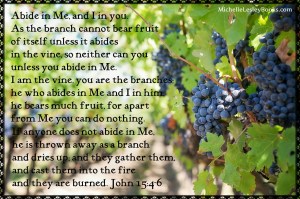
As I carefully cut away the spoiled area to salvage the rest of the fruit, I was reminded of what Jesus said in John 15:4-6:

purple-grapes-553462_1280

In the first half of John 15, Jesus talks a lot about vines and branches and fruit. The main application of this passage is that Jesus is the vine and we are the branches. The living, fruit-bearing branches are those who have truly been born again. The dried up branches who don’t bear fruit are people who appear to be or claim to be Christians, but aren’t actually saved. But there’s a second layer to this story for those who are genuinely regenerate Christians: obedience. Walking with the Lord day by day and producing healthy fruit.

I looked over at the little stump of cantaloupe branch I had cut off and thrown away. Because it hadn’t been abiding in the main vine, it had dried up. It was no longer bearing new fruit nor was it carrying nutrients from the vine to its already existing fruit, namely, the cantaloupe sitting on my counter, turning to mush.

The same thing happens to Christians when we disobey God by neglecting our relationship with Him. When we go days without picking up our Bibles or praying or gathering for worship with other Believers, we begin to dry out and shrivel up, spiritually. There’s no biblical nutrition flowing from Christ through us, so we’re not bearing any new fruit, and any already existing fruit we’ve produced starts showing signs of rot.

Galatians 5:22-23 tells us:

pineapples-1606852_1280_kindlephoto-18964258

I don’t know about you, but when I’ve skipped my Bible study and prayer time for even a few days, I can tell that I’m not bearing any new spiritual fruit and that I’m less patient, less loving, less self-controlled- more rotten in all of these areas than I normally am. I can tell if my husband is neglecting his time with the Lord, and when my children aren’t having their daily quiet times. I’m surrounded by slowly rotting fruit.

As daughters of Christ, it is imperative that we receive the nourishment He has provided for us in His word, in prayer, through the church, and through obedience to Him so that we can bear good, strong, growing fruit. Because the longer we walk through life at a distance from Christ, the rottener we’ll become. Just ask a cantaloupe.


THIS ARTICLE WAS ORIGINALLY PUBLISHED AT SATISFACTION THROUGH CHRIST.

Bible Study, Throwback Thursday

Throwback Thursday ~ Nine Helps for Starting and Sticking to Daily Bible Study

Originally published March 31, 2015

9 helps daily bible study

It seems to be a common dilemma among new Christians, Christians who have never developed the habit of daily Bible study, and even those whose current Bible study methods or materials just don’t seem to be “working.” You know you need to be studying God’s word efficiently and effectively every day, but you aren’t quite sure how to get the ball rolling.

Let me just say right off the bat that getting over that ginormous hurdle between knowing you ought to study your Bible today and actually doing it is normal. Every Christian goes through that at least occasionally. So don’t worry that your flesh balking initially when it’s time to open your Bible means you aren’t saved or you don’t have enough faith, or whatever. But don’t let it stop you either. There are some things you can do to get off to a good start with setting up and sticking to a daily Bible study time. What can you do to set yourself up for success?

Prioritize It

Take a little time to get alone with the Lord, and be honest with Him and yourself. Is daily Bible study actually important to you – something you want to do? Why or why not? Do you feel like you should be studying, but you don’t really have a desire to? Ask God to help you understand your motivations and submit them to Him. Ask him to give you a passion for His word. Ask Him to help you to be obedient to Him in making His word a priority in your life.

Pair It

Pair your study time with something you already do faithfully, and at roughly the same time, every day. Study while you’re eating lunch, during the baby’s nap time, right after you exercise, as soon as you get up in the morning, etc. Piggybacking onto something that’s already built in to your schedule helps you stay faithful and keeps you from forgetting.

Plan for It

Do your best to block off your schedule for your Bible study time and guard that time from interruptions. Turn your phone off and get away from social media. Don’t schedule other appointments or activities that might run long and impinge on your study time. Take care of any possible contingencies that could come up before you get started.

Be Purposeful About It

The Bible should be studied in an orderly way so you can understand and apply it properly. I usually recommend simply picking up the Bible and studying it rather than using Bible study books and workbooks, and having a systematic plan of study is essential, not only to proper understanding and application of God’s word, but also to keep you from wasting time trying to figure out what to study each day. Choose a book of the Bible, start at the beginning, and work your way through it, or choose a plan for working your way through the New Testament, Old Testament, or whole Bible.

Pare It

Bible reading plans are great, but some of them can simply require so much daily reading that you don’t have time to slow down, take it all in, and linger over what you need to linger over. You don’t have to read the whole Bible in a year, but if a plan interests you, you could tweak the timing of it or pare it down in some way so you’re not biting off more than you can chew. Go for quality rather than an overwhelming quantity. Many beginners find that a chapter a day (unless it’s Psalm 119!) is just about right.

Partner with Someone

Check in regularly with a friend or your husband and discuss what each of you is learning from God’s word and how He’s using what you’re studying to make you more like Christ. It’s great fellowship and will help keep you both accountable to staying in the Word.

Positively Reinforce It

It’s true that studying God’s word is its own reward, but sometimes disciplining yourself to stick to a schedule needs a little extra boost of incentive, especially when you’re just starting out. How about making a deal with yourself that you can get on social media, watch TV, have dessert, etc., only after you’ve had your Bible study time? Or that if you don’t miss any days of studying your Bible for a whole week, you’ll reward yourself with an ice cream cone, a bubble bath or some other small treat?

Pursue It

Realize from the get go that there are going to be some days when you’re going to forget to study your Bible, or oversleep, or have an emergency, or just plain old give into temptation to skip it. Take a breath. It’s OK. If there was sin involved, repent and ask God’s forgiveness. If there’s still time left in the day, and you’re able, go ahead and pull your Bible out, even if it’s not your regularly scheduled time. If not, just get back up on that horse tomorrow. God’s mercies are new every morning (Lamentations 3:22-23).

Prize It

Above all, whether it’s a day when you’ve had a fantastic time in God’s word or a day when you’ve messed up royally, keep your eyes on the prize and see the long term value in spending time in the Scriptures each day. God is using His word to grow you in holiness and make you more Christlike.

All Scripture is breathed out by God and profitable for teaching, for reproof, for correction, and for training in righteousness, that the man of God may be complete, equipped for every good work.
2 Timothy 3:16-17


THIS ARTICLE WAS ORIGINALLY PUBLISHED AT SATISFACTION THROUGH CHRIST.
Parenting, Throwback Thursday

Throwback Thursday ~ 12 Techniques for Raising Bible-Saturated Kids

Phew. That’s a pretty tall order, isn’t it? God may have said this through Moses to Old Testament Israel, but His words are just as relevant for 21st century Christian parents. God wants our children immersed in His Word as they go about their daily lives. Ephesians 6:4 reminds fathers that they are to bring their children up “in the discipline and instruction of the Lord,” and as moms, we have the joy of supporting our husbands in that venture by bringing Scripture and prayer to bear on all those little daily “walk by the way” moments. But how? Here are some practical ways I’ve discovered for capturing those teachable moments and pouring God’s Word into them.

1. Set an example.

Be faithful to your own Bible study and prayer time. Let your children “catch you in the act” from time to time. Share with them what you’re learning from God’s Word, things you’re praying about, things you’ve asked God to forgive you for, etc.

2. Train your children to have their own daily Bible study time.

You might be surprised at how early you can start developing this godly habit in your child. With an infant, you might simply take a few minutes of her morning feeding to read aloud from your Bible and pray. With a toddler, you can regularly set aside five or ten minutes (when she’s not tired or hungry) for her to sit down and look at pictures in a children’s Bible, maybe while you’re sitting nearby with your own Bible, modeling for her. As children get a little older and can read, you can set aside a block of time before their bedtime for individual Bible study and prayer. When they’re very small, children aren’t going to understand much from the Bible (although they will surprise you sometimes!), but they will still be absorbing some valuable things: the Bible is an important book, God is the top priority in my family, and God and His Word should be preeminent in my life.

3. Establish a regular time of family worship at home.

If your husband is a believer, be careful not to usurp his leadership in this area. It is ultimately His responsibility to lead his family in worship. Help each other think of ways to make your family worship time age appropriate for the children, and support your husband as he teaches God’s Word. Also, understand that with children comes chaos. (My four children who are still at home range in age from 11 to 19, and I still have to remind them to quiet down and stay on track during family worship.) It’s going to happen. Just tuck and roll and don’t give up.

4. Sing.

Who cares if you can’t carry a tune in a bucket? God doesn’t, that’s for sure. Sing some hymns while you’re washing the dishes. Sing along with some worship music (doctrinally sound, of course) in the car. Music is a great way to get God’s truths into your child’s heart and mind.

5. Conversation Prayer

During our family worship time, we used to go around and share prayer requests, then one or two people would pray. We found that the children were either forgetting the prayer requests or we would have to spend time writing them down. So now we often do what we have dubbed “conversation prayer”. One parent will say a brief opening prayer, and then the “floor is open” for anyone to say a (or several) one or two sentence prayer about whatever is on his heart (“Please help me do well on my math test tomorrow,” or “Lord, please save Grandmamma.”). When it seems like everyone is finished, the other parent says a closing prayer.

6. What is God up to?

Sometimes it’s hard for children (and even adults) to recognize and remember the ways God is answering prayers and working in their lives. When our children were smaller, I put up a piece of posterboard on the wall of the breakfast room with the title “What is God up to?” at the top. Whenever God answered something we had been praying about, provided for us, moved in our lives in some way, or blessed us, we made a little note about it, along with the date. It had big things – like my daughter getting saved – as well as little things – like my son finally learning to tie his shoes. It helped my children to recognize God’s sovereignty over all areas of our lives, that He does answer prayer, and that He gets the glory for everything.

7. Let’s pray about this.

Your children are going to struggle with things. They’re going to have times of rejoicing and times of sorrow. There will be times when they have disobeyed and need to repent of their sin. What better opportunities to teach them to take everything to God in prayer? Teach them how to ask God for help when something is too hard. Teach them to thank God for blessing them and ask Him to comfort them when they’re sad. Show them how to ask God for forgiveness when they’ve done wrong.

8. Sprinkle life with Scripture.

(In order to do this, you’re going to have to know Scripture, so be sure to be faithful to your own study of God’s Word.) When you see a beautiful sunset, talk about how God created the sun and moon. When your child is kind to someone, praise him and tell him God wants us to be kind to others. When you discipline him, show him his sin from Scripture, and talk about repentance and God’s forgiveness.

9. Memorize Scripture together.

There is a wonderfully wide variety of Scripture memory resources out there. My children were all involved in a Scripture memory program at church when they were small, and we worked on their memory verses together at home. Our home schooling curriculum, at the kindergarten level, had a 26 verse Scripture memory program in which we memorized a verse beginning with each letter of the alphabet. Seeds Kids Worship is a fantastic program with word for word Scripture songs and other great resources. There are even apps that can help. And you can always make up your own fun programs, songs, and contests to help the whole family memorize God’s Word.

10. Ask questions.

“Would God be pleased with the way you’re acting? How do you know?” “What does the Bible say about the way we should treat each other?” “What does the Bible say about _____?” Questions like these get your children thinking. They take your children from simply reading and hearing God’s Word to applying Scripture to their lives and recognizing that they must submit to it.

11. The Gratitude Game

Forget the tablets and the radio. This is a great way to harness that down time in the car (or anywhere else) and use it to teach your kids about prayer and thankfulness. It’s kind of like playing “I Spy.” Just look out the window and take turns thanking God for what you see: “Thank You, God, for making birds.” “Thank You for ice cream.” “Thank You for police officers who help us.” Or pray for people as you pass by various buildings. “God, please help the sick people in that hospital…help the pastor of that church do a good job of preaching Your Word…provide homes for the people in that shelter…” We also made it a habit to pray for victims of accidents or tragedies whenever we saw an ambulance or fire truck.

12. Kiddievangelism

Our kids need to see us sharing the gospel with people as a normal part of everyday life, and we need to explain to them why it’s so important. There’s an easy way to get your kids personally involved, too, especially when they’re small: tracts. Get some doctrinally sound tracts (my favorites are from Bezeugen) and let your child leave one in the waiting room at the doctor’s office, on the table when you leave McDonald’s, or hand one to the cashier at the store. I’ve had people turn me down when I offer them a tract, but who’s going to refuse an adorable three year old? Get them started on a lifelong habit of sharing the gospel wherever they go.


As Christian parents it’s our responsibility before God to train our children in the Scriptures, prayer, and godliness. If we slow down and ask God to direct us, He will show us all kinds of ways we can teach them diligently to our children, when we sit in our houses, and when we walk by the way, and when we lie down, and when we rise.

What are some fun or unique ways you’ve found
to pour God’s word into your children’s everyday lives?