Mailbag

The Mailbag: Potpourri (Bible study for the lost, good preachers, new Christian witnessing, Catholic statues, “The Chosen” update)

Welcome to another “potpourri” edition of The Mailbag, where I give short(er) answers to several questions rather than a long answer to one question. I also like to take the opportunity in these potpourri editions to let new readers know about my comments/e-mail/messages policy. I’m not able to respond individually to most e-mails and messages, so here are some helpful hints for getting your questions answered more quickly. Remember, the search bar (at the very bottom of each page) can be a helpful tool!

In these potpourri editions of The Mailbag, I’d also like to address the three questions I’m most commonly asked:

“Do you know anything about [Christian pastor/teacher/author] or his/her materials? Is he/she doctrinally sound?”

Try these links: 
Popular False Teachers /
 Recommended Bible Teachers / search bar
Is She a False Teacher? 7 Steps to Figuring It Out on Your Own
(Do keep bringing me names, though. If I get enough questions about a particular teacher, I’ll probably write an article on her.)

“Can you recommend a good women’s Bible study?”

No. Here’s why:
The Mailbag: Can you recommend a good Bible study for women/teens/kids?
The Mailbag: “We need to stop relying on canned studies,” doesn’t mean, “We need to rely on doctrinally sound canned studies.”.

“You shouldn’t be warning against [popular false teacher] for [X,Y,Z] reason!”

Answering the Opposition- Responses to the Most Frequently Raised Discernment Objections


My daughter who is not yet saved wants to do a Christian book study with a friend. I am just thrilled that she even has that desire. She is thinking about doing one of Lysa TerKeurst’s books who I know not to have solid theology (among other problems with her).  Could you suggest someone who would be a good option?


I’m so glad your daughter seems to be gravitating toward wanting to read something biblical. If it were one of my children, I would be excited too. Thank you for protecting her from false doctrine.

But to answer your question, no. I’m afraid I can’t. I don’t recommend what I call “canned” Bible study books, DVDs, etc., on principle, even (maybe especially) for unsaved people. You can read more at the articles linked under “Can you recommend a good women’s Bible study?” above, but here’s the gist of my reasoning:

• Modern evangelicalism and Christian retailing has conditioned most Christians to believe that if they’re going to study the Bible, they have to use a pre-fab, packaged study instead of simply studying straight from the text of Scripture. There are a lot of super, doctrinally sound Christians who have no problem recommending these kinds of (solid) studies, and that’s great, but if I have to be the lone voice crying in the wilderness that we need to stop being dependent on Bible study books, I’m going to be that gal. And if I’m going to put my money where my mouth is, I can’t, in good conscience, recommend study books.

• The overwhelming majority of “canned” Bible studies, especially the ones written for women, contain false doctrine. Trying to find a “good” one is like trying to find three grains of salt in a bowl full of sugar. It’s much more efficient to recommend something we all know is completely trustworthy and inerrant – the Bible itself.

• God’s Word is sufficient for our every need. For thousands of years, people have gotten saved and sanctified simply by reading Scripture, and we need to get back to that.

• Most Christians (including me) who have done both book studies and studying straight from Scripture will tell you that studying straight from Scripture is far more rewarding. It creates a greater intimacy with God, the Holy Spirit illumines and applies Scripture to your life in the way you need it, and you learn so much more. It’s like the difference between watching someone else search for buried treasure, and searching for it, and finding it, yourself.

So here are a few options I’d recommend for your daughter instead of someone else’s book:

Look through some of the studies I’ve written at the Bible Studies tab in the blue menu bar at the top of this page to see if any of them would be of interest to her. My studies are designed to teach women how to study the Bible for themselves, so that once they get the hang of it, they won’t have to depend on anyone else’s materials any more, even mine.

At that same tab is a list of Bible reading plans. Your daughter probably isn’t ready for a “read through the Bible in a year” plan, but there are several links to much shorter plans – some as short as 1-3 weeks – that will take her through a topic or a book of the Bible.

Order her a gospel of John from Pocket Testament League, and encourage her to read about a chapter a day (or whatever she’s comfortable with). PTL actually uses the book of John as an evangelism tool. They have all sorts of unique designs and translations (I would recommend ESV), and a small, groovy looking little “booklet” might be less intimidating to her than the whole Bible. You can read more here.


Love your blog! I have read your list on ministries or preachers you write on and don’t recommend. I highly admire this. I would like to find ones that I could watch that you do recommend. Do you have a list of men preachers that would fall under this category with a thumbs up? Also any women’s Bible studies I could follow online as well.

Thank you so much for your kind words. I’m glad you’re finding the blog helpful.

If you’ve read the Popular False Teachers and Unbiblical Trends tab, you were soooooo close to finding what you were looking for! :0) Right next to that tab (in the blue menu bar at the top of this page) is a tab entitled Recommended Bible Teachers. You’ll find lots of great pastors and teachers there.

As I mentioned above, I highly recommend you study straight from the Bible itself. If you need a little help getting started, the (online) studies I’ve written will teach you how to do that. You can find them at the Bible Studies tab (also in the blue menu bar at the top of this page). Our current study is Ezekiel.


I’m recently saved, and I feel compelled to share the Gospel with a co-worker but I hesitate because of my past reputation at work. I worry that I will have no credibility. Yes, they’ve all seen the change in me but they’re waiting for it to ‘wear off’. Should I wait until I’m farther removed from my sin to share the gospel with him? Wait until they’re all satisfied that I’ve changed and am not going back to my old ways? Wait for someone else to step up and share with him? He has weighed heavily on my mind as of late and I want him to have the same living hope that I have experienced and to understand the importance of forgiveness. 

Great question! I’m so thrilled you want to share the gospel with someone!

You’ve explained in your e-mail to me that the nature of your relationship to this co-worker isn’t going to be problematic, but for any readers wondering about sharing the gospel with men, please see #11 here and always exercise wisdom and caution.

Take a moment to read the story of the woman at the well. She was zero minutes removed from her sin – in fact she may not have truly been a Believer yet – when she ran back to town urging her friends and neighbors, “Come, see a man who told me all that I ever did. Can this be the Christ?”.

Or the blind man Jesus healed: “The man called Jesus made mud and anointed my eyes and said to me, ‘Go to Siloam and wash.’ So I went and washed and received my sight…One thing I do know, that though I was blind, now I see.”

Honey, that’s you. You’re just one beggar telling another beggar where to find bread. You don’t have to be perfect and you don’t have to have all the answers, because you’re not the one who’s going to save this guy. Jesus is. He is perfect. He has all the answers. It’s OK to tell your co-worker that you’re new at all this and still learning…but tell Him about Jesus.

Tell him how Jesus washed all your sins away. Tell him how Jesus set you free and gave you peace. Tell him you want him to have the same living hope that you have experienced and to understand the importance of forgiveness. Tell him.


I just read your article about Nativity scenes, and I agree with you. This article makes me wonder, however: I’m curious about your take on the statues and various sacraments that are typical in a Catholic church. Do you think there is a line that has been crossed with such things, or do you think it depends on how an individual approaches and uses these items?

This is a super question – I really like the way you’re thinking this through!

Yes, a line has been crossed in Catholicism, but it’s much more foundational than most Christians realize. There’s no way to gently and, at the same time, clearly say this for those who may not be aware, so I’ll just say it: Catholicism is not Christianity. Even though it utilizes the Bible and Christian terminology, much like Mormonism, It is a different religion at its very core.

There are many reasons for this, and idol (statues) worship, as you’ve touched on, is only one of them. Positioning Mary as co-redemptrix with Christ is blasphemy. Purgatory blatantly contradicts both Christ’s sufficient atonement for sin and outright rejects Scripture’s teaching on God’s judgment after death. Re-crucifying Christ in the Mass along with transubstatiation is an abomination. Praying to (or in or through or with or whatever conjunction they want to use) dead people (the “saints” and Mary) is patently unbiblical. Infused righteousness rejects the biblical teaching of imputed righteousness. The teaching that one must be baptized into the Catholic “church” in order to be saved is anti-gospel.The Pope is not infallible as proved by all of the above and more. And don’t get me started on the Catholic “church’s” scores of brutal murders and imprisonments of Bible believing, Bible preaching, Bible translating, and Bible owning Christians during the Protestant Reformation. I could go on and on.*

But possibly the most egregious heresy Catholicism teaches is that anyone who believes this…

For by grace you have been saved through faith. And this is not your own doing; it is the gift of God, not a result of works, so that no one may boast. Ephesians 2:8-9

…is anathema – excommunicated from Catholicism and therefore damned to an eternity in Hell. This is just one of the many anathemas from the Council of Trent, which convened in 1545 to codify Catholic doctrine and repudiate Protestantism:

If any one saith, that by faith alone the impious is justified; in such wise as to mean, that nothing else is required to co-operate in order to the obtaining the grace of Justification, and that it is not in any way necessary, that he be prepared and disposed by the movement of his own will; let him be anathema.

According to Catholicism’s own doctrines, anyone who believes what the Bible says about being saved by grace alone, through faith alone, in Christ alone, and not by these plus accompanying works, is damned. If that’s not “another gospel,” I don’t know what is.

I am astonished that you are so quickly deserting him who called you in the grace of Christ and are turning to a different gospel— not that there is another one, but there are some who trouble you and want to distort the gospel of Christ. But even if we or an angel from heaven should preach to you a gospel contrary to the one we preached to you, let him be accursed. As we have said before, so now I say again: If anyone is preaching to you a gospel contrary to the one you received, let him be accursed. Galatians 1:6-9

So, to answer your question a little more directly, there is no right or “biblical” way for a Catholic to use statues, relics, sacraments, or any other accoutrements of Catholicism because the entire system is corrupt, anti-biblical, and is not Christianity.

Here are a few more resources that may be helpful if you’d like to read more:

Catholic Questions at Got Questions

Roman Catholicism at CARM

List of excommunicable offences from the Council of Trent at Wikipedia (I know, I know, it’s Wikipedia, but as of the date I’m posting this, it’s a pretty decent article.)

*Invariably, when I (or any other Protestant for that matter) address a well established doctrine or practice of Catholicism and how/why it isn’t biblical, a Catholic will argue: “That’s not what we really believe!”. If you’re a Catholic and you’re about to make a comment along those lines, here’s my response: That’s what your own “church” teaches, so it IS what Catholics are supposed to believe. If you don’t believe your own “church’s” doctrine, why are you still a Catholic?

Thank you so much for your ministry. I am truly blessed by it. In regards to The Chosen, I was listening to Todd Friel on Wretched and he said something very interesting about the producer. I have attached the link.

Thank you so much for bringing this to my attention. For those who might be unfamiliar, The Chosen is a made for streaming “TV show” drama on the life and ministry of Jesus, produced by Dallas Jenkins. It premiered earlier this year, the week before Easter. At that time, I wrote a review of the series, which you can read here if you like. I have added the following update to that article:

Update (7/12/20): Thank you to a kind reader who brought to my attention a recent interview of Dallas on a Mormon YouTube channel. Dallas seems to believe that Mormonism and Catholicism are both Christianity. You can listen to the short version (with Todd Friel’s commentary) here (starting at 45:00) or the entire interview here. You may also wish to compare (fairly, objectively, and discerningly) Dallas’ comments in the interview with his comments (below) at the end of this article. It is one thing to use the products and services of a non-Christian company. It is another matter to personally believe, as a Christian, that false religions are Christianity and that adherents of those religions are brothers and sisters in Christ. If these revelations of Dallas’ beliefs prevent you from watching The Chosen, that is certainly understandable, and I would encourage you not to sin against your conscience by watching it. However, these revelations do not somehow magically change the actual content of the episodes, nor my evaluation of said content. In other words, I biblically evaluated what I saw in the episodes, so the remainder of this review stands.


If you have a question about: a Bible passage, an aspect of theology, a current issue in Christianity, or how to biblically handle a family, life, or church situation, comment below (I’ll hold all questions in queue {unpublished} for a future edition of The Mailbag) or send me an e-mail or private message. If your question is chosen for publication, your anonymity will be protected.

Ezekiel Bible Study

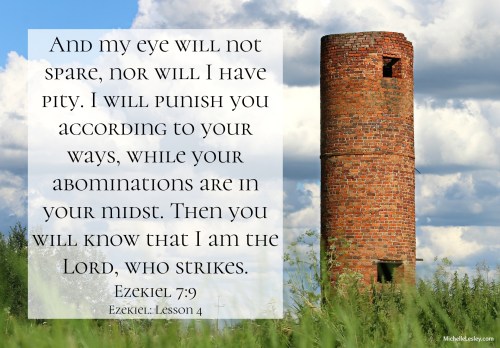
Ezekiel ~ Lesson 4


Previous Lessons: 1, 2, 3

Read Ezekiel 6-7

Reminder: I know we’re handling a lot of Scripture each week, and if you’re deep diving into the passages, it’s easy to get behind. Don’t worry! Remember, this study is self-paced. Take your time and take as long as you need. Also, I always build “catch up weeks” into my studies, so, scattered throughout the course of the study, there will be a few weeks with no new lesson which you can use for catching up.

Questions to Consider

1. Review your notes from last week’s lesson and be reminded of the things that lead into, and set the stage for, this week’s passage.

2. Read 6:1-7.

“Who” does God have Ezekiel preaching to? (6:2,3) Did these inanimate objects need to “hear” the word of the Lord? Who did? What was God telling the people about what would happen on the mountains, hills, ravines, and valleys in 6:1-7?

What is the sin God is judging in 6:1-7? Find the words “altars,” “incense altars,” and “high places” in this passage. Were these used for worshiping God?

How would you characterize Israel’s sin of idolatry? Were most of the people faithful to the Lord, while a few briefly gave in to the temptation to worship idols, then repented and showed contrition when rebuked? Or, were most of the people rebellious, hard-hearted, and stubbornly unrepentant of their idolatry over an extended period of time? Does God respond to repentant sinners with the ferocity of wrath we have seen so far in Ezekiel, or does He reserve that wrath for unrepentant sinners?

3. Read 6:8-14

What was God’s purpose in keeping “some of you alive”? (8)

4. Read chapter 7.

Examine 7:6-7,12, and explain the difference between God’s eternal and immutable (unchanging) attribute of patience, and the exercise of His patience for a finite amount of time with particular people in certain circumstances. In Ezekiel, we are seeing the exercise of God’s patience with Israel nearing the end of its finite time. When is the next time in human history that we will see God’s exercise of patience with people come to an end?

What is the “beautiful ornament” of verse 20? What does God say will happen to it? (20-22)

5. List all of the specific ways in chapters 6-7 that God says He will kill people. Why does God repeat Himself about this? (If you have, or teach, children, think about how many times you have to repeat yourself to them, and why.)

Are there any phrases in chapters 6-7 that sound like they might refer to Israel repenting? What are they? As you look closely at these phrases and consider them within the broader context of chapters 6-7 and the theme of the book of Ezekiel, compare them to the godly grief and worldly grief over sin described in 2 Corinthians 7:10. Which type of grief, if any, over sin is Israel displaying?

How can a loving God express this kind of wrath against His own people? Explain how God’s wrath is an expression of, or complementary to, His love. How was the cross a simultaneous expression of God’s perfect wrath and perfect love?

6. Think about chapters 6-7 through the lens of 2 Timothy 3:16-17:

All Scripture is breathed out by God and profitable for teaching, for reproof, for correction, and for training in righteousness, that the man of God may be complete, equipped for every good work.

How is this passage profitable for us as 21st century Christians under the covenant of grace? How can God use it for teaching, reproof, etc., in your life? How does it help complete and equip you?


Homework

• Did you make your “And you/they shall know that I am the Lord” list from last week’s homework? Add the incidences of this phrase from this week’s lesson (6:7, 10, 13, 14 and 7:4, 9, 27), and write down who will know that He is the Lord, what will cause them to know He is the Lord, and why God wants them to know He is the Lord.

• Do some research on altars and high places, including an image (pictures) search. Consider the amount of work it would have taken the Israelites – with hand tools – to build multiple (note the plurals in 6:1-7) structures like this. Describe how all of this work was making provision for the flesh, to gratify its desires.

An idol doesn’t have to be a statue we physically bow down to, or build an altar to, and worship. We can idolize a person, money, a certain lifestyle, popularity, a favorite pastor or teacher, false teaching, our children, the perfect marriage, etc. An idol is anything you love, value, or lavish time, money, and effort on, more than the God of the Bible. Are there any idols in your life? In what ways do you “make provision for the flesh” (purposefully make room in your heart and life) for that idol? Over the next week, pray that God will reveal any sin of idolatry you are participating in and that He will help you repent and get rid of those idols.


Suggested Memory Verse

Ezekiel Bible Study

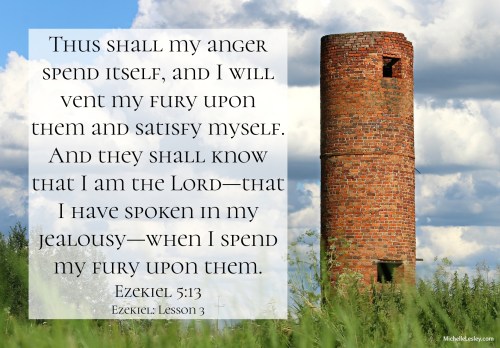
Ezekiel ~ Lesson 3


Previous Lessons: 1, 2

Read Ezekiel 3:16-5:17

Questions to Consider

1. Review your notes from last week’s lesson and be reminded of the things that transpired in 1:1-3:15 that lead into, and set the stage for, this week’s passage. According to 3:16, how long after the events of 1:1-3:15 do the events of 3:16ff take place?

2. Read 3:16-21. What was the purpose of a (literal) watchman in Ezekiel’s day? Explain God’s charge to Ezekiel in this passage. Who was he to warn, and what was he to warn them about? What would be the consequences for Ezekiel for not warning the people as God commanded? What would be the result for him if he did obey God’s command to warn them?

Are there any general principles we can draw from this passage about our responsibility to share the gospel with the lost? What about confronting sin in a fellow Christian or warning the church against false teachers? Are the consequences Ezekiel faced for warning/not warning the same for Christians warning/not warning against sin and unbelief? Which New Testament Scriptures can you think of that would seem to be in line with, or would indicate a difference from, 3:16-21 for Christians?

What does this passage teach us about God’s perspective on sin and repentance?

3. Read 3:22-27.

What does 3:23 refer back to (hint- use your cross-references)? How did it benefit Ezekiel (in ch.1 and ch.3) to experience God’s glory right before God called him to do something difficult? How does immersing ourselves in the glory of God through His Word, prayer, and worship prepare us to do the difficult things He calls us to do?

What did God do to Ezekiel in 3:26-27? If Ezekiel was supposed to speak God’s word to the people, why would God make him mute? Why might God withhold His word or His truths from people? (3:26-27)

4. Read Ezekiel 4:1-5:17*.

If you’re unfamiliar with the Old Testament battle concept of siege and what siegeworks would have looked like, do some research as you consider chapter 4 (especially 4:1-3). It will give you a better understanding of the illustrations God was asking Ezekiel to set up and carry out in this passage. Sketch out or visualize what Ezekiel’s little diorama in 4:1-3 would have looked like. What did the iron wall and Ezekiel turning his face toward it represent?

Explain the message God is conveying to His people in 4:4-8. Using cross-references, commentaries, your Bible’s study notes, etc., what do the 390 years and 40 years represent? How does Ezekiel symbolically “bearing the punishment” and “laying down” his life for his people’s sin point toward Christ literally bearing the punishment and laying down His life for His people’s sin?

What part of the siege was God warning about in 4:9-17? What did the illustration of the bread mean? (4:16-17) Explain the concept of “uncleanness” for the Israelites and how horrifying and humiliating this part of God’s judgment should have been to them. Compare Ezekiel’s aversion to uncleanness to Peter’s. How is the concept of uncleanness an illustration of the holiness of God and His aversion to sin?

What was God’s message to the people in 5:1-4? (5:10b,12)

How did Israel’s sin compare to the sin of the pagan nations around them? (5:5-7) Make a list of the words and phrases in 5:5-17 that impress upon you just how deadly serious God is about sin and how intense is His wrath against sinners. When you finish making your list, read back through it and consider this wrath that God poured out on Christ on the cross as well as His mercy and grace in salvation toward you, a sinner.

As we continue on in Ezekiel, we will see other instances of God instructing Ezekiel to communicate His message through illustrations, dioramas, or a dramatic presentation rather than through a sermon or other direct verbalization. Why might this be God’s preferred method of communication with His people in these instances?


Homework

*(Homework is usually optional, but I’d really like you to do this one.) Ezekiel 5:13 is the first of 72 times in the book of Ezekiel that we will see the phrase (or some variant of it), “And they shall know that I am the Lord.” As we study through Ezekiel, keep a running list of each time you see this phrase, and write down who will know that He is the Lord, what will cause them to know He is the Lord, and why God wants them to know He is the Lord.

• Are you familiar with Ezekiel 4:9 Bread? Explain why their use of this Scripture is out of context for marketing their bread. Did God tell Ezekiel to make his bread from a combination of grains “to ensure unrivaled honest nutrition and pure, delicious flavors”? Think about the context of chapter 4 as you answer. Are you sinning if you eat this bread just because you happen to like it?


Suggested Memory Verse


Ezekiel Bible Study

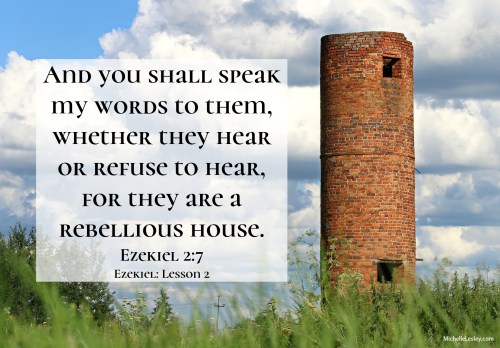
Ezekiel ~ Lesson 2

Welcome, ladies! I’m so glad you’re here! I have received a lot of questions about the study that were answered in last week’s introductory lesson. Please do not skip Lesson 1 (link below). Not only will it answer any questions you may have about the study itself, but if you want to study Ezekiel properly, you must do the background work contained in Lesson 1.


Previous Lessons: 1

Read Ezekiel 1:1-3:15

Questions to Consider

1. Review your notes from last week’s introductory lesson. What are some things to keep in mind as you begin to study the text of Ezekiel today? Drawing from your notes and 1:1-3, imagine you’re a playwright and write the setting for the “script” of Ezekiel. Which phrases in verses 1 and 3 connect us to 2 Timothy 3:16?

2. Read 1:4-28. Does this passage remind you of any other biblical passages? Which ones, and why? Read through all of the cross-references and footnotes in this passage as well as any study Bible notes or commentaries you like on this passage in order to gain as good an understanding of it as you can. Why do prophetic visions of Heaven and the spiritual realm (apocalyptic passages) always seem so hard to understand? Is it OK if we read these passages and, despite our best efforts, don’t completely grasp all of the symbolism? Do you think Ezekiel understood everything he was shown?

What does 1:28b say that the main idea of 1:4-28a is? What was Ezekiel’s response to seeing the glory of God? (1:28b) How did being overwhelmed by God’s glory put Ezekiel in the right frame of mind and heart to receive and proclaim the message God subsequently gave him? (1:28b-2:2)

3. Read chapters 2-3.

Using your concordance, search the term “son of man“. Ignoring false results (ex: “son of Manasseh”), what are the main ways this term is used? How many times is Ezekiel called “son of man”? What other major Bible character is called the Son of Man? What is the difference between the reference to Ezekiel as “son of man” and Christ’s title “the Son of Man“?

To whom is God sending Ezekiel (2:3, 3:11), and why (2:4,7, 3:4,11)? How will Israel respond?(3:7) How would the pagans have responded if God had sent Ezekiel to them instead? (3:4-7) Explain the shame it should bring to God’s people – in Ezekiel’s day and today – when lost people respond to the preaching of God’s Word in repentance and faith, and those who claim to be His people do not.

Compare God’s charge to Ezekiel to speak His word to His people “whether they hear or refuse to hear” to God’s charge to pastors to preach the Word to His people “in season and out of season” in 2 Timothy 4:1-2.

Explain the metaphor of Ezekiel eating the scroll in 2:8-3:3. How does this apply to us as Christians today?

Why was it bad for Israel to be “hard headed” but good for Ezekiel to be “hard headed”? (3:7-9) Explain why a pastor, or any Christian, needs to be “hard headed” (yet soft-hearted) when dealing with Believers (or false converts) who are disobedient to God’s Word.


Homework

•If you’re artistic, illustrate part or all of the scene in 1:4-28.

•Are you familiar with the “heavenly tourism” books like Heaven Is for Real or 90 Minutes in Heaven that were popular a few years back? Read some of the descriptions of “Heaven” found in these books and compare them with Ezekiel’s, Daniel’s, and Revelation’s descriptions of heavenly scenes. How do they compare?

•From what I can tell, this church has horribly unbiblical theology, so don’t follow them or their beliefs, but I loved their choir’s rendition of Ezekiel Saw the Wheel. Listen carefully to the lyrics (or Google them). How closely do they match up to Ezekiel 1:4-28 and/or other passages of Scripture?


Suggested Memory Verse

Bible Study

A Hard Bible for Hard Times

These days, popular women’s “Bible” studies tend to be seven lessons of fluff, feelings, and false doctrine.

This is the “anti-study”.

Roughly 20 lessons of digging into the text of what can be a challenging passage of Scripture.

I believe you’re up for the challenge, ladies. Let’s study.

A couple of days ago, I launched Ezekiel – our new Bible study here on the blog – with these introductory remarks on social media. I made it pretty clear, both in my social media remarks and the introduction to the study itself that this wasn’t going to be your typical walk-in-the-park women’s “Bible” study designed to make you feel better about yourself.

Ezekiel is a long book. There are parts of it that are going to be hard to understand. There are parts of it that, to our flesh, are going to be boring. There are cubits. Lots and lots of cubits. This is a Bible study that’s going to require extra work – probably with commentaries and study Bibles. And I’m not making any “feel good” guarantees.

And yet, I was overwhelmed by the response from so many readers: “I’m in!” “Sign me up!” “Looks like a good time!” “Excited is an understatement!”

All this about….a hard text? More work? Even as we endure Corona and quarantine, separation from loved ones, the shuttering of our churches, economic hardship, increasing persecution, racial strife, rampant crime, rioting, anarchy, and God only knows what’s next?

Yeah. Want to know why?

It’s the same reason that being bone-weary after a long day of hot, sweaty yard work feels better than the mind-numbed sleepiness you feel when you’ve been binge-watching Netflix in your pajamas all day. The same reason you feel better after a satisfying, well-balanced meal than after snarfing a dozen Oreos.

It’s what we need.

It’s what’s good for us.

It’s accomplishing something lasting.

We need a hard Bible in these hard times.

Think about the hard times the first century Christians of the New Testament went through. For refusing to offer a pinch of incense in worship to Caesar, for declaring that Jesus alone – not Jesus plus the pantheon – is Lord, they were fed to the lions for sport, burned and boiled alive, crucified, beheaded, speared, beaten, stoned, whipped, exiled, and considered “the scum of the world, the refuse of all things.”

And for most of that first century, the bulk of the Scriptures Believers had access to was the Old Testament. The part that soft, milquetoasty, “I want a God made in my own image” evangelicals today want to “unhitch” from precisely because it’s hard.

While fearing for their very lives for following Christ, our forefathers in the faith studied the God who flooded the earth for its rebellion against Him, who wiped out pagan nations for their idolatry, who sent horrific plagues upon those who defied Him, and who poured out His wrath on His own people for their sin and spiritual whoredom.

They had a hard Bible during their hard times.

To be sure, they saw, and we also see, the God of mercy, love, and grace who spared Noah, who provided His children with a land flowing with milk and honey, who rescued the Hebrews out of slavery, and who blessed all who were faithful to Him. And we know that all of Scripture – the hard to swallow parts and the easy to embrace parts, the “dig in and study hard” parts and the simple and sweet to the soul parts – all of Scripture is profitable.

But we need a hard Bible for hard times.

Because hard passages that make us stop and spend extra time and effort build discipline, endurance, and patience into our spirits. They make us do the hard work of digging for the nature and character of God and reward us with the treasure of knowing Him more intimately. They show us who God is in a unique way that the easy passages do not.

Feelings, fluff, and false doctrine can never accomplish those ends. They do not prepare us to endure suffering and persecution with strength and dignity, but to whine and complain and focus on the hurt. They do not teach us who God truly is in our trials and temptations, but that we can create a custom-made idol we’re comfortable with and call it “God”. They do not lead us to trust and obey God when the going gets tough, but to abandon His Word and His statutes in favor of worldly means and methods of dealing with difficulties.

Most evangelical women today are spiritually flaccid because no one – not their denomination, nor their church, nor their pastor, nor their Sunday School teachers, nor their women’s ministry leaders, nor their favorite “Bible” study authors – has ever made them do the hard work of wrestling with challenging Scriptures, overcoming them, and adding that victory to their inventory of joy in Christ.

We need to raise the bar.

We need to expect more, not less.

We need to encourage the pink side of the pew to do hard spiritual things, and cheer them on and help them as they try.

The Kingdom doesn’t need weak women who don’t know their Bibles because all they’ve been taught – and all they’ve been taught to hunger for – is feelings, fluff, and false doctrine. Because those women crumple in the face of controversy. They fall away rather than stand and fight.

The Kingdom needs strong, godly women who apply their hearts and minds to knowing and understanding God’s Word and reach down to help their weaker sisters do the same.

Hiding God’s Word in our hearts doesn’t just mean we learn the surface-level do’s and don’t’s, giving us a spiritual Post-It note reminder not to lie and steal. In order to hide something, we first have to possess it. Own it. And to own God’s Word we have to plunge in and swim in it. Breathe it in and out. Drink deeply of it. Eat the honey-sweet scroll. Let it so penetrate our souls’ DNA that when the rooster begins to crow, and the accusers point and say, “I know you. You were with Jesus,” we can plant our feet firmly and mean it when we boldly declare, “Yes. And though others may fall away because of Him, I will never fall away. Even if I must die for Jesus, I will not sin by denying Him.”

Because those hard times are coming.

Indeed, they are already here.

And we need a hard Bible for hard times.