Christian women, New Testament, Obedience, Sunday School, Women

Miraculous Inceptions: Elizabeth and Mary ~ Sunday School Lesson ~ 10-5-14

inceptions

These are my notes from my ladiesโ€™ Sunday School class this morning. Iโ€™ll be posting the notes from my class here each week. Click here for last week’s lesson.

Through the Bible in 2014 ~ Week 40 ~ Sep. 28- Oct. 4
Nehemiah 8-13, Psalm 126, Malachi, Luke 1-3, John 1, Matthew 1-3, Mark 1
Miraculous Inceptions: Elizabeth and Mary

Background/Timeline
1. 424 – 6 B.C. The Intertestamental Period- Nehemiah 13 and the book of Malachi record the last historical events and the last prophecy, respectively, of the Old Testament. Over 400 years would pass between those events and and the opening of the New Testament. Although God was still at work in the world and in the lives of His people, Scripture does not record anything from this time period. There was no prophetic word from God during the Intertestamental Period, thus, it is often called the 400 years of silence.

2. 424-334 B.C.- Israel remained a Persian territory for about 100 years after the last recorded events in the Old Testament

3. 334-331 B.C.- Alexander the Great conquers Persia and gains control of all Persian holdings, including Israel. Greek rule is established by 332 B.C.

4. 301-198 B.C.- After the death of Alexander the Great, his generals vie for control. General Ptolemy I Soter sets up the Greek Ptolemaic dynasty in Egypt (later demanding to be made Pharaoh). Ptolemaic rule of Israel begins.

5. 198 B.C.- Another Greek, Antiochus the Great defeats the Ptolemaic dynasties and takes over. He persecutes Israel to the extreme, not allowing them to keep the Sabbath, forcing them to offer unclean sacrifices, and eat unlawful foods.

6. 166-142 B.C.- Mattathias, a Jewish priest, and his five sons lead the 24 year Maccabean (named for Judas Maccabeus, the oldest son and leader) Revolt against Antiochus. The Jews eventually won their independence (though they still retained many Greek ways), and Mattathias set up the Hasmonean dynasty of priests (unbiblical since priests could only come from the family line of Zadok, and his family did not) to govern Israel.

7. 63 B.C.- Rome takes over the known world, including Israel.

8. 37-4 B.C.- Rome sets up Herod the Great as king of Israel. He is still king when Jesus is born.

The stage was set. After four hundred years of silence God was about to speak again, act mightily on behalf of His people again. And it all started with two godly women.

Luke 1:5-24

Elizabeth
It’s helpful to remind ourselves right from the start that, although we know something amazing is about to happen, Elizabeth and Zechariah had no idea. They were just regular people going about their daily lives.

5- Zechariah was a priest, but Elizabeth was also from the priestly tribe. (And what did the priests do? They minister before the Lord; just what John would do.) They were likely respected in their community and what we would consider “upper middle class,” at the least.

6 (John 9:3, Romans 9:10-16)- Both Zechariah and Elizabeth were godly people. “Blameless” doesn’t mean “sinless,” it just means that they loved the Lord, desired to obey Him, and kept His commands and statues the best they could, repenting when they sinned. It’s important this fact was mentioned before Luke went on to say that she was barren. Barrenness was often seen as a punishment from God for sin. Sometimes it was, but that wasn’t the case here. As Jesus would later say as he healed the man born blind, Elizabeth wasn’t being punished for sin, โ€œbut this happened so that the works of God might be displayed in” her.

But by the same token, Elizabeth did not earn this honor God was about to bestow on her by living blamelessly. There were probably thousands of other godly Israelite women living at that time. Why Elizabeth and not one of them? That answer is found in the mind of God alone. It is, as Hebrews says, “not because of works but because of him who calls.”

8-13- The angel appears and begins telling Zechariah what’s about to happen. This is an answer to prayer (13) for Zechariah and Elizabeth. Scripture doesn’t say this, I am only speculating, but it would not surprise me if they had stopped praying for a child long ago. Elizabeth was not only barren, both of them were “advanced in years” (7). Maybe they thought God had said “no” when He had really said “not yet.” But now was God’s perfect timing. Can you think of any other Bible characters who conceived when they were old and/or had been barren for years? Several of our Old Testament heroes came into the world this way: Hannah (Samuel), Rebekah (Jacob), Rachel (Joseph), and Mrs. Manoah (Samson) were all barren until God opened their wombs. But Elizabeth’s pregnancy in old age after years of barrenness would probably have reminded her community most of Sarah (Isaac). All of these miraculous Old Testament births after barrenness would certainly have alerted Israel that John would be one to watch.

Also notable is that, while the angel may have appeared and spoken to Zechariah, it was Elizabeth that God would use to bring John into the world. God is God. He could have dropped John out of the sky or grown him out of the ground like a tree. But He didn’t. He chose a woman to work through. It’s just another example of the way God values and uses women as He accomplishes His purposes.

24-25- When amazing things happen to godly people, godly people respond in godly ways. There’s no doubt Elizabeth was overjoyed that her prayer for a child was finally being answered in such a miraculous way and with such a child. But she responded humbly and modestly, staying in seclusion -possibly as an act of gratitude or to ensure a safe pregnancy- for five months. She also responded with thanks and acknowledgement of God’s grace and power in answering her prayer.

Luke 1:25-38

Mary
Mary and Elizabeth were cousins of some degree, but their lives were very different from one another. Mary was young, probably in her teens, while Elizabeth was older. Elizabeth was from a priestly lineage (Aaron). Mary was from a kingly lineage (David). Elizabeth had been married many years. Mary was only engaged. Elizabeth was not a virgin. Mary was. Elizabeth and Zechariah were financially comfortable. Mary’s family was poor. Elizabeth had been praying for a child for years. The last thing Mary would have wanted at that point in her life was a baby.

26-30- There was nothing special about Mary. She was a regular girl from a regular family growing up and about to get married.

“O favored one” literally means “full of grace.” It is an expression used elsewhere in Scripture as a general reference to a Believer. Luke called Elizabeth blameless and righteous and simply called Mary a Believer. Likely this difference was to drive home the point that Elizabeth was not barren due to sin. Also, Elizabeth would probably have been more mature in the faith since she was older and had access to a live-in priest.

As with Elizabeth, we see that God chooses whom He will for His own reasons. Mary was a godly young woman, and God was pleased with this, but she was a sinner just like everyone else. She had not “found favor with God” or earned her position as Jesus’ mother because she was somehow holier than other young women like her. God’s favor rested on Mary because He chose her, not because she earned it.

34-37- Both Mary and Zechariah were confused and questioning when an angel showed up and announced an unplanned pregnancy. So why was Zechariah rebuked while Mary was merely given an explanation? First, Zechariah was a priest, and knew the Scriptures intimately. He knew there was precedent for his situation (Sarah, Rebekah, Rachel, etc.), had even prayed for a child, and should have known that God was capable of doing the same thing in his own family. There was zero precedent for Mary’s situation. She hadn’t prayed for a child, wasn’t married, and a virgin birth was unheard of. Though she undoubtedly knew some of the Scriptures, she certainly wouldn’t have known them as well as a priest. God knows the heart, and He knew that Zechariah’s question was born of doubt, and Mary’s was born of confusion, ignorance, and a desire to understand.

38- Once again, a godly woman responds in a godly way. She didn’t express what was probably a very real fear– that she would be accused of adultery and possibly stoned, or that Joseph would divorce her (which he nearly did). She simply trusted that the God who was about to do this amazing thing was big enough to protect her from whatever might come her way. Whatever God wanted to do with her was fine. She was His servant.

Elizabeth, Mary, and Me (2 Corinthians 12:9)
The God who said “My power is made perfect in weakness,” (2 Cor.) has always delighted to show Himself glorious through weak, sinful, ordinary people from all walks of life like Elizabeth, Mary, and each of us. Though God will probably not do something as major in my life or yours as He did in Elizabeth’s and Mary’s lives, He is still at work in our lives, accomplishing His Kingdom purposes. And that is what is important.

Too many Christians these days wear themselves out running around asking, “What’s my purpose? What’s my purpose?” when what we should really be asking is, “What is God’s purpose for His Kingdom, and how can I be obedient to Him so He can accomplish His purposes through me?” Mary and Elizabeth both considered themselves nothing more than God’s slaves, and humbly submitted to whatever God wanted to do in their lives, whether it would bring joy or hardship. Will we do the same?

Evangelism, Old Testament, Sunday School, Types and Shadows

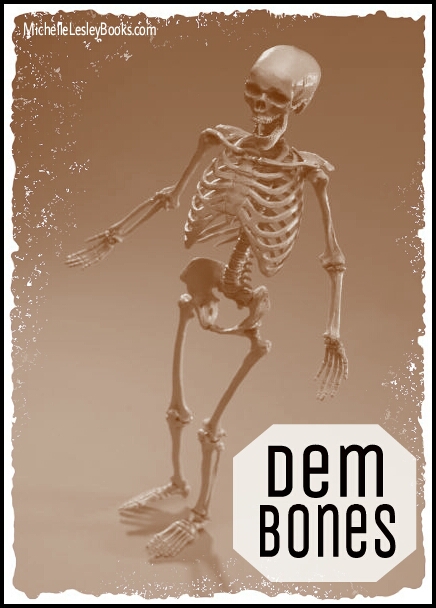
Dem Bones ~ Sunday School Lesson ~ 9-14-14

Dem BonesThese are my notes from my ladiesโ€™ Sunday School class this morning. Iโ€™ll be posting the notes from my class here each week. Click here for last week’s lesson.

Through the Bible in 2014 ~ Week 37 ~ Sep. 7-13
Ezekiel 35-48, Joel
Dem Bones

And beginning with Moses and all the Prophets, [Jesus] interpreted to them in all the Scriptures the things concerning himself. Luke 24:27

The most beautiful thing about the Old Testament is that Jesus’ fingerprints are all over it. The imagery and symbolism displaying His life and the gospel pop out from the least expected places to surprise and delight us. And at the same time we see the “far,” New Testament application, of Old Testament passages, we can also see the “near,” or immediate application the passage has for the Bible characters the story is literally happening to. It’s like getting two lessons in one.

Ezekiel 37:1-14

Something Old
God sent this vision to Ezekiel the night before the messenger came with word of the fall of Jerusalem. The people of Israel were devastated and fearful, and this vision was meant to comfort and reassure them.

The valley (1) represented the areas of the world to which Israel and Judah had been (or would shortly be) exiled. As the skeletons were scattered all over the valley, so God’s people were scattered in various parts of the world.

The bones (2-3, 11) are a picture of death. With exile impending, Israel felt that all hope was dead and gone. The fact that the bones in the valley were “very dry” means that they had been there for quite a while, just as Israel would be in exile for seventy long years. It was the death of life as they knew it.

The prophecy (4-10, 12-14, Jeremiah 3:12, Isaiah 54:8, Psalm 30:5) this time, after so many prophecies of God’s coming wrath, was a prophecy of hope and restoration. God would breathe the breath of life and hope back into Israel. He would raise them up out of the grave of those pagan lands and resurrect them to a new life back in the Promised Land.

Go, and proclaim these words toward the north, and say, โ€œโ€˜Return, faithless Israel, declares the Lord. I will not look on you in anger, for I am merciful, declares the Lord; I will not be angry forever. (Jer.)

In overflowing anger for a moment I hid my face from you, but with everlasting love I will have compassion on you,โ€ says the Lord, your Redeemer. (Is.)

For his anger is but for a moment, and his favor is for a lifetime. Weeping may tarry for the night, but joy comes with the morning. (Ps.)

What a kind and compassionate God! He justly executes judgment, but graciously forgives sin when His people repent.

Something New
The first layer of our lesson today was the “near” application– the literal, immediate application to Israel. From that, we’ve learned that God will not tolerate idolatry, that He is patient with His children, but does discipline them, and that He is merciful and forgiving towards Israel.

The second layer of the story is the “far,” or New Testament layer. It takes those attributes of God and redemption that we’ve just learned about in Israel’s story and shows us how Jesus “fleshed them out.”

The valley (1) could be anywhere. People are scattered over the whole earth just the way the bones were scattered across the valley.

The bones (2-3, 11, Ephesians 2:1-2a, John 15:16; 6:44, Hebrews 11:6, Romans 6:23) are people who are still dead in sin and have never come to repentant faith in Jesus Christ.

Let’s take a look at Ephesians 2:

And you were dead in the trespasses and sins in which you once walked.

Prior to salvation, we are spiritually dead. Just like a corpse can’t move, act, think, or decide, we can’t do anything to choose God (Jn. 15), or please Him (Heb.), or decide on our own to get saved (Jn. 6).

And not only are we spiritually dead during our time on earth, but eternal death awaits us when our earthly lives are over (Rom.). Without Christ, we are born dead, live dead, and die unto eternal death.

Gives you kind of a hopeless feeling (like the Israelites had) doesn’t it?

The prophecy (4-10, 12-14, Matthew 13:57, John 11:25-26; 3:6-7; 16:7; 20:22, 2 Timothy 3:16, Romans 6:4, Ephesians 2:4-7, 2 Corinthians 1:22)
Just like God sent the prophet Ezekiel -“Son of Man” (God calls him this 93 times)- to his people with the good news of the hope of new life, He sent His Son -also called the “Son of Man” (87 times in the New Testament)- the greatest prophet (Matt.), not just to proclaim the good news of new life, but to become that good news by giving His life on the cross so that we might not die, but live.

Verse 6 says: And I will lay sinews upon you, and will cause flesh to come upon you, and cover you with skin, and put breath in you, and you shall live, and you shall know that I am the Lord.โ€

At Lazarus’ tomb, “Jesus said to her, โ€œI am the resurrection and the life. Whoever believes in me, though he die, yet shall he live, and everyone who lives and believes in me shall never die. Do you believe this?โ€ (Jn. 11)

Just as Ezekiel prophesied to the bones (7-10) and they were born again from the dead, Jesus preached, “You must be born again.” (Jn. 3:7). And just as the bodies in verse 8 were fully fleshed out but had no spirit in them, Jesus said, “That which is born of the flesh is flesh, and that which is born of the Spirit is spirit.” (Jn. 3:6)

Ezekiel prophesied to the breath and it entered the dead bodies and brought them to life. You may have a footnote in your Bible on the word “breath” in verse 5, 6, 9, or 10 that says “or spirit.” The Hebrew (the Old Testament was written in Hebrew) word ruah is the same for “breath” or “spirit.”

In John 16, Jesus prophesied to His disciples that the Holy Spirit would come and fill them: “Nevertheless, I tell you the truth: it is to your advantage that I go away, for if I do not go away, the Helper will not come to you. But if I go, I will send him to you.”

And in John 20: “…he [Jesus] breathed on them [the disciples] and said to them, โ€œReceive the Holy Spirit.”

Interestingly, the Greek (the New Testament was written in Greek) word pneuma means both “spirit” and “breath.” You probably recognize this Greek word as the root of our English word “pneumonia,” a disease of the lungs, or “breath.” The branch of theology that deals with the study of the Holy Spirit is called pneumatology. When 2 Timothy 3:16 says, “All Scripture is inspired by God…” the word translated “inspired” is theopneustos, or God (theo) breathed (pneustos). It is not until the Holy Spirit, the breath of life, enters us that we are “raised to walk in newness of life.” (Rom.)

As God said to Israel in verses 13-14, “And you shall know that I am the Lord, when I open your graves, and raise you from your graves, O my people. And I will put my Spirit within you, and you shall live, and I will place you in your own land. Then you shall know that I am the Lord; I have spoken, and I will do it, declares the Lord.โ€

so He says to us in Ephesians 2, “But God, being rich in mercy, because of the great love with which he loved us, even when we were dead in our trespasses, made us alive together with Christโ€”by grace you have been savedโ€” and raised us up with him and seated us with him in the heavenly places in Christ Jesus, so that in the coming ages he might show the immeasurable riches of his grace in kindness toward us in Christ Jesus.”

“and who has also put his seal on us and given us his Spirit in our hearts as a guarantee.” (2 Cor.)

Something Borrowed, Just for You
We have seen the “near” application to the Israelites, and the “far” application to the gospel, so what is the “now” application for us? What can we “borrow” from this passage to do in our own walk with the Lord?

We are to follow in the footsteps of Ezekiel and Jesus and preach (share) the gospel of the resurrection to new life to dry, dead bones, and pray God to do His mighty work of raising sinners from the dead.

Can these bones live? Oh, Lord God, You know.

Faith, Gospel, Salvation, Sin, Throwback Thursday, Tragedy

Throwback Thursday ~ Never Forget…

Originally Published September 11, 2013

9-11neverforgetNever forget.

We will remember.

The words jump off the page, off the screen, from our lips. A haunting breath whispering of unspeakable tragedy and heart rending grief.

The terrorist attacks of September 11, 2001 did something to this country. It changed our history. It changed us.

It was a despicable act of cruelty. People innocent of any crime against their executioners were brutally slaughtered in service to a god who demands the death of infidels.

It was egregious. Horrific. Abominable. And we will never forget. Nor should we.

Do this in remembrance of Me.

The words lie quietly on the page, beckoning us back to another day. A day dusty with the passing of centuries. But it changed our history. It changed us.

It was a despicable act of cruelty. Jesus, innocent of any crime, was brutally slaughtered by executioners serving a God who demands the death of infidels.

But this was no infidel. This was no innocent victim dying needlessly and for no one. This was God Himself laying down His life to take the place of the infidel. You. Me. He satisfied His own wrath against us by pouring it out on His Son.

The cross drove a stake into the heart of sin and death that day and shouted across the expanse of creation, “NO MORE.”

It was egregiously beautiful. A horrific triumph. Abominably liberating. And we will never forget. Nor should we.

cross_phixr

Top 10

Top Ten: Favorite Passages from Isaiah

Top 10 Isaiah

ย 

1. Isaiah 53:2-5
2 For he grew up before him like a young plant,
ย  ย  and like a root out of dry ground;
he had no form or majesty that we should look at him,
ย  ย  and no beauty that we should desire him.
3 He was despised and rejected by men;
ย  ย  a man of sorrows, and acquainted with grief;
and as one from whom men hide their faces
ย  ย  he was despised, and we esteemed him not.
4 Surely he has borne our griefs
ย  ย  and carried our sorrows;
yet we esteemed him stricken,
ย  ย  smitten by God, and afflicted.
5 But he was pierced for our transgressions;
ย  ย  he was crushed for our iniquities;
upon him was the chastisement that brought us peace,
ย  ย  and with his wounds we are healed.

2. Isaiah 40:8ย 
The grass withers, the flower fades,
ย  ย  but the word of our God will stand forever.

3. Isaiah 9:6ย 
For to us a child is born,
ย  ย  to us a son is given;
and the government shall be upon his shoulder,
ย  ย  and his name shall be called
Wonderful Counselor, Mighty God,
ย  ย  Everlasting Father, Prince of Peace.

4. Isaiah 64:6ย 
We have all become like one who is unclean,
ย  ย  and all our righteous deeds are like a polluted garment.
We all fade like a leaf,
ย  ย  and our iniquities, like the wind, take us away.

5. Isaiah 55:6-9
โ€œSeek the Lord while he may be found;
ย  ย  call upon him while he is near;
7 let the wicked forsake his way,
ย  ย  and the unrighteous man his thoughts;
let him return to the Lord, that he may have compassion on him,
ย  ย  and to our God, for he will abundantly pardon.
8 For my thoughts are not your thoughts,
ย  ย  neither are your ways my ways, declares the Lord.
9 For as the heavens are higher than the earth,
ย  ย  so are my ways higher than your ways
ย  ย  and my thoughts than your thoughts.

6. Isaiah 53:6ย 
All we like sheep have gone astray;
ย  ย  we have turnedโ€”every oneโ€”to his own way;
and the Lord has laid on himย  ย  the iniquity of us all.

7. Isaiah 30:18ย 
Therefore the Lord waits to be gracious to you,
ย  ย  and therefore he exalts himself to show mercy to you.
For the Lord is a God of justice;
ย  ย  blessed are all those who wait for him.

8. Isaiah 49:13
Sing for joy, O heavens, and exult, O earth; break forth, O mountains, into singing! For the Lord has comforted his people and will have compassion on his afflicted.

9. Isaiah 44:22
I have blotted out your transgressions like a cloud and your sins like mist; return to me, for I have redeemed you.

10. Isaiah 7:14
Therefore the Lord himself will give you a sign. Behold, the virgin shall conceive and bear a son, and shall call his name Immanuel.ย 

The Holy Bible, English Standard Version Copyright ยฉย 2001 byย Crossway Bibles, a division of Good News Publishers.

Those are some of my favorites.
Do you have a favorite verse from Isaiah?

Wednesday's Word

Wednesday’s Word ~ Mark 1

For further study on the book of Mark, try my study, Mark: Godโ€™s Good News for the Gentiles, from which this lesson is excerpted.

Mark 1

1 The beginning of the gospel of Jesus Christ, the Son of God.

2 As it is written in Isaiah the prophet,

โ€œBehold, I send my messenger before your face,
    who will prepare your way,
3 the voice of one crying in the wilderness:
    โ€˜Prepare the way of the Lord,
    make his paths straight,โ€™โ€

4 John appeared, baptizing in the wilderness and proclaiming a baptism of repentance for the forgiveness of sins. 5 And all the country of Judea and all Jerusalem were going out to him and were being baptized by him in the river Jordan, confessing their sins. 6 Now John was clothed with camel’s hair and wore a leather belt around his waist and ate locusts and wild honey. 7 And he preached, saying, โ€œAfter me comes he who is mightier than I, the strap of whose sandals I am not worthy to stoop down and untie. 8 I have baptized you with water, but he will baptize you with the Holy Spirit.โ€

9 In those days Jesus came from Nazareth of Galilee and was baptized by John in the Jordan. 10 And when he came up out of the water, immediately he saw the heavens being torn open and the Spirit descending on him like a dove. 11 And a voice came from heaven, โ€œYou are my beloved Son; with you I am well pleased.โ€

12 The Spirit immediately drove him out into the wilderness. 13 And he was in the wilderness forty days, being tempted by Satan. And he was with the wild animals, and the angels were ministering to him.

14 Now after John was arrested, Jesus came into Galilee, proclaiming the gospel of God, 15 and saying,โ€œThe time is fulfilled, and the kingdom of God is at hand; repent and believe in the gospel.โ€

16 Passing alongside the Sea of Galilee, he saw Simon and Andrew the brother of Simon casting a net into the sea, for they were fishermen. 17 And Jesus said to them, โ€œFollow me, and I will make you become fishers of men.โ€ 18 And immediately they left their nets and followed him. 19 And going on a little farther, he saw James the son of Zebedee and John his brother, who were in their boat mending the nets. 20 And immediately he called them, and they left their father Zebedee in the boat with the hired servants and followed him.

21 And they went into Capernaum, and immediately on the Sabbath he entered the synagogue and was teaching. 22 And they were astonished at his teaching, for he taught them as one who had authority, and not as the scribes. 23 And immediately there was in their synagogue a man with an unclean spirit. And he cried out, 24 โ€œWhat have you to do with us, Jesus of Nazareth? Have you come to destroy us? I know who you areโ€”the Holy One of God.โ€ 25 But Jesus rebuked him, saying, โ€œBe silent, and come out of him!โ€ 26 And the unclean spirit, convulsing him and crying out with a loud voice, came out of him. 27 And they were all amazed, so that they questioned among themselves, saying, โ€œWhat is this? A new teaching with authority! He commands even the unclean spirits, and they obey him.โ€ 28 And at once his fame spread everywhere throughout all the surrounding region of Galilee.

29 And immediately he left the synagogue and entered the house of Simon and Andrew, with James and John. 30 Now Simon’s mother-in-law lay ill with a fever, and immediately they told him about her. 31 And he came and took her by the hand and lifted her up, and the fever left her, and she began to serve them.

32 That evening at sundown they brought to him all who were sick or oppressed by demons. 33 And the whole city was gathered together at the door. 34 And he healed many who were sick with various diseases, and cast out many demons. And he would not permit the demons to speak, because they knew him.

35 And rising very early in the morning, while it was still dark, he departed and went out to a desolate place, and there he prayed. 36 And Simon and those who were with him searched for him, 37 and they found him and said to him, โ€œEveryone is looking for you.โ€ 38 And he said to them, โ€œLet us go on to the next towns, that I may preach there also, for that is why I came out.โ€ 39 And he went throughout all Galilee, preaching in their synagogues and casting out demons.

40 And a leper came to him, imploring him, and kneeling said to him, โ€œIf you will, you can make me clean.โ€ 41 Moved with pity, he stretched out his hand and touched him and said to him, โ€œI will; be clean.โ€ 42 And immediately the leprosy left him, and he was made clean. 43 And Jesus sternly charged him and sent him away at once, 44 and said to him, โ€œSee that you say nothing to anyone, but go, show yourself to the priest and offer for your cleansing what Moses commanded, for a proof to them.โ€ 45 But he went out and began to talk freely about it, and to spread the news, so that Jesus could no longer openly enter a town, but was out in desolate places, and people were coming to him from every quarter.


The Holy Bible, English Standard Version Copyright ยฉ 2001 by Crossway Bibles, a division of Good News Publishers.


Questions to Consider:

1. What is the theme or purpose of the book of Mark? What is the historical backdrop for the book of Mark?

2. What two titles does Mark ascribe to Jesus in verse 1? What does the word โ€œChristโ€ mean, and why is it an important title for Jesus? What does it mean that Jesus is the โ€œSon of Godโ€œ? How do verses 21-45 demonstrate that Jesus is, indeed, the promised Messiah, and that He is divine? How does Mark 1:1-20 โ€œcredentializeโ€ Jesus and lay the foundation for what he does in verses 21-45?

3. How does Johnโ€™s message of repentance preceding Jesusโ€™ message of the gospel demonstrate that repentance is a crucial aspect of saving faith in Christ? (1-15) Would God have sent John to preach the message of repentance if He did not consider it a vital part of salvation? What does Mark indicate was the theme of the message Jesus preached? (15) Some people say repentance is not necessary for salvation- that only belief in Jesus is necessary. Did Jesus consider repentance to be part of the gospel? (15)

4. Examine verses 9-11. Since Jesus was without sin, why did He take part in a baptism of repentance? How does Jesusโ€™ baptism set an example for believers to follow Him in being baptized? How does this passage reveal the Trinity (God the Father, God the Son, God the Holy Spirit) to us? How does this passage refute the false teaching of modalism/Sabellianism and show us that God is one God in three Persons?

5. What are the three main categories of ministry Jesus engages in in 21-45? Do you think Jesus would have preferred to be known more for His teaching or for His miracles? Why?