Discernment Bible Study

Choose What Is Right: A Study in Discernment- Lesson 7


Previous Lessons: 1, 2, 3, 4, 5, 6


Refuse to Heed the Shepherd and You’ll Have the Wool Pulled Over Your Eyes

Todayโ€™s Scripture passages are embedded in the body of the study. Please click the links in each question.


Questions to Consider

Throughout this study we will be looking at various passages of Scripture rather than working our way through a book of the Bible verse by verse. Because of that, we will need to be extra vigilant to rightly handle these passages in context. I will always attempt to provide the context you need for understanding these passages correctly, but if you need more clarity please feel free to read as much of the surrounding text as you need to – even the whole book, if necessary – in order to properly understand the passage presented.

1. We need a firm foundation. What is that firm foundation? First and Second Timothy and Titus comprise what are known as the “pastoral epistles”. They are God’s instructions, via Paul, to Timothy, Titus, and all other pastors about how to run the church. I often liken the pastoral epistles to a “policy and procedure manual” for the church.

Even in these three very brief epistles, God has a lot to say about sound and false doctrine, and sound and false teachers. Read these passages from the pastoral epistles (you may wish to read more of the surrounding verses for context). What is the foundation of a healthy church? How does a foundation of being intentional and purposeful to preach and teach sound doctrine protect a church against the infiltration of false doctrine and false teachers?

Meditate on Paul’s solemn charge to pastors in the 2 Timothy 4:1-2 passage. Explain exactly what he is saying in these verses. Would you liken this charge to a vow or “oath of office”? Why or why not? Put yourself in Timothy’s sandals. Do you feel the weightiness of this charge and responsibility? How so?

As Paul is preparing to leave the Ephesian church, he mentions two ways, in Acts 20:29-30, in which false teachers can infiltrate the church. What are those two ways? How does a solid foundation of sound doctrine help guard against false teachers coming into the church from the outside, and prevent those who are already church members from believing false doctrine and becoming false teachers inside the church?

2. Regarding discernment, why do we need the firm foundation of the preaching and teaching of sound doctrine? Examine these passages. (Compare the verse references to the passages from question 1. See the proximity and context?) Why, in the context of discernment, is the teaching and preaching of sound doctrine so crucial? What will happen to those who refuse to heed sound doctrine? Which adjectives does Paul use in the 1 Timothy passage to paint a picture of the deceitfulness of false teachers? How does Paul address the idea of people being deceived and departing from the faith in these passages – as a possibility or a certainty? (Hint: Look for the word “will”.)

3. How is this deception accomplished? Are these people who “depart from the faith” deceived solely by the false teachers, self-deceived, or both?

Study these passages. What do they tell us about a person’s role in her own deception? Who is taking the initiative in these two passages, the false teachers/prophets, or the people who want to follow them? In the Isaiah passage, before the people turn to the seers and prophets in verse 10, how does verse 9 describe them? What have they already turned from? In the 2 Timothy passage, before the people turn to false teachers (3b) and myths (4b), what have they already turned away from (3a, 4a)?

Compare 2 Timothy’s “they will accumulate for themselves” and “teachers to suit their own passions” (3b) with Isaiah’s 10-11. How did the people in Isaiah proactively pursue or accumulate false teachers? What were “their own passions” they wanted to suit? Are people who turn to false teachers hapless, powerless victims of those false teachers or willing participants in their own deception?

Again, what happens when you “refuse to heed the Shepherd” (Jesus, His Word, sound doctrine, etc.)? Think about the nature and definition of the word “deceived”. Do deceived people know they’re deceived?

But if every teacher out there only taught sound doctrine, would self-deceived people be able to accumulate teachers to themselves to suit their own passions? It’s kind of a symbiotic relationship, isn’t it?

Study these passages. What do all of these passages say false teachers disguise themselves as? Make a list of the words and phrases from each passage that led you to your answer:

  • 2 Corinthians 11:
  • Galatians 2:
  • 2 Peter 2:
  • Titus 1:

Think about some of the false teachers you’re aware of (or check here if you need a little help). Do any of them go by the title “False Teacher”? Introduce themselves as false teachers? Write books and give interviews as experts in the field of false teaching? What titles do they go by? What do they want to be known as?

In the 2 Corinthians passage, what does Paul say the false apostles claim? (12) Are their claims true? (13) What three words in verse 13 indicate that these men are not honest? Compare verses 14-15 with Jesus addressing the Pharisees (the false teachers of His day) in John 8:42-47. Who is the spiritual “father” of these false teachers in both passages? Who do they actually serve? Are they actually Christians, as they claim to be? What does Paul mean, “Their end will correspond to their deeds.”(15)? What will their end be? (Hint- use your cross references)

Why do you think some professing Christians believe even the most egregious false teachers are actually Christians despite what these passages teach to the contrary? Is it fair to say they are believing the false teacher’s word over God’s Word?

Compare the 2 Corinthians passage and the John 8 passage above with Genesis 3:1-7. What similarities do you see when it comes to the descriptions of Satan’s character and methods?


Homework

Read 1 & 2 Timothy and Titus. Carefully examine each passage that deals with either the need to preach and teach sound doctrine or the need to rebuke and refute false teachers or false doctrine. Why is the proactive, purposeful, and intentional teaching of sound doctrine vital to the health of the church? How does sound doctrine itself refute false doctrine? Why is it imperative to rebuke and remove unrepentant false teachers from the church?

A common argument against the public rebuke and refutation of false teachers is that, “You shouldn’t warn against them, you should just pray for them.” (see #10 here). How would you answer that argument with the passages you examined in 1 & 2 Timothy and Titus?

You may wish to refer to parts of my studies on the pastoral epistles as you study:

1 & 2 Timothy: The Structure and Spirit of the Church

Titus: God’s Order of Service


Suggested Memory Verse

Discernment

Throwback Thursday ~ Discernment Hysteria and the God Who Wins

Originally published April 8, 2016
There are a lot of different facets to Christianity. Thereโ€™s worship. Fellowship with other Christians. Studying Godโ€™s Word alone, with our families, and with the local church. Evangelism. Serving at church. Teaching. Discipling other believers. Prayer. All of these things, and others, are vital to a healthy, growing relationship with Christ.

But things can get out of whack if we focus too much on any one of these areas to the neglect of others. Spend too much time in prayer, and you could overlook serving others. Focus on evangelism too much, and your Bible study time might suffer. It can be tricky, but itโ€™s important that we keep a good balance in our walk with the Lord.

If youโ€™re like me you probably have one or two areas that youโ€™re tempted to go overboard in. My temptation is studying, particularly in the area of discernment- false doctrine and false teachers. Itโ€™s a fascinating topic, and people educated in the field of discernment and doctrine are desperately needed in the church today.

But if you spend a lot of time studying discernment โ€“and many do- it can get pretty discouraging pretty quickly. You begin to realize just how pervasive false doctrine is and how many false teachers there are. Itโ€™s in your church, at your childโ€™s Christian school, on your Christian radio and TV stations, in your Christian bookstore. Itโ€™s everywhere. And itโ€™s not just the home grown heretics who spring from the soil of already apostate โ€œchurches.โ€ Weโ€™ve also got men and women who were once trustworthy teachers and preachers of Godโ€™s Word turning traitor and joining the forces of evil at an alarming rate. They just keep coming and coming, always more and more. Itโ€™s starting to feel like Invasion of โ€œThe Bodyโ€ Snatchers.

False teachers just keep coming and coming. Itโ€™s starting to feel like Invasion of โ€œThe Bodyโ€ Snatchers.

I hear often from women approaching panic and frenzy over the state of the church. And I get that, because I regularly feel the same way. But for all of us, there are some great reasons to take a step back when we get overwhelmed. To breathe, to relax, and to rejoice in some good news in the midst of the heresy hurricane.

There are some great reasons to take a step back when we get overwhelmed. To breathe, to relax, and to rejoice in some good news in the midst of the heresy hurricane.

God is both sovereign and just.

And praise His name for that. Nothing, and I mean nothing, escapes His notice. He sees everything- every thought, every action. There is going to come a day of reckoning for the enemies of God. They will get exactly what they deserve, and God will be good for punishing them. When itโ€™s all said and done, nobodyโ€™s getting away with anything, and nothing is going to slip through the cracks.

And no creature is hidden from his sight, but all are naked and exposed to the eyes of him to whom we must give account.
Hebrews 4:13

It is Godโ€™s job to preserve the church, not ours.

Thousands of years. Extreme idolatry and blasphemy. War. Exile. And yet God preserved a remnant of His people throughout the Old Testament. He preserved the church through its infancy of persecution and heresy. And He will continue to preserve His church today. Should we fight false doctrine the best we can? Yes. Will some local churches fold and apostasize? Yes. But, saving the church is way too big a job for us. Ultimately, the burden of preserving the Bride is on the Bridegroom.

Christ loved the church and gave himself up for her, that he might sanctify her, having cleansed her by the washing of water with the word, so that he might present the church to himself in splendor, without spot or wrinkle or any such thing, that she might be holy and without blemish.
Ephesians 5:25b-27

Godโ€™s Word isnโ€™t changing.

It doesnโ€™t matter how loudly people scream that this sin or that sin is OK. It doesnโ€™t matter how many people teach the most unbiblical false doctrine or how widespread its acceptance is. Godโ€™s Word is Godโ€™s Word. And Godโ€™s Word changes for no man. The Bible – not anyoneโ€™s opinion or the general consensus of sinful humans – is the standard God has issued and the rod of judgment He will wield. Godโ€™s Word isnโ€™t going anywhere.

for
โ€œAll flesh is like grass
    and all its glory like the flower of grass.
The grass withers,
    and the flower falls,
but the word of the Lord remains forever.โ€
1 Peter 1:24-25

It doesnโ€™t matter how many people teach the most unbiblical false doctrine or how widespread its acceptance is. Godโ€™s Word is Godโ€™s Word. And Godโ€™s Word changes for no man.

The gospel still has the power to save.

God is mightier to save than any false teacher is to deceive. Get out there and keep faithfully scattering that gospel seed and proclaiming Godโ€™s truth. A lot of people will reject it – just like they did when Jesus preached it โ€“ but some will listen and be saved. Theyโ€™re worth it.

Behold, the Lord’s hand is not shortened, that it cannot save, or his ear dull, that it cannot hear;
Isaiah 59:1

God is mightier to save than any false teacher is to deceive.

Heaven awaits.

Look around. This is all just temporary. In Heaven, there is no false doctrine. There are no false teachers. There will be no more contending for the faith. We will all finally be able to worship Christ in the splendor of His holiness with out any hint of error impeding us or infiltrating the Body.

Then I saw a new heaven and a new earth, for the first heaven and the first earth had passed away, and the sea was no more. And I saw the holy city, new Jerusalem, coming down out of heaven from God, prepared as a bride adorned for her husband. And I heard a loud voice from the throne saying, โ€œBehold, the dwelling place of God is with man. He will dwell with them, and they will be his people, and God himself will be with them as their God.
Revelation 21:1-3

Be encouraged my sisters, and donโ€™t grow weary in well doing. Because God is mighty. He is still on His throne. He is still saving souls.

And hear me, and cling to this as you walk through this evil world: God wins.

Let that sink in and drive you to rejoice and worship. The devil may do his worst in the world, but God wins.

he wins

Cling to this as you walk through this evil world: God wins. Let that sink in and drive you to rejoice and worship. The devil may do his worst in the world, but GOD WINS.

Mailbag, Parenting

The Mailbag: Potpourri (Rescinding a recommendation… Women at the Last Supper… Consistent discipline)

Welcome to another โ€œpotpourriโ€ edition of The Mailbag, where I give short(er) answers to several questions rather than a long answer to one question.

I like to take the opportunity in these potpourri editions to let new readers know about my comments/e-mail/messages policy. Iโ€™m not able to respond individually to most e-mails and messages, so here are some helpful hints for getting your questions answered more quickly. Remember, the search bar (at the very bottom of each page) can be a helpful tool!

Or maybe I answered your question already? Check out my article The Mailbag: Top 10 FAQs to see if your question has been answered and to get some helpful resources.


Our women’s ministry team recently asked all of us Bible study teachers to promote the study they have chosen, and I personally recommended it to the women in my class. I told them โ€œI donโ€™t know anything about the author and havenโ€™t read the study, but I trust the women’s ministry team and recommend you participate.โ€ That afternoon I began researching her and discovered she was a woman pastor. I immediately contacted the womenโ€™s coordinator and shared my concerns.

I feel TERRIBLE that I have recommended a woman whose life choices make her a stumbling block to the gals I dearly love and have taught for years. My first instinct is to send my students only an email rescinding my recommendation and warning them that the author routinely preaches in her local church. I am torn between protecting them from a very beguiling threat and the implications a warning has for exposing the women’s ministry team. LESSON LEARNED for future recommendations, but for now, what is my Biblical obligation/priority?

That’s a difficult spot to be in. I’ve been there myself, having passed along a recommendation from someone I thought was discerning and trustworthy, only to find out later that she was not.

Here’s what I would suggest:

  • If you haven’t already, get alone with the Lord in prayer and repent of your carelessness. There is grace, mercy, and forgiveness awaiting you.

  • Write out a carefully, kindly, and wisely worded email to your class apologizing for your carelessness and explaining why you need to rescind your recommendation. Support everything you say with Scripture. (If you think it would be helpful, you may wish to include a link to this article of mine.) Don’t hit “send” yet.

  • Talk to your pastor before you do anything else. Explain the situation, plead with him to cancel the study, tell him (don’t ask him) your conscience demands that you send an email to your class rescinding your recommendation of the study, and offer to show it to him if he’d like to see it.

  • I pray your pastor will cancel the study. I really do. That will take the pressure off of you. You will still need to apologize to your class and explain why you agree with the pastor’s decision to cancel the study. Unfortunately, in situations like this, the pastor almost always backs up the study and the women’s director, not the discerning Christian who comes to him with concerns.

  • If your pastor affirms the study and the women’s ministry leader, express your disappointment calmly and politely, and reiterate that you must still send the email. Go to the women’s ministry leader, and as a gesture of courtesy, explain that you’ll be sending an email to your class rescinding your recommendation. Then, send the email.

  • Immediately begin looking for a new, doctrinally sound church. Women who are “pastors” and/or preach to men are false teachers. They preach with their behavior, “I don’t like this command of Scripture, so I’m not going to obey it. If there’s a command of Scripture you don’t like, you don’t have to obey it either.”. If your pastor is so doctrinally ignorant or unsound that he affirms this sin and false teaching, you don’t need to be sitting under his teaching and leadership.

What are the Scripture verses that back up the teachings that women were at the last supper? I know that this is something Iโ€™ve heard before, yet now my grandson is asking me about it because thatโ€™s what he learned in school.

There aren’t any. In fact, I’ve never heard anyone claim that any person – man or woman – other than Jesus and the twelve disciples were in attendance at the Last Supper.

  • The Matthew account says Jesus “reclined at table with the twelve.”
  • The Mark account says Jesus “came with the twelve. And as they were reclining at table and eating…”
  • The Luke account says Jesus “reclined at table, and the apostles with him.”
  • The John account focuses more on Jesus’ teaching at and after the supper than the actual supper itself, but even John says, “During supper” (v.2) Jesus “began to wash the disciples’ feet…” (v.5)

When you consider all four of the gospel accounts together, there is absolutely no argument to be made that anyone was present at the Last Supper besides Jesus and the twelve. There were no women among the twelve. There were no women apostles. Therefore, no women were at the Last Supper.

I’m guessing what happened is that somebody – perhaps Catholicism, in order to elevate Mary, or perhaps feminists, in order to make Jesus seem like an egalitarian – took a mention of “disciples” (without “the twelve” in front of it) from one of these passages and decided that could mean any follower of Jesus he or she wanted it to mean (most likely Mary, the mother of Jesus, or Mary Magdalene).

If your grandson is asking questions like this, take him to Scripture and teach him how to be a good Berean. Show him how to look up the passages in question and compare what he’s being taught to what the Bible actually says.

And if you have a relationship with his parents that allows you to express your concerns about what he’s being taught at school, express them (kindly, yet seriously, taking care not to be overbearing). I shudder to think about all the unbiblical things that school is indoctrinating your grandson with that he’s not asking you about.


I am a Christian mom, and I rarely accept back talk from my son. I always call it out, and usually give him some kind of discipline, but it doesn’t seem to improve things. Is there a secret formula?๐Ÿ˜ƒ

That’s something a lot of moms deal with, and I know it’s got to be frustrating. Good for you for looking for ways to make your discipline more effective!

If what you’re doing isn’t working, your discipline either isn’t severe enough or isn’t consistent enough, or both. Discipline has to hurt in order to be effective.

A good example of the importance of consistency is an experiment I learned about when I was a psychology major back in the Stone Age. We were studying conditioning (training a subject in a behavior), and a lot of the studies we looked at had to do with training rats to push a lever for a pellet of food. Some rats got a pellet every time they pushed the lever. Some never got a pellet. Some got a pellet sometimes. Those were the rats who pushed the lever the most because they never knew when they would be rewarded with food or “punished” with none.

It’s the same with inconsistent discipline. You’re actually increasing the undesired behavior by being inconsistent because your child never knows whether that bad behavior is going to be rewarded, ignored, or punished. This is also part of what Ephesians 6:4 is talking about when it says not to exasperate your children.

Especially with boys, Dad needs to be involved. Your son needs to know that if he doesn’t respond to your discipline, Dad is going to step in and take over. The two of you should sit down, talk this through, and put a plan in place for how to work this out in various situations.

Also helpful would be to find a couple in your church whose children are well behaved and respectful and ask them to disciple you and your husband in this area.

Get those things going, and you’ll see improvement.


If you have a question about: a Bible passage, an aspect of theology, a current issue in Christianity, or how to biblically handle a family, life, or church situation, comment below (Iโ€™ll hold all questions in queue {unpublished} for a future edition of The Mailbag) or send me an e-mail or private message. If your question is chosen for publication, your anonymity will be protected.

Discernment

Throwback Thursday ~ Amputating Discernment Ministry from the Body of Christ

Originally published February 2, 2018

“There’s no place for Christian blogs and podcasts. Preaching, teaching, and encouragement should only be done by pastors and teachers in the local church.”

“Open air preaching ministry needs to go the way of the dinosaur.”

“Pro-life ministry organizations just cause too much strife. Lost people are going to reject the gospel because of them.”

“The Bible nowhere mentions Christian legal defense organizations.”

You’ve probably never heard someone give one of these statements as a reason for doing away with podcasts or street preaching or the ADF, but these days it seems like everybody – including doctrinally sound, discerning Christians – is screaming, “Off with its head!” about parachurch discernment ministries for these supposed reasons, and others. It’s become the bandwagon du jour. The popular whipping boy for Christian social media. The here-today-gone-tomorrow zeitgeist of online evangelicalism.

Among those who wish to amputate discernment ministry from the Body are good, solid, loving, godly brothers and sisters in Christ. I just wish they realized that there are many of us on this side of the discernment fence who are also good, solid, loving, godly brothers and sisters in Christ.

Among those who wish to amputate discernment ministry from the Body are good, solid Believers. I just wish they realized that there are many of us on this side of the discernment fence who are *also* good, solid Believers.

It is a sad irony that the genuinely good guys who are clamoring for the death of discernment ministry are, in some cases themselves doing the very things they accuse discernment ministries of doing. While they may give a brief hat tip to “some discernment ministries aren’t so bad”, in calling for the disbanding of discernment ministry across the board, they effectively lump everyone who does any sort of discernment work – regardless of how infrequently or how biblically it’s done – into the same category as those who indiscriminately lob a constant barrage of truth-bending, vitriolic grenades at everyone from the rankest heretic to the reputable, doctrinally sound brother who has a slightly different take on their eschatological view. And in the same way it wouldn’t be fair to throw these brothers and sisters who speak from biblical love and concern for the church into the same bin as “Christians” who scream like banshees about discernment ministry because they just want to worship their idols in peace without their consciences being pricked, it’s not fair to unilaterally declare that discernment ministry should be banned, either.

Rebuke those doing discernment work whose character, behavior, and handling of Scripture is so egregious it disqualifies them from any ministry whatsoever (and, unfortunately, they do exist) but encourage those who do discernment ministry right.

Just like you would with any other ministry.

Rebuke those doing discernment work whose egregious character, behavior, and handling of Scripture disqualifies them from ministry, but encourage those who do discernment ministry right. Just like you would with any other ministry.

Because if there were ever a dire need for discernment ministry done right and biblically, it’s now. Banishing the discerning altogether would be neither biblical nor beneficial to the Body.

Discernment: A Major Theme of the New Testament

The Old Testament is rife with idolatry, syncretism, and false prophets. Every book of the New Testament except Philemon deals in some way with false doctrine or false teachers and the importance of keeping them out of the church and away from Christians. It is a major issue throughout the Bible, but particularly in New Testament theology and ecclesiology. Jesus dealt with it. Paul dealt with it. So did Peter, Jude, John, and other New Testament figures.  Part of the reason the 21st century church is so steeped in false doctrine and enamored with false teachers now is that we have been brushing discernment aside for so long instead of bringing it front and center like the Bible does. If the Holy Spirit – the author of Scripture – considers discernment to be so vital, shouldn’t we?

If the Holy Spirit – the author of Scripture – considers discernment to be so vital, shouldn’t we?

Amputating Body Parts

Now there are varieties of gifts, but the same Spirit; and there are varieties of service, but the same Lord; and there are varieties of activities, but it is the same God who empowers them all in everyone. To each is given the manifestation of the Spirit for the common good. For to one is given through the Spirit…the ability to distinguish between spiritsAll these are empowered by one and the same Spirit, who apportions to each one individually as he wills…But as it is, God arranged the members in the body, each one of them, as he chose. If all were a single member, where would the body be? As it is, there are many parts, yet one body. The eye cannot say to the hand, โ€œI have no need of you,โ€ nor again the head to the feet, โ€œI have no need of you.โ€
1 Corinthians 12:4-8a, 10b, 11, 18-21 (emphasis mine)

Discernment (distinguishing spirits) is just as ontologically valid a spiritual gift – a manifestation of the Holy Spirit – as any of the others listed in 1 Corinthians 12. It is a biblically legitimate gift, service, and activity given for the common good of the church and empowered by the same Spirit, Lord, and God who gives and empowers the spiritual gifts of those who would do away with discernment ministry. Spiritual gifts are given by God and arranged in the Body as He sees fit. It is not for one individual body part to say to another, “I have no need of you.” Selah.

Discernment is a biblically legitimate gift given for the common good of the church and empowered by the same Spirit who gives and empowers the spiritual gifts of those who would do away with discernment ministry.

Check Your Privilege

If you’re a discerning person who goes to a discerning church, has a discerning pastor and elders, and hangs out with discerning friends maybe you don’t see that there’s much of a need for discernment ministry.

And if you lived in Hawaii, you wouldn’t see much of a need for snow shovels, either.

But if you lived in Alaska, you would.

We each exist in our own little bubble of personal experience. And if your bubble is one where pretty much everybody is discerning, make sure you thank God profusely for that every day, because you are extremely blessed. You’re also an extremely rare anomaly, because the vast majority of the rest of Christianity has no clue what that’s like. The 99 per cent-ers live in a bubble that looks like the shelves of your local Christian retailer – some good stuff (if you know where to look) and a whole lot of skubalon. And most of them don’t know the difference because they’ve never been taught. Don’t assume your experience is the norm for everyone.

Maybe you don’t see that there’s much of a need for discernment ministry. And if you lived in Hawaii, you wouldn’t see much of a need for snow shovels, either. But if you lived in Alaska, you would.

Of Course Pastors Should Be Leading the Way

One of the most common arguments I hear against discernment ministry is that it’s the job of the pastor, not discernment ministries, to teach discernment. And with that statement, I could not more heartily agree! Discernment work is half of a pastor’s job description:

He must hold firm to the trustworthy word as taught, so that he may be able to give instruction in sound doctrine and also to rebuke those who contradict it.
Titus 1:9 (emphasis mine)

So let me ask you 99 per cent-ers: when was the last time you heard a pastor rebuke someone who contradicts sound doctrine? Or call a false teacher by name? Or teach about a currently popular false doctrine and warn against it? I am honored to know several pastors who aren’t afraid to faithfully perform this part of their job, and God bless them for it. We need far more pastors like them. Yes, pastors should be spearheading the work of discernment in their local churches. But by and large, they’re not. And the Bible doesn’t say that only pastors have the gift and responsibility of discernment. It is insanity to tell ready, able, and willing laymen with garden hoses to stand down and watch a building burn to the ground while they wait…and wait…and wait…for the professional firemen who may never show up.

Yes, pastors should be spearheading the work of discernment in their local churches. But by and large, they’re not.

But Lost People Will Reject the Gospel!

Lost people already reject the gospel. That’s why they’re lost. They don’t get any lost-er by seeing a discernment ministry critique a false teacher. In fact, I’ve known of lost people who have expressed their thanks to discernment ministries for denouncing the blasphemies of false teachers. Even in their spiritually blind state many unbelievers know a wolf when they see one. Sometimes – to our shame – even better than those who call themselves Christians. When someone rejects the gospel, it is no more the fault of a discernment ministry than it is the fault of a pro-life ministry, a ministry that disciples newly saved homosexuals, or any other type of biblical ministry. God is sovereign in salvation. He will save who He means to save, and no mere mortal is going to prevent Him from doing so.

When someone rejects the gospel, it is no more the fault of a discernment ministry than it is the fault of a pro-life ministry, a ministry that disciples newly saved homosexuals, or any other type of biblical ministry.

Your Comfort Versus Their Souls

Whatever it is that bothers you about discernment ministries, is your state of botheration as important as the spiritual condition of the person that discernment ministry is reaching? Maybe you’re worried about those lost people out there who might reject the gospel because of discernment ministry conflict. Are you just as concerned about the lady in the pew next to you at church who’s every bit as lost as those people “out there” because she listens to false teachers who preach a false gospel that’s made her a false convert? What if a discernment ministry could help her understand the truth of the gospel? It’s happened. I’ve heard many stories of false converts Providentially “stumbling upon” a discernment ministry, hearing the unadulterated gospel for the first time, and getting saved.

What about the Christian woman who spends her quiet time in tears every day because she’s been falsely taught that God will talk to her if she just listens hard enough and has enough faith, and she’s in despair because she’s not hearing from God? What if a discernment ministry could set her free from that burden by teaching her what the Bible really says and steering her away from those who have deceived her? It’s happened. I know it has, because something similar happened to me. Is your annoyance at discernment ministries more important than her spiritual health?

Whatever it is that bothers you about discernment ministries, is your state of botheration as important as the spiritual condition of the person that discernment ministry is reaching?

There is absolutely a place – a good, God-ordained, nobody-puts-Baby-in-a-corner place – for discernment ministry in the Body of Christ. Inside the church, online, in parachurch ministry, from pastors, elders, and laymen alike. Yes, those who abuse their position of ministry – in any ministry – should be rebuked and removed. But we don’t do away with entire spiritual gifts and areas of ministry because of a few bad apples. Instead of amputating, maybe we should be excising gangrenous tissue instead. Otherwise we’ll just be shooting ourselves – the Body – in the foot.

There is absolutely a place – a good, God-ordained, nobody-puts-Baby-in-a-corner place – for discernment ministry in the Body of Christ.

Discernment Bible Study

Choose What Is Right: A Study in Discernment- Lesson 6


Previous Lessons: 1, 2, 3, 4, 5


Sheep Follow the Shepherd,
Not Strangers

Read This Passage


Questions to Consider

Throughout this study we will be looking at various passages of Scripture rather than working our way through a book of the Bible verse by verse. Because of that, we will need to be extra vigilant to rightly handle these passages in context. I will always attempt to provide the context you need for understanding these passages correctly, but if you need more clarity please feel free to read as much of the surrounding text as you need to – even the whole book, if necessary – in order to properly understand the passage presented.

1. Read John 9. Note the motifs of darkness and light, blindness and sight, night and day. What do darkness, blindness, and night represent? What do light, sight, and day represent? What is Jesus saying about Himself in v. 5? What is the spiritual truth Jesus is trying to convey in chapter 9 – to His immediate audience, and to us? In what ways does this story mirror a person being saved?

What is the spiritual parallel and significance of 8-9? In what ways do we look different to others after salvation?

Describe all of “the works of God” (3) that were displayed in the blind beggar – was it simply God’s power to heal, or was there more to this situation than that?

2. Review legalism and antinomianism in lesson 3 (link above). Which kind of false doctrine were the Pharisees displaying in chapter 9? Give some specific examples of their legalistic remarks, accusations, beliefs, etc.

Compare the works of God displayed in the blind beggar to the works of “their father, the Devil” displayed in the Pharisees. What fruit do we see from the works of God? From the works of the Devil? What is the culmination of the works of God (30-32, 35-39)? The culmination of the works of the Devil? (39-41)

3. Compare the healed man’s parents’ fearful response to the Pharisees (18-23) with the healed man’s “wild abandon” response to the Pharisees (17, 24-34). What made the difference between those two responses (35-38)? Can a false teacher have power over someone who has truly been set free in Christ? Why or why not?

4. Describe Jesus’ disposition toward the false teachers in chapter 9. Toward the repentant, victim of the false teachers? What example does this set for us regarding our own disposition toward false teachers versus our disposition toward those who are trapped in false religious systems and need the gospel?

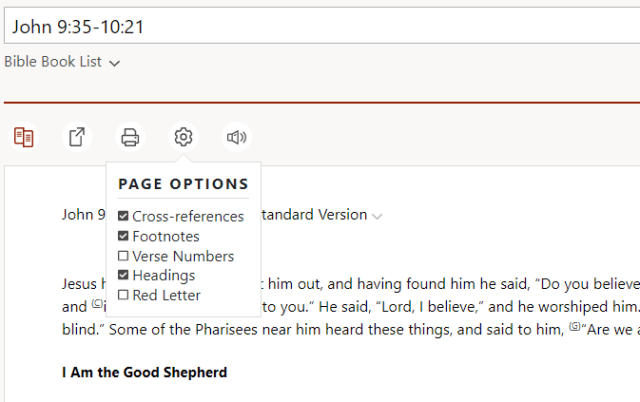
5. Read John 9:35-10:21 without chapter and verse markings. (If you’re using Bible Gateway, just click on the “page options” icon and uncheck “verse numbers”.)

Do you notice the flow from chapter 9 into chapter 10? What does that tell you about the timing and the relationship between the events and remarks in chapter 9 and Jesus’ teaching in chapter 10? (Hint: See 10:21b). How do the events of chapter 9 lay the foundation for the teaching of chapter 10?

6. Carefully study 10:1-21. What type of literary device is Jesus using to illustrate His point in chapter 10? Is Jesus using literal or figurative language in this passage?

Identify who or what each of the following represent (hint: there’s some overlap):

  • The thief/robber (1,8,10)
  • The shepherd (2)
  • The gatekeeper (3)
  • The sheep (3ff.)
  • The stranger (5)
  • The door of the sheep (7,9)
  • The good shepherd (11,14)
  • The hired hand (12,13)
  • The wolf (12)
  • The flock (16)

7. False teachers today often use the phrases “The sheep hear his voice” (3), “they know his voice” (4), “they will listen to my voice” (16), and “My sheep hear my voice” (27), from this passage to teach that Christians should hear God talking to them audibly (extra-biblical revelation). Examine all of the references to listening, hearing, and voice in this passage. Is this passage teaching that you should hear God talking to you audibly? Why not? What role does context play in your answer? If this passage is a metaphor, which uses figurative language, why would the “sheep” part of these phrases be figurative but the “voice/hear/listen” parts be literal?

Explain what Jesus means in 3b-5, 8, 16b, 27 when He says that His sheep listen to His voice and follow Him, and that they will not follow the voice of strangers. What does “knowing” Jesus and His voice (4-5, 14b) have to do with this? Think back over the message of chapter 9. How does having one’s “eyes opened” connect to this?

If genuinely regenerated Christians (Jesus’ sheep), generally speaking, do not follow false teachers (thieves, robbers, strangers), what can we reasonably conclude about people who claim to be Christians, yet whose lives are marked by a consistent trajectory of following false teachers and listening to the voice of false doctrine over a long period of time? Are these people likely to listen to and understand your voice and the voice of Scripture as you point out what is unbiblical about their favorite false teachers? (6) Why not? Thinking back over the message of chapters 9 and 10, what do they need first in order to “see the light”?

Is it possible for a genuine sheep (Christian) to wander a few steps away from the Shepherd toward a false teacher (i.e. temporarily show an interest in a false teacher or false doctrine)? What does a Good Shepherd do when a sheep wanders?

8. Explain why it is crucial for the local church to have a gatekeeper (3) who only opens the door to sound doctrine and the true Jesus of Scripture, and who chases off the thieves, robbers, and strangers (1,5) who sneak in (1)? Compare your answer to Titus 1:9-16.

9. In lesson 5 (link above) we touched on the idea of whether or not a false teacher (someone who consistently and unrepentantly teaches demonstrably false doctrine, not a doctrinally sound teacher who occasionally makes a mistake) could actually be a genuinely regenerated Christian. Notice the way this passage describes false teachers, their goals, and their effects. What inferences can you reasonably draw about a false teacher’s salvation?


Homework

  • I have heard this scenario from Christian women numerous times and experienced it myself, personally: โ€œI went to a womenโ€™s Bible study where they were using a book by __. I sat there and listened, and I just knew something was wrong. I didnโ€™t know my Bible well enough at that time to be able to put my finger on it, but I got out of there, started studying my Bible and researching this teacher, and now I know sheโ€™s a false teacher.โ€ Have you ever had an experience like that? How does the concept of sheep listening only to the Shepherd and not to strangers apply to this scenario?

Suggested Memory Verse