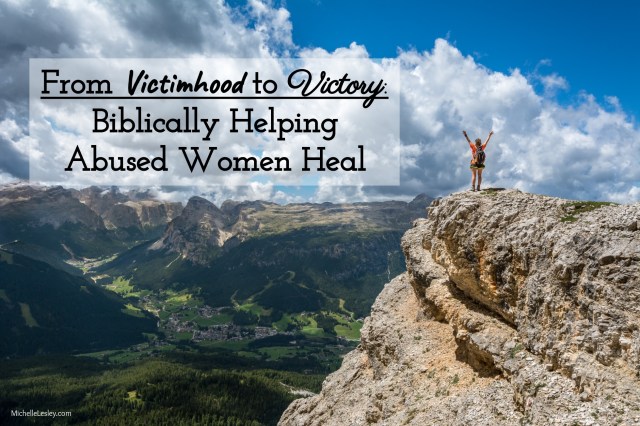
Ever since the Me Too movement exploded on social media a couple of years ago, we’ve been hearing more and more heartbreaking stories of women who have experienced physical and sexual abuse. If anyone can help and should be helping victims of abuse, it ought to be the church. But, unfortunately, it seems that the people in the evangelical spotlight who are stepping up to advocate for victims are often popular false teachers.
In 2019, we saw Beth Moore take the lead at the Caring Well conference, which centered around helping abuse victims. Christine Caine is the founder and leader of A 21, an anti-human trafficking ministry. In 2018, Lisa Harper was the keynote speaker at the Pastors’ Wives Conference at the annual Southern Baptist Convention where she addressed the issue of abuse. And in addition to stepping out into the spotlight as champions for abuse victims, Beth Moore, Christine Caine, and Lisa Harper, as well as Joyce Meyer, Paula White, Lysa TerKeurst, Jackie Hill Perry – and many more, I’m sure – share their own personal stories of abuse at their conferences, in their books, and so on.
These are the people being showcased to the average Jane in the pew as those who care about abuse victims. These are the people who are actually (supposedly) doing something about abuse. By and large, we’re not seeing doctrinally sound men and women being put forth on the stage of the visible church as caring about abuse victims or doing anything about abuse.
And so, when an Evangelical woman is coming to terms with her abuse, these are the women she’s seeing, so these are the women and their resources that she reaches out for. And by the same token, because these false teachers are in the spotlight and have name recognition and resources available, and there aren’t very many well known doctrinally sound resources available, churches who want to help abuse victims are also reaching out and grabbing hold of false teaching to try to help the women in their churches.
So what we’re finding is that women who are victims of abuse are especially vulnerable to false teaching because they see these teachers as someone who has gone through the same thing they’ve gone through: “This teacher knows how I feel. She has experienced the same thing.” And that’s the primary reason victims seek out these false teachers, rather than seeking out someone who – regardless of whether or not he or she has experienced abuse – can help them to heal with rightly handled Scripture.
This is one reason I am purposely not disclosing in this article whether or not I have ever been abused. Because biblical healing from abuse isn’t about me or my personal experiences. It’s about what the Bible says. My experiences don’t change what God’s Word says. The Bible remains the same whether I’ve been abused or not. Scripture is our standard, not our personal experiences.
But, unfortunately in the church, and particularly in the realm of women’s Bible study, we have indoctrinated women with the idea that personal experience reigns, not Scripture. So what abused women get when they seek out these false teachers for help dealing with their abuse is exactly what I’ve said before is the problem with women’s Bible study in general: narcissism.
These victims of abuse don’t get taught how to biblically come to terms with what happened to them and how to biblically heal from it. They get a cheap, shallow compassion that teaches them to focus on their own pain and feelings, and to harbor bitterness against their abuser and everyone and everything else they can assign blame to for the abuse (some of those things supposedly being biblical complementarianism, sexism in the church, misogyny in the church, not enough women in positions of leadership in the church, as Beth Moore said at the Caring Well conference, etc.)
These women are being victimized twice.
And so these women are being victimized twice – once by the abuser, and once by false teachers who are not only not helping them to heal biblically, but are actually eroding biblical teaching and sound doctrine – for that woman personally and in the church in general – by saying that biblical precepts, such as leadership of the church being restricted to men, are at fault for their abuse. It’s really insidious, because what’s implied by this whole paradigm is that this mixture of focusing on your feelings and believing unbiblical teaching is the quick fix that will make them feel better right away. This is what will finally bring them healing and wholeness. They’re being sold a lie.
Praise be to God, there are lots of doctrinally sound Christians out there who are quietly, out of the spotlight, helping victims of abuse in a biblical way, one on one, in their own local churches. So, how are they doing it, and how should we be doing it? What are some biblical ways we can help abuse victims?
Genuine Compassion
Abuse is a horrible, despicable thing that no one should ever have to suffer. The pain that it causes doesn’t just magically disappear because it happened years ago. It is not something about which any woman should ever be told, “You just need to get over it and forget about it.”
And certainly no woman should ever be made to feel that it was her fault, or that if she had just done something differently it wouldn’t have happened. The sin of abuse lies with the abuser, not the victim.
The sin of abuse lies with the abuser, not the victim.
So when we disciple a woman who is just beginning the journey of healing from her abuse, it should be handled with biblical compassion every step of the way. It’s important, especially in the beginning, to do what Romans 12:15 says, and “weep with those who weep”.
Let her pour out her feelings of pain and anger, and sit there in that with her.
Yes, that was awful.
No, you didn’t do anything to cause it. It wasn’t your fault.
That man was evil and took advantage of you. It was his sin, not yours.
We need to have that same heart for her that God has in Psalm 147:3: “He heals the brokenhearted and binds up their wounds.”
A Biblical Perspective of Suffering
It’s imperative that we have a biblical perspective of suffering so we can teach it to abuse victims. Because one of the things you’ll notice about the way false teachers approach the issue of abuse is that this component is completely missing. Why? Because walking through suffering in a biblical way can be hard and scary and painful and messy. It’s much easier to just smile and exude sympathy and say, “Just listen to me and I’ll tell you how to feel better right now.”
And if we’re honest with ourselves, that’s what we all want, isn’t it? Our flesh doesn’t want to suffer, we just want to feel better now. And that’s what makes this a hard sell that false teachers don’t want to deal with. It doesn’t fit in with their ear-tickling paradigm. But if we want to offer victims true help and true healing in Christ, we have to address the issue of suffering, and address it biblically and correctly.
A biblical theology of suffering applied to the issue of abuse understands that…
Everyone suffers. You’re not the first person to suffer, and you won’t be the last. 1 Peter 4:12 says, “Beloved, do not be surprised at the fiery trial when it comes upon you to test you, as though something strange were happening to you.” When it comes to suffering, you’re not special, and neither am I. We don’t all suffer in the same way, but everybody suffers. It’s just the human condition resulting from the Fall.
Even Jesus suffered. Isaiah 53 tells us: “He was despised and rejected by men, a man of sorrows and acquainted with grief; He was oppressed, and he was afflicted,”
Abuse is not a special class of suffering that exempts you from dealing with it in obedience to Scripture. We’re kind of seeing this line of thinking with homosexuality- that it’s a special class of sin that people don’t have to repent of. That homosexuals can hold onto their sin, cherish it in their hearts, and maybe even live it out, and still supposedly be biblical Christians.
And that’s the same sort of mindset a lot of the false teachers espouse: Abuse is a special class of suffering that you don’t have to walk through in a biblical way. You get to wallow in your victimhood for the rest of your life and think and act and feel and express yourself however you want to because you’ve been hurt so deeply. That’s not right. Perpetual victimhood is not biblical, it doesn’t help you heal, and it doesn’t bring your abuser to justice. It makes God look impotent and uncaring. If He can’t or won’t transform someone from victimhood to victory, how could He have the power to raise Christ from the dead? If He doesn’t care about a victim of abuse, why would He care about anybody else’s problems?
I would never minimize the pain and suffering of abuse victims, but all Believers are required by Scripture to act in a godly way regardless of their particular kind of suffering. Believers who have terminal diseases have to deal with that in a godly way. Believers who have lost a child have to deal with that in a godly way. Believers whose spouses have cheated on them have to deal with that in a godly way. Believers who are being tortured and persecuted just for being Christians have to deal with that in a godly way. We all have to bear up and respond to suffering in a godly way, regardless of what kind of suffering we’re dealing with.
1 Peter 4:19: “Therefore let those who suffer according to God’s will entrust their souls to a faithful Creator while doing good.”
Jesus understands your pain and serves as your perfect example for responding to suffering. Go back and read Isaiah 53. Go back and read the gospel accounts of Jesus’ trials, flogging, and crucifixion. He knows what it feels like to be abused. And look at the way he handled it. He didn’t give up. He didn’t feel sorry for himself or lash out at his abusers or become bitter. He didn’t blame God or the church or anyone else or His circumstances.
Jesus knows what it feels like to be abused.
Jesus kept his eyes on the Father. He continued to walk out God’s plan for Him and didn’t let the abusers distract him from that plan. He continued to behave in a godly way. He forgave his abusers, even though it must have been extraordinarily difficult. Remember what He said on the cross: “Father, forgive them, for they know not what they do.”
You don’t have to suffer alone. If you are a Believer, the Holy Spirit dwells within you. He will enable you and empower you to suffer well. You are never alone.
“Pray without ceasing,” 1 Thessalonians 5:17 tells us. “My grace is sufficient for you, for my power is made perfect in weakness,” God says in 2 Corinthians 12:9. Ask God to carry you through the difficult times. Ask God to heal you, to help you forgive, to give you strength. Whatever you need, ask Him for it.
God has a purpose for your pain. The abuse you suffered was horrific, but in God’s economy, it wasn’t random and senseless. God can take what that abuser meant for evil and turn it around and use it for your good– to grow you and strengthen you. There are so many passages of Scripture that talk about this. One of my favorites is Romans 5:3-5:
Not only that, but we rejoice in our sufferings, knowing that suffering produces endurance, and endurance produces character, and character produces hope, and hope does not put us to shame, because God’s love has been poured into our hearts through the Holy Spirit who has been given to us.
Jesus didn’t save you for you to live in self-pity, bitterness, unforgiveness, and victimhood. That is not the abundant life He promised you in John 10:10. It’s no life at all. Christians are not weak, helpless victims. Jesus makes us victors. Yes, what happened to you was unspeakably evil and hurtful. But in Christ, that’s not where your story ends!
Jesus makes us victors.
As you walk with Christ – trusting Him, obeying Him, loving Him – day by day, He will bring you that peace that passes understanding. He will reveal Himself to you as hope of the hopeless. He will heal your broken heart and bind up your wounds. If you refuse to handle your pain biblically, you’re missing out on all of the good things God wants to use that pain for – the godly character He wants to build in you, the healing He wants to give you. If you refuse to handle your pain biblically, you’re choosing to give that abuser the power to continue to stand in the way of all those good gifts God wants to give you.
Your pain and suffering won’t last forever. Once Christ begins healing you, your pain will fade over time, and eventually He will wipe it out all together in Heaven. Consider these two wonderfully comforting and hope-giving passages:
2 Corinthians 4:17-18: For this light momentary affliction is preparing for us an eternal weight of glory beyond all comparison, as we look not to the things that are seen but to the things that are unseen. For the things that are seen are transient, but the things that are unseen are eternal.
Revelation 21:1,3-4: Then I saw a new heaven and a new earth, for the first heaven and the first earth had passed away, and the sea was no more…And I heard a loud voice from the throne saying, “Behold, the dwelling place of God is with man. He will dwell with them, and they will be his people, and God himself will be with them as their God. 4 He will wipe away every tear from their eyes, and death shall be no more, neither shall there be mourning, nor crying, nor pain anymore, for the former things have passed away.”
Your suffering has a time limit.
Your suffering has a time limit, and one day God is going to take it away forever. Rest in that hope.
How can we biblically help abuse victims move from victimhood to victory? We continually take them back to the truth of God’s Word and remind them of His goodness and grace, and the hope and healing He wants to bring them through Christ.
Additional Resources:
This article is excerpted from the A Word Fitly Spoken Podcast episode It’s Time for Sound Leaders to Talk About Abuse
Band-Aids vs. Chemotherapy: Why Suffering Women are Drawn to False Doctrine and 7 Things We Can do to Help
Weeping with Those Who Weep
Christ- the Suffering Servant
Six Reasons to Rejoice that Christ is Enough in Our Suffering
True or False: Is Your Theology of Suffering Biblical?
God’s Good Purposes in Suffering







 “How can I know with certainty what the Bible is saying? How can I be certain what books really belong in the Bible? How can I be sure that my interpretation of any text is correct, and, still more, what its proper application is…?” Have you ever tried to explain a biblical principle to someone only to hear the retort, “
 “Pastors, I have a plea for you. Please, love your women enough to warn them against false teachers. It isn’t enough to simply teach the good stuff; if they don’t know what is out there that is not good and why it isn’t good? They will continue to fall for it.” Check out Amy Spreeman’s article,
  “Christianity is sexist!” “The Bible is patriarchal and just wants to keep women down!” We hear these tired arguments trotted out again and again, but are they really true? No, Eric Davis explains in his excellent article over at Cripplegate,
  Crossway has an interesting infographic for us on a study they conducted on prayer: “Over 14,000 people recently shared about various aspects of their prayer lives with us…we invite you to dig into the data, looking at established prayer habits, common pain points, and useful practices and tools for prayer.” Take a look at