Ladies- did you read yesterday’s Mailbag article, Counter Arguments to Egalitarianism? If not, I would encourage you to read it before watching today’s movie. And if you’re new to the complementarian vs. egalitarian kerfuffle, I would encourage you to read, not only that article, but all of the articles in the “Additional Resources” section of that article as well.
Why?
Because today’s Movie Tuesday movie, Battle for the Minds, approaches the issue from the egalitarian perspective, and you need to be sure you’re firmly grounded in the biblical perspective so that “no one takes you captive by philosophy and empty deceit, according to human tradition, according to the elemental spirits of the world, and not according to Christ.”
Also, today’s movie is kind of like a homework assignment. How would you apply the complementarian apologetics you learned in yesterday’s article as well as your knowledge of Scripture to the egalitarian arguments and pronouncements being made in this movie?
Battle for the Minds was released on PBS in 1997. It presents the egalitarian viewpoint on the stage of Southern Baptist Theological Seminary’s transition from theological liberalism to biblical theological conservatism under the then-new leadership of Dr. Albert Mohler, and delves into a bit of the Conservative Resurgence in the Southern Baptist Convention around that time as well. (As an aside, I am not familiar with any of the people in the film presented as being on the egalitarian side except for Ann Graham Lotz. I’m only familiar with a few of those on the complementarian side: Albert Mohler, David Miller, and Paige Patterson.)
If you are Southern Baptist, I strongly encourage you to watch and carefully consider these events from our history in light of the battle we are now facing in the SBC concerning the role of women in the church and in the Convention. Because what Nancy Ammerman says at the 37:04 mark is correct. Since all SBC churches are autonomous, many Southern Baptists only concern themselves with their own churches and don’t trouble themselves to worry about what’s going on at the national level. But when you do this, you fail to take into consideration that what’s going on at the national level trickles down to your local church in the form of what’s being taught to your next pastor or staff member at our seminaries; the authors, musicians, and other content creators being sold (and not being sold) at LifeWay; the theology in the Sunday School and VBS curriculum your church uses, etc. It also affects the theology and ecclesiology our IMB and NAMB missionaries and church planters use and teach. And finally, the leadership and issues at the national level are the face the Southern Baptist Convention presents to the world.
But even if you’re not Southern Baptist, you will probably still find this movie informative to the way your own church or denomination is responding to the issue of the biblical role of women in the church.
A couple of things to be on the lookout for, and give consideration to, as you watch Battle for the Minds:
•Notice the amount of Scripture presented in the movie. Is any Scripture presented that backs up the egalitarian view? Is egalitarianism vs. complementarianism presented as a biblical and spiritual issue or an “our position vs. their position” issue?
•Note the sex of each person on the egalitarian side and the sex of each person on the complementarian side. Are any complementarian women presented? Do you think there were absolutely no women on the complementarian side of the issue when these events were transpiring? Do you see how the exclusion of complementarian women in this film gives the subtle illusion that a) all women are egalitarian, and b) the reason men are complementarian is because they’re sexist and trying to protect their power and position – the same argument people like Beth Moore are attempting to make today?* Do you think it was sexist to exclude women from the complementarian side?
“What are some of your favorite counterarguments to egalitarian theology?” a reader of my blog once asked.
It’s such a great question for a plethora of reasons. One important reason is that it’s always a hot topic that needs to be dealt with biblically in order to silence the lies and to make onlookers aware that the Bible does address this issue with the correct answer. Another reason is that, when you think through an issue via an apologetics, “point-counterpoint” framework, it really helps solidify in your mind, and give you confidence in, what the Bible has to say about the issue.
Let’s start off with some basics…
If “egalitarian” is a new term for you, let’s nail down what egalitarianism is and what complementarianism is. Both have to do with the issue of women’s roles in the church and in the home.
Egalitarianism is the anti-biblical view that women can do anything men can do in the context of the church and home. Women can be pastors, elders, heads of denominations, preach and teach the Bible whenever, wherever, and to whomever they want, and they don’t have to submit to their husbands.
Complementarianism is the biblical view that women and men are of equal value and worth in salvation and in the imago dei, but have different, yet equally important roles in marriage and the church. Complementarians embrace the Bible’s teaching that women are privileged to portray the relationship of the church to Christ by graciously and joyfully submitting to our husbands. Complementarians honor and respect the high calling and unique gifting women have to disciple other women and to raise up the next generation of godly men and women by discipling our own, and other, children. Because this is such a weighty and arduous responsibility, we consider it a blessing that God has not also burdened us with the responsibility to pastor churches, preach, teach the Scriptures to men, or exercise authority over men in the context of the gathering of the church. Rather, we encourage the men who have been given this responsibility, leaving godly women free and unfettered to carry out the ministry God has given us.
In the 20teens, there was a movement afoot to establish a formal, third-way position regarding this issue. It was called narrow or soft complementarianism – an attempt to straddle the fence, make everybody in both camps happy, and have your cake and eat it too. There are a variety of beliefs among those who choose this label, but for most, what it boils down to is the position that a woman may not hold the office of “senior pastor” (i.e. she can’t be on staff as the primary pastor of a church), but it’s perfectly OK for her to do anything and everything else in the church that men do.
She can preach the sermon to the assembled congregation on Sunday morning, whether that’s weekly or once a year on Mother’s Day. She can teach (or co-teach with her husband) co-ed adult Sunday School, Bible study classes, and small groups. She can hold any position of leadership or authority in the church, including positions such as head of the personnel committee, and make decisions about hiring, firing, evaluating, and directing the pastor. She can preach and teach the Bible to co-ed audiences at Christian conferences.
In the 2020’s, we saw a shift away from the push to make narrow/soft complementarianism an official third-way position. Those who held to this position dropped the “narrow/soft,” but kept the “complementarian”. Now the folks in this camp go about calling themselves “complementarian” – which confuses others into thinking they hold to the definition in the “Complementarianism” paragraph above – when they really hold to the narrow/soft complementarian definition. (If a real life example would help you understand this paradigm better, please see my article on Jen Wilkin.)
Let’s dispense with narrow/soft complementarianism – or the neo-complementarian iteration of it – once and for all. It is a position of compromise between the biblical and the anti-biblical. Compromising with sin has never been a biblical stance for God’s people to take. Ever. The Bible tells us “a little leaven leavens the whole lump.” You don’t have to consider yourself a full-blown egalitarian to infect the church with ungodliness. Just a little compromise, a little leaven, a little dab’ll do ya. And that little dab never makes the church or individual Christians more godly, more biblical, or more Christlike. It always leads to more compromise and greater ungodliness.
Furthermore, we don’t treat other sin and rebellion this way. No one would dream of saying, “I hold to a soft view of adultery. Only actual extra-marital intercourse is off the table. Kissing, touching, dating other people – that’s all fine.”
Yes, women “pastoring,” preaching, teaching the Bible to men, and exercising authority over men in the gathering of the Body is a sin. When God commands us not to do something and we do it anyway because we want to, that’s sin. Christianity is not a religion for people who want to do whatever they feel like doing. Christianity is a religion in which we obey our God’s commands in thought, word, and deed.
Egalitarianism is sin because it is rebellion against God’s Word. And it is extremely detrimental when high profile classic complementarians unhelpfully classify it as a “secondary issue”. I know all they mean when they say that is that it is not part of the ordo salutis or a linchpin doctrine of soteriology. But when Christians hear “secondary issue” what they think is, “Oh, this is an issue where both sides have genuine biblical support like many views of eschatology and baptism. We can just agree to disagree and both sides are biblical.” Nobody thinks that about adultery, murder, gossip, lying or any other sin, and we need to be more careful in our terminology lest we give people an opening to think that way about egalitarianism.
Rebelling against God’s commands regarding the role of women is either a sin or it is not. There is no middle ground, so narrow/soft complementarianism is not a biblically legitimate position to take. If you’re a “narrow/soft complementarian,” you’re a functional egalitarian. And if you’re a Christian who’s toying with this idea, I urge and encourage you to repent, love Christ and His Word more than you love the world and its ideals, and unashamedly embrace and promote what the Bible says about the role of women.
Who are we addressing when we make these apologetic arguments?
There are only two kinds of people in the world: saved people and unsaved people. Which means there are only two kinds of people who hold the egalitarian view: saved people and unsaved people.
The Bible is abundantly clear that saved people have the mind of Christ. That means we think the way Jesus thinks and we view the world and the church the way Jesus views the world and the church. We deny ourselves, putting aside whatever we might want or think, and we submit, as Jesus did, to “It is written…“. Additionally, obedience (or lack thereof) to the commands of Scripture is an indicator of whether or not someone actually belongs to Him. In fact, God says if you claim to be a Christian and you habitually and unrepentantly walk in disobedience to, and rebellion of heart against His commands, you’re a liar, and you don’t know Christ.
What this means in practical terms when dealing with any biblical issue – egalitarianism, evolution, abortion, homosexuality, etc. – is that a sizable portion of the people on the unbiblical side of the issue are unsaved. Because a saved person has the mind of Christ, she will embrace, believe, and obey God’s Word regarding these issues and come out of these unbiblical camps, and an unsaved person will continue to fight for the unbiblical position. A new or previously poorly discipled Christian may need to be taught what Scripture says about these things, and it may take some time for her to come to grips with God’s commands, but her nature is to fight her flesh to submit to God’s Word, not to make provision for her flesh to fight against God’s Word.
Why do we need to understand this crucial foundational concept in debating this issue? Because people who are unsaved regard the things of God as foolishness and they cannotaccept them no matter how much you explain Scripture to them or how much sense you make. This is a spiritual issue that requires a spiritual solution – the Holy Spirit must save the person and open her eyes to the truth of His Word. Often, what the person you’re arguing with needs most is the gospel, not an argument about a theological issue. And you will need to be careful and wise to discern when your apologetics are helpful and effective with someone who truly wants to learn and accept the biblical view, and when it’s time to gather up your pearls, step out of the pigpen, and go home until the Holy Spirit does His good work in her heart.
All of this would be my primary apologetic argument against egalitarianism (or any other position that defies Scripture): If you’re truly saved, the fruit of your new nature in Christ will be to forsake and repent of any opinions or positions you hold that conflict with Scripture and submit to, love, and obey God’s commands. If you’re not saved, your opinion doesn’t really matter when it comes to how the church is run because the church is the body of Christ – Believers – not the house of unbelief.
Let’s take a stroll through the Bible…
The “let’s take a stroll through the Bible” counterargument is a handy starting point, because it demonstrates the baseline position, consistent through the entirety of Scripture, regarding male headship. Additionally, it addresses so many arguments about 1 Timothy 2:12 that it’s almost a “one size fits all” argument:
But the Bible only says one timethat women can’t preach to men!
God didn’t prohibit women from teaching men. That was Paul, the human being’s, idea.
That passage is about wives taking authority over their husbands, not about women preaching to or exercising authority over men in the church.
That instruction only applied to the women of the Ephesian church at that particular time in church history.
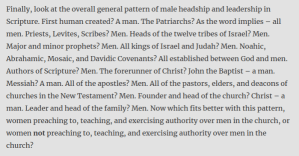
Look at the overall general pattern of male headship and leadership in Scripture.
First human created? A man.
The Patriarchs? As the word implies – all men.
Priests, Levites, Scribes? Men.
Heads of the twelve tribes of Israel? Men.
Major and minor prophets? Men.
All kings of Israel and Judah? Men.
Noahic, Abrahamic, Mosaic, and Davidic Covenants? All established between God and men.
Authors of Scripture? Men.
The forerunner of Christ? John the Baptist – a man.
Messiah? A man.
All of the apostles? Men.
All of the pastors, elders, and deacons of churches in the New Testament? Men.
Founder and head of the church? Christ – a man.
Leader and head of the family? Men.
Now which fits better with this pattern, women preaching to, teaching, and exercising authority over men in the church, or women not preaching to, teaching, and exercising authority over men in the church?
It’s not just one verse. The entirety of Scripture backs up 1 Timothy 2:12. Which means it wasn’t just Paul’s human idea, just for the women of Ephesus, or just about wives and husbands. Male headship and leadership in God’s foundational institutions – family and church – has been God’s idea, God’s plan since the dawn of Creation (as 1 Timothy 2:13-14 clearly explains). It’s much harder for someone claiming to be a Christian to throw out the whole Bible than to sweep one verse aside.
Descriptive vs. Prescriptive Scripture
Another argument that often needs to be made is explaining the difference between descriptive and prescriptive passages of Scripture, because one of the most common arguments egalitarians will make is, “Look at Deborah! Look at Priscilla! Look at the women at Jesus’ tomb! Look at the women Paul commends in Romans 16! They were all in some sort of leadership or teaching position, so that means women can do anything in the church that men can do!” No. No it doesn’t.
Broadly speaking, there are two main types of Scripture: descriptive and prescriptive. Descriptive passages describe something that happened: Noah built an ark. Esther became queen. Paul got shipwrecked. These passages simply tell us what happened to somebody. Prescriptive passages are commands or statements to obey. Don’t lie. Share the gospel. Forgive others.
If we wanted to know how to have a godly marriage, for example, we would look at passages like Ephesians 5:22-33, 1 Corinthians 7, and Exodus 20:14,17. These are all passages that clearly tell us what to do and what not to do in order to have a godly marriage.
What we would not do is look at David’s and Solomon’s lives and conclude that polygamy is God’s design for marriage. We would not read about Hosea and assume that God wants Christian men to marry prostitutes or adulteresses. We would not read the story of the woman at the well and think that being married five times and then shacking up with number six is OK with Jesus.
And when looking for instruction about the role of women in the church, we look to clear, prescriptive passages which tell us what to do and what not to do, not descriptive passages about various women in the Bible. Descriptive passages may support, but never trump, the clear instruction of prescriptive passages.
Some try to make the argument that it’s OK for a woman to preach or teach Scripture to men if she’s doing it “under her husband’s/pastor’s authority”. Excerpted from my article Fencing off the Forbidden Fruit Tree:
When God tells us (in context, rightly handled, correct covenant, etc., of course) not to do something and we do it anyway, that is sin, right? Only God has the authority to say what is sin and what is not. No one – not your pastor, your husband, your parents, your best friend, the Pope, nobody – has the authority to tell you that it’s OK to do something God has said is sin. That authority belongs to God alone.
Try inserting any other sin into that situation. Does your husband, pastor, etc., have the authority to tell you it’s OK to lie? Cuss? Covet? Of course not. And why would they even consider doing such a thing?
If you were to ask your husband and pastor to show you from Scripture where God says it’s OK for them to allow you to teach men, they would quickly realize that they are not basing their decision on Scripture (because there is no Scripture that allows them to do this), but on their own opinion that it’s OK.
When God says “no,” no man has the right to say, “yes.”
[Word] games people play…
Recently, a couple of “word game” arguments have started popping up in this ongoing tussle:
“The Bible never says that women can’t preach!”
No, there’s not a Bible verse that says, verbatim, “Women can’t preach.”. Somehow egalitarians think this is a “gotcha,” but this is really one of their weakest and most embarrassing arguments.
First Timothy 2:12 clearly says, “I do not allow a woman to teach…”. Their argument here is that the verse says “teach,” not “preach,” so they think they’ve found a loophole. But what is preaching? Think about what’s transpiring during preaching – it’s teaching! Whoever is preaching is imparting knowledge and explaining concepts to the hearers and encouraging them to understand, believe, and act on said knowledge and concepts. Preaching is teaching.
Furthermore, the passage that governs this issue isn’t just 1 Timothy 2:12. It’s 1 Timothy 2:11-3:7, Titus 1:5-9, and 2 Timothy 4:1-2. First Timothy 2:11-15 tell us who is not qualified to pastor, preach to and teach the congregation, and exercise authority in the gathering of the church body, and why. First Timothy 3:1-7, Titus 1:5-9, and 2 Timothy 4:1-2 tell us who is qualified to do those things, and why and how.
First Timothy 3:1-7 and Titus 1:1-9 are the qualifications for pastors, elders, and overseers. Not only do these passages exclude women from this office (“husband of one wife,” male referents {“he,” etc.} throughout), they also exclude all men who do not meet these qualifications.
Both of these passages require that a pastor/elder/overseer be “able to teach” the congregation. This is juxtaposed against the word “teach” (teach men, so, not teaching the congregation) in 1 Timothy 2:12. The primary function of a pastor/elder/overseer is to teach the congregation. Since God prohibits women from teaching the congregation in 2:12, women are disqualified from the office of pastor in 3:1-7, because they are not able to teach (according to God’s definition of teaching in this context {i.e. instructing the whole congregation}). Conversely, since God excludes women from being pastors/elders/overseers in 3:1-7 (“husband of one wife,” male referents {“he,” etc.} throughout), women are prohibited from the primary function of that office, teaching the congregation, in 2:12.
Second Timothy 4:1-2 then steps up to the plate and specifies the primary type of teaching a pastor/elder/overseer is to do: preaching. Remember, 1-2 Timothy and Titus are the pastoral epistles. They are God’s instructions to pastors/elders/overseers about how they’re to do their jobs and how God wants His church to be structured and to operate. These three epistles are God’s “policy and procedure” manual, if you will, for pastors and the church.
I do not permit a woman to teach… 1 Timothy 2:12 Therefore an overseer must be…able to teach, 1 Timothy 3:2 He must…be able to give instruction in sound doctrine Titus 1:9 I charge you [pastors]…preach the word 2 Timothy 4:1-2
And the second “word game” argument is like unto the first:
“The Bible never says women can’t be pastors!”
Again, the Bible does not say, verbatim, “Women cannot be pastors.”. That’s the first alleged “loophole”. The second alleged loophole* is that the Bible uses the terms “elder” and “overseer,” rather than “pastor,” in 1 Timothy 3:1-7 and Titus 1:5-9. So – follow this carefully – even if women can’t be elders and overseers, the argument goes, women can still be pastors.
*It bears noting here that if you’re looking for “loopholes,” “technicalities,” and ways to bypass or circumvent the plain teaching of Scripture so you can indulge your fleshly desires, you’re already sinning. You never have to step behind a pulpit or preach a single word. Your heart is in rebellion against God, and you need to repent.
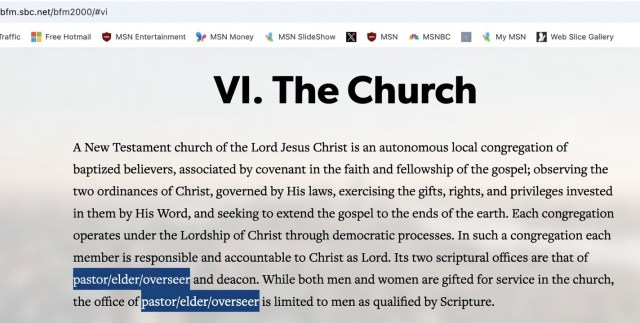
This is another painfully cringe-worthy “argument”. Scripture uses the terms “elder,” “overseer,” and “pastor,” synonymously and interchangeably. That’s why you often see Christians use the phraseology “pastor/elder/overseer” – because these terms mean the same thing. For example, the Southern Baptist Convention’s statement of faith, the Baptist Faith and Message 2000:
This particular argument that “the Bible doesn’t prohibit women from being pastors” is tantamount to 1 Timothy 3:1-7 teaching that the church fellowship hall may not contain a couch, and Titus 1:5-9 teaching that church fellowship halls are not to have davenports, and egalitarians saying, “It’s perfectly fine for church fellowship halls to contain sofas. The Bible nowhere says that church fellowship halls can’t have sofas.”.
Sometimes egalitarians will try to argue that the terms “pastor” and “shepherd” indicate a different office and function from elder/overseer. They then argue that the Bible doesn’t say women can’t be “pastors” and “shepherds”. This is an attempt to bypass the passages which clearly address the issue of women leading and preaching to the church, 1 Timothy 2:11-3:7 and Titus 1:5-9, and instead, kidnaping and pressing into service passages which do not address this issue.
However the wheels immediately – almost comically – fall off this argument when you come to 1 Peter 5:1-2:
So I exhort the elders among you, as a fellow elder …shepherd the flock of God that is among you, exercising oversight…
1 Peter 5:1-2
Shepherding is the way that elders and overseers exercise oversight over the church, or “flock”. Pastors, overseers, shepherds, and elders are all the same person, position, office, and function.
If you’d like to read more, I highly recommend thes articles:
Sometimes appended to the aforementioned “The Bible doesn’t say women can’t be pastors!” argument is the argument that pastoring and shepherding are a spiritual gift rather than an office. Even if that were true in the way egalitarians seem to mean it (it’s not – God doesn’t “gift” people to do what He has clearly forbidden.), God has every right to dictate how we may and may not use any gift He chooses to give us. What loving parent would give her child the gift of a bicycle and not tell her how she may and may not use that bicycle for her own good and safety, and the good and safety of others?
If God gives someone the gift of generous giving, that person may notembezzle money from his employer so that he will have more to give.
Whatever “shepherding” means to any woman who thinks she has that gift, God does not allow her to use the gift of “shepherding” to hold the office or perform the function of an elder or overseer, including preaching, teaching men the Bible, or holding authority over men in the gathering of the church.
Christians are never allowed to exercise any spiritual gift in any way that violates the clear commands of Scripture.
It’s all Greek to you…
And there’s the “You don’t know Greek, so you don’t know what that passage really means. I do.” fallacy.
Lost in translation?
Some have tried to make the argument that 1 Timothy 2:12 is mistranslated – that “woman” and “man” should be translated as “wife” and “husband” – and that this passage isn’t prohibiting women from teaching men at all, it’s really about marriage. The short answer to that is: hogwash. If you’d like to read the longer version, check out my article The Mailbag: Potpourri (…Mistranslating 1 Tim. 2:12…) (second question).
Bigger fish to fry?
And then, there’s the “bigger fish to fry” argument, otherwise known as pitching a hissy fit. It goes something like this:
I am so sick and tired of this argument over whether or not women can preach or be pastors! There are people starving in Africa! Christians are being killed all over the world! There are Christian wedding vendors who are being persecuted for refusing to service homosexual “weddings”! Islam is making dangerous inroads in the United States! And you people want to argue that women can’t be pastors and preach?
You’re the one arguing, my egalitarian friend. Those of us on the biblical side of things are simply stating what Scripture has always said. There wouldn’t be an argument without you egalitarians arguing against what God has plainly decreed. And by the way, what are you doing to stop the starvation in Africa, the martyrdom, the persecution, Islam, and all the other “more important” issues in the world? Why don’t you simply stop arguing that women can be pastors, preach, etc., submit to and obey Scripture, and instead devote your time to getting to work on all those other problems?
Additionally, God never presents spewing emotional vomit everywhere as any sort of spiritually mature, godly, logical way to present an argument. Nor does the fact that “There are bigger problems in the world!” ever excuse sin or ever cause God to instruct us to deal with all the “big problems” in the world first before we can ever confront, address, and correct “little” sins. Even Jesus said, “The poor, you will always have with you.”.
“There are bigger problems in the world!” is never a reason to refrain from doing the right thing. And not only that, but there are Christians all over the place addressing all of these “more important problems”. It’s not like God gave us only enough bandwidth or personnel to address one problem at a time. We’re made in His image. We can multi-task.
But let’s try to apply this “argument” to some other scenarios in order to demonstrate how silly it is:
“What, God? You’re telling them to stone me for picking up sticks on the Sabbath? Don’t You know there are about a dozen pagan nations out here just waiting to attack us any day? And this is what You want to spend Your time on?”
“Are you kidding me, God? All I did was tell a little white lie about the selling price of my land and You’re going to strike me dead for that? Don’t You know the Romans are out here crucifying Christians -even Jesus!- and feeding Christians to the lions? Why aren’t You doing something about that?”
Yeah. You really don’t want to be arguing against God and His commands.
A “real world” warning…
And finally, if a Christian struggles with the biblical argument against egalitarianism, God has graciously given us a real-time, tangible, visible argument against it. Take a look at all the once doctrinally sound Christian churches and denominations that are now apostate – the ones that embrace homosexuality, New Apostolic Reformation heresy, preach moralism or liberal politics instead of the gospel, etc. They all followed the same pattern.
The very first step they took on the road to apostasy was “soft complementarianism”: letting women teach co-ed Sunday School classes, preach on Mother’s Day, hold committee positions that placed them in biblically improper authority over men, and so on. The next step was full blown egalitarianism: allowing women to be elders, ordaining women as pastors, placing women in unbiblical denominational leadership positions. Next came embracing homosexuality: extending church membership to unrepentant, practicing homosexuals (and now, transgender people), ordaining them, and allowing them to serve in any and every position of church and denominational leadership, including the pastorate. And the final step is abandoning the gospel and the authority and sufficiency of God’s Word altogether.
It happened to the Lutherans, the Episcopalians, the Methodists, the Presbyterians, scores of non-denominational churches, and now it’s happening to Southern Baptists. Not a single church or denomination that has embraced egalitarianism has become holier, truer to God’s Word, or more spiritually healthy. They have all ended up dead eventually, and the true Christians in those churches and denominations have left to form biblical churches and denominations.
Egalitarianism is anti-biblical, harmful to men, women, and the church, and dishonoring to God. We may not be able to convince every egalitarian to repent and embrace what God’s Word says about the role of women, but it’s important to think through this issue in a biblical way, and using an apologetic framework is a great way to do that.
For the past few lessons, we’ve looked at biblical womanhood in the family. Today, we’ll begin looking at biblical womanhood in the church setting, examining the beautiful position God has given women in the gathering of the Body.
Questions to Consider
1. Read Galatians 3:28 (if you have a moment, read all of chapter 3 for a fuller view of the context). What does this verse, especially in light of the remainder of chapter 3, mean? What does it mean to be “one in Christ Jesus”? How does this verse speak to the concept of unity in the church? How does this verse speak to the equal value of every person in the eyes of God? When it comes to a soul being saved, is there any difference between a woman or man, slave or freeman, Jew or Greek? Do Greeks have to repent more than Jews? Does Jesus have to work harder to save women than men?
2. Briefly review the topics of lessons 4-9 (links above). Are any of these concepts (identity in Christ, being created by God, etc.) specific to one sex, or do they apply to all people? Make two lists: “Things Christians Are” and “Things Christians Do”. List about 5-10 things Christians are (ex: forgiven, ambassadors for Christ) and things Christians do (ex: pray, show mercy). Are any of the things you listed specific to men only or women only? Considering all the things the Bible says Christians are and Christians do, what would you estimate is the percentage of things all Christians are to be and do versus the percentage of things that are only for men or only for women?
3. Examine the 1 Corinthians passage. Verse 33 is kind of the “theme verse” of 1 Corinthians 14. What is the main subject of this chapter? (Hint: See section heading here). What is the venue (home, church, marketplace, etc.) in which the instructions of chapter 14 apply? (33b) Briefly skim over the rest of chapter 14. What was the overall, “for the greater good,” reason for the instruction to women in v. 34-35? What were some other activities and people the Holy Spirit, via Paul, placed restrictions on in chapter 14? Why? What is the main priority of chapter 14? Does the instruction in 34-35 mean that women may never utter a word once they step through the doors of the church? How do you know that? What do these instructions mean, and how do they apply to women in the church today? What do these instructions teach us about our responsibility to pay attention to the preaching and teaching of the Word and learn from it? How can this passage help us to see the value and edification in discussing the Scriptures at home with our husbands?
4. Go to the 1 Timothy and Titus passages by clicking on the “Read These Selected Scriptures” link at the top of today’s lesson. Recall that when the Bible was written, there were no chapter and verse numbers. (Those were added much later.) First Timothy and Titus would have read like one long, continuous letter or e-mail. Click on the “options” icon and uncheck the box next to “verse numbers”.
Now read the 1 Timothy passage, noting the flow of thought and how the end of chapter 2 is interconnected with chapter 3. What is the main idea of this passage? (OK, now click the verse numbers back on. :0)
What is the first word of verse 11? Think about women’s social status and value in Paul and Timothy’s culture, and in many cultures since that time, even today. Why does the Holy Spirit instruct pastors to “let” women learn? What does this teach us about the responsibility God places on us as women to learn His Word? Would you categorize verse 11 as a “do this” or “don’t do this” verse?
Examine verse 12. Is this mainly a “do this” or “don’t do this” verse? What two things does the Holy Spirit say women are not to do in the gathering of the church body? What does He say women are to do? Think about God’s nature and character. Does He ever give instructions arbitrarily or just to spoil our fun? Why does God give us commands and instructions, generally speaking? Are the instructions in verse 12 good for women and for the church?
Does God have to give us the reasons behind His instructions, or is “because I said so” sufficient reason for us to obey Him? Take a look at 13-14. God kindly gives not one, but two reasons for His instructions in verses 11-12. What are those two reasons? How do they fall in line with God’s design for male headship and leadership across biblical history in the hierarchical structures He has set up?
The 11-15 passage starts with a “do this” verse (11), followed by a “don’t do this” (12) “and here’s why” (13-14) section, then finishes up with another “do this” verse (15).
Verse 15 can be a little cryptic to us today because we equate the word “saved” with salvation. Does verse 15 mean that women gain salvation by having children? How do we know it doesn’t? The NASB helpfully, and more accurately, renders this word as “preserved“. We don’t feel it much today, but think about the stigma women (particularly Jewish women) carried at the time this was written simply because they were daughters of Eve. Paradise was lost and the curse of sin entered the world because of a woman, many men thought, and they viewed and treated women accordingly. Yet who was chosen to bring the Messiah into the world? And following in her footsteps, a major way godly women can “save” or “preserve” the reputation, esteem, and value of womankind is to “continue in” what 3 godly character traits? (15) Because if they continue in those three godly character traits, they will be raising up a godly seed to the Lord (even if the children they bear aren’t perfect like Mary’s child was :0)
So we’ve seen the position women are to occupy in the church, followed by the positions women aren’t to occupy, and that’s followed, in the 1 Timothy 3 and Titus 1 passages by the p_____s m__ are to o____.
According to the 1 Timothy 3 and Titus 1 passages, which positions are men to occupy in the church? What is an overseer? (Use your cross-references if necessary.) Go through these two passages circling any words or phrases that indicate that pastors, elders, and deacons are to be men. Are these positions open to all men in the church?
Examine each of the three sections (1 Timothy 3:1-7, 3:8-13, and Titus 1:5-9) individually. How could the wife of a pastor, elder, or deacon help him, or make things easier for him, to meet the biblical requirements for his office? (Ex: How could a pastor’s wife make it easier for him to be hospitable?)
Homework
If you’d like to dig deeper on some of these passages, you may enjoy reading the following articles from my Rock Your Role series:
I had an awesome time, recently, chatting with Kevin, Scott, and James from the Theology. Driven. podcast. What an honor to be their first ever female guest! We covered a variety of topics: what to do if your church is hosting a Beth Moore study, my background in writing and teaching ministry, the Southern Baptist Convention’s slouching toward egalitarianism, studying the Bible without using Bible study books…and more!
Theology. Driven. is also offering a special giveaway in connection with my episode. If you tweet a link to the episode (or re-tweet a post about the episode such as this one) and include the hashtag #MichelleTheologyDriven, you’ll be entered into the drawing. Listen all the way to the end of the episode to find out all the details.
Give this episode a listen, and share it around! You can subscribe to Theology. Driven. on iTunes, Google Play, Overcast, and Podbean, or just listen online at the Theology. Driven. website (episode 27). And don’t forget to follow Theology. Driven. on Facebook and Twitter!
(Information on the theological problems with Beth Moore. For information on others, please see the “Popular False Teachers” tab at the top of this page.)
Got a podcast of your own or have a podcasting friend who needs a guest? Need a speaker for a women’s conference or church event? Click the “Speaking Engagements” tab at the top of this page, drop me an e-mail, and let’s chat!
Welcome to another “potpourri” edition of The Mailbag, where I give short(er) answers to several questions rather than a long answer to one question. I also like to take the opportunity in these potpourrri editions to let new readers know about my comments/e-mail/messages policy. I’m not able to respond individually to most e-mails and messages, so here are some helpful hints for getting your questions answered more quickly. Remember, the search bar can be a helpful tool!
In the Apostles Creed, there is a section that states Christ descended into hell and was resurrected. Isn’t that what Joyce Meyer teaches? What about the part about the “holy catholic church: the communion of the saints”? Is that talking about Catholicism and the mass?
These are very common questions (I threw in the second part about Catholicism and the mass, since that’s also commonly asked.), and it’s good to ask, because if you’re confused, other people probably are, too.
I believe in God, the Father Almighty,
the Creator of heaven and earth,
and in Jesus Christ, His only Son, our Lord:
Who was conceived of the Holy Spirit,
born of the Virgin Mary,
suffered under Pontius Pilate,
was crucified, died, and was buried.
He descended into hell.
The third day He arose again from the dead.
He ascended into heaven
and sits at the right hand of God the Father Almighty,
whence He shall come to judge the living and the dead.
I believe in the Holy Spirit, the holy catholic church,
the communion of saints,
the forgiveness of sins,
the resurrection of the body,
and life everlasting.
Amen.
It’s a beautiful, basic reiteration of the gospel which many churches and ministries use as part of their official statement of faith. Some churches even recite the Apostles’ Creed during their worship services.
The earliest written record of the creed is from AD 390, in Greek, so you can imagine that some of the terminology used had different connotations back then than those terms have in 21st century America.
Providentially, my friend, Pastor Gabe Hughes, was also recently asked this same question and addressed it both on his podcast and in a WWUTT video, so I’m going to let him do the “heavy lifting” of Scripture and history in the resources below and just give you the short and sweet version:
📜 You’re quite right in saying that Joyce Meyer teaches that Jesus went to hell between His death on the cross and His resurrection. The Bible doesn’t say this anywhere, and this is a heretical teaching. Just one of the multiple reasons no Christian should follow Joyce Meyer.
📜 The word “hell” in the Apostles’ creed is based on a mistranslation or confusing translation. The literal meaning of the phrase is that he descended into the grave or was buried.
📜 You might have noticed that the word “catholic” in the creed starts with a lowercase “c” rather than a capital “C”. The noun “catholic” with a lowercase “c” simply means the universal church – all genuinely regenerated Believers across the globe, past, present, and future. Roman Catholicism is (or at least by rules of grammar is supposed to be) denoted by a capital “C”.
📜 “Communion” in the creed does not refer to the Roman Catholic mass or even to the Protestant Lord’s Supper. A clearer word to us today would be “fellowship” or “unity”. The sense is that Believers commune with on another.
Some churches have modernized and clarified the creed by replacing these phrases with “He descended into the grave” or “He descended to the dead” and “the holy Christian church.”
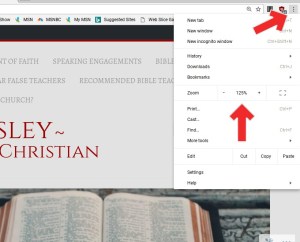
I was wondering if you could post your articles in a larger font. I have an old computer that messes up when I try to make the font bigger. My old eyes are a real struggle.
At first, I thought I was the only one having this problem, but I’ve gotten this question a couple of times, so I know it’s not just my own aging eyes :0)
I’m going to play around with the font a little bit and see if I can find one that’s bigger. Just a few things to understand as I’m working on it: WordPress gives me a limited number of fonts to choose from, and the sizes of those fonts are pre-set. In other words, I can’t set it to 12 point or 18 point, I can only choose from tiny, small, normal, large, and huge. (Right now it’s set on “normal” if you can believe that. “Tiny” is virtually invisible.)
Additionally, when I change the font size, it doesn’t just change the size of the font in the body of my articles, it also changes the size of things like the tags (to the immediate upper left of every article), the sidebar (far left of the page), and the tab titles (top of the page), which, as you can see, are already much larger than the font in the article body. When the font of those texts gets larger, it throws the layout of the whole page out of whack. You might not notice it on a desktop computer with a large monitor, but it can be problematic for people who are viewing the blog on a phone or tablet.
Like I said, I’ll play around with it and see what I can do, but if I’m not able to enlarge the font, there are two workarounds that may help:
1. The reader said she’s unable to change her screen magnification, but it works for me and might work for others. Here’s what it looks like on my computer. Maybe yours is similar:
2. If worse comes to worst, you can highlight and copy the body of the article, paste it into your word processing program, and enlarge the font accordingly.
I have been leading a women’s small group at our church for a couple of years now. My husband and I have decided to leave the church because, even after confronting leadership about the direction the church is being led doctrinally, they continue to espouse unsound doctrine. What do you think is a wise way to tell the ladies I will no longer be teaching? Do I tell them we are leaving? If so, do I tell them why? What do you think you would do?
It’s hard to say exactly what I would do because every situation and every church is different. But I can tell you that the first thing I would do is talk it through with my husband and ask his advice. There have been many times when he has had very good ideas about how to address (or not address) certain issues, and he will sometimes bring out an aspect of the situation that I hadn’t thought of before. I would encourage you to do that first, and also to make sure you’re submitting to your husband in whatever ways might be applicable in this situation.
My inclination is to advise you to take the “the less said, the better” route with regard to the whole class. (There may be other venues, such as you and your husband meeting with the elder board, in which you’ll need to clearly spell out all the problems, but let’s just focus on the class right now.)
I would probably wait until the end of the very last class and say something generic, like, “I’ve really enjoyed leading this class, but I wanted to let you know I won’t be teaching any more. I encourage you to continue studying God’s Word and growing in Christ. Class dismissed.” Then, go home fairly quickly.
The next level is going to be women coming up to you individually and asking why you won’t be teaching any more. Unless she’s a very close friend, I’d still keep it pretty generic: “We love our brothers and sisters at this church, but we’re finding we disagree with some of the doctrine that’s being taught here, and we’ll be going to a new church.”
For very close friends, you might wish to disclose more about the doctrinal problems, but do so wisely, making sure your focus is on doctrine, not on personal conflicts with the pastor or others. You don’t want people jumping to the wrong conclusion about why you’re leaving.
I really would not talk to people about leaving other than discreetly informing those who need to know. If you give details or talk about it a lot there could be an ugly blow up, and most people will make wrong assumptions about why you’re leaving.
Do you have any information on the Orange Curriculum for children’s Sunday School?
The main thing I know about the Orange Curriculum (or Orange Strategy) is that it is put out by Andy Stanley’s “church”. That’s enough for me to warn people to stay far, far away from it. Andy Stanley is a Scripture-twisting false teacher. You don’t want your children being taught by him or his disciples.
My friend Amy Spreeman over at Berean Research was asked the same question by a reader. I refer you to her article, Parents: If your church is “Turning Orange…” for more details.
How would you respond to someone’s who says that [1 Timothy 2:12] was meant only for that time and culture?
It’s one of the most common arguments made by people who are looking for an acceptable way to rebel against God’s clear command, “I do not permit a woman to teach or to exercise authority over a man; rather, she is to remain quiet.” I have never had a woman who was humbly seeking to deny herself and obey Scripture make this argument, only those who stubbornly want to have their own way despite what the Bible says, yet simultaneously want to cloak themselves in the appearance of obeying Scripture.
God gave us His exact reasons for this command in verses 13 and 14 (almost as if He somehow knew this argument was coming!), and those reasons weren’t restricted to the women in the first century Ephesian church. The first reason was the Creative order – Adam was formed first, then Eve. The second reason is that Eve was deceived. Both of those reasons are universal (applying to all women and churches everywhere regardless of era or culture). It makes no sense that these two reasons related to Eve would apply only to first century Ephesus any more than it would make sense for them to apply only to tenth century Damascus or seventeenth century Paris.
Next, examine the context of 1 Timothy 2. There are all sorts of instructions to the church in that chapter. Was the instruction to pray for governmental leaders (1-2) limited to the first century Ephesian church? Were only the men of the first century Ephesian church to pray without quarreling (8)? Was modesty (9-10) only required of women in the first century Ephesian church? Then why pick out this one instruction in verse 12 and claim it was limited to that time and culture?
Finally, look at the overall general pattern of male headship and leadership in Scripture. First human created? A man. The Patriarchs? As the word implies – all men. Priests, Levites, Scribes? Men. Heads of the twelve tribes of Israel? Men. Major and minor prophets? Men. All kings of Israel and Judah? Men. Noahic, Abrahamic, Mosaic, and Davidic Covenants? All established between God and men. Authors of Scripture? Men. The forerunner of Christ? John the Baptist – a man. Messiah? A man. All of the apostles? Men. All of the pastors, elders, and deacons of churches in the New Testament? Men. Founder and head of the church? Christ – a man. Leader and head of the family? Men. Now which fits better with this pattern, women preaching to, teaching, and exercising authority over men in the church, or women not preaching to, teaching, and exercising authority over men in the church?
But the truth is, you can have all the biblical evidence in the world, and it’s not going to convince someone who’s in rebellion against Scripture because self is reigning on the throne of her heart. She’s not concerned with actually obeying God’s Word, she just wants to be able to claim that Scripture supports what she wants to do, either to look good to others or to attempt to drown out the Holy Spirit’s conviction of her sin.
If you have a question about: a Bible passage, an aspect of theology, a current issue in Christianity, or how to biblically handle a family, life, or church situation, comment below (I’ll hold all questions in queue {unpublished} for a future edition of The Mailbag) or send me an e-mail or private message. If your question is chosen for publication, your anonymity will be protected.