
Celebrity Pastors, Discernment, False Teachers, Word of Faith Movement

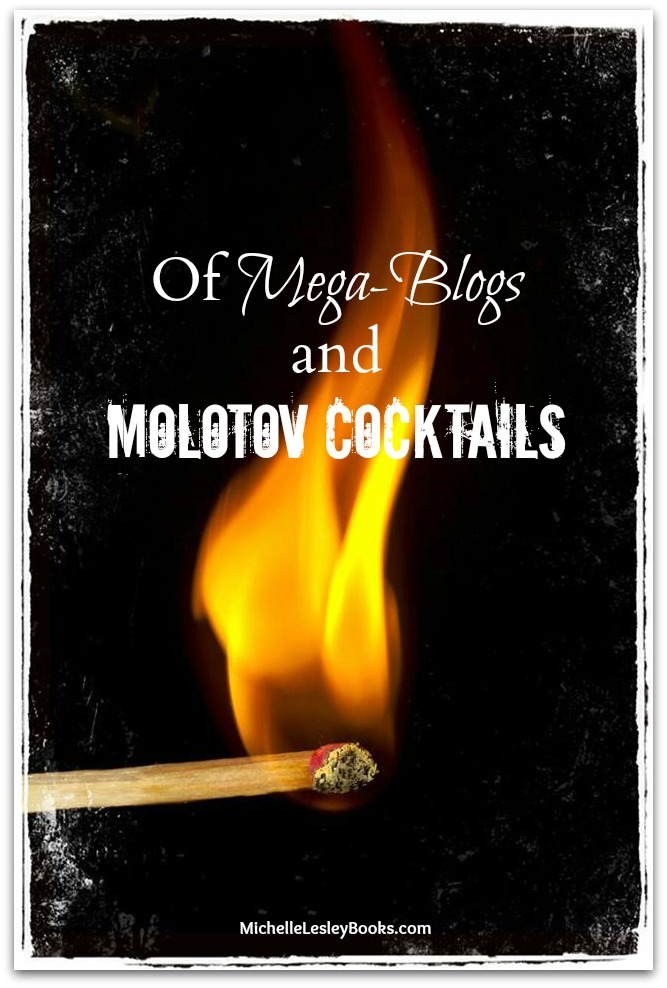
Of Mega-Blogs and Molotov Cocktails

megablogs molotov

I Look Down on Young Women With Husbands and Kids, and I’m Not screaming-womanSorry, screamed the headline. Quite an attention grabber. It certainly grabbed mine. So, of course, I read the article.

It was brash. Extremist. Rude. Rather one dimensional and completely devoid of nuance. And it made me mad, too, since I used to be a young woman with a husband and kids. (“Used to be,” as in, I still have the husband and kids and I’m still a woman, but “young” would be a stretch at this point.)

I was all set to write a blog post in response about the value of wifing, mothering, and working outside the home. You know, whatever God has called you to. So as prep for my article, I read the article again. And again.

And, like a toddler yanking at the hem of my skirt to get my attention, an epiphany pushed and shoved its way into my consciousness.

It wasn’t real.

Or maybe I should say: I suspect it wasn’t 100% sincere.

Have you ever visited a mega-blog like Buzzfeed or Mashable? They churn out tons of cheap content every day, glasscandy-532959which means lots of hits on their web sites and lots of posts that go viral, which means lots of money from advertisers. (Nothing wrong with that, but it’s usually not terribly deep stuff. Sometimes people want a little mind candy, and that’s OK.)

Guess what? Lots of people want a piece of that pie and it’s easier to copycat than to innovate, so there are lots of other upstarts out there trying to become the next mega-blog. Like Thought Catalog, which published the aforementioned article on young women with husbands and kids.

As they say, there’s no such thing as bad publicity, and in a PR move that would make even Miley Cyrus chartreuse with envy, Thought Catalog threw out a Molotov cocktail of an article, stood back, and watched the crowd gather. Nearly a quarter of a million shares on Facebook. Almost 2000 re-tweets. Over 11,000 comments. From a PR standpoint, there’s pretty much no choice but to admire them.

Is Amy Glass, the author of the article, a real person? Maybe she is, or maybe it’s a pseudonym for someone who works for Thought Catalog as a content writer. If she’s a real person, are these her genuine thoughts and feelings, or did she throw in a hearty dose of hyperbole to push her readers into clicking, tweeting, sharing, pingback-ing, and writing response articles?

I don’t know.

There’s a lot of deception going on out there these days (I’m not saying Thought Catalog is being deceptive. Honestly, I haven’t poked around over there enough to know.) and it’s not just “out there.” It’s inside the walls of the church, as well.

joel_osteen-false_prophetThere are plenty of “Buzzfeed” pastors, leaders, and Christian authors who are throwing out cheap content and bombshells…

…2014 is going to be the year God turns everything around for you!
…Just say what you want! If you can say it, you can have it!
…God wants you to achieve all your dreams, so reach for the stars!

Joyce-MeyerThe glass breaks, the flames fly, and the crowd gathers. Their churches are overflowing with people. Their books become best sellers. They’re invited to speak at all the big conferences. And when the little guys start copying them and their methods, they know they’ve arrived.

But are they telling you the truth? And if you’re one of their devotees, how do you know whether or not they’re telling you the truth? Do you even want to know, or are you just happy with being entertained or being told what you want to hear?

There’s a way to find out. Get your Bible out and study it. Don’t just give it a surface reading– do the work and dig. Use the brain God gave you and pursue the knowledge of His word. Ask Him to open your eyes to understand the truth of Scripture. Love God with your mind, not just your emotions. Don’t be deceived.

Because they hated knowledge
and did not choose the fear of the Lord,
would have none of my counsel
and despised all my reproof,
therefore they shall eat the fruit of their way,
and have their fill of their own devices.
For the simple are killed by their turning away,
and the complacency of fools destroys them;
but whoever listens to me will dwell secure
and will be at ease, without dread of disaster.
Proverbs 1:29-33

Bible, Church, Creation, Discernment, Evolution, False Teachers, New Apostolic Reformation, Prayer, Word of Faith Movement, Worship

Keep On Keeping Up: 6 More Issues Christians Need Guidance About From Our Pastors ~ Part 2

14333562683841

Recently, I read a great article by Justin Peters entitled “Ignorance Is Not An Option.” I would call this article a response to that one, but it’s really more of a…well, I guess you could call it a “ricochet”. Last week, in Part 1 of this article, I discussed five current issues in evangelicalism that we folks in the pew need some guidance on from our pastors. Following are six more issues we all, pastors and church members alike, need to learn about and and keep a biblical perspective on.

Creation vs. Evolution:  Sorely missing from some pulpits these days is the exhortation to Christians that the Bible is our final authority on every issue in life and that we are called to believe God’s word- believe it intelligently, yes, but believe it, even in the face of worldly opposition. This admonition does not begin with Genesis 3, it begins with Genesis 1.  We are called to believe that God created the world and that He created it the way the Bible says He created it.

*Resources:
Answers in Genesis– From Creation apologetics to scholarly scientific articles to colleges that teach Creation to VBS curricula, you would be hard put to find a more comprehensive, gospel-centered Creation resource.
The Case for a Creator by Lee Strobel

Denominational Differences: Do you know the basics of what the major Christian denominations teach (salvation, baptism, communion, membership, etc.) and the differences between their doctrine and the doctrine of your own denomination? Are you aware that some denominations which are considered by many to be “Christian” hold to doctrines- including soteriology- that conflicts with God’s word? Are you fairly well acquainted with the doctrines of the denomination or religion that is predominant (or secondary if your own denomination predominates) in your area? Pastoral instruction on the basics of other denominational beliefs (as well as their own!) can be quite helpful as we church members relate to friends and family members or help new church members who come from a different denominational background.

Resources: 
GotQuestions.org For a brief overview of most of the major religions and denominations, type “Methodist,” “Mormon,” etc., in the search box.

For more detailed information, find the denomination’s main web site and click on their “statement of faith” or “what we believe” page (Keep in mind that there are several different “flavors” of Baptist, Presbyterian, Lutheran, etc., whose doctrines and practices may vary significantly from each other.), or get to know local pastors of other denominations and just ask what they teach.

The Word of Faith Movement:  Used almost interchangeably with the term “prosperity gospel,” anti-biblical Word of Faith concepts such as the “little gods” doctrine (we have a divine nature), health and wealth prosperity (it is never God’s will for you to be sick or poor, and if you are, it’s because of your lack of faith), positive confession (Our words have the power to create reality or speak things into existence. Conversely, negative words create negative circumstances.), and twisted teachings about tithing (“sow your seed so God will multiply it back to you”), among others, are infiltrating unsuspecting churches at an alarming rate, and many are being deceived.

Because church members are often introduced to these doctrines by seemingly innocuous, popular speakers and leaders such as Joel Osteen, Joyce Meyer, Christine Caine, Hillsong personnel, Robert Morris, John and Lisa Bevere, John Hagee, Kari Jobe, and Judah Smith, whose materials are sold at Christian stores, conferences, and web sites, church members, and even some pastors, have no way of knowing they’re encountering false teaching unless they understand sound biblical doctrine and have a modicum of discernment skills.  It is now more necessary than ever for Christians to be trained in the basics of hermeneutics and discernment. 

Resources:
A Call for Discernment by Justin Peters
Word Faith Movement at Stand Up For the Truth
Sound the Alarm: The Dangers of the Word of Faith Movement by Emmanuel Davis
A Softer Prosperity Gospel: More Common Than You Think at 9Marks

The New Apostolic ReformationHopefully, your church members have never encountered NAR leaders, doctrines, or manifestations, or, if they have, were immediately turned off by its weirdness and because it is so blatantly anti-biblical. NAR takes the Word of Faith movement, and –BAM!– kicks it up a notch. But, as a gateway drug can lead to addiction and addiction can lead to a fatal overdose, so exposure to Joel Osteen can lead to T.D. Jakes to Benny Hinn to holy laughterstrange “anointings,” glory clouds of gold dust, tremoring, false prophecy, and being “drunk in the Spirit.” This is signs and wonders on steroids.

The NAR is also largely responsible for many of the corrupt teachings on prayer (mainly through Bethel Church in Redding, California) that have become popular in recent years, such as: contemplative/centering prayer, lectio divina, the International House of Prayer, Sozo prayer, healing rooms, and soaking prayer, as well as the false teaching of dominionism.

Resources:
False Spirits Invade the Church: Part 1, Part 2, Part 3  A Documentary by Andrew Strom
Love and Death in the House of Prayer by Jeff Tietz of Rolling Stone

The Emergent/Emerging Church MovementEver heard the old joke, “The only rule is…there are no rules!” Well, replace the word “rule” with “doctrine” and you’ve got a somewhat loose definition of the emergent church. It’s a post-modern mix of ethereal non-traditionalism, feelings, experiences, and mysticism as a means of worship, anti-absolute truth, ideological inclusivism, and anything goes universalism, topped off with a heaping helping of “did God really say…?“. Everything in the Bible, from moral absolutes to the divinity of Christ to the atonement to every other jot and tittle of the Word is questioned, if not outright denied. The only doctrine is…there is no doctrine. And, unfortunately, we church members can find any number of emergent books and materials on the shelves at our local Christian bookstores.

Resources:
What is the Emerging Church? by CARM.org
Exposing the Emergent Movement by Stand Up For the Truth

Bible Translations and Paraphrases, Study Bibles, and Theme BiblesIf the members of your church are carrying the LOLCat Bible or the KLV (yes, folks, that’s the Klingon Language Version of the Bible {Thanks a lot, Aaron. I’ll never be able to unsee that.}) into the sanctuary every week, you probably need more doctrinal intervention than I’m qualified to offer. But, while there are a number of theologically sound study Bibles and theme Bibles out there, there are some that may be just as theologically off base as the gospel according to kitty cats and Star Trek. Joyce Meyer’s Everyday Life Bible, Joel Osteen’s Hope for Today Bible, Sarah Young’s Jesus Calling Devotional Bible, and T.D. Jakes’ Woman Thou Art Loosed Bible are a few that come to mind. (Notice that these are all sold on a Christian web site right alongside materials that teach sound doctrine.)

Are you somewhat familiar with the most common Bible translations being used today, and which ones are the most accurate? Do your church members understand the difference between a translation and a paraphrase? What about gender neutral Bibles? There is such a variety of Bible options available today that the members of your congregation could likely use some guidance in selecting an accurate translation for studying God’s word.

Resources: 
BibleGateway.com– Just about every Bible translation and paraphrase you can imagine, all on line, all free. Compare a few versions side by side, and, if you’re thinking of buying a new version, try it out at BG before you buy.
Comparison of English Bible Translations
Translation Comparison Charts
How the Use of Some Bible Versions Can Twist God’s Truth at The Sacred Sandwich

*The resources given are obviously not an exhaustive list. For the most part, they are resources I have used myself, found to be helpful, and trust to be generally doctrinally sound. There are many other wonderful resources out there, but our most important resource is to compare all things and people to God’s word in context.

Bible, Bible Study, Church

Context Message Me

gettysburg-veterans-public-domainYesterday, I saw several friends and organizations re-posting this article (and others like it) on Facebook. The gist of the article is about teaching the Gettysburg Address to students in a “stand alone” sort of way without teaching that it has anything to do with the Civil War.  As a teacher myself, this seems utterly ridiculous to me. How can students grasp the full meaning, depth, and impact of the Gettysburg Address without knowing the history and events that led up to it, who wrote and delivered it, the people to whom it was delivered, and why it was delivered? Yes, a few things can be gleaned merely from the text itself, but is that all we want our students to learn about the Gettysburg Address? Are we satisfied for them to merely skim the surface of this document and leave with a superficial (and likely, incorrect) understanding of it, or do we want them to dig in and learn all they can about it?

And then it hit me:

What many of us would not abide in the classroom,
we embrace in the sanctuary.

Week after week, many Christians sit under pastors and Bible teachers who fail to preach and teach God’s word in context. A verse from one book is thrown in here, a half verse from another passage, there, like so many sprinkles on top of an ice cream sundae.

No mention is made of the historical (pre-Exile or post-Exile?) or cultural (Was this written to Jews or Gentiles?) context of the passage.

Prescriptive (thou shalt/shalt not do X) passages are conflated with descriptive (here’s what happened to this particular guy) passages, leading to confusion over law, grace, and precisely what it is that God wants from us.

Promises that were never meant for 21st century Christians (because they were written only to a specific person(s) at a specific time) are ripped away from their intended audience and plastered, bait and switch style, onto you and me. (I’ve always wondered why Jeremiah 29:11 is preached as applying to today’s Christians, but verses such as Jeremiah 29:17-19 are not.)

Pastors and teachers treat individual Bible verses and brief passages as “stand alone” items rather than showing how they fit into the immediate context of the surrounding passage and book, while simultaneously neglecting to show how those Bible tidbits fit into the broader, complete story of the gospel revealed across both Testaments.

Pastors and Bible teachers, myself included (and, believe me, I’ve failed many times in this area, too) are to care for those who sit under our teaching by doing our best to handle God’s word correctly (2 Timothy 2:15) and by preaching and teaching, as Paul put it, “the whole counsel of God” (Acts 20:26-27). May we as teachers not merely skim the surface of God’s word, but proclaim the Truth, the whole Truth, and nothing but the Truth. And may our hearers demand nothing less.


Church, Discernment, Worship

The Way We Wor (ship)

mt_sinai

And you shall set limits for the people all around, saying, ‘Take care not to go up into the mountain or touch the edge of it. Whoever touches the mountain shall be put to death.  No hand shall touch him, but he shall be stoned or shot; whether beast or man, he shall not live.’ When the trumpet sounds a long blast, they shall come up to the mountain.”
Exodus 19:12-13

From Cain and Abel to the Israelites in the wilderness to Ananias and Sapphira, God sets limits on the way we may approach Him. He has always said “whosoever will” may come to Him, but He is just as exacting about the way in which we come to Him today as He was back then.

It’s no small matter that many people in the Bible were put to death for approaching God in anything less than an attitude of utmost awe, fear, and reverence for His holiness. Uzzah touched the Ark of the Covenant. Nadab and Abihu offered strange fire before the Lord. The Corinthians took the Lord’s Supper in an unworthy manner.

I recently heard Perry Noble, a well known leader of a seeker sensitive megachurch, who has done such things as having his church’s band play AC/DC’s “Highway to Hell” on Easter Sunday, say, “I’m willing to offend the church people to reach people for Jesus.” When asked where he drew the line at what was too offensive in church, he went on to say, “I probably wouldn’t have a stripper on stage…” and continued to justify using worldly and irreverent antics in church in order to “bring people to Jesus.”

But Perry has missed the point. Worship isn’t about people and what they like or don’t like. It isn’t about entertaining people and making sure they have some sort of enjoyable or emotional experience. It isn’t about attracting the attention of people.

Worship is about God.

What does God think? How does He want to be worshiped? What does He find offensive?

God is not the God of “anything goes.” If you doubt that, go back to the Old Testament and read His precise instructions on constructing the tabernacle, offering sacrifices, the behavior and duties of priests and Levites, and so on. Anything goes? Far from it.

Christ should be the sun in our solar system of worship. Just as the sun’s gravity exerts just the right force on each planet, keeping them revolving around it in exactly the right path, so, when Christ is at the center of our worship, every song, every prayer, every word spoken will fall into exactly the right orbit around Him.

What about your church? The next time you attend a worship service, sit back and view it through the lens of discernment. Is it designed to make you happy? Comfortable? Entertained? Emotional? Or is every element of the service centered on Christ– His holiness, His sacrifice for sin, His love and grace — leading you to exalt Him and forget about yourself?

Pastors and worship leaders, one day you will answer to God for the way you led your church. Do you design worship services to attract and hold the attention of people, manipulate their emotions, and entertain them, or do you sit at your desk, pray, and consider what will please God, how you can best lift up the name of Christ, expose His glory, and keep things centered on Him? God has not called you to be a shock jock, stand up comedian, or motivational speaker. He has called you to preach Christ and Him crucified.

Let’s stop the silliness and stupidity, and repent. Worship is serious business.

Discernment, Faith

The Perilous Parable of Dr. Shepherd and Dr. Tickle

mh900442249

Once upon a time, there was a college student who was majoring in engineering. Let’s call her Brie. (Why? No particular reason except that I’m hungry and I happen to like cheese. But back to our story.)

One of the pre-requisite classes Brie had to take for her major was calculus. Brie had heard about the various calculus professors at her university. Some were tough. Some were boring. A few had a reputation for being easy.

MH900409045

Brie knew she did not want to take calculus from Dr. Shepherd. Although she had some friends who had taken his class and really seemed to know their stuff, calculaically speaking, they had told her that he demanded excellence of his students, had a no qualms about flunking students who weren’t trying and didn’t know the material, and gave regular—and challenging— homework and tests.

MH900386222

Brie was leaning more towards Dr. Tickle. Everybody said she was really nice and cared warmly for her students. She wasn’t a stickler about deadlines for assignments, taught in a funny and entertaining way, and –most importantly for Brie—didn’t believe in tests. Brie hated tests.

All of the sections of Dr. Tickle’s classes usually filled up quickly, so Brie wasted no time registering, and, happily, secured a spot. She knew she’d made the right choice when, on the first day of class, Dr. Tickle started the lesson off with a one woman skit. She filled the rest of the class period with jokes and inspiring personal stories about her own days as an engineering major. No formulas. No notes. They didn’t even crack the spines on their new text books. Brie felt completely at home and comfortable in Dr. Tickle’s class.

About half way through the semester, Brie was regaling her friend, Tess, with a joke Dr. Tickle had told in class that day. Tess giggled at the punch line, but then her brow furrowed.

“Wow, you’re really taking Dr. Tickle for calculus?” Tess asked.

MH900442248

“Sure,” replied Brie, “I love her class. Why?”

“Well, I took her calculus class for a few weeks. Dr. Tickle didn’t really teach much actual math. And even when she did teach us a little bit about how to work some of the problems, I checked my notes against the book, and she had completely botched it. She had left out parts of the formulas, and some of the other things she taught us were the exact opposite of what the book said. If I had stayed in her class, I wouldn’t have a clue as to what’s going on in the upper level classes I’m taking now. In fact, I probably wouldn’t even be graduating. I’d really recommend that you drop Dr. Tickle’s class and take calculus from a good professor who knows what he’s doing. I took Dr. Shepherd’s class. He’s tough, but he’s a great teacher.”

“What?!?! How can you say that about Dr. Tickle? I leave her class every day feeling great about calculus! Not once has she ever made me feel uncomfortable or stressed about my calculations. She’s so understanding and kind, and I love the fun way she teaches. I thought you were my friend, Tess, and I thought you were a nice person, too. How could you say such mean things about Dr. Tickle?”

“I am your friend, Brie! I want you to be able to understand calculus properly so you’ll do well in the tougher classes that come later. I want to see you graduate with high marks and become a great engineer. I’m trying to help you!”

“Well, I think Dr. Tickle is a great teacher, and I really enjoy her class,” Brie responded coolly, “We’ll just have to agree to disagree.”

There are Dr. Shepherds and Dr. Tickles on church campuses, too. God has not called pastors to stand in the pulpit and tickle your ears with jokes and stories. Nor has He called them to make the Bible and his sermons all about you and your self esteem, your dreams, your health, or your lust for material things. God has called pastors to:

preach the word; be ready in season and out of season; reprove, rebuke, exhort, with great patience and instruction. For the time will come when they will not endure sound doctrine; but wanting to have their ears tickled, they will accumulate for themselves teachers in accordance to their own desires, and will turn away their ears from the truth and will turn aside to myths. But you, be sober in all things, endure hardship, do the work of an evangelist, fulfill your ministry. 2 Timothy 4:2-5

If you have a Tess in your life who is warning you that a pastor, teacher, or author you’re following is a false teacher, don’t react like Brie did. What if your friend is right? Do you really want to follow a wolf in shepherd’s clothing, or do you want to follow a Dr. Shepherd who will give you the truth of God’s word even if it’s difficult? Check him out. Where? Here are some resources:

carm_logo

www.carm.org

simple_img_1

Fighting for the Faith with Chris Rosebrough
www.fightingforthefaith.com

Got-Questions-main-header

www.gotquestions.org

apprising.org

 www.apprising.org