Discernment, Mailbag

The Mailbag: “I Speak Jesus,” Charity Gayle, and How to Vet Christian Music

Every time I hear “I speak Jesus over you” I cringe. I can’t exactly explain why. Is it scriptural??

No it’s not, which is why it makes you cringe. It’s pretending to be biblical and your John 10:5, 27 sheep ears know it’s not. Here’s why it’s not:

• There’s nothing in Scripture that tells us to do, or shows an example of anyone doing anything of the sort. The Bible speaks in terms of encouraging, teaching, preaching, exhorting, rebuking, reproving, and comforting others with the written Word of God. If that’s what the person using this phrase means, then that’s what she should say.

Christians should use biblical terminology for biblical concepts, not made up, mystic linguistics. But what “I speak Jesus over you” sounds like, and what she probably means is some sort of supernatural transaction in which she mystically, verbally pulls Jesus down out of Heaven and invisibly spreads Him out over you, like a tarp or an umbrella, to ward off evil spirits or negative circumstances. Sounds kinda pagan, and witchcrafty or incantationy doesn’t it? That’s because it is, which brings us to the second reason you’re cringing…

• You don’t hear doctrinally sound, biblical Christians saying this. This is a buzzword/phrase typical of New Apostolic Reformation heretics. You probably heard this from an NAR false teacher or someone you know who’s into NAR (Bethel, etc.) garbage. This is John 10 at work in your spirit again: Christ’s true sheep (genuinely regenerated Believers) know His voice – what His teaching of sound doctrine from Scripture sounds like – and they will not follow the voice of strangers (false teachers).

• It’s grammatically… incorrect stupid. We speak words. We can’t speak objects or people. It’s impossible. It makes no more grammatical sense to “speak Jesus” over someone than it does to “speak a frying pan” over her.

God ontologically wired human beings for language, and the structure and grammar that goes with it, and we intuitively know when something is linguistically whackadoodle, even if we can’t put our finger on why. That’s another reason you’re cringing.

So if someone said “I speak Jesus over you” to me, I’d have some questions:

• What do you mean by that?

• Where, in context and rightly handled, does the Bible teach us to do that?

• What is that supposed to accomplish, or what will the result of that be so I can watch for it?

People who use this kind of phraseology are going to have trouble coming up with answers to those questions, because “I speak Jesus over you” is not taught in Scripture and doesn’t even make logical or grammatical sense.

◦◦◦◦◦

I was asked this question publicly on X. Since I don’t listen to pop “Christian” music – and especially not “Christian” music of this theological caliber – I was not aware that I Speak Jesus is the title of a song by an artist named Charity Gayle. I misunderstood the lady who asked the question to mean that this is a phrase she’s heard people using in conversation (I’ve heard NAR people say similar things), so that’s the way I answered. After I answered, she informed me that it’s a song.

(Just a little aside here: I do try to keep abreast of things and people in evangelicalism, I promise, but there are so many things and so many people that it’s impossible. Followers often ask me brief questions with little context, use acronyms I’m not familiar with, vaguely allude to situations I’ve never heard of, etc., assuming I’ll know what they’re talking about. I’m very flattered that my followers think I’m up on everything that’s going on out there, but I just want to be perfectly transparent that I’m not. I can’t be. Sorry about that. So when you have a question, do have mercy on me and make sure I know what you’re talking about so I can give you an answer that will actually be helpful to you. I don’t want to be unhelpful. :0)

So now that I know it’s a song, I thought this would be a good opportunity to demonstrate for you, step by step, using I Speak Jesus as an example, how to vet the purportedly “Christian” music you might be listening to.

1.

You hear a song. It’s catchy. You like it. You’re kind of half paying attention to the lyrics, but nothing jumps out and slaps you in the face as overtly heretical, like “🎶 Ooo, ooo… the Trinity doesn’t exist…🎶” or “🎶 Shall we continue in sin that grace may abound? YES, baby, YES! 🎶.”

2.

You listen again, this time paying attention to all of the lyrics. You still don’t hear anything overtly heretical. On the surface, everything seems like it aligns with Scripture, or at least doesn’t contradict it. In fact, you’re pretty sure you heard some theological words or part of a Bible verse in there, somewhere. It must be a biblical song, right? Not so fast, there, Skippy.

3.

🎶 Whoa, whoa… listen to the music…🎶 NOT. Turn the music off, get a text copy of the lyrics (It’s easy to do this by typing the title of the song, followed by the word “lyrics” into your preferred search engine.), slowly, carefully, and discerningly read the words, and compare them to rightly handled, in context Scripture.

Why read instead of listen? Because, whether you realize it or not, the music itself is impacting you. You wouldn’t have finished listening to the song the first time if you hated the music. It’s pleasing your senses, drawing you in, and dulling your objectivity*. You don’t need that distraction when you’re trying to be discerning. Additionally, listening to a song, no matter how slow the tempo, doesn’t give you the time you need to stop and ponder the words in light of Scripture, nor do you have all of the words in front of you at once.

*(Full disclosure: I gave the answer above to the lady on X about the phrase, “I speak Jesus over you” and went through the lyrics of this song two or three times before I listened to it, and even then I could feel a little tickle at the back of my brain going, “The music is great. Maybe the song isn’t so bad after all.” That’s probably exactly how Eve was feeling in the Garden when the serpent offered her that beautiful piece of fruit. And we all know how that turned out. It’s imperative that our brains, logic, and rational thought keep our feelings and senses in check when we’re trying to be discerning.)

Let’s look at the lyrics of I Speak Jesus:

I Speak Jesus

Verse 1:
I just wanna speak the name of Jesus
Over every heart and every mind
‘Cause I know there is peace within Your presence
I speak Jesus

Verse 2:
I just wanna speak the name of Jesus
‘Til every dark addiction starts to break
Declaring there is hope and there is freedom
I speak Jesus

Refrain:
‘Cause Your name is power
Your name is healing
Your name is life
Break every stronghold
Shine through the shadows
Burn like a fire

Verse 3:
I just wanna speak the name of Jesus
Over fear and all anxiety
To every soul held captive by depression
I speak Jesus

Refrain

Bridge:
Shout Jesus from the mountains
Jesus in the streets
Jesus in the darkness, over every enemy
Jesus for my family
I speak the holy name
Jesus, oh (oh)

Repeat bridge

Refrain

Repeat verse 1
Repeat bridge and refrain as artist desires

Performed by: Charity Gayle
Written by: Jesse Reeves, Dustin Smith, Abby Benton, Kristen Dutton, Carlene Prince, Raina Pratt
I Speak Jesus lyrics © Integrity’s Praise! Music, All Essential Music, For Me And My House Songs

OK, so what is the singer saying she wants to do here?
She wants to speak the name of Jesus.

Over whom?
Verse 1: Over every heart and mind (all people)
Verse 2: Over addiction itself (as a spirit or entity), or over people with addictions (it’s unclear)
Verse 3: Over fear and all anxiety (as spirits or entities), and over people with depression

Why?
Because she believes merely speaking the word “Jesus” taps into His power, healing, and life. She believes that speaking the word “Jesus” can break every stronghold; that the word “Jesus” will shine through the shadows and burn like a fire. (You’d have to ask the songwriters exactly what they mean by those last two metaphors, but I’m surmising that they mean something along the lines of, “Speaking the word ‘Jesus’ brings light to spiritual darkness.”)

Is this biblical?
No. Not in the way it’s being presented, as if the word “Jesus” is some sort of magic word you say, like “Abracadabra!” or “Hocus Pocus!” that – TA DAAAA! – magically makes things like addiction and depression disappear.
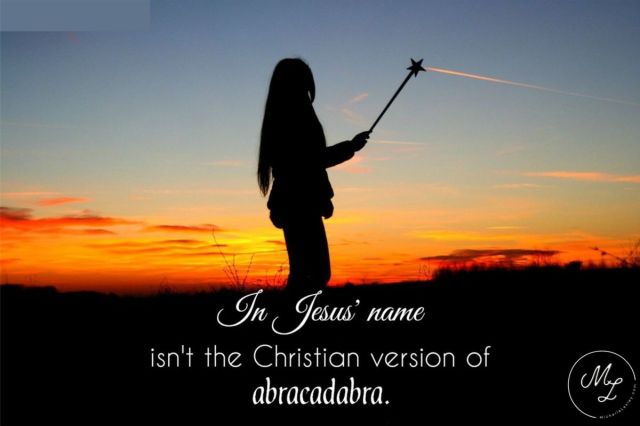
If saying the word “Jesus” did that, you’d see a lot more healing and peace and all the other things mentioned in the song happening, because a lot of people “speak Jesus” in vain a lot of the time. I mean, when was the last time you were watching a TV show and one of the characters blasphemously exclaimed, “J—s!”? Did that heal you of the flu or your gout? No, of course it didn’t.

To which Charity and the songwriters would probably reply, “Well, we didn’t mean it like that! We mean Christians speaking the name of Jesus over people with faith that doing so will heal them, bring them peace, etc.”.

Maybe so, but that’s not what they’re saying. The lyrics of the song imply that there is some sort of intrinsic power in the word “Jesus” itself. “Your name is power. Your name is healing. Your name is life.” The lyrics don’t give any other provisos other than the word passing someone’s lips.

But let’s grant them the benefit of the doubt that when they say “speak Jesus” they mean Christians speaking it with some sort of faith in what saying it will accomplish. Is that biblical?

No, it’s not. It is actually a violation of the third Commandment (taking God’s name in vain) and the laws and commands against practicing witchcraft, magic, and casting spells. Because that is exactly the way they’re using the name of Jesus – the same way witches cast spells. They’re attempting to speak words that harness supernatural power that doesn’t belong to them in order to exercise power and control over things that only God has power and control over.

And remember this little incident in Acts 19:11-19a?

And God was doing extraordinary miracles by the hands of Paul, 12 so that cloths or aprons were even carried from his body to the sick, and the diseases left them and the evil spirits went out. 13 But also some of the Jewish exorcists, who went from place to place, attempted to invoke over those who had the evil spirits the name of the Lord Jesus, saying, “I implore you by Jesus whom Paul preaches.” 14 Now seven sons of one named Sceva, a Jewish chief priest, were doing this. 15 And the evil spirit answered and said to them, “I recognize Jesus, and I know about Paul, but who are you?” 16 And the man, in whom was the evil spirit, leaped on them, subdued all of them, and utterly prevailed against them, so that they fled out of that house naked and wounded. 17 And this became known to all, both Jews and Greeks, who lived in Ephesus; and fear fell upon them all and the name of the Lord Jesus was being magnified. 18 Also, many of those who had believed kept coming, confessing and disclosing their practices. 19 And many of those who practiced magic brought their books together and were burning them in the sight of everyone;

The magicians burning their books of spells in the fear of God in verse 19 demonstrates that they recognized that the Jewish exorcists “invoking the name of the Lord Jesus” (13) were doing essentially the same thing they were doing- casting spells. The magicians saw what happened to the exorcists and they didn’t want that to happen to them, too.

And invok[ing] over those who had the evil spirits the name of the Lord Jesus (13) is exactly what I Speak Jesus is teaching. Go back up to “Over whom?” above. See how I’ve notated the lyrics “addiction,” “fear,” and “anxiety,” as “a spirit or entity”? There’s a reason for that. The NAR doesn’t teach sin like the Bible does. It doesn’t say, “You’ve committed the sin of drunkenness and you need to repent.” It says, “The spirit of addiction is on you and you need to be delivered from that spirit.” The NAR teaches that sin (and illness) happen because you’re possessed by, or at least influenced by, demonic spirits, and you need “deliverance” from those demons and spirits (Sounds an awful lot like the “exorcists” trying to drive out “evil spirits” in v. 13, doesn’t it?). This is not at all what the Bible teaches about sin (or illness either, for that matter). Here’s what God says about why we sin:

But each one is tempted when he is carried away and enticed by his own lust. Then when lust has conceived, it gives birth to sin, and when sin is fully matured, it brings forth death. James 1:14-15

No demons. No evil spirits. You and I sin because our flesh wants to. Because our flesh craves and lusts after something unholy that we’re not supposed to have. “The devil made me do it,” was a Flip Wilson comedy routine, not biblical theology. We are responsible for our sin, not some demon or spirit.

This was funny at the time because everyone – even pagans – knew it was ridiculous. But this is basically what’s now being taught at New Apostolic Reformation “churches” all over the world.

The Bible does not teach us to “speak Jesus over” anyone or anything for the purpose of bringing about results (healing, peace, freedom from sin, conquering the enemy, etc.) that are strictly within the purview of God. If you want to see people set free from sin, fear, anxiety, depression, and addiction, the biblical thing to do is to call them to repent and believe the gospel.

Is this song biblical?
No. It teaches false doctrine and is completely unbiblical.

4.

Now, maybe you’re not so much with all this “right brain” stuff – artsy words and metaphors and such. You’re more of a “left brain,” analytical, “Just the facts, ma’am,” kind of gal. Or maybe you’re just looking for a faster way to find out whether a song is worth listening to in the first place.

I have good news for you. Assuming the artist in question is somewhat prolific, there’s often a faster and easier way to find out what you should or shouldn’t be listening to. And it’s also a more biblical way than vetting individual songs.

When the Bible deals with false teachers, it doesn’t teach us to sift through every article they’ve written or every sermon they’ve preached and keep what’s good and throw out what’s bad. (In common parlance, this is often referred to as “chewing up the meat and spitting out the bones,” and it is an unbiblical way of dealing with false teachers.) The Bible teaches us to stay away from them, altogether.

Romans 16:17-18– “Turn away from” or “avoid” them.
2 John 9-11– “Do not receive him into your house and do not give him a greeting”.
Titus 3:10– “Reject” a factious man.

Scripture teaches us to avoid that teacher completely. Avoid him as a person and every piece of content he has ever created. And that’s the model we should be following with Christian musicians as well. In the same way you wouldn’t listen to a “good” sermon from heretics like Bill Johnson or Steven Furtick, you shouldn’t be listening to “good” songs from doctrinally unsound or heretical musicians. And churches should definitely not be using music from heretical sources in their worship services.

Why Your Church Should Stop Playing Bethel, Hillsong, Elevation, and Jesus Culture

How do you find out who should be avoided? You examine the musician’s life, doctrine, and practices. If you need a little help, you can use the resource I’ve created for vetting teachers: Is She a False Teacher? 7 Steps to Figuring it Out on Your Own.

The first thing I would suggest looking for is any ties to Bethel, Hillsong, or Elevation – all households of heresy (New Apostolic Reformation / Word of Faith). Bethel practically holds a monopoly on the Christian music industry (Hillsong, not as much any more since all the scandals, but Elevation is still hanging in there as a wannabe.), so any evangelical musician seeking fame and fortune is going to be looking to hitch her wagon to Bethel’s star. So look for connections to Bethel and anyone with strong ties to Bethel, for example, Phil Wickham. But also look for connections to any musician or band that you know has bad theology. I’ve got a few listed here, but this is honestly not an area I keep current with, so you may need to bounce things off a discerning friend who is more in the know than I.


Is “I speak Jesus over you” a biblical concept? Nope. Is the song I Speak Jesus biblical? Nope. Keep being discerning as you decide which music and artists to listen to.


If you have a question about: a Bible passage, an aspect of theology, a current issue in Christianity, or how to biblically handle a family, life, or church situation, comment below (I’ll hold all questions in queue {unpublished} for a future edition of The Mailbag) or send me an e-mail or private message. If your question is chosen for publication, your anonymity will be protected.
Church

Throwback Thursday ~ Axiom Questions, I’ll Tell You No Lies

Originally published May 1, 2015

axioms

Why do churches do church the way churches do church?

Ever thought about that? Moreover, have you ever thought about why churches take for granted that they have to do certain things or do things a certain way? Is there an unspoken assumption at your church that you have to have a sermon outline in the bulletin (or for that matter, that you have to have a bulletin), that Vacation Bible School is a non-negotiable event, or that the deacons absolutely must wear ties when serving the Lord’s Supper? Has it gone on for so long that now “it goes without saying”?

Don’t get me wrong- sermon outlines and bulletins can be very helpful, VBS is a great outreach, and I’m in favor of more men wearing ties to church, period. And I’m not talking about irrefutable biblical truths, either, such as, “faith in Christ is the only way of salvation,” or “God created the world,” or “women are not to instruct or hold authority over men in the church.” What I’m trying to get at here is that there are lots of church practices, preferences, and philosophies that we take as axiomatic. We never question them. We just assume they’re true. We act on them as though they’re immutable laws of physics or something. And every once in a while, somebody notices this and wants to change things up.

When it’s an axiom that’s been around for a few decades, the people who hold to that particular ideal are often chided (sometimes deservedly, sometimes not) by those who are pressing for changes. They’re called “inflexible” or “enslaved to tradition.” They’re labled as the “We’ve never done it that way before,” or “We’ve always done it this way,” people.

But have we ever stopped to think that, in many cases, the changes people seek to make today are the outmoded preferences of tomorrow? Often, we’re not making the church better or more biblical, we’re just adding a new premise here or trading one axiom for another there. Like rearranging deck chairs on a cruise ship. Or the Titanic.

Let’s take a look at some of those new axioms that have materialized over the last couple of decades and are now assumed to be a “given” when it comes to ecclesiology.

1. Pastors need to “cast vision,” and churches need a vision/mission statement.
No, they don’t. Christ is the head of the church, the CEO, if you will. Therefore, He is the only one whose place it is to have a vision for the church and to set a mission statement for it. And He has already done that for us. It was one of the last items on His agenda before leaving earth. It’s called the Great Commission:

And Jesus came and said to them, “All authority in heaven and on earth has been given to me. Go therefore and make disciples of all nations, baptizing them in the name of the Father and of the Son and of the Holy Spirit, teaching them to observe all that I have commanded you. And behold, I am with you always, to the end of the age.” Matthew 28:18-20

2. Churches have to be attractional.
Should you invite people to church? Absolutely. Should you be kind and welcoming to visitors? Of course. But that’s not what “attractional” means these days. Attractional means assimilating church into the culture so that lost people will think it’s a cool and groovy place and will flock through the door in droves. That’s why you see pastors coming out onto a stage and giving a Tonight Show-esque monologue while dressed like a teenager at a concert, churches playing music that sounds like what you hear on the radio (sometimes music that is on the radio) accompanied by bands that mimic whichever artist is popular at the moment, no choirs, no pews, no crosses, no pulpits, no hymnals, but a Starbucks in the lobby. Everything a sinner is used to in his daily life. Everything that will make him perfectly comfortable.

Where is this model of doing church found in the Bible? If you answered, “nowhere,” you’d be correct. The church, by definition, is made up of believers. Christ Himself is what is attractional to people who have genuinely been born again. And when we meet together, we have one purpose: to worship and grow in Him. The Bible never tells the church to make itself look like the world to bring lost people into the church. Christ tells us, believers, the church, to go out and make disciples, to go out into the highways and byways and urge the lost to trust Christ so that His house might be filled…with believers.

3. Church should be fun.
Nope, not going to find that one in the Bible either. Worshiping Christ should bring us the deepest joy we can fathom, but that’s not the same thing as rock concert, bouncy house, stand up comedian, outlandish props and gimmicks, music video back up dancers, cash and prizes giveaway, “fun”. Church should be joyful, welcoming, warm, and pleasant. It should also be reverent, solemn, and, often, serious. Worshiping Christ, handling and learning His word, partaking of communion and baptism– these are not frivolous things, and the climate of the church should reflect that.

4. When it comes to the size of a local church, bigger is not only better, but more spiritual.
I see articles from denominational leaders and church growth gurus all the time that start with the presupposition that if your church isn’t constantly growing until you’ve reached thousands in attendance and have to go multi-site, you need to get on that problem, pronto. Or that if your attendance numbers are “stuck” around the 200 or 300 mark, it’s a crisis that needs to be addressed. Pastor, you need to do something about that. It’s assumed that you want to do something about that.

Says who? Says people who have made a lot of money selling church growth materials and want to make more, that’s who. The fact of the matter is, mega churches are the exception, not the rule. The average size of a church in the U.S. is 186 people, and 94% of church goers attend a church of under 500 members.

There are many perfectly legitimate and biblical reasons why a local church might be small. Smaller churches foster intimacy in fellowship, accountability in discipleship, and make it easier for pastors to shepherd individuals and small groups. Certainly, a church should welcome any newcomers wishing to join and should seek to minister to the surrounding community, but if zeal for the gospel is in place, there is no shame in being a small church.

5. Our worship music has to be contemporary.
Why? No, really. Why does it have to be pop-contemorary style? Because we’ll lose or fail to attract young people? First of all, there are plenty of young people who, believe it or not, like hymns and traditional worship music. Why aren’t we concerned about alienating them? What about the older people who like hymns? What about the young people who like country music, or classical music, or rap, or screamo, or death metal, or opera? How come we don’t cater to any of their musical preferences (assuming that’s the basis on which you choose the genre of worship music) during the worship hour?

Up until the early ’80’s or so, when you went to church, you expected to sing hymns out of a hymnal. There’s nothing wrong with adding new songs here and there to the church’s repertoire, but there is something wrong with trying to replicate what’s going on in the world in order to entice lost people into the church. When people go to a funeral they expect to hear funeral music. When they go to a fais do do they expect to hear Cajun music. And have you seen how incensed people get when somebody tries to put a fresh spin on the National Anthem? It’s perfectly all right for church music to sound churchy. We don’t need to apologize for that.

6. Leaving a church (or deciding not to join one) because you don’t like contemporary worship music is selfish, petty, and reeks of spiritual immaturity.
Really? I thought you just said we had to use contemporary music to get young people to join and keep them from leaving. Are they selfish, petty, and spiritually immature for having their music preference catered to? Why don’t they have to suck it up and sing hymns? Would you go to a church that used only a genre of music you hate, like rap or opera? Does that make you selfish, petty, and spiritually immature?

It’s time we stopped shaming people for wanting to leave a church that has changed to a genre of music or a worship style that they hate. There will be times in every church when a particular song (or maybe even several) is sung that you don’t like. That’s normal no matter which genre your church uses. But music is a huge part of our worship services, and if, even after making an effort to embrace the music, you are so distracted by the genre that you’re incapable of focus on Christ, you need to go to a church- a doctrinally sound one, mind you – where you can worship.

We make a lot of assumptions about the way we should do church. Maybe it’s time to start questioning some of them.

What are some other church axioms you’ve noticed?

Mailbag

The Mailbag: Potpourri (“Potty Prayers,” Women as Children’s/Worship Pastors, Solid churches with heretical music, Eternal Security)

Welcome to another “potpourri” edition of The Mailbag, where I give short(er) answers to several questions rather than a long answer to one question. I also like to take the opportunity in these potpourri editions to let new readers know about my comments/e-mail/messages policy. I’m not able to respond individually to most e-mails and messages, so here are some helpful hints for getting your questions answered more quickly. Remember, the search bar (at the very bottom of each page) can be a helpful tool!

In these potpourri editions of The Mailbag, I’d also like to address the three questions I’m most commonly asked:

“Do you know anything about [Christian pastor/teacher/author] or his/her materials? Is he/she doctrinally sound?”

Try these links: 
Popular False Teachers /
 Recommended Bible Teachers / search bar
Is She a False Teacher? 7 Steps to Figuring It Out on Your Own
(Do keep bringing me names, though. If I get enough questions about a particular teacher, I’ll probably write an article on her.)

“Can you recommend a good women’s Bible study?”

No. Here’s why:
The Mailbag: Can you recommend a good Bible study for women/teens/kids?
The Mailbag: “We need to stop relying on canned studies,” doesn’t mean, “We need to rely on doctrinally sound canned studies.”.

“You shouldn’t be warning against [popular false teacher] for [X,Y,Z] reason!”

Answering the Opposition- Responses to the Most Frequently Raised Discernment Objections


I know this is going to sound silly or troll-like, but I’m serious! I have a habit of praying a quick prayer when thoughts cross my mind, like “God, please help Aunt Pam to feel better from her cold today,” or “Lord, thank You for providing that salary bonus I needed.” Sometimes those same kinds of thoughts and prayers cross my mind when I’m using the bathroom. Is that wrong? Should I wait until I get out of the bathroom to think that little prayer? What about what Deuteronomy 23:14 says about using the bathroom, “that God may not see anything indecent among you and turn away from you”?

I don’t think that’s a silly or troll-like question at all, and I’ll bet there are bunches of Christians out there who do the exact same thing and now, after reading this question, are wondering the exact same thing.

First Thessalonians 5:17 instructs us to “pray without ceasing,” which means our hearts are to be constantly oriented toward prayer even though we’re not consciously praying every moment of the day. (Kind of like your compass’ needle always points north even if it’s just sitting in a drawer not being used.) For most Christians, that means we’re intermittently speaking to God, just like you described, throughout the day as things happen, as random thoughts cross our minds, as we see various things. And this becomes such a habit (a good one!) that it doesn’t occur to us to think about where we are or what we’re doing as we utter those prayers in our hearts. Honestly, I think that mindset of reflexive prayer is pleasing to God, because it embodies what it means to pray without ceasing.

Deuteronomy 23:12-14 is part of the Old Testament ceremonial law regarding, in this particular case, the way Israel was to set up camp. When you give the law a good, thorough reading, you’ll notice that the underlying principle of most of the laws is that Israel is to be set apart and holy – different – from the pagan nations surrounding them. And He gives them laws to this effect that touch every aspect of their lives so that, at every turn, throughout the course of their day, there are little reminders, through the law, to “Be holy for I am holy.” This law is just one more of those little reminders: Don’t act like animals like the pagan nations around you, Israel, and just potty willy nilly in the street or the front yard or wherever you take a notion to. Step it up and keep your camp to a higher standard, because God is with you and you are His people.

The Deuteronomy passage is not about offending God by relieving yourself. God has seen every single time every person on the planet has ever relieved himself/herself, because God is omnipresent. If that were offensive to Him, He would not have designed your body to work that way.

Although I don’t think “bathroom time” should be the only time you pray, I don’t see anything in Scripture indicating that God considers it offensive for you to reflexively pray even though you happen to be in the bathroom at that moment. However, if it offends your sensibilities, wait until you get out of the bathroom and then pray.


Would you read 1 Tim 3 1-7 to read women can’t be “overseers/leaders/official” as in they can’t be “Children pastors” or “Women Pastors” in the church with those actual titles or even as directors? The verses only say men and state guidelines on how to choose. I’ve noticed some red flags in my church with a woman Worship Leader, which I don’t agree with since she sometimes teaches in between songs, but they are also giving women the pastor title, but only for children and women.

If I’m understanding correctly, you’re asking:

  • Is it biblical for women to hold a position of leadership over the women’s ministry or children’s ministry of a church?
  • Is it biblical for a woman to be the worship leader of a church?
  • If so, is it biblical to give those women leaders the title of, for example: “Pastor of Women’s Ministry” or “Children’s Pastor”?

Here are the fast and dirty answers. Below are a couple of links where I’ve discussed these issues in more detail.

Assuming the woman is doctrinally sound, has a godly character, her husband (if she’s married) is on board, and she’s otherwise qualified for the job, it’s fine for a woman to lead women or children in the church as long as the position she holds (which will vary from church to church) doesn’t require her to preach to or teach Scripture to men, or hold unbiblical authority over men.

No, it is not biblical for a woman to be the worship leader of a church. This is supposed to be a pastoral position.

No, churches should not give any woman on staff the title of “Pastor,” even if she isn’t violating Scripture in her position. Because Scripture doesn’t permit women to be pastors it is misleading and confusing, and will probably give people the impression that she is violating Scripture and that that’s OK. Neither should the converse be true – churches should not have women on staff in any capacity that violates Scripture (preaching to/teaching men, holding authority over men) and try to conceal that fact by giving her a title (instead of “pastor”) like “minister,” “facilitator,” “coach,” “associate,” “director,” etc.

Rock Your Role: Jill in the Pulpit

Rock Your Role FAQs (see #16, 21)


We have been searching for a doctrinally sound church in the area we moved to, and unfortunately it has not been easy! The few that we have found still use a Hillsong, Bethel or Elevation music. I usually cross a church off the list quickly if they sing from those artists. But like I said, now I am finding even doctrinally sound churches are throwing some of those songs in. Do you have any insight to this dilemma?

It can be really difficult to find a doctrinally sound church these days. Unfortunately even some churches that are fairly solid use music from these groups. The first thing I would recommend is that you check out the Searching for a new church? tab in the blue menu bar at the top of this page, just to make sure you haven’t overlooked any doctrinally sound churches in your area. There are lots of church search engines there and other resources that might help.

My counsel would be to find the most doctrinally sound church you possibly can (following your husband’s leadership, of course, if you’re married, {and assuming, in this particular case, that he’s saved}), attend for a while to get a feel for whether or not it’s a fit for your family, and set up an appointment with the pastor to ask any questions you might have (check out the articles under “What to look for in a church” at the “Searching…” tab for suggestions of questions you may want to ask). (I would recommend the appointment with the pastor regardless of how perfect the church seems.)

If the church uses Bethel, etc. music, this would be the time to gently and lovingly address it with the pastor, but let him know that this is a reason you’re a bit reticent about joining the church so he’ll understand the seriousness of the problem. I would approach the subject giving him the benefit of the doubt that he simply doesn’t know the problems with these groups (the vast majority of pastors are ignorant of things like this – they shouldn’t be, but it is what it is).

If he seems open, you might want to ask if you can send him some information. (You can find links on all three groups at the “Popular False Teachers & Unbiblical Trends” tab. Pick the 2 or 3 most convincing links for each group and send those rather than sending him the link to that tab. For someone who’s ignorant in the area of discernment, opening up that tab would be information overload, and he’ll tune it out.) If he says yes, send the links and then touch base with him again in a couple of weeks to get his reaction.

The only other counsel I would offer you is to remember that no church is perfect, and God may put you into a particular church to help it with those imperfections.

I would now like to take a moment to highlight this reader’s question for pastors and ministers of music. This is yet one more reason it is detrimental to your church to use music from Bethel, Jesus Culture, Hillsong, Elevation, any musician connected these groups (such as Phil Wickham who’s very prolific and has strong ties to Bethel), or any other musician who isn’t doctrinally sound (after you have thoroughly vetted him/her/them.) regardless of how biblical the lyrics of any particular song of theirs that you’re using might be. You could potentially be turning away solid, mature, discerning Believers who might otherwise be interested in joining your church. The woman who sent in this question is not the first to ask me something like this – not by a long shot. This issue is increasingly of concern to Christians looking for a solid church. (For that reason, I do not list churches – even Reformed or seemingly otherwise doctrinally sound churches – on my Reader Recommended Churches list, who use music from heretical sources like these.)

When a visitor walks into your sanctuary for the first time, your worship service is the “face” of your church to her. What kind of a first impression are you making? When you use music by doctrinally unsound musicians, it does not say, “We’re really a doctrinally sound church – honest! We only use songs from these groups whose lyrics are biblical.”. It says, “This church has leaders who aren’t discerning,” or “If this church uses music by these heretical groups, what other doctrinal problems does it have?”. Why put that stumbling block out there when there is plenty of music available with biblical lyrics written/performed by doctrinally sound musicians?

And there’s another stumbling block that using this type of music puts in front of weaker brothers and sisters that you may not have realized. I have heard from a number of Christians whom God graciously saved and rescued out of the pit of “churches” similar to Bethel, Hillsong, and Elevation. They tell me that when they walk into what they think is a doctrinally sound church and hear music from these and other heretical sources, it triggers a form of spiritual PTSD. It’s traumatizing to them. They immediately become fearful that your church is mere steps from turning into one of these types of “churches.” Will they grow out of that reflexive reaction? Yes, someday, as God continues to sanctify them. In the meantime, do you want the music at your church to cause them unnecessary anxiety? I hope not.

Even for Christians who have not come out of “churches” like these but are knowledgeable about their heretical theology, using these songs in your worship service is putting a stumbling block in front of them, too. Take me, for example. I’ve studied these groups. I’ve seen their heresy and the damage they do to both the Kingdom and to the individuals who follow them. And because of that, I’ve zealously spoken out against them. If I visit your church and an Elevation song suddenly flashes up on the screen, my ability to worship is completely derailed in grief that your church would use a song from that source – especially if you know about their theology and are well acquainted with music from doctrinally sound sources that you could have used instead. I cannot sin against my conscience by singing those songs. Consider me a “weaker brother” if you like, but do you care more about me as your sister in Christ, or your “right” to use music from these sources? What about Paul’s posture in 1 Corinthians 8:9-13?

But take care that this right of yours does not somehow become a stumbling block to the weak. For if anyone sees you who have knowledge eating in an idol’s temple, will he not be encouraged, if his conscience is weak, to eat food offered to idols? And so by your knowledge this weak person is destroyed, the brother for whom Christ died. Thus, sinning against your brothers and wounding their conscience when it is weak, you sin against Christ. Therefore, if food makes my brother stumble, I will never eat meat, lest I make my brother stumble.

If this was true in Paul’s personal life, shouldn’t it surely be true of our worship services? If you wouldn’t put a Christmas tree or portrayals of Jesus in your sanctuary because it might offend a brother in Christ, why would you use worship music that causes offense to your brothers and sisters?

Finally, what is the proactively good reason for intentionally choosing music from a heretical source? In other words, when you’re selecting music for the worship service, why would you choose, say, a Hillsong song about God’s glory, or Psalm 23, or the crucifixion, when you could just as easily choose a song from a doctrinally sound source about any of those things – a source that isn’t a stumbling block to anyone, won’t give anyone the wrong impression about your church, won’t lead anyone to follow a heretical “church,” and won’t use your church’s offerings to support a heretical “church”? What makes the Hillsong song you’re choosing better than the song from the doctrinally sound source? It doesn’t seem to me that there’s a good enough reason to use songs from these sources that outweighs all the good, biblical reasons not to use them.

There is simply no good reason for a doctrinally sound church to use music from heretical sources like these.

The Mailbag: False Doctrine in Contemporary Christian Music

Why Our Church No Longer Plays Bethel or Hillsong Music (or Elevation or Jesus Culture), and Neither Should Yours

Hillsong’s Theology of Music and Worship

The Mailbag: Should Christians listen to “Reckless Love”?


Hello there. I read your blog about Priscilla Shirer being a false teacher. Read some parts of your blog. Found your recommended preachers with sound doctrine. I don’t know what denomination you’re in. But I just wanted to ask if you believe if we can lose our salvation?

Hi there! I’m a Reformed Southern Baptist. You can read more about my denomination and my beliefs at the Statement of Faith tab and the Welcome tab (both in the blue menu bar at the top of this page.

No, I do not believe genuinely regenerated Christians can lose their salvation because that’s not what the Bible teaches. I discussed this at length, including the relevant Scriptures, in my article The Mailbag: Can unforgiveness cause you to you lose your salvation?.


If you have a question about: a Bible passage, an aspect of theology, a current issue in Christianity, or how to biblically handle a family, life, or church situation, comment below (I’ll hold all questions in queue {unpublished} for a future edition of The Mailbag) or send me an e-mail or private message. If your question is chosen for publication, your anonymity will be protected.
Worship

In My Humble Opinion…The One with the Modernized Hymns

I don’t often share my personal, completely subjective opinions with y’all. I figure there’s enough of that in the world and what’s sorely lacking is unambiguous biblical truth. So that’s what I try to share instead.

But today, I have an opinion. I’m sure it’ll be wildly unpopular and generate a bunch of hate mail, but that’s in my wheelhouse, so here goes:

I don’t really like most modernizations of hymns.

I didn’t say, “I don’t like modern hymns.” There are several of those I like, and contemporary hymn writers like the Gettys are doing a bang up job of writing lovely new, doctrinally sound hymns. Frankly, we need more theologically rich contemporary hymns.

What I mean is that I don’t like some well-meaning hipster to pick up How Great Thou Art and go, “Hey, those words – most of them anyway…or…at least a few of them – are cool, but that melody, harmony, tempo, and syncopation? Haul out the mothballs! We can’t be singing THAT in church! It’s gotta sound like something on CCM radio! Relevant! Fresh! Cutting edge!”. And then they proceed to put their grubby little paws all over someone else’s hard work and mangle it into something barely reminiscent of the work of art it once was.

It’s kind of the same reason I hate modern remakes of movies of yesteryear. It takes something that was great the way it was and ends up diminishing it to make it palatable and marketable to today’s consumer.

Hymn modernizers are often melody driven. They take a melody they like and force the original hymn lyrics to fit it – leading to awkward phrasing or the need to change words – rather than letting the lyrics lead and crafting a melody around them.

What’s wrong with the original music? I mean it. What on earth is wrong with the original music to the hymn? Nobody’s clamoring for the modernization of Gregorian chant or classical music or big band or 50’s rock, or 60’s folk music, or disco. People listen to those genres and appreciate them for what they are, and if they want to listen to a different genre, they switch genres, they don’t play musical Silly Putty with the current genre. If every generation of people had taken the hymn modernizers’ approach, we’d currently be listening to the 21st century version of Nebuchadnezzar’s horn, pipe, lyre, trigon, harp, and bagpipe.

To me, it’s functionally musical plagiarism even if it doesn’t fit the technical legal definition. They take an existing piece of someone else’s work, change at least 50% of it (sometimes more if they change some of the lyrics in addition to the music) and popularize it under their own name. Whatever happened to “Keep your eyes on your own paper and do your own work.”?

Most of the hymns now being modernized were written at a time when people sang like normal human beings, which nobody seems to know how to do any more. Today, when listening to modernized hymns, you have two choices of “artists”: the wispy, breathy ones who sound like a stiff breeze would knock them over, or the moany, growly ones whose vocalizations are more fit for a Barry White ditty (let the reader understand) than a hymn.

But…but…but…

Yes, I know all the exceptions to everything I’ve just said. I know various hymns have been modernized from time immemorial. I know lyrics of songs are often changed to fit existing melodies. I know some people like modernized hymns and growly or wispy singers.

But that’s kind of the point of why I posted an opinion today. This is my personal preference. I get to like what I like and dislike what I dislike as long as I’m within the confines of Scripture. So do you. So does everybody in the Body. And that’s OK.

Varied personal opinions and preferences – not biblical truth, mind you; we have to know the difference – are not things to divide over. We need to make sure we’re listening to each other, understanding each other, and valuing the unique quirks and characteristics God created in each other. God put each of us together differently for His glory. Those differences show the kind of creativity and diversity He is capable of.

So you have your subjective opinion and I’ll have mine, and we’ll love each other and have those opinions to the glory of God.

Just keep your mitts off How Great Thou Art, if you please.

Mailbag, Top 10

Top 10 Mailbag Articles of 2019

I always enjoy the annual “year in review” articles and TV shows that run in abundance in late December, so I thought I’d contribute my own. Several Mailbag articles were among this year’s most popular, so I decided to make two separate lists. Check out my top 10 non-Mailbag articles of 2019 tomorrow. Here are my ten most popular Mailbag blog articles from 2019:

Vaxxers, Anti-Vaxxers, and the Health of the Body

To vaccinate, or not to vaccinate? It’s a tough issue to discuss these days. 


Do You Recommend Angie Smith (“Seamless”)?

Wife of Todd Smith of the Christian music group, Selah, Angie started out as a blogger, then blossomed into a Christian author and speaker. Her best known book to date is a women’s study: Seamless: Understanding the Bible as One Complete Story


Potpourri (Todd Friel on Rick Warren, Enneagram, Should I stay or should I go?…)

Todd says Rick isn’t a heretic?…Sharply, yet gently, rebuking false teachers…What is an Enneagram?…Books vs. interactions…Should I leave my women’s Bible study group?


BSF (Bible Study Fellowship)

While I totally support the idea of delving deeply into the Scriptures with other women, there are a few of aspects of BSF that concern me… 


Should My Church Participate in Operation Christmas Child’s Shoebox Ministry?

Should my church participate in Operation Christmas Child? What are some other good international ministries my church could participate in instead?


Do you recommend these teachers/authors? Volume 1

Jennifer Kennedy Dean, Lisa Harper, Karen Kingsbury, Rebekah Lyons, Raechel Myers, Shauna Niequist, Jennifer Rothschild, Susie Shellenberger, Sheila Walsh, Amanda Bible Williams

(After today, I’ll be retiring this article. Thanks to Project Breakdown, I have completed updated, individual articles on each of these teachers which you may access at the Popular False Teachers and Unbiblical Trends tab at the top of this page, or by entering the teacher’s name in the search bar.)


Should Christians listen to “Reckless Love”?

Remember, everything we do should be governed by Scripture, not our opinions and preferences, or whether we happen to like a particular song or not…


Questions about the Open Letter to Beth Moore

Since the publication of the Open Letter to Beth Moore, several questions have arisen that I’d like to address…


Do you recommend these teachers/authors? Volume 3

Jill Briscoe, Lauren Chandler, Tony Evans, Rachel Hollis, Chrystal Evans Hurst, Brenda Leavenworth, Leslie Ludy, Bianca Olthoff, Wellspring Group, Jen Wilkin


Do you recommend these teachers/authors? Volume 2

Jennie Allen, Lisa Bevere, Rachel Held Evans, Heather Lindsey, Ann Graham Lotz, Kelly Minter, Nancy Leigh (DeMoss) Wolgemuth

(Project Breakdown begins on this list next!)


If you have a question about: a Bible passage, an aspect of theology, a current issue in Christianity, or how to biblically handle a family, life, or church situation, comment below (I’ll hold all questions in queue {unpublished} for a future edition of The Mailbag) or send me an e-mail or private message. If your question is chosen for publication, your anonymity will be protected.