Complementarianism

Throwback Thursday ~ Solving Misogyny- You’re Doing It Wrong

Originally published June 8, 2018
Not an endorsement for this movie, just illustrative of the point of this article.

If God is the God of Romans 8:28…

And we know that for those who love God all things work together for good, for those who are called according to his purpose.

…then Satan is the god of the anti-Romans 8:28. He wants to twist anything and everything that’s the least little bit good into harm, especially for those who are called according to God’s purpose.

Several very good things have come out of the #MeToo and #ChurchToo movements. Many victims who previously kept silent out of fear and shame have found the courage to tell their stories and begin healing. We’ve had the opportunity to offer them comfort and encouragement through the gospel. Churches have become more aware of how widespread the problem of abuse is and have begun to respond accordingly. In several cases, abusers have been exposed and brought to justice.

Unfortunately, Satan has also used this movement to harm people. False accusations have been made against innocent individuals. Sweeping accusations have been made against Christian men in general. And now, perhaps worst of all, there are rumblings afoot to right the wrongs of real, and imagined, misogyny by “empowering” Christian women and giving us greater, often unbiblical, positions of church and denominational leadership, either as reparations for past mistreatment of women or prophylaxis against future mistreatment of women, or both. (Pastor Tom Buck wrote an excellent series of articles on this – part 1, part 2, part 3, part 4 – which I urge you to read for more details.)

Don’t fall for it, ladies. This is Eden all over again.

Don’t fall for it, ladies. This is Eden all over again.

In the same way that God created a very good tree, planted it in the midst of the Garden, and put a “do not eat” fence around it, God also created the very good “tree” of Christian leadership, planted it in the midst of the church, and put a 1 Timothy 2:12 fence around it.

God’s restrictions about the tree of the knowledge of good and evil were minimal: don’t eat from it. Eve was free to sit in its shade, admire its beauty, fertilize it, plant flowers around it, pretty much anything, except eat from it. And that one restriction is what Satan used to tempt her to sin.

For women, God’s restrictions on church leadership are also minimal: don’t instruct men in the Scriptures and don’t exercise authority over men. That’s literally all there is to it. There are scrillions of ways women can – and must – serve the Body of Christ without getting anywhere near that fence. But these two small restrictions are what Satan is using to tempt us to sin. And, unfortunately, this time, instead of approaching Eve in the form of a serpent, he’s approaching Christian women in the form of the sinful or misinformed words and ideas of pastors and Christian leaders. “Did God really say you can’t have that particular position of leadership?”

But there’s another issue at play here that needs some airing out.

Power. Leadership. These are the ideals that are being touted as the way to lift women up. Is that what Jesus taught? Is that the example He set? No. Jesus taught and exemplified humility, lowliness, and servanthood:

But they kept silent, for on the way they had argued with one another about who was the greatest. And he sat down and called the twelve. And he said to them, โ€œIf anyone would be first, he must be last of all and servant of all.โ€
Mark 9:34-35

But Jesus called them to him and said, โ€œYou know that the rulers of the Gentiles lord it over them, and their great ones exercise authority over them. It shall not be so among you. But whoever would be great among you must be your servant, and whoever would be first among you must be your slave, even as the Son of Man came not to be served but to serve, and to give his life as a ransom for many.โ€
Matthew 20:25-28

When he had washed their feet and put on his outer garments and resumed his place, he said to them, โ€œDo you understand what I have done to you? You call me Teacher and Lord, and you are right, for so I am. If I then, your Lord and Teacher, have washed your feet, you also ought to wash one another’s feet. For I have given you an example, that you also should do just as I have done to you.
John 13:12-15

God doesn’t think the way we think. We think that the only way someone can be valued and heard is if she has power and prestige in the eyes of her fellow humans. That’s where this “empower women and give them positions of leadership” idea is coming from. It is a worldly way of thinking.

God’s way of thinking about this is that we are already intrinsically valuable in His eyes because we are made in His image. Being valued by God is so infinitely more significant than being valued by other humans, that how we look to others shouldn’t even register on our radar. Letting go of what other people think of us frees us up to live in the holy gratitude to God that says, “It is my joy to serve You because I love You. I will live like Jesus no matter what I have to give up, no matter how much I suffer, no matter how humbling it is. You are worthy of my self-abasement.”

He must increase, but I must decrease.
John 3:30

I would rather be a doorkeeper in the house of my God than dwell in the tents of wickedness.
Psalm 84:10b

In God’s economy, the way to greatness is to be a slave. The way to fame is anonymity. The way to exaltation is humility. Why are Christian women being encouraged to stand up and demand the seat at the head of the table instead of being encouraged to give up their seats for others, serve those at the table, even clean up after the meal? What do these Christian leaders want for women – that they find favor with man or that they find favor with God? Orchestrating outward appearances, such as giving women positions of unbiblical leadership, is merely attempting to fix the very real problem of women being sinned against by putting another coat of whitewash on the outside of a tomb that’s full of dead men’s bones. You don’t fix one sin by creating another. You clean out the tomb.

Orchestrating outward appearances is simply putting another coat of whitewash on the outside of a tomb that’s full of dead men’s bones. You don’t fix one sin by creating another. You clean out the tomb.

In any instance in which women are being sinned against by men, the answer is not to “elevate” women to improper places of leadership. The answer is to exercise biblical church discipline against the men and disciple both the men and the women to humbly serve Christ and the church in accordance with God’s Word. Broken, sinful men do not need to hear what broken, sinful women think about how women should be treated. They both need to hear what the holy, almighty God who created men and women has to say about how women should be treated. And the way God has structured leadership in the church, the responsibility of teaching what God’s Word says about this or any other issue falls primarily to the pastor.

Broken, sinful men do not need to hear what broken, sinful women think about how women should be treated. They both need to hear what the Creator of men and women has to say about how women should be treated.

That’s especially of note in this particular situation. Why would these Christian leaders further burden women they consider mistreated with any part of the responsibility of fixing their mistreatment? Why aren’t they instead urging pastors to step up to the plate and properly train the men of their churches to regard and treat women in a godly way?

Encouraging women who have already been victimized to act in ungodly ways is just victimizing them all over again; this time, spiritually.

This whole idea of solving the problem of alleged misogyny in the church with an “I am woman, hear me roar” groundswell is backwards, wrong, and – ironically – man-centered. And encouraging women who have already been victimized to act in ungodly ways is just victimizing them all over again, this time; spiritually. As the Body of Christ, we must be Christ-centered. God has given us all of the necessary instructions for handling problems in the church and between Believers in His Word. We need only to follow them. And Him. Let’s do this right, church.

Complementarianism, Mailbag

The Mailbag: Women teaching men- Questions from a young reader

I received this very astute line of questioning from a young lady who left a comment on one of my articles. The comment and questions were rather lengthy, so I’ve broken it up into portions in order to answer it in an organized way. If you need to read the entire comment, uninterrupted, for context or ease of understanding, scroll down, reading only the portions in bold.


Hi! Just to let you know, though it may seem, I have no intention of being rude in this question, and genuinely want to know your response to this. I am only in 9th grade, so I have a lot to learn, and want to know what you think about my comment...Thank you, and I am very curious to find out what you think about my questions and things that I might have misunderstood or missed.

That’s awesome! I wish I had been thinking as deeply about these things as you are when I was in the ninth grade. And, rest assured, your questions didn’t seem rude to me at all. I’m so glad you want to learn! I hope you’ll understand that my answers aren’t meant to be rude either, although they may not be quite what you’re expecting or wanting to hear.

You didn’t mention whether or not you’re a Christian or what your church background, if any, is, so let me just start off by saying, if you’ve never been genuinely born again, my answers might not make much sense. I would encourage you, even if you’re pretty sure you’re saved, to examine the materials at the What must I do to be saved? tab in the blue menu bar at the top of this page before moving ahead.

I was just wondering, if women are not allowed to teach men, and you are a woman and this blog is public to men and women, then arenโ€™t you technically providing biblical insight and evangelizing to whatever gender is reading this to inform them of the Bible?

Nope. I’ve answered that question in detail in my article Are Female Bloggers Violating Scripture by โ€œTeachingโ€ Men?

Additionally, “evangelism” and “teaching” (“providing insight” isn’t really a biblical category) are two different, separate things. You might find our podcast episode Women Preaching the Gospel? helpful for understanding the distinction.

Also, the book of Timothy, like you said, was a letter written from Paul to Timothy, so this was just the teachings that Paul gave to Timothy as instructions for the churches, and not necessarily coming from God.

I’m afraid that’s one of the things you’ve misunderstood. This wasn’t just a letter from one human being to another. The words in 1 Timothy, just like every word of every book of the Bible are from the very lips of God Himself. Second Timothy 3:16 tells us that “All Scripture is breathed out by God.” There aren’t some parts of Scripture that are from God and others that aren’t. It all comes from God, from Genesis 1:1 to Revelation 22:21.

First and second Timothy and Titus are what we call the pastoral epistles (“epistle” means “letter”). That means they are God’s instructions, written through His human instrument, Paul, to Timothy and Titus and every pastor who came after them, about how to run the church.

I know Paul was a prophet and one argument could be that he got this information from God,

No, Paul was not a prophet, he was an apostle. And, as I discussed above, the Bible says that all Scripture is breathed out by God, so “Paul got his information from God” is the only argument that can be made, especially for Christians. Because, for Christians, the Bible is our authority on what to believe, not human arguments, opinions, and ideas.

but even prophets (besides Christ) make mistakes in their instructions to others,

I’m afraid that’s also incorrect. There’s not a single prophet in the Bible who, when speaking as a prophet to people on God’s behalf ever made one iota of a mistake about what He said. There were false prophets (who received the death penalty for saying they spoke for God when God had not really spoken to them), but none of God’s true prophets – like Isaiah, Jeremiah, Micah, Habakkuk, etc. – ever got anything wrong or “made mistakes in their instructions to others” when speaking on behalf of God.

such as Abraham, who instructed people to be stoned for certain sins,

I think you mean “Moses” here. Abraham wasn’t a prophet, and I don’t recall any instance in Scripture in which Abraham “instructed people to be stoned for certain sins”. Moses didn’t either. God did. God gave Moses the law on Mt. Sinai, and Moses wrote it down and taught it to the people.

and you can see that it was unlawful in Godโ€™s eyes

I’m sorry, but that’s incorrect as well. Since God is the One who gave the laws about stoning people for certain sins, He would never have said that someone properly obeying His law was doing something unlawful. That would be like God saying He was wrong when He made that law. And, of course we know that God is never wrong.

and you can see that it was unlawful in Godโ€™s eyes when Jesus told the priests about to stone Mary of Magdala that they should not stone her because they have sinned as well and God sees all sins as the same.

I think you’re talking about the story of the adulterous woman in Luke 7-8, right? Again, I’m sorry, but there are many things that need to be corrected here:

  • Stoning a woman caught in adultery was not “unlawful in God’s eyes”. It was lawful. God is the one who gave this law. The scribes and Pharisees correctly cited the law in 8:5.
  • Jesus wasn’t speaking to the priests, He was speaking to the scribes – experts in the law (which was an important point of this passage) – and Pharisees.
  • The text does not say the unnamed woman was Mary Magdalene.
  • Look carefully at the passage. In which verse does Jesus say “they should not stone her”? Answer: He didn’t say, “Don’t stone her.”. On the contrary, He said that they could commence with the stoning as long as whichever one of them was without sin cast the first stone.
  • He also didn’t say they couldn’t stone her because “they have sinned as well”. Every lawful stoning that has ever taken place on planet earth was carried out by sinners, because (except for Jesus) every human being is a sinner.
  • The Bible doesn’t say that God “sees all sins as the same” (In fact, we can see in the way that God deals with various sins in various ways throughout Scripture that this isn’t true.), so Jesus would never have said this nor given it as a reason that these men should not have stoned this woman.

Jesus didn’t say the law against stoning an adulteress was wrong. That would have been equal to saying God was wrong for giving that law. He didn’t tell the men not to obey the law, either. The key to understanding this story is in verses 4-7:

4 they said to him, โ€œTeacher, this woman has been caught in the act of adultery. 5 Now in the Law, Moses commanded us to stone such women. So what do you say?โ€ 6 This they said to test him, that they might have some charge to bring against him. Jesus bent down and wrote with his finger on the ground. 7 And as they continued to ask him, he stood up and said to them, โ€œLet him who is without sin among you be the first to throw a stone at her.โ€

They didn’t care about this woman or what happened to her. They didn’t care about the man who was sinning right along with her. They didn’t care that this sin wrecked the man’s and woman’s lives. They didn’t care that God’s law had been broken. They didn’t care that adultery grieves the heart of God. They didn’t care.

All of those things were just a means to an end for them. All they cared about was trying to get the advantage over Jesus. To trick Him into saying something they could use against Him so they could discredit Him or bring Him up on charges with the Sanhedrin (Jewish court). And they were using God’s precious and holy Word as a tool to accomplish this evil goal. They were blasphemously using God’s own Word against Him.

That is the entire point of this story. God’s Word is His representation of Himself to us. It is our lifeline to Him, because it is how we come to know Christ as Savior. It should be revered as high and holy, not twisted and abused for wicked purposes.

This is just one example of many things that Godโ€™s prophets have taught wrongly.

No, none of the things you’ve mentioned, nor the corrections I’ve given, have demonstrated that any true prophet of God has ever taught anything wrong when it comes to prophecy or commands of Scripture. Second Peter 1:20-21 tells us:

…knowing this first of all, that no prophecy of Scripture comes from someone’s own interpretation. For no prophecy was ever produced by the will of man, but men spoke from God as they were carried along by the Holy Spirit.

So, since times were different in the first century and women were not seen as important to men, couldnโ€™t this have been something Paul told Timothy to do based off of his own understandings culturally?

No. Again, 1 Timothy is a passage of God-breathed Scripture, not Paul’s personal human opinion. It was not based on Paul’s human understanding (see 2 Peter 1:20-21, above), culturally, or in any other way. This is God’s command to pastors, based solely on God’s reasons.

And God kindly shares those reasons with us in verses 13 and 14 of 1 Timothy 2:

11Let a woman learn quietly with all submissiveness. 12 I do not permit a woman to teach or to exercise authority over a man; rather, she is to remain quiet.

13 For Adam was formed first, then Eve; 14 and Adam was not deceived, but the woman was deceived and became a transgressor.

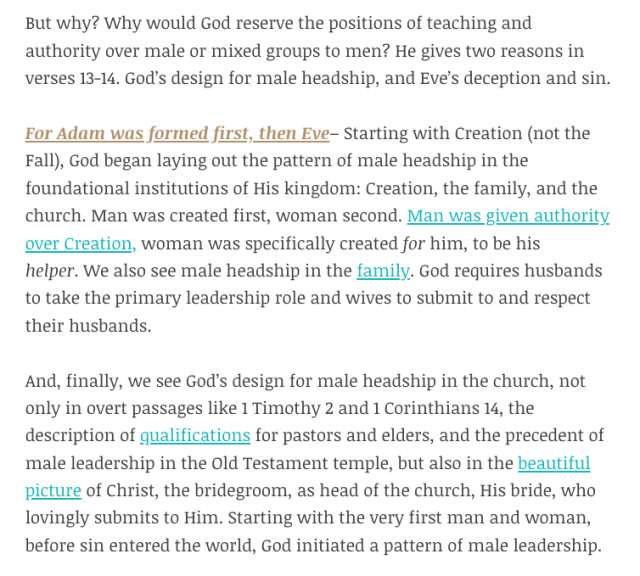
God gives us two reasons for His command that women are not to teach or exercise authority over men in the gathering of the church body: the creation order and pattern of male headship (13), and the fact that the woman was the one who was deceived into sin (14).

That’s why. Not culture, not Paul’s personal opinions, not because men didn’t value women at the time, not because the women in that particular church at that particular time were unruly or false teachers, not for any of the man-made theories that people have come up with. God tells us exactly why He made this rule for the church in verses 13-14. I’ve discussed this in greater detail in my articles Rock Your Role: Jill in the Pulpit and The Mailbag: Counter Arguments to Egalitarianism. Here are a few of the pertinent excerpts:

You’ve asked some really great questions here, and your reasoning skills are sharp. It was my pleasure to serve you by answering your comment. Keep asking questions, studying, and learning all God has to teach us through His authoritative, inspired, all-sufficient written Word.


If you have a question about: a Bible passage, an aspect of theology, a current issue in Christianity, or how to biblically handle a family, life, or church situation, comment below (Iโ€™ll hold all questions in queue {unpublished} for a future edition of The Mailbag) or send me an e-mail or private message. If your question is chosen for publication, your anonymity will be protected.

Complementarianism, Rock Your Role

Are Female Bloggers Violating Scripture by “Teaching” Men?

“You say that women shouldn’t teach men (1 Timothy 2:12), but what about men who read your blog or listen to your podcast? Aren’t you teaching them?”

It’s the canard that will not die. Complementarian women bloggers, authors, podcasters, and content creators are frequently asked this question, often by dissenters looking for a โ€œgotchaโ€ moment. Other times itโ€™s a genuine concern from Christian women who want to write, speak, or create, but still be in obedience to Godโ€™s Word as it speaks to the role of women. But, whatever the motivation for asking, itโ€™s a great question that needs to be answered. Biblically.

It is true that God has ordained different roles for Christian men and women. Both roles are needed and important, but different. Part of the role for women is outlined in 1 Timothy 2:11-15. Women are not to preach to or teach men in the gathering of the church or hold other positions of authority over men in the church body.

But notice that key phrase โ€œin the church.โ€ The context of all of the passages dealing with women refraining from teaching men refers to the teaching of Godโ€™s Word in the gathering together of the body of believers.

Thatโ€™s not the same thing as writing or speaking in the public square. The gathering of the church body might take place within the four walls of a church building, at a park for a Resurrection Day sunrise service, at a Christian conference, at a chapel service at a Christian college or seminary, at a Bible study in someone’s home, or a myriad of other venues, but it’s just that – a physical gathering together of the body of Christ for the purpose of worship, studying the Word, sitting under the preaching of the Word, observing the ordinances, prayer, practicing the “one anothers,” and other “churchy” things.

You’re reading this blog right now. Are you practicing the “one anothers” with anyone? Is anyone standing in front of you preaching the Word? Are you actively worshiping? Do you see an offering being taken up? Baptism? Communion? Prayer? Do you consider yourself to be attending church right now? Of course not. You’re staring at a screen reading an article. This is a blog. Not the gathering of the church.

The Greek word for “church” in the New Testament is แผฮบฮบฮปฮทฯƒฮฏฮฑ, or ekklesia. It literally means a gathering or assembly. No gathering, no church.1 And because of that, women bloggers and other content creators aren’t violating the Scriptures that prohibit them from teaching men in the gathering of the church. (And, by the way, this all applies to women on social media, too. That’s not the gathering of the church either, praise the Lord.)

When I explain this biblical distinction to the “gotcha” folks, the pushback (that’s a polite word for it) I often get is, “You’re just hypocritically splitting hairs and doing hermeneutical gymnastics to justify yourself!”. No, you’re just conflating things the Bible clearly distinguishes from one another.

Think of it this way: If I say that all sexual activity outside of marriage is sinful, but I joyfully fulfill my marital duty to my husband, am I a hypocrite? Am I splitting hairs or doing hermeneutical gymnastics? No. Because there are right and wrong contexts for sexual activity just like there are right and wrong contexts for women teaching the Bible, writing on biblical topics, and so on. The Bible has defined categories and contexts. The Bible draws lines of distinction. Conflating a biblical “do” with a biblical “don’t”? That’s what’s unbiblical.

But let’s consider something else, too. Even though Scripture doesn’t require it, most godly, doctrinally sound women bloggers and online content creators – including me – aim our content primarily at Christian women. I have set up parameters for my blog (and my book, when it was in print) and for my ministry to do everything I can to place myself under the umbrella of 1 Timothy 2:12. Look at the title of this page and my Facebook page. It specifically says “Discipleship for Christian Women“. My book was always labeled and marketed as a women’s Bible study. If youโ€™ll take a look at the โ€œWelcomeโ€ tab at the top of this page, youโ€™ll see I explicitly say that this blog is for Christian women and that Iโ€™m a complementarian. When I address the readers of this blog I nearly always address them as โ€œladies,โ€ both because my target audience is women, and also to remind the handful of men who follow me that they are not my audience; they are, in a sense, โ€œeavesdropping” on what I’m saying to women. My speaking engagements are for women only. I ask men not to use my Bible studies. I’m not really sure what more I need to do to make it clear that my blog and my ministry are for women, not men.

Don’t men bear any responsibility here? Why should the entire burden for women not “teaching” men fall on the shoulders of women bloggers and content creators? Why don’t the Christian men who are ostensibly so concerned about men consuming content from women address the men who are reading our blogs and following our platforms?

But sometimes these โ€œgotcha guysโ€ – who often have ulterior motives of undermining complementarianism – will visit my blog, claim to have learned something, and then turn around and attack me as a hypocrite for โ€œteachingโ€ them. This is akin to a man listening at the door of a womenโ€™s Sunday school class, then bursting in and saying, โ€œAha! You taught a man.โ€ To those men, I would ask a simple question- If a female blogger puts a fence around her blog and you jump over it and trespass on her property, how is she the one at fault?2

Along with Christian women, Christian men ought also to be obedient to 1 Timothy 2:12 by not seeking out female content creators for biblical instruction for themselves. While I welcome male readers – especially those who are vetting me for their wives and daughters or the women of their church, or to gain a better understanding of the issues affecting Christian women in order to lead and shepherd them better – I do not want men seeking me out for personal biblical instruction. All of my readers should look to the doctrinally sound teaching of their pastors and elders for biblical instruction. For women, my blog should only be a leisure time supplement to their sermons and classes at church.

Being a godly female blogger or content creator can be a tightrope walk. All of us have fallen off from time to time, and in those cases we ask that you extend us grace and forgiveness, knowing that we didnโ€™t do it intentionally or rebelliously. Praise God for the โ€œnetโ€ of Godโ€™s mercy and cleansing that catches us and puts us right back up on that tightrope so we can encourage and build up the lovely Christian ladies in our audience. You mean so much to each of us. We love you and want you to grow in the grace and knowledge of our Lord Jesus Christ. Thatโ€™s why we do what we do.


1This is why it is impossible to “attend church” by watching an online church service. You are not “attending church” online, you are watching other people attend church.

2Brothers, this “trespassing” metaphor is addressed to the aforementioned “gotcha guys,” not solid, complementarian brothers who have stopped by the blog to read something to help them minister to the women in their lives and churches. You are welcome here!

This article is an updated and revamped version of the original article by the same title, published on October 23, 2015.


Additional Resources

Rock Your Role – a series examining the Scriptures governing the biblical role of women in the church

Rock Your Role FAQs

Sisters Are Part of the Family of God, Too!

Women Preaching the Gospel? at A Word Fitly Spoken (on the issue of conflation)

Is it a sin for Christian women to blog? by Doreen Virtue and Jacob Tanner

Complementarianism, Podcast Appearances

Podcast Guest Appearance – Servants of Grace

Before all the hubbub of the holidays, I had the pleasure of sitting down for a chat with Dave Jenkins of the Servants of Grace podcast.

Listen in (or watch and listen above) as we delve into the issue of women pastors and why this is such a blight on the modern day church, how the church can support women and foster Titus 2 relationships, and more!

Be sure to check out all of the materials, podcasts, and other contributors at the Servants of Grace website, and find their social media links so you can give them a follow. Also, go subscribe to the Servants of Grace YouTube channel so you’ll never miss an episode, or add it to your queue on your favorite podcast platform.

Articles / resources mentioned or touched on in the episode:

Bible Studies

Speaking Engagements

Rock Your Role: Jill in the Pulpit

Let Me Count the Ways: 75 Ways Women Can Biblically Minister to Others

The Servanthood Survey

A Word Fitly Spoken Podcast

Contact & Social Media

Searhing for a new church?


Got a podcast of your own or have a podcasting friend who needs a guest? Need a speaker for a womenโ€™s conference or church event? Click the โ€œSpeaking Engagementsโ€ tab in the blue menu bar at the top of this page, drop me an e-mail, and letโ€™s chat!

Mailbag

The Mailbag: Potpourri (A rabbi, Rosaria, and a boy mom walk into a blog…)

Welcome to another โ€œpotpourriโ€ edition ofย The Mailbag, where I give short(er) answers to several questions rather than a long answer to one question. I also like to take the opportunity in these potpourri editions to let new readers know about my comments/e-mail/messages policy. Iโ€™m not able to respond individually to most e-mails and messages, so here are someย helpful hintsย for getting your questions answered more quickly.ย Remember, the search bar can be a helpful tool!


Do you have any recommendations for mothers raising Godly men? I became a believer after I was married and my husband is not a believer yet.

As a mom to five boys myself, the best advice I can offer you is this: If you want to raise godly men, be a godly woman. Model godliness for your boys. Study your Bible, and teach them to study their Bibles. Pray, and teach them to pray. Be faithful to your church, find a way to serve there, and teach them to do the same. Obey God’s Word, and teach them to be obedient. When you sin, use it as an opportunity to teach them about repentance and forgiveness. Ask God for wisdom, strength, guidance, and patience. Pray for your boys’ salvation. Submit to your husband. Pray for him and for his salvation.

Some other resources you may find helpful:

Your pastorย – Set up an appointment with your pastor to get some counsel. This is part of his job in shepherding you. It would also be very helpful to find an older, doctrinally sound sister in Christ at your church (preferably one who has raised boys) and ask her to mentor/disciple you.

Imperishable Beauty: A Study of Biblical Womanhoodย – If you’d like to learn more about being a godly woman, join our current Bible study here on the blog.

Bringing Up Boysย by James Dobson – Although I wouldn’t endorse everything from Dobson, I found this book to be helpful years ago when my sons were young. (I have an older edition of the book, so I can’t vouch for any revisions in this newer edition.)

Six Ways to Raise a Godly Man

Parenting Articles


Are you preaching to men here? Are you instructing them?

This has been my frustration with this whole issue. I read the Bible a lot and can see so very much deception here in the West but feel like I am not allowed to say anything to the males who are deceived. And there are many, many false teachers who are male.

I’m not preaching to men or instructing them in that article. As I stated in the conclusion:

…in the end, this article is not meant to be a castigation of pastors or other Christian men, but an impassioned plea from a church lady who wants to see her sisters make it out alive. Help us. Please.

But even if that article had been instructive to men, that’s not a violation of Scripture. What the Bible prohibits is women preaching to men, instructing men in the Bible, and holding authority over men in the gathered body of Believers – the church setting. A blog is not the church. I think these articles may help as you study through this issue:

Rock Your Role: Jill in the Pulpit
Rock Your Role FAQs
Are Female Bloggers Violating Scripture by “Teaching” Men?
The Mailbag: Is it OK for Christian men to read Christian womenโ€™s blogs?

The Bible also does not prohibit you from having a conversation with a male friend or relative to scripturally discourage him from following a false teacher or being a false teacher. (Obviously, you should use biblical wisdom about appearances and temptation when meeting with someone of the opposite sex, though.) That’s essentially what Priscilla and Aquila did when they corrected Apollos – they took him aside privately and explained the gospel more accurately to him.

I would just encourage you to think about your relationship with the man you’re considering talking to. Are you the best person for the job? Not because you’re a woman, but perhaps there’s someone he’s closer to or looks up to as a mentor whose correction might make more of an impact. What about you and your husband (if you’re married and he’s biblically able) approaching this man together as Priscilla and Aquila did? Just some things to consider.


Could you recommend your most trusted watchdog or heresy sites? Iโ€™m trying to find info on [a certain rabbi] as my mom has asked me to watch his teachings.

Well…if he’s a rabbi, he is – by definition – not a Christian, so you should not believe anything he says about God, Jesus, the Bible, church, theology, etc. If any Christian discernment sites have anything on him it will probably beย Berean Research, Pirate Christian’s Blogs, or Fighting for the Faith. These are the sites I most often use for researching false teachers. I’ve listed a few other helpful discernment sitesย here (see #6).


In a recent article you said, “Iโ€™ve often cited the false teaching that prayer is a ‘two-way conversation’ (you talk to God and then He talks back to you).”

Are you saying that God never “talks” to us in reply to our prayers/talking to Him? Or are you saying that the idea of God talking to us as we talk to each other is wrong? (Thanks so much, in advance, for taking time to answer. I really think assuming things makes us vulnerable to misunderstanding…. May God bless you!)

May God bless you too, and thanks for your question.

The answer to both of your questions is “yes”. God does not “talk” to us, and the idea that He talks to us is biblically incorrect. God hasย alreadyย spoken to us, and even went so far as to have His words written down for us – it’s called the Bible. I’ve explained more about this in my article Basic Training: The Bible is Sufficient.


“You made a bunch of allegations in this article but didn’t back them up with any evidence.”

“You mentioned [a particular word, phrase, or concept] in your article. I don’t understand what that is. Can you please explain?”

Hyperlinks, y’all. They’re called hyperlinks. And you need to click on them to find the information you’re looking for.

If youโ€™re reading one of my articles and you see a word inย redย thatโ€™s underlined when you hover over it (other sites might use other colors), clicking on it will take you to another article or resource that will provide you with more information. It’s a little bit like a footnote in a book.

If I stopped to explain every concept I thought people might not understand, gave the full details of every incident I allude to, or wrote out every Scripture that supports the point I’m making, my articles would be tediously long (even more so than usual!). Hyperlinks are a convenient way to provide you with the details, information, or Scriptures you need without adding unbearable length to the article.

All you have to do is click on them.


Our church recently did a book study on “The Gospel Comes with a House Key” by Rosaria Butterfield. The book’s theme is “radical hospitality”. She and her husband invite non-believing people into their home for meals etc. They place no boundaries on this, many are strangers to them.

Concerns my husband and I had were the lack of safety for their family, and the spiritual danger of being yoked together with unbelievers. When we expressed our concerns, no one else spoke up in agreement with us. We have no problem inviting non-believers into our home, we just want to have some idea of who they are. What is your opinion of this book?

I haven’t read the book, but I have listened to two or three interviews with Rosaria in which she talked about the book and the way she and her husband practice hospitality, so I’ve heard her explain how they open their home to those in their neighborhood whom they may not necessarily know. (For those who aren’t familiar with Rosaria – I do not follow her closely, but from what I know of her, and the people who endorse her, she is doctrinally sound.)

The Butterfields’ Methodย The Bible tells us to practice hospitality, but it doesn’t specify precisely how we are to do that. That’s because the Bible has to be applicable to all people across all cultures, contexts, and time. Hospitality will look different even between two families in the same church who are next-door neighbors.

You and your husband are not the Butterfields. You do not live in their town or neighborhood. Your family is different from theirs. And all of that is perfectlyย fine.ย God does not call or expect Christians to be carbon copies of each others. That means the way you practice hospitality may not look exactly like the way the Butterfields practice hospitality. And that’s perfectly fine, and biblical, too.

I don’t think the purpose of Rosaria’s book was to say, “This is the definition of hospitality and this is how every Christian has to practice it.”. I think the purpose was to explore the topic of hospitality and stress its importance. Her description of the specific way her family practices hospitality serves as an example of one way to practice it if that would be a fit for your family.

The Butterfields’ Safety I can understand why, in this day and age, you would be concerned about their safety and the security of their home. They have chosen to accept this risk and practice hospitality this way.

There are two “no-no’s” that go along with your concern and their decision. Your concern does not mean they have to change their decision (not saying you think that, but a surprising number of Christians do), and their decision does not get to dictate the way your family practices hospitality.ย That we practice hospitality is a biblical command. The way we practice hospitality is a matter of Christian liberty and wisdom for each individual family.

Yoking with Unbelievers The mere act of inviting unbelievers to your home for a meal or social event is not a violation of Scripture, especially when the end game is to share the gospel with them. This is the kind of hospitality Jesus practiced with unbelievers, except He didn’t have a home to invite them to. He went to their homes.

The only danger of yoking with unbelievers that could come with practicing this kind of hospitality is getting too intimate with unbelieving friends you’ve made and allowing them to pull you away from Christ and into disobedience. For Christians who are mature enough to stand firm in the faith and keep a wise amount of distance with unbelieving friends, the Butterfields’ method of hospitality should not present a problem in this respect. If your family is more spiritually vulnerable, it would probably be wise to consider other ways of practicing hospitality.


It’s wonderful that you’re considering ways to practice hospitality. I would suggest you and your husband pray for wisdom and guidance. Brainstorm some ways you could tweak what the Butterfields do so it’s a fit for your family, or come up with your own unique way of practicing hospitality.


If you have a question about: a Bible passage, an aspect of theology, a current issue in Christianity, or how to biblically handle a family, life, or church situation, comment below (Iโ€™ll hold all questions in queue {unpublished} for a future edition ofย The Mailbag) or send me anย e-mail or private message. If your question is chosen for publication, your anonymity will be protected.