Podcast Appearances

Videocast Guest Appearance with Doreen Virtue and Melissa Dougherty: What the Bible Says About Women’s Ministry


What a joy it was to sit down and chat with Doreen Virtue and Melissa Dougherty recently to discuss…well, all kinds of things! From the role of women in the church to Christian women in online ministry, from yoga to the Enneagram, I think we pretty much covered it all!

I would encourage you to watch some of Doreen’s and Melissa’s other videos, and subscribe to their YouTube channelsDoreen  Melissa. You can also follow these wonderful ladies on Facebook: Doreen  Melissa, and on Twitter: Doreen  Melissa.

My articles mentioned or touched on in the interview:

Popular False Teachers and Unbiblical Trends (tab at the top of this page)

Recommended Bible Teachers (tab at the top of this page)

Searching for a new church? (tab at the top of this page)

Speaking Engagements (tab at the top of this page)

A Word Fitly Spoken Podcast (“Podcast” tab at the top of this page)

Rock Your Role: Jill in the Pulpit

Rock Your Role: Order in His Courts: Silencing Women? (1 Corinthians 14:33b-35)

Adam 3.0: Meanwhile, Back in the Garden, It’s Deja Vu All Over Again

Are Female Bloggers Violating Scripture by “Teaching” Men?

The Mailbag: Should women give testimonies and reports, lead prayer and worship in church?

The Enneagram

The Mailbag: Should Christians do yoga?

Answering the Opposition- Responses to the Most Frequently Raised Discernment Objections (see #1 for info on the Matthew 18 issue)

Hillsong, Bethel/Jesus Culture, Elevation Music

The Mailbag: False Doctrine in Contemporary Christian Music

The Mailbag: How should I approach my church leaders about a false teacher they’re introducing?


Got a podcast of your own or have a podcasting friend who needs a guest? Need a speaker for a women’s conference or church event? Click the “Speaking Engagements” tab at the top of this page, drop me an e-mail, and let’s chat!

Special Events

Cruciform Conference Special Discount!


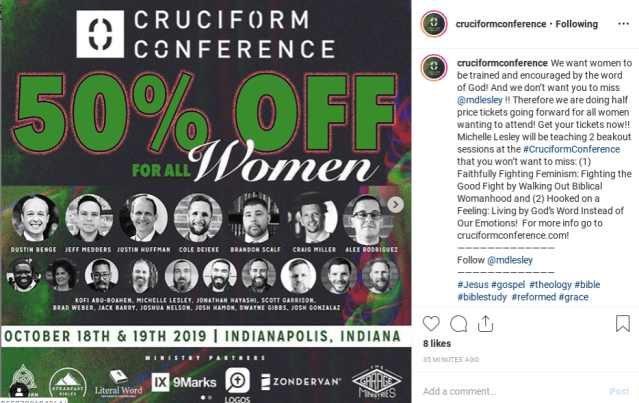
Ladies, Cruciform is almost upon us, and in order to encourage more women to attend, the conference organizers have graciously extended a 50% discount on tickets to you!

Grab your tickets fast, gather up your husband or your friends, and join me in Indianapolis the weekend of October 18-19. You won’t want to miss this wonderful time of cross-centered preaching and teaching and some awesome fellowship with your brothers and sisters in Christ.

And as a special treat for the ladies, I will be teaching two breakout sessions just for women:

Faithfully Fighting Feminism:
Fighting the Good Fight by Walking Out Biblical Womanhood
and
Hooked on a Feeling: Living by God’s Word Instead of Our Emotions

I hope to see you there!

Sanctification, Sin

Throwback Thursday ~ Wise to the Ways of the Worldly: 4 Ways Worldliness Sneaks In, and the Scriptures to Slay It

Originally published August 31, 2018

Lately, every time I turn around, I keep bumping up against the same biblical concept. It’s showing up in my personal Bible study time. In Sunday School. In sermons. Even in a revival my husband and I served at this week.

Worldliness, and the need for Christians to be set apart.

What is worldliness? It’s thinking, acting, and “attituding” the way lost people think, act, and attitude. It’s taking everything in through a fleshly filter instead of a biblical one and putting yourself out there through a fleshly filter instead of a biblical one. It’s dealing with the world around you in any way Jesus wouldn’t.

God has called His people to be set apart from the world from day one. (OK, day six, if you want to get all technical about it.) You can’t be more set apart than living at an address God personally designed for you and plopped you down in the middle of.

The whole purpose of the Promised Land, the Law, driving out the pagan nations and destroying them, depending on God to miraculously win wars and conquer the enemy, was for God to set apart a people for Himself. To raise up a nation that the rest of the world could look at and say, “Hey, those Israelite folks are different, and their God is different, too. What’s their one God got that our pantheon doesn’t?”.

Jesus reminded God’s people what it looked like to be different and set apart from the world. So did His disciples. And the New Testament is chock full of passages in which the apostles exhort Christians and the church to be holy and distinct from the world in heart, mind, and behavior.

Why? Because being different, and holy, and counter-cultural is weird, and counter-intuitive, and attention-grabbing to the world. And once we’ve got their attention, we’ve got an opportunity to share the gospel with them.

Yes, sister, God has called you to be a weirdo for Jesus.

And you’re going to have to fight the flesh to do it, because worldliness is insidious and subtle. Just like that sneaky, slimy serpent slithered in to paradise with no alarm bells ringing, we modern day Eves often don’t even notice worldliness has slipped in and tempted us to think and act in ways it has never even occurred to us aren’t godly. Sure, we don’t drink, and we don’t chew, and we don’t go with boys who do. And we don’t rob banks or murder people. But is that all there is to it? Avoiding the big, bad, behavioral no-no’s?

Before Eve ever extended her hand to pluck the fruit off the tree, Satan had already won several skirmishes with her heart. He had gotten her to doubt God’s character, disbelieve God’s word, and disregard God’s desires in favor of her own. And isn’t he still doing that with us today? Jesus warned us:

The good person out of the good treasure of his heart produces good, and the evil person out of his evil treasure produces evil, for out of the abundance of the heart his mouth speaks. Luke 6:45

As we look at these four ways worldliness can tiptoe into our actions unannounced and unnoticed, let’s also think about how our actions are merely the fruit of what’s going on in our hearts.

What are some of those sneaky snakes of worldliness, and how can we mortify those sins and respond in a godly way?

1.
Being quick to take offense

It’s getting to the point where you can hardly carry on a mundane, “Nice weather we’re having,” conversation any more without being accused of racism, gender bias, or having some sort of “privilege”. Even compliments and positive comments are likely to be twisted and heard by the easily offended as insults or condescension.

Think of the way Jesus endured and responded to the verbal abuse and false accusations intentionally and maliciously hurled at Him. Can you imagine Him freaking out at an innocent, offhand remark, someone’s tone of voice, or somebody unintentionally sticking her foot in her mouth?

Neither can I, yet this form of worldliness is probably my biggest area of weakness. It’s just the pride of life, pure and simple. (Well, not pure, I guess.) How dare anyone ruffle my feathers!

And how do I respond? Maybe the same way you do. I get my back up and strike back, fighting fire with fire. I rarely take a moment to step back and think that maybe this person didn’t intend for her tone to sound like that, or maybe to her that word means something different than what it means to me, or maybe she’s just PMS-ing today, or maybe I misheard or misinterpreted what she actually said. I don’t think, “How can I respond in godly love to this person?”. I don’t think at all. I just vomit my fleshly emotions all over her. Instead, I’m to respond in patience, kindness, and love, even if the situation calls for standing firm on Scripture without budging.

The Serpent Slayer:

Do not repay evil for evil or reviling for reviling, but on the contrary, bless, for to this you were called, that you may obtain a blessing. 1 Peter 3:9

Live in harmony with one another. Do not be haughty, but associate with the lowly. Never be wise in your own sight. Repay no one evil for evil, but give thought to do what is honorable in the sight of all. If possible, so far as it depends on you, live peaceably with all. Romans 12:16-18

2.
Being “Tolerant”

The world has been torturing this poor word “tolerant” for at least a few decades now. The definition has morphed from its actual meaning of “peacefully putting up with something that bothers you” to “embracing and celebrating any and every behavior and ideology (except biblical Christianity) as worthy and valid.” You’re not even allowed to think someone else’s worldview or behavior is wrong. You have to think it’s good or you’re a terrible person.

Now, of course, most Christians would not go around blatantly proclaiming that any old religion is just fine or that sexual immorality and perversion are perfectly acceptable or that abortion is a valid health care choice. But what about shying away from sharing the gospel with our Muslim neighbor for fear of appearing to be an Islamophobe? What about attending the homosexual “wedding” of a friend or loved one in order not to offend him and to maintain the relationship? What about failing to stand up for what’s right at work when unethical practices are the industry standard?

The Bible is very clear that following Christ and loyalty to His Word divides people. It divides family members from one another. It divides friends from one another, and it divides God’s people from those who claim to be God’s people and from the rest of the world. Jesus came to unite repentant sinners to God, not to unite unrepentant sinners to saved people. We must do what is right and biblical, refusing to participate in sinful and worldly activities, and lovingly, yet firmly, calling sinners to repentance and faith in Christ, even if it costs us family members, friends, our reputations, our churches, or our jobs.

The Serpent Slayer:

“Do not think that I have come to bring peace to the earth. I have not come to bring peace, but a sword. For I have come to set a man against his father, and a daughter against her mother, and a daughter-in-law against her mother-in-law. And a person’s enemies will be those of his own household. Whoever loves father or mother more than me is not worthy of me, and whoever loves son or daughter more than me is not worthy of me. And whoever does not take his cross and follow me is not worthy of me. Whoever finds his life will lose it, and whoever loses his life for my sake will find it.” Matthew 10:34-39

You adulterous people! Do you not know that friendship with the world is enmity with God? Therefore whoever wishes to be a friend of the world makes himself an enemy of God…Submit yourselves therefore to God. James 4:4,7a

3.
Being Flippant or Consumeristic about Church

The world has no reason to think going to church is important. Why would they? They’re lost. And if they do darken the door of a church, it’s not because they love Christ and want to worship Him, it’s ultimately for self-centered reasons. To assuage their guilt, to get Mom or the wife off their back, to feel better about themselves, to satisfy their curiosity.

Gathering to worship God is what genuinely regenerated Christians do. We have a God-given craving for fellowship with brothers and sisters in Christ and approaching His throne in prayer, praise, and the study of His Word together. Skipping church at the drop of a hat, shopping around for a church with all the slappy happy bells and whistles that make you comfortable, demanding that your church cater to your feelings, opinions, and preferences, strolling in with a “what’s in it for me” attitude? Uh uh. Those are worldly, self-centered attitudes, and might even indicate that you’re not saved.

Christians see faithfully attending and serving at church as vital to their relationship with Christ and other Christians. It’s not, “What’s in it for me?” but “How can I serve you?”. It’s not, “What did I get out of the worship service?” but “How can I wholeheartedly throw myself into the worship of Christ?”.

The Serpent Slayer:

And let us consider how to stir up one another to love and good works, not neglecting to meet together, as is the habit of some, but encouraging one another, and all the more as you see the Day drawing near. Hebrews 10:24-25

even as the Son of Man came not to be served but to serve, and to give his life as a ransom for many. Matthew 20:28

So then, as we have opportunity, let us do good to everyone, and especially to those who are of the household of faith. Galatians 6:10

Therefore let us be grateful for receiving a kingdom that cannot be shaken, and thus let us offer to God acceptable worship, with reverence and awe, Hebrews 12:28

4.
Being Defiant

If ever there were a generation of Americans who treated defying authority as the national pastime, this is it. Have you seen all the videos of people pulled over by the police who refuse to comply with their every request, sometimes even turning violent? How about the way wives these days run their marriages and treat their husbands like children? And the way children are allowed to rebel at school and at home? What about the rioting in the streets we’ve seen over the last few years?

The more I study the New Testament, the more passages I find instructing Christians to submit to the authorities in our lives. I’m not sure if I’d call it a major theme of the New Testament, but it sure isn’t a minor one. We’re to submit to the government, governing officials, earthly “masters” (literally if we’re slaves, figuratively – bosses, supervisors, etc. – if we’re not), wives are to submit to our husbands, children are to submit to their parents, and church members are to submit to our pastors and elders. Every human institution.

God’s people are a submitting people. Submitting to the authorities in our lives paints a picture for the watching world that one day every knee will bow in submission to the ultimate authority – God. And because God is our ultimate authority, the only time we disobey the human authorities in our lives is when what they’re asking us to do would cause us to disobey or dishonor God. Otherwise, we humble ourselves and joyfully and graciously submit.

The Serpent Slayer:

Therefore God has highly exalted him and bestowed on him the name that is above every name, so that at the name of Jesus every knee should bow, in heaven and on earth and under the earth, and every tongue confess that Jesus Christ is Lord, to the glory of God the Father. Philippians 2:9-11

Be subject for the Lord’s sake to every human institution. 1 Peter 2:13a

But Peter and the apostles answered, “We must obey God rather than men.” Acts 5:29


There are so many more ways Satan tempts Christians to act like the world. We put our faith in politicians to fix things rather than in God. We approach the world with a posture of entitlement and demand our rights instead of laying them down to serve others. We lash out in bitterness at those who have hurt us, holding grudges and cutting them out of our lives instead of forgiving as Christ has forgiven us. The list could go on and on.

But however worldliness manifests itself, it all has the same serpentine root in the heart: doubting God’s character, disbelieving God’s Word, and disregarding God’s desires. And when our hearts become ambivalent about God, and we push His desires and directives aside, the void that’s left has to be filled with something.

That “something” is the idol of self. I want to do what I want to do and I don’t want anybody standing in my way. This thing, or person, or idea makes me happy and comfortable, and keeping it is more important to me than what God says about it. That’s ultimately what’s going on in our hearts when we think, speak, and act in worldly ways.

out of the abundance of the heart his mouth speaks

Submit to the Scriptures. Be subject to the Savior. Slay the serpent of worldliness.


What are some other forms of worldliness that can sneak into our lives,
and what Scriptures can we use to combat them?


Share Your Testimony

Testimony Tuesday: Stories from Several Sisters 5

On today’s Testimony Tuesday,
several sisters in Christ share their stories.

Tiffany’s Story

My husband and I and family were first at a word of faith/prosperity church, and thankfully God granted us and we continually prayed for wisdom and discernment. We then moved on to an AG [Assemblies of God] church and again, just like the last church, we got heavily involved. The more we read and the more we talked, we realized they weren’t on the same page as us, and it’s only been 3 weeks but we have found a Reformed Bible church. I continually pray that the people in our old church will have their eyes open and begin seeing the truth in the Word. I’m so grateful and thankful to the Father for the journey He has us on. We continually learn and teach our children.


Latoya’s Story

As some other women on your site have said: “Yay, women like me! Who believe in The Word! I’m not weird!”

I was born and raised in a Pentecostal church…but have REALLY been having a relationship with God for over one year now.

Thank you for teaching me what a Godly, Bible-based church looks like. . .

One particular article spoke of expository versus topical sermons. I am reading though the Bible (for the first time ever) since last summer. Wow! I can’t say enough of how awesome The Word is! It’s my favorite thing to do: study His Word! Anyway, that article spoke to me. I thought: I’ve never been under an expository preacher, but it sounds amazing! So, out of curiosity (..and because I do feel led to be at another church…although I do not know where yet) I looked under the “searching for a new church?” tab. I found a church one hour away. The sermons are listed. Each Sunday they take a handful of verses in order from each chapter. ((Jumping up and down that this even exists!)). I never knew.


Christine’s Story

I grew up as a Catholic. I prayed to God but didn’t understand anything of the Bible or the significance of why Jesus had to die. I attended “church” weekly growing up, but knew nothing of the Bible. I lived a life with no clarity in why I needed a Savior and like so many, thought I was a pretty good person, so I would be fine. In the meantime, I met my husband in college. He also grew up Catholic and led a similar life of sin and confusion. Just before we got engaged, my husband was saved at a Christian service that I did not attend. We got married and continued to go to Catholic service while he was growing in his faith.

My husband then led us to a non-denomination church, which I reluctantly attended. They shared the Gospel regularly and taught from the Bible. It wasn’t until years later, after we had two boys and after my dad passed, that I was saved. It took several years of me hearing the Gospel before I truly accepted Christ and repented of my sins. I am beyond grateful for what Jesus did for me, opening my eyes to His Truth and saving me from my sin. I am also so thankful he saved my husband years earlier before I even realized what that meant. My husband and I have become passionate creationists and are looking forward to an upcoming trip with our boys to the Creation Museum and Ark in Kentucky! Although we continue to be sinners, I hope I can continue to live my life glorifying God and sharing the Gospel of what Jesus did for us, dying on the cross to save us from our sins and reconciling us back to our perfect God.


Michele’s Story

When my husband and I moved to a new city 13 years ago, we spent almost a year searching for a new church. We settled in a church that seemed to affirm the authority of Scripture while honoring the freedom we have in Christ. We attended faithfully and served in many different capacities. This past year, as we have grown in our knowledge and love of the Bible as well as in biblical discernment, we have realized we were in a purpose-driven, seeker-sensitive church.

We met with the pastor and associate pastor many times, but they were defensive and unhearing. After many months of continuing to serve, to cope, to adapt, we knew we had to leave.

I almost dreaded to process of finding a new church. In our small town, there didn’t seem to be many (if ANY!) realistic options, and I just didn’t want to church shop. I longed to be planted quickly into a fellowship of like-minded believers. I prayed, “You know my desires, Lord, but Your will be done.”

I clicked on your “searching for a new church” tab and scrolled through the items. There were few suggested churches for [my state], and none for our city. Then I clicked on “churches recommended by my readers” and saw the one listing for our area.

I would like to say that it was love at first visit! However, I had been so pampered and pandered to that I didn’t have much patience for the longer service and deep, expositional preaching. However, I was encouraged by the Lord to persist. Our first visit was in April and earlier this month we became members.

I am so very grateful to the Lord for directing us to this precious little church and to your resources. I mean, really.


Ladies, God is still at work in the hearts and lives of His people, including yours! Would you like to share a testimony of how God saved you, how He has blessed you, convicted you, taught you something from His Word, brought you out from under false doctrine, placed you in a good church or done something otherwise awesome in your life? Private/direct message me on social media, e-mail me (MichelleLesley1@yahoo.com), or comment below. Your testimony can be as brief as a few sentences or as long as 1500 words. Let’s encourage one another with God’s work in our lives!

Mailbag

The Mailbag: Potpourri (DivorceCare, When are they men?, Touring unbiblical churches…)

Welcome to another “potpourri” edition of The Mailbag, where I give short(er) answers to several questions rather than a long answer to one question. I also like to take the opportunity in these potpourri editions to let new readers know about my comments/e-mail/messages policy. I’m not able to respond individually to most e-mails and messages, so here are some helpful hints for getting your questions answered more quickly. Remember, the search bar can be a helpful tool!

In these potpourri editions of The Mailbag, I’d also like to address the three questions I’m most commonly asked:

“Do you know anything about [Christian pastor/teacher/author] or his/her materials? Is he/she doctrinally sound?”

Try these links: 
Popular False Teachers /
 Recommended Bible Teachers / search bar
Is She a False Teacher? 7 Steps to Figuring It Out on Your Own
(Do keep bringing me names, though. If I get enough questions about a particular teacher, I’ll probably write an article on her.)

“Can you recommend a good women’s Bible study?”

No. Here’s why:
The Mailbag: Can you recommend a good Bible study for women/teens/kids?
The Mailbag: “We need to stop relying on canned studies,” doesn’t mean, “We need to rely on doctrinally sound canned studies.”.

“You shouldn’t be warning against [popular false teacher] for [X,Y,Z] reason!”

Answering the Opposition- Responses to the Most Frequently Raised Discernment Objections


I’m wondering if the DivorceCare support groups are good?

I’ve never been to a DivorceCare group or been a part of a church that hosted a group or used its materials, so I’m strictly drawing on what I’m seeing on their website.

The DC statement of faith is biblical, if minimalistic.

The format of meetings is for the group to watch “a video seminar featuring top experts on divorce and recovery subjects” and then discuss it, support group style. So, I took a look at the list of seminar experts. I don’t recognize half or more of the names, but of the names I do recognize, most are biblical counselors (the biblical counseling world has a reputation for being generally doctrinally sound), and two or three are pastors and Bible teachers I wouldn’t recommend but aren’t heretics either (if they’re teaching strictly on issues of divorce, I’m guessing what you’ll get from their videos is pretty much in line with Scripture).

So, all of that to say, as far as the materials DC provides, I don’t think you’re going to be taught major doctrinal error if you choose to participate. However, I’m guessing these groups vary widely depending on who is leading them and how good or bad that person’s/church’s theology is, so that’s a major component to take into consideration.

Having said all of that, I would not recommend that you participate in a parachurch organization for help getting through a divorce. It’s not their job to do that, it’s your local church’s job. Your pastor should be counseling you and/or your spouse to reconcile if that’s at all possible, and counseling you in other ways if not. Your Sunday School or Bible study class and other church family should be supporting you, helping you, and walking through this difficult time with you. When Galatians 6:2 says, “Bear one another’s burdens,” it’s talking to the church, not a parachurch organization or a support group. And you need real live, “Call me any time, day or night,” church family to do that, not a bunch of strangers, not an expert on a screen. I think people who choose a parachurch organization like this are going to miss out on a lot more than they realize.

Furthermore, while counseling people who are going through a divorce is a good and necessary thing, it concerns me that so many churches are putting so much emphasis on post-divorce programs when what they should be throwing most of their energy into is preventing divorce by:

  • preaching and teaching biblically about marriage and divorce
  • extensive pre-marital teaching and counseling
  • encouraging, strengthening, and enabling healthy marriages
  • intervening and helping couples in marital distress
  • treating initiating and pursuing divorce for unbiblical reasons as the sin the Bible says it is
  • commencing with church discipline for church members who are initiating and pursuing divorce for unbiblical reasons.

Churches that proactively support and protect marriage this way will rarely find the need for divorce counseling.


I agree that Scripture is clear about women not teaching men the Scriptures. At what age are males considered to be ‘men’?

It’s an insightful question, and one that there’s no hard and fast “exact age” answer to. I think most of us would probably agree that pre-teens and under are children, not men, and I hope that most of us could agree that males in their mid-20s and upward are men. It’s those pesky teens to early 20s ages that throw a monkey wrench into the question.

Males ages 18 to early 20s may, in some cases seem like boys, but for this question, I think the common grace of American law (if you’re an American) can help us feel confident defining any male over 18 as a man. If American law treats a person as an adult at age 18 with regard to crimes, voting, marriage, property, etc., should the church be treating them as children?

So now we’ve narrowed our window of potential “men” down to age 12 or 13 to 17. And for that narrow window of ages, I’m going to refer you to question 13 of my article Rock Your Role FAQs:

What about teaching the boys in my church’s youth group?

Women should not serve as youth pastors. The Bible restricts pastoral and elder roles to men.

As to teaching the Bible to co-ed groups of minors (in Sunday School, as a youth helper, etc.), there is no hard and fast rule, but my recommendation is that a good time for women to break from teaching boys at church is around the time they start middle school. In the Bible, boys traditionally moved from childhood to adulthood at age thirteen. Jesus exhibited growth toward manhood and engaged the rabbis in the temple at age twelve. Of course, these are both anecdotal and neither means this age is the basis of any sort of law for Christian women about teaching boys, but there seems to be some wisdom there- a good rule of thumb. Once they hit their early teens, boys really need the guidance of godly men who can lead by example and teach them what it means to grow into godly manhood. When it comes to teaching adolescent boys at church, it’s much less about what women are “allowed” to do and much more about the best way to grow godly men. Only men can train boys to be men.


Over the years when we have visited various cities, we have toured old churches, several of which have been Catholic churches. Our main interest has been the architecture of the buildings along with the historical aspect. We have never participated in a church service, only informational tours. I was wondering if you have an opinion of Christians touring Catholic churches.

For someone who is genuinely saved, and in no danger of being wooed toward false doctrine simply by walking through a beautiful building and listening to a tour guide, I don’t think that’s problematic at all. Simply being in a building and learning about its structure and history doesn’t mean you agree with what happened there. I mean, if you toured Auschwitz, that would not mean you agreed with or supported what happened there, right? When I was in Egypt several years ago, I toured (as far as women were allowed to tour) a mosque. If I were in Salt Lake City, I would certainly check out the Mormon Tabernacle. If I were in Rome I would visit the Vatican. There’s nothing sinful for you personally about going to places like these to view the architecture or learn something about the religion or customs any more than it would be wrong to read about those things in a book.

If your conscience doesn’t bother you about taking the tour itself, and you’re not worried about your theology veering off course, there are only two ways I can think of that this could be a problem, biblically. First, if there’s an admission fee to tour the church, what is that money supporting? Speaking for myself, I could not knowingly pay a fee that would, in any way, support a false religion or the spread of it. Second, would entering one of these buildings somehow hurt your witness or be a stumbling block to someone who knows you? That would really depend on the other person, the situation, etc., but that is something you should take into consideration.

I would suggest that you look for opportunities for evangelism during these tours. Leave a tract behind if there’s a way to do that without littering (the ladies’ room is usually a good spot). Before you leave, take a moment to silently pray for the salvation of the people who go to church there (or work there, or are on the tour with you). If there’s an opportunity to ask a simple gospel-centered question or make a biblical comment during the tour, take advantage of that (don’t interrupt or argue, don’t lecture or debate, don’t do “gotcha” questions, and be sweet – you’re scattering seed, not waging war).

Enjoy your trip, and I hope you learn a great deal.


Michelle, are you going to be at the G3 Conference in January 2020?

I wish! I’d love to be there, but I don’t think it’s going to happen this time. It’s a wonderful conference, and I highly recommend it for everyone who’s able to attend. Y’all have fun!

(I will be at the Cruciform Conference next month, though! Find me and say hi!)


So there are women in my home who enjoy, unaware, the teachings of Rohr/Shirer/Enneagram/journaling/meditation/etc. I’m not sure I really have a voice anymore in their spiritual pursuit outside of prayer. Do you have any strategies or a playbook of sorts on how to navigate through this season of life?

(This question comes from a gentleman.)

I’m so sorry for the difficult situation you’re in. It is always sorrowful and frustrating to watch those we love chase after ungodly things.

You say “there are women in my home,” so I’m not really clear on whether these women are your wife, daughters, sisters, other relatives, female boarders, etc. I’m also unclear on whether or not you are the head of the home (husband/dad).

If you are not the head of the home (i.e. these women are your mother and sisters or other relatives or non-relations over whom you have no biblical authority), continue to pray for them and set up an appointment with your pastor for counsel on how best to handle this situation.

If you are the head of the home, I’m sure you know that God has given you the responsibility of being the spiritual leader of your household. I’m honored that you reached out to me for help, but learning to lead well is going to be a long road of face to face discipleship that must take place in your own local church with your pastor and brothers in Christ there. As a woman, I am neither equipped, nor would it be biblically appropriate for me to walk you through this long term and through a computer screen. There are no magic strategies for a quick fix, but your church family can help you work through the “playbook” – the Bible – as you grow in Christ and in spiritual leadership. I would strongly recommend that you set up an appointment with your pastor for counseling and, definitely continue to pray for these women.


If you have a question about: a Bible passage, an aspect of theology, a current issue in Christianity, or how to biblically handle a family, life, or church situation, comment below (I’ll hold all questions in queue {unpublished} for a future edition of The Mailbag) or send me an e-mail or private message. If your question is chosen for publication, your anonymity will be protected.