Biblical Womanhood Bible Study

New Bible Study Kickoff and Title Pic Contest

Happy Wednesday, Ladies! I hope you all enjoyed our study of The Women of Genesis.

Today, we’re kicking off our new study…

…with a fun title pic contest!

The title is taken from 1 Peter 3:4:

but let your adorning be the hidden person of the heart with the imperishable beauty of a gentle and quiet spirit, which in God’s sight is very precious.

During the course of this topical study, we’ll take a look at the imperishable beauty of biblical womanhood, studying the various Scriptures that teach us what it means to be a godly woman. Married or single, young or old, if you want to become more conformed to the image of Christ and represent Him well as a Christian woman – whatever your station in life – this study is for you.

But before we get started studying, how about a little fun?

You’ve probably noticed that I design a title picture for each Bible study I write. Here are a few past title pics:

(You can see the rest of them at the Bible Studies tab, if you like.)

I got some great entries for The Women of Genesis title pic contest, so, once again, I wanted to get some of y’all involved in the design process for Imperishable Beauty.

Do you enjoy and have a knack for photo editing? Know someone who does? If so, I’m accepting submissions for title pictures for the Imperishable Beauty study. If your submission is chosen it will be used each week of the study, and you’ll be credited (name or website) by watermark. I’d love to be able to offer a huge cash prize, but, hey, we’re small potatoes here. This is just for fun and maybe a little publicity for your site, if you have one.

Contest Guidelines

 You must use images that don’t require attribution. Pictures you’ve taken yourself are fine, as are images from sources such as Pixabay, Pexels, Freely, Unsplash, StockSnap, or other free stock photo web sites. Please include the image source web sites you use along with your submission. (You cannot just grab and use any old picture off the internet. Photographers own their images and usually require permission, attribution, and often a fee, for their use.)

Title pics should be landscape (a horizontal rectangle) with a width of 640-1500 pixels and proportionate height. I prefer JPG images, but PNG is fine, too, if necessary.

 Your title pic must contain the full title of the study: Imperishable Beauty: A Study of Biblical Womanhood. (Be sure to double check your spelling).

 If your submission is selected, I’ll be glad to watermark it with your website address (please submit your picture without any watermarks) as long as your web site doesn’t conflict with my statement of faith or my beliefs outlined in the Welcome tab.

 Deadline for submissions is 11:59 p.m. Monday, September 10, 2018. 

E-mail your title pic submission along with your full name, web site address (if any), and the source(s) you used for your image(s) to MichelleLesley1@yahoo.com.

 Please don’t be offended if your submission isn’t selected. If I peruse all the submissions and I’m just not “feeling it,” I may still elect to design one of my own.

Feel free to share this around with friends who have an interest in photo editing. If you want to take a whack at it for fun but don’t know where to start, play around with Be Funky, PicMonkey, or Canva and see which one works best for you. Think about what it means to be a strong, godly woman and try to capture the feeling of the title, Imperishable Beauty: A Study of Biblical Womanhood, in your image.

Happy designing!

Women of Genesis Bible Study

The Women of Genesis: Lesson 36- Wrap Up

Previous Lessons: 1, 2, 3, 4, 5, 6, 7, 8, 9, 10, 11, 12, 13, 14, 15, 16, 17, 18, 19, 20, 21, 22, 23, 24, 25, 26, 27, 28, 29, 30, 31, 32, 33, 34, 35

📖📖📖📖📖

Read Genesis 1-50

📖📖📖📖📖


I hope you have enjoyed our long walk through the book of Genesis – almost as long as Abraham’s and Jacob’s wanderings! – and our study of the women who people this great story of Israel’s history from Creation to Egypt.

Today, we’re going to be wrapping up by looking at some of the broader themes and topics in Genesis. You may want to look back over your notes, or previous lessons, all of which are linked above.

Our next study will be a topical study of the Scriptures dealing with biblical womanhood. We’ll be having another fun title pic contest prior to the start of the study. I’ll have the exact title of the study and all the other details here for you next Wednesday (September 5), so get those creative juices flowing and pass the word to any artsy friends who might be interested!

Questions to Consider

1. What is the overall theme or purpose of the book of Genesis? Which attribute(s) of God does Genesis point to?

2. Make a list of each of the women we studied in this book. In what way did each of them contribute to moving the theme or purpose of Genesis forward?

3. What are some godly attributes of the women we studied that you aspire to in your walk with the Lord?

4. What are some ungodly attributes of the women we studied that God showed you were present in your own life? What are some ways you can mortify those sins and avoid those ungodly attitudes and actions in the future?

5. Which “Woman of Genesis” did you learn the most from, and why?

6. List three attributes of God that you learned about in this study.

7. What are the three major covenants in Genesis? Explain how each of them affected the person (and his family) it was given to and how each covenant points ahead to Christ.

8. All of the action in Genesis took place before God gave the Law (in Exodus, Leviticus, etc.). What are some specific incidents in Genesis that demonstrate that God’s moral law is transcendent (i.e. that the rules of morality – intrinsically good and bad behavior/attitudes – are universal. They applied before God gave Israel the Law and still apply now that Christ has fulfilled the Law – to everyone, everywhere.)?

9. What are the major historical events of Genesis?

10. What did you learn from this study about ancient Middle Eastern cultural practices, especially those that impacted the life of women?

11. In what ways is the book of Genesis an introduction and background to the book of Exodus?


Thanks again for studying The Women of Genesis. I hope it was as much of a blessing to you as it was to me! For more studies and resources on how to study the Bible for yourself, please click the “Bible Studies” tab at the top of this page.

Christian women, Complementarianism

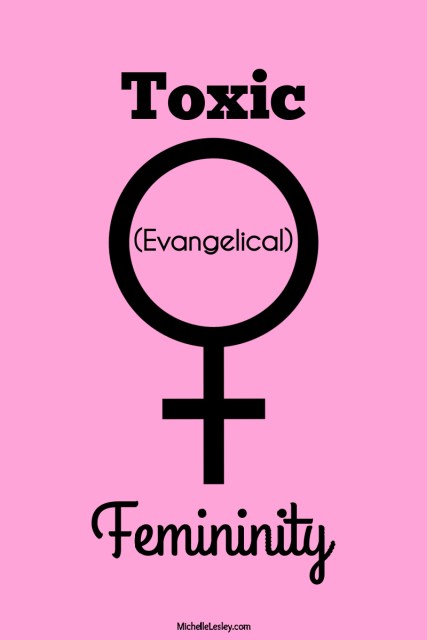
Toxic (Evangelical) Femininity

Toxic masculinity. It’s a buzzword that’s gaining momentum as it’s bandied about in pop culture like a shuttlecock over a badminton net. There’s a clinical definition of the term (which, in the ivory towers of the scholarly world is, properly, “hegemonic masculinity“):

Hegemonic masculinity is defined as a practice that legitimizes men’s dominant position in society and justifies the subordination of women, and other marginalized ways of being a man. Conceptually, hegemonic masculinity proposes to explain how and why men maintain dominant social roles over women, and other gender identities, which are perceived as “feminine” in a given society.

And then there’s the sort of similar working definition of the huddled masses: Anything a man does that others, especially women, don’t like that can, by any stretch of the imagination, be blamed on the fact that he’s a man.

If a man cuts you off in traffic, it’s not that he’s a jerk or didn’t see you, it’s toxic masculinity. If a man holds a door open for a woman, it’s not that he’s polite and helpful, it’s toxic masculinity. If a man leaves his socks on the bathroom floor, it’s not that he’s sloppy and has no home training, it’s toxic masculinity. In other words, he’s not doing these things because he’s a polite or rude or aggressive or helpful human being, it’s because he’s a man who just wants to keep women down and exercise dominance over them.

Pardon my French, but what a bunch of malarkey.

Yes, I’m sure there’s a fringe element of men out there who consciously think they’re better than women, that women shouldn’t have any rights or hold any positions of responsibility, blah, blah, blah. And you know what? They’re considered fringe kooks, and rightly so. But I’m not buying this business of these elitist gnostics telling us that every little move a man makes is a subconscious act of belittling women or exercising domination over them, and neither should you. It’s like the race-baiters who say that every single white person is racist, deep down, and this latent racism manifests itself in everything we do, from the way we tie our shoes to the breakfast cereal we buy at the store. We’re just not aware of it, supposedly.

Poppycock.

You want to know where this notion of toxic masculinity came from? It sprang from the loins of toxic feminism. Zoom out and look at the big picture. This is a manufactured concept, baptized in the (assumed) credibility of academia, designed to help women leverage power and control over men. How? By denigrating them at every turn, thereby convincing the world that men are intrinsically bad and women are good and must be elevated to prominence. Call me crazy if you want to, but it doesn’t take a prophet or the son of a prophet to look down the road and see that the feminist end game here is a matriarchal world where women rule and men drool. And there are plenty of brazen females out there who would openly and unashamedly admit this.

That, however, is not my concern. Sinners gonna sin, and God’s going to deal with them in His own way and in His own good time.

My concern is the way this attitude is fleshing (pun intended) itself out in Christian families and the visible church, and creeping into evangelical women’s (and men’s) hearts. Because, whether or not we’d like to admit it, this worldliness is advancing upon us, and we need to be aware of – and biblically approach – the facets of this issue that are already at our doorstep:

On the Top of the World Looking Down on Creation

I actually laughed out loud when reading some of the academic definitions of so-called toxic masculinity. There seemed to be an air of, “We just don’t understand it! This pattern of male dominance seems to transcend all cultures and time periods!”

Well here’s a really academic response to that: Duh.

I mean, you have to wonder if these researchers and scholars have ever said to  themselves, “I wonder if there’s a reason for that. I wonder if this tendency in men that defies time and culture can be traced back to a pinpointed source.”

There is, and it can. It’s called Creation, and God is the one responsible. God created man first and then woman. God created husbands to lead and wives to be helpers. God set up the Old Testament patriarchal society that became the nation of Israel, which was led by male tribal heads and, later, male kings. God established male leadership in the temple, and subsequently, in the church. The major and minor prophets were male, Jesus was male, the apostles were male, the writers of Scripture were male. And all of this traces back to that one moment in Genesis 2 in which God decided to create man first and hard-wire him to lead, protect, and git ‘er done. Broadly¹ speaking, the reason we see a general¹ pattern of male leadership across time and culture is because God set those wheels in motion.

As Christians, we recognize that sinful men sometimes abuse the positions of leadership God has given them, but that doesn’t negate the entire pattern and call for us to turn it on its head. We study our Bibles and embrace and submit to the way God has instructed men and women to behave in the roles He has bestowed upon us.

(Don’t) Do the Woke-Emotion

One of the components of God’s creative work that adds inexplicable beauty to this world is the tender-heartedness, passion, and empathy He built into women in a uniquely feminine way. Emotions. Feelings. God created them, and they are good. What a dreary and heartless world this would be if women didn’t bring nurturing, caring, sympathy, and love to the table. God uses us to soften the hard edges of life and make the planet pleasantly inhabitable.

But along with that good gift comes the challenge to steward it wisely and in obedience to God so that we may use it to glorify Him rather than dishonoring Him.

I see Christian women wisely stewarding their emotions to the glory of God every day as they care for their husbands and families, friends and co-workers, and serve in their churches. It is a beautiful picture of the mature fruit of biblical womanhood.

Unfortunately, I also see the exact opposite. I see (ostensibly) Christian women who scream like banshees any time their pastor preaches on the passages of Scripture dealing with women’s roles in marriage or the church. I’ve seen women who claim to believe and follow the Bible throw an everloving fit when someone points out – from Scripture – that their favorite women’s “Bible” study author is a false teacher. I see women formulating their beliefs and practices about God, worship, the Bible, their own behavior, their families, and their churches based on their own personal opinions, experiences, and feelings rather than on rightly handled Scripture.

And, just like secular feminists demand domination over men because they feel oppressed, have experienced sexism, or resent the world’s history of male dominion, I see Christian women letting their emotions rule the day as they demand unbiblical solutions to their real or perceived personal experiences with men and male leadership.

The anger, the outrage, the hurt feelings, and being offended are nearly as evident in evangelicalism as they are in society at large.

Godly women are not ruled by their feelings. We are ruled by the Bible. We make our feelings submit to and obey God’s Word. We don’t make decisions based on what we like or don’t like, or what makes us feel good about ourselves. We base our decisions on what the Bible says. When our feathers get ruffled, we take a step back and evaluate the situation with rightly handled Scripture. Maybe we’re upset because someone actually sinned against us, but maybe we’re upset because our pride or vanity was wounded, or our unbiblical notions were biblically challenged, or because God used someone to expose an idol we’re worshiping. Maybe it’s not that the other person sinned, but that we’re in sin. Those hurt feelings could be a wake up call from God to humble ourselves and repent.

Ladies, we must learn to put our feelings aside and act on the objective truth of God’s Word instead of our fickle and deceptive emotions. If we display the same sorts of fleshly emotionalism as unsaved women, how are we being salt and light in the world, pointing the way to Christ? We’re supposed to be set apart and different from the world.

Why Can’t a Woman Be More Like a Man?

Because – speaking of salt and light – embracing and submitting to our biblical roles in the family and in the church sets us apart from the world. Now, more than ever, we have a unique opportunity to be counter-cultural – simply by obeying God’s Word.

Women being hired as pastors and teaching and exercising authority over men in the church and leading denominations and becoming popular evangelical conference speakers with co-ed audiences – that’s what the world expects because that’s the way they do things. But a Christian woman who happily puts her foot down and refuses to teach men in the church setting or joyfully insists on submitting to her husband? That’s different. It’s against the grain, not the norm.

Remember that out of the ordinary burning bush that caught Moses’ attention and he turned aside out of curiosity to investigate? And remember how, when Moses was watching it burn, wondering what in the world was going on, that God called to him out of that fiery shrub – “Follow Me.”? God can do the same thing with our obedience to Scripture.

Lost people see this anomaly of our “weird” behavior, and they want to know what in the world is going on. Why do we act differently than they do? And that’s when we get to explain it to them. We get to share the gospel. God can call to them out of our passionate burning for Christ and His Word, “Follow Me.”.

People in darkness gravitate toward light. Salt makes people thirsty. Do we care more about giving them the Light of the World and the Living Water or our own selfish and fleshly desires for power and position? Our embrace of and obedience to the biblical roles God has laid out for us as Christian women is one gateway to sharing the gospel with the lost.


Toxic femininity is worldly and fleshly. It has no place in Christian homes and churches. How do we combat it? We take up the sword. We submit to the authority and sufficiency of Scripture. We recognize that God is the authority in our lives, not self, and that we are to obey Him at any cost – even at the cost of our convenience and pleasure. We trade our desires for His.


¹I’m well aware that there are plenty of exceptions to this generalization. I’m referring to a broad pattern across time and culture, here. There are many biblical ways women can contribute and lead in the family, society, and the church.
Women of Genesis Bible Study

The Women of Genesis: Lesson 35

Previous Lessons: 1, 2, 3, 4, 5, 6, 7, 89, 10, 11, 12, 13, 14, 15, 16, 17, 18, 19, 20, 21, 22, 23, 24, 25, 26, 27, 28, 29, 30, 31, 32, 33, 34

📖📖📖📖📖

Read Genesis 47:27-50:26

📖📖📖📖📖


Questions to Consider

1. Briefly summarize, in your own words, Joseph’s story and how Jacob and his family came to live in Egypt, reviewing previous lessons (links above) if necessary.

2. Compare 47:27 with Jeremiah 29:4-7 and these New Testament passages. Think about the concept of God’s people living among pagans, displaced from their Promised Land, and waiting for the day when they can enter and possess it. Describe how this concept fleshes itself out in each of these passages. What is the Christian’s “Promised Land“? How does God want His people to live during the time of their exile? In the Genesis and Jeremiah passages, are there any general principles for godly living that you can apply to your life in “exile” on this earth today?

3. Examine 47:29-31 and 49:29-32. Where did Jacob (Israel) want to be buried? Why was it so important to him not to be buried in Egypt but to be buried in Canaan? Consider family/tribal bonds, the Abrahamic Covenant, and God’s promise to Jacob in 46:4 as you answer.

4. Explain 48:5-6 as it pertains to the establishment of twelve tribes of Israel (49:28, 49:1-27). What group do Israel’s twelve sons point ahead to in the New Testament?

5. Compare Jacob’s blessing of Ephraim and Manasseh (48:8-20) to Isaac’s blessing of Jacob and Esau. What are the similarities? The differences?

6. Consider Jacob’s blessing of Ephraim, Manasseh, and each of his sons. (48:15-49:28) What was the significance of the patriarchal blessing of the sons? Was it prophecy? Good wishes for a bountiful posterity? Instructions for the future? Information on the inheritance? Examine the cross references for each of the people Jacob blessed. How did his predictions for the future come true for each?

7. Which of the twelve tribes of Israel was Jesus descended from? Examine 49:9-12 as well as the cross-references. What do these verses call to mind about Jesus?

8. Revisit your answers to question #2. What was the result of Jacob’s and Joseph’s godly living while in “exile”? What sort of impact did these men have on the Egyptians? (50:2-3,6-7,9-11)

9. Examine 50:15-21. How is this a picture of the permanence of God’s forgiveness and of salvation? What was Joseph’s reaction (50:17) when he realized his brothers didn’t trust his forgiveness?

10. Compare Joseph’s request about his remains (50:24-25) to Jacob’s (47:29-31, 49:29-32). What were the similarities? The differences? How did Joseph’s request demonstrate his faith that God would keep His promises of the Abrahamic Covenant and serve as an introduction to Exodus? Where did both Jacob’s and Joseph’s remains eventually end up?


Homework

Compare 50:20 to Romans 8:26-30 and James 1:2-4. How does God’s ability to “make a silk purse out of a sow’s ear” demonstrate His sovereignty? What are some of the ways God can bless and grow us during times of difficulty? How can these passages inform our prayer lives when God allows or causes difficult circumstances in our lives? Write out a prayer that lines up with these passages that you can pray the next time you face a trial or tribulation.


Suggested Memory Verse

As for you, you meant evil against me, but God meant it for good, to bring it about that many people should be kept alive, as they are today.
Genesis 50:20

Favorite Finds

Favorite Finds ~ August 21, 2018

Here are a few of my favorite recent online finds…

Here’s something helpful that came out of the TGC Women’s Conference earlier this summer, the 9Marks at 9 breakout session Women and the Local Church. Karen, Keri, Bev, and Abigail discuss what makes a church, the importance of the local church, what makes a healthy church, practical things you can do to help your church become healthy, prioritizing the local church, and the impact your commitment to the church makes on your children.


Wretched has, not one, but two freebies for you! Download the gospel booklet Don’t Stub Your Toe or The Biggest Question video (also available in Spanish) and share them on social media or via e-mail with friends who need to hear the gospel. You might even enjoy reading and watching them yourself!


Pastor Allen Nelson has written a helpful seven-part review and response to Rachel Held Evans’ new book, Inspired: Slaying Giants, Walking on Water, and Loving the Bible Again. It’s over at the Things Above Us blog, and it’s entitled God-Breathed: A Response to Rachel Held Evans’s View of Scripture. If you’re unfamiliar with Rachel, you can read more about her here, where I have also linked Allen’s article series.


At night or in the morning? Commentaries or journaling? “In January 2018, Crossway surveyed over 6,000 readers, asking questions about their Bible reading habits.” They’ve given us some of the results of that survey in a nifty little infographic, How Do You Read the Bible? 


Yet she will be saved through childbearing—
if they continue in faith and love and holiness, with self-control.
1 Timothy 2:15

Have you ever wondered what that verse means? WordBoard explains with the Boardies video What Does She Will Be Saved Through Childbearing Mean?