Welcome to another “potpourri” edition of The Mailbag, where I give short(er) answers to several questions rather than a long answer to one question. I also like to take the opportunity in these potpourri editions to let new readers know about my comments/e-mail/messages policy. I’m not able to respond individually to most e-mails and messages, so here are some helpful hints for getting your questions answered more quickly. Remember, the search bar can be a helpful tool!

In these potpourri editions of The Mailbag, I’d also like to address the three questions I’m most commonly asked:
“Do you know anything about [Christian pastor/teacher/author] or his/her materials? Is he/she doctrinally sound?”
Try these links:
Popular False Teachers / Recommended Bible Teachers / search bar
Is She a False Teacher? 7 Steps to Figuring It Out on Your Own
(Do keep bringing me names, though. If I get enough questions about a particular teacher, I’ll probably write an article on her.)
“Can you recommend a good women’s Bible study?”
No. Here’s why:
The Mailbag: Can you recommend a good Bible study for women/teens/kids?
The Mailbag: “We need to stop relying on canned studies,” doesn’t mean, “We need to rely on doctrinally sound canned studies.”.
“You shouldn’t be warning against [popular false teacher] for [X,Y,Z] reason!”
Answering the Opposition- Responses to the Most Frequently Raised Discernment Objections

Usually The Mailbag is all about mail I’ve received from readers, but today, I want to start by sending a thank you note to you!
Thank you from the depths of my heart to each and every one of you who donated so graciously and made it possible for me to speak at the Cruciform Conference in Indianapolis this October. I was floored by your generosity and it was a great way to celebrate my birthday. I’m so honored that you would partner with me in ministry to the ladies at the conference. Thank you and God bless you.
(I tried to make sure I sent an individual thank you message/e-mail to each donor, but if you donated anonymously or I somehow missed being notified of your donation, I apologize and hope you’ll accept my thanks here.)
If you’re going to be in the area, come on out to Cruciform. It will be a blessing to you, and I’d love to meet you!
I’m the pianist at my church, and my pastor has asked me to select the hymns for our worship services because it takes a lot off him and helps him out. I select the songs from a certain hymnal and two other doctrinally sound sources. Am I in an unbiblical position of “leading” the worship service when I select these songs?
This is a great question. It’s so encouraging when Christian women want to be godly in every aspect of their ministry at church!
No, that’s not leading, that’s serving your pastor and your church. Basically what you’ve got here is a body of songs your pastor already approves of, and he has asked you to whittle it down to four or five songs each week from this pre-approved “list”.
If you choose a song he doesn’t like for some reason or that doesn’t fit with what he’s preaching that week, he always has the prerogative to say, “This song isn’t a fit this week. Could you please choose a different one?” In essence, you’re presenting him with suggestions and he makes the final decision, so he’s still the one in the position of authority. I used to do the same thing for my husband when he was a minister of music at one of our former churches.
Thank you for serving your pastor and your church!
I loved your article Women’s Events on a Shoestring Budget. The funding tips encouraged me to put on an event for our ladies, but our small church has never done anything like this before. What kind of event should we have and how should we get started?
I was so encouraged to get a couple of questions like this in response to my article. Even at a small church (and sometimes especially at a small church) a women’s event can really help refresh and build up the ladies of your church. It can be a great outreach to the ladies of your community, too.
I would recommend starting small and then growing year by year. For example, if I were in a church with an attendance of 50-150, I would start with an in-house (only ladies from your own church) mini-conference. A Saturday morning simple breakfast (coffee, doughnuts, fruit – food that’s easy to get, serve, and handle), followed by a local speaker (maybe the pastor’s wife at a sister church, or even one of the ladies in your own church) and a couple of songs. You could end there, or possibly have a time of discussion around the tables afterward, or just allow the ladies to hang around and fellowship with each other.
The next year, you could build on that. Maybe the speaker does two sessions with a break between, and you invite/publicize to other local churches. The following year, you could do an overnight retreat or you could expand the conference to an all day thing and have more than one speaker. If you start small and grow your event each year, you’ll learn things you should and shouldn’t do differently along the way, and you won’t be biting off more than you can chew the first time out.
Another thing that might be a good idea is to have a meeting with all of your ladies and ask them what kind of event they’d like. You might be thinking “conference” and they might be thinking “movie night”. It’s good to brainstorm and take the pulse of your ladies on what they’d prefer.
You could also get the men of your church involved in putting together and serving at your conference or event. I spoke at one conference where the men of the church actually put on the conference for their ladies – to honor and thank them. That was one happy bunch of ladies!
Just remember what I said in the article: Don’t try to compete with the expensive glitz, glam, and giveaways of mega-conferences. You do you, your church or host organization…And remember, it’s the caring and hospitality of the hosts that will make the greatest impact on your attendees, not the swanky food, decorations and swag bags.
I wanted to let you know I saw an inappropriate advertisement on your blog.
Thank you so much for letting me know. Rest assured, I don’t choose those ads, nor do I have any control over them. I can’t even see them from my end. I’m in the process of considering some formatting changes to the blog that may (or may not) put an end to the ads.
In the meantime, my article Advertising Redux explains what you can do to avoid those inappropriate and annoying ads on my site and on other sites as well.
I have a friend who was baptized as an infant, but since she was baptized in the name of the Trinity, she feels as though she can not be re-baptized as an adult believer. How would you speak to her?
I’ll bet that’s kind of a challenging road to navigate as her friend, isn’t it? Without a great deal more information I’m hesitant to give a definitive answer, but hopefully I can point both of you in a helpful direction.
I’m assuming if your friend is considering being baptized, she’s either a member of a local church or a candidate for membership at a local church. The first thing I would want to make sure of is that she’s in a doctrinally sound local church, because the second thing I’m going to advise is that she set up an appointment with her pastor to discuss this issue of baptism. (If the church she’s in isn’t doctrinally sound, getting her into one that is is job one, not baptism. Check out the Searching for a new church? tab at the top of this page.)
Different churches and denominations have different understandings of baptism. Her pastor can explain to her how her church views baptism, why it is requiring(?) her to be re-baptized for membership, and how it understands Trinitarian paedo (infant) baptism versus credo (Believer’s) baptism.
Once she has sat down with the pastor and had all of her questions answered, she will need to search the Scriptures, pray for wisdom, and make sure her understanding of baptism lines up with that of the church she’s considering being baptized into. If it does not, she will need to further study the Scriptures to determine whether or not her personal view of baptism is indeed biblical. If it is but does not align with her current church, she will probably need to find a new church whose view on baptism she agrees with.
If you have a question about: a Bible passage, an aspect of theology, a current issue in Christianity, or how to biblically handle a family, life, or church situation, comment below (I’ll hold all questions in queue {unpublished} for a future edition of The Mailbag) or send me an e-mail or private message. If your question is chosen for publication, your anonymity will be protected.



 “Complementarian interpretation of Scripture holds that God’s creation purpose for man and woman entails equality of individual value but also distinct roles.” Our friends over at Crossway give us 5 Myths about Complementarianism.
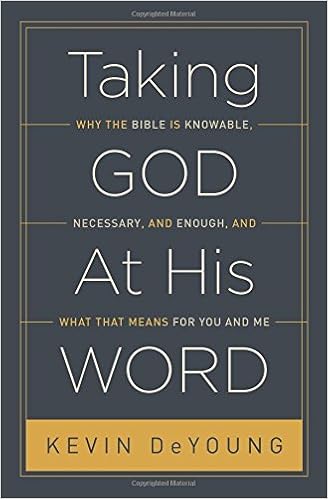 How about a free book? Here’s the PDF of Kevin DeYoung’s book Taking God at His Word: Why the Bible is Knowable, Necessary, and Enough, and What that Means for You and Me.
 “You’ve heard it repeatedly on radio, podcasts, and TV. You’ve read it in various books and articles. You’ve even heard it in your pastor’s sermon. The problem: it’s a lie: 50% of all marriages end in divorce.” The Cripplegate helpfully explains why everything you know about American divorce statistics, including the divorce rate among Christians, is probably wrong in The 50% Lie.




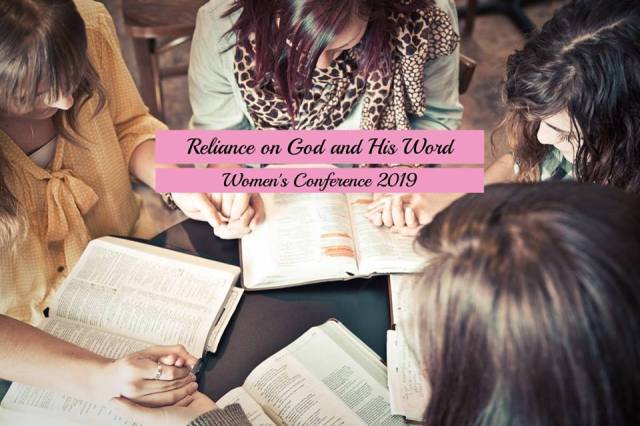
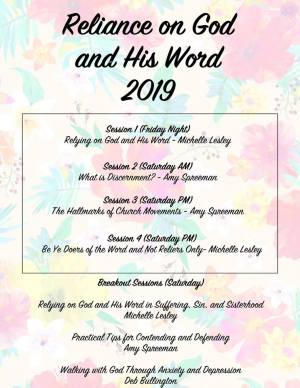
 “I’m not sad that I’m not and couldn’t be a church planter or lead pastor. I don’t feel restricted or resentful. Instead, I feel full.” I always appreciate the voices of sisters in Christ who are leading unashamedly under the banner of strong, biblical complementarianism. Complementarianism is a blessing, not a burden, so I really enjoyed
  “…since loving Christ entails loving the Church; it’s time for you now to heed the summons of God’s Word and go back into a local church, a local expression of the Body of Christ.” I really appreciate Jennifer Brogdon’s* gentle and compassionate approach to encouraging wounded saints to go back to church (especially compared to my usual “bull in a china shop” treatment of the