Church, Ministry, Parenting

Throwback Thursday ~ Anonymous Parent’s Letter to a Youth Pastor

Originally published September 23, 2013

Trevin Wax is one of my favorite bloggers.1 Today he wrote an absolutely awesome piece called Anonymous Youth Pastor’s Letter to a Parent. It talked about some of the struggles youth pastors go through and how we as parents of youth can support our kids’ youth pastors better. I commented that the next article should come from the parent’s perspective, and that, being a parent of youth, boy, could I write that article. One of Trevin’s readers suggested I go ahead and write it, and I thought it sounded like a fun and challenging project, so here’s the result.  (The first three paragraphs are an homage to Trevin’s letter.)


CAVEAT: This is addressed to an amalgam or “everyman” youth pastor, not to any of my kids’ youth pastors/workers past or present. In fact, some of the things I mention in the letter are things my kids’ youth pastors got RIGHT that I really appreciated.


Dear Youth Pastor,

I need to get something off my chest.

When I first put my child into your youth group, you told me how excited you were to be showing my kids what it means to love Jesus, be part of His Church, and grow as a Christian. You told me you were praying for my child and that you had his back. You had high hopes for the youth ministry.

I had high hopes too. But I must confess that I am frustrated right now because I feel like you’re working against me, not with me.

My husband and I are Christian parents doing our best to pour the gospel into our children every day.  We understand that we are the ones responsible to God for the spiritual upbringing of our children, and we take that responsibility seriously. Very seriously. And that includes what he is exposed to in youth group.

“Let no one look down on your youth” notwithstanding, you’re 25. I love you all to pieces, but you know nothing about parenting a teenager. I repeat: nothing. No, the fact that you and your wife have an infant or a three year old does not qualify you as a veteran parent. I have a couple of decades of life experience and parenting on you. I remember being 25. It was that glorious time of my life when I knew everything and had fresh ideas that people in their 40s just wouldn’t understand because they had passed the “cool” stage of life.

Look deep into my eyes, Bub. I am your future.

Listen to me when I explain to you that my kids don’t need another peer. They need mature, godly leadership. Not a buddy. Not an idol to be emulated with the latest clothes from Abercrombie, the hippest glasses frames, edgy tattoos and piercings, and enough product in your hair to put bouffanted church ladies to shame.

You are not a rock star.

You’re a teacher. You’re a caretaker of young souls, and you’re influencing them for eternity. One way or the other. And one day, you’ll stand in front of God and answer for the way you led my, and other parents’, children. Makes your knees knock a little, doesn’t it? Good. It should.

So, when I drop my child off at your youth Bible study or Sunday School class, here’s what I expect. When you say you want to “show my kids what it means to love Jesus, be part of His Church, and grow as a Christian,” I expect that to mean that you will teach them the Bible. Not some watered down, comic book, MTV, “What does this verse mean to you?” version of a Bible story, but the whole counsel of God. I want you to put more time and effort into prayer and studying God’s word so you can teach it properly than you put into hooking up the oh-so-fabulous light show and making inane videos that appeal only to the basest nature of eighth grade boys.

Do you know what these kids are learning in school? If they can be expected to learn Shakespeare and higher math, you can expect them to learn sound biblical doctrine.

When you’re choosing a Bible study curriculum or DVD, or you’re looking at a Christian camp or concert to take the kids to, do your homework. Just because somebody claims to be a Christian author, speaker, pastor, or worship leader doesn’t make it true. Where is this person, doctrinally? What’s his church background and training? Listen to his sermons. Examine the lyrics of her songs. Read some of his books. Does this person rightly divide the Word of truth? Does he exalt Christ and revere God’s word? Does he call sinners- my child and the other children in your youth group- to repentance and faith in Christ, or are his sermons an exercise in navel gazing and nagging about how to be a better person?

Lead my children to serve the church. And I’m not talking about getting paid to do it, either. They’re old enough to help clean up after Wednesday night supper, help in the nursery, assist with a children’s class, serve at a senior citizens’ banquet, work at a church work day, help set up chairs and tables, etc. Over the last few years, the youth group has become the entitlement community of the church, always asking for handouts and rarely giving anything back. Let’s teach them to serve. Because the youth that serve today will be the adults that serve tomorrow.

Teach my children that a mission trip is not a glorified vacation, and that missions isn’t just feeding the hungry or building houses for the homeless. Missions is proclaiming the gospel before and after and while they’re doing those things. Teach my children how to share the gospel properly and encourage them to do it often.

Lead by example:

1. Plan ahead and be organized. If you know you’re going to need to do six fundraisers for youth camp, start them in September and space them out over a few months. Don’t wait until mid-April and have one every weekend. Show up on time. Secure your parent chaperones and drivers well in advance. Follow through on what you say you’re going to do.

2. Obey those in authority over you. Whether that means following the pastor’s instructions or obeying the speed limit and not putting 20 people in a 15 passenger van, when you flout the rules, you’re tacitly teaching my kids to do the same.

3. Be a man, not an overgrown adolescent. Boys, especially, need to see strong examples of what it means to be a godly man, and these are becoming rarer and rarer in the church. They already know how to be adolescents. Show them how to be men.

4. Prioritize safety and chaperonage. Do you know how many horror stories I’ve heard about children dying in church van wrecks on the way back from youth camp, and youth sneaking off and having sex during a lock in? I don’t want that to be my kid. I love him far more than you could ever think about loving him. Don’t be lax about keeping him safe and monitoring his whereabouts and behavior.

And, finally, my dear youth pastor, know that I love you and want to come alongside you and help in any way I can. You see, my husband used to be a youth pastor, so I know it’s a tough and often thankless job. I’m praying for you as you seek to disciple that band of crazed teenagers in the youth room.

Go with God, dear youth pastor. Go with God.


1Keep in mind that this was written in 2013. I no longer follow Trevin Wax and I don’t know much about what he’s up to these days except that he’s still with TGC, which I don’t recommend.


Christmas, Mailbag, Parenting

The Mailbag: What should we tell our kids (and grandkids) about Santa Claus?

Originally published December 4, 2017

As Christian parents, is it OK for us to tell our children about Santa Claus?

Christmastime can be so much fun when you have children. Many of us remember the excitement of Santa, the Christmas tree, and presents from our own childhood. They’re happy memories, and we want to recreate those for our children.

But as Christian parents, our first priority isn’t fun, it’s obedience to Scripture. Yet is there a way to make Christmas merry for our children while still upholding God’s Word? Is Santa patently unbiblical?

No, he doesn’t have to be, as long as he keeps his sleigh parked inside the parameters of Scripture. Let’s take a look at some of the ways Santa can be unscripturally naughty, and how godly parents can keep him nice and biblical.

Santa Claus isn’t real. If you tell your children he is, or that he is the one who brings their presents, or that he knows whether they’ve been naughty or nice, you’re lying. The Bible says that lying is a sin, period. There’s no exception for jolly old elves who pass out toys (or for tooth fairies or Easter bunnies, either, for that matter). And not only is lying a sin, it is extraordinarily hypocritical to lie to your children about Santa Claus and then turn around later and punish them when they lie about something. Lying to your children about Santa Claus teaches them that it’s OK to lie (i.e. sin) when you want to or when it would be to your advantage.

Don’t lie to your children about Santa Claus. Tell them the truth: he’s a fun, fictional character that we can enjoy reading stories and singing songs about, just like Goldilocks or Superman or Old MacDonald. As for the presents, maybe you’d like to handle it similarly to the way my husband and I did with our children. When they were very small, my husband or I would don a Santa hat on Christmas Eve and say something like: “You know how you like to play pretend? Well, mommies and daddies like to play pretend, too, especially at Christmas! Now it’s time for you to go to bed so we can pretend to be Santa Claus.”

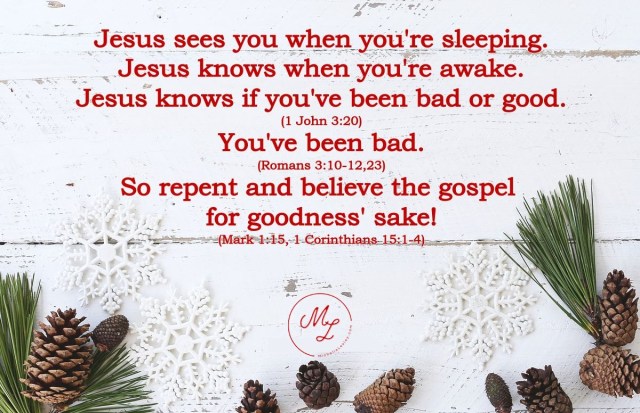
Santa Claus isn’t omniscient. 

He sees you when you’re sleeping
He knows when you’re awake
He knows if you’ve been bad or good
So be good, for goodness’ sake!¹

Uh uh. No way. Omniscience is an incommunicable attribute of God. He is the only One who has the power to see and know all things, and it is an insult and an affront to Him to even suggest that a mere mortal – let alone a fictional character – has the same power and knowledge that He has. In reverence and awe for God’s preeminence, we should never ascribe to others the things that belong to God alone.

Teach your children about the attributes of God. When you read your children stories about Santa Claus or hear Santa Claus Is Comin’ to Town on the radio, it’s a perfect opportunity to teach them about God’s omniscience and power. “Did y’all just hear that? That song said Santa Claus can see you and knows how you’re behaving. Is that true? Who is the only One who always sees you, cares for you, and knows what you’re doing and thinking? Can anybody else besides God do that?”

Santa Claus teaches works righteousness. In St. Nick’s economy, good behavior earns a reward (presents). Bad behavior earns punishment (coal). If you’ve ever shared the gospel with anybody, that will probably sound familiar. Most lost people think that’s what Christianity is. If you’re a “good person” God is happy with you and you’ll go to Heaven. Hell is the punishment for “bad people”: Hitler, murderers, and rapists. This is not what the Bible teaches, either about salvation, or about why children should obey their parents.

Teach your children the gospel. Again, this whole “naughty or nice” part of the Santa Claus narrative is a perfect gospel-teaching opportunity. Take advantage of it! Ask your child to be “nice” for one whole day. At bed time, take a few minutes to talk about the times she messed up and was “naughty” when she was supposed to be trying to be “nice.” Nobody can be nice and obedient all the time, no matter how hard we try. We are all naughty – sinners with coal black hearts deserving the punishment of Hell. Jesus came and lived a life of perfect “niceness” (obedience), died on the cross to take the punishment for our naughtiness, was buried, and rose again. He did that, not because we earned it with good behavior, but because of His mercy and grace. And then He gave us the greatest gift ever. A gift we naughty people don’t deserve: salvation and eternal life in Heaven. And it is because of our love and gratitude to Christ for saving us that we obey Him, not so that He will give us what we want. Indeed, the Bible tells us that the more obedient to Christ we are, the more persecution we will face.

Santa Claus doesn’t automatically have to be on the Christian parent’s naughty list. There are lots of ways to enjoy the fun of Santa and even turn him into an opportunity to teach your child biblical truth, all while being obedient to Scripture. But if Santa makes you biblically uncomfortable in some way, then by all means, don’t go against your conscience. Whichever way you decide – after prayer, study of the Scriptures, and discussing it with your spouse – do not judge other Christian parents by your personal convictions about Santa Claus.

Any advice for grandparents about Santa? Our son wants our grandchildren to believe in Santa. How do we respond to a grandchild who asks of the reality of Santa? I will not lie, but I want to keep peace with my son.

Thank you for being a godly grandma!

I think the solution to this dilemma is going to start with being a godly mom. Is your son a Believer? If so, you might want to show him all of the information above and talk to him about any Scriptures he’s violating. Let’s pray that will be convicting to him and he’ll decide to handle Santa in a godly way with your grandchildren.

But if he’s not convinced, or if he’s not a Believer, talk to him about your convictions about not lying to his children. Explain the difficult position he’s putting you in. He’s essentially asking you to choose between pleasing him by sinning (lying) or pleasing God by not sinning.

If he still won’t relent, the only solution I can see that keeps you from sinning yet doesn’t go against your son’s wishes is to put it back on him. When your grandchild comes to you and asks, “Grandma, is Santa Claus real?” you reply, “That’s a great question, but I think you should ask your mom and dad about that. How about some hot chocolate?”.

Your son made this bed. You shouldn’t have to lie in it.

Additional Resources:

Santa Pause with Justin Peters at A Word Fitly Spoken


¹Santa Claus Is Comin’ to Town. John Frederick Coots and Haven Gillespie, 1934.

If you have a question about: a Bible passage, an aspect of theology, a current issue in Christianity, or how to biblically handle a family, life, or church situation, comment below (I’ll hold all questions in queue {unpublished} for a future edition of The Mailbag) or send me an e-mail or private message. If your question is chosen for publication, your anonymity will be protected.

Holidays (Other), Mailbag, Thanks/Thanksgiving

The Mailbag: Teaching Children Gratefulness

Do you know of any Biblically sound books that will help teach a 3 yr old how to have a grateful heart? My daughter is trying to cultivate that in my 3 yr old grandson.

Awww, how sweet! What a blessing that he has a godly mommy and Grammy (or Mimi or Mamaw or…).

My youngest child is 18 so I’m not familiar with whatever is currently popular and available, although I’m sure there are some good, doctrinally sound children’s books out there. (Readers, if you have any suggestions, let this sister know in the comments.)

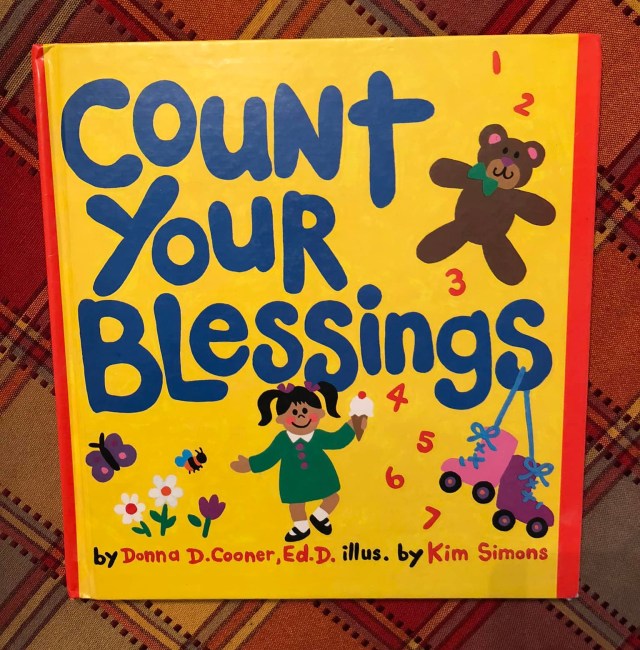
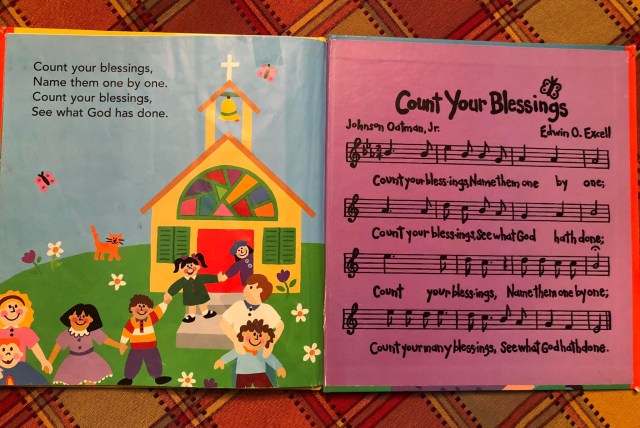
But if you’ll indulge me a trip down memory lane to wallow in sentimentality for just a moment, this was my daughter’s favorite book when she was a toddler (and all her little brothers loved it too!). It combines counting skills, thankfulness, and a hymn – pretty great, if you ask me!

Count Your Blessings by Donna D. Cooner, 1995

Now, it’s just sitting in my closet waiting for my grandchildren to enjoy it…

If you decide to buy some toddler books on gratitude, I would just caution you to vet the authors of any book you’re considering just like you would vet the author of a book for adults. There are many false teachersPriscilla Shirer, Sarah Young, and Sheila Walsh just to name a few off the top of my head – who have branched out into writing children’s books.

But honestly, I think this is a great opportunity for you and your daughter to start teaching your grandson the Bible, Scripture memory, and prayer as it relates to being grateful to God.

This is a great opportunity to start teaching your child the Bible, Scripture memory, and prayer as it relates to being grateful to God.

Read some stories about people in the Bible who were thankful – the thankful leper, Zacchaeus, Noah, Daniel, rebuilding the temple…really any story in which God acts, provides, or protects and people thank Him for it – and ask a few simple questions.

  • What did the main character in the story need or ask God for? What did God do?
  • What did the main character say or do when God acted, provided, or protected?
  • Has God ever acted, provided for, or protected you like that? How can we tell Him thank you?

Grab your concordance and look up some words and phrases like “give thanks“. Find a simple verse(s), talk about what it means, and practice saying it together. You might be surprised at just how quickly he can memorize those verses! The Bible verse memes in my article Top 10 Bible Verses on Giving Thanks are perfect for printing out or copying to your phone or tablet for this.

Another way to reinforce giving thanks to God is through music. You may find something helpful at Seeds Kids Worship, or just create your own playlist on your favorite music platform.

One way I helped my children remember to be thankful (and let me tell you, it didn’t just help my children!) was with a simple little game I called The Gratitude Game. It’s kind of like playing “I Spy.” Just look out the window when you’re driving around in the car, or look around as you’re taking a walk, and take turns thanking God for what you see: “Thank You, God, for making birds.” “Thank You for ice cream.” “Thank You for police officers who help us.”

Be sure to model thankfulness, too. When you or your daughter say bedtime prayers or the blessing before meals with your grandson, be sure to spend some time thanking God for things and acknowledging Him as provider, protector, the Giver of blessings, and so on. Remark thankfully on various things throughout the day: “I’m so thankful God gave us a warm day to play outside,” “Thank you, God, for sending the ice cream truck our way!” Also make sure you’re showing gratitude to people. Set the example for your grandson of saying “Thank you,” sending thank you notes or gifts, and demonstrating appreciation for others.

Books can be fun and helpful, and I hope you find a good one for your little sweetie, but you can’t beat stories and activities that center on Scripture itself.

When it comes to teaching your little ones gratitude, you can’t beat stories and activities that center on Scripture itself.


If you have a question about: a Bible passage, an aspect of theology, a current issue in Christianity, or how to biblically handle a family, life, or church situation, comment below (I’ll hold all questions in queue {unpublished} for a future edition of The Mailbag) or send me an e-mail or private message. If your question is chosen for publication, your anonymity will be protected.

Share Your Testimony, Uncategorized

Testimony Tuesday: An Anonymous Sister’s Story

Anonymous’ Story

I certainly never expected that I would fall into the trap of false teaching. I was raised in a Christian home with loving parents who took me to church, taught me Christian values, and even sacrificed to send me to a Christian school where I learned the Bible and practiced spiritual disciplines daily. I made the decision to follow Christ for myself at age 15 and never really went through the rebellious teenager stage. I have memorized Scripture and would estimate that I know probably 75% of the events that take place in the Bible. I married a Christ-following man after college and have continued to seek after the Lord and attend Bible-believing churches in the years since we have been married. I would have told you that there was no way I could have fallen into deception as far as what the Bible taught! And I would have been very wrong. Let me briefly tell you our story of becoming parents.

I would have told you that there was no way I could have fallen into deception…

My husband and I felt God’s leading to start the process to become foster parents as fresh, young 26-year-olds who had never been in the role of “Mom and Dad” before. We had the willingness to parent kids from hard places, but very little experience.

As we embarked on the journey of being parents to our first little one, we realized that not only did we have an instant toddler, walking, talking, running…(away from us in parking lots), we did not have the bonds that most parents and toddlers have who were biologically stitched together. We were getting a trial-by-fire introduction to parenting, and as most parents do, we needed some wisdom from those who had gone before us.

Through our church and social media pages, we kept hearing about taking classes which help parents raise kids who have come from traumatic situations. We signed up and took a class over the course of six weeks. The classes we attended and books we read were full of good ideas. They equipped us with different strategies to engage children of all ages to exercise self-control and practice calmness and thoughtfulness. The idea was that, over time, greater depths of discipline could be achieved as the child learned to operate inside a foundation built on trust and love for their parents- something that newborn babies all the way up to teenagers may not have experienced in their birth families.

The classes helped us understand brain physiology and develop empathy and compassion for what trauma and abuse can do to a person and how to be more patient in training our children who are in foster care. The classes in and of themselves were helpful and gave us some tools to address the behaviors and needs of our children that we hadn’t considered before.

Since we found the class to be helpful, I began to surround myself with other trauma-focused women through church, friendships, social media, podcasts, etc. I loved my life as a foster mom and was eager to glean wisdom from these older, wiser ladies that had a lot to say about raising children from traumatic situations. This is where the problems began.

These older, “wiser” women, all of whom attended Bible-believing churches, many of whom were even pastors’ wives, never said anything to me about the Bible, other than to tell me that this way of parenting aligned to the Gospel. They never pointed me to the Scriptures or encouraged me to hold my children accountable for their sin. They never reminded me that only God could heal my children from their past abuse. They only pointed me to the “religion” of trauma-based parenting and its ideologies.

They never pointed me to the Scriptures…

Admittedly, I even pushed my husband into these ideologies as we tried to bring a unified approach to parenting in this way, as was the case for most of the couples that I had contact with over the years who were also in these circles. These ideologies were not explicitly taught but were intrinsic to the conversations, the memes, and the discussions on podcasts, social media pages, and during Mom’s Coffee Night. Here are four of the most common ideas that I observed creeping into the minds and hearts of the women involved:

  1. You aren’t modeling God’s love and grace if you are unyielding in your expectations for your child’s behavior.
  2. Kids misbehave because of the trauma they have experienced, and if they could make a better choice, they would. Therefore they don’t because they physiologically can’t.
  3. If you don’t subscribe to and practice nearly everything produced by these parenting programs, you are not helping your child heal from their trauma (and might be making it worse).
  4. You should identify your own “triggers” from childhood that might be causing you to take offense to your child’s wrong behaviors (you may never have known you had any triggers- getting counseling will “reveal” these to you.)

As you can see, these ideas are not without spiritual implications. What started out as the desire to teach and train my children in a way that is conducive to reshaping their past experiences, quickly morphed into an expected lifestyle. Those pushing these ideologies employ a worldview which blames the parents’ hidden character flaws for a child’s misbehavior, places the weight of mental and emotional healing on the parents’ discipline efforts, and absolves kids almost completely of their sin simply because of their circumstances in life.

Though my husband and I didn’t immerse ourselves fully in the practices that these “leaders” were pushing, as we continued to foster and eventually adopt, we regularly felt defeated in our attempts to parent the way we heard others in these circles were parenting. I tried to keep a mental checklist of what to do and what not to do based on the social media posts and heartfelt stories that I saw from those I thought were doing it “the right way.” I berated my husband when he didn’t handle something “right”, and beat myself up and felt like a terrible mother when I reverted back to the “less loving and gracious” way of parenting (which I did regularly).

Our kids didn’t seem to really care about any of the non-punitive consequences that we attempted to enforce, and actually responded better to the way we were told not to parent, though we felt guilty for reverting back into some of these tendencies. We weren’t seeing the results we wanted to and ultimately we felt powerless as parents.

Over the next couple of years, we started seeing that what we had considered to be resources, encouragement, and even discipleship were actually just lies. We unsubscribed from the social media, the podcasts, the church classes, etc. and ultimately unsubscribed our family from the ideologies making us weak, ineffective parents producing weak, excuse-filled children.

We have now been foster and adoptive parents for several years and have had over a dozen children in and out of our home, adopting several of them. Our children are very happy, healthy, and successful at home and school and love the Lord. My husband and I argue less about
the right way to handle something, we are more confident as parents, and we are able to delight in our kids instead of wondering if we’re worsening their trauma.

I am forever thankful to the faithfulness of God to eventually help us see that we had strayed from what He says is the right way to view misbehavior and the discipline of our children. Now, it is my mission to make sure that other moms, whether they are foster and adoptive moms or not, see parenting programs for what they can be: God-given resources to equip us to be godly parents, and what they are never to be: the indoctrination of a different worldview, seeing children as inherently sinless or as a product of their circumstances who want to do the right thing but can’t.

I am forever thankful to the faithfulness of God…

Let me be clear, the reason that I fell into this pattern of wrong thinking was not because I didn’t know that the Bible said anything raising children. It is because I subconsciously did not consider Scripture to be the only valuable resource out there and I mistakenly placed my trust in the advice of women who marketed themselves as Gospel-centered trauma experts. Turns out their approach was very light on the Gospel.

When I started to really believe that Scripture was solely sufficient for all issues in life, I understood that what I had been following were very covert lies. And I began to see everything outside of Scripture as either deception or a resource that is only useful if you are using it within the bounds of what God says in Scripture.

Ladies, if you haven’t recently read 2 Timothy 3, stop right now and go read it. In it, Paul has a lot to say about how people will think and behave in the last days. It warns women to not fall prey to people who “have the appearance of godliness, but deny its power.” It tells us to stay away from those who “creep into households and capture weak women, burdened with sins and led astray by various passions, always learning and never able to arrive at a knowledge of the truth.” Paul says that people who do this “will not get very far, for their foolishness will be plain to all.”

Second Timothy 3 also calls Christ-followers to “continue in what you have learned and have firmly believed, knowing from whom you learned it and how from childhood you have been acquainted with the sacred writings, which are able to make you wise for salvation through faith in Christ Jesus.” It reminds us that “All Scripture is breathed out by God and profitable for teaching, for reproof, for correction, and for training in righteousness, that the man of God may be complete, equipped for every good work.”

When we are vulnerable to believe anything that we see from leaders that claim to be Christians, without examining what they’re saying against the whole Word of God, we are these weak women. We want what is best for our children, but we are sinful because we are not trusting God with their healing or to guide us to appropriate discipline through the study of His Word and the knowledge He allows us to have through others who have gone before us.

Instead of taking useful strategies, thanking God, and applying them to what He has already told us to do, we are led astray by the leaders who have created entire movements based on a few good principles, turning instead to their social media pages, to their classes and teachings. We feel that we can never know enough about how to help our children because we do not believe that God’s system of discipline and instruction is sufficient. And as a result, our children are also carried away by excuses, in searching for what will make them whole. We have spent our lives looking for the solution to their trauma and as a result we have trained ourselves and our kids that God is not it.

In fact, God is the one who teaches us through His infallible Word that He is the solution for every circumstance that belies us. His Word is helpful for teaching and correcting our kids, for training our entire family in the way of righteousness, and to equip us for every good work, including raising our kids.

Our children can be complete by knowing God, knowing His Word and coming to salvation through Him. Any resources God brings to us from other humans, is simply that. A resource. Not a way of life. Not a worldview. Not a religion.

We have all we need in Christ.


Ladies, God is still at work in the hearts and lives of His people, including yours! Would you like to share a testimony of how God saved you, how He has blessed you, convicted you, taught you something from His Word, brought you out from under false doctrine, placed you in a good church or done something otherwise awesome in your life? Contact me, or comment below. Your testimony can be as brief as a few sentences or as long as 1500 words. Let’s encourage one another with God’s work in our lives!

Mailbag

The Mailbag: Christian Women Working, Using Birth Control, and Limiting Family Size

Originally published July 15, 2019

I have a question [as] to what your convictions are about a woman working at all in the first place, in reference to your answer to the question “Is it ok for a woman to make more than her husband?

What also is your position on birth control or having a planned family size? You are very openly pro life, and amen to that, but it seems you also are supportive of a woman working outside of her home, and with that I can only generalize and forgive me if I am wrong, that you also support a woman limiting her family size because a mother of many children, which is usually the natural order of things when no contraceptives are used, would very difficultly work and also be able to look well to the ways of her household. Can you clear your position up for us wondering? Thank you Michelle! God bless you!

Thank you so much for your questions and kind remarks. These are important issues that women and their husbands need to prayerfully consider in order to arrive at a biblical conclusion for their family.

One thing it’s imperative to remember is that situations differ vastly from family to family. We can easily slip into a pattern of thinking that “every family is just like mine so every family ought to make the same decisions we’ve made,” and even to consider our family’s decisions as the biblical standard for every family. That’s not the case, and that’s not a biblical way of regarding others. It’s important to broaden our view to realize there are scads of family difficulties, logistics, and situations that we’ve never had to face before and that two families can make different decisions on these issues – due to the unique circumstances God has placed them in – and still both be in obedience to God.

The reason it’s possible for two families to make different decisions on these issues is because the Bible doesn’t give any clear cut commands that women should never “work at all in the first place,” or that family size should never be limited, or that no form of birth control should ever be used. We may have strong convictions about these things, but God does not specifically prohibit them in His Word, and that’s what we have to go by, not only when making decisions about our own families, but also when considering the decisions other families have made.

I took a closer look at what God’s Word says (and doesn’t say) about women working in my Mailbag article Stay at Home Dads? I would encourage you to read that article and look up the Scriptures I referenced, but, long story short, the Bible does not make an across the board prohibition that no woman may ever work to earn income. In fact, we see several examples of women in Scripture working, and God does not condemn these women for doing so. In some circumstances, it is perfectly biblical for women to work.

I think the confusion you may be experiencing stems from the fact that you’re assuming several “facts not in evidence” when it comes to women working outside the home. Your questions seem to be predicated on the idea that “working woman” necessarily means a married woman who has small children and who doesn’t want children to get in the way of her career. That may be the case for some women who work but it’s not the case for every woman. Not every woman is married. God has not blessed every woman with children. Some women have children who are grown and on their own. Some women are single mothers and have no choice but to work. Some women have disabled husbands who can’t work. Some women can work part time from home (or outside the home) and their jobs don’t interfere with raising their children and managing their households. Occasionally, when a couple marries, the wife is already well established in a lucrative career, while the husband hasn’t had the same educational/career opportunities, and regardless of how hard he works, and considering all other circumstances, the wife and husband agree that it just makes more financial sense for a particular season of their family’s life for her to work and for the husband to stay home with the kids. We cannot make a blanket statement that godly women in these circumstances, working outside the home (or from home), are necessarily violating Scripture. As I said, we need to be aware of the vast array of circumstances taking place in various families, and not judge those families by our own.

Your next question was about birth control and limiting family size. Again, we must look to Scripture to see what it says.

Since the Bible was written in a time before birth control pills and surgical sterilization were invented, naturally it does not address those specific types of birth control, or, really, any type of birth control. People have tried to make the case that a couple of passages address the issue of what we might call “natural family planning”:

The story of Onan describes Onan engaging in coitus interruptus (withdrawal) and God subsequently putting Him to death. This passage is sometimes offered as evidence that God is against even “natural” birth control. However, all you have to do is read the passage in context, and it’s clear that it wasn’t that particular sexual act itself that cost Onan his life, but his selfishness in refusing to obey what would later become the law of levirate marriage.

1 Corinthians 7:5 permits husbands and wives to engage in mutually agreed upon periods of abstinence which could be stretched like Silly Putty into a biblical endorsement of the rhythm method (natural family planning), but again, the context of the verse makes it clear that the abstinence mentioned in this verse is not for the purposes of birth control, it’s for the purposes of concentrated prayer, sort of a “fasting from sex” idea.

So birth control, even natural forms of it, is not really addressed in Scripture. It’s neither prohibited nor endorsed. And as a consequence, limiting the size of one’s family isn’t addressed either because that wasn’t normally, biologically-speaking, a realistic option.

The Bible does, however, speak to the issue of abortion. Abortion is the murder of an innocent human being, so all the biblical passages prohibiting murder also prohibit abortion. This includes any form of birth control that kills an already conceived baby.

Another biblical principle I think it’s important to take into consideration is that the Bible seems to assume that procreation is one of the main goals of both sex and marriage. While God created sex to be pleasurable, gratifying our desire for physical ecstasy is dessert, not the main course of sex, as our libidinous 21st century sexual ethic would have us believe. God created marriage as the boundary lines for sexual activity, and the foundation for creating families. The Bible knows nothing of a man and woman getting married and proactively deciding for fleshly or selfish reasons (career, travel, freedom, spending habits, etc.) not to have children. The Bible takes for granted that married couples who are physically able will form families by having children. That is His plan for propagating human life.

The Bible also views children as a blessing to families and views motherhood as an honor, a vocation worthy of respect and value. I’m very disturbed at the increasing attitude in our society, and even among some Christians, that children are an annoying inconvenience and a hindrance to women pursuing their own personal goals. I remember seeing a billboard ad for condoms a few years ago that featured a picture of a screaming toddler emblazoned with the caption, “You should have used X Brand condoms.” Recently I saw a TV commercial for an IUD that said something along the lines of, “It’s easier to make an appointment with your doctor to get this IUD than to deal with a thee year old.”

And just last night, I saw part of a sitcom in which a stay at home mom comes home from a night out with friends (all career women) and complains to her husband that ever since the kids were born she’s been stuck at home, that her friends are doing exciting things and all she’s doing is raising kids, that she needs to get out of the house and do something. So she decides to get a job. As if being a mother is an unexciting burden and she’s not really doing anything worthwhile.

Children are a precious gift of God and deserve to be treated with love and dignity, to feel like they’re wanted and valued by the person they love most in the world – Mom.

So taking all of these things into consideration, where does that leave us when it comes to making godly decisions about these three issues of women working, birth control, and limiting the size of one’s family?

Here are some biblical conclusions we can draw:

•Christians should not have abortions or use any type of abortifacient birth control. Barrier methods, true contraceptives (birth control that prevents conception), surgical sterilization (tubal ligation/vasectomy), and natural family planning are not sinful in and of themselves, but we need to prayerfully consider whether or not we have sinful or selfish reasons for wanting to use them.

•As with any decision, Christians should examine their motives for wanting to use birth control, limit their family size, and for wanting Mom to work outside the home. Are these motives sinful, fleshly, selfish, based on a lack of trust in God? If so, that’s the root issue that needs to be dealt with, because Christians should have biblical and godly motives for their decisions, not sinful ones. Godly decisions spring from godly motives.

•Generally speaking, in families with children at home, God’s pattern is for Mom to stay home, manage the household and raise the children, and for Dad to support the family financially. For many couples today, that will necessitate limiting the size of their family at least to a degree. The Duggars might be able to support 20 children on Jim Bob’s salary alone, but that is not the case for most families. Most couples will, at some point, have to make a decision as to whether or not they are physically and financially able to care for additional children, or if having additional children will force Mom to get a job, leaving a day care or someone else to raise the children.

•Because God’s general pattern for families is for Mom to stay home and Dad to work, husbands and wives should try to follow this pattern if at all possible. Explore all possibilities of reducing expenses, bringing in extra income, and keeping Mom at home:

  • Cut your expenses- Move to a cheaper area or into cheaper, possibly smaller, housing. Get a cheaper vehicle. Cut extraneous expenses like cable, going out to eat, recreational shopping, buying name brands, mani-pedis, gym memberships, organizations that require dues, lawn and housekeeping services, etc.
  • Think outside the box when it comes to employment. Bringing in income doesn’t have to mean working outside the home 9 to 5 as someone else’s employee. What about working online or starting your own business? Creating/crafting things and selling them online? Taking in laundry, ironing, or sewing? Babysitting? Homeschooling other people’s children? Working a late night or early morning shift while the kids are sleeping?
  • I highly recommend the late Larry Burkett’s book Women Leaving the Workplace: How to Make the Transition from Work to Home. It came out in 1995, before the internet was really a thing, so it doesn’t have much information on working online, websites you can go to, etc., but most of the practical advice he gives is timeless, and it’s easy to think of online alternatives to some of the “analog” things he mentions.

•Christian wives need to remember to obey Scripture’s instruction to submit to their husbands. If your husband does not want you to work outside the home or has made another decision (that does not violate clear Scripture) about one of these three issues, you are to lovingly and graciously submit to that decision. Remember, there isn’t an explicit biblical command (outside of the prohibition of abortifacients) one way or the other about any of these three issues, but there is an explicit command that you’re to submit to your husband.

•Pray. Making wise and godly decisions about things that aren’t prohibited or endorsed by Scripture can be tough, but this is one of the ways God grows us in dependence on Him. Ask Him for guidance and wisdom. He delights to answer such prayers.

•Get counsel. Set up an appointment with your pastor for counseling or contact a biblical counselor. It can be very helpful to get objective biblical advice when you’re working through these issues.

In some seasons of life and family circumstances it can be perfectly biblical for a woman to work, as long as her home and family remain her first priority and do not suffer because of her working. Abortifacients should never be used by Christians, and Christians should carefully and prayerfully consider whether or not they have godly motives for wanting to limit their family size or use non-abortifacient types of birth control. Christian couples need to make certain they aren’t violating any explicit commands of Scripture, seek to align themselves with biblical principles, and prayerfully make the wisest and most godly decisions for their families that they can about each of these issues.


If you have a question about: a Bible passage, an aspect of theology, a current issue in Christianity, or how to biblically handle a family, life, or church situation, comment below (I’ll hold all questions in queue {unpublished} for a future edition of The Mailbag) or send me an e-mail or private message. If your question is chosen for publication, your anonymity will be protected.