Book Reviews

Guest Post: A Review of “Before the Throne”

If your theology pretty much matches up with mine (as outlined in the “Welcome” and “Statement of Faith” tabs) and you’d like to contribute a guest post, drop me an e-mail at MichelleLesley1@yahoo.com,
and let’s chat about it.
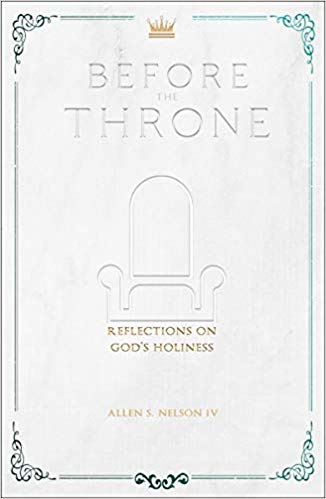
A Review of Allen S. Nelson IV’s
Before the Throne
by Melissa Googe

Each day, I become increasingly grieved by our world. We are surrounded by conflict over issues that, if we were to abide by Scripture, would be quickly settled. How can those saved by God’s grace be so divided over the answers to today’s controversies?

As a long-time Christian and the wife of a pastor, I am blessed to have spent many years in my faith. I grew up in a Christian home. I have many Christian friends. I teach in a public school system where our motto is JOY (Jesus, Others, Yourself). I am surrounded by Christians, yet I find myself so frustrated with family members, friends, or colleagues that I strongly consider unfollowing them on social media or want to avoid being around them.

Sadly, there is a movement among Christians to “modernize” our faith to make it more “relevant.” To accomplish this, churches have adopted popular worldly ideas instead of expecting the lost to embrace Biblical views upon salvation. In Nelson’s preface, when I was beginning to know that I had found a kindred soul, he wrote that the answer to the church’s compulsion to be relevant is “to look downward so as to look upward.” He continued on to say that “the church that looks long into the face of God in Scripture will find that the question for “relevancy” is no longer all that relevant.” (2)

Oversimplification of all that is involved in living a Christian life and reaching others for Christ has led to churches full of lost people who falsely believe they are saved. How do we know this? Just take an honest look around. Many who claim to be Christians today actually hold to a form of “practical atheism.” (19) Nelson describes a practical atheist as one who “acknowledges the existence of God in his or her mind but lives as though He either doesn’t exist, or that He actually doesn’t care how we live or how He is to be worshiped.” Wow! This description really brings some people to mind, doesn’t it?

I sat down with Nelson’s Before the Throne: Reflections on God’s Holiness with an expectation of encountering complex theology about God’s holiness that would require me to stop reading and research information to be able to make my way through the text. While God’s holiness is not a simple subject, instead of having to stop because of running into something I didn’t understand, I had to stop because I was being humbled. This book, while it is about God’s holiness, is guaranteed to cause you not only to reflect upon God’s holiness, but to realize how truly unworthy and lost we are without Him and the sacrifice of His son.

Sin. Such a small word, but what word carries more weight? Humans try to minimize sin, but there is nothing of greater cost to us as the dividing line between us and holiness of God. Acknowledging God but then living as though He doesn’t exist, as though He doesn’t care how we live, or as though He doesn’t care about how we worship Him is completely sinful. If we are honest, no one reading this would dare to claim to have never sinned in such a way. Like Paul said in Romans 7: 15, “I do not understand what I do. For what I want to do I do not do, but what I hate I do.”

Nelson’s Before the Throne helps readers understand what holiness is, how God and holiness are synonymous, and what referring to God’s holiness really means. While God’s holiness is anything but simple, Nelson has done an exemplary job of detailed explanations and examples of God’s undoubtable, unspeakable, untamable, unblemishable, unmatchable, unquestionable, uncontainable, unchangeable, unapproachable, uncompromising, unborable, and unquenchable holiness.

I will not attempt to touch upon each of Nelson’s points; read his book and find for yourself the “excitement, woe, conviction, awe, and gladness” of God’s holiness that Nelson shares with readers! (1) Instead, I will share how reading Nelson’s book helped me to immediately recognize God’s holiness in action. God’s holiness isn’t something that we should only think about during the preaching hour on Sunday; we should spend time each day “intentionally contemplating the holiness of God.” (209) I propose that reading Nelson’s book will help to clarify attributes of God’s holiness that are described and present in His Word, and you will then be able to apply your improved understanding of God’s holiness to life’s many different circumstances.

Last week, our small, rural county lost a pillar of our community. I could never put into words what he meant to many in the area, as he, the owner of the only funeral home in the county, was the one who ministered to us when we lost family members and friends. One response to his passing on social media was to share an excerpt from The Shack by William P. Young. In this excerpt, “the Lord” states, “…because I work incredible good out of unspeakable tragedies doesn’t mean I orchestrate the tragedies. Don’t ever assume that my using something means I caused it or that I needed it to accomplish my purposes.” I know this was shared with the intention of comforting those grieving, but exactly how is reading about how the Lord has nothing to do with “unspeakable tragedies” going to comfort the bereaved?

I am sure we have all experienced the deep grief that comes with the passing of a loved one. Four years ago, my best friend’s battle with cancer ended. I believe He has a plan. I believe in God’s holiness. Yet it is hard to hold onto those truths in such times. Today, I could still allow myself to be drawn into the heartbreak of losing Katherine’s tangible presence, of missing our laughter, of seeing her children grow up without her. Instead, I choose, and let us all choose, to be comforted by these truths about God’s unquestionable holiness. “We don’t judge events and conditions and then question whether God was holy in His actions. Rather, we begin with the premise that God is holy and then we filter all these through this truth – even the events and circumstances we cannot fully explain.” (102) “For today, we only know in part, but part of what we do know is that all God decides, decrees, and demands is holy.” (103)

Yesterday, a friend shared a Steven Furtick video from Elevation Church dated April 4th in which Furtick seeks to illustrate God’s grace between the gaps of where you have been and where He is taking you. However, Furtick’s illustration shows that in walking with God, “When you take a step, when you make a move, God moves too.” According to Furtick, God will not let you reach Him because you would become arrogant; “So what God is gonna do, God is going to make sure that as you grow, the gap stays.” Essentially, Furtick’s illustration teaches that you can strive to live a holy and obedient life, but you will never grow any closer to God.

I am thankful for God’s unchangeable holiness and for His unapproachable holiness. Nelson cites A.W. Tozer who wrote, “For He, being unchanging and unchangeable, can never become holier than He is.” (132) God is not going to become any holier, so He is not going to continuously move away from us. As Nelson states, “The fact that God is unchanging is unquestionable upon any honest reading of the Scriptures,” and he references verses from James, Malachi, and Hebrews. (132-33)

Furtick’s illustration missed the mark. It communicated that you can walk in God’s grace, and you can grow from where you were, but you are not ever going to be able to reach God. The people in Furtick’s church cheered his message. Dear Christian brothers and sisters, this is a perfect example of why we need to know His Word, of why we need to be able to recognize false teachings, and of why we need a much better grasp of His holiness. “Grace doesn’t minimize our sin. It exposes it for what it really is and then covers it with the blood of Jesus.” (158) Christians should desire sanctification (an important word missing from Furtick’s illustration), at the same time knowing that “In and of ourselves, we cannot approach the God of unapproachable holiness. But the son can. And in Him, we can draw near to God.” (157) Praise be to God!

As a Language Arts teacher, I speak often of the vast number of words we have that fall short in the most important moments of life. Sometimes all we can do to express our meaning is to repeat our words. I leave you with a note from Nelson on God’s unquestionable holiness. “Language buckles under the pressure to satisfactorily describe God. The threefold repetition of holy is the best our words can do to show that God is holy to the maximum.” (100) There is nothing of any greater importance than God’s holiness, and no better example of when one word alone is not enough. May Before the Throne deepen your understanding of God’s holiness and leads you to desire to know His Word and our holy, holy, holy God evermore.


Allen “Cuatro” Nelson, IV, author of Before the Throne, is the pastor of Perryville Second Baptist Church in Perryville, Arkansas. Contact Allen directly via Twitter to order Before the Throne or his first book, From Death to Life. You can also order from Amazon.

Melissa Googe came to know Christ at a young age and is thankful for each day she has had to spend with Him. Being raised in a Christian home, being the wife of a pastor, and being the mother of three are just a few of the other blessings God has given her. Melissa’s primary ministry has been to serve as a middle school teacher for eighteen years in public schools. She enjoys sharing her love of reading with students and friends and fulfilling the call to minister to others.


ALTHOUGH I DO MY BEST TO THOROUGHLY VET THE THEOLOGY OF THOSE WHO SUBMIT GUEST POSTS, IT IS ALWAYS POSSIBLE FOR THINGS TO SLIP THROUGH THE CRACKS. PLEASE MAKE SURE ANYONE YOU FOLLOW, INCLUDING ME, RIGHTLY AND FAITHFULLY HANDLES GOD’S WORD AND HOLDS TO SOUND BIBLICAL DOCTRINE
Favorite Finds

Favorite Finds ~ May 14, 2019

Here are a few of my favorite recent online finds…

“Complementarian interpretation of Scripture holds that God’s creation purpose for man and woman entails equality of individual value but also distinct roles.” Our friends over at Crossway give us 5 Myths about Complementarianism.
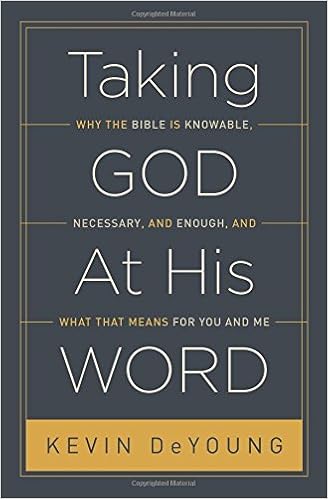
 

Image result for taking god at his wordHow about a free book? Here’s the PDF of Kevin DeYoung’s book Taking God at His Word: Why the Bible is Knowable, Necessary, and Enough, and What that Means for You and Me.


Image result for 50 of all marriages end in divorce“You’ve heard it repeatedly on radio, podcasts, and TV. You’ve read it in various books and articles. You’ve even heard it in your pastor’s sermon. The problem: it’s a lie: 50% of all marriages end in divorce.” The Cripplegate helpfully explains why everything you know about American divorce statistics, including the divorce rate among Christians, is probably wrong in The 50% Lie.

 

Image result for ccef‘No’ to a husband’s advances is a big deal in a marriage. A godly wife can certainly say “no” but she will also be alert to the way her response might be taken by her husband. Understanding and compassion can go a long way at these moments.” CCEF explores the sensitive subject of marital intimacy in “Not tonight dear”… men rejected.

 

On his most recent episode of Ask AnythingDr. Albert Mohler tackles a number of interesting questions, not the least of which is (from a Southern Baptist perspective) Should women preach the Sunday sermon in church? (8:58).

Favorite Finds

Favorite Finds ~ April 9, 2019

Here are a few of my favorite recent online finds…

In February’s edition of Favorite FindsI mentioned that I was hoping to have the opportunity to see the movie  Patterns of Evidence: The Moses Controversy, which was in theaters in mid-March. Well, life intervened and I wasn’t able to get to the theater when it was playing, so I guess I’ll have to wait for it to come out on Netflix or something. Did you see the movie? What did you think of it? I’d love to hear a little feedback…or maybe you’d like to write a review of the movie as a guest post?


“I’m not sad that I’m not and couldn’t be a church planter or lead pastor. I don’t feel restricted or resentful. Instead, I feel full.” I always appreciate the voices of sisters in Christ who are leading unashamedly under the banner of strong, biblical complementarianism. Complementarianism is a blessing, not a burden, so I really enjoyed Whitney Woollard’s* article Delighting in Authority: How to Create a Culture of Happy Complementarians over at Eternal Perspectives Ministry.


Go Back to the Local Church“…since loving Christ entails loving the Church; it’s time for you now to heed the summons of God’s Word and go back into a local church, a local expression of the Body of Christ.” I really appreciate Jennifer Brogdon’s* gentle and compassionate approach to encouraging wounded saints to go back to church (especially compared to my usual “bull in a china shop” treatment of the same topic) in her article Go Back to the Local Church.


Image result for life in four stages

Who’s in the mood for a free book? Here’s a PDF copy of Al Mohler’s Life in Four Stages: A Biblical Celebration of Childhood, Youth, Adulthood and Age.


Want to study the Ten Commandments? Here’s a free  devotional excerpted from Kevin DeYoung’s book, The Ten Commandments: What They Mean, Why They Matter, and Why We Should Obey Them.


If you’re looking for great listening and reading material, you cannot go wrong with Steve Lawson. I highly recommend him. Here’s an excerpt from his sermon It Will Cost You Everything. (Subtitles in various languages available.)


*I’m not very familiar with these writers or all the content at these blogs. I do not endorse anything you might find at these sites that conflicts with my theology as outlined at the Welcome and Statement of Faith tabs at the top of this page.
Book

The Twitter Book Challenge: 7 Books I Love


If you’re on Twitter, maybe you’ve seen this little challenge making the rounds:

I’ve accepted a challenge from Joe Blow to post covers of 7 books I love — no explanations or reviews, just the cover. Each time I post a cover, I’ll ask someone else to take the challenge. 1/Day for a week. My day 1 nomination goes to Jane Doe. #books

Yesterday, I got tagged into in the challenge by a sweet and lovely follower, and I wanted to participate.

But I didn’t like the rules.

You see, there are some “books I love” that I love just because they tell a good tale. Gone with the Wind. Biographies of the Reformers. Animal Farm. Pretty much every legal thriller John Grisham has ever written.

But there are other books I love for other reasons. Reasons that have less to do with what’s between the covers and more to do with the story that explains those reasons.

So today I’d like to take the challenge…but I’m breaking all the rules. I’m sharing photos of all seven books (and more) today. I’m sharing them here instead of on Twitter. I’m sharing the story behind why I chose each book. And, I’m not tagging anyone in particular – but I do invite you to share the name of a book you love, and why, in the comments section (or on Twitter) if you’d like.


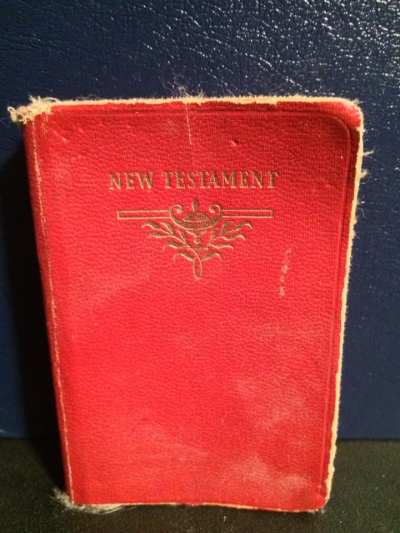
1.

I have had this little red New Testament since I was a child. I’m not sure how old I was when I got it, but I remember carrying it to Sunday School and church from a very young age. It must be an antique by now!


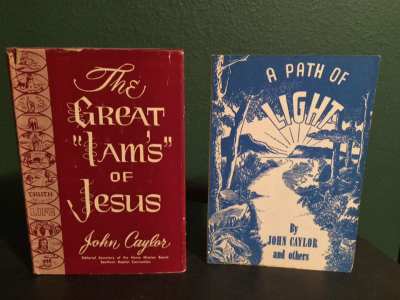
2.

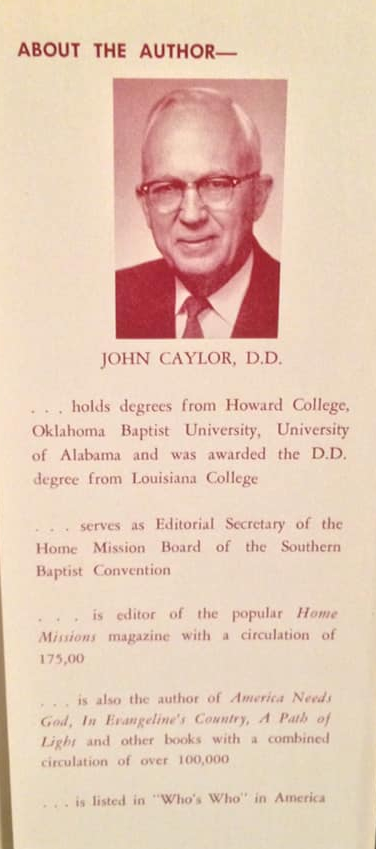
These books (and several others) were written by my maternal great grandfather, Dr. John Caylor, who was a pastor and also served in various capacities with the SBC, including on the Home Mission Board (now the North American Mission Board). A Path of Light is a compilation of missionary biographies. The Great “I Am’s” of Jesus examines twelve of Jesus’ “I am” statements. This particular copy of the book was one he autographed to my paternal grandparents.


3.

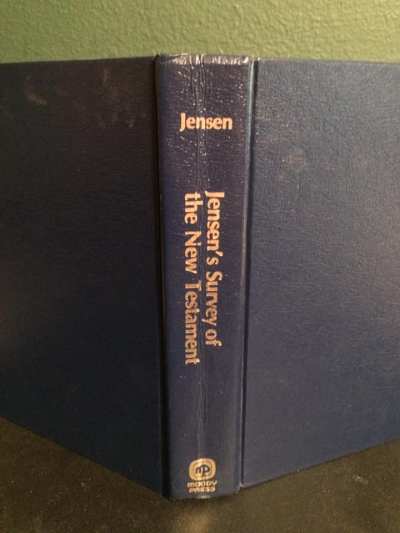
This was the textbook for the first theological class I ever took, New Testament Survey, when I was a freshman in college. I don’t know if it was the professor, the book, my lame brain, or some combination of the three, but it was the most boring class on the Bible – in church, school, or anywhere else – that I’ve ever taken in my life. I hated that class. It made a big impression on me:
The Bible is the most interesting book ever written.
No book or class about the Bible should ever be boring.


4.

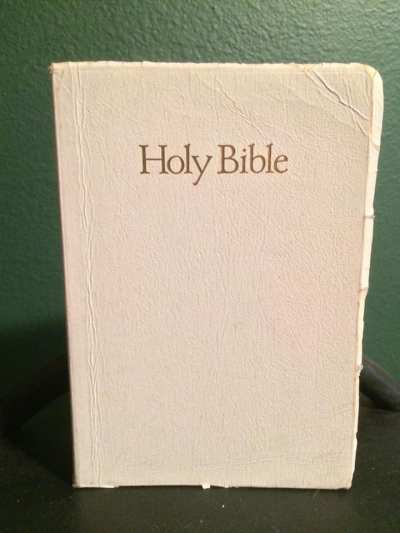
This is my favorite Bible ever. My husband gave it to me the Christmas after we started dating. When he gave it to me, it only had my first name imprinted on it. The following Christmas, just days before our wedding, he sneaked it away and then gave it to me again – this time with my new last name imprinted on the cover. (It’s a NASB if you’re wondering.)


5.

When my husband and I got married, we weren’t really close to any little girls who were the right age to be a flower girl. But we were close to two special little boys – Joshua and Caleb – my husband’s sons. So instead of a flower girl, we had a ring bearer (Joshua, below right) and a Bible bearer.
This is the Bible Caleb (below left) carried in our wedding.


6.

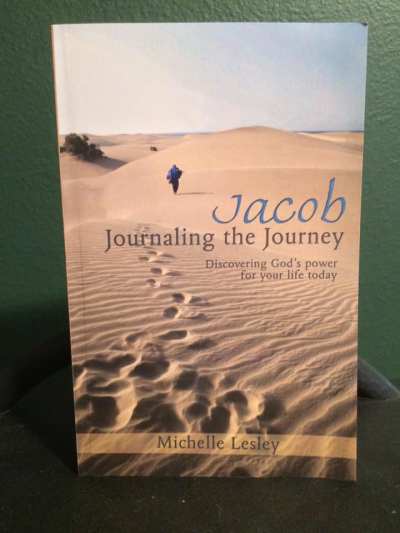
 This is the book that made me a published author. It was a joy to write. It taught me about the publishing business, marketing, public relations, promotion, and Christian retailing. It introduced me to a lot of wonderful people, and it stretched me in ways it would take far too long to describe. I love this book for everything except its hermeneutics. (Jacob is no longer in print, and, because of those unlovely hermeneutics, I would not recommend it to you if it were.)


7.


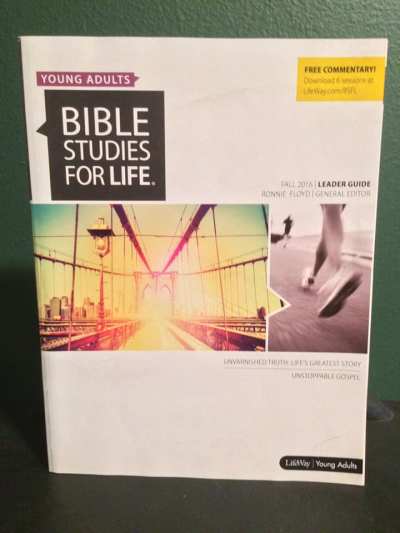
Technically, this is a booklet, not a book. It’s the leader guide for the Fall 2016 edition of one of the SBC’s Sunday School curricula for young adults: Bible Studies for Life. I wrote the discussion questions for one of the units. It was my first paid contract writing project, and it was a really interesting and informative experience.


How about you? What’s a book you love, and why do you love it?

Mailbag

The Mailbag: Potpourri (Todd Friel on Rick Warren, Enneagram, Should I stay or should I go?…)

Welcome to another “potpourri” edition of The Mailbag, where I give short(er) answers to several questions rather than a long answer to one question. I also like to take the opportunity in these potpourri editions to let new readers know about my comments/e-mail/messages policy. I’m not able to respond individually to most e-mails and messages, so here are some helpful hints for getting your questions answered more quickly. Remember, the search bar can be a helpful tool!


Do you have any thoughts on Todd Friel’s latest comment that Rick Warren is not a heretic?

Yes, I’m a faithful listener of Wretched Radio, and I did hear that episode. (You can listen to the specific remarks this reader is referencing here starting around the 5:25 mark.)

I’d like to start by saying that I don’t speak for Todd, so if this is of great concern to you, I would recommend contacting Todd directly and getting a “straight from the horse’s mouth” response from him.

The following is what I understood Todd’s remarks to mean:

I believe Todd was using a more classical theological definition of heresy used by many pastors and theologians (and which I agree with), which a lot of people are unaware of these days because the term “heresy” is tossed about so haphazardly (I’m sure I’ve been guilty of it myself). In this definition, real heresy is narrowly focused. It has only to do with the basic doctrines of salvation. In other words, the things you have to believe to be a Christian, and the things you can’t believe to be a Christian.

For example, T.D. Jakes is a heretic for two reasons: a) he is a modalist, a classic heresy which denies the biblical nature of the Trinity, and b) he preaches Word of Faith heresy – “another gospel” as described in Galatians 1:6-9.

Rick Warren, on the other hand, is someone I would categorize as a “false teacher” (again, I cannot speak for Todd, so I don’t know if he would use that label, but I think he would agree with the remainder of this paragraph). He says and does a lot of unbiblical things which he needs to stop and repent of, and nobody should be following him, but he does not preach or claim to believe anything (to my knowledge anyway) that goes against the basic doctrines of salvation. If you sat him down and talked to him, he would affirm the biblical doctrine of the Trinity, the deity of Christ, that Christ is the only way of salvation, etc.

I think the confusion is that the classical definition of heresy differentiates between true heretics and false teachers, but many Christians don’t seem to understand that because the terms “heretic” and “false teacher” are often used interchangeably. This is a definitional thing. Todd is not saying Rick Warren is a doctrinally sound pastor you should be following. He’s made that abundantly clear on a number of occasions.


My friend Samuel had a great question on Twitter recently:

This testimony is true. Therefore rebuke them sharply, that they may be sound in the faith,
Titus 1:13

It’s a great passage with a lot to consider. My thoughts:

1. Look at the rest of 13: “that they may be sound in the faith”. That’s the goal of the sharp rebuke- to bring them out of false doctrine and restore them to sound doctrine. That goal is what should inform the “sharpness” of the rebuke as well as the tone.

2. I think the “sharpness” has more to do with the urgency and immovability of the content of the message you’re conveying, and gentleness, kindness, etc., have more to do with the way (tone) in which you convey it.

3. Notice the word “For” at the beginning of v. 10. It draws our attention back to v. 5-9, the qualifications for elders. In other words, “Elders need to have these qualities (5-9) because of the need to silence and sharply rebuke these false teachers (10-16).” Verses 7-8 call for an elder not to be “arrogant…quick-tempered…violent…but…self-controlled, upright, holy, and disciplined.” Those qualities should govern how an elder gives a sharp rebuke.

4. I totally agree [I think someone else in the Twitter discussion mentioned this] that we should follow Christ’s example in Matthew 23, but we need to keep in mind that a culturally appropriate sharp rebuke in the first century Middle East might not be exactly the same as a culturally appropriate sharp rebuke in 21st century America. We convey the same message, but in a different way.


What is an Enneagram? A church in my area is offering a Bible study on it. Is it biblical?

The Enneagram is basically a tool that purports to help you discover which of nine fundamental personality types you are in order to maximize your strengths and grow in areas in which you are weak.

Is it biblical? There are a lot of different opinions and information out there, so it depends on who you ask. Some would say it’s merely a tool that helps identify less Christlike areas of your personality so you can be aware of, and strive to be more obedient in, those areas of weakness. Others grab on to the Enneagram and dive headfirst into the New Age mysticism that seems to be lurking in all its nooks and crannies.

I would just ask – have you ever read a passage of Scripture that says we need to analyze our personalities – using any tool, for any reason? No, you haven’t. And that’s the main reason I would say you don’t need the Enneagram or any other personality evaluation tool. Just like Christians for the past 2000 years haven’t needed them.

God gives us everything we need for life and godliness in the Bible. Do you tend to be too much of a people pleaser? That’s called fear of man. It’s in the Bible. Too harsh with others? You’re being unkind. It’s in the Bible. Struggle with anxiety? You’re not trusting God. It’s in the Bible.

A lot of people don’t want to hear this again and again because it’s not shiny and new, popular and fun like the Enneagram, personality tests, or internet quizzes (plus it takes longer and involves hard, spiritual work), but we don’t need to be looking for the latest evangelical fad to microwave us into spiritual maturity. We need the slow, deep, plodding work of studying our Bibles, sitting under good preaching and teaching at church, being discipled by older, wiser brothers and sisters in Christ, praying for wisdom, and repenting of sin.

If I were considering using the Enneagram, here’s what I would ask myself:

Why would I rather use the Enneagram – which isn’t mentioned or suggested anywhere in Scripture and has some sketchy spiritual elements to it – than use the methods (prayer, Bible study, discipleship, etc.) I know God has prescribed in Scripture?

For more information on the Enneagram here are some good resources:

Enneagram at Berean Research

Christian Answers for the New Age (Marcia posts great information on her Facebook page. You may have to scroll a bit or ask her to find the specific topic you’re looking for. Here’s something on the Enneagram I happened to find near the top of her feed today.)

Girl What’s Your Number? The Enneagram Episode at Sheologians

The New Age & Quack Spirituality Origins of the Enneagram with Marcia Montenegro and Steve Kozar


Can you recommend a good resource on _____ [a very specific relationship issue]?

There are a lot of wonderful books and other materials out there that can help us deal with certain relational issues, and when I’m aware of those resources I try to recommend them if I think they would help. I am all for reading and learning from helpful, doctrinally sound materials.

But the more specific and interpersonal the issue is, the less helpful resources are, because those resources are general by nature and can’t address every conceivable scenario, including yours. Sometimes you don’t need to read a book, you need to have a conversation with the other person(s) involved in the issue.

For example, if Sally is constantly gossiping about you to other people at church, you don’t need to read a book on gossip or relationships between church members. You need to go to Sally and ask why she’s saying these things. You might need to set the record straight about your behavior that she’s gossiping about. You might have received a false report that she’s gossiping about you. You might need to rebuke her and proceed to the next step of church discipline. But you won’t know any of those things unless you sit down and talk to her. And you’re not going to find those answers in a book.

In other situations, getting the wise counsel of a godly older sister in your church, or setting up an appointment with your pastor for counseling can be much more helpful than simply reading a book. These people know you and care about you. They’re available to help you and answer your questions. They can walk through the changing ups and downs of the situation with you over time. You can’t get all of that from a book.

Materials and resources are great and can be very helpful, but not in every situation.


I still meet with my ladies Bible study group, but they continue to choose very questionable material. Teachers that you have warned against as false and I agree with you. I have voiced my concerns to them over and over and at this point I am just starting to sound like a broken record. My question is, do I still participate and try my level best to help them discern or do I just leave the group?

In my article The Mailbag: Should I attend the “Bible” study to correct false doctrine? I addressed the question, “Should I attend a study using a false teacher’s materials in order to correct false doctrine, or should I decline to attend the study due to the unbiblical materials they’re using?”

Either option can be perfectly biblical depending on the situation and the people involved. This reader chose to go the former route, which brings up an additional question: If I join this group and they continue to teach false doctrine via materials by false teachers despite my correction, how long do I hang in there and continue to correct?

Since every situation is different, I can’t give a hard and fast answer to that. I would reiterate the counsel I gave in the previous article about praying for wisdom and discussing it with your husband and your pastor. If, in these discussions, you and your husband decide that, in addition to the women’s group, there are sufficient biblical reasons to look for another church, you may want to hang in there until you move to a new church.

If you decide to leave the group, another natural time to make the break would be when they finish the book they’re currently using and before they begin a new book.

If the question is less, “When should I leave?” and more, “Is it biblical to leave the group when it’s obvious they aren’t going to listen to biblical rebuke and sound doctrine?” the answer is yes, and practically the whole Bible is precedent for this.

Think back over the Scriptures. What is the Bible’s general posture and response to people – particularly God’s people – who have been repeatedly warned about their sin or presented with biblical truth, and choose to continue in that sin or ignore that truth (as this group seems to be acting toward the reader)?

Think about God’s repeated warnings to Old Testament Israel about their sins of idolatry and syncretism (which are basically what importing false doctrine into a church is). Even God didn’t hang in there continuing to warn them forever. What was His eventual response to them? He used pagan nations to conquer them and send them into exile.

Passages like these also help us see the New Testament’s take on moving on when sound doctrine is rejected:

As for a person who stirs up division, after warning him once and then twice, have nothing more to do with him, knowing that such a person is warped and sinful; he is self-condemned.
Titus 3:10-11 (For more on false doctrine as “division”, see Romans 16:17-18, Jude 18-19.)

And if any place will not receive you and they will not listen to you, when you leave, shake off the dust that is on your feet as a testimony against them.
Mark 6:11 (see verses 7-13 for context)

Do not give dogs what is holy, and do not throw your pearls before pigs, lest they trample them underfoot and turn to attack you.
Matthew 7:6

Do you have scriptural grounds to leave if a group rejects biblical correction of their false doctrine? Yes. When should you leave? You’ll have to ask God to give you the wisdom to decide.


If you have a question about: a Bible passage, an aspect of theology, a current issue in Christianity, or how to biblically handle a family, life, or church situation, comment below (I’ll hold all questions in queue {unpublished} for a future edition of The Mailbag) or send me an e-mail or private message. If your question is chosen for publication, your anonymity will be protected.