If you are considering commenting or sending me an e-mail objecting to the fact that I warn against certain teachers, please click here and read this article first. Your objection is most likely answered here. I won’t be publishing comments or answering emails that are answered by this article.
This article is kept continuously updated as needed.
I get lots of questions about particular authors, pastors, and Bible teachers, and whether or not I recommend them. Some of the best known can be found above at my Popular False Teachers tab. The teacher below is someone I’ve been asked about recently, so I’ve done a quick check (this is brief research, not exhaustive) on her.
Generally speaking, in order for me to recommend a teacher, speaker, or author, he or she has to meet three criteria:
a) A female teacher cannot currently and unrepentantly preach to or teach men in violation of 1 Timothy 2:12. A male teacher or pastor cannot allow women to carry out this violation of Scripture in his ministry. The pastor or teacher cannot currently and unrepentantly be living in any other sin (for example, cohabiting with her boyfriend or living as a homosexual).
b) The pastor or teacher cannot currently and unrepentantly be partnering with or frequently appearing with false teachers. This is a violation of Scripture.
c) The pastor or teacher cannot currently and unrepentantly be teaching false doctrine.
I am not very familiar with most of the teachers I’m asked about (there are so many out there!) and have not had the opportunity to examine their writings or hear them speak, so most of the “quick checking” I do involves items a and b (although in order to partner with false teachers (b) it is reasonable to assume their doctrine is acceptable to the false teacher and that they are not teaching anything that would conflict with the false teacher’s doctrine). Partnering with false teachers and women preaching to men are each sufficient biblical reasons not to follow a pastor, teacher, or author, or use his/her materials.
Just to be clear, “not recommended” is a spectrum. On one end of this spectrum are people like Nancy Leigh DeMoss Wolgemuth and Kay Arthur. These are people I would not label as false teachers because their doctrine is generally sound, but because of some red flags I’m seeing with them, you won’t find me proactively endorsing them or suggesting them as a good resource, either. There are better people you could be listening to. On the other end of the spectrum are people like Joyce Meyer and Rachel Held Evans- complete heretics whose teachings, if believed, might lead you to an eternity in Hell. Most of the teachers I review fall somewhere in the middle of this spectrum (leaning toward the latter).
If you’d like to check out some pastors and teachers I heartily recommend, click the Recommended Bible Teachers tab at the top of this page.
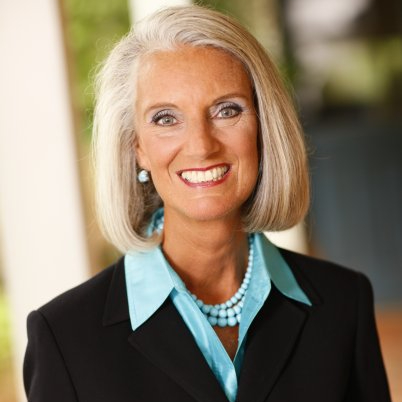
Anne Graham Lotz Not Recommended
Perhaps best known for being Billy Graham’s daughter, Anne Graham Lotz “speaks around the globe…Her Just Give Me Jesus revivals have been held in more than 30 cities in 12 different countries, to hundreds of thousands of attendees.” She is the founder and president of AnGeL Ministries, her speaking, publishing, events, etc., organization.
While the core of Anne Graham Lotz’s teaching historically hasn’t been radically off base, biblically, (i.e. she’s not blatantly teaching Word of Faith, NAR, or other heretical doctrine), she handles Scripture poorly, and there are too many red flags about her teaching and behavior to regard her as a trustworthy teacher of God’s word.
“Called ‘the best preacher in the family’ by her father, Billy Graham…” This opening sentence of her website is how Anne Graham Lotz has chosen to introduce herself to the world: as a female “preacher.” We could take this as a cute, antiquated father-daughter endearment if Anne did not, in fact, preach to men. However, she has no qualms about doing so herself and encouraging other women to do so, habitually violating this prohibition of Scripture. Just a few brief examples of the myriad available:
I Saw the Lord (Men clearly present in the audience at 7:29)
Preaching the Sunday sermon at Maranatha Chapel, 2/9/20. At 1:04, Anne says, “I’m very grateful for Pastor Ray giving me this opportunity…and for a pastor to give up his pulpit…I want to say thank you to him for that, and also for the statement that he makes concerning women in ministry…the fact that he would allow me to stand in his pulpit on a Sunday morning and speak to his congregation…so if you’re a woman in ministry, be encouraged.”
Preaching the Sunday sermon at Bridgeway Community Church, 2/16/20. At 0:40, Anne says: “I want to thank Pastor Anderson for his affirmation, his support, his encouragement, of women in ministry…To be in a church, on a Sunday morning, and for a pastor to give up his pulpit to me is a rare privilege.”. Two Sundays in a row. A nearly verbatim spiel. Not that “rare,” apparently.
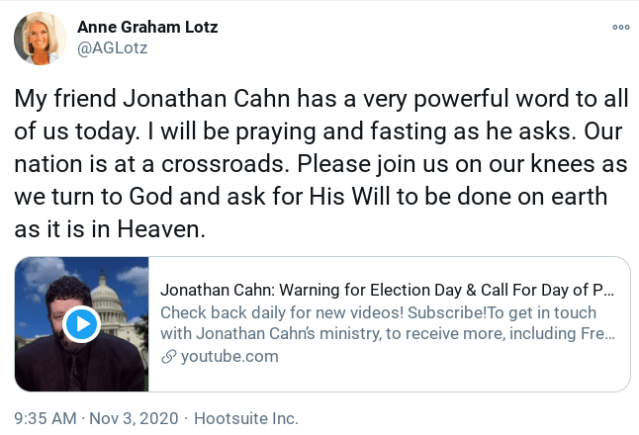
Anne also participated in The Return, a September 2020 prayer and revival event organized by Cahn. Additionally, Anne sits on the board of advisors of The Return with Cahn and false teachers Pat Robertson, “Bishop” Harry Jackson, Robert Morris, Marcus Lamb, and John Kilpatrick, as well as Steve Strang– publisher/founder of Charisma Magazine, and Gordon Robertson- CEO of CBN.
Also participating in The Return1 were Che Ahn and Cindy Jacobs – “apostles” and major players in the New Apostolic Reformation, and Michael Brown, who often functions as an apologist for NAR (and other) false teachers on his radio program.
Again, Anne sits on the board of advisors for this event / organization. She cannot be ignorant as to who these people are and what they teach.
The following year, as chair of the 2017 National Day of Prayer Task Force, Anne mishandled the same passage the same way, combined it with a mishandling of Daniel’s prayer in Daniel 9, and claimed that these passages are God’s promise to “heal” America’s moral ills if we will just pray hard enough. Neither of these passages are about, nor apply to the secular nation of America. They both pertain to God’s covenant people, Old Testament Israel, at a very specific point in history.
This is indicative of Anne’s general hermeneutic when it comes to anything having to do with politics, America, social issues, foreign relations, etc. Her standard practice is to eisegete all of those things into Old Testament Scripture, taking God’s warnings to Israel as though they were literal warnings to America, and claiming God’s promises to Israel as literal promises to America. This is not rightly handling God’s Word.
…she correctly emphasizes that God speaks through His Word, yet in this same video (and other venues such as this article at Decision Magazine, How to Know God’s Voice) she also seems to teach extra-biblical revelation by saying we can mistake other people’s voices for the voice of God, that some people aren’t hearing God speak, and continually using phrases like “listening for God’s voice.”
In her article, Preprayer 2016 Anne explains and endorses unbiblical “circle-making” prayer. Similar to Mark Batterson’s book, The Circle Maker, Anne re-tells the story of Honi the circle-maker, then says:
As I look ahead into 2016, I feel compelled to draw a circle around this city, this state, this nation… and pray! Until God answers. Do the same. Please. On this first day of the New Year, draw your own circle. Then pray for everything that’s inside of it.
As we might expect, with her numerous ties to false prophets and New Apostolic Reformation heretics, Ann has begun to dabble in NAR-esque prophesying.
In his July 7, 2014 episode of Fighting for the Faith, Chris Rosebrough deftly analyzes a message Anne says God gave her for the United States.
In the Charisma News article Anne Graham Lotz Gives Prophetic Warning About 2016, Anne predicts “As I look ahead into 2016, I believe our national and global situation will get worse,” and “I have been repeatedly warned in my spirit that the enemy is advancing. It’s something that I know.”
Anne seems to be a lovely and caring person, not to mention very patriotic. I know she’s a sentimental favorite to many because of her father. Those are all endearing qualities. But we must put feelings and nostalgia aside when we evaluate whether or not someone is qualified to teach. James 3:1 is clear that teachers will be judged more strictly, not given a pass because they’re nice people or related to a beloved spiritual figure. Anne consistently mishandles Scripture, yokes in ministry with heretics and false teachers, and preaches to men, encouraging other women to do the same. She is not a trustworthy teacher, and I recommend that you not follow or receive teaching from her.
If you are considering commenting or sending me an e-mail objecting to the fact that I warn against certain teachers, please click here and read this article first. Your objection is most likely answered here. I won’t be publishing comments or answering emails that are answered by this article.
This article is kept continuously updated as needed.
I get lots of questions about particular authors, pastors, and Bible teachers, and whether or not I recommend them. Some of the best known can be found above at my Popular False Teachers tab. The teacher below is someone I’ve been asked about recently, so I’ve done a quick check (this is brief research, not exhaustive) on her.
Generally speaking, in order for me to recommend a teacher, speaker, or author, he or she has to meet three criteria:
a) A female teacher cannot currently and unrepentantly preach to or teach men in violation of 1 Timothy 2:12. A male teacher or pastor cannot allow women to carry out this violation of Scripture in his ministry. The pastor or teacher cannot currently and unrepentantly be living in any other sin (for example, cohabiting with her boyfriend or living as a homosexual).
b) The pastor or teacher cannot currently and unrepentantly be partnering with or frequently appearing with false teachers. This is a violation of Scripture.
c) The pastor or teacher cannot currently and unrepentantly be teaching false doctrine.
I am not very familiar with most of the teachers I’m asked about (there are so many out there!) and have not had the opportunity to examine their writings or hear them speak, so most of the “quick checking” I do involves items a and b (although in order to partner with false teachers (b) it is reasonable to assume their doctrine is acceptable to the false teacher and that they are not teaching anything that would conflict with the false teacher’s doctrine). Partnering with false teachers and women preaching to men are each sufficient biblical reasons not to follow a pastor, teacher, or author, or use his/her materials.
Just to be clear, “not recommended” is a spectrum. On one end of this spectrum are people like Nancy Leigh DeMoss Wolgemuth and Kay Arthur. These are people I would not label as false teachers because their doctrine is generally sound, but because of some red flags I’m seeing with them, you won’t find me proactively endorsing them or suggesting them as a good resource, either. There are better people you could be listening to. On the other end of the spectrum are people like Joyce Meyer and Rachel Held Evans- complete heretics whose teachings, if believed, might lead you to an eternity in Hell. Most of the teachers I review fall somewhere in the middle of this spectrum (leaning toward the latter).
If you’d like to check out some pastors and teachers I heartily recommend, click the Recommended Bible Teachers tab at the top of this page.
Jennie Allen / IF:Gathering Not Recommended
Jennie Allen is “a Bible teacher, author, and the founder and visionary of IF:Gathering,” an annual conference for women. She also blogs, hosts the Made for This podcast, and speaks at IF:Gathering and other events.
(This article is still extremely relevant, but in February 2025, after ten years of annual conferences, Jennie replaced the IF: Gathering conference for women with Gather25, a co-ed international online event. Learn more about Gather25 here.)
The IF:Gathering conference organization (now including Gather25, IF:One Night, IF:Pray, IF:Lead, IF:Equip, IF:Table, IF:Local, IF:TV, and Discipleship Collective), around which most of Jennie’s ministry centers, was “inspired by the question, ‘If God is real…then what?‘.” If God is real– is a troubling premise for an ostensibly Christian ministry. The Christian existence does not center around the pablum possibility that God is real, but on the rock-solid, stake your life and your eternity on it certainty that He is not only real but the Creator of, and Sovereign over, the universe, and the only hope of salvation for sinners. If God is real…then what? as the foundation of a Christian ministry is somewhat akin to If 1+1=2, then what? as the foundational concept of a Mensa-esque organization for the top mathematical minds in the world.
As to the “…then what?” part of the equation, Jennie’s and IF’s solution is woefully unbiblical. Jennie has an established history of embracing and partnering in ministry with false teachers, female “pastors,” and women who preach to men. Just a few of the many available examples:
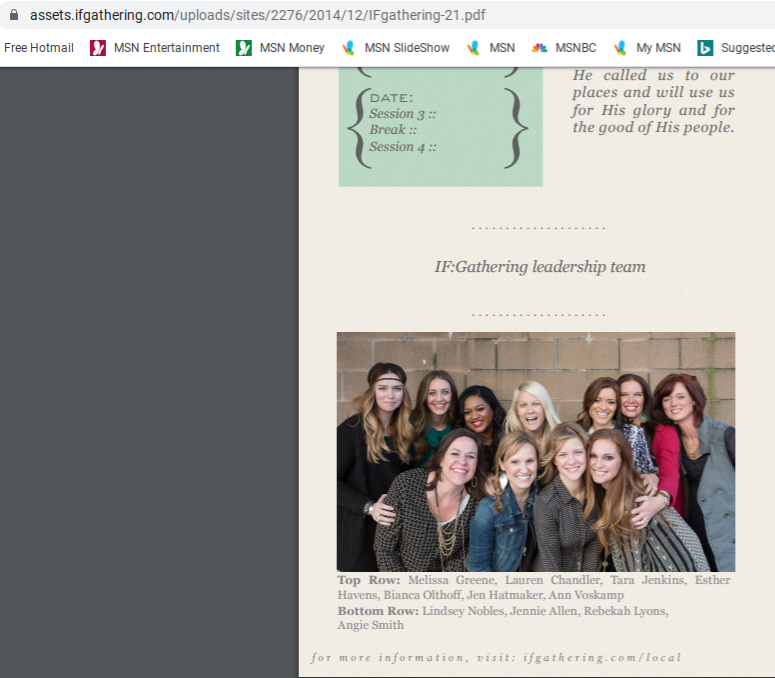
Since the launch of IF:Gathering in 2014, Jennie has habitually featured false and biblically problematic teachers and female preachers/pastors as speakers and as part of IF’s leadership team:
Top Row: Melissa Greene, Lauren Chandler, Tara Jenkins, Esther Havens, Bianca Olthoff, Jen Hatmaker, Ann Voskamp Bottom Row: Lindsey Nobles, Jennie Allen, Rebekah Lyons, Angie Smith
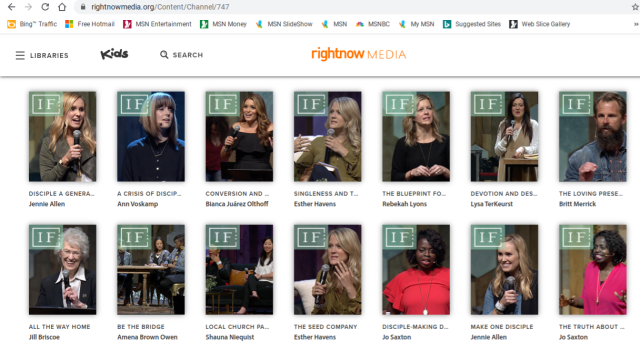
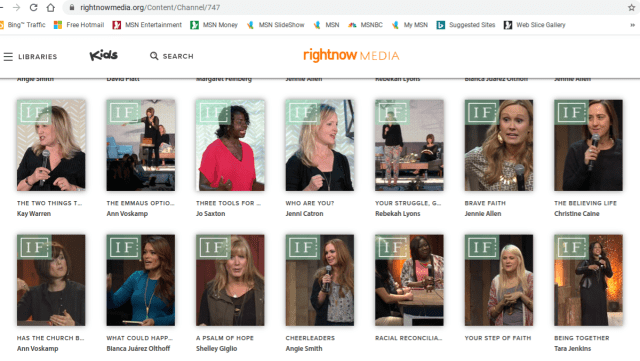
IF 2022 included a similar tableau of false teachers, female preachers/pastors, and racialists (some are returning speakers, some are new):
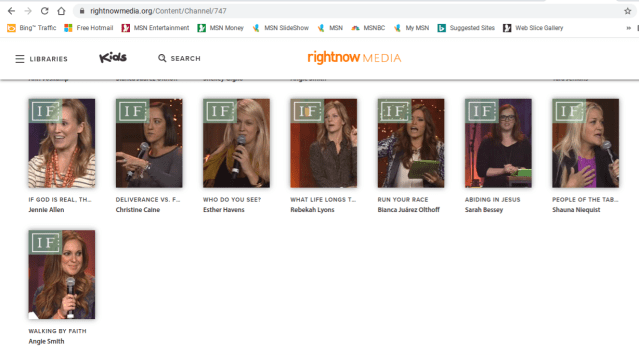
And, once again, IF 2023 features many of the same speakers, plus a few new faces who mostly (though not all) fall into the same categories of female “pastor,” women who preach to men, false teachers, and racialists.
In addition to Beth Moore speaking at IF:Gathering 2020 and IF:Lead 2020, Jennie’s partnerships and displays of affinity with her are far too numerous to list (just Google Jennie Allen Beth Moore, and you’ll see what I mean) and have been going on for years. A couple of recent examples:
Jennie preaching at Liberty University’s convocation (chapel) (LU Convocation – Mar.6, 10:30 AM, Streamed Live on March 6, 2020 – Jennie begins preaching at 40:59) Starting at 38:40 the man introducing Jennie says, “…I believe Jennie has a message for every single one of us…I’m so excited to sit under her teaching because I don’t believe…the principles that she has for us are just for women…I want you to know, especially the men in this room, that I believe that what God has brought through this messenger at this very moment is not just for the ladies in the room. It would be very closed minded for us to think that…every time a man shows up here that’s just for the men in the room and every time a woman comes, that’s just for the other [women]…”
I can’t seem to locate a statement of faith for Jennie or what church she currently attends, so you’ll have to infer what she believes by reading her books and blog, but I have learned a few specifics about her theology. Jennie is a proponent of the unbiblicalEnneagram. Jennie believes in extra-biblical revelation, and started IF:Gathering because “a voice from the sky” told her to:
Jennie often focuses on “dreaming” (in the sense of future goals or creative aspirations), a concept foreign to Scripture. I downloaded her “Dream Guide” for 2019 and found some of her statements troubling:
It really is as simple as this. Do the best you can in this world and as you’re going, love God and give Him away to people.
“Do the best you can in this world”? Where does the Bible say that? “And as you’re going, love God”? Like it’s an afterthought or an accessory to your life of “doing the best you can”? No. It really is as simple as this: Repent and believe the gospel, and walk in a manner worthy of the Lord, fully pleasing to him: bearing fruit in every good work and increasing in the knowledge of God.
When we create and thrive for the good of others, you’re participating in God’s redemptive work of making the world better.
Again, the Bible doesn’t teach this anywhere. “God’s redemptive work” is not “making the world better.” The Bible clearly says that “the Lord will empty the earth and make it desolate, and he will twist its surface and scatter its inhabitants,” and, “the world is passing away along with its desires.” Furthermore, “God’s redemptive work” is to save people. That’s the entire point of the whole Bible. His redemptive work was completed in the life, death, burial, and resurrection of Christ to save sinners. And if you want to “participate in God’s redemptive work,” you don’t “create and thrive” (whatever that means) “for the good of others,” you share the gospel with them and disciple them as we’re commanded to in the Great Commission.
..this is our goal, to create beauty out of chaos and thrive.
Also not in the Bible anywhere. Also not our goal. As Christians, our goal is to grow in the grace and knowledge of Christ, pursue holiness, and carry out the Great Commission. All of which are in the Bible.
Dreaming is an incredible privilege. It is a stewardship of the opportunities God has put in front of us.
Not to sound like a broken record, but, again, none of this is in the Bible, and the second sentence doesn’t even make logical sense. To “steward” something is to use it wisely and for a godly purpose. To do something with it to the glory of God. Sitting around “dreaming” isn’t doing anything. In fact, since “dreaming” isn’t something we’re instructed to do in Scripture, it’s actually squandering the “opportunities God has put in front of us” – opportunities like sharing the gospel, serving others, studying our Bibles, prayer, worship, etc. – which are things Scripture instructs us to do, in favor of sitting around relying on our dreams.
At the end of the “Dream Guide” are several “conversation card” questions about how you can improve yourself in the coming year. One of them is pretty good: “How could you better plug into and serve the local church?”. The rest are fairly narcissistic, and there’s nothing about studying Scripture, growing in holiness, prayer, or repenting of sin. Additionally Jennie quotes only one passage of Scripture in the entire booklet, and she quotes it from The Message, one of the worst versions (it’s a paraphrase, not a translation) of the Bible out there.
And regarding “being a strong woman in the church,” while Jennie mostly stays vague and neutral, she does touch on a few biblical concepts:
18:35- “What my husband heard from me was: My wife has strong gifts and a strong passion for God, and she wants to serve Him, and she’s not because of me.” As if she couldn’t passionately serve God with her gifts by being a godly wife and serving and submitting to her husband.
22:31- “I know that the obvious question that everybody wants to know the answer of is ‘What about roles and positions in the church?’…But I think we oftentimes get so distracted by that…that we are missing all the work that God has for us. And, you know, my view on that is every local church is going to have a different opinion about that…So wherever you go, Scripture just says, ‘Don’t be divisive,’…but the bigger issue to me is the way we view each other, the way we value each other…” Notice Jennie uses no Scripture to answer the “obvious question” everybody wants to know the answer to, she only gives her personal opinion that we are getting “distracted” by this legitimate, biblical question, and that the bigger issue – to her – is not what the Bible says about the role of women in the church, but “the way we value each other”. It’s a problem that “every local church is going to have a different opinion” about the role of women in the church because there is only one position on that issue that’s biblical. The local church doesn’t get to have an opinion on that issue, the issue is decided by Scripture and the church is to submit to and uphold Scripture’s teaching on it. Furthermore, Scripture does not just say, “Don’t be divisive.” Scripture is abundantly clear what the role of women in the church is to be, and both individual women and church leaders are to obey it.
The fact that Jennie consistently and unrepentantly platforms female “pastors” and women who preach to men at IF speaks much more clearly about her personal (and unbiblical) opinion on the role of women in the church than her finessing answer here.
27:21- The interviewer asks Jennie, “What does submission mean?” Her response is much too long to quote, so I’ll summarize. The first words out of Jennie’s mouth are, “That word? To me?” She then proceeds to give a not altogether unbiblical answer about how she loves submission, but it is mainly her opinion and personal experience with her own husband, not Scripture, and primarily centers around the fact that if she brings something to her husband for a decision and he decides unbiblically, he will have to answer to God for it, not her, and that she will have no accountability to God for any sin she might commit in the process. “It’s gonna be awesome!” she chortles, as the audience laughs along, as though there’s something funny about her husband standing before God and giving an account for his decision, and her blaming him for it. Jennie then pivots to describing how “that word [submit] has been used like a pistol to [many women’s] heads” and says “so the fact that that word has a bad rap makes sense to me…Here’s the problem, guys, we’re divided, but there’s reasons on it for both sides.” She seems to be saying that submitting or not submitting is not based on Scripture’s commands, but on personal experiences and situations, and that both submitting and refusing to submit are equally valid choices depending on our own experiences, feelings, and opinions. (And, no, I am not saying women should “submit” to being abused. That’s not the biblical definition of submission.)
Jennie seems like a lovely, genuinely caring person, and earnest when she speaks and writes, but none of those things qualify someone to teach Scripture. And in this case, Jennie is disqualified by her errant theology and unbiblical practices. I regret that I’m forced to recommend that you not receive teaching from Jennie Allen, her materials and conferences, or anyone connected to the IF organization.
If you are considering commenting or sending me an e-mail objecting to the fact that I warn against certain teachers, please click here and read this article first. Your objection is most likely answered here. I won’t be publishing comments or answering emails that are answered by this article.
This article is kept continuously updated as needed.
I get lots of questions about particular authors, pastors, and Bible teachers, and whether or not I recommend them. Some of the best known can be found above at my Popular False Teachers tab. The teacher below is someone I’ve been asked about recently, so I’ve done a quick check (this is brief research, not exhaustive) on her.
Generally speaking, in order for me to recommend a teacher, speaker, or author, he or she has to meet three criteria:
a) A female teacher cannot currently and unrepentantly preach to or teach men in violation of 1 Timothy 2:12. A male teacher or pastor cannot allow women to carry out this violation of Scripture in his ministry. The pastor or teacher cannot currently and unrepentantly be living in any other sin (for example, cohabiting with her boyfriend or living as a homosexual).
b) The pastor or teacher cannot currently and unrepentantly be partnering with or frequently appearing with false teachers. This is a violation of Scripture.
c) The pastor or teacher cannot currently and unrepentantly be teaching false doctrine.
I am not very familiar with most of the teachers I’m asked about (there are so many out there!) and have not had the opportunity to examine their writings or hear them speak, so most of the “quick checking” I do involves items a and b (although in order to partner with false teachers (b) it is reasonable to assume their doctrine is acceptable to the false teacher and that they are not teaching anything that would conflict with the false teacher’s doctrine). Partnering with false teachers and women preaching to men are each sufficient biblical reasons not to follow a pastor, teacher, or author, or use his/her materials.
Just to be clear, “not recommended” is a spectrum. On one end of this spectrum are people like Nancy Leigh DeMoss Wolgemuth and Kay Arthur. These are people I would not label as false teachers because their doctrine is generally sound, but because of some red flags I’m seeing with them, you won’t find me proactively endorsing them or suggesting them as a good resource, either. There are better people you could be listening to. On the other end of the spectrum are people like Joyce Meyer and Rachel Held Evans- complete heretics whose teachings, if believed, might lead you to an eternity in Hell. Most of the teachers I review fall somewhere in the middle of this spectrum (leaning toward the latter).
If you’d like to check out some pastors and teachers I heartily recommend, click the Recommended Bible Teachers tab at the top of this page.
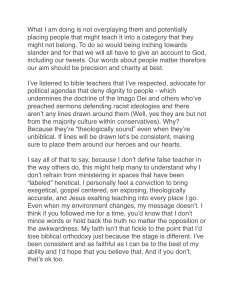
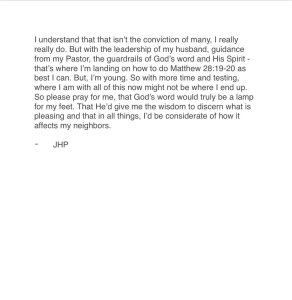
Jackie Hill Perry Not Recommended
“Jackie Hill-Perry is a writer, speaker, and artist…[she shares] the light of gospel truth through teaching, writing, poetry, and music as authentically as she can.” Jackie is a Christian hip hop and spoken word artist who has released two albums, and two books. She first began to gain a following with her debut book, Gay Girl, Good God, her personal testimony of God saving her out of a life of rebellion and homosexuality.
Jackie’s initial foray into public ministry had her associating with well known Reformed (or, Reformed-ish) organizations with a reputation for doctrinal soundness such as Desiring God and The Gospel Coalition. She was even featured in the film American Gospel: Christ Alone, a documentary which presented the biblical gospel juxtaposed against the prosperity gospel. And, indeed, she still maintains many of these types of ties. For example, she is a featured speaker at the upcoming 2020 TGC Women’s Conference, and she recently announced that she will be pursuing her Master’s of Divinity degree at RTS (Reformed Theological Seminary).
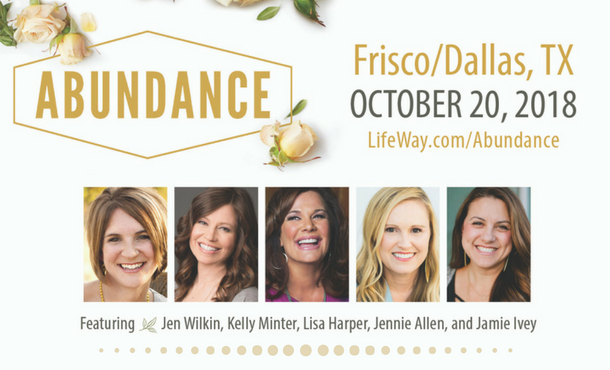
Over the past several years, Jackie has publicly associated herself and/or yoked in ministry with a plethora of false teachers. I believe part of this stems from the fact that Jackie, like Jen Wikin, has has been added to LifeWay Women’s stable of women’s “Bible” study authors which, through LifeWay ministry events, has affiliated her with a number of false and problematic teachers. In addition to my normal concerns about someone yoking with false teachers (i.e. the Bible says not to, and disobeying God’s Word is a sin), I am concerned that LifeWay is using Jackie (for her reputation for being doctrinally sound) to lend credibility to the false teachers they promote, and I’m also concerned that Jackie’s previously doctrinally sound reputation is now suffering by being associated with these false teachers.
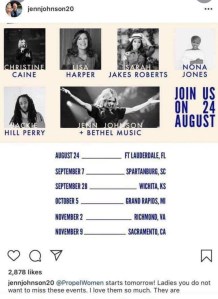
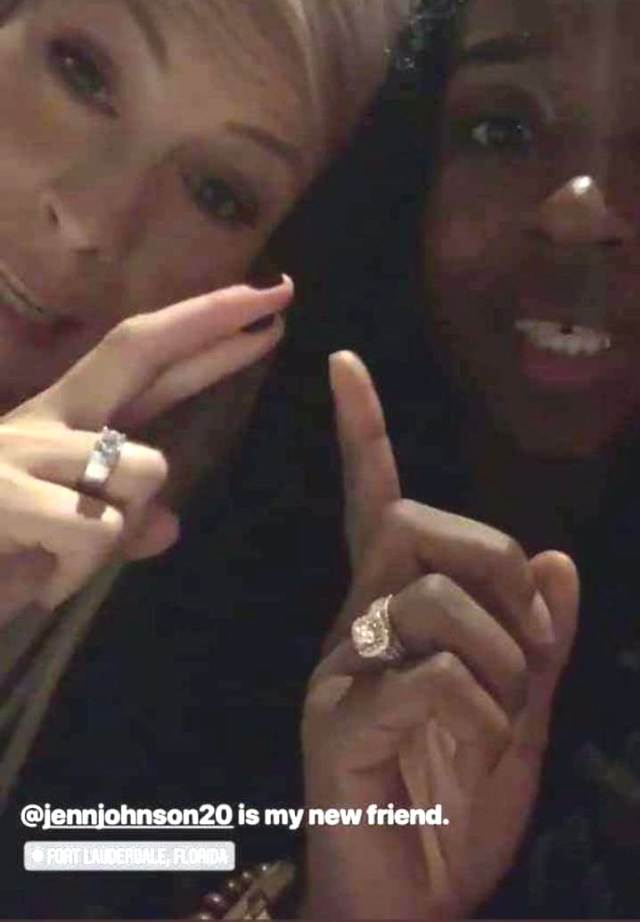
In August 2019, largely due to the fact that Jackie posted this picture calling Bethel’s Jenn Johnson her “friend”…
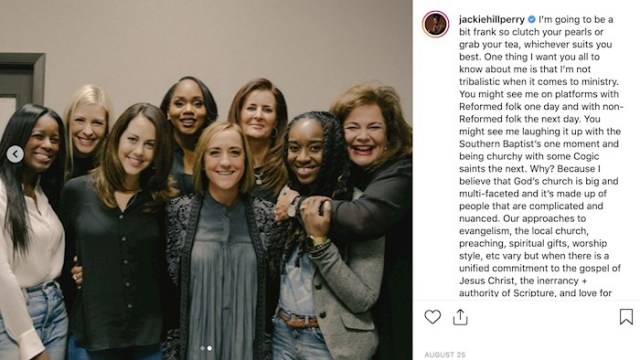
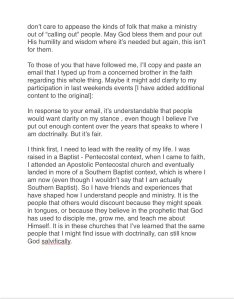
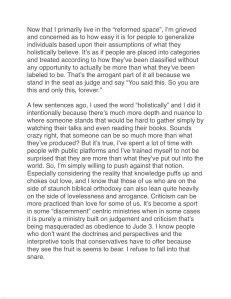
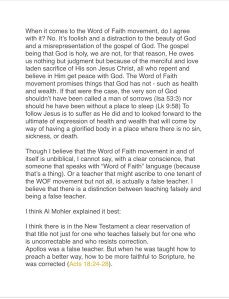
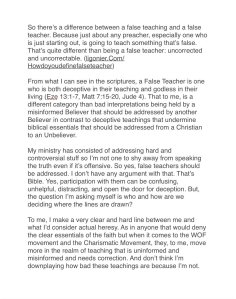
…many of Jackie’s followers were awakened, for the first time, to the fact that she has been sinfully yoking in ministry with false teachers for some time. She was rebuked by many of her followers and was even disinvited from speaking at Answers in Genesis‘ 2020 women’s conference (at which she had previously been invited to speak) when this news came to their attention. Unfortunately, instead of heeding these biblical warnings and rebukes, Jackie dug her heels in and defended both her actions and the false teachers in this Instagram post…
…disdainfully characterizing those who were biblically right to call her to account as judgmental, arrogant, slanderous, loveless, critical, etc.
You might notice that while Jackie does cite a few Scriptures in these posts, she provides none which support her yoking with false teachers (because there aren’t any). She defends her actions and perspective only with her personal opinions and experiences (note how many times she says “I think,” “to me,” etc.). “…How are we deciding where the lines are drawn?” Jackie asks. The answer should be clear to any Christian and was certainly clear to those rebuking her: the Bible. God decides where the lines are drawn between doctrinally sound and false teacher, not Jackie or anyone else, and He makes that very clear in His written Word.
Jackie repeatedly says that she believes people like Jenn Johnson are just misguided and in need of correction, which would require us to ask, “Jackie, did you correct Jenn and the others you’ve been associating with who hold to unbiblical doctrine? If they did not repent and correct their doctrine (as appears to be the case) do you now consider them false teachers? And if you now consider them false teachers, why are you still partnering with them in ministry?”.
My friend Constance over at the Truth+Fire blog wrote a thoughtful, compassionate, and Scripture-filled article responding to this incident entitled Bye…Jackie?, which I would encourage you to read, as well as Elizabeth Prata’s excellent article (in the “Additional Resources” section below).
In addition to multiple partnerships with false teachers, Jackie, unfortunately, also preaches to men. Just a few of the copious examples:
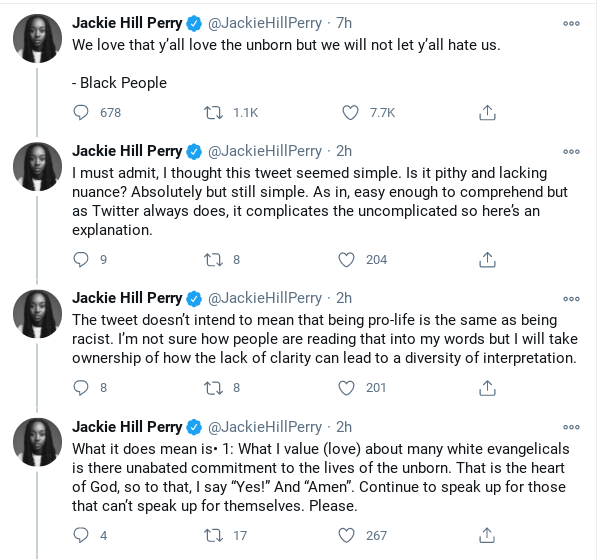
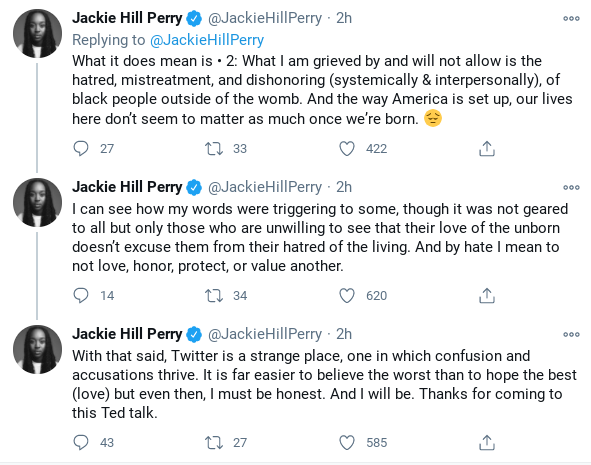
In addition to the concerns about Jackie yoking with false teachers and preaching to men (either of which, as I stated in the preface to this article are sufficient biblical reason to avoid a particular teacher), Jackie’s remarks and associations (particularly on Twitter) indicate that she is increasingly identifying with the social justice/critical race theory/intersectionality movement. A couple of brief examples:
In the video So…About Racism on the With the Perrys YouTube channel, Jackie and her husband discuss Robin DiAngelo’s White Fragility, white power, and de-funding the police, among other things. (In case it later gets scrubbed from YouTube, as often happens, you can find excerpts of the original video here and here.)
If you are considering commenting or sending me an e-mail objecting to the fact that I warn against certain teachers, please click here and read this article first. Your objection is most likely answered here. I won’t be publishing comments or answering emails that are answered by this article.
This article is kept continuously updated as needed.
I get lots of questions about particular authors, pastors, and Bible teachers, and whether or not I recommend them. Some of the best known can be found above at my Popular False Teachers tab. The teacher below is someone I’ve been asked about recently, so I’ve done a quick check (this is brief research, not exhaustive) on her.
Generally speaking, in order for me to recommend a teacher, speaker, or author, he or she has to meet three criteria:
a) A female teacher cannot currently and unrepentantly preach to or teach men in violation of 1 Timothy 2:12. A male teacher or pastor cannot allow women to carry out this violation of Scripture in his ministry. The pastor or teacher cannot currently and unrepentantly be living in any other sin (for example, cohabiting with her boyfriend or living as a homosexual).
b) The pastor or teacher cannot currently and unrepentantly be partnering with or frequently appearing with false teachers. This is a violation of Scripture.
c) The pastor or teacher cannot currently and unrepentantly be teaching false doctrine.
I am not very familiar with most of the teachers I’m asked about (there are so many out there!) and have not had the opportunity to examine their writings or hear them speak, so most of the “quick checking” I do involves items a and b (although in order to partner with false teachers (b) it is reasonable to assume their doctrine is acceptable to the false teacher and that they are not teaching anything that would conflict with the false teacher’s doctrine). Partnering with false teachers and women preaching to men are each sufficient biblical reasons not to follow a pastor, teacher, or author, or use his/her materials.
Just to be clear, “not recommended” is a spectrum. On one end of this spectrum are people like Nancy Leigh DeMoss Wolgemuth and Kay Arthur. These are people I would not label as false teachers because their doctrine is generally sound, but because of some red flags I’m seeing with them, you won’t find me proactively endorsing them or suggesting them as a good resource, either. There are better people you could be listening to. On the other end of the spectrum are people like Joyce Meyer and Rachel Held Evans- complete heretics whose teachings, if believed, might lead you to an eternity in Hell. Most of the teachers I review fall somewhere in the middle of this spectrum (leaning toward the latter).
If you’d like to check out some pastors and teachers I heartily recommend, click the Recommended Bible Teachers tab at the top of this page.
Jen Wilkin Not Recommended
Jen is a women’s Bible study author, blogger, and conference speaker, and until 2023, when she left to focus on her own ministry, was on staff at The Village Church as the Executive Director of Next Gen Ministries (TVC’s ministry to “children and students ages 0–18”).
Jen’s older books and Bible study materials have a reputation for being generally doctrinally sound. I’ve published a review of Jen’s book, Women of the Word, and here is one reader’s take on her book 1 Peter: A Living Hope in Christ:
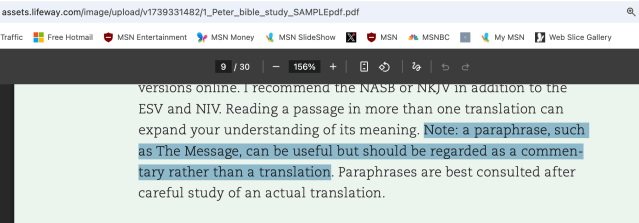
“…in the foreword Jen wrote, ‘a paraphrase, such as the NLT or The Message,* can be useful but should be regarded as a commentary rather than a translation.’ However, aside from that, I have found no other problems with the book at all. It is an eight week long study of 1 Peter based on the method of Bible study that she writes about in Women of the Word. My favorite thing about this study is that it causes us to focus on what the text is telling us about God. I love how Jen Wilkin is teaching women to study the Bible properly. I wish she would be more discerning about who and what she endorses though. There are so few women who bring us solid teaching and discernment.”
*Please see “February 2026 Update” at the end of this article. Jen Wilkin herself brought to my attention that in later editions of this book, she removed her reference to the NLT from this sentence. She did not explain why, but my guess would be (and she has thus far not corrected me) that she removed “the NLT” because The New Living Translation is considered to be a translation, and Jen mistakenly referred to it as a “paraphrase”.
The reader’s concern (and mine, too) in mentioning this quote, however, is not that Jen mistakenly called the NLT a paraphrase, but that Jen recommended The Message as an acceptable paraphrase. You need only to click on the link above to see why this is concerning.
Also in the past, Jen limited her speaking engagements and teaching to audiences of women, which is the biblical parameter for Christian women teachers. And although her website speaking engagement request form says she is a “teacher who helps women…” she has been increasingly preaching to and instructing men in recent years.
For example, Jen’s former staff position as TVC’s “Executive Director” of children’s and student ministries, depending on the exact nature of her job responsibilities, probably (I am making a reasonable inference, as TVC’s website does not explicitly say) required her to teach Scripture to, or exercise improper authority over young men in the student ministry (which includes students through age 18) and men who teach or volunteer in the student ministry. The title “Executive Director” makes it sound as though she was over the entire ministry and everyone in that ministry was under her purview.
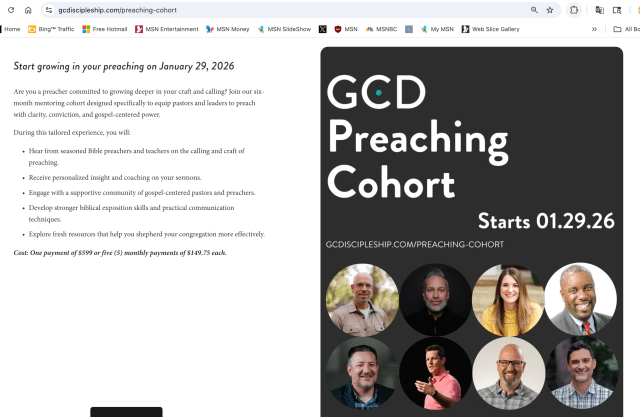
A more recent example demonstrating Jen’s increasing rebellion against Scripture regarding the role of women in the church is the Gospel Centered Discipleship “Preaching Cohort” in which Jen is a “Coach”. She (along with the other coaches) is described as a “seasoned Bible preacher and teacher,” and will be coaching pastors“on the calling and craft of preaching”.
In the past, there have also been questions about exactly where Jen stood on the biblical role of women in the church. She presented herself -and still does- as a complementarian, stating clearly that women are not to hold the office of pastor. What she did not make clear in the past, but what has become abundantly clear in recent years, is that she is (or has developed into) what’s often called a “soft” or “narrow” complementarian. This is the belief that women can do anything men can do in the gathering of the church body except hold the office of “senior pastor” – women can preach the Sunday sermon, hold any other office in the church (for many that includes the office of elder, “associate pastor,” etc.), exercise authority over men in the church, and so on. This is unbiblical. And what’s dangerous here is that Jen doesn’t call herself a “soft/narrow” complementarian, she just calls herself a complementarian, leading Christians who haven’t kept up with her to think she holds a biblical position and practice of the role of women, when she, in fact, does not.
As an example of Jen’s murkiness on the role of women, in the video* below (~32:05), she says:
“We need [women’s] visible leadership. How visible? As visible as your church’s complementarianism allows.”
This remark is at best, unhelpful, and at worst, opens the door for women and pastors to rebel against Scripture. The biblical answer to this question (aside from the fact that the church should be far more focused on servanthood than leadership) is: Women may serve in any position in the church that does not require them to preach to, teach Scripture to, or exercise authority over men, and which does not violate any other principles of Scripture.
Whatever position on the role of women Jen may have held in the past, she is now a “soft/narrow complementarian,” which is, in reality, a functional egalitarian.
In addition to the aforementioned preaching cohort in which Jen instructs pastors, she has spoken at several co-ed conferences in recent years. Give the first 15 minutes of the video below a listen*. Despite the fact that Jen’s very first remark is that she is not teaching the Bible in this session for pastors and church planters, she almost immediately goes on to quote and allude to the opening chapters of Genesis (and later in the video, other passages) and teach on them. I would challenge you to listen to what she says and ask yourself, “If I heard a pastor give this type of instruction, would I consider it a sermon/Bible lesson?” I think most of us could easily answer, “yes”. *(Unfortunately, the full length video of Jen’s complete teaching session has been removed from the internet. The video below is an excerpt of the full length video.)
(This is also the teaching session in which Jen made her infamous remarks about menstruation helping women to understand the gospel differently from men, which is not only a private and potentially uncomfortable subject to address in public – especially for an audience of men – it’s a patently ridiculous teaching. Menstruation teaches us nothing about the gospel. The two subjects are completely unrelated. Also, aside from Jen, I’ve never heard a single woman say her period helped her better understand the shedding of Christ’s blood.)
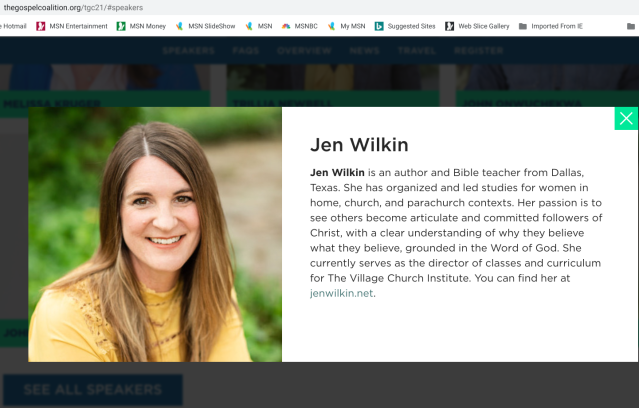
In another instance of preaching to a co-ed audience, Jen has been featured as a speaker multiple times at The Gospel Coalition’s national conference* at least as far back as 2017. (In the opening seconds of this 2017 TGC conference session, Why It’s Good that God Is Different from Us, Jen acknowledges and welcomes the men in her audience.) TGC, as many have noted, has been on a woke / social justice trajectory for years. Jen has been featured on TGC’s site numerous times.
*Jen has also been a featured speaker at TGC’s women’s conference (TGCW), not to be confused with TGC’s national conference, which is co-ed.
Again, one of the reasons it’s especially problematic for Jen to be teaching men, or to even to seem to be teaching men, is that she openly and unashamedly wears the label of complementarian. Boldly proclaiming complementarianism while teaching men muddies the waters and confuses the women who follow her as to what the Bible truly teaches about the role of women in the church. Are there times when it is technically not a violation of Scripture for a woman to speak with men in the audience? Yes (see #7 here). But weigh the impact Jen has on the church by speaking to men against the counter-evangelicultural impact someone of her stature could have by flagrantly refusing to teach men. Which would cause more people to sit up and take notice, set a better example for Christian women, and have a more biblical influence on the church?
Another concern about Jen is that she seems to be increasingly associating and appearing with false or problematic teachers.
Several years ago, Jen was added to LifeWay Women’s stable of Women’s “Bible” study authors including many of the aforementioned teachers and others. In addition to my normal concerns about someone yoking with false teachers (i.e. the Bible says not to, and disobeying God’s Word is a sin), I’m guessing LifeWay Women may have initially signed Jen in order to use her – that is, her reputation for being a doctrinally sound teacher and a complementarian – to lend credibility to the false teachers they promote. And, of course, Jen’s previously perceived good reputation has suffered by being associated with these false teachers.
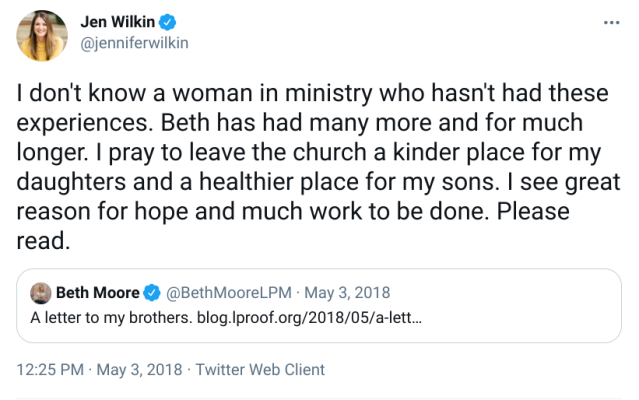
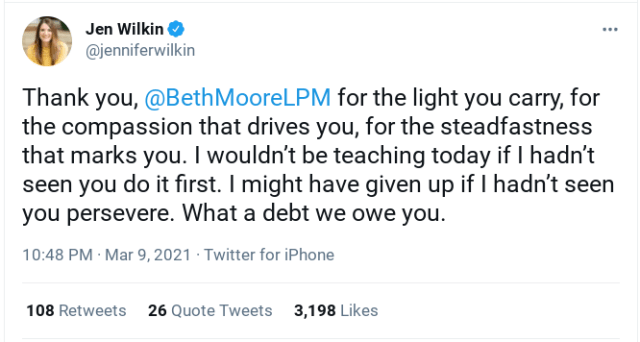
In March 2021, when Beth Moore cut ties with the Southern Baptist Convention, Jen offered this glowing farewell…
In a strange irony, in the midst of unbiblically partnering with these false teachers, in her session, The Gospel and The Future of Bible-Centered Discipleship at the 2018 Southern Baptist Convention Pre-Conference (also to a co-ed audience), Jen teaches the following…
[Biblical literacy] guards against false teaching…Basic comprehension-level mastery of the text guards against false teaching. (~30:12)
You know what our [discipleship] formula has been for the last 20 years? [We’ve said], ‘We’re going to keep making [the level of biblical teaching] lower and lower’…It is our high calling, in the face of a biblical literacy crisis, to raise the bar in an age of low expectations. (~43:40…44:39)
And yet, Jen’s level of “mastery of the text” – to the point that she is instructing people in the text and teaching them how to improve discipleship – has not sufficiently guarded her against partnering with women who are largely responsible for the bulk of false teaching aimed at women today, who don’t teach “basic comprehension-level mastery of the text,” and who have continued to lower the bar and perpetuate low expectations for biblical literacy. Jen has associated with, talked to, and listened to the teaching of these women far more than I have, I’m certain. How does she not see this?
(February 2026 UPDATE- I’ve removed a small section of this article {unrelated to the paragraph above or below} that previously appeared here. Please scroll down to the “Additional Resources” section for an explanation, and for additional extra information.)
Finally, in the same way that the influence Steven Furtick has on Lysa TerKeurst as her pastor is worrisome, I’ve seen some things over the years with Jen’s pastor, Matt Chandler, and his wife, Lauren Chandler (with whom Jen has appeared at conferences; screenshot), that have given me pause.
As a member of The Village Church, Jen is pastored by Matt, and as a ministry leader there (though no longer a staff member), she works under his direction and influence. Over the past few years, Matt has publicly praised or affirmed false teachers like Ann Voskamp, Beth Moore, and Jesus Culture. He has raised some questions about the extent of his continuationism with His notorious “pirate ship prophecy“. He allows Bethel and Israel Houghton (Joel Osteen’s former worship leader) music to be used for worship at his church. Matt allows his wife, a worship leader at TVC, to select this music, and to yoke with and be influenced by numerous false teachers. Matt and Lauren and their associations with false teachers have undoubtedly influenced Jen. Additionally, Matt’s character and personal integrity were sullied in 2022 when he had to take a leave of absence after admitting to an “inappropriate” texting relationship with another woman.
In summary, I would urge you not to follow Jen Wilkin, attend her conferences, or use her materials due to her trajectory of increasingly unbiblical teaching and behavior.
Prior to February 14, 2026, this small section appeared in the above indicated area of this article:
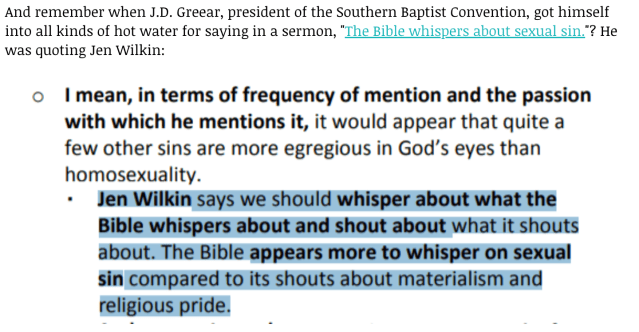
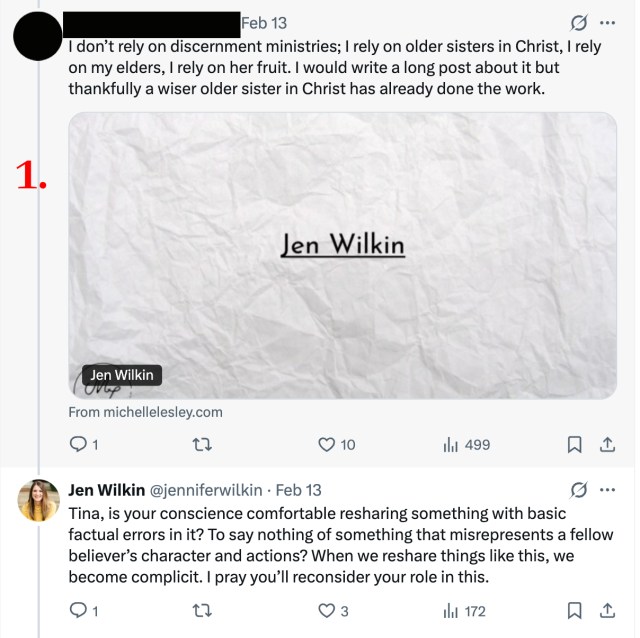
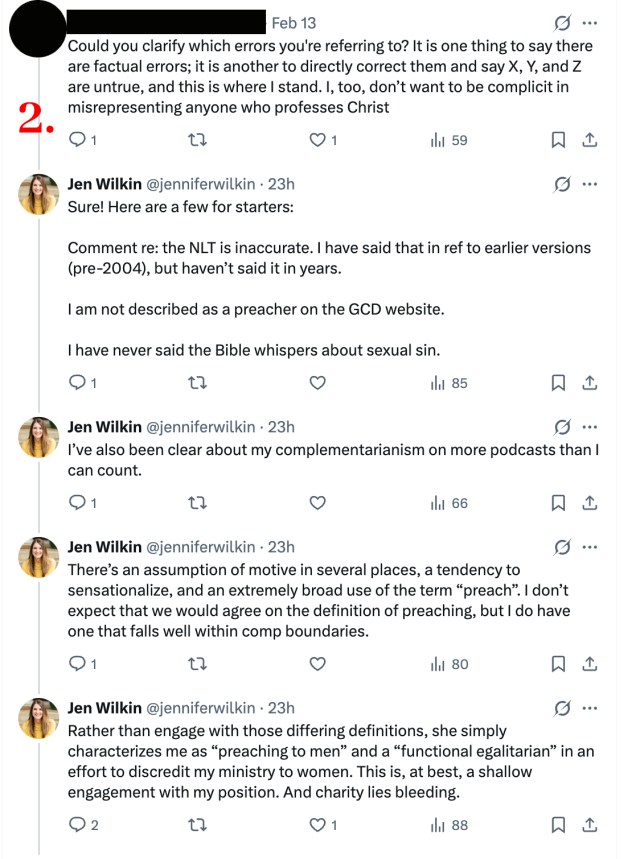
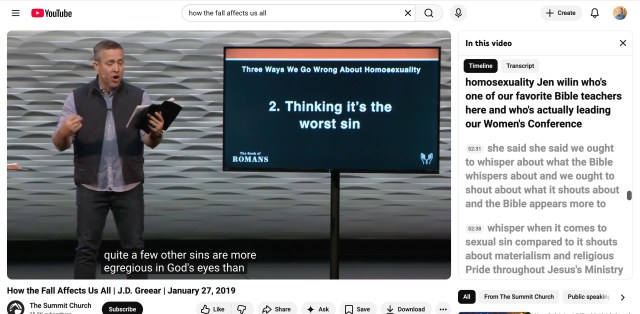
On February 13-14 Jen Wilkin and I had an exchange on X in which she said, “I have never said the Bible whispers about sexual sin.” (see image 2 below)
The first part of J.D.’s statement, “We ought to whisper about what the Bible whispers about and we ought to shout about what it shouts about,” was a quote of Jen. J.D. then added his own opinion, “…and the Bible appears more to whisper when it comes to sexual sin…” to the end of the quote of Jen, making it sound like the entire quote was something she said.
I apologize – to Jen and to my readers – for making this mistake, and ask your forgiveness. I hope my character speaks for itself when I assure you that this was simply a misunderstanding of an unclear statement. It was not a fabrication, nor was it done maliciously. But I am still sorry for making the mistake and for any negative consequences it resulted in for Jen or anyone else.
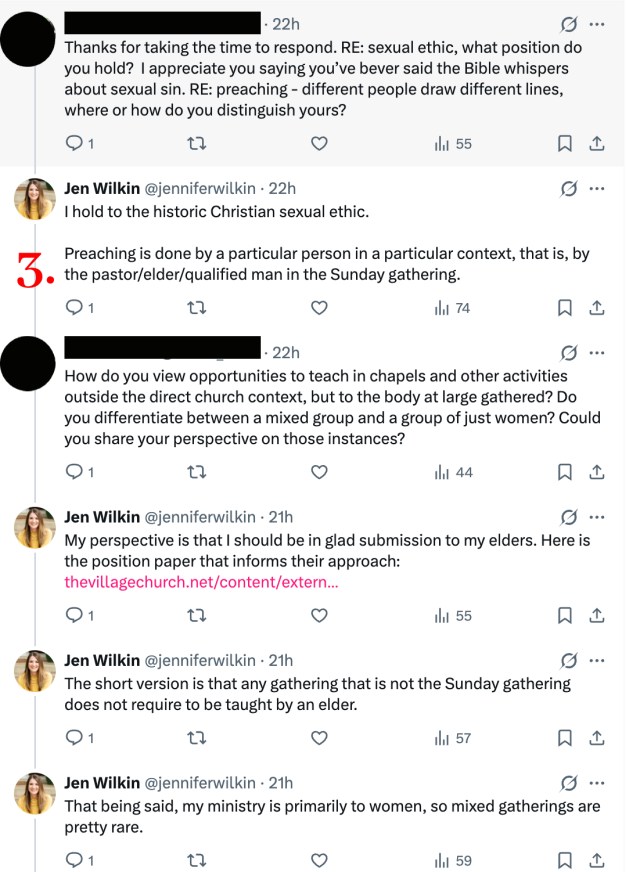
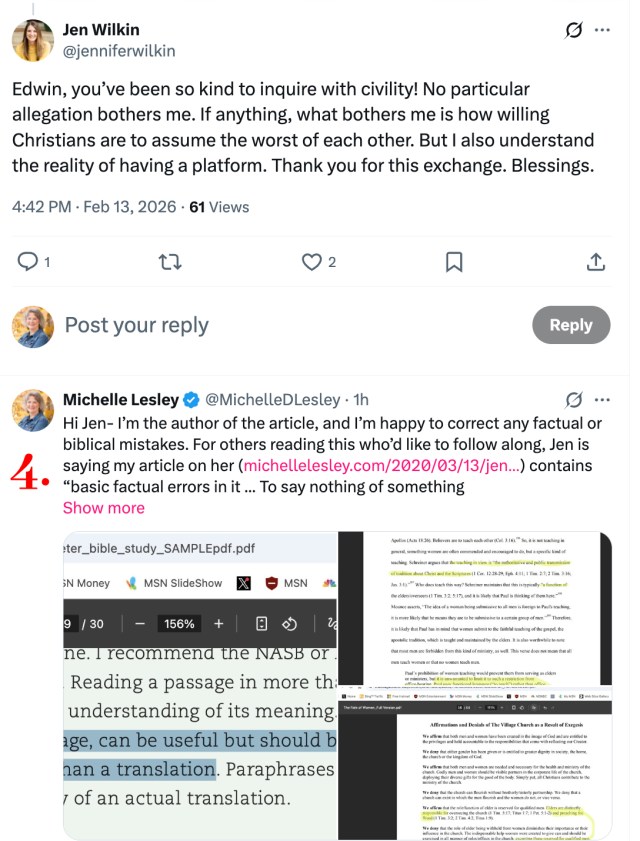
This point, however, was not the only thing Jen took issue with about this article, as you can see from the images in the slideshow above. Here is the original exchange. My response to Jen’s allegations is below in article format for ease of reading:
Hi Jen- I’m the author of the article, and I’m happy to correct any factual or biblical mistakes. For others reading this who’d like to follow along, Jen is saying my article on her contains “basic factual errors in it … To say nothing of something that misrepresents a fellow believer’s character and actions”.
I apologize for the length of this answer, but I wanted to address all of your concerns clearly, accurately, biblically, and citing sources:
“Comment re: the NLT is inaccurate. I have said that in ref to earlier versions (pre-2004), but haven’t said it in years.”
First, this is a quote from an email I received from a reader commenting on your book 1 Peter: A Living Hope in Christ. I introduced the quote by saying, “Jen’s older books and Bible study materials have a reputation for being generally doctrinally sound.” (I also linked to a positive review on my blog of your book Women of the Word in which I actually recommended [at that time] that my readers buy themselves a copy of it. The reader’s quote begins:
“…in the foreword Jen wrote, ‘a paraphrase, such as the NLT or The Message, can be useful but should be regarded as a commentary rather than a translation.’…”
I checked the most recent version of your book (2024 edition; sample on Amazon), of 1 Peter: A Living Hope in Christ, and you’re correct, you’ve removed the part about the NLT. The quote now says, “a paraphrase, such as The Message, can be useful but should be regarded as a commentary rather than a translation.”.
My guess is that you removed “the NLT [New Living Translation]” because it’s considered a translation, not a paraphrase. Is that correct? If not, please feel free to explain. I’m glad to add a note to the article saying that you’ve removed the phrase “the NLT” from that sentence in later editions, and if you have a link to an article or other material that explains why you removed it, I’ll be happy to add that link as well.
So just to clarify here, the quote from your book (in which you mistakenly called the NLT a “paraphrase”) actually is accurate. You are the one who changed it in later editions, presumably to correct your error. So this is not, in fact, a “factual error”. The reader’s quote was accurate.
However, the primary concern here is not that you mistakenly called the NLT a “paraphrase” instead of a translation (if that’s why you removed the part about the NLT), or even that you recommended the NLT. The primary concern is that you recommended – and, apparently, STILL recommend- The Message, one of the worst, most grossly inaccurate “paraphrases” out there, written by Eugene Peterson, who, along with mangling the text of Scripture, wrote a cover endorsement for the heresy-laden book, “The Shack,” and said he would officiate a same sex wedding.
But you still cite The Message as an acceptable paraphrase to use. So that part is factually correct.
Your next concern was: “I am not described as a preacher on the GCD website.”
Here, you’re misquoting me and either misunderstanding or misrepresenting what the article actually says (so you’re the one guilty of a “basic factual error” in this case).
The article contains a screenshot of the GCD (Gospel Centered Discipleship) web page picturing you and describing the event, and quotes directly from that web page. This is the actual quote from my article:
“…the Gospel Centered Discipleship “Preaching Cohort” in which Jen is a “Coach”. She (along with the other coaches) is described as a “seasoned Bible preacher and teacher,” and will be coaching pastors “on the calling and craft of preaching”.
The point of these two sentences is that you will be instructing pastors on how to be better pastors/preachers, when this is unbiblical and you have no place doing so. Neither of these sentences says that GCD called you, specifically, a “preacher”. (Additionally, albeit tangentially: just from a logical perspective, why would GCD engage someone who isn’t a pastor and isn’t qualified to be a pastor to instruct pastors about being better pastors? That’s like a hospital hiring someone who isn’t a doctor and isn’t qualified to be a doctor to instruct doctors about being better doctors.)
Finally, you said, “I have never said the Bible whispers about sexual sin.”
In this instance, you’re correct. Here’s what I said in the article: “And remember when J.D. Greear, president of the Southern Baptist Convention, got himself into all kinds of hot water for saying in a sermon, “The Bible whispers about sexual sin.“? He was quoting Jen Wilkin…”
My statement was based on a misunderstanding of JD’s quote in the video of his sermon. He was quoting you when he said, “We ought to whisper about what the Bible whispers about and we ought to shout about what it shouts about,” but then added HIS OWN thought to the end of that quote, and HE stated his opinion that “the Bible appears more to whisper when it comes to sexual sin compared to it shouts about materialism and religious Pride”.
I apologize for getting that wrong. I’ll be glad to remove that small section entirely. I’ll make a note in the article, and explain publicly on social media, how I got that wrong, along with a public apology to you, both in the article and on my other social media platforms. I’m very sorry for my mistake there.
“I’ve also been clear about my complementarianism on more podcasts than I can count.”
Yes, you’ve said you’re a complementarian, but as I accurately explained in the article, you’re not using the original definition of “complementarian”. You’re using the current, twisted definition of complementarian, i.e. women can do anything in the church that men can do except hold the office of pastor. That’s what used to be called “soft complementarianism” or “narrow complementarianism” and it is functional egalitarianism. I’m not the one in “factual error” here.
Calling yourself a “complementarian” and using that twisted definition is -whether you intend it to be or not, and I’m assuming “not”- deceptive and misleading. It’s similar (I’m using this strictly as an analogy, not accusing you of heresy) to Mormons saying, “We believe in Jesus,” when the Mormon version of Jesus is very different from what Scripture says about Jesus.
Furthermore, as a Southern Baptist, I’m sure you’ve heard (as have I), our leadership say regarding women preaching to men, “The function IS the office,” meaning that a woman functioning in the role of pastor -i.e. preaching- is usurping the office of pastor, as Dr. Albert Molher explains here in refutation of the definition of “complementarianism” you espouse, namely, that “a woman ought to be able to do…or authorized to do everything a non-ordained man can do.”
“There’s an assumption of motive in several places, a tendency to sensationalize…”
This is your personal, subjective opinion, not a “factual error”.
You’ll need to specifically quote at least one of these “several places”. And I would remind you that what you characterize as “assumption of motive” the Bible would likely characterize as, “out of the abundance of the heart, the mouth speaks” (Luke 6:45) and/or “You will know them by their fruit” (Matthew 7:16,20). But until you cite a specific “assumption of motive/tendency to sensationalize” we can’t know for sure, I can’t apologize if something is, in fact, an unbiblical “assumption of motive,” or “sensationalism,” and this is an unsubstantiated accusation.
“an extremely broad use of the term “preach”
No broader than the Bible’s definition. The actual prohibition in 1 Timothy 2:12, as I’m sure you know, is against women “teaching” men. Preaching is just one form of teaching.
“I don’t expect that we would agree on the definition of preaching, but I do have one that falls well within comp boundaries.”
As evidenced by the fact that you preach to men, your definition of preaching falls well within the aforementioned current twisting of “complementarian” boundaries: functional egalitarianism, which unbiblically allows women to preach to men.
There is no definition of women preaching to men that falls within traditional complementarian boundaries because traditional complementarianism – which simply describes what the Bible says about the role of women in the church- does not allow women to preach to men.
“Rather than engage with those differing definitions,”
I did “engage with those differing definitions”. I compared your so-called “complementarian” definition of preaching to men – i.e. “it’s OK for women to preach to men” – to Scripture. Scripture forbids this. Engagement over.
“she simply characterizes me as ‘preaching to men’”
I didn’t “characterize” you as preaching to men, I flat out stated a fact: You preach to men. There’s plenty of evidence of it in the article. If you’re going to preach to men why not just proudly and unashamedly say so and clearly enumerate your reasons for doing so, rather than preaching to men and then going around and saying, “I’m not really preaching to men, I’m really a complementarian.”? If it’s OK for you to preach to men, you should be able to easily back up that assertion with clear, rightly handled (2 Timothy 2:15), in context Scripture.
“and a ‘functional egalitarian’”
You are. When you function like an egalitarian by preaching to men, you’re a functional egalitarian.
“in an effort to discredit my ministry to women.”
Your “ministry to women” should be discredited because you’re teaching them to disobey Scripture. Every time you stand up and preach to men, your behavior is teaching women (and men) that if they come to a command of Scripture they don’t like (like 1 Timothy 2:12), they’re free to ignore it and disobey it. That teaching is false doctrine and a defiance of Scripture, and should, therefore, be discredited (and that’s only one of the points in the article – I’ve cited many other reasons why your ministry should be discredited).
“This is, at best, a shallow engagement with my position.”
No it isn’t. Your position is in direct conflict with the plain and clear teaching of Scripture. Concisely demonstrating that (and linking to two other articles refuting your position and explaining at length what the Bible says about the role of women in the church) is not “shallow engagement”.
“Preaching is done by a particular person in a particular context, that is, by the pastor/elder/qualified man in the Sunday gathering.”
Where does the Bible specifically say that, rightly handled and in context? Chapter and verse, please.
Christians are first and foremost to be in glad submission to Scripture, because Scripture is infallible and perfect, and elders – as your pastor, Matt Chandler, has amply demonstrated over the last several years – are not.
So if your elders are not upholding what Scripture teaches, and you are submitting to them, both you and your elders are in disobedience to Scripture, which is the standard for Christians.
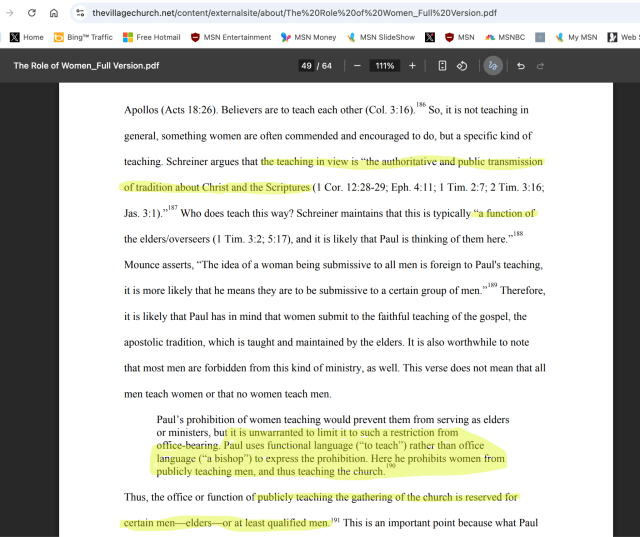
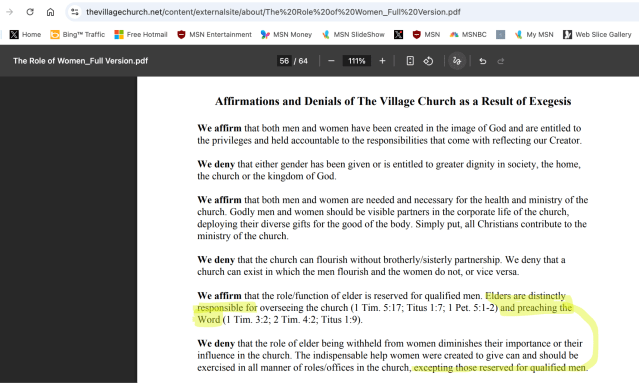
Nevertheless, in the document you cited, your own elders say this:
So your own elders say that publicly preaching the Word to the gathering of the church is restricted to men.
We often have to clarify to Believers and unbelievers alike that the “church” is not the building we meet in, it’s the people – Christians. So whenever Christians are gathered for the purpose of worship, instruction in the Scriptures, etc., it is a gathering of the church, and the prohibition of women teaching men applies.
But, in any event, the document makes clear on p. 55 that this is the position of “the role of women at The Village Church.” My article doesn’t deal with you preaching at TVC, but at other gatherings of the church outside TVC, so TVC’s policy for TVC is irrelevant to those events.
“The short version [of the TVC document] is that any gathering that is not the Sunday gathering does not require to be taught by an elder.”
I didn’t see that statement or any statement similar to that in the document, but I may have missed it. What page is that on?
“That being said, my ministry is primarily to women, so mixed gatherings are pretty rare.”
1. “Rare” does not equal “not sinful”. You still need to repent of preaching to men and stop doing it.
2. It doesn’t look “rare” considering all of the instances I’ve cited in the article (and including any instances I may have missed and haven’t included).
3. It isn’t “rare,” as though you used to preach to men and no longer do. This is something you’re continuing to do and currently doing. The GCD Cohort in which you’ll be unbiblically instructing pastors started less than three weeks ago.
So, to summarize, you found one actual error of fact in this entire, lengthy article (which I apologized for and will gladly delete and explain to my audience). The remainder of the article – dealing with far more than you’ve brought up here – is correct and is not “basic factual errors” or a “misrepresentation” of your “character and actions”.
And by implying that the article, overall, consists of “basic factual errors” and “misrepresents [your] character and actions,” you have actually misrepresented my character and actions.
But all of that aside, what’s more important here is you. I care about you, and I hate to see you going down the same road that so many of your Lifeway Women compatriots – like Beth Moore, Lysa TerKeurst, Priscilla Shirer, etc. – have gone.
I have taken a moment to pray for you, and, in love, I urge you to repent of the sins of preaching to men, yoking with false teachers, and the other things I’ve cited in the article, for the glory of God, for the good of your own soul before Christ, and for the biblical discipleship of your followers.
I have three questions that are kind of related to each other:
1 Corinthians 14:35 says women should ask their husbands questions at home; how does this fit with women mentoring other women in Titus 2?
Where does a husband’s role end and where does the role of a godly older woman begin in terms of teaching younger women?
Are there areas where a pastor’s authority trumps a husband’s authority?
Thank you for your help.
These are really awesome questions. I love it when women ask questions that demonstrate that they’re digging into Scripture and thinking deeply about the things of God. It’s so exciting to me!
(Before I begin answering, let me just stipulate, as I usually do in articles about marriage, that the following statements assume a normal, relatively healthy, average marriage, not abusive marriages, extremely aberrant marriages, etc. Also, it’s not my intent to leave out my single sisters, but the reader asked specifically about married women, so that’s how I’m answering the questions.)
So let’s take each question separately…
1 Corinthians 14:35 says women should ask their husbands questions at home; how does this fit with women mentoring other women in Titus 2:3-5?
The first thing we need to do when we’re addressing questions like this is to look at each of these passages in context. This is a very simple study skill that will clear up nearly all instances of supposed contradictions in Scripture.
Read 1 Corinthians 14:26-40. What is the venue for Paul’s instructions in this passage? In other words, is he telling people how to behave at home? At work? At the movies? Look at the key phrases in verses 26 (“when you come together”) and 28,33b-35 (“in church”). Paul is giving instructions for how an orderly worship service is to be conducted. He is not making a blanket statement that any time any woman wants to know anything about Scripture or God or life in general that the only person she can ever ask questions of is her husband. What he’s saying is that in order to avoid chaos in the worship service, women are to sit down and be quiet during the preaching and teaching, rather than interrupting to comment or ask questions (one of the reasons Paul says this is that the women in the Corinthian church were doing just that – interrupting the preaching and teaching with questions and comments). If you read further in chapter 14, you’ll notice he places similar restrictions on prophesying and speaking in other languages to prevent chaos and confusion during the worship service. I’ve discussed this passage in further detail in my article Rock Your Role ~ Order in His Courts: Silencing Women?
Now read Titus 2. What’s the main idea of this chapter? Is it the same as the main idea of 1 Corinthians 14 – instructions for an orderly worship service? No. Verse 12 gives a nice summary of chapter 2: “renounce ungodliness and worldly passions, and to live self-controlled, upright, and godly lives in the present age.” That’s what this chapter is about. “Titus, here’s what your church members (and you) are to do and how they’re to conduct themselves as they go about the business of living as Christians in this world and in community with one another.” The older women teaching and training the younger women in verses 3-5 is not taking place during the worship service, but as these women go about daily life with one another. Today, this kind of teaching and training takes place in women’s Bible study classes, women’s fellowship groups, and in one on one discipleship, not in, nor instead of, the gathering of the whole church for worship.
So as we can see when we examine the context of both passages, 1 Corinthians 14:35 and Titus 2:3-5 are not in conflict, they’re actually in harmony, addressing two distinct ways women are to conduct themselves in two completely different venues.
Where does a husband’s role end and where does the role of a godly older woman begin in terms of teaching younger women?
I don’t think it’s really that discrete and linear, i.e. the husband teaches this list of topics the wife needs to be taught about and the godly older woman teaches that list of topics she needs to be taught about, and never the twain shall meet. It’s a much more informal and “whatever is needful at the moment” type of thing. Additionally, it’s going to vary from marriage to marriage. Some women have unsaved husbands. Some women are newly saved with husbands who have been saved for decades. Some husbands and wives are very private about everything, some are very open to others. So the balance between who (husband or older woman mentor) teaches what, and how much, and when, is going to look different in every marriage.
I would just offer a few guidelines:
• After your relationship with Christ, if you’re married, your highest allegiance is to your husband. He should be your best friend and first confidant, not a woman who’s mentoring you (or even your mother, sister, or female best friend). He should never feel like he’s in competition for your time, interest, or affinity with the woman who’s mentoring you, or that you esteem her on the same (or, perish the thought, higher) level of loyalty or emotional intimacy with him. If you’ve gotten that close to your mentor, you’re too close. Turn your attention toward your husband.
• Along those same lines, always keep in mind that God instructs you to submit to your husband, not your mentor. The only time you should ever follow your mentor’s advice over your husband’s desires is if your husband is asking you to do something the Bible clearly calls sin and your mentor is advising you to obey Scripture instead. (But even in that case, you’re not really choosing your mentor over your husband, you’re choosing to obey God rather than to sin.)
• There are some things that are private between a husband and wife that shouldn’t be shared with anyone, including a mentor. Which things? Again, that’s going to vary from marriage to marriage, but a few no no’s might include the private details of your sex life, your finances, and anything your husband would be embarrassed for someone else to know. Talk with your husband and ask if there’s anything he would rather you didn’t share with your mentor.
Are there areas where a pastor’s authority trumps a husband’s authority?
It really depends on what you have in mind when you ask that question.
If you’re talking about personal decisions made between a husband and wife, let’s say, for instance, whether or not to move to a certain part of town or whether or not the wife should take a part time job, it is not the pastor’s place to step in and overrule the husband’s decision, nor should the pastor have any expectation that the couple would obey any edicts he issues. If the couple goes to him for counseling or asks for his advice, he can certainly give it, but we never see any place in Scripture where a pastor has authority over another family’s decisions. The husband is responsible before God for leading his family, not the pastor.
But if you’re talking about a situation in the church, then yes, a pastor’s (or the elders’) authority – assuming he’s abiding by Scripture – trumps a husband’s authority, and pretty much every other church member’s authority as well. For example, a husband does not have the authority to walk up to the pastor and say, “I’m going to let my wife preach the sermon next Sunday,” or “My wife is going to take over this Sunday School classroom and use it as her personal office.”. If a husband were to say something like that, the pastor is well within his authority as shepherd of the church to say, “Oh no she’s not.”. The buck stops with the pastor when it comes to how the church runs, and he is responsible before God for making godly decisions for the church.
I’m aware that there are aberrant, fringe “churches” (many of them are some stripe of New Apostolic Reformation or extreme legalism/fundamentalism) out there in which the “pastor” has ultimate authority over every decision a family makes: where they live, how many children they have, what to name their children, whether and where each spouse should work, etc. If you’re in a so-called church like that, leave immediately and find a doctrinally sound church to join. A church doesn’t plunge to that depth of spiritual abuse without succumbing to other dangerous false doctrines along the way.
If you have a question about: a Bible passage, an aspect of theology, a current issue in Christianity, or how to biblically handle a family, life, or church situation, comment below (I’ll hold all questions in queue {unpublished} for a future edition of The Mailbag) or send me an e-mail or private message. If your question is chosen for publication, your anonymity will be protected.